Your Trading App Looks Like a Gambling Shop. Regulators Have Noticed.

Friday, 29/05/2026 | 05:09 GMT by Aydin Bonabi
  • Reports from the ESMA, FCA, and IOSCO have raised concerns about the design of trading platforms, especially the gamification aspect.
  • Surveill's own assessment of 154 CySEC-regulated CFD and FX firms found that 90% lacked policy language governing how platform design choices create conflicts between the firm's commercial interests and client outcomes.
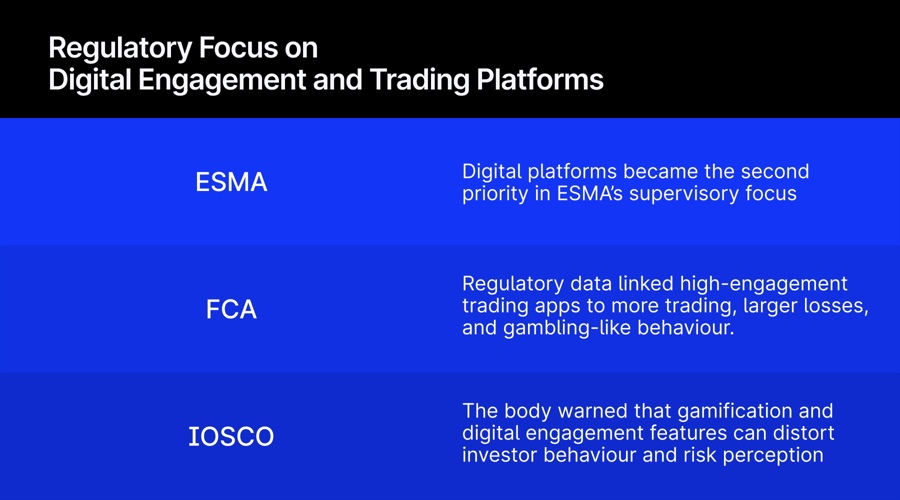
Regulatory focus on digital engagement and trading platforms

The retail trading industry should pay very close attention to what regulators are signalling right now. Buried inside ESMA's latest Common Supervisory Action priorities was a message that many firms likely underestimated: digital platforms ranked second among regulatory concerns.

Not leverage. Not disclosures. Not even product complexity. It's digital platforms.

That alone should tell the industry where this is heading. Because regulators are no longer just looking at what retail investors trade. They are now looking at how platforms influence them to trade in the first place. And the tone is rapidly changing.

An Empirical Case by a Regulator

For years, regulatory concerns about trading app design were theoretical. Regulators raised concerns. Papers were published. Industry pushed back. That phase is over.

In April 2025, the Financial Conduct Authority published what is likely the most consequential piece of regulatory research on trading app design ever produced. Drawing on real consumer transaction data linked to credit files across multiple UK trading platforms, the first study of its kind, the FCA's findings are not directional warnings. They are data.

The median user of a high digital engagement practice (DEP) app made seven times more trades than the median user of a low engagement app. Users of high engagement apps were 4.8 percentage points more likely to suffer a large loss, defined as a realised loss exceeding 2% of annual net income. They were almost twice as likely to display what the FCA calls potentially problematic engagement, elevated, erratic, or concerning trading behaviour modelled directly on problem gambling frameworks. They logged in at night, between 11 pm and 6 am, four times as often as users of low engagement platforms.

And the rate of financial distress among high-engagement app users was 5.1%, more than twice the 1.9% seen on low-engagement platforms, rising to 7.3% for CFD users specifically. These are not survey results. These are real transactions, linked to real credit files, across real platforms.

Related: Will Curbs on the Gamification of Trading End Retail Demand?

The FCA has produced an empirical case that platform design drives materially worse outcomes for retail investors.

One further finding deserves particular attention. As of the period studied, none of the firms in the sample had conducted any internal testing of the causal impact of their digital engagement practices on consumer outcomes. Not one.

The Global Standard-Setter Has Spoken

If the FCA paper established the evidence base, IOSCO's final report on digital engagement practices, published on 19 May 2025, as part of its Roadmap for Retail Investor Online Safety, established the global regulatory expectation. IOSCO's membership includes the ESMA, the FCA, the SEC, and virtually every other major financial regulator worldwide.

When IOSCO publishes a final report, it is not a discussion paper. It is a global signal about the direction of supervisory travel.

The DEPs' final report addresses gamification of trading websites and apps directly, badges, rewards, celebratory messages, and instant gratification features, noting that these affect investors' evaluation of risk and potentially lead to worse outcomes. IOSCO made a specific observation that cuts to the heart of the issue: in the traditional model, where a trader called their broker to place a trade, there was an intermediary who could mitigate risky behaviour. That buffer no longer exists.

Simultaneously, IOSCO published companion reports on finfluencers and online imitative trading, identifying a growing intersection between platform-driven engagement, influencer-driven acquisition, and the gamification mechanics that push retail investors toward behaviour they would not otherwise exhibit.

Read more: The UAE Regulated Finfluencers First. Now Comes the Hard Part.

The three reports together are not coincidental. They describe the same ecosystem from three different angles. IOSCO's Chairman was direct: "From finfluencer promotions to gamified apps and imitative content, these reports set out globally aligned expectations for ethical conduct and effective oversight." Globally aligned expectations. That phrase should be read carefully by every compliance officer in the retail trading industry.

The Industry's Defence Is Already Under Pressure

SIFMA, representing the US securities industry, pushed back on IOSCO's consultation, arguing that digital engagement practices are "nothing more than the natural evolution of customer engagement practices" and that additional DEP-specific policies, procedures, risk management systems, testing, and disclosures are not necessary beyond existing frameworks. That argument is the most revealing thing the industry has said on this topic. Because it describes precisely the gap that regulators have now documented empirically.

The FCA found that none of the firms studied had tested the impact of their own engagement features on consumer outcomes. IOSCO found that existing frameworks were insufficient to address the emerging risk. ESMA elevated digital platforms to the second priority of its Common Supervisory Action.

Surveill's own assessment of 154 CySEC-regulated CFD and FX firms found that 90% had no policy language governing how platform design choices create conflicts between firm commercial interests and client outcomes. The firms saying existing frameworks are sufficient are the same firms whose existing frameworks contain nothing about the conflict implications of their platform design. That is not a defence. It is an illustration of the problem.

The Regulatory Convergence

Three major regulatory bodies published or acted on digital engagement practices within a twelve-month window. The FCA published empirical research in April 2025. IOSCO published its final global report in May 2025. ESMA's Common Supervisory Action is already underway across every EU national competent authority, including CySEC and MFSA, which has digital platforms as its second priority.

This is not a coincidence. This is coordination. And coordination at this level has historically preceded enforcement.

Historically, brokers defended themselves through disclosure. Risk warnings, terms and conditions, appropriateness tests. The assumption was that if the customer understood the risks, the responsibility ultimately sat with the investor. But digital engagement practices challenge that framework entirely because they influence behaviour before the investment decision is even made.

A push notification encouraging a user to trade volatility is not neutral infrastructure. A leaderboard encouraging users to outperform other traders is not a passive design. A frictionless onboarding process engineered to minimise hesitation is not merely convenient. These are behavioural systems.

Regulators are now treating them that way.

Where This Is Heading

Once regulators begin viewing trading apps through the same lens as addictive digital products, social media algorithms, or online gambling mechanics, and the FCA's research explicitly draws on problem gambling frameworks to measure potentially problematic engagement, the regulatory conversation moves far beyond disclosure obligations. It becomes a discussion about manipulation.

That is a far more dangerous conversation for industry because, unlike leverage restrictions or marketing rules, behavioural regulation cuts directly into the growth engine of many retail platforms.

Engagement is no longer just a UX strategy. It is becoming a regulatory risk.

The firms that survive the next wave of scrutiny will not be the ones with the flashiest interfaces or the highest acquisition numbers. They will be the firms that recognise, early, that regulators are no longer examining only the products being sold. They are examining the psychology of the platforms selling them.

The retail trading industry should pay very close attention to what regulators are signalling right now. Buried inside ESMA's latest Common Supervisory Action priorities was a message that many firms likely underestimated: digital platforms ranked second among regulatory concerns.

Not leverage. Not disclosures. Not even product complexity. It's digital platforms.

That alone should tell the industry where this is heading. Because regulators are no longer just looking at what retail investors trade. They are now looking at how platforms influence them to trade in the first place. And the tone is rapidly changing.

An Empirical Case by a Regulator

For years, regulatory concerns about trading app design were theoretical. Regulators raised concerns. Papers were published. Industry pushed back. That phase is over.

In April 2025, the Financial Conduct Authority published what is likely the most consequential piece of regulatory research on trading app design ever produced. Drawing on real consumer transaction data linked to credit files across multiple UK trading platforms, the first study of its kind, the FCA's findings are not directional warnings. They are data.

The median user of a high digital engagement practice (DEP) app made seven times more trades than the median user of a low engagement app. Users of high engagement apps were 4.8 percentage points more likely to suffer a large loss, defined as a realised loss exceeding 2% of annual net income. They were almost twice as likely to display what the FCA calls potentially problematic engagement, elevated, erratic, or concerning trading behaviour modelled directly on problem gambling frameworks. They logged in at night, between 11 pm and 6 am, four times as often as users of low engagement platforms.

And the rate of financial distress among high-engagement app users was 5.1%, more than twice the 1.9% seen on low-engagement platforms, rising to 7.3% for CFD users specifically. These are not survey results. These are real transactions, linked to real credit files, across real platforms.

Related: Will Curbs on the Gamification of Trading End Retail Demand?

The FCA has produced an empirical case that platform design drives materially worse outcomes for retail investors.

One further finding deserves particular attention. As of the period studied, none of the firms in the sample had conducted any internal testing of the causal impact of their digital engagement practices on consumer outcomes. Not one.

The Global Standard-Setter Has Spoken

If the FCA paper established the evidence base, IOSCO's final report on digital engagement practices, published on 19 May 2025, as part of its Roadmap for Retail Investor Online Safety, established the global regulatory expectation. IOSCO's membership includes the ESMA, the FCA, the SEC, and virtually every other major financial regulator worldwide.

When IOSCO publishes a final report, it is not a discussion paper. It is a global signal about the direction of supervisory travel.

The DEPs' final report addresses gamification of trading websites and apps directly, badges, rewards, celebratory messages, and instant gratification features, noting that these affect investors' evaluation of risk and potentially lead to worse outcomes. IOSCO made a specific observation that cuts to the heart of the issue: in the traditional model, where a trader called their broker to place a trade, there was an intermediary who could mitigate risky behaviour. That buffer no longer exists.

Simultaneously, IOSCO published companion reports on finfluencers and online imitative trading, identifying a growing intersection between platform-driven engagement, influencer-driven acquisition, and the gamification mechanics that push retail investors toward behaviour they would not otherwise exhibit.

Read more: The UAE Regulated Finfluencers First. Now Comes the Hard Part.

The three reports together are not coincidental. They describe the same ecosystem from three different angles. IOSCO's Chairman was direct: "From finfluencer promotions to gamified apps and imitative content, these reports set out globally aligned expectations for ethical conduct and effective oversight." Globally aligned expectations. That phrase should be read carefully by every compliance officer in the retail trading industry.

The Industry's Defence Is Already Under Pressure

SIFMA, representing the US securities industry, pushed back on IOSCO's consultation, arguing that digital engagement practices are "nothing more than the natural evolution of customer engagement practices" and that additional DEP-specific policies, procedures, risk management systems, testing, and disclosures are not necessary beyond existing frameworks. That argument is the most revealing thing the industry has said on this topic. Because it describes precisely the gap that regulators have now documented empirically.

The FCA found that none of the firms studied had tested the impact of their own engagement features on consumer outcomes. IOSCO found that existing frameworks were insufficient to address the emerging risk. ESMA elevated digital platforms to the second priority of its Common Supervisory Action.

Surveill's own assessment of 154 CySEC-regulated CFD and FX firms found that 90% had no policy language governing how platform design choices create conflicts between firm commercial interests and client outcomes. The firms saying existing frameworks are sufficient are the same firms whose existing frameworks contain nothing about the conflict implications of their platform design. That is not a defence. It is an illustration of the problem.

The Regulatory Convergence

Three major regulatory bodies published or acted on digital engagement practices within a twelve-month window. The FCA published empirical research in April 2025. IOSCO published its final global report in May 2025. ESMA's Common Supervisory Action is already underway across every EU national competent authority, including CySEC and MFSA, which has digital platforms as its second priority.

This is not a coincidence. This is coordination. And coordination at this level has historically preceded enforcement.

Historically, brokers defended themselves through disclosure. Risk warnings, terms and conditions, appropriateness tests. The assumption was that if the customer understood the risks, the responsibility ultimately sat with the investor. But digital engagement practices challenge that framework entirely because they influence behaviour before the investment decision is even made.

A push notification encouraging a user to trade volatility is not neutral infrastructure. A leaderboard encouraging users to outperform other traders is not a passive design. A frictionless onboarding process engineered to minimise hesitation is not merely convenient. These are behavioural systems.

Regulators are now treating them that way.

Where This Is Heading

Once regulators begin viewing trading apps through the same lens as addictive digital products, social media algorithms, or online gambling mechanics, and the FCA's research explicitly draws on problem gambling frameworks to measure potentially problematic engagement, the regulatory conversation moves far beyond disclosure obligations. It becomes a discussion about manipulation.

That is a far more dangerous conversation for industry because, unlike leverage restrictions or marketing rules, behavioural regulation cuts directly into the growth engine of many retail platforms.

Engagement is no longer just a UX strategy. It is becoming a regulatory risk.

The firms that survive the next wave of scrutiny will not be the ones with the flashiest interfaces or the highest acquisition numbers. They will be the firms that recognise, early, that regulators are no longer examining only the products being sold. They are examining the psychology of the platforms selling them.

About the Author: Aydin Bonabi
Aydin Bonabi
  • 3 Articles
About the Author: Aydin Bonabi
A regulatory lawyer with hands-on experience at FXCM and Rabobank, I’ve spent my career inside the fast-moving FX/CFD world. Seeing firsthand how compliance challenges slow businesses down, I built Surveill—an AI-powered solution that bridges law, technology, and operational efficiency.
  • 3 Articles

More from the Author

Retail FX

!"#$%&'()*+,-./0123456789:;<=>?@ABCDEFGHIJKLMNOPQRSTUVWXYZ[\]^_`abcdefghijklmnopqrstuvwxyz{|} !"#$%&'()*+,-./0123456789:;<=>?@ABCDEFGHIJKLMNOPQRSTUVWXYZ[\]^_`abcdefghijklmnopqrstuvwxyz{|}