
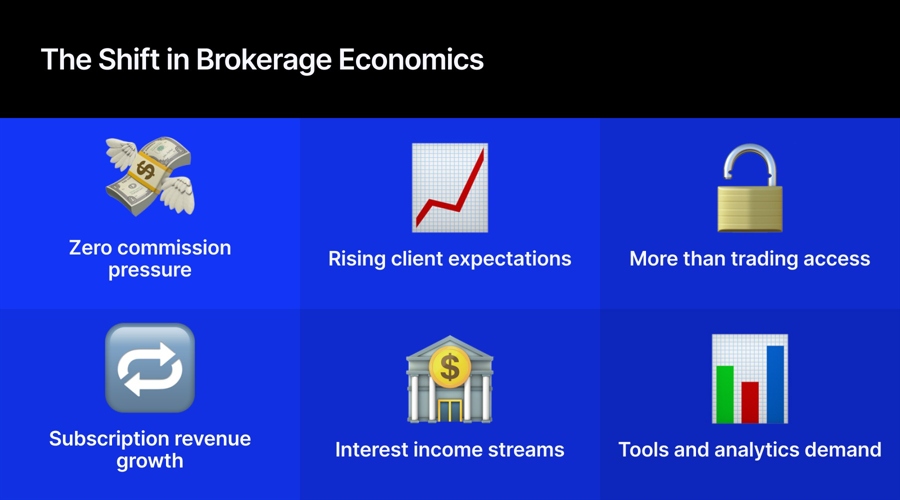
For decades, the brokerage business was relatively simple, and companies made money just by giving people access to the market. The entire model was built around deals, and the more trades clients executed, the more brokers earned.
However, today, very few users would be satisfied with simple access to trade. People want analytics, AI-driven insights, access to leverage, and more complex assets. If a company cannot offer all of this, clients can easily move to competitors.
Singapore Summit: Meet the largest APAC brokers you know (and those you still don't!)
As a result, earning revenue from transactions has become increasingly difficult. So, brokers have been seeking new monetisation models, with many turning to the SaaS model. This may seem unusual. However, the idea of software-as-a-service fits well with new market demands, offering predictable recurring revenue and making it much easier to monetise the existing user base.
How the Market Pushed Brokers to SaaS
This, however, raises a question: what exactly has changed so much in the market to push brokers towards SaaS in the first place? The fact is that the traditional model became too fragile.
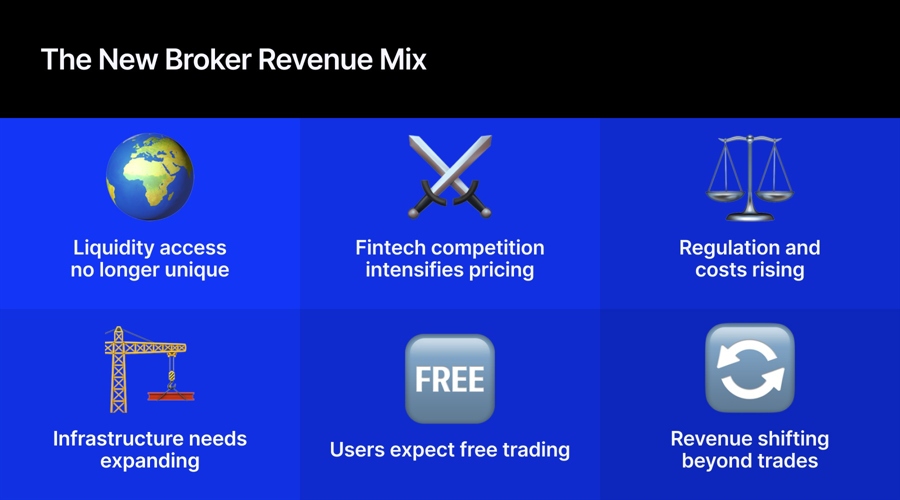
Traditional brokers have lost their uniqueness. In the past, access to liquidity was limited, and anyone who wanted to trade on the NYSE had to open an account with a major firm.
Today, this is no longer an issue. Dozens of fintech startups are ready to give clients access not only to the NYSE but also to European and Asian exchanges, cryptocurrencies, and even prediction contracts, along with liquidity that was once available only to wealthy investors. Competition became so intense that it forced brokers to rethink their business models.
This competition also puts pressure on traditional deal-based revenue, as retail brokers have spent years competing by lowering trading costs. Eventually, the market settled on the “zero commission” model and ended up stuck in a trap. They simply cannot lower commissions further, as they are already close to zero, but they cannot generate enough revenue from them either.
The user base expanded, of course, but expectations changed, as users now assume that buying a stock should cost nothing. Explaining why clients should pay for trades at all has become increasingly difficult. After all, it would cost them nothing to switch to another broker that offers free trading.
Pressure on the business model does not come only from users, as market regulation and operations have become much more complex. Modern financial services are highly sophisticated, and it is no longer enough for a broker to offer an interface with “buy” and “sell” buttons. They must build a full infrastructure for settlement, compliance, risk management, and security. The market simultaneously demands lower costs for clients and constant investment in technology.
- Digital Brokerage and Trading Platforms: Innovative Disruption in the Investment Industry
- tastyworks Launches Risk Analysis Tool
- HCYM (UK) Ends 2021 with Solid Profits despite Marginal Revenue Drop
How the Business Model Changes Exactly
All of this makes the SaaS model essential for brokers to operate and compete, as it allows them to diversify and collect revenue from other sources. For example, one visible SaaS element is recurring subscriptions. Brokers are increasingly offering subscription tiers that provide access to personalised analytics or, for example, lower fees and better margin trading conditions. As a result, revenue becomes more predictable and easier to forecast.
Another opportunity is interest income. Clients’ idle funds no longer sit quietly in their accounts; brokers can deploy them into assets and earn a spread, while clients receive their share. Therefore, even if a user does not trade at all, they still generate revenue. SaaS effectively opens many ways to generate revenue, as brokers can monetise through embedded financial products, premium analytics, and access to AI-driven tools.
Robinhood is a clear illustration of this new model. The company grew out of accessible trading, and brokerage remains its core business. However, revenue driven by a SaaS-like model is taking up an increasingly large share. In the first quarter of 2026, the company reported $1 billion in revenue, with 44% coming from non-transaction-based sources.
Robinhood is the devil.
— Brennan Schlagbaum, CPA (@Budgetdog_) April 28, 2026
Robinhood users trades 9x as much as E-Trade users and 40x as much as Charles Schwab users.
The top 20% of most active traders trail the market by 5.5% annually and by 10.3% after risk adjustment.
Further, there’s brain imaging research that found money…
Premium subscriptions stand out in particular. Over the past year, the number of subscribers grew by 36%, and the company notes that the average subscriber holds five times as many assets as a typical user. The loyalty generated by the new model is translating directly into assets.
Are Brokers Going to Disappear?
Such an evolution may raise concerns about the future of brokerages. Could they simply disappear as they stop meeting market demands? The answer is no. Brokers are not going anywhere. In the end, someone still has to connect users to global markets. More likely, they will evolve into modern fintech companies and become one part of a broader ecosystem.
Finally, the adoption of a SaaS model will place brokers as one of the most important layers of embedded finance. Users no longer treat investing and trading as something exceptional that requires long preparation or careful thought. Buying Bitcoin or placing a bet on a prediction market has become an everyday activity for many, something that can be done casually during a lunch break. For traditional brokers without SaaS models, it would be hard to provide such an experience.


