
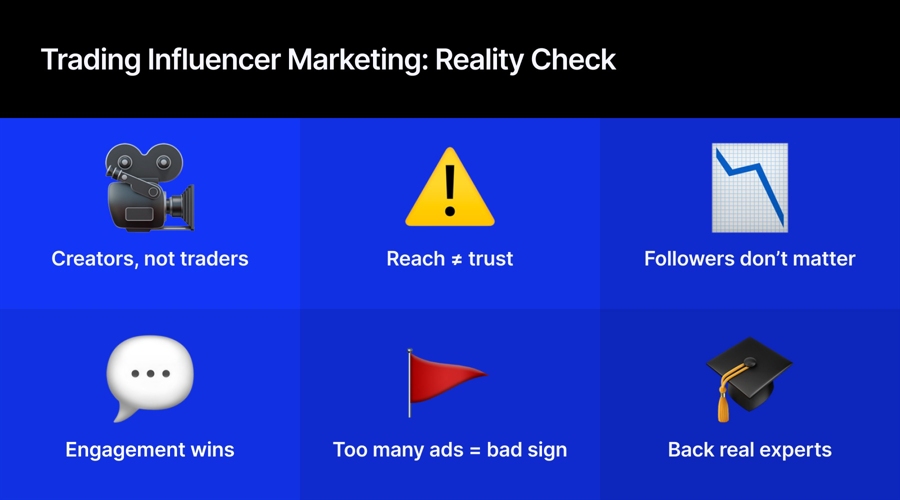
Deals with financial influencers, commonly known as finfluencers, have become a common marketing practice in the industry. But how much value do those affiliate or direct deals with these social media personalities bring to firms? Are more followers always better, or is there more nuance to it?
I am a content creator in the trading space and a marketing advisor to fintech companies and prop firms. That gives me a view most marketing teams do not have: I know what these creators actually do and what their audiences actually think of them.
Singapore Summit: Meet the largest APAC brokers you know (and those you still don't!)
The majority of trading influencers on Instagram, TikTok, and YouTube are not traders. They are content businesses using trading aesthetics: charts, terminals, and P&L screenshots as a growth mechanism. The products they sell are courses, memberships with low conversion and retention rates, and attention.
Brokers keep buying it as if it were a trust. Those are not the same thing, and the gap between them is where marketing budgets go to die.
Creators Optimise for Volume, Not Trust
The trading influencer model is built on viral hooks: income claims, lifestyle content, and fabricated account screenshots. Once an account scales, monetisation comes through sponsorships, broker deals, prop firm codes, courses, and signal groups. Actual trading, where it happens at all, is secondary to the business.
Many popular finfluencer accounts carry substantial followings and run affiliate programmes across most major brokers and prop firms simultaneously. The reach is real. The authority is not. Especially for smaller firms allocating budgets.
Many popular finfluencer accounts have large followings and affiliate deals with multiple brokers and prop firms at the same time. The reach is real. The authority is not, especially for smaller firms, spending marketing budgets.
You may also like: The UAE Regulated Finfluencers First. Now Comes the Hard Part.
The Platform Trap: Followers Are Not an Audience
The most common mistake in creator selection is treating Instagram follower count as the main metric. On its own, it is almost irrelevant.
What actually determines whether a creator can move depositors is the depth of their owned community: their Telegram group, Discord server, and email list. A creator with 500k Instagram followers but no off-platform community has little real distribution. A creator with 80k Instagram followers and an active 15,000-member Discord community has a genuine audience relationship that directly drives conversion and retention.
The evaluation criteria that actually matter:
| Metric | Red Flag | Acceptable | Strong |
| Instagram engagement rate | Below 2% | 5% | Above 5% |
| TikTok engagement rate | Below 1% | 2-5% | Above 5% |
| YouTube engagement rate | Below 1% | 5% | Above 2% |
| Discord members | None | 1k-5k | 10k+ active |
| Telegram | None | Under 5k | 10k+ |
| Active sponsorships per niche | 5+ | 3-5 | 10k+ |
The engagement benchmarks above reflect the trading niche specifically. Around two per cent engagement on Instagram is standard. Accounts below that are largely speaking to ghost audiences, regardless of follower count.
Brokers Are Selecting on the Wrong Variable
Because influencer selection is handled by marketing teams focused on cost-per-acquisition, evaluation often defaults to what is easiest to measure: follower count, CPM, and promo code click-through rates.
What they are not measuring is whether the audience trusts the creator’s judgment — the only factor that determines whether a sponsored post drives clicks or retained depositors. I have compiled these figures after working with industry players.
| Creator Type | Typical Following | Community Depth | 90-Day Retention | Brand Risk | Recommended Use |
| Lifestyle / Flexer | 100k–2M | Low/Instagram only | 25–35% | High | Awareness only |
| Multi-sponsor generalist | 50k–500k | Low/Medium | 30–40% | Medium –High | Short-term CPA only |
| Signal / alert seller | 10k–200k | Medium (Telegram-heavy) | 30–40% | Very High | Avoid entirely |
| Niche educational creator | 5k–80k | High/Discord, email, Telegram | 55–70% | Low | Core long-term partner |
| Founder / operator content | Varies | Owned — brand community | 60–75% | Very Low | Highest LTV, compounds |
Results may vary by creator, especially as the space evolves, but these are the patterns prop firms should be looking for.
One of the most important metrics is cross-checking communities beyond a single platform. How loyal is the audience? That is what the 90-day retention column reflects, and what should drive every partnership decision. It almost never does.
- New Zealand Joins 17-Regulator Finfluencer Crackdown
- India’s Regulator Deletes 120,000 Social Media Posts from Unregulated Finfluencers
What Creator Deals Actually Look Like | And Where the Structure Goes Wrong
Understanding the deal economics explains why the incentives are misaligned by default.
| Deal Type | Typical Structure | Who Offers It | Risk |
| Pure CPA / affiliate | 30-50% commission per funded account | Most prop firms and brokers | Creator optimises for volume, not quality |
| Flat fee per post | $2,000-$5,000 per post at 100k followers | Mid-tier creators | No performance accountability |
| Retainer | From $10,000/month at entry level | Established creators | High fixed cost regardless of results |
| Hybrid (retainer + CPA) | Retainer + 30-50% commission | Large creators - they demand both | Most expensive; only justified with exclusivity |
| Exclusive partnership | Retainer + CPA + category exclusivity | Best-in-class creators | Highest upfront cost, highest LTV return |
The hybrid model — retainer plus commission — is what established creators with genuine audiences demand. It is also the structure that best aligns incentives when paired with exclusivity. Without exclusivity, you are paying premium rates for a creator who may promote your competitor next month.
From what I’ve seen, Maven Trading is a strong example of this done properly. Rather than spreading budgets across a large creator roster, they work with creators on exclusive contracts and have built the brand around the founder as the main content face: educational, transparent, and directly accountable to the community.
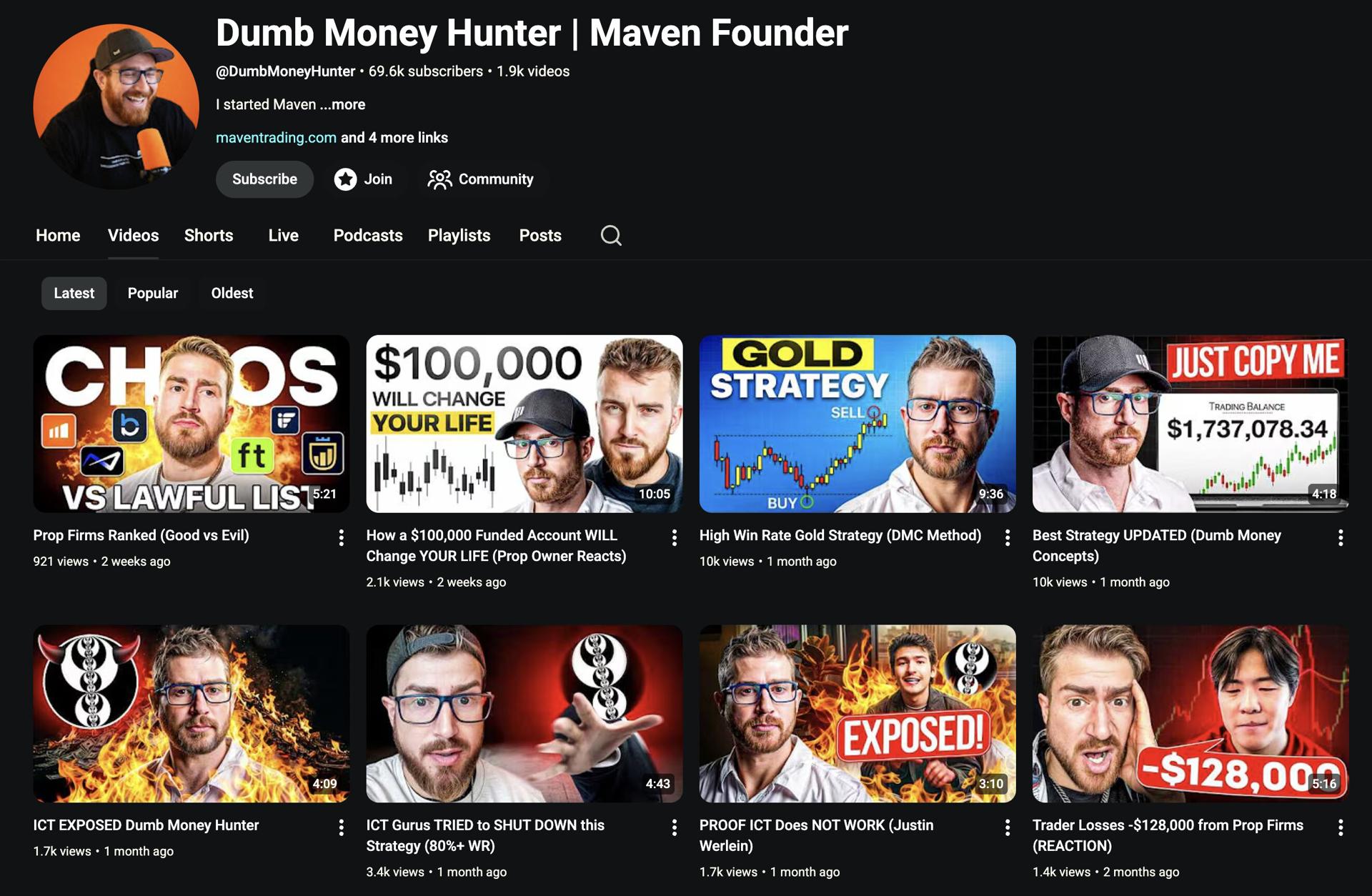
Their Discord community of more than 95,000 members is the result of that strategy. It drives a level of retention no short-term affiliate code campaign can match.
The Oversaturation Problem: How Many Deals Is Too Many
The point at which a creator’s endorsement becomes worthless is more specific than most firms realise. From what I see across the space, the threshold is two active partnerships per category — two prop firms, two brokers, or two crypto platforms. Beyond that, audiences stop viewing promotions as genuine recommendations.
Read more: How Prop Firms Win India Without Saying ‘Forex’ or ‘CFDs’
The math is straightforward. A creator running six financial sponsorships at the same time is pushing six promo codes, six urgency campaigns, and six deposit bonuses to their audience each month. Audiences do not see that as six genuine recommendations. They see it as advertising, and respond accordingly.
| Sponsorship Density | Audience Perception | Expected Conversion Impact |
| 1 active deal (exclusive) | Genuine endorsement | Baseline - full trust transfer |
| 2 deals (different categories) | Acceptable & still credible | Minimal impact |
| 2 deals (same category) | Starts to feel commercial | 20–30% conversion drop |
| 3+ deals (same category) | Billboard, not trusted voice | 50%+ conversion drop |
| 5+ deals across categories | Audience fully desensitised | Near-zero genuine conversion |
Trading brands must take risks when working with influencers. But what are the costs of those risks, and how can they be reduced?
| Mistake | Immediate Consequence | Downstream Effect | Mitigation |
| Selecting on follower count alone | High CPM, low genuine conversion | Rising CPA with no retention improvement | Audit community depth before signing |
| No exclusivity clause | Creator promotes competitor within 60 days | Brand association diluted, audience confused | Negotiate category exclusivity on all retainer deals |
| Too many simultaneous partners | Audience desensitisation across all partners | All promo codes underperform, budget wasted | Maximum 2 creators per product category |
| Briefing for promotion, not education | Short-term clicks, high churn depositors | 90-day retention collapses, LTV negative | Require an educational content ratio in contract |
| Instagram-only creator with no community | Impressions without conversion depth | Campaign looks active, deposits don't follow | Require Telegram/Discord metrics before signing |
| No performance review at 90 days | Underperforming partnerships auto-renew | Budget locked into low-ROI creators for quarters | Build 90-day retention review into every contract |
What a Better Strategy Looks Like
Audit your current roster based on community depth, not reach. Review Telegram, Discord, YouTube, and email list sizes for every active partner. If a creator cannot show a meaningful off-platform community, renegotiate the deal structure before the next renewal.
Cut roster size and deepen each partnership. Two well-chosen exclusive partners with genuine category authority will outperform ten shallow affiliate relationships. The compounding effect of a trusted creator consistently educating an engaged audience cannot be replicated through volume.
Brief creators for education, not promotion. A creator explaining your challenge structure in a 15-minute video produces a retained depositor. One pushing a countdown timer and discount code produces churn. That difference shows up directly in 90-day retention numbers.
Founder-led content should also be treated as a distribution channel. The cost is lower than any retainer, the trust signal is stronger, and it cannot be bought by a competitor or walk away. Over 24 months, it compounds in value in a way no external creator relationship can.
Retail traders have permanently recalibrated their scepticism. What the industry treats as a distribution problem — how to reach more traders — is actually a credibility problem. Reach is available at scale. Trust is not.
The firms that recognise this will have structurally lower CPAs and higher LTVs than competitors still cycling through creator rosters chasing short-term sign-ups. The ones that do not will keep seeing acquisition numbers work while everything downstream collapses.


