
Robinhood and Kalshi (Again) Sued Over Event Contracts Resembling Sports Betting

Thursday, 21/08/2025 | 07:33 GMT by Damian Chmiel
  • The Wisconsin tribe claims the prediction market platform violates federal gaming laws and tribal sovereignty.
  • Event contracts are drawing criticism from both the financial industry and the gambling sector.
Robinhood
Robinhood, source: Shutterstock

Kalshi and Robinhood Markets were hit with a federal lawsuit this week from the Ho-Chunk Nation, a federally recognized tribal nation in Wisconsin that operates multiple gaming facilities under a state compact allowing sports betting on tribal lands.

The plaintiffs’ main objection seems to be that the gambling takes place not in their casinos, but on smartphones.

Lawsuit Against Kalshi Over Sports Betting on Tribal Lands

The 47-page complaint, filed in the Western District of Wisconsin, accuses Kalshi of disguising sports betting as "event contracts" that allow users to buy "yes" or "no" positions on sporting event outcomes. The Wisconsin-based tribe argues this violates the Indian Gaming Regulatory Act, which gives tribes exclusive authority to regulate gaming on their lands.

Kalshi markets itself as a regulated derivatives exchange where users can trade on real-world events, from sports outcomes to political elections. The platform has gained attention for allowing 18-year-olds to place what the tribe calls "bets" on everything from NFL games to March Madness basketball tournaments.

"Currently, 18-year-old high school students across the United States, including some that are located on Indian reservations, are on their phones placing bets on the outcome of virtually every sporting event occurring across the globe," the complaint states.
Source: Court Documents

While it is clear that the tribes are concerned about someone taking a share of their profitable business, they may be right about one thing: event contracts are largely sports bets. This is evident even in the latest offering from CME Group, which this week partnered with the online gaming company FanDuel, a provider of sports betting.

Event Contracts: Gamble or Not?

The lawsuit centers on whether Kalshi's sports event contracts constitute gambling under federal law. While Kalshi describes its offerings as regulated commodities contracts overseen by the Commodity Futures Trading Commission (CFTC), the Ho-Chunk Nation argues these are simply sports wagers disguised with financial terminology.

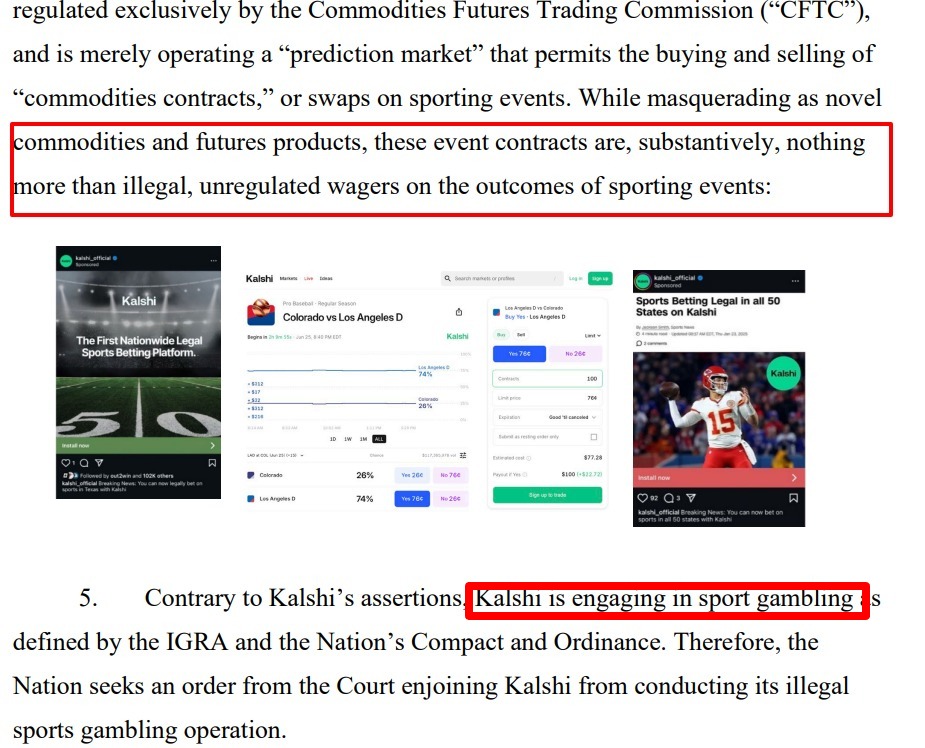
The tribe points to Kalshi's own marketing materials as evidence, citing Instagram posts where the company promoted itself as "The First Nationwide Legal Sports Betting Platform" and advertised "Sports Betting Legal in all 50 States on Kalshi."

Wisconsin law restricts sports betting to tribal casinos operating under state compacts. The Ho-Chunk Nation operates three gaming facilities and claims Kalshi's platform directly competes with its regulated sportsbooks by allowing people to bet from home instead of visiting tribal casinos.

Robinhood Also Hit

The complaint also targets Robinhood, which partnered with Kalshi in March to offer a "prediction markets hub" on its investment platform. During March Madness alone, Kalshi reported over $320 million in trading volume on tournament-related contracts.

The timing of Kalshi's expansion into sports markets has raised eyebrows. The company filed to offer sports event contracts in January, just days after Donald Trump Jr. announced he was joining Kalshi as a strategic advisor. Trump's nominee to chair the CFTC, Brian Quintenz, currently serves on Kalshi's board and owns stock in the company.

Several states have already moved against Kalshi's sports offerings. Nevada, New Jersey and Maryland gaming regulators have sent cease-and-desist letters demanding the platform stop operating in their jurisdictions. In response, Robinhood implemented geofencing to block users in certain states, though Kalshi has filed lawsuits challenging state authority.

The Ho-Chunk Nation's case follows similar litigation from three California tribes who sued Kalshi and Robinhood earlier this year. These tribal nations argue that unregulated online gambling undermines their exclusive gaming rights and diverts revenue that funds tribal government services.

Kalshi and Robinhood Markets were hit with a federal lawsuit this week from the Ho-Chunk Nation, a federally recognized tribal nation in Wisconsin that operates multiple gaming facilities under a state compact allowing sports betting on tribal lands.

The plaintiffs’ main objection seems to be that the gambling takes place not in their casinos, but on smartphones.

Lawsuit Against Kalshi Over Sports Betting on Tribal Lands

The 47-page complaint, filed in the Western District of Wisconsin, accuses Kalshi of disguising sports betting as "event contracts" that allow users to buy "yes" or "no" positions on sporting event outcomes. The Wisconsin-based tribe argues this violates the Indian Gaming Regulatory Act, which gives tribes exclusive authority to regulate gaming on their lands.

Kalshi markets itself as a regulated derivatives exchange where users can trade on real-world events, from sports outcomes to political elections. The platform has gained attention for allowing 18-year-olds to place what the tribe calls "bets" on everything from NFL games to March Madness basketball tournaments.

"Currently, 18-year-old high school students across the United States, including some that are located on Indian reservations, are on their phones placing bets on the outcome of virtually every sporting event occurring across the globe," the complaint states.

Source: Court Documents

While it is clear that the tribes are concerned about someone taking a share of their profitable business, they may be right about one thing: event contracts are largely sports bets. This is evident even in the latest offering from CME Group, which this week partnered with the online gaming company FanDuel, a provider of sports betting.

Event Contracts: Gamble or Not?

The lawsuit centers on whether Kalshi's sports event contracts constitute gambling under federal law. While Kalshi describes its offerings as regulated commodities contracts overseen by the Commodity Futures Trading Commission (CFTC), the Ho-Chunk Nation argues these are simply sports wagers disguised with financial terminology.

The tribe points to Kalshi's own marketing materials as evidence, citing Instagram posts where the company promoted itself as "The First Nationwide Legal Sports Betting Platform" and advertised "Sports Betting Legal in all 50 States on Kalshi."

Wisconsin law restricts sports betting to tribal casinos operating under state compacts. The Ho-Chunk Nation operates three gaming facilities and claims Kalshi's platform directly competes with its regulated sportsbooks by allowing people to bet from home instead of visiting tribal casinos.

Robinhood Also Hit

The complaint also targets Robinhood, which partnered with Kalshi in March to offer a "prediction markets hub" on its investment platform. During March Madness alone, Kalshi reported over $320 million in trading volume on tournament-related contracts.

The timing of Kalshi's expansion into sports markets has raised eyebrows. The company filed to offer sports event contracts in January, just days after Donald Trump Jr. announced he was joining Kalshi as a strategic advisor. Trump's nominee to chair the CFTC, Brian Quintenz, currently serves on Kalshi's board and owns stock in the company.

Several states have already moved against Kalshi's sports offerings. Nevada, New Jersey and Maryland gaming regulators have sent cease-and-desist letters demanding the platform stop operating in their jurisdictions. In response, Robinhood implemented geofencing to block users in certain states, though Kalshi has filed lawsuits challenging state authority.

The Ho-Chunk Nation's case follows similar litigation from three California tribes who sued Kalshi and Robinhood earlier this year. These tribal nations argue that unregulated online gambling undermines their exclusive gaming rights and diverts revenue that funds tribal government services.

About the Author: Damian Chmiel
Damian Chmiel
  • 3066 Articles
  • 96 Followers
About the Author: Damian Chmiel
Damian's adventure with financial markets began at the Cracow University of Economics, where he obtained his MA in finance and accounting. Starting from the retail trader perspective, he collaborated with brokerage houses and financial portals in Poland as an independent editor and content manager. His adventure with Finance Magnates began in 2016, where he is working as a business intelligence analyst.
  • 3066 Articles
  • 96 Followers

More from the Author

Retail FX

!"#$%&'()*+,-./0123456789:;<=>?@ABCDEFGHIJKLMNOPQRSTUVWXYZ[\]^_`abcdefghijklmnopqrstuvwxyz{|} !"#$%&'()*+,-./0123456789:;<=>?@ABCDEFGHIJKLMNOPQRSTUVWXYZ[\]^_`abcdefghijklmnopqrstuvwxyz{|}