The Polish broker's trading system crashed during market hours, with users reporting stuck positions.
The alleged technical failure blocked access to CFD trading during the evening session.
XTB, one of
Europe's largest publicly listed brokers (WSE: XTB), experienced a major
platform failure yesterday (Wednesday) that prevented clients from closing
positions for several hours, leaving traders exposed to market movements
without the ability to manage their risk.
However, the
company’s shares at today's (Thursday’s) open did not show a sharp negative reaction to
the recent run of problems, falling 0.7% and testing 70.92 zlotys.
On Thursday afternoon, XTB issued an official statement explaining the cause of the outage. Its full content is available at the bottom of the article.
XTB Platform Outage Blocks
Position Closures During Trading Hours
The
problems started around 4 p.m. local time when users began reporting they could
open new positions but couldn't close existing ones.
“Yesterday, I wanted to show my brother how the XTB app works and how to
navigate it - so we picked a random U.S. stock from the HOT category,” one
retail trader from Poland told FinanceMagnates.com. “I bought around nine
shares for 41 zlotys (as the minimum was 10 dollars) and from that moment the
system showed an error. I have the shares in my account, but I cannot do
anything with them. We then watched the position move from minus 5% to
plus 21% and back down to plus 2% without any ability to manage
it."
The issue persisted
through the evening, with XTB announcing at 10 p.m. that all CFD trading would
be suspended between 10 p.m. and 11 p.m. while engineers attempted repairs.
"We
are informing you that due to problems in the functioning of our investment
platform and in order to repair the technical fault, trading on CFD instruments
between 22-23 will be impossible," the company said in a statement on its
website. "We will keep you informed about the progress of this work on an
ongoing basis. We apologize for the inconvenience."
By late
Wednesday evening, XTB had not explained what caused the failure or when normal
operations would resume. The company's silence left traders guessing about the
technical root cause and their potential losses from being unable to react to
market swings.
Social
media filled with speculation about the source of the problem. One theory
gaining traction among technical observers suggested the platform hit a
programming limit known as integer overflow, where a counter tracking
transaction IDs exceeded the maximum value a standard 32-bit integer can hold.
A user
posting on X under the handle kwit_flip wrote
that XTB "just rolled over its INT," referring to the 4-byte integer
data type. "That's why you can't close positions right now," the user
claimed, noting that transaction numbers had wrapped from positive to negative
values after hitting roughly 2.1 billion.
XTB właśnie przekręciło INT'a.
To jest rozmiar 4-bajtowego INTEGERA - to typ danych, którym zapisywane są transakcje na platformie @xtb. Dziś został przekroczony dodatni maksymalny numer transakcji i mamy ujemne wartości.
The outage
marks the latest in a series of technical problems at XTB. In a recent interview
with Parkiet, board member Filip Kaczmarzyk acknowledged past platform
issues while defending the company's progress.
"Of
course there were moments when the platform did not work as it should, and such
situations have no right to happen," Kaczmarzyk said. "It is a
problem for all of us, not just for clients. However, it is definitely not the
case that we only look at the platform when something bad happens. Compared to
what it was two or three years ago, we have also made really huge
progress."
The timing
proved particularly awkward for XTB, which just days earlier announced
a record 100,000 new clients in October. The company now faces questions
about whether its infrastructure can handle its rapidly growing user base.
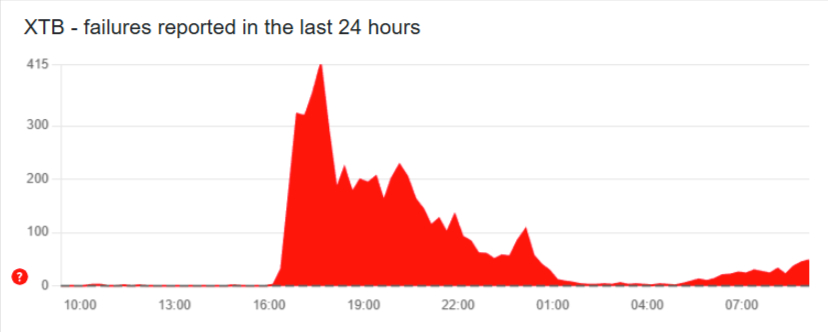
Data from
Downdetector showed a sharp spike in problem reports between 4 p.m. and
midnight Wednesday, then dropping to near zero afterward. On Thursday morning,
however, a slight upward trend is visible again:
XTB has not
yet addressed whether it will compensate clients who suffered losses during the
outage or clarified the complaints process mentioned by customer service
representatives.
Another Issue Following
the August Hack
Given that
XTB refunded
client losses in August after the alleged 150,000 zloty hack drew wide
attention, some investors may hope that the latest case will lead to a similar
outcome.
The
announcement came amid renewed pressure after the
latest victim’s account gained traction on local financial forums and media
outlets. The client described how hackers allegedly carried out simultaneous
buy and sell orders on thinly traded securities, leaving his account
consistently in loss while a separate account captured the gains. The incident
has again raised questions about the platform’s security and investor
protection standards.
XTB Official Statement
On Wednesday, November 5th, a technical issue occurred on
the XTB trading platform, temporarily preventing clients from modifying or
closing CFD positions opened after 4:25 p.m. We would like to emphasize that
clients retained full access to manage positions opened earlier.
Our technology team immediately began diagnosing the situation. Implementing
the necessary fixes required a temporary suspension of CFD trading between
10:00 p.m. and 11:00 p.m. At 10:40 p.m., the ability to modify new positions on
the web platform was restored. By approximately 1:00 a.m. on November 6th, the
same functionality was reinstated in the mobile app, fully resolving the issue.
Yesterday’s incident affected only positions opened after 4:25 p.m. - around
0.4% of a total of 25 million positions. The trades themselves were correctly recorded in the system databases; however, an error occurred when attempting to modify or close them.
The problem was caused by a technological limitation in the system responsible
for transferring data between the trading engine and both the mobile and web
platforms. Most of XTB’s architecture has already been rebuilt using modern
technologies where such limitations have been eliminated at the design stage.
The migration of position management to the new architecture is currently
underway and is scheduled for completion in the first quarter of next year.
We kindly ask all investors affected by yesterday’s issue to submit complaints
via the form available in the Client Office. Each case will be reviewed
individually based on data from XTB’s trading system. Full details of the
complaint process can albo be found on our website: https://www.xtb.com/pl/edukacja/proces-reklamacji.
The article was updated at 15:00 CET to include the statement from XTB.
XTB, one of
Europe's largest publicly listed brokers (WSE: XTB), experienced a major
platform failure yesterday (Wednesday) that prevented clients from closing
positions for several hours, leaving traders exposed to market movements
without the ability to manage their risk.
However, the
company’s shares at today's (Thursday’s) open did not show a sharp negative reaction to
the recent run of problems, falling 0.7% and testing 70.92 zlotys.
On Thursday afternoon, XTB issued an official statement explaining the cause of the outage. Its full content is available at the bottom of the article.
XTB Platform Outage Blocks
Position Closures During Trading Hours
The
problems started around 4 p.m. local time when users began reporting they could
open new positions but couldn't close existing ones.
“Yesterday, I wanted to show my brother how the XTB app works and how to
navigate it - so we picked a random U.S. stock from the HOT category,” one
retail trader from Poland told FinanceMagnates.com. “I bought around nine
shares for 41 zlotys (as the minimum was 10 dollars) and from that moment the
system showed an error. I have the shares in my account, but I cannot do
anything with them. We then watched the position move from minus 5% to
plus 21% and back down to plus 2% without any ability to manage
it."
The issue persisted
through the evening, with XTB announcing at 10 p.m. that all CFD trading would
be suspended between 10 p.m. and 11 p.m. while engineers attempted repairs.
"We
are informing you that due to problems in the functioning of our investment
platform and in order to repair the technical fault, trading on CFD instruments
between 22-23 will be impossible," the company said in a statement on its
website. "We will keep you informed about the progress of this work on an
ongoing basis. We apologize for the inconvenience."
By late
Wednesday evening, XTB had not explained what caused the failure or when normal
operations would resume. The company's silence left traders guessing about the
technical root cause and their potential losses from being unable to react to
market swings.
Social
media filled with speculation about the source of the problem. One theory
gaining traction among technical observers suggested the platform hit a
programming limit known as integer overflow, where a counter tracking
transaction IDs exceeded the maximum value a standard 32-bit integer can hold.
A user
posting on X under the handle kwit_flip wrote
that XTB "just rolled over its INT," referring to the 4-byte integer
data type. "That's why you can't close positions right now," the user
claimed, noting that transaction numbers had wrapped from positive to negative
values after hitting roughly 2.1 billion.
XTB właśnie przekręciło INT'a.
To jest rozmiar 4-bajtowego INTEGERA - to typ danych, którym zapisywane są transakcje na platformie @xtb. Dziś został przekroczony dodatni maksymalny numer transakcji i mamy ujemne wartości.
The outage
marks the latest in a series of technical problems at XTB. In a recent interview
with Parkiet, board member Filip Kaczmarzyk acknowledged past platform
issues while defending the company's progress.
"Of
course there were moments when the platform did not work as it should, and such
situations have no right to happen," Kaczmarzyk said. "It is a
problem for all of us, not just for clients. However, it is definitely not the
case that we only look at the platform when something bad happens. Compared to
what it was two or three years ago, we have also made really huge
progress."
The timing
proved particularly awkward for XTB, which just days earlier announced
a record 100,000 new clients in October. The company now faces questions
about whether its infrastructure can handle its rapidly growing user base.
Data from
Downdetector showed a sharp spike in problem reports between 4 p.m. and
midnight Wednesday, then dropping to near zero afterward. On Thursday morning,
however, a slight upward trend is visible again:
XTB has not
yet addressed whether it will compensate clients who suffered losses during the
outage or clarified the complaints process mentioned by customer service
representatives.
Another Issue Following
the August Hack
Given that
XTB refunded
client losses in August after the alleged 150,000 zloty hack drew wide
attention, some investors may hope that the latest case will lead to a similar
outcome.
The
announcement came amid renewed pressure after the
latest victim’s account gained traction on local financial forums and media
outlets. The client described how hackers allegedly carried out simultaneous
buy and sell orders on thinly traded securities, leaving his account
consistently in loss while a separate account captured the gains. The incident
has again raised questions about the platform’s security and investor
protection standards.
XTB Official Statement
On Wednesday, November 5th, a technical issue occurred on
the XTB trading platform, temporarily preventing clients from modifying or
closing CFD positions opened after 4:25 p.m. We would like to emphasize that
clients retained full access to manage positions opened earlier.
Our technology team immediately began diagnosing the situation. Implementing
the necessary fixes required a temporary suspension of CFD trading between
10:00 p.m. and 11:00 p.m. At 10:40 p.m., the ability to modify new positions on
the web platform was restored. By approximately 1:00 a.m. on November 6th, the
same functionality was reinstated in the mobile app, fully resolving the issue.
Yesterday’s incident affected only positions opened after 4:25 p.m. - around
0.4% of a total of 25 million positions. The trades themselves were correctly recorded in the system databases; however, an error occurred when attempting to modify or close them.
The problem was caused by a technological limitation in the system responsible
for transferring data between the trading engine and both the mobile and web
platforms. Most of XTB’s architecture has already been rebuilt using modern
technologies where such limitations have been eliminated at the design stage.
The migration of position management to the new architecture is currently
underway and is scheduled for completion in the first quarter of next year.
We kindly ask all investors affected by yesterday’s issue to submit complaints
via the form available in the Client Office. Each case will be reviewed
individually based on data from XTB’s trading system. Full details of the
complaint process can albo be found on our website: https://www.xtb.com/pl/edukacja/proces-reklamacji.
The article was updated at 15:00 CET to include the statement from XTB.
Damian Chmiel is a Senior Analyst & Editor at Finance Magnates with more than 15 years of experience in the CFD and online trading industry. Active as both a trader and journalist since 2010, he focuses on broker coverage, fintech innovation, and regulatory developments across Europe, the Middle East, and Asia.
His work includes interviews with C-level leaders at major brokerages and fintech platforms, as well as co-authoring Finance Magnates’ quarterly industry benchmarking reports. Damian’s reporting is data-driven, market-aware, and grounded in direct industry engagement. His analysis and commentary have also been cited by external media outlets, including Investing.com, Binance, The Asset, Stockhead, and Dispatch.
Education:
MA in Finance and Accounting, Cracow University of Economics
FTMO Says Monthly Rewards Near $15 Million in September
Featured Videos
AvaTrade to Acquire Most of FXCM; NAGA Raises $8M
AvaTrade to Acquire Most of FXCM; NAGA Raises $8M
AvaTrade to Acquire Most of FXCM; NAGA Raises $8M
AvaTrade to Acquire Most of FXCM; NAGA Raises $8M
Today’s financial news recap covers AvaTrade agrees to acquire most of FXCM, NAGA secures eight million dollars in new financing, and Wise seeks a tax settlement in the UK.
Finance Magnates Daily Recap brings you the latest news from forex and CFD brokers, fintech, payments, cryptocurrency, digital assets, trading platforms, financial regulation and global markets.
Get the key company news, executive moves, deals, regulatory updates and market developments of the day, in just a few minutes. New episodes published every weekday.
Read more: https://www.financemagnates.com
#FinanceMagnates #ForexNews #FintechNews
Today’s financial news recap covers AvaTrade agrees to acquire most of FXCM, NAGA secures eight million dollars in new financing, and Wise seeks a tax settlement in the UK.
Finance Magnates Daily Recap brings you the latest news from forex and CFD brokers, fintech, payments, cryptocurrency, digital assets, trading platforms, financial regulation and global markets.
Get the key company news, executive moves, deals, regulatory updates and market developments of the day, in just a few minutes. New episodes published every weekday.
Read more: https://www.financemagnates.com
#FinanceMagnates #ForexNews #FintechNews
Today’s financial news recap covers AvaTrade agrees to acquire most of FXCM, NAGA secures eight million dollars in new financing, and Wise seeks a tax settlement in the UK.
Finance Magnates Daily Recap brings you the latest news from forex and CFD brokers, fintech, payments, cryptocurrency, digital assets, trading platforms, financial regulation and global markets.
Get the key company news, executive moves, deals, regulatory updates and market developments of the day, in just a few minutes. New episodes published every weekday.
Read more: https://www.financemagnates.com
#FinanceMagnates #ForexNews #FintechNews
Today’s financial news recap covers AvaTrade agrees to acquire most of FXCM, NAGA secures eight million dollars in new financing, and Wise seeks a tax settlement in the UK.
Finance Magnates Daily Recap brings you the latest news from forex and CFD brokers, fintech, payments, cryptocurrency, digital assets, trading platforms, financial regulation and global markets.
Get the key company news, executive moves, deals, regulatory updates and market developments of the day, in just a few minutes. New episodes published every weekday.
Read more: https://www.financemagnates.com
#FinanceMagnates #ForexNews #FintechNews
XTB Adds Overnight US Stock Trading; Nasdaq Ventures Invests in One Trading
XTB Adds Overnight US Stock Trading; Nasdaq Ventures Invests in One Trading
XTB Adds Overnight US Stock Trading; Nasdaq Ventures Invests in One Trading
XTB Adds Overnight US Stock Trading; Nasdaq Ventures Invests in One Trading
XTB Adds Overnight US Stock Trading; Nasdaq Ventures Invests in One Trading
XTB Adds Overnight US Stock Trading; Nasdaq Ventures Invests in One Trading
Today’s financial news recap covers XTB expands overnight US stock trading, Fortrade reports higher revenue, Nasdaq backs One Trading, and Vest Labs raises 13 million dollars.
Finance Magnates Daily Recap brings you the latest news from forex and CFD brokers, fintech, payments, cryptocurrency, digital assets, trading platforms, financial regulation and global markets.
Get the key company news, executive moves, deals, regulatory updates and market developments of the day, in just a few minutes. New episodes published every weekday.
Read more: https://www.financemagnates.com
#FinanceMagnates #ForexNews #FintechNews
Today’s financial news recap covers XTB expands overnight US stock trading, Fortrade reports higher revenue, Nasdaq backs One Trading, and Vest Labs raises 13 million dollars.
Finance Magnates Daily Recap brings you the latest news from forex and CFD brokers, fintech, payments, cryptocurrency, digital assets, trading platforms, financial regulation and global markets.
Get the key company news, executive moves, deals, regulatory updates and market developments of the day, in just a few minutes. New episodes published every weekday.
Read more: https://www.financemagnates.com
#FinanceMagnates #ForexNews #FintechNews
Today’s financial news recap covers XTB expands overnight US stock trading, Fortrade reports higher revenue, Nasdaq backs One Trading, and Vest Labs raises 13 million dollars.
Finance Magnates Daily Recap brings you the latest news from forex and CFD brokers, fintech, payments, cryptocurrency, digital assets, trading platforms, financial regulation and global markets.
Get the key company news, executive moves, deals, regulatory updates and market developments of the day, in just a few minutes. New episodes published every weekday.
Read more: https://www.financemagnates.com
#FinanceMagnates #ForexNews #FintechNews
Today’s financial news recap covers XTB expands overnight US stock trading, Fortrade reports higher revenue, Nasdaq backs One Trading, and Vest Labs raises 13 million dollars.
Finance Magnates Daily Recap brings you the latest news from forex and CFD brokers, fintech, payments, cryptocurrency, digital assets, trading platforms, financial regulation and global markets.
Get the key company news, executive moves, deals, regulatory updates and market developments of the day, in just a few minutes. New episodes published every weekday.
Read more: https://www.financemagnates.com
#FinanceMagnates #ForexNews #FintechNews
Today’s financial news recap covers XTB expands overnight US stock trading, Fortrade reports higher revenue, Nasdaq backs One Trading, and Vest Labs raises 13 million dollars.
Finance Magnates Daily Recap brings you the latest news from forex and CFD brokers, fintech, payments, cryptocurrency, digital assets, trading platforms, financial regulation and global markets.
Get the key company news, executive moves, deals, regulatory updates and market developments of the day, in just a few minutes. New episodes published every weekday.
Read more: https://www.financemagnates.com
#FinanceMagnates #ForexNews #FintechNews
Today’s financial news recap covers XTB expands overnight US stock trading, Fortrade reports higher revenue, Nasdaq backs One Trading, and Vest Labs raises 13 million dollars.
Finance Magnates Daily Recap brings you the latest news from forex and CFD brokers, fintech, payments, cryptocurrency, digital assets, trading platforms, financial regulation and global markets.
Get the key company news, executive moves, deals, regulatory updates and market developments of the day, in just a few minutes. New episodes published every weekday.
Read more: https://www.financemagnates.com
#FinanceMagnates #ForexNews #FintechNews
CMC Founder Downplays Volatility Hit; Devexperts Names CEO
CMC Founder Downplays Volatility Hit; Devexperts Names CEO
CMC Founder Downplays Volatility Hit; Devexperts Names CEO
CMC Founder Downplays Volatility Hit; Devexperts Names CEO
CMC Founder Downplays Volatility Hit; Devexperts Names CEO
CMC Founder Downplays Volatility Hit; Devexperts Names CEO
Today’s financial news recap covers low volatility pressures brokers, Devexperts names a new CEO, Saxo cuts onboarding time, and OKX reaches a 25 billion dollar valuation.
Finance Magnates Daily Recap brings you the latest news from forex and CFD brokers, fintech, payments, cryptocurrency, digital assets, trading platforms, financial regulation and global markets.
Get the key company news, executive moves, deals, regulatory updates and market developments of the day, in just a few minutes. New episodes published every weekday.
Read more: https://www.financemagnates.com
#FinanceMagnates #ForexNews #FintechNews
Today’s financial news recap covers low volatility pressures brokers, Devexperts names a new CEO, Saxo cuts onboarding time, and OKX reaches a 25 billion dollar valuation.
Finance Magnates Daily Recap brings you the latest news from forex and CFD brokers, fintech, payments, cryptocurrency, digital assets, trading platforms, financial regulation and global markets.
Get the key company news, executive moves, deals, regulatory updates and market developments of the day, in just a few minutes. New episodes published every weekday.
Read more: https://www.financemagnates.com
#FinanceMagnates #ForexNews #FintechNews
Today’s financial news recap covers low volatility pressures brokers, Devexperts names a new CEO, Saxo cuts onboarding time, and OKX reaches a 25 billion dollar valuation.
Finance Magnates Daily Recap brings you the latest news from forex and CFD brokers, fintech, payments, cryptocurrency, digital assets, trading platforms, financial regulation and global markets.
Get the key company news, executive moves, deals, regulatory updates and market developments of the day, in just a few minutes. New episodes published every weekday.
Read more: https://www.financemagnates.com
#FinanceMagnates #ForexNews #FintechNews
Today’s financial news recap covers low volatility pressures brokers, Devexperts names a new CEO, Saxo cuts onboarding time, and OKX reaches a 25 billion dollar valuation.
Finance Magnates Daily Recap brings you the latest news from forex and CFD brokers, fintech, payments, cryptocurrency, digital assets, trading platforms, financial regulation and global markets.
Get the key company news, executive moves, deals, regulatory updates and market developments of the day, in just a few minutes. New episodes published every weekday.
Read more: https://www.financemagnates.com
#FinanceMagnates #ForexNews #FintechNews
Today’s financial news recap covers low volatility pressures brokers, Devexperts names a new CEO, Saxo cuts onboarding time, and OKX reaches a 25 billion dollar valuation.
Finance Magnates Daily Recap brings you the latest news from forex and CFD brokers, fintech, payments, cryptocurrency, digital assets, trading platforms, financial regulation and global markets.
Get the key company news, executive moves, deals, regulatory updates and market developments of the day, in just a few minutes. New episodes published every weekday.
Read more: https://www.financemagnates.com
#FinanceMagnates #ForexNews #FintechNews
Today’s financial news recap covers low volatility pressures brokers, Devexperts names a new CEO, Saxo cuts onboarding time, and OKX reaches a 25 billion dollar valuation.
Finance Magnates Daily Recap brings you the latest news from forex and CFD brokers, fintech, payments, cryptocurrency, digital assets, trading platforms, financial regulation and global markets.
Get the key company news, executive moves, deals, regulatory updates and market developments of the day, in just a few minutes. New episodes published every weekday.
Read more: https://www.financemagnates.com
#FinanceMagnates #ForexNews #FintechNews
Today’s financial news recap covers Trade Nation buys FXCM's UK client book, Trading 212 reports higher revenue, the CFTC's move to allow perpetual index futures.
Finance Magnates Daily Recap brings you the latest news from forex and CFD brokers, fintech, payments, cryptocurrency, digital assets, trading platforms, financial regulation and global markets.
Get the key company news, executive moves, deals, regulatory updates and market developments of the day, in just a few minutes. New episodes published every weekday.
Read more: https://www.financemagnates.com
#FinanceMagnates #ForexNews #FintechNews
Today’s financial news recap covers Trade Nation buys FXCM's UK client book, Trading 212 reports higher revenue, the CFTC's move to allow perpetual index futures.
Finance Magnates Daily Recap brings you the latest news from forex and CFD brokers, fintech, payments, cryptocurrency, digital assets, trading platforms, financial regulation and global markets.
Get the key company news, executive moves, deals, regulatory updates and market developments of the day, in just a few minutes. New episodes published every weekday.
Read more: https://www.financemagnates.com
#FinanceMagnates #ForexNews #FintechNews
Today’s financial news recap covers Trade Nation buys FXCM's UK client book, Trading 212 reports higher revenue, the CFTC's move to allow perpetual index futures.
Finance Magnates Daily Recap brings you the latest news from forex and CFD brokers, fintech, payments, cryptocurrency, digital assets, trading platforms, financial regulation and global markets.
Get the key company news, executive moves, deals, regulatory updates and market developments of the day, in just a few minutes. New episodes published every weekday.
Read more: https://www.financemagnates.com
#FinanceMagnates #ForexNews #FintechNews
Today’s financial news recap covers Trade Nation buys FXCM's UK client book, Trading 212 reports higher revenue, the CFTC's move to allow perpetual index futures.
Finance Magnates Daily Recap brings you the latest news from forex and CFD brokers, fintech, payments, cryptocurrency, digital assets, trading platforms, financial regulation and global markets.
Get the key company news, executive moves, deals, regulatory updates and market developments of the day, in just a few minutes. New episodes published every weekday.
Read more: https://www.financemagnates.com
#FinanceMagnates #ForexNews #FintechNews
Today’s financial news recap covers Trade Nation buys FXCM's UK client book, Trading 212 reports higher revenue, the CFTC's move to allow perpetual index futures.
Finance Magnates Daily Recap brings you the latest news from forex and CFD brokers, fintech, payments, cryptocurrency, digital assets, trading platforms, financial regulation and global markets.
Get the key company news, executive moves, deals, regulatory updates and market developments of the day, in just a few minutes. New episodes published every weekday.
Read more: https://www.financemagnates.com
#FinanceMagnates #ForexNews #FintechNews
Today’s financial news recap covers Trade Nation buys FXCM's UK client book, Trading 212 reports higher revenue, the CFTC's move to allow perpetual index futures.
Finance Magnates Daily Recap brings you the latest news from forex and CFD brokers, fintech, payments, cryptocurrency, digital assets, trading platforms, financial regulation and global markets.
Get the key company news, executive moves, deals, regulatory updates and market developments of the day, in just a few minutes. New episodes published every weekday.
Read more: https://www.financemagnates.com
#FinanceMagnates #ForexNews #FintechNews
Your career isn’t a linear path.
Your career isn’t a linear path.
Your career isn’t a linear path.
Your career isn’t a linear path.
Your career isn’t a linear path.
Your career isn’t a linear path.
Roles change. Career goals change. Sometimes you want a completely new challenge.
But the skills and knowledge you build along the way can stay with you and give you something to build on.
For Jeff Patterson, that continued growth is key to long-term career development.
You bring the skills. FM Academy helps you build the knowledge.
#FMAcademy #FinanceMagnates #FinanceCareers #ProfessionalDevelopment #Fintech
Roles change. Career goals change. Sometimes you want a completely new challenge.
But the skills and knowledge you build along the way can stay with you and give you something to build on.
For Jeff Patterson, that continued growth is key to long-term career development.
You bring the skills. FM Academy helps you build the knowledge.
#FMAcademy #FinanceMagnates #FinanceCareers #ProfessionalDevelopment #Fintech
Roles change. Career goals change. Sometimes you want a completely new challenge.
But the skills and knowledge you build along the way can stay with you and give you something to build on.
For Jeff Patterson, that continued growth is key to long-term career development.
You bring the skills. FM Academy helps you build the knowledge.
#FMAcademy #FinanceMagnates #FinanceCareers #ProfessionalDevelopment #Fintech
Roles change. Career goals change. Sometimes you want a completely new challenge.
But the skills and knowledge you build along the way can stay with you and give you something to build on.
For Jeff Patterson, that continued growth is key to long-term career development.
You bring the skills. FM Academy helps you build the knowledge.
#FMAcademy #FinanceMagnates #FinanceCareers #ProfessionalDevelopment #Fintech
Roles change. Career goals change. Sometimes you want a completely new challenge.
But the skills and knowledge you build along the way can stay with you and give you something to build on.
For Jeff Patterson, that continued growth is key to long-term career development.
You bring the skills. FM Academy helps you build the knowledge.
#FMAcademy #FinanceMagnates #FinanceCareers #ProfessionalDevelopment #Fintech
Roles change. Career goals change. Sometimes you want a completely new challenge.
But the skills and knowledge you build along the way can stay with you and give you something to build on.
For Jeff Patterson, that continued growth is key to long-term career development.
You bring the skills. FM Academy helps you build the knowledge.
#FMAcademy #FinanceMagnates #FinanceCareers #ProfessionalDevelopment #Fintech