Bitcoin
(BTC) price is holding steady on Thursday, March 27, 2025, trading at $87,243,
up 3.6% from the past week’s lows. After months of uncertainty tied to U.S.
trade tariffs and macroeconomic shifts, BTC is showing signs of recovery. Since
dipping below $80,000 earlier this month, the cryptocurrency has gained nearly
10%, reigniting a key question among investors: Will Bitcoin reach $100K
again?
Recent data
from Polymarket, a leading prediction platform, suggests BTC could hit $138K by
the end of 2025—a 60% jump from today’s price. In this article, we’ll break
down the latest Bitcoin price predictions, the factors driving its potential
resurgence, and whether reclaiming $100K in 2025 is within reach.
This above is an advertisement by Utip
Bitcoin Price Today Is Up
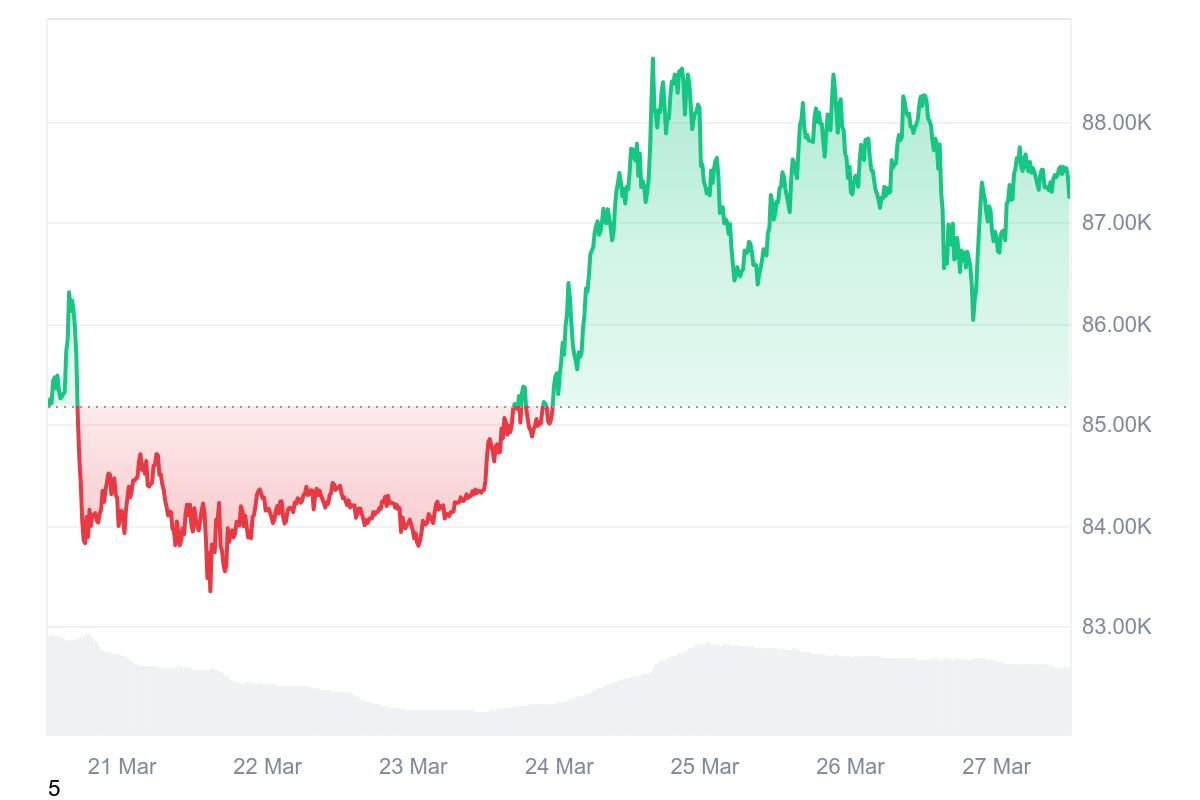
Bitcoin is
riding a wave of renewed confidence this week, with a modest 1.2% uptick in the
last 24 hours, per CoinMarketCap data. Bitcoins are currently changing hands at
$87,226.
Bitcoin price today is going up. Source: CoinMarketCap
On the flip
side, failure to hold support at $85,000 might trigger a pullback to
$76,000—the yearly average that traders like Aksel Kibar call “extremely
important” for maintaining bullish momentum.
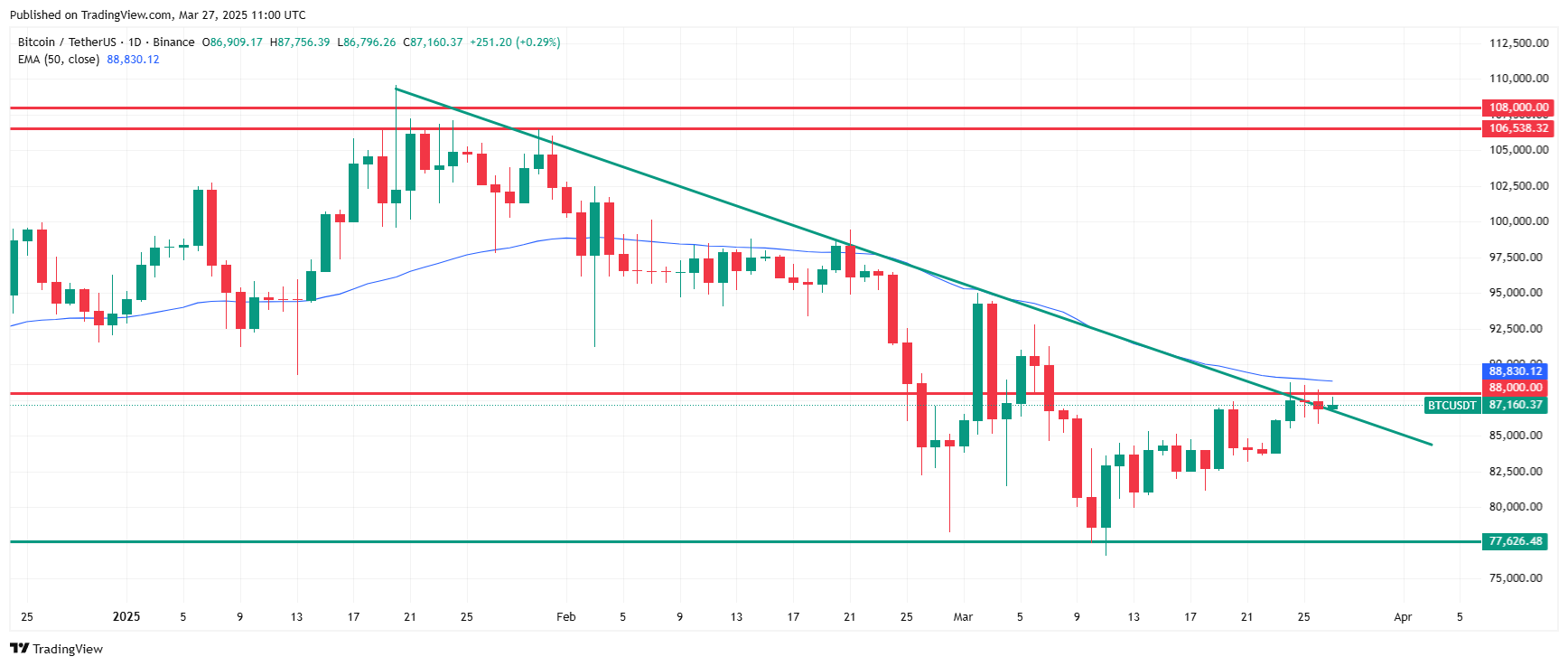
My
technical analysis also indicates that a bullish breakout has occurred above
the descending trendline drawn along the lower highs since January 2025.
Although the breakout isn’t yet strong and its confirmation would require a
move above the current resistance, it could serve as an additional impetus to
encourage buyers.
"Bitcoin should be seen as a long-term
investment. Anyone considering buying now should be prepared for the
possibility of a major drop i.e. say down to $15,000—and for the price to stay
there for a year or more," commented Dr
Kirill Kretov from CoinPanel. "That’s why it’s important to only invest money that
one shouldn't need in the short term. If there’s no pressure to exit at a loss,
holding through the downturns becomes much easier. Personally, I remain very
positive on Bitcoin’s future. It’s just a matter of when—not if—we reach those
higher levels."
Bitcoin’s Recent
Resilience: Why Is BTC Price Going Up Today?
BTC’s
ability to hover above $87K comes after a rocky quarter marked by U.S. trade
tariff concerns and broader risk-asset turbulence. Yet, fresh analysis from
Polymarket reveals growing optimism. Crypto researcher Ashwin, analyzing BTC
price bets on the platform, found that market participants see a ceiling of
$138,617 for 2025—a conservative yet promising target.
Adding to
the positivity, Bitcoin’s historical support levels—$73,800 (the 2023 high) and
$69,000 (the 2021 peak)—remain intact. A forecasting tool cited by
Cointelegraph earlier this month gave a 95% chance of $69,000 holding as a
floor, bolstering confidence in BTC’s bull market trajectory.
"According to our proprietary blockchain data analysis, a
substantial amount of liquidity has recently (starting in November) been
withdrawn from actively transacting entities—such as exchanges—into cold
wallets. A similar pattern, though on a smaller scale, was observed ahead of
the 2020–2021 bull run," added Kretov.
Polymarket’s
data pegs BTC’s 2025 range between $59,040 and $138,617, with $100K well within
reach. In the near term, Ashwin predicts BTC could oscillate between
$85,000–$90,000, with a breakout above $88,000 potentially sparking a rally
toward $100K by mid-2025.
Technical
indicators are mixed: the Relative Strength Index (RSI) sits in neutral
territory, while the Moving Average Convergence Divergence (MACD) hints at
cautious optimism. Analyst Aksel Kibar emphasizes that preserving the $76,000
yearly average is critical to avoid a deeper correction.
“Short-term
targets range from $85K–$90K, with upside potential to $100K–$110K if momentum
builds,” Ashwin noted. “Long-term, $138K by 2025 is plausible if macroeconomic
headwinds ease.”
Aksel Kibar, the Chartered Market Technician (CMT) commented this week that it will be “Extremely important for the price not to breach the year-long average.”
Historical
Patterns: Bitcoin’s
post-halving cycles (like 2024’s) often see explosive gains in the following
year, supporting a $100K+ scenario.
Ashwin’s
analysis sees BTC climbing to $138K by 2025’s end, assuming the bull market
regains steam. Even conservative estimates from Kalshi ($122K) place BTC
comfortably above $100K, making it a realistic milestone.
Bitcoin Price Prediction
2025 Table
Scenario
Price Range
Source
Key Driver
Bull Case
$180,000–$250,000
Fundstrat (Tom Lee)
$250K
target based on halving supply shock and 0.5% U.S. Treasury allocation.
Standard Chartered
$200K due
to $100B in ETF inflows by Q4 2025.
VanEck (Matthew Sigel)
$180K if
BTC captures 10% of the $12T offshore wealth market.
Base Case
$120,000–$150,000
JPMorgan
$145K
with 3x Lightning Network growth to 8,000 BTC.
Bloomberg Intelligence
$135K if
BTC reaches 20% of gold’s market cap.
Polymarket (Ashwin)
$138K as the market recovers from tariff uncertainty.
Market
Volatility: A
downturn in broader markets or a Bitcoin correction below $76,000 could delay
the $100K push.
Macro
Pressures: Ongoing
U.S. tariff debates or global economic slowdowns might cap risk-asset
gains.
Competition: Altcoins like Ethereum ($2,090, up
3.8%) could divert capital if BTC stalls.
Conclusion: Will Bitcoin
Hit $100K Again?
So, will
Bitcoin reach $100K again? The latest predictions say yes, with Polymarket’s
$138K target and Kalshi’s $122K forecast painting a clear path past six figures
in 2025. BTC’s resilience above $87K, coupled with easing tariff fears and
technical support, fuels the optimism. However, volatility and macro risks mean
investors should stay vigilant.
For now,
Bitcoin’s trajectory looks promising. Whether you’re a hodler or a trader,
watching the $88K resistance and upcoming market catalysts could be your ticket
to riding the next surge. Do you think BTC will reclaim $100K? Drop your take
below!
Bitcoin Price News, FAQ
Could Bitcoin Reach $100K
Again?
Yes,
experts widely agree Bitcoin could hit $100K in 2025. Polymarket predicts a
$138K ceiling, Kalshi averages $122K, and base case forecasts like JPMorgan’s
$145K and Bloomberg’s $135K all clear the six-figure mark. Even bull cases from
Fundstrat ($250K) and VanEck ($180K) reinforce the optimism.
Can Bitcoin Hit $150K?
It’s
possible—$150K falls within the base-to-bull case spectrum. VanEck’s $180K,
Standard Chartered’s $200K, and Fundstrat’s $250K forecasts suggest $150K is
achievable if ETF inflows, offshore wealth capture, or U.S. Treasury adoption
materialize. Polymarket’s $138K cap is more conservative, but X chatter often
eyes $150K+ in a strong bull run.
Can Bitcoin Hit $120K?
Highly
likely—$120K aligns with multiple predictions. Kalshi’s $122K average,
Bloomberg’s $135K, JPMorgan’s $145K, and Polymarket’s $138K all place BTC above
$120K by 2025. From $87,450, it’s a 37% gain—well within Bitcoin’s historical
post-halving surges.
How High Will BTC Go?
Bitcoin’s
2025 peak is a moving target. Bullish forecasts soar to $250K (Fundstrat) if
supply shocks and Treasury adoption hit, while Standard Chartered ($200K) and
VanEck ($180K) see ETF and wealth trends driving growth. Base cases cluster
around $120K–$150K (Kalshi, Polymarket, JPMorgan, Bloomberg), fitting a 40–70%
rise from $87,450. Bears like BitMEX ($70K) and Glassnode ($74K) warn of
downside if ETF outflows or support fails.
Short-term,
$100K–$110K is plausible above $88K resistance; long-term, $138K–$250K hinges
on adoption and macro stability. What’s your guess—$100K or $200K?
Bitcoin
(BTC) price is holding steady on Thursday, March 27, 2025, trading at $87,243,
up 3.6% from the past week’s lows. After months of uncertainty tied to U.S.
trade tariffs and macroeconomic shifts, BTC is showing signs of recovery. Since
dipping below $80,000 earlier this month, the cryptocurrency has gained nearly
10%, reigniting a key question among investors: Will Bitcoin reach $100K
again?
Recent data
from Polymarket, a leading prediction platform, suggests BTC could hit $138K by
the end of 2025—a 60% jump from today’s price. In this article, we’ll break
down the latest Bitcoin price predictions, the factors driving its potential
resurgence, and whether reclaiming $100K in 2025 is within reach.
This above is an advertisement by Utip
Bitcoin Price Today Is Up
Bitcoin is
riding a wave of renewed confidence this week, with a modest 1.2% uptick in the
last 24 hours, per CoinMarketCap data. Bitcoins are currently changing hands at
$87,226.
Bitcoin price today is going up. Source: CoinMarketCap
On the flip
side, failure to hold support at $85,000 might trigger a pullback to
$76,000—the yearly average that traders like Aksel Kibar call “extremely
important” for maintaining bullish momentum.
My
technical analysis also indicates that a bullish breakout has occurred above
the descending trendline drawn along the lower highs since January 2025.
Although the breakout isn’t yet strong and its confirmation would require a
move above the current resistance, it could serve as an additional impetus to
encourage buyers.
"Bitcoin should be seen as a long-term
investment. Anyone considering buying now should be prepared for the
possibility of a major drop i.e. say down to $15,000—and for the price to stay
there for a year or more," commented Dr
Kirill Kretov from CoinPanel. "That’s why it’s important to only invest money that
one shouldn't need in the short term. If there’s no pressure to exit at a loss,
holding through the downturns becomes much easier. Personally, I remain very
positive on Bitcoin’s future. It’s just a matter of when—not if—we reach those
higher levels."
Bitcoin’s Recent
Resilience: Why Is BTC Price Going Up Today?
BTC’s
ability to hover above $87K comes after a rocky quarter marked by U.S. trade
tariff concerns and broader risk-asset turbulence. Yet, fresh analysis from
Polymarket reveals growing optimism. Crypto researcher Ashwin, analyzing BTC
price bets on the platform, found that market participants see a ceiling of
$138,617 for 2025—a conservative yet promising target.
Adding to
the positivity, Bitcoin’s historical support levels—$73,800 (the 2023 high) and
$69,000 (the 2021 peak)—remain intact. A forecasting tool cited by
Cointelegraph earlier this month gave a 95% chance of $69,000 holding as a
floor, bolstering confidence in BTC’s bull market trajectory.
"According to our proprietary blockchain data analysis, a
substantial amount of liquidity has recently (starting in November) been
withdrawn from actively transacting entities—such as exchanges—into cold
wallets. A similar pattern, though on a smaller scale, was observed ahead of
the 2020–2021 bull run," added Kretov.
Polymarket’s
data pegs BTC’s 2025 range between $59,040 and $138,617, with $100K well within
reach. In the near term, Ashwin predicts BTC could oscillate between
$85,000–$90,000, with a breakout above $88,000 potentially sparking a rally
toward $100K by mid-2025.
Technical
indicators are mixed: the Relative Strength Index (RSI) sits in neutral
territory, while the Moving Average Convergence Divergence (MACD) hints at
cautious optimism. Analyst Aksel Kibar emphasizes that preserving the $76,000
yearly average is critical to avoid a deeper correction.
“Short-term
targets range from $85K–$90K, with upside potential to $100K–$110K if momentum
builds,” Ashwin noted. “Long-term, $138K by 2025 is plausible if macroeconomic
headwinds ease.”
Aksel Kibar, the Chartered Market Technician (CMT) commented this week that it will be “Extremely important for the price not to breach the year-long average.”
Historical
Patterns: Bitcoin’s
post-halving cycles (like 2024’s) often see explosive gains in the following
year, supporting a $100K+ scenario.
Ashwin’s
analysis sees BTC climbing to $138K by 2025’s end, assuming the bull market
regains steam. Even conservative estimates from Kalshi ($122K) place BTC
comfortably above $100K, making it a realistic milestone.
Bitcoin Price Prediction
2025 Table
Scenario
Price Range
Source
Key Driver
Bull Case
$180,000–$250,000
Fundstrat (Tom Lee)
$250K
target based on halving supply shock and 0.5% U.S. Treasury allocation.
Standard Chartered
$200K due
to $100B in ETF inflows by Q4 2025.
VanEck (Matthew Sigel)
$180K if
BTC captures 10% of the $12T offshore wealth market.
Base Case
$120,000–$150,000
JPMorgan
$145K
with 3x Lightning Network growth to 8,000 BTC.
Bloomberg Intelligence
$135K if
BTC reaches 20% of gold’s market cap.
Polymarket (Ashwin)
$138K as the market recovers from tariff uncertainty.
Market
Volatility: A
downturn in broader markets or a Bitcoin correction below $76,000 could delay
the $100K push.
Macro
Pressures: Ongoing
U.S. tariff debates or global economic slowdowns might cap risk-asset
gains.
Competition: Altcoins like Ethereum ($2,090, up
3.8%) could divert capital if BTC stalls.
Conclusion: Will Bitcoin
Hit $100K Again?
So, will
Bitcoin reach $100K again? The latest predictions say yes, with Polymarket’s
$138K target and Kalshi’s $122K forecast painting a clear path past six figures
in 2025. BTC’s resilience above $87K, coupled with easing tariff fears and
technical support, fuels the optimism. However, volatility and macro risks mean
investors should stay vigilant.
For now,
Bitcoin’s trajectory looks promising. Whether you’re a hodler or a trader,
watching the $88K resistance and upcoming market catalysts could be your ticket
to riding the next surge. Do you think BTC will reclaim $100K? Drop your take
below!
Bitcoin Price News, FAQ
Could Bitcoin Reach $100K
Again?
Yes,
experts widely agree Bitcoin could hit $100K in 2025. Polymarket predicts a
$138K ceiling, Kalshi averages $122K, and base case forecasts like JPMorgan’s
$145K and Bloomberg’s $135K all clear the six-figure mark. Even bull cases from
Fundstrat ($250K) and VanEck ($180K) reinforce the optimism.
Can Bitcoin Hit $150K?
It’s
possible—$150K falls within the base-to-bull case spectrum. VanEck’s $180K,
Standard Chartered’s $200K, and Fundstrat’s $250K forecasts suggest $150K is
achievable if ETF inflows, offshore wealth capture, or U.S. Treasury adoption
materialize. Polymarket’s $138K cap is more conservative, but X chatter often
eyes $150K+ in a strong bull run.
Can Bitcoin Hit $120K?
Highly
likely—$120K aligns with multiple predictions. Kalshi’s $122K average,
Bloomberg’s $135K, JPMorgan’s $145K, and Polymarket’s $138K all place BTC above
$120K by 2025. From $87,450, it’s a 37% gain—well within Bitcoin’s historical
post-halving surges.
How High Will BTC Go?
Bitcoin’s
2025 peak is a moving target. Bullish forecasts soar to $250K (Fundstrat) if
supply shocks and Treasury adoption hit, while Standard Chartered ($200K) and
VanEck ($180K) see ETF and wealth trends driving growth. Base cases cluster
around $120K–$150K (Kalshi, Polymarket, JPMorgan, Bloomberg), fitting a 40–70%
rise from $87,450. Bears like BitMEX ($70K) and Glassnode ($74K) warn of
downside if ETF outflows or support fails.
Short-term,
$100K–$110K is plausible above $88K resistance; long-term, $138K–$250K hinges
on adoption and macro stability. What’s your guess—$100K or $200K?
Damian Chmiel is a Senior Analyst & Editor at Finance Magnates with more than 15 years of experience in the CFD and online trading industry. Active as both a trader and journalist since 2010, he focuses on broker coverage, fintech innovation, and regulatory developments across Europe, the Middle East, and Asia.
His work includes interviews with C-level leaders at major brokerages and fintech platforms, as well as co-authoring Finance Magnates’ quarterly industry benchmarking reports. Damian’s reporting is data-driven, market-aware, and grounded in direct industry engagement. His analysis and commentary have also been cited by external media outlets, including Investing.com, Binance, The Asset, Stockhead, and Dispatch.
Education:
MA in Finance and Accounting, Cracow University of Economics
Inside the Prediction Markets: $1.6B Institutional Inflow Meets a Federal Crackdown
Featured Videos
FP Markets Winner Spotlight 🏆 | Global Broker of the Year 2025 #Trading #Broker #Innovation #Shorts
FP Markets Winner Spotlight 🏆 | Global Broker of the Year 2025 #Trading #Broker #Innovation #Shorts
FP Markets Winner Spotlight 🏆 | Global Broker of the Year 2025 #Trading #Broker #Innovation #Shorts
FP Markets Winner Spotlight 🏆 | Global Broker of the Year 2025 #Trading #Broker #Innovation #Shorts
FP Markets takes the spotlight as Global Broker of the Year 2025 at the Finance Magnates Awards.
Martin Stoilov, Head of Client Experience, shares that trust, innovation, and people played a key role in the company’s success, supported by a strong foundation of integrity and client-centricity.
Following this milestone, FP Markets continues to focus on growth, technology investment, and its core values of transparency and excellence.
👉 Be part of FM Awards 2026: https://awards.financemagnates.com/#nominate
FP Markets takes the spotlight as Global Broker of the Year 2025 at the Finance Magnates Awards.
Martin Stoilov, Head of Client Experience, shares that trust, innovation, and people played a key role in the company’s success, supported by a strong foundation of integrity and client-centricity.
Following this milestone, FP Markets continues to focus on growth, technology investment, and its core values of transparency and excellence.
👉 Be part of FM Awards 2026: https://awards.financemagnates.com/#nominate
FP Markets takes the spotlight as Global Broker of the Year 2025 at the Finance Magnates Awards.
Martin Stoilov, Head of Client Experience, shares that trust, innovation, and people played a key role in the company’s success, supported by a strong foundation of integrity and client-centricity.
Following this milestone, FP Markets continues to focus on growth, technology investment, and its core values of transparency and excellence.
👉 Be part of FM Awards 2026: https://awards.financemagnates.com/#nominate
FP Markets takes the spotlight as Global Broker of the Year 2025 at the Finance Magnates Awards.
Martin Stoilov, Head of Client Experience, shares that trust, innovation, and people played a key role in the company’s success, supported by a strong foundation of integrity and client-centricity.
Following this milestone, FP Markets continues to focus on growth, technology investment, and its core values of transparency and excellence.
👉 Be part of FM Awards 2026: https://awards.financemagnates.com/#nominate
In this video, we review @HolaPrimeMarketsOfficial, a multi-asset forex and CFDs broker offering different account types, trading platforms, and flexible trading conditions.
We cover the broker’s overall offering, including account options, trading environment, platforms like MT4 and MT5, and additional services such as managed accounts and fast withdrawals.
Watch the full video to see if Hola Prime Markets fits your trading needs.
📣 Stay up to date with the latest in finance and trading. Follow Finance Magnates for industry news, insights, and global event coverage.
Connect with us:
🔗 LinkedIn: /financemagnates
👍 Facebook: /financemagnates
📸 Instagram: https://www.instagram.com/financemagnates
🐦 X: https://x.com/financemagnates
🎥 TikTok: https://www.tiktok.com/tag/financemagnates
▶️ YouTube: /@financemagnates_official
#HolaPrime #ForexBroker #CFDTrading #FinanceMagnates #Trading #Forex #BrokerReview
In this video, we review @HolaPrimeMarketsOfficial, a multi-asset forex and CFDs broker offering different account types, trading platforms, and flexible trading conditions.
We cover the broker’s overall offering, including account options, trading environment, platforms like MT4 and MT5, and additional services such as managed accounts and fast withdrawals.
Watch the full video to see if Hola Prime Markets fits your trading needs.
📣 Stay up to date with the latest in finance and trading. Follow Finance Magnates for industry news, insights, and global event coverage.
Connect with us:
🔗 LinkedIn: /financemagnates
👍 Facebook: /financemagnates
📸 Instagram: https://www.instagram.com/financemagnates
🐦 X: https://x.com/financemagnates
🎥 TikTok: https://www.tiktok.com/tag/financemagnates
▶️ YouTube: /@financemagnates_official
#HolaPrime #ForexBroker #CFDTrading #FinanceMagnates #Trading #Forex #BrokerReview
In this video, we review @HolaPrimeMarketsOfficial, a multi-asset forex and CFDs broker offering different account types, trading platforms, and flexible trading conditions.
We cover the broker’s overall offering, including account options, trading environment, platforms like MT4 and MT5, and additional services such as managed accounts and fast withdrawals.
Watch the full video to see if Hola Prime Markets fits your trading needs.
📣 Stay up to date with the latest in finance and trading. Follow Finance Magnates for industry news, insights, and global event coverage.
Connect with us:
🔗 LinkedIn: /financemagnates
👍 Facebook: /financemagnates
📸 Instagram: https://www.instagram.com/financemagnates
🐦 X: https://x.com/financemagnates
🎥 TikTok: https://www.tiktok.com/tag/financemagnates
▶️ YouTube: /@financemagnates_official
#HolaPrime #ForexBroker #CFDTrading #FinanceMagnates #Trading #Forex #BrokerReview
In this video, we review @HolaPrimeMarketsOfficial, a multi-asset forex and CFDs broker offering different account types, trading platforms, and flexible trading conditions.
We cover the broker’s overall offering, including account options, trading environment, platforms like MT4 and MT5, and additional services such as managed accounts and fast withdrawals.
Watch the full video to see if Hola Prime Markets fits your trading needs.
📣 Stay up to date with the latest in finance and trading. Follow Finance Magnates for industry news, insights, and global event coverage.
Connect with us:
🔗 LinkedIn: /financemagnates
👍 Facebook: /financemagnates
📸 Instagram: https://www.instagram.com/financemagnates
🐦 X: https://x.com/financemagnates
🎥 TikTok: https://www.tiktok.com/tag/financemagnates
▶️ YouTube: /@financemagnates_official
#HolaPrime #ForexBroker #CFDTrading #FinanceMagnates #Trading #Forex #BrokerReview
In this video, we review @HolaPrimeMarketsOfficial, a multi-asset forex and CFDs broker offering different account types, trading platforms, and flexible trading conditions.
We cover the broker’s overall offering, including account options, trading environment, platforms like MT4 and MT5, and additional services such as managed accounts and fast withdrawals.
Watch the full video to see if Hola Prime Markets fits your trading needs.
📣 Stay up to date with the latest in finance and trading. Follow Finance Magnates for industry news, insights, and global event coverage.
Connect with us:
🔗 LinkedIn: /financemagnates
👍 Facebook: /financemagnates
📸 Instagram: https://www.instagram.com/financemagnates
🐦 X: https://x.com/financemagnates
🎥 TikTok: https://www.tiktok.com/tag/financemagnates
▶️ YouTube: /@financemagnates_official
#HolaPrime #ForexBroker #CFDTrading #FinanceMagnates #Trading #Forex #BrokerReview
In this video, we review @HolaPrimeMarketsOfficial, a multi-asset forex and CFDs broker offering different account types, trading platforms, and flexible trading conditions.
We cover the broker’s overall offering, including account options, trading environment, platforms like MT4 and MT5, and additional services such as managed accounts and fast withdrawals.
Watch the full video to see if Hola Prime Markets fits your trading needs.
📣 Stay up to date with the latest in finance and trading. Follow Finance Magnates for industry news, insights, and global event coverage.
Connect with us:
🔗 LinkedIn: /financemagnates
👍 Facebook: /financemagnates
📸 Instagram: https://www.instagram.com/financemagnates
🐦 X: https://x.com/financemagnates
🎥 TikTok: https://www.tiktok.com/tag/financemagnates
▶️ YouTube: /@financemagnates_official
#HolaPrime #ForexBroker #CFDTrading #FinanceMagnates #Trading #Forex #BrokerReview
Hola Prime Review: What You Need to Know | Full Breakdown by Finance Magnates
Hola Prime Review: What You Need to Know | Full Breakdown by Finance Magnates
Hola Prime Review: What You Need to Know | Full Breakdown by Finance Magnates
Hola Prime Review: What You Need to Know | Full Breakdown by Finance Magnates
Hola Prime Review: What You Need to Know | Full Breakdown by Finance Magnates
Hola Prime Review: What You Need to Know | Full Breakdown by Finance Magnates
In this video, we review @HolaPrime_Global, a proprietary trading firm offering evaluation programs and performance-based payouts in simulated market environments.
We cover how the challenge model works, including account types, profit splits (up to 95%), trading rules, and what it takes to reach a funded account. You’ll also learn about available platforms like MT4, MT5, cTrader, and more, along with insights into payouts, support, and trading conditions.
Watch the full video to see if Hola Prime fits your trading style.
📣 Stay up to date with the latest in finance and trading. Follow Finance Magnates for industry news, insights, and global event coverage.
Connect with us:
🔗 LinkedIn: /financemagnates
👍 Facebook: /financemagnates
📸 Instagram: https://www.instagram.com/financemagnates
🐦 X: https://x.com/financemagnates
🎥 TikTok: https://www.tiktok.com/tag/financemagnates
▶️ YouTube: /@financemagnates_official
#HolaPrime #PropFirm #Trading #FinanceMagnates #Forex #FuturesTrading #TradingReview #PropFirmReview
In this video, we review @HolaPrime_Global, a proprietary trading firm offering evaluation programs and performance-based payouts in simulated market environments.
We cover how the challenge model works, including account types, profit splits (up to 95%), trading rules, and what it takes to reach a funded account. You’ll also learn about available platforms like MT4, MT5, cTrader, and more, along with insights into payouts, support, and trading conditions.
Watch the full video to see if Hola Prime fits your trading style.
📣 Stay up to date with the latest in finance and trading. Follow Finance Magnates for industry news, insights, and global event coverage.
Connect with us:
🔗 LinkedIn: /financemagnates
👍 Facebook: /financemagnates
📸 Instagram: https://www.instagram.com/financemagnates
🐦 X: https://x.com/financemagnates
🎥 TikTok: https://www.tiktok.com/tag/financemagnates
▶️ YouTube: /@financemagnates_official
#HolaPrime #PropFirm #Trading #FinanceMagnates #Forex #FuturesTrading #TradingReview #PropFirmReview
In this video, we review @HolaPrime_Global, a proprietary trading firm offering evaluation programs and performance-based payouts in simulated market environments.
We cover how the challenge model works, including account types, profit splits (up to 95%), trading rules, and what it takes to reach a funded account. You’ll also learn about available platforms like MT4, MT5, cTrader, and more, along with insights into payouts, support, and trading conditions.
Watch the full video to see if Hola Prime fits your trading style.
📣 Stay up to date with the latest in finance and trading. Follow Finance Magnates for industry news, insights, and global event coverage.
Connect with us:
🔗 LinkedIn: /financemagnates
👍 Facebook: /financemagnates
📸 Instagram: https://www.instagram.com/financemagnates
🐦 X: https://x.com/financemagnates
🎥 TikTok: https://www.tiktok.com/tag/financemagnates
▶️ YouTube: /@financemagnates_official
#HolaPrime #PropFirm #Trading #FinanceMagnates #Forex #FuturesTrading #TradingReview #PropFirmReview
In this video, we review @HolaPrime_Global, a proprietary trading firm offering evaluation programs and performance-based payouts in simulated market environments.
We cover how the challenge model works, including account types, profit splits (up to 95%), trading rules, and what it takes to reach a funded account. You’ll also learn about available platforms like MT4, MT5, cTrader, and more, along with insights into payouts, support, and trading conditions.
Watch the full video to see if Hola Prime fits your trading style.
📣 Stay up to date with the latest in finance and trading. Follow Finance Magnates for industry news, insights, and global event coverage.
Connect with us:
🔗 LinkedIn: /financemagnates
👍 Facebook: /financemagnates
📸 Instagram: https://www.instagram.com/financemagnates
🐦 X: https://x.com/financemagnates
🎥 TikTok: https://www.tiktok.com/tag/financemagnates
▶️ YouTube: /@financemagnates_official
#HolaPrime #PropFirm #Trading #FinanceMagnates #Forex #FuturesTrading #TradingReview #PropFirmReview
In this video, we review @HolaPrime_Global, a proprietary trading firm offering evaluation programs and performance-based payouts in simulated market environments.
We cover how the challenge model works, including account types, profit splits (up to 95%), trading rules, and what it takes to reach a funded account. You’ll also learn about available platforms like MT4, MT5, cTrader, and more, along with insights into payouts, support, and trading conditions.
Watch the full video to see if Hola Prime fits your trading style.
📣 Stay up to date with the latest in finance and trading. Follow Finance Magnates for industry news, insights, and global event coverage.
Connect with us:
🔗 LinkedIn: /financemagnates
👍 Facebook: /financemagnates
📸 Instagram: https://www.instagram.com/financemagnates
🐦 X: https://x.com/financemagnates
🎥 TikTok: https://www.tiktok.com/tag/financemagnates
▶️ YouTube: /@financemagnates_official
#HolaPrime #PropFirm #Trading #FinanceMagnates #Forex #FuturesTrading #TradingReview #PropFirmReview
In this video, we review @HolaPrime_Global, a proprietary trading firm offering evaluation programs and performance-based payouts in simulated market environments.
We cover how the challenge model works, including account types, profit splits (up to 95%), trading rules, and what it takes to reach a funded account. You’ll also learn about available platforms like MT4, MT5, cTrader, and more, along with insights into payouts, support, and trading conditions.
Watch the full video to see if Hola Prime fits your trading style.
📣 Stay up to date with the latest in finance and trading. Follow Finance Magnates for industry news, insights, and global event coverage.
Connect with us:
🔗 LinkedIn: /financemagnates
👍 Facebook: /financemagnates
📸 Instagram: https://www.instagram.com/financemagnates
🐦 X: https://x.com/financemagnates
🎥 TikTok: https://www.tiktok.com/tag/financemagnates
▶️ YouTube: /@financemagnates_official
#HolaPrime #PropFirm #Trading #FinanceMagnates #Forex #FuturesTrading #TradingReview #PropFirmReview
Axi Winner Spotlight 🏆 | Global Most Innovative Broker 2025 #Innovation #Trading #Fintech #Broker
Axi Winner Spotlight 🏆 | Global Most Innovative Broker 2025 #Innovation #Trading #Fintech #Broker
Axi Winner Spotlight 🏆 | Global Most Innovative Broker 2025 #Innovation #Trading #Fintech #Broker
Axi Winner Spotlight 🏆 | Global Most Innovative Broker 2025 #Innovation #Trading #Fintech #Broker
Axi Winner Spotlight 🏆 | Global Most Innovative Broker 2025 #Innovation #Trading #Fintech #Broker
Axi Winner Spotlight 🏆 | Global Most Innovative Broker 2025 #Innovation #Trading #Fintech #Broker
Axi takes the spotlight at the Finance Magnates Awards, winning Global Most Innovative Broker 2025.
Olivia Xenofontos and Ivanna Openko share how the team will feel: proud, motivated, and ready to keep delivering.
They also describe the night as well-organized, focused, and enjoyable for all.
👉 Be part of FM Awards 2026.
Axi takes the spotlight at the Finance Magnates Awards, winning Global Most Innovative Broker 2025.
Olivia Xenofontos and Ivanna Openko share how the team will feel: proud, motivated, and ready to keep delivering.
They also describe the night as well-organized, focused, and enjoyable for all.
👉 Be part of FM Awards 2026.
Axi takes the spotlight at the Finance Magnates Awards, winning Global Most Innovative Broker 2025.
Olivia Xenofontos and Ivanna Openko share how the team will feel: proud, motivated, and ready to keep delivering.
They also describe the night as well-organized, focused, and enjoyable for all.
👉 Be part of FM Awards 2026.
Axi takes the spotlight at the Finance Magnates Awards, winning Global Most Innovative Broker 2025.
Olivia Xenofontos and Ivanna Openko share how the team will feel: proud, motivated, and ready to keep delivering.
They also describe the night as well-organized, focused, and enjoyable for all.
👉 Be part of FM Awards 2026.
Axi takes the spotlight at the Finance Magnates Awards, winning Global Most Innovative Broker 2025.
Olivia Xenofontos and Ivanna Openko share how the team will feel: proud, motivated, and ready to keep delivering.
They also describe the night as well-organized, focused, and enjoyable for all.
👉 Be part of FM Awards 2026.
Axi takes the spotlight at the Finance Magnates Awards, winning Global Most Innovative Broker 2025.
Olivia Xenofontos and Ivanna Openko share how the team will feel: proud, motivated, and ready to keep delivering.
They also describe the night as well-organized, focused, and enjoyable for all.
👉 Be part of FM Awards 2026.
Recognition that matters.
Built on transparency.
Driven by the industry.
The Finance Magnates Awards 2026.
Nominations are now open.
🔗 https://awards.financemagnates.com/?utm_source=SM&utm_medium=social&utm_campaign=recognition-matters
Recognition that matters.
Built on transparency.
Driven by the industry.
The Finance Magnates Awards 2026.
Nominations are now open.
🔗 https://awards.financemagnates.com/?utm_source=SM&utm_medium=social&utm_campaign=recognition-matters
Recognition that matters.
Built on transparency.
Driven by the industry.
The Finance Magnates Awards 2026.
Nominations are now open.
🔗 https://awards.financemagnates.com/?utm_source=SM&utm_medium=social&utm_campaign=recognition-matters
Recognition that matters.
Built on transparency.
Driven by the industry.
The Finance Magnates Awards 2026.
Nominations are now open.
🔗 https://awards.financemagnates.com/?utm_source=SM&utm_medium=social&utm_campaign=recognition-matters
Recognition that matters.
Built on transparency.
Driven by the industry.
The Finance Magnates Awards 2026.
Nominations are now open.
🔗 https://awards.financemagnates.com/?utm_source=SM&utm_medium=social&utm_campaign=recognition-matters
Recognition that matters.
Built on transparency.
Driven by the industry.
The Finance Magnates Awards 2026.
Nominations are now open.
🔗 https://awards.financemagnates.com/?utm_source=SM&utm_medium=social&utm_campaign=recognition-matters