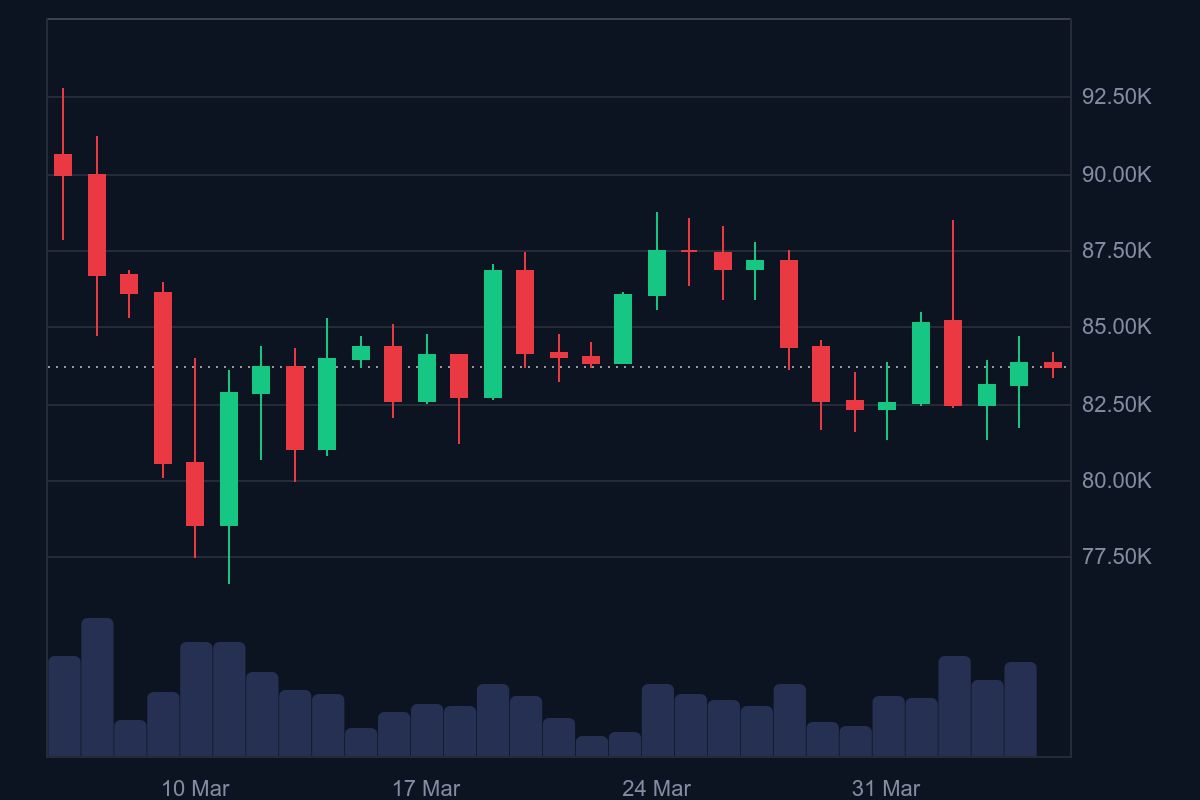
Bitcoin faces a near-term risk of dropping to $76,000–$78,000 by late April, with a possible summer low of $52,000–$56,000.
Trade wars and Fed policy will dictate short-term moves, while regulatory surprises could spark a recovery.
Investors must weigh Bitcoin’s safe haven allure against its correlation to traditional markets.
Bitcoin
(BTC), the world’s leading cryptocurrency, has been thrust into the spotlight
once again as global markets grapple with the ripple effects of President
Donald Trump’s latest trade tariffs, announced in early April 2025.
With
Bitcoin dropping below $82,000 this week amid a broader market sell-off,
investors are asking a pressing question: Will Bitcoin crash? A new BTC price
prediction from Tracy Jin, Chief Operating Officer (COO) of crypto exchange
MEXC, suggests a potential plunge to $52,000–$56,000 by summer 2025, driven by
escalating trade tensions, market volatility, and shifting perceptions of
Bitcoin as a safe haven asset.
This above is an advertisement by Utip
Bitcoin Price Is Down,
Trump’s Tariffs Shake the Market
The
tariffs, dubbed “Liberation Day” measures by the Trump administration, sparked
immediate volatility. Within 24 hours, the crypto market saw $293 million in
long positions and $220 million in short positions liquidated, reflecting panic
on both sides of the trade. This high volatility underscores a key financial
principle: uncertainty breeds market turbulence. As trade negotiations unfold,
retaliatory tariffs and Trump’s vocal commentary—often delivered via social
media—are expected to amplify these swings.
As of
today, Saturday, April 5, Bitcoin price is changing hands at $83,690, dropping slightly
by 0,19% and moving in the consolidation channel from the last few weeks:
But why do
tariffs matter to Bitcoin? Unlike traditional assets, Bitcoin operates outside
direct governmental control. However, its price is heavily influenced by
macroeconomic factors like the U.S. dollar’s strength, interest rates, and
investor sentiment—all of which are now under pressure from Trump’s policies.
Why Bitcoin Is Going Down?
A Weakening Dollar and Fed Dilemma
Despite the
initial market shock, Jin highlights a silver lining: “Cryptocurrency prices
are supported by the weakening of the US dollar and a slight recovery of the
S&P 500.” A weaker dollar often boosts Bitcoin’s appeal as an alternative
store of value, while a rebounding stock market can restore risk-on sentiment
among investors. However, the introduction of tariffs could slow the U.S.
economy, prompting the Federal Reserve to reconsider its monetary stance.
"The
slowdown in the US economy due to the introduction of new tariffs may push the
Federal Reserve to resume the cycle of interest rate cuts,” Jin explains. “This
circumstance, along with the fall in Treasury yields and the weakening dollar,
also has a restraining effect on cryptocurrency and indices."
Lower
interest rates typically benefit risk assets like Bitcoin by reducing the
opportunity cost of holding non-yielding investments. Yet, this potential
lifeline is overshadowed by uncertainty. Maksym Sakharov, Co-Founder and Board
Member of WeFi, a decentralized on-chain bank, adds another layer of
complexity:
Maksym Sakharov, Co-Founder and Board Member of WeFi
“The
current markets are experiencing headwinds as a result of the tariffs imposed
by the US administration and retaliatory measures from trading partners. So
far, however, market proponents say that Trump’s tariffs are primarily a
negotiation strategy, and their effect on businesses and consumers will remain
manageable. Adding to the uncertainty are the inflationary pressures that could
challenge the US Federal Reserve’s rate-cutting outlook.”
Sakharov
also points to a looming fiscal debate in Washington over the federal budget
and debt ceiling, which could exacerbate market jitters if unresolved. These
macroeconomic crosscurrents—trade wars, inflation fears, and Fed policy—form
the backbone of Bitcoin’s near-term trajectory.
Bitcoin’s Safe Haven
Status Under Scrutiny
Historically,
Bitcoin has been touted as “digital gold”—a hedge against economic uncertainty.
Yet, Jin warns that this narrative may be unraveling:
"In
its current state, the market is easily manipulated—this carries the threat of
new disappointments for retail and institutional investors, which will lead to
a further increase in the correlation between Bitcoin and gold. This will call
into question the status of Bitcoin as a safe haven asset, which may lead to an
even sharper outflow of funds from the ETF."
Will Bitcoin Crash?
Bitcoin Price Prediction Shows $52K on the Horizon
Jin’s
bearish outlook paints a grim picture for Bitcoin in the coming months:
"In
this context, a negative scenario appears more likely—Bitcoin may end April in
the $76,000–$78,000 range, with a potential drop to $52,000–$56,000 during the
summer."
This
prediction hinges on several factors:
Persistent Volatility: Ongoing trade negotiations
and Trump’s rhetoric are likely to keep markets on edge, amplifying price
swings.
Loss of Confidence: A shift away from Bitcoin as
a safe haven could trigger a mass exodus of capital, particularly from
ETFs.
In March
2020, Bitcoin crashed alongside stocks during the COVID-19 panic, dropping from
$10,000 to below $4,000 in days. While the current scenario differs, the
parallel lies in how external shocks can overwhelm Bitcoin’s resilience. Jin’s
$52,000 target aligns with key technical support levels, such as the 200-day
moving average, which could act as a floor if selling intensifies.
For
Ethereum (ETH), the outlook is even bleaker: “The blockchain faces deeper
structural issues that go beyond political influence, such as Trump’s policies,
and could see a significant decline in value in the near term.” Issues like
network congestion and competition from rival blockchains could compound ETH’s
vulnerability.
Will Bitcoin Rebound? A
Trump-Led Crypto Revival
Despite the
gloom, Jin offers a glimmer of hope:
"Nevertheless,
the Trump administration may still bring pleasant surprises for the crypto
market. Changes in the refinancing rate, taxation and/or regulation can become
a catalyst for an upward price movement. A return to January’s values of
$100,000–$102,000 for Bitcoin can stimulate a transfer of capital from gold to
Bitcoin and Bitcoin ETF, potentially pushing BTC further toward
$118,000–$120,000."
Trump has
previously signaled pro-crypto leanings, including his March 2025 executive
order establishing a Strategic Bitcoin Reserve. If the administration pivots to
supportive policies—such as tax incentives for crypto investments or
streamlined regulations—Bitcoin could rebound sharply. A real-world precedent:
After the 2017 Tax Cuts and Jobs Act, risk assets surged as investor confidence
soared. A similar catalyst could propel BTC back to six figures.
Personally,
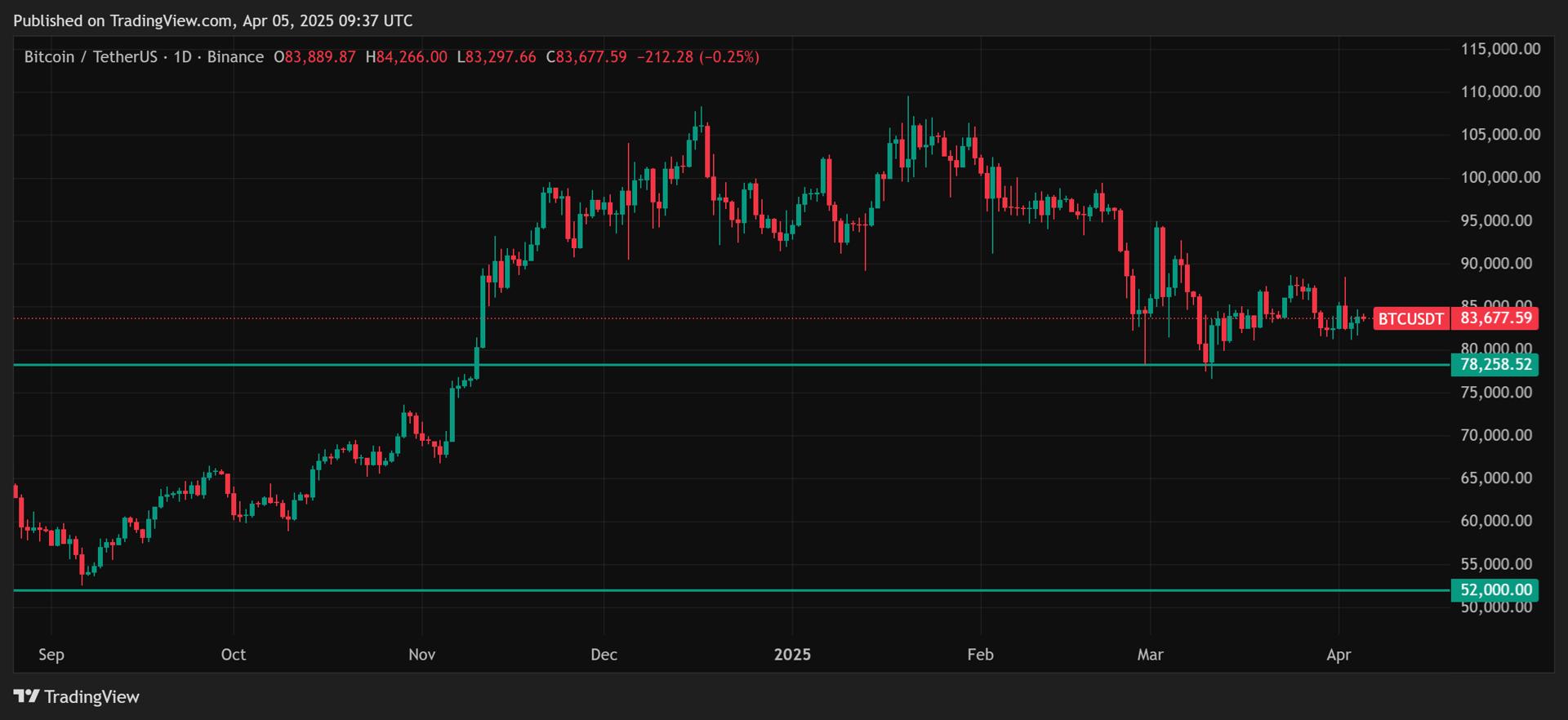
on the chart, I identify a support zone around $78,000, and my technical
scenario does not currently assume a drop to the $52,000 level. That would be
the lowest price for BTC since September 2024.
Like Jin,
some analysts also present long-term scenarios that could push BTC prices
higher. Omid Malekan, an adjunct professor at Columbia Business School, whose
forecasts I recently wrote about, claims that the price of BTC could ultimately
rise to as high as $150,000.
Is Now a Good Time to Buy
Bitcoin? What Should Investors Do
For
investors, the uncertainty demands a strategic approach:
Beginners: Consider dollar-cost
averaging (DCA) to mitigate volatility. Start small and scale up if
Bitcoin approaches Jin’s $52,000–$56,000 range—a potential buying
opportunity.
Seasoned Traders: Watch key support levels
($76,000, $52,000) and monitor Trump’s social media for market-moving
cues. High volatility favors short-term trades over long-term holds.
Hodlers: If you believe in Bitcoin’s
long-term value, weathering the storm may pay off, especially if Trump
delivers pro-crypto policies.
Will
Bitcoin crash? Tracy Jin’s prediction of a $52,000 BTC price target after
Trump’s tariffs reflects a perfect storm of trade tensions, economic slowdown,
and shifting investor sentiment. Yet, the potential for a Trump-led crypto
renaissance offers a counterbalance to the bearish narrative. As of April 5,
2025, the market hangs in the balance, with volatility as the only certainty.
FAQ: Bitcoin Price
Predictions and Investment Insights
Is it possible for Bitcoin
to crash?
Yes.
Bitcoin can crash due to factors like Trump’s tariffs, trade tensions, and high
market volatility, as seen with its drop below $82,000 on April 3, 2025.
Is Bitcoin predicted to
fall?
Yes, but
only in short-term. Expert Tracy Jin forecasts Bitcoin could fall to
$76,000–$78,000 by late April 2025, with a potential drop to $52,000–$56,000 by
summer due to economic pressures.
Is it worth investing in
Bitcoin right now?
Yes.
Volatility makes it risky, but a potential dip to $52,000 could be a buying
opportunity for long-term investors, while traders might capitalize on swings.
Can Bitcoin prices go
down?
Yes. Prices
can decline due to tariff-induced economic slowdown, loss of safe-haven status,
and outflows from Bitcoin ETFs, as outlined in Jin’s analysis.
For more cryptocurrency analyses and forecasts for Bitcoin and the biggest tokens, visit FinanceMagnates.com,
Bitcoin
(BTC), the world’s leading cryptocurrency, has been thrust into the spotlight
once again as global markets grapple with the ripple effects of President
Donald Trump’s latest trade tariffs, announced in early April 2025.
With
Bitcoin dropping below $82,000 this week amid a broader market sell-off,
investors are asking a pressing question: Will Bitcoin crash? A new BTC price
prediction from Tracy Jin, Chief Operating Officer (COO) of crypto exchange
MEXC, suggests a potential plunge to $52,000–$56,000 by summer 2025, driven by
escalating trade tensions, market volatility, and shifting perceptions of
Bitcoin as a safe haven asset.
This above is an advertisement by Utip
Bitcoin Price Is Down,
Trump’s Tariffs Shake the Market
The
tariffs, dubbed “Liberation Day” measures by the Trump administration, sparked
immediate volatility. Within 24 hours, the crypto market saw $293 million in
long positions and $220 million in short positions liquidated, reflecting panic
on both sides of the trade. This high volatility underscores a key financial
principle: uncertainty breeds market turbulence. As trade negotiations unfold,
retaliatory tariffs and Trump’s vocal commentary—often delivered via social
media—are expected to amplify these swings.
As of
today, Saturday, April 5, Bitcoin price is changing hands at $83,690, dropping slightly
by 0,19% and moving in the consolidation channel from the last few weeks:
But why do
tariffs matter to Bitcoin? Unlike traditional assets, Bitcoin operates outside
direct governmental control. However, its price is heavily influenced by
macroeconomic factors like the U.S. dollar’s strength, interest rates, and
investor sentiment—all of which are now under pressure from Trump’s policies.
Why Bitcoin Is Going Down?
A Weakening Dollar and Fed Dilemma
Despite the
initial market shock, Jin highlights a silver lining: “Cryptocurrency prices
are supported by the weakening of the US dollar and a slight recovery of the
S&P 500.” A weaker dollar often boosts Bitcoin’s appeal as an alternative
store of value, while a rebounding stock market can restore risk-on sentiment
among investors. However, the introduction of tariffs could slow the U.S.
economy, prompting the Federal Reserve to reconsider its monetary stance.
"The
slowdown in the US economy due to the introduction of new tariffs may push the
Federal Reserve to resume the cycle of interest rate cuts,” Jin explains. “This
circumstance, along with the fall in Treasury yields and the weakening dollar,
also has a restraining effect on cryptocurrency and indices."
Lower
interest rates typically benefit risk assets like Bitcoin by reducing the
opportunity cost of holding non-yielding investments. Yet, this potential
lifeline is overshadowed by uncertainty. Maksym Sakharov, Co-Founder and Board
Member of WeFi, a decentralized on-chain bank, adds another layer of
complexity:
Maksym Sakharov, Co-Founder and Board Member of WeFi
“The
current markets are experiencing headwinds as a result of the tariffs imposed
by the US administration and retaliatory measures from trading partners. So
far, however, market proponents say that Trump’s tariffs are primarily a
negotiation strategy, and their effect on businesses and consumers will remain
manageable. Adding to the uncertainty are the inflationary pressures that could
challenge the US Federal Reserve’s rate-cutting outlook.”
Sakharov
also points to a looming fiscal debate in Washington over the federal budget
and debt ceiling, which could exacerbate market jitters if unresolved. These
macroeconomic crosscurrents—trade wars, inflation fears, and Fed policy—form
the backbone of Bitcoin’s near-term trajectory.
Bitcoin’s Safe Haven
Status Under Scrutiny
Historically,
Bitcoin has been touted as “digital gold”—a hedge against economic uncertainty.
Yet, Jin warns that this narrative may be unraveling:
"In
its current state, the market is easily manipulated—this carries the threat of
new disappointments for retail and institutional investors, which will lead to
a further increase in the correlation between Bitcoin and gold. This will call
into question the status of Bitcoin as a safe haven asset, which may lead to an
even sharper outflow of funds from the ETF."
Will Bitcoin Crash?
Bitcoin Price Prediction Shows $52K on the Horizon
Jin’s
bearish outlook paints a grim picture for Bitcoin in the coming months:
"In
this context, a negative scenario appears more likely—Bitcoin may end April in
the $76,000–$78,000 range, with a potential drop to $52,000–$56,000 during the
summer."
This
prediction hinges on several factors:
Persistent Volatility: Ongoing trade negotiations
and Trump’s rhetoric are likely to keep markets on edge, amplifying price
swings.
Loss of Confidence: A shift away from Bitcoin as
a safe haven could trigger a mass exodus of capital, particularly from
ETFs.
In March
2020, Bitcoin crashed alongside stocks during the COVID-19 panic, dropping from
$10,000 to below $4,000 in days. While the current scenario differs, the
parallel lies in how external shocks can overwhelm Bitcoin’s resilience. Jin’s
$52,000 target aligns with key technical support levels, such as the 200-day
moving average, which could act as a floor if selling intensifies.
For
Ethereum (ETH), the outlook is even bleaker: “The blockchain faces deeper
structural issues that go beyond political influence, such as Trump’s policies,
and could see a significant decline in value in the near term.” Issues like
network congestion and competition from rival blockchains could compound ETH’s
vulnerability.
Will Bitcoin Rebound? A
Trump-Led Crypto Revival
Despite the
gloom, Jin offers a glimmer of hope:
"Nevertheless,
the Trump administration may still bring pleasant surprises for the crypto
market. Changes in the refinancing rate, taxation and/or regulation can become
a catalyst for an upward price movement. A return to January’s values of
$100,000–$102,000 for Bitcoin can stimulate a transfer of capital from gold to
Bitcoin and Bitcoin ETF, potentially pushing BTC further toward
$118,000–$120,000."
Trump has
previously signaled pro-crypto leanings, including his March 2025 executive
order establishing a Strategic Bitcoin Reserve. If the administration pivots to
supportive policies—such as tax incentives for crypto investments or
streamlined regulations—Bitcoin could rebound sharply. A real-world precedent:
After the 2017 Tax Cuts and Jobs Act, risk assets surged as investor confidence
soared. A similar catalyst could propel BTC back to six figures.
Personally,
on the chart, I identify a support zone around $78,000, and my technical
scenario does not currently assume a drop to the $52,000 level. That would be
the lowest price for BTC since September 2024.
Like Jin,
some analysts also present long-term scenarios that could push BTC prices
higher. Omid Malekan, an adjunct professor at Columbia Business School, whose
forecasts I recently wrote about, claims that the price of BTC could ultimately
rise to as high as $150,000.
Is Now a Good Time to Buy
Bitcoin? What Should Investors Do
For
investors, the uncertainty demands a strategic approach:
Beginners: Consider dollar-cost
averaging (DCA) to mitigate volatility. Start small and scale up if
Bitcoin approaches Jin’s $52,000–$56,000 range—a potential buying
opportunity.
Seasoned Traders: Watch key support levels
($76,000, $52,000) and monitor Trump’s social media for market-moving
cues. High volatility favors short-term trades over long-term holds.
Hodlers: If you believe in Bitcoin’s
long-term value, weathering the storm may pay off, especially if Trump
delivers pro-crypto policies.
Will
Bitcoin crash? Tracy Jin’s prediction of a $52,000 BTC price target after
Trump’s tariffs reflects a perfect storm of trade tensions, economic slowdown,
and shifting investor sentiment. Yet, the potential for a Trump-led crypto
renaissance offers a counterbalance to the bearish narrative. As of April 5,
2025, the market hangs in the balance, with volatility as the only certainty.
FAQ: Bitcoin Price
Predictions and Investment Insights
Is it possible for Bitcoin
to crash?
Yes.
Bitcoin can crash due to factors like Trump’s tariffs, trade tensions, and high
market volatility, as seen with its drop below $82,000 on April 3, 2025.
Is Bitcoin predicted to
fall?
Yes, but
only in short-term. Expert Tracy Jin forecasts Bitcoin could fall to
$76,000–$78,000 by late April 2025, with a potential drop to $52,000–$56,000 by
summer due to economic pressures.
Is it worth investing in
Bitcoin right now?
Yes.
Volatility makes it risky, but a potential dip to $52,000 could be a buying
opportunity for long-term investors, while traders might capitalize on swings.
Can Bitcoin prices go
down?
Yes. Prices
can decline due to tariff-induced economic slowdown, loss of safe-haven status,
and outflows from Bitcoin ETFs, as outlined in Jin’s analysis.
For more cryptocurrency analyses and forecasts for Bitcoin and the biggest tokens, visit FinanceMagnates.com,
Damian Chmiel is a Senior Analyst & Editor at Finance Magnates with more than 15 years of experience in the CFD and online trading industry. Active as both a trader and journalist since 2010, he focuses on broker coverage, fintech innovation, and regulatory developments across Europe, the Middle East, and Asia.
His work includes interviews with C-level leaders at major brokerages and fintech platforms, as well as co-authoring Finance Magnates’ quarterly industry benchmarking reports. Damian’s reporting is data-driven, market-aware, and grounded in direct industry engagement. His analysis and commentary have also been cited by external media outlets, including Investing.com, Binance, The Asset, Stockhead, and Dispatch.
Education:
MA in Finance and Accounting, Cracow University of Economics
In this video, we review @HolaPrimeMarketsOfficial, a multi-asset forex and CFDs broker offering different account types, trading platforms, and flexible trading conditions.
We cover the broker’s overall offering, including account options, trading environment, platforms like MT4 and MT5, and additional services such as managed accounts and fast withdrawals.
Watch the full video to see if Hola Prime Markets fits your trading needs.
📣 Stay up to date with the latest in finance and trading. Follow Finance Magnates for industry news, insights, and global event coverage.
Connect with us:
🔗 LinkedIn: /financemagnates
👍 Facebook: /financemagnates
📸 Instagram: https://www.instagram.com/financemagnates
🐦 X: https://x.com/financemagnates
🎥 TikTok: https://www.tiktok.com/tag/financemagnates
▶️ YouTube: /@financemagnates_official
#HolaPrime #ForexBroker #CFDTrading #FinanceMagnates #Trading #Forex #BrokerReview
In this video, we review @HolaPrimeMarketsOfficial, a multi-asset forex and CFDs broker offering different account types, trading platforms, and flexible trading conditions.
We cover the broker’s overall offering, including account options, trading environment, platforms like MT4 and MT5, and additional services such as managed accounts and fast withdrawals.
Watch the full video to see if Hola Prime Markets fits your trading needs.
📣 Stay up to date with the latest in finance and trading. Follow Finance Magnates for industry news, insights, and global event coverage.
Connect with us:
🔗 LinkedIn: /financemagnates
👍 Facebook: /financemagnates
📸 Instagram: https://www.instagram.com/financemagnates
🐦 X: https://x.com/financemagnates
🎥 TikTok: https://www.tiktok.com/tag/financemagnates
▶️ YouTube: /@financemagnates_official
#HolaPrime #ForexBroker #CFDTrading #FinanceMagnates #Trading #Forex #BrokerReview
In this video, we review @HolaPrimeMarketsOfficial, a multi-asset forex and CFDs broker offering different account types, trading platforms, and flexible trading conditions.
We cover the broker’s overall offering, including account options, trading environment, platforms like MT4 and MT5, and additional services such as managed accounts and fast withdrawals.
Watch the full video to see if Hola Prime Markets fits your trading needs.
📣 Stay up to date with the latest in finance and trading. Follow Finance Magnates for industry news, insights, and global event coverage.
Connect with us:
🔗 LinkedIn: /financemagnates
👍 Facebook: /financemagnates
📸 Instagram: https://www.instagram.com/financemagnates
🐦 X: https://x.com/financemagnates
🎥 TikTok: https://www.tiktok.com/tag/financemagnates
▶️ YouTube: /@financemagnates_official
#HolaPrime #ForexBroker #CFDTrading #FinanceMagnates #Trading #Forex #BrokerReview
In this video, we review @HolaPrimeMarketsOfficial, a multi-asset forex and CFDs broker offering different account types, trading platforms, and flexible trading conditions.
We cover the broker’s overall offering, including account options, trading environment, platforms like MT4 and MT5, and additional services such as managed accounts and fast withdrawals.
Watch the full video to see if Hola Prime Markets fits your trading needs.
📣 Stay up to date with the latest in finance and trading. Follow Finance Magnates for industry news, insights, and global event coverage.
Connect with us:
🔗 LinkedIn: /financemagnates
👍 Facebook: /financemagnates
📸 Instagram: https://www.instagram.com/financemagnates
🐦 X: https://x.com/financemagnates
🎥 TikTok: https://www.tiktok.com/tag/financemagnates
▶️ YouTube: /@financemagnates_official
#HolaPrime #ForexBroker #CFDTrading #FinanceMagnates #Trading #Forex #BrokerReview
Hola Prime Review: What You Need to Know | Full Breakdown by Finance Magnates
Hola Prime Review: What You Need to Know | Full Breakdown by Finance Magnates
Hola Prime Review: What You Need to Know | Full Breakdown by Finance Magnates
Hola Prime Review: What You Need to Know | Full Breakdown by Finance Magnates
Hola Prime Review: What You Need to Know | Full Breakdown by Finance Magnates
Hola Prime Review: What You Need to Know | Full Breakdown by Finance Magnates
In this video, we review @HolaPrime_Global, a proprietary trading firm offering evaluation programs and performance-based payouts in simulated market environments.
We cover how the challenge model works, including account types, profit splits (up to 95%), trading rules, and what it takes to reach a funded account. You’ll also learn about available platforms like MT4, MT5, cTrader, and more, along with insights into payouts, support, and trading conditions.
Watch the full video to see if Hola Prime fits your trading style.
📣 Stay up to date with the latest in finance and trading. Follow Finance Magnates for industry news, insights, and global event coverage.
Connect with us:
🔗 LinkedIn: /financemagnates
👍 Facebook: /financemagnates
📸 Instagram: https://www.instagram.com/financemagnates
🐦 X: https://x.com/financemagnates
🎥 TikTok: https://www.tiktok.com/tag/financemagnates
▶️ YouTube: /@financemagnates_official
#HolaPrime #PropFirm #Trading #FinanceMagnates #Forex #FuturesTrading #TradingReview #PropFirmReview
In this video, we review @HolaPrime_Global, a proprietary trading firm offering evaluation programs and performance-based payouts in simulated market environments.
We cover how the challenge model works, including account types, profit splits (up to 95%), trading rules, and what it takes to reach a funded account. You’ll also learn about available platforms like MT4, MT5, cTrader, and more, along with insights into payouts, support, and trading conditions.
Watch the full video to see if Hola Prime fits your trading style.
📣 Stay up to date with the latest in finance and trading. Follow Finance Magnates for industry news, insights, and global event coverage.
Connect with us:
🔗 LinkedIn: /financemagnates
👍 Facebook: /financemagnates
📸 Instagram: https://www.instagram.com/financemagnates
🐦 X: https://x.com/financemagnates
🎥 TikTok: https://www.tiktok.com/tag/financemagnates
▶️ YouTube: /@financemagnates_official
#HolaPrime #PropFirm #Trading #FinanceMagnates #Forex #FuturesTrading #TradingReview #PropFirmReview
In this video, we review @HolaPrime_Global, a proprietary trading firm offering evaluation programs and performance-based payouts in simulated market environments.
We cover how the challenge model works, including account types, profit splits (up to 95%), trading rules, and what it takes to reach a funded account. You’ll also learn about available platforms like MT4, MT5, cTrader, and more, along with insights into payouts, support, and trading conditions.
Watch the full video to see if Hola Prime fits your trading style.
📣 Stay up to date with the latest in finance and trading. Follow Finance Magnates for industry news, insights, and global event coverage.
Connect with us:
🔗 LinkedIn: /financemagnates
👍 Facebook: /financemagnates
📸 Instagram: https://www.instagram.com/financemagnates
🐦 X: https://x.com/financemagnates
🎥 TikTok: https://www.tiktok.com/tag/financemagnates
▶️ YouTube: /@financemagnates_official
#HolaPrime #PropFirm #Trading #FinanceMagnates #Forex #FuturesTrading #TradingReview #PropFirmReview
In this video, we review @HolaPrime_Global, a proprietary trading firm offering evaluation programs and performance-based payouts in simulated market environments.
We cover how the challenge model works, including account types, profit splits (up to 95%), trading rules, and what it takes to reach a funded account. You’ll also learn about available platforms like MT4, MT5, cTrader, and more, along with insights into payouts, support, and trading conditions.
Watch the full video to see if Hola Prime fits your trading style.
📣 Stay up to date with the latest in finance and trading. Follow Finance Magnates for industry news, insights, and global event coverage.
Connect with us:
🔗 LinkedIn: /financemagnates
👍 Facebook: /financemagnates
📸 Instagram: https://www.instagram.com/financemagnates
🐦 X: https://x.com/financemagnates
🎥 TikTok: https://www.tiktok.com/tag/financemagnates
▶️ YouTube: /@financemagnates_official
#HolaPrime #PropFirm #Trading #FinanceMagnates #Forex #FuturesTrading #TradingReview #PropFirmReview
In this video, we review @HolaPrime_Global, a proprietary trading firm offering evaluation programs and performance-based payouts in simulated market environments.
We cover how the challenge model works, including account types, profit splits (up to 95%), trading rules, and what it takes to reach a funded account. You’ll also learn about available platforms like MT4, MT5, cTrader, and more, along with insights into payouts, support, and trading conditions.
Watch the full video to see if Hola Prime fits your trading style.
📣 Stay up to date with the latest in finance and trading. Follow Finance Magnates for industry news, insights, and global event coverage.
Connect with us:
🔗 LinkedIn: /financemagnates
👍 Facebook: /financemagnates
📸 Instagram: https://www.instagram.com/financemagnates
🐦 X: https://x.com/financemagnates
🎥 TikTok: https://www.tiktok.com/tag/financemagnates
▶️ YouTube: /@financemagnates_official
#HolaPrime #PropFirm #Trading #FinanceMagnates #Forex #FuturesTrading #TradingReview #PropFirmReview
In this video, we review @HolaPrime_Global, a proprietary trading firm offering evaluation programs and performance-based payouts in simulated market environments.
We cover how the challenge model works, including account types, profit splits (up to 95%), trading rules, and what it takes to reach a funded account. You’ll also learn about available platforms like MT4, MT5, cTrader, and more, along with insights into payouts, support, and trading conditions.
Watch the full video to see if Hola Prime fits your trading style.
📣 Stay up to date with the latest in finance and trading. Follow Finance Magnates for industry news, insights, and global event coverage.
Connect with us:
🔗 LinkedIn: /financemagnates
👍 Facebook: /financemagnates
📸 Instagram: https://www.instagram.com/financemagnates
🐦 X: https://x.com/financemagnates
🎥 TikTok: https://www.tiktok.com/tag/financemagnates
▶️ YouTube: /@financemagnates_official
#HolaPrime #PropFirm #Trading #FinanceMagnates #Forex #FuturesTrading #TradingReview #PropFirmReview
Axi Winner Spotlight 🏆 | Global Most Innovative Broker 2025 #Innovation #Trading #Fintech #Broker
Axi Winner Spotlight 🏆 | Global Most Innovative Broker 2025 #Innovation #Trading #Fintech #Broker
Axi Winner Spotlight 🏆 | Global Most Innovative Broker 2025 #Innovation #Trading #Fintech #Broker
Axi Winner Spotlight 🏆 | Global Most Innovative Broker 2025 #Innovation #Trading #Fintech #Broker
Axi Winner Spotlight 🏆 | Global Most Innovative Broker 2025 #Innovation #Trading #Fintech #Broker
Axi Winner Spotlight 🏆 | Global Most Innovative Broker 2025 #Innovation #Trading #Fintech #Broker
Axi takes the spotlight at the Finance Magnates Awards, winning Global Most Innovative Broker 2025.
Olivia Xenofontos and Ivanna Openko share how the team will feel: proud, motivated, and ready to keep delivering.
They also describe the night as well-organized, focused, and enjoyable for all.
👉 Be part of FM Awards 2026.
Axi takes the spotlight at the Finance Magnates Awards, winning Global Most Innovative Broker 2025.
Olivia Xenofontos and Ivanna Openko share how the team will feel: proud, motivated, and ready to keep delivering.
They also describe the night as well-organized, focused, and enjoyable for all.
👉 Be part of FM Awards 2026.
Axi takes the spotlight at the Finance Magnates Awards, winning Global Most Innovative Broker 2025.
Olivia Xenofontos and Ivanna Openko share how the team will feel: proud, motivated, and ready to keep delivering.
They also describe the night as well-organized, focused, and enjoyable for all.
👉 Be part of FM Awards 2026.
Axi takes the spotlight at the Finance Magnates Awards, winning Global Most Innovative Broker 2025.
Olivia Xenofontos and Ivanna Openko share how the team will feel: proud, motivated, and ready to keep delivering.
They also describe the night as well-organized, focused, and enjoyable for all.
👉 Be part of FM Awards 2026.
Axi takes the spotlight at the Finance Magnates Awards, winning Global Most Innovative Broker 2025.
Olivia Xenofontos and Ivanna Openko share how the team will feel: proud, motivated, and ready to keep delivering.
They also describe the night as well-organized, focused, and enjoyable for all.
👉 Be part of FM Awards 2026.
Axi takes the spotlight at the Finance Magnates Awards, winning Global Most Innovative Broker 2025.
Olivia Xenofontos and Ivanna Openko share how the team will feel: proud, motivated, and ready to keep delivering.
They also describe the night as well-organized, focused, and enjoyable for all.
👉 Be part of FM Awards 2026.
Recognition that matters.
Built on transparency.
Driven by the industry.
The Finance Magnates Awards 2026.
Nominations are now open.
🔗 https://awards.financemagnates.com/?utm_source=SM&utm_medium=social&utm_campaign=recognition-matters
Recognition that matters.
Built on transparency.
Driven by the industry.
The Finance Magnates Awards 2026.
Nominations are now open.
🔗 https://awards.financemagnates.com/?utm_source=SM&utm_medium=social&utm_campaign=recognition-matters
Recognition that matters.
Built on transparency.
Driven by the industry.
The Finance Magnates Awards 2026.
Nominations are now open.
🔗 https://awards.financemagnates.com/?utm_source=SM&utm_medium=social&utm_campaign=recognition-matters
Recognition that matters.
Built on transparency.
Driven by the industry.
The Finance Magnates Awards 2026.
Nominations are now open.
🔗 https://awards.financemagnates.com/?utm_source=SM&utm_medium=social&utm_campaign=recognition-matters
Recognition that matters.
Built on transparency.
Driven by the industry.
The Finance Magnates Awards 2026.
Nominations are now open.
🔗 https://awards.financemagnates.com/?utm_source=SM&utm_medium=social&utm_campaign=recognition-matters
Recognition that matters.
Built on transparency.
Driven by the industry.
The Finance Magnates Awards 2026.
Nominations are now open.
🔗 https://awards.financemagnates.com/?utm_source=SM&utm_medium=social&utm_campaign=recognition-matters
Tickmill Winner Spotlight | Broker of the Year 2025 (LATAM) 🏆 | Finance Magnates Awards #Trading
Tickmill Winner Spotlight | Broker of the Year 2025 (LATAM) 🏆 | Finance Magnates Awards #Trading
Tickmill Winner Spotlight | Broker of the Year 2025 (LATAM) 🏆 | Finance Magnates Awards #Trading
Tickmill Winner Spotlight | Broker of the Year 2025 (LATAM) 🏆 | Finance Magnates Awards #Trading
Tickmill Winner Spotlight | Broker of the Year 2025 (LATAM) 🏆 | Finance Magnates Awards #Trading
Tickmill Winner Spotlight | Broker of the Year 2025 (LATAM) 🏆 | Finance Magnates Awards #Trading
What helped Tickmill stand out this year?
In this Winner Spotlight, Johnny Khalil, Executive Director at Tickmill Europe, shares how listening closely to clients and delivering strong trading conditions made the difference.
A big thank you to the community whose support continues to drive progress every day.
👉 Think your brand has what it takes? Nominate for the 2026 Finance Magnates Awards: https://awards.financemagnates.com/#nominate
What helped Tickmill stand out this year?
In this Winner Spotlight, Johnny Khalil, Executive Director at Tickmill Europe, shares how listening closely to clients and delivering strong trading conditions made the difference.
A big thank you to the community whose support continues to drive progress every day.
👉 Think your brand has what it takes? Nominate for the 2026 Finance Magnates Awards: https://awards.financemagnates.com/#nominate
What helped Tickmill stand out this year?
In this Winner Spotlight, Johnny Khalil, Executive Director at Tickmill Europe, shares how listening closely to clients and delivering strong trading conditions made the difference.
A big thank you to the community whose support continues to drive progress every day.
👉 Think your brand has what it takes? Nominate for the 2026 Finance Magnates Awards: https://awards.financemagnates.com/#nominate
What helped Tickmill stand out this year?
In this Winner Spotlight, Johnny Khalil, Executive Director at Tickmill Europe, shares how listening closely to clients and delivering strong trading conditions made the difference.
A big thank you to the community whose support continues to drive progress every day.
👉 Think your brand has what it takes? Nominate for the 2026 Finance Magnates Awards: https://awards.financemagnates.com/#nominate
What helped Tickmill stand out this year?
In this Winner Spotlight, Johnny Khalil, Executive Director at Tickmill Europe, shares how listening closely to clients and delivering strong trading conditions made the difference.
A big thank you to the community whose support continues to drive progress every day.
👉 Think your brand has what it takes? Nominate for the 2026 Finance Magnates Awards: https://awards.financemagnates.com/#nominate
What helped Tickmill stand out this year?
In this Winner Spotlight, Johnny Khalil, Executive Director at Tickmill Europe, shares how listening closely to clients and delivering strong trading conditions made the difference.
A big thank you to the community whose support continues to drive progress every day.
👉 Think your brand has what it takes? Nominate for the 2026 Finance Magnates Awards: https://awards.financemagnates.com/#nominate