

Silver rose to $90.73 per ounce Wednesday, up 4.16% on the day, its highest print since February 4. The intraday high tagged just below $91, a level the market has not seen in three weeks. At the time of writing, the metal is holding near $90.70, consolidating just above the breakout zone.
Silver price surge may be the most technically significant of the year so far. In this article, I examine why silver is surging today, analyze the chart in detail based on my over a decade of experience as an analyst and trader, and present the newest silver price predictions from major institutions and market analysts.
Follow me on X for more silver market analysis: @ChmielDk
Silver Price Today: Breaking Out of February's Range
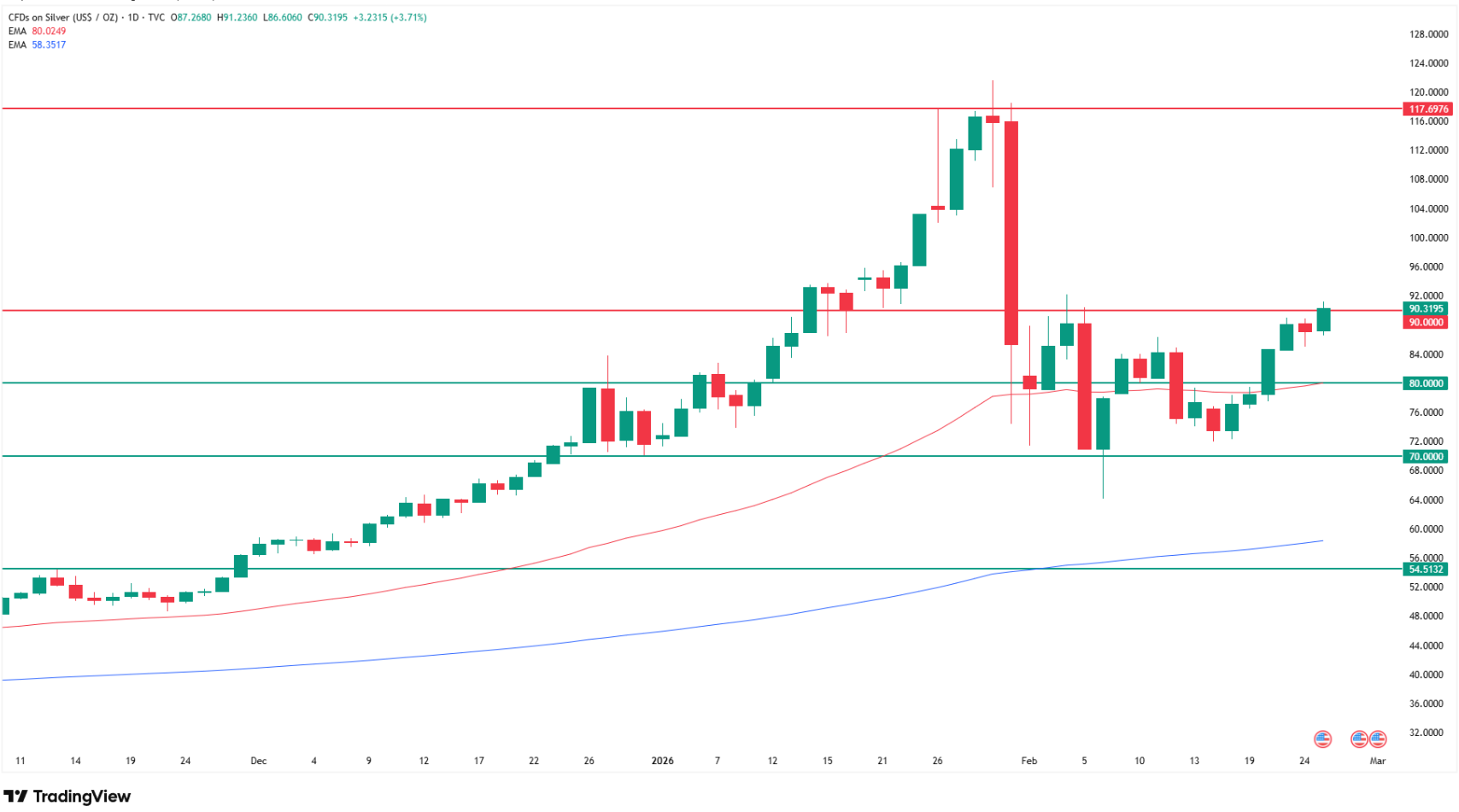
To understand the significance of this move, context matters. Silver plunged from its all-time high of $121.67 on January 29 to lows near $70 in early February - one of the most violent precious metals selloffs in recent history, a crash I covered in detail at the time in Why Silver Price Crashed 33%: Fed Chair, Reuters Panic and Algo Selloff. The entire month of February has since been a slow, grinding recovery - until today. Year-over-year, silver remains up approximately 184%.
According to my technical analysis, today's session is delivering the most important signal of the month. As shown on my chart, silver has spent all of February oscillating inside a well-defined consolidation channel with clear boundaries:
- Upper resistance (now broken): $90 - the ceiling of February's range, aligned with structural price memory
- Channel midpoint / key support: $80 - aligning precisely with the December 29 highs and the 50 EMA, which has been moving horizontally throughout the month
- Channel floor: $70 - the early February lows, the deepest point of the post-ATH correction
Today's candle is testing a breakout above that upper boundary. A daily or weekly close above $90 is the confirmation signal I am watching. If silver achieves that close, the technical path reopens toward:
- $100 - the psychological level and first major target
- $118 - the January 26 session highs, which represent the ultimate resistance before the ATH zone. Note: while silver traded above $118 on January 29, the session closed below that level - meaning $118 continues to act as significant resistance, not just a waypoint
- $121.67 - the all-time high
The bearish scenario requires watching carefully too. A failure to hold $90 and a return into the consolidation channel would not be catastrophic on its own - but a breakdown below the $70 floor would open a much more serious move toward $55-$59 per ounce, where the November 13 structural peaks and the 200 EMA currently sit. That is the level that would truly challenge the bull market thesis.
Why Is Silver Going Up: Tariff War Resumes With Full Force
The catalyst for Wednesday's move is the same force that has been driving precious metals all month - but with fresh intensity. After the Supreme Court struck down Trump's IEEPA tariff framework last Thursday, markets briefly exhaled. That relief lasted less than 24 hours.
Trump responded by imposing 15% global tariffs under Section 122, then threatened additional duties against any country that "plays games" with current trade arrangements. The shifting policy stance has made it impossible for institutional traders to price certainty into any risk-asset position - and when uncertainty spikes, silver and gold are the instinctive beneficiaries.
"Silver has witnessed dramatic moves in recent days, reflecting the sensitivity of this dual-natured metal - both investment and industrial - to political and monetary shocks at the same time," said Rania Gule, Senior Market Analyst at XS.com.
- Why Is Silver Falling with Gold? Silver Price Crashes 3rd Hardest in 6 Years
- Why Gold Is Falling with Silver and Why Ron Paul Predicts a $20K Price
- Why Silver Price Crashed 33% Today? Fed Chair, Reuters Panic And Algo Selloff
As she noted about the recent pattern: "What happened does not represent a trend reversal as much as it reflects a rapid repricing of a sudden political shock, followed by the natural behavior of markets that tend to test extremes before stabilizing new positions."
The second macro driver is US-Iran tensions. Diplomatic talks are scheduled to resume Thursday, with Trump reiterating his preference for a negotiated resolution while warning of "serious consequences" if no nuclear deal is secured. That combination - open negotiation with a military ultimatum attached - is the precise kind of headline that keeps safe-haven demand elevated without fully releasing it.
"The sharp rally was not surprising," Gule added. "Trade escalation typically revives investor appetite for hedging assets, particularly in a global environment marked by slowing growth and rising geopolitical polarization."
Beyond the immediate catalysts, the structural picture remains firmly in silver's corner:
- Five consecutive annual supply deficits, with the Silver Institute projecting no resolution in 2026
- China's new silver export licensing system, implemented January 1, 2026, restricting physical flows from the world's largest silver-producing nation
- COMEX registered silver inventories below 100 million ounces for the first time since records began - a level crossed last week
- Industrial demand from solar manufacturing, AI infrastructure buildout, EV production, and defense electronics showing no signs of slowing
Silver's Contradictions: The Industrial Hedge Dilemma
Silver's dual nature - simultaneously a safe-haven asset and an industrial input - creates a tension that distinguishes it from gold. Gule of XS.com put it plainly: "Silver differs from gold in that it is more sensitive to the economic cycle, given its close link to industrial demand. A trade shock that heightens concerns about supply chains may support prices through safe-haven flows in the short term, while simultaneously raising questions about global industrial activity in the medium term."
This contradiction partly explains the swift profit-taking that followed Monday's initial 6% surge to $89, before the market found footing and built higher again. It also explains why silver's intraday volatility continues to dwarf gold's - and why the technical structure I outlined above matters so much. Silver needs to close sessions above key levels, not just tag them intraday.
As JPMorgan noted in its February 2026 outlook, silver's 130%+ rise through 2025 was "fueled by industrial demand and uncertainty over tariff regulations" - precisely the same combination driving today's move.
Silver Price Prediction 2026: Where Do Analysts See the Price Going?
The range of credible forecasts for silver in 2026 is extraordinarily wide - reflecting both genuine analytical disagreement and the unprecedented nature of recent price action.
Analyst / Institution | Silver Target | Timeframe | Notes |
David Hunter | $180 | Q2 2026 | Gold target $6,800 alongside |
Rashad Hajiyev | $250-$400 | 2026 cycle | Requires Gold/Silver Ratio ~20-30 |
JPMorgan | $60-$90 avg | 2026 | Structural deficit, industrial demand |
Bank of America | $56-$65 | 2026 | Already exceeded |
HSBC | $68 avg | 2026 | Despite volatility forecast |
CoinCodex model | $400.57 | Dec 2026 | Algorithmic projection |
"I'm very bullish the metals. My silver target is $180 and gold $6,800 - and I think we could see those targets reached in the second quarter," said macro strategist David Hunter. Rashad Hajiyev goes further, arguing that if the Gold/Silver Ratio continues its compression toward the 2011 low of 30, "$250 silver becomes a mathematical expectation with gold at $7,500." The ratio currently sits near 57-59 - its lowest level since 2011.
For broader institutional context on where gold fits into this picture, see my analysis: Gold Price Prediction 2026: How High Can Gold Really Go?
Silver's Road Back to $100: Key Milestones to Watch
The recovery from February's brutal lows has been steady but not smooth. After the January 29-30 crash - which I documented in Why Gold Is Falling With Silver Today: The Strongest XAU and XAG Selloff in 13 Years - silver found support near $70 and began rebuilding. T
he February 13 session produced another sharp 10% decline, covered in Why Is Silver Falling With Gold? Silver Price Crashes 3rd Hardest in 6 Years, before the metal stabilized and began its current recovery. Monday's session - detailed in Why Silver Is Surging With Gold Price and Why Analyst Predicts $400 in 2026 - was the first sign this breakout attempt was building momentum.
Today's close is the one that matters most. As shown on my chart, the $90 level is not just resistance - it is the gate. Everything technically interesting happens above it.
FAQ
Why is silver going up today?
Silver is surging Wednesday due to renewed safe-haven demand driven by Trump's 15% global tariff escalation and ongoing US-Iran nuclear tensions, with talks resuming Thursday. The move also reflects a technical breakout above the $90 resistance that has capped February's entire consolidation range, attracting momentum buyers.
How high can silver go in 2026?
Based on my technical analysis, a sustained close above $90 targets $100, then $118 resistance, and ultimately the $121.67 all-time high. Institutional forecasts range from HSBC's $68 average - already well exceeded - to David Hunter's $180 and Rashad Hajiyev's $250-$400 in a high-conviction bull scenario where the Gold/Silver Ratio compresses to 20-30.
What is the silver price prediction for 2026?
JPMorgan sees silver averaging $60-$90, underpinned by structural supply deficits and industrial demand. Bank of America's $65 target has already been surpassed. More aggressive analysts target $150-$400, with the structural case built on five consecutive deficit years, China export controls, and COMEX inventory depletion.
What could stop silver's rally?
A failure to hold $90 on a daily close and a return into the $70-$90 consolidation channel would be the first warning sign. A breakdown below $70 - the February lows - would open a move toward $55-$59, where the November structural peaks and the 200 EMA converge. Macro resolution of the tariff situation or a US-Iran deal could temporarily reduce safe-haven demand and trigger profit-taking.


