Silver price crashed 10% Thursday in its third-worst decline since 2020, losing $9 per ounce in a single session.
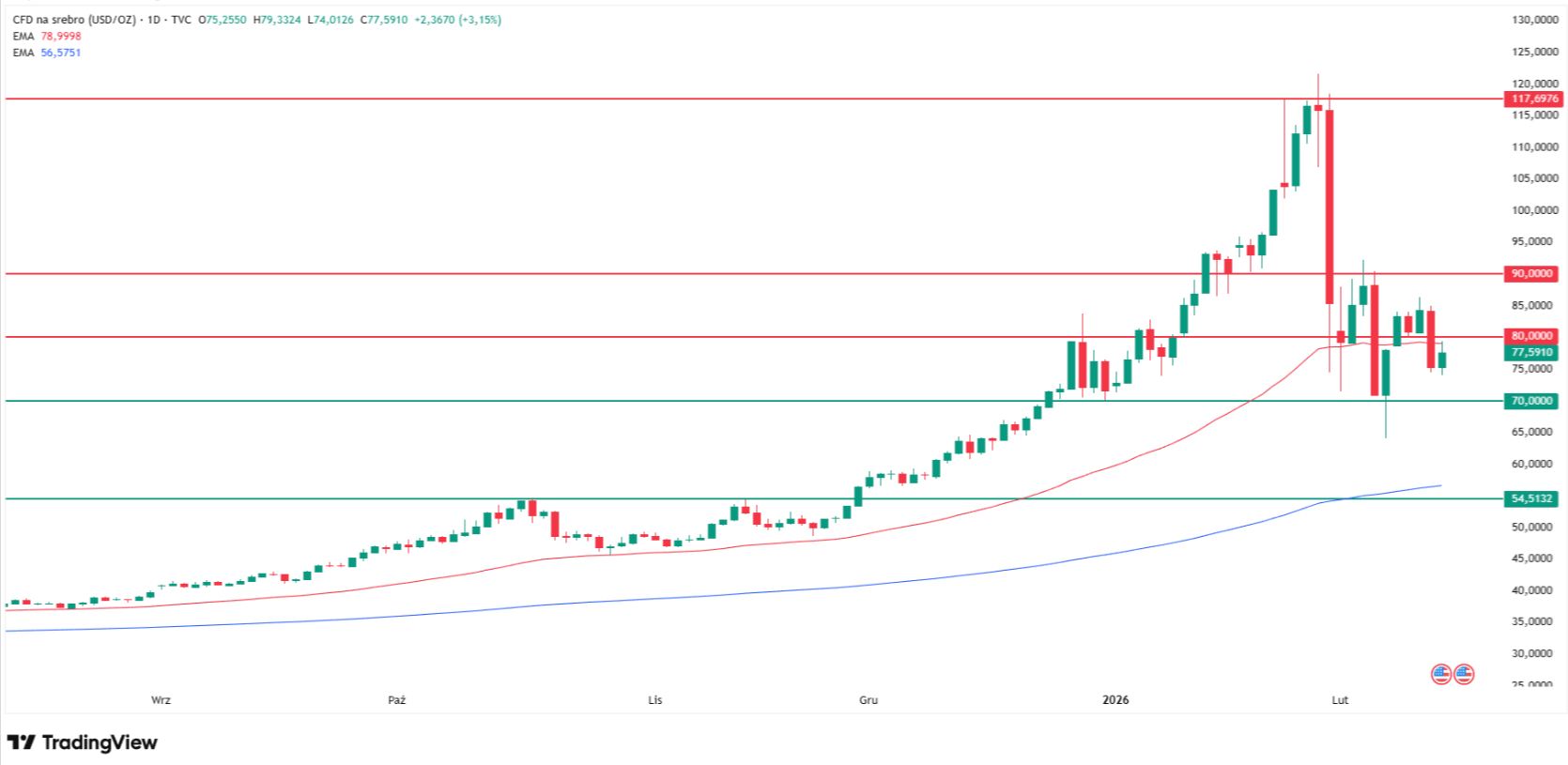
Price trades at $78 Friday, testing $80 resistance (50 EMA) while $70 support and $55 major support remain intact.
HSBC forecasts $68 average for 2026 despite volatility, while gold-silver ratio hits 15-year low at 61-65:1.
Why silver price is going down today and what are the newest silver price forecasts?
Silver
crashed more than 10% during Thursday's trading session, marking one of the
three most violent selloffs since the COVID-19 pandemic began nearly six years
ago. The white metal lost approximately $9 in value during that single session,
though prices remain within technically safe zones as of Friday, February 13,
2026.
According
to my technical analysis, the $80 level is once again acting as resistance, these
were the highs from late 2025, and the 50-day exponential moving average (50
EMA) currently runs almost horizontally through this zone, reinforcing this
resistance level. This level was already tested from above during Friday's
session, when silver changed hands at $77 per ounce, which may be a short-term
signal of continued correction momentum.
In this
article, I am examining why silver is falling after its historic crash,
analyzing the silver price chart based on over a decade of experience as an
analyst and trader, and presenting the newest silver price predictions from
major financial institutions for 2026-2027.
Follow
me on X for more silver market analysis:@ChmielDk
Silver Price Today. Recovery
Attempt After 10% Single-Day Plunge
Silver rose
to approximately $78.91 per troy ounce on Friday, up 5.52% from Thursday's
$74.78 close, recovering some of the brutal losses. However, the metal remains
down 16.69% over the past month, with prices oscillating between $73 and $90
throughout early February.
"The
silver market is currently experiencing one of its most sensitive and complex
phases since the beginning of the latest monetary tightening cycle," Rania
Gule, Senior Market Analyst at XS.com, noted.
As she
added about the current rebound, "this contradictory movement reflects a
clear struggle between short-term technical factors supporting a rebound and
deeper fundamental pressures weighing on the broader trend."
The
Thursday crash represented silver's third-hardest single-day decline in six
years, following the brutal 33% flash
crash on January 30 when
prices plummeted from $121 to $76. That earlier selloff was triggered by
Reuters reporting about ending US strategic metals support, which sparked
algorithmic panic selling and forced mass liquidations across precious metals
markets.
Silver Technical Analysis:
Key Support and Resistance Levels
As shown on
my chart, we now have another crucial support zone forming around the $70
level, defined by local lows from late December, the February 2 minimum, and
where the selling pressure halted on February 5. Even if this level breaks, the
next significant support zone appears around $55, where the 200-day moving
average runs alongside historical highs from October 2025.
Why silver price is falling today? Source: Tradingview.com
Critical
Price Levels to Watch:
Immediate resistance: $80 (50 EMA, late 2025
highs)
First support: $70 (late December/early
February lows)
Path to ATH: $100 psychological level,
then $120 (January 29 high)
"The
pullback in gold and silver reflects a wider cross-asset correction rather than
a metals-specific move," Laurence Booth, Global Head of Markets at CMC
Markets, said. As he added about the broader picture, "while there has
been consolidation from recent highs, the complex remains firmly higher
year-to-date."
For silver
to seriously consider a move toward all-time highs again, we would first need
to see a breakout of local resistance and a return above the $90 level, where
another significant resistance zone emerges. Not counting the psychological
$100 level—which also attracts profit-taking orders, the path toward $120, last
tested on January 29, should reopen once these hurdles clear.
Why Is Silver Price
Falling? Key Market Drivers
Several
interconnected factors explain the current silver weakness:
Fed policy uncertainty: The Federal Reserve
maintained its 3.5-3.75% target range in January, pausing the easing cycle
and signaling cautious assessment of incoming data
Profit-taking after extreme
rally: Silver
surged 65% in
January 2026 alone following a 150% gain in 2025, creating massive profit-taking
pressure
According
to my analysis, even if a more significant correction occurs, the 50 EMA
combined with the psychological $4,700 per ounce level for gold provides
substantial support for the precious metals complex. I've also identified a
zone around the late October and early November lows as another critical
support area for related metals positioning.
"Across
precious metals, we anticipate a more sideways bias to develop, with easing
volatility potentially encouraging renewed participation in gold," Booth
added about near-term expectations.
Silver Price Predictions
2026-2027: What Banks Forecast
Despite the
recent volatility, major financial institutions maintain constructive
medium-term views on silver, though with significantly more cautious near-term
outlooks than their January forecasts.
Institutional Silver Forecasts:
Institution
2026 Forecast
Timeframe
Key Assumption
HSBC
$68.25 avg, $58-88 range
Full year 2026
Physical tightness persists
Citigroup
$150-170
3-6 months
Ratio compression to 32:1
HSBC (bearish)
$62 by year-end
End-2026
Supply improves H2
HSBC
$57 avg, $55 year-end
2027
Deficit narrows significantly
HSBC's
Colin Steel raised the bank's 2026 average silver forecast from $44.50 to
$68.25 per ounce, citing "persistent physical tightness, strong investor
demand and a supportive macro backdrop". However, Steel views current
prices as "fundamentally overvalued" and expects volatility to
persist with "likely upside spikes" as long as near-term tightness
endures.
Earlier,
my January 20
piece on silver's rally highlighted Robert Kiyosaki's $200 forecast and Robert Maloney's
$375 target, though these extreme predictions now appear less probable
following the correction.
The synchronized
gold and silver selloff on January 30 marked the worst single-day decline since
2013, with gold crashing 8% and silver plunging 17%. Yet both metals remain
significantly higher year-to-date, suggesting the fundamental bull case remains
intact despite the volatility.
What's Next for Silver?
Near-Term Outlook
According
to my technical analysis, silver's immediate trajectory depends on whether the
$80 resistance level can be reclaimed and held. Friday's pin bar candlestick
formation suggests supply rejected the bulls' move toward all-time highs,
though the new week brings another attempt to enter price discovery mode
[user-provided analysis].
US economic data: Employment reports,
inflation figures, and Fed speaker commentary
Dollar dynamics: A weaker dollar
historically supports precious metals pricing
Geopolitical developments: Middle East tensions and
trade policy shifts
Chinese demand: Central bank buying and
industrial consumption trends
Retail participation: Physical demand at
current price levels
Even with
moderate corrections, HSBC's Colin Steel noted that "moderate deficits, a
soft dollar and ongoing geopolitical and policy uncertainty should continue to
support silver prices on downswings". This suggests the $55-70 zone
represents high-probability accumulation territory for longer-term positioning.
As shown on
my chart, silver maintains important technical support structures despite the
violent selloff. The 50 EMA near $80 and the 200 EMA around $55 provide clear
boundaries for the correction range. If silver were to correct 25-30% from
recent highs, similar to typical precious metals bull market corrections, the
$55-60 zone aligns perfectly with these technical levels and would likely
attract substantial institutional buying interest.
FAQ: Silver Price
Questions Answered
Why is silver price
falling today?
Silver is
consolidating after a 10% crash on Thursday and remains below the $80
resistance level (50 EMA). Profit-taking following a 65% January rally, Fed
policy uncertainty, and cross-asset correlation with tech stocks are driving
the weakness.
Will silver continue
declining?
According
to my technical analysis, silver has strong support at $70 (late December lows)
and major support at $55 (200 EMA, October highs). HSBC expects a $58-88
trading range for 2026, suggesting current levels may find buyers.
What is silver price
prediction for 2026-2027?
HSBC
forecasts $68.25 average for 2026, Citigroup maintains a $150 target within 3-6
months, while more conservative estimates place year-end 2026 at $62 and 2027
average at $57. The wide range reflects extreme uncertainty.
Should I sell silver now?
This
depends on your time horizon and risk tolerance. Silver remains up 11%
year-to-date despite the correction. Structural supply deficits and industrial
demand provide long-term support, but near-term volatility remains extreme.
This article does not constitute investment advice.
Is this a buying
opportunity for silver?
The $70-80
zone may offer tactical entry points for traders, while the $55-60 area (200
EMA) represents higher-probability accumulation for longer-term investors.
However, extreme volatility and potential for further declines require careful
position sizing and risk management.
Silver
crashed more than 10% during Thursday's trading session, marking one of the
three most violent selloffs since the COVID-19 pandemic began nearly six years
ago. The white metal lost approximately $9 in value during that single session,
though prices remain within technically safe zones as of Friday, February 13,
2026.
According
to my technical analysis, the $80 level is once again acting as resistance, these
were the highs from late 2025, and the 50-day exponential moving average (50
EMA) currently runs almost horizontally through this zone, reinforcing this
resistance level. This level was already tested from above during Friday's
session, when silver changed hands at $77 per ounce, which may be a short-term
signal of continued correction momentum.
In this
article, I am examining why silver is falling after its historic crash,
analyzing the silver price chart based on over a decade of experience as an
analyst and trader, and presenting the newest silver price predictions from
major financial institutions for 2026-2027.
Follow
me on X for more silver market analysis:@ChmielDk
Silver Price Today. Recovery
Attempt After 10% Single-Day Plunge
Silver rose
to approximately $78.91 per troy ounce on Friday, up 5.52% from Thursday's
$74.78 close, recovering some of the brutal losses. However, the metal remains
down 16.69% over the past month, with prices oscillating between $73 and $90
throughout early February.
"The
silver market is currently experiencing one of its most sensitive and complex
phases since the beginning of the latest monetary tightening cycle," Rania
Gule, Senior Market Analyst at XS.com, noted.
As she
added about the current rebound, "this contradictory movement reflects a
clear struggle between short-term technical factors supporting a rebound and
deeper fundamental pressures weighing on the broader trend."
The
Thursday crash represented silver's third-hardest single-day decline in six
years, following the brutal 33% flash
crash on January 30 when
prices plummeted from $121 to $76. That earlier selloff was triggered by
Reuters reporting about ending US strategic metals support, which sparked
algorithmic panic selling and forced mass liquidations across precious metals
markets.
Silver Technical Analysis:
Key Support and Resistance Levels
As shown on
my chart, we now have another crucial support zone forming around the $70
level, defined by local lows from late December, the February 2 minimum, and
where the selling pressure halted on February 5. Even if this level breaks, the
next significant support zone appears around $55, where the 200-day moving
average runs alongside historical highs from October 2025.
Why silver price is falling today? Source: Tradingview.com
Critical
Price Levels to Watch:
Immediate resistance: $80 (50 EMA, late 2025
highs)
First support: $70 (late December/early
February lows)
Path to ATH: $100 psychological level,
then $120 (January 29 high)
"The
pullback in gold and silver reflects a wider cross-asset correction rather than
a metals-specific move," Laurence Booth, Global Head of Markets at CMC
Markets, said. As he added about the broader picture, "while there has
been consolidation from recent highs, the complex remains firmly higher
year-to-date."
For silver
to seriously consider a move toward all-time highs again, we would first need
to see a breakout of local resistance and a return above the $90 level, where
another significant resistance zone emerges. Not counting the psychological
$100 level—which also attracts profit-taking orders, the path toward $120, last
tested on January 29, should reopen once these hurdles clear.
Why Is Silver Price
Falling? Key Market Drivers
Several
interconnected factors explain the current silver weakness:
Fed policy uncertainty: The Federal Reserve
maintained its 3.5-3.75% target range in January, pausing the easing cycle
and signaling cautious assessment of incoming data
Profit-taking after extreme
rally: Silver
surged 65% in
January 2026 alone following a 150% gain in 2025, creating massive profit-taking
pressure
According
to my analysis, even if a more significant correction occurs, the 50 EMA
combined with the psychological $4,700 per ounce level for gold provides
substantial support for the precious metals complex. I've also identified a
zone around the late October and early November lows as another critical
support area for related metals positioning.
"Across
precious metals, we anticipate a more sideways bias to develop, with easing
volatility potentially encouraging renewed participation in gold," Booth
added about near-term expectations.
Silver Price Predictions
2026-2027: What Banks Forecast
Despite the
recent volatility, major financial institutions maintain constructive
medium-term views on silver, though with significantly more cautious near-term
outlooks than their January forecasts.
Institutional Silver Forecasts:
Institution
2026 Forecast
Timeframe
Key Assumption
HSBC
$68.25 avg, $58-88 range
Full year 2026
Physical tightness persists
Citigroup
$150-170
3-6 months
Ratio compression to 32:1
HSBC (bearish)
$62 by year-end
End-2026
Supply improves H2
HSBC
$57 avg, $55 year-end
2027
Deficit narrows significantly
HSBC's
Colin Steel raised the bank's 2026 average silver forecast from $44.50 to
$68.25 per ounce, citing "persistent physical tightness, strong investor
demand and a supportive macro backdrop". However, Steel views current
prices as "fundamentally overvalued" and expects volatility to
persist with "likely upside spikes" as long as near-term tightness
endures.
Earlier,
my January 20
piece on silver's rally highlighted Robert Kiyosaki's $200 forecast and Robert Maloney's
$375 target, though these extreme predictions now appear less probable
following the correction.
The synchronized
gold and silver selloff on January 30 marked the worst single-day decline since
2013, with gold crashing 8% and silver plunging 17%. Yet both metals remain
significantly higher year-to-date, suggesting the fundamental bull case remains
intact despite the volatility.
What's Next for Silver?
Near-Term Outlook
According
to my technical analysis, silver's immediate trajectory depends on whether the
$80 resistance level can be reclaimed and held. Friday's pin bar candlestick
formation suggests supply rejected the bulls' move toward all-time highs,
though the new week brings another attempt to enter price discovery mode
[user-provided analysis].
US economic data: Employment reports,
inflation figures, and Fed speaker commentary
Dollar dynamics: A weaker dollar
historically supports precious metals pricing
Geopolitical developments: Middle East tensions and
trade policy shifts
Chinese demand: Central bank buying and
industrial consumption trends
Retail participation: Physical demand at
current price levels
Even with
moderate corrections, HSBC's Colin Steel noted that "moderate deficits, a
soft dollar and ongoing geopolitical and policy uncertainty should continue to
support silver prices on downswings". This suggests the $55-70 zone
represents high-probability accumulation territory for longer-term positioning.
As shown on
my chart, silver maintains important technical support structures despite the
violent selloff. The 50 EMA near $80 and the 200 EMA around $55 provide clear
boundaries for the correction range. If silver were to correct 25-30% from
recent highs, similar to typical precious metals bull market corrections, the
$55-60 zone aligns perfectly with these technical levels and would likely
attract substantial institutional buying interest.
FAQ: Silver Price
Questions Answered
Why is silver price
falling today?
Silver is
consolidating after a 10% crash on Thursday and remains below the $80
resistance level (50 EMA). Profit-taking following a 65% January rally, Fed
policy uncertainty, and cross-asset correlation with tech stocks are driving
the weakness.
Will silver continue
declining?
According
to my technical analysis, silver has strong support at $70 (late December lows)
and major support at $55 (200 EMA, October highs). HSBC expects a $58-88
trading range for 2026, suggesting current levels may find buyers.
What is silver price
prediction for 2026-2027?
HSBC
forecasts $68.25 average for 2026, Citigroup maintains a $150 target within 3-6
months, while more conservative estimates place year-end 2026 at $62 and 2027
average at $57. The wide range reflects extreme uncertainty.
Should I sell silver now?
This
depends on your time horizon and risk tolerance. Silver remains up 11%
year-to-date despite the correction. Structural supply deficits and industrial
demand provide long-term support, but near-term volatility remains extreme.
This article does not constitute investment advice.
Is this a buying
opportunity for silver?
The $70-80
zone may offer tactical entry points for traders, while the $55-60 area (200
EMA) represents higher-probability accumulation for longer-term investors.
However, extreme volatility and potential for further declines require careful
position sizing and risk management.
Damian Chmiel is a Senior Analyst & Editor at Finance Magnates with more than 15 years of experience in the CFD and online trading industry. Active as both a trader and journalist since 2010, he focuses on broker coverage, fintech innovation, and regulatory developments across Europe, the Middle East, and Asia.
His work includes interviews with C-level leaders at major brokerages and fintech platforms, as well as co-authoring Finance Magnates’ quarterly industry benchmarking reports. Damian’s reporting is data-driven, market-aware, and grounded in direct industry engagement. His analysis and commentary have also been cited by external media outlets, including Investing.com, Binance, The Asset, Stockhead, and Dispatch.
Education:
MA in Finance and Accounting, Cracow University of Economics
Why Is Crypto Going Down Today? Bitcoin Slips Toward $82,600, XRP Falls 7%
Featured Videos
How Much Are CFD Industry Executives Making; Plus500 Buys Brazilian Broker
How Much Are CFD Industry Executives Making; Plus500 Buys Brazilian Broker
How Much Are CFD Industry Executives Making; Plus500 Buys Brazilian Broker
How Much Are CFD Industry Executives Making; Plus500 Buys Brazilian Broker
Today’s financial news recap covers FinTop Consulting shared its 2026 salary surveys for Dubai, London and Cyprus with Finance Magnates, Plus500 buys a Brazilian broker, and Google opens the door to CFD ads in Denmark and Chile.
Finance Magnates Daily Recap brings you the latest news from forex and CFD brokers, fintech, payments, cryptocurrency, digital assets, trading platforms, financial regulation and global markets.
Get the key company news, executive moves, deals, regulatory updates and market developments of the day, in just a few minutes. New episodes published every weekday.
Read more: https://www.financemagnates.com
#FinanceMagnates #ForexNews #FintechNews
Today’s financial news recap covers FinTop Consulting shared its 2026 salary surveys for Dubai, London and Cyprus with Finance Magnates, Plus500 buys a Brazilian broker, and Google opens the door to CFD ads in Denmark and Chile.
Finance Magnates Daily Recap brings you the latest news from forex and CFD brokers, fintech, payments, cryptocurrency, digital assets, trading platforms, financial regulation and global markets.
Get the key company news, executive moves, deals, regulatory updates and market developments of the day, in just a few minutes. New episodes published every weekday.
Read more: https://www.financemagnates.com
#FinanceMagnates #ForexNews #FintechNews
Today’s financial news recap covers FinTop Consulting shared its 2026 salary surveys for Dubai, London and Cyprus with Finance Magnates, Plus500 buys a Brazilian broker, and Google opens the door to CFD ads in Denmark and Chile.
Finance Magnates Daily Recap brings you the latest news from forex and CFD brokers, fintech, payments, cryptocurrency, digital assets, trading platforms, financial regulation and global markets.
Get the key company news, executive moves, deals, regulatory updates and market developments of the day, in just a few minutes. New episodes published every weekday.
Read more: https://www.financemagnates.com
#FinanceMagnates #ForexNews #FintechNews
Today’s financial news recap covers FinTop Consulting shared its 2026 salary surveys for Dubai, London and Cyprus with Finance Magnates, Plus500 buys a Brazilian broker, and Google opens the door to CFD ads in Denmark and Chile.
Finance Magnates Daily Recap brings you the latest news from forex and CFD brokers, fintech, payments, cryptocurrency, digital assets, trading platforms, financial regulation and global markets.
Get the key company news, executive moves, deals, regulatory updates and market developments of the day, in just a few minutes. New episodes published every weekday.
Read more: https://www.financemagnates.com
#FinanceMagnates #ForexNews #FintechNews
Capital.com UAE Clients Trade $1T in H1; Saxo Signs Nine Athletes
Capital.com UAE Clients Trade $1T in H1; Saxo Signs Nine Athletes
Capital.com UAE Clients Trade $1T in H1; Saxo Signs Nine Athletes
Capital.com UAE Clients Trade $1T in H1; Saxo Signs Nine Athletes
Capital.com UAE Clients Trade $1T in H1; Saxo Signs Nine Athletes
Capital.com UAE Clients Trade $1T in H1; Saxo Signs Nine Athletes
Today’s financial news recap covers Capital.com’s trading data, Saxo Bank’s athlete campaign, Revolut’s Gibraltar crypto licence, and eToro’s new desktop terminal.
Finance Magnates Daily Recap brings you the latest news from forex and CFD brokers, fintech, payments, cryptocurrency, digital assets, trading platforms, financial regulation and global markets.
Get the key company news, executive moves, deals, regulatory updates and market developments of the day, in just a few minutes. New episodes published every weekday.
Read more: https://www.financemagnates.com
#FinanceMagnates #ForexNews #FintechNews
Today’s financial news recap covers Capital.com’s trading data, Saxo Bank’s athlete campaign, Revolut’s Gibraltar crypto licence, and eToro’s new desktop terminal.
Finance Magnates Daily Recap brings you the latest news from forex and CFD brokers, fintech, payments, cryptocurrency, digital assets, trading platforms, financial regulation and global markets.
Get the key company news, executive moves, deals, regulatory updates and market developments of the day, in just a few minutes. New episodes published every weekday.
Read more: https://www.financemagnates.com
#FinanceMagnates #ForexNews #FintechNews
Today’s financial news recap covers Capital.com’s trading data, Saxo Bank’s athlete campaign, Revolut’s Gibraltar crypto licence, and eToro’s new desktop terminal.
Finance Magnates Daily Recap brings you the latest news from forex and CFD brokers, fintech, payments, cryptocurrency, digital assets, trading platforms, financial regulation and global markets.
Get the key company news, executive moves, deals, regulatory updates and market developments of the day, in just a few minutes. New episodes published every weekday.
Read more: https://www.financemagnates.com
#FinanceMagnates #ForexNews #FintechNews
Today’s financial news recap covers Capital.com’s trading data, Saxo Bank’s athlete campaign, Revolut’s Gibraltar crypto licence, and eToro’s new desktop terminal.
Finance Magnates Daily Recap brings you the latest news from forex and CFD brokers, fintech, payments, cryptocurrency, digital assets, trading platforms, financial regulation and global markets.
Get the key company news, executive moves, deals, regulatory updates and market developments of the day, in just a few minutes. New episodes published every weekday.
Read more: https://www.financemagnates.com
#FinanceMagnates #ForexNews #FintechNews
Today’s financial news recap covers Capital.com’s trading data, Saxo Bank’s athlete campaign, Revolut’s Gibraltar crypto licence, and eToro’s new desktop terminal.
Finance Magnates Daily Recap brings you the latest news from forex and CFD brokers, fintech, payments, cryptocurrency, digital assets, trading platforms, financial regulation and global markets.
Get the key company news, executive moves, deals, regulatory updates and market developments of the day, in just a few minutes. New episodes published every weekday.
Read more: https://www.financemagnates.com
#FinanceMagnates #ForexNews #FintechNews
Today’s financial news recap covers Capital.com’s trading data, Saxo Bank’s athlete campaign, Revolut’s Gibraltar crypto licence, and eToro’s new desktop terminal.
Finance Magnates Daily Recap brings you the latest news from forex and CFD brokers, fintech, payments, cryptocurrency, digital assets, trading platforms, financial regulation and global markets.
Get the key company news, executive moves, deals, regulatory updates and market developments of the day, in just a few minutes. New episodes published every weekday.
Read more: https://www.financemagnates.com
#FinanceMagnates #ForexNews #FintechNews
CXM Group to Buy TD Markets; Interactive Brokers Raises Dividend
CXM Group to Buy TD Markets; Interactive Brokers Raises Dividend
CXM Group to Buy TD Markets; Interactive Brokers Raises Dividend
CXM Group to Buy TD Markets; Interactive Brokers Raises Dividend
CXM Group to Buy TD Markets; Interactive Brokers Raises Dividend
CXM Group to Buy TD Markets; Interactive Brokers Raises Dividend
Today’s financial news recap covers CXM Group agrees to acquire TD Markets, Interactive Brokers raises its dividend, Your Bourse and 4XPORTAL formalise a technology partnership, and IC completes its rebranding from IC Markets.
Finance Magnates Daily Recap brings you the latest news from forex and CFD brokers, fintech, payments, cryptocurrency, digital assets, trading platforms, financial regulation and global markets.
Get the key company news, executive moves, deals, regulatory updates and market developments of the day, in just a few minutes. New episodes published every weekday.
Read more: https://www.financemagnates.com
#FinanceMagnates #ForexNews #FintechNews
Today’s financial news recap covers CXM Group agrees to acquire TD Markets, Interactive Brokers raises its dividend, Your Bourse and 4XPORTAL formalise a technology partnership, and IC completes its rebranding from IC Markets.
Finance Magnates Daily Recap brings you the latest news from forex and CFD brokers, fintech, payments, cryptocurrency, digital assets, trading platforms, financial regulation and global markets.
Get the key company news, executive moves, deals, regulatory updates and market developments of the day, in just a few minutes. New episodes published every weekday.
Read more: https://www.financemagnates.com
#FinanceMagnates #ForexNews #FintechNews
Today’s financial news recap covers CXM Group agrees to acquire TD Markets, Interactive Brokers raises its dividend, Your Bourse and 4XPORTAL formalise a technology partnership, and IC completes its rebranding from IC Markets.
Finance Magnates Daily Recap brings you the latest news from forex and CFD brokers, fintech, payments, cryptocurrency, digital assets, trading platforms, financial regulation and global markets.
Get the key company news, executive moves, deals, regulatory updates and market developments of the day, in just a few minutes. New episodes published every weekday.
Read more: https://www.financemagnates.com
#FinanceMagnates #ForexNews #FintechNews
Today’s financial news recap covers CXM Group agrees to acquire TD Markets, Interactive Brokers raises its dividend, Your Bourse and 4XPORTAL formalise a technology partnership, and IC completes its rebranding from IC Markets.
Finance Magnates Daily Recap brings you the latest news from forex and CFD brokers, fintech, payments, cryptocurrency, digital assets, trading platforms, financial regulation and global markets.
Get the key company news, executive moves, deals, regulatory updates and market developments of the day, in just a few minutes. New episodes published every weekday.
Read more: https://www.financemagnates.com
#FinanceMagnates #ForexNews #FintechNews
Today’s financial news recap covers CXM Group agrees to acquire TD Markets, Interactive Brokers raises its dividend, Your Bourse and 4XPORTAL formalise a technology partnership, and IC completes its rebranding from IC Markets.
Finance Magnates Daily Recap brings you the latest news from forex and CFD brokers, fintech, payments, cryptocurrency, digital assets, trading platforms, financial regulation and global markets.
Get the key company news, executive moves, deals, regulatory updates and market developments of the day, in just a few minutes. New episodes published every weekday.
Read more: https://www.financemagnates.com
#FinanceMagnates #ForexNews #FintechNews
Today’s financial news recap covers CXM Group agrees to acquire TD Markets, Interactive Brokers raises its dividend, Your Bourse and 4XPORTAL formalise a technology partnership, and IC completes its rebranding from IC Markets.
Finance Magnates Daily Recap brings you the latest news from forex and CFD brokers, fintech, payments, cryptocurrency, digital assets, trading platforms, financial regulation and global markets.
Get the key company news, executive moves, deals, regulatory updates and market developments of the day, in just a few minutes. New episodes published every weekday.
Read more: https://www.financemagnates.com
#FinanceMagnates #ForexNews #FintechNews
Trade Nation Enters Poland; FCA Finds Gaps at Seven Brokers
Trade Nation Enters Poland; FCA Finds Gaps at Seven Brokers
Trade Nation Enters Poland; FCA Finds Gaps at Seven Brokers
Trade Nation Enters Poland; FCA Finds Gaps at Seven Brokers
Trade Nation Enters Poland; FCA Finds Gaps at Seven Brokers
Trade Nation Enters Poland; FCA Finds Gaps at Seven Brokers
Today’s financial news recap covers Trade Nation expands into Poland, the FCA finds surveillance gaps at seven UK retail brokers, perpetual futures on US stocks could launch within weeks, and Australia's crypto platforms face a new regulatory deadline.
Finance Magnates Daily Recap brings you the latest news from forex and CFD brokers, fintech, payments, cryptocurrency, digital assets, trading platforms, financial regulation and global markets.
Get the key company news, executive moves, deals, regulatory updates and market developments of the day, in just a few minutes. New episodes published every weekday.
Read more: https://www.financemagnates.com
#FinanceMagnates #ForexNews #FintechNews
Today’s financial news recap covers Trade Nation expands into Poland, the FCA finds surveillance gaps at seven UK retail brokers, perpetual futures on US stocks could launch within weeks, and Australia's crypto platforms face a new regulatory deadline.
Finance Magnates Daily Recap brings you the latest news from forex and CFD brokers, fintech, payments, cryptocurrency, digital assets, trading platforms, financial regulation and global markets.
Get the key company news, executive moves, deals, regulatory updates and market developments of the day, in just a few minutes. New episodes published every weekday.
Read more: https://www.financemagnates.com
#FinanceMagnates #ForexNews #FintechNews
Today’s financial news recap covers Trade Nation expands into Poland, the FCA finds surveillance gaps at seven UK retail brokers, perpetual futures on US stocks could launch within weeks, and Australia's crypto platforms face a new regulatory deadline.
Finance Magnates Daily Recap brings you the latest news from forex and CFD brokers, fintech, payments, cryptocurrency, digital assets, trading platforms, financial regulation and global markets.
Get the key company news, executive moves, deals, regulatory updates and market developments of the day, in just a few minutes. New episodes published every weekday.
Read more: https://www.financemagnates.com
#FinanceMagnates #ForexNews #FintechNews
Today’s financial news recap covers Trade Nation expands into Poland, the FCA finds surveillance gaps at seven UK retail brokers, perpetual futures on US stocks could launch within weeks, and Australia's crypto platforms face a new regulatory deadline.
Finance Magnates Daily Recap brings you the latest news from forex and CFD brokers, fintech, payments, cryptocurrency, digital assets, trading platforms, financial regulation and global markets.
Get the key company news, executive moves, deals, regulatory updates and market developments of the day, in just a few minutes. New episodes published every weekday.
Read more: https://www.financemagnates.com
#FinanceMagnates #ForexNews #FintechNews
Today’s financial news recap covers Trade Nation expands into Poland, the FCA finds surveillance gaps at seven UK retail brokers, perpetual futures on US stocks could launch within weeks, and Australia's crypto platforms face a new regulatory deadline.
Finance Magnates Daily Recap brings you the latest news from forex and CFD brokers, fintech, payments, cryptocurrency, digital assets, trading platforms, financial regulation and global markets.
Get the key company news, executive moves, deals, regulatory updates and market developments of the day, in just a few minutes. New episodes published every weekday.
Read more: https://www.financemagnates.com
#FinanceMagnates #ForexNews #FintechNews
Today’s financial news recap covers Trade Nation expands into Poland, the FCA finds surveillance gaps at seven UK retail brokers, perpetual futures on US stocks could launch within weeks, and Australia's crypto platforms face a new regulatory deadline.
Finance Magnates Daily Recap brings you the latest news from forex and CFD brokers, fintech, payments, cryptocurrency, digital assets, trading platforms, financial regulation and global markets.
Get the key company news, executive moves, deals, regulatory updates and market developments of the day, in just a few minutes. New episodes published every weekday.
Read more: https://www.financemagnates.com
#FinanceMagnates #ForexNews #FintechNews
FxPro Sells EU Clients to Capital.com; NAGA H1 Profit Revised
FxPro Sells EU Clients to Capital.com; NAGA H1 Profit Revised
FxPro Sells EU Clients to Capital.com; NAGA H1 Profit Revised
FxPro Sells EU Clients to Capital.com; NAGA H1 Profit Revised
FxPro Sells EU Clients to Capital.com; NAGA H1 Profit Revised
FxPro Sells EU Clients to Capital.com; NAGA H1 Profit Revised
Today’s financial news recap covers FxPro agrees to sell its European client book to Capital.com, NAGA raises its first-half profit estimate, Trade Republic prepares a fee-free pension account, and Interactive Brokers introduces Ether staking.
Finance Magnates Daily Recap brings you the latest news from forex and CFD brokers, fintech, payments, cryptocurrency, digital assets, trading platforms, financial regulation and global markets.
Get the key company news, executive moves, deals, regulatory updates and market developments of the day, in just a few minutes. New episodes published every weekday.
Read more: https://www.financemagnates.com
#FinanceMagnates #ForexNews #FintechNews
Today’s financial news recap covers FxPro agrees to sell its European client book to Capital.com, NAGA raises its first-half profit estimate, Trade Republic prepares a fee-free pension account, and Interactive Brokers introduces Ether staking.
Finance Magnates Daily Recap brings you the latest news from forex and CFD brokers, fintech, payments, cryptocurrency, digital assets, trading platforms, financial regulation and global markets.
Get the key company news, executive moves, deals, regulatory updates and market developments of the day, in just a few minutes. New episodes published every weekday.
Read more: https://www.financemagnates.com
#FinanceMagnates #ForexNews #FintechNews
Today’s financial news recap covers FxPro agrees to sell its European client book to Capital.com, NAGA raises its first-half profit estimate, Trade Republic prepares a fee-free pension account, and Interactive Brokers introduces Ether staking.
Finance Magnates Daily Recap brings you the latest news from forex and CFD brokers, fintech, payments, cryptocurrency, digital assets, trading platforms, financial regulation and global markets.
Get the key company news, executive moves, deals, regulatory updates and market developments of the day, in just a few minutes. New episodes published every weekday.
Read more: https://www.financemagnates.com
#FinanceMagnates #ForexNews #FintechNews
Today’s financial news recap covers FxPro agrees to sell its European client book to Capital.com, NAGA raises its first-half profit estimate, Trade Republic prepares a fee-free pension account, and Interactive Brokers introduces Ether staking.
Finance Magnates Daily Recap brings you the latest news from forex and CFD brokers, fintech, payments, cryptocurrency, digital assets, trading platforms, financial regulation and global markets.
Get the key company news, executive moves, deals, regulatory updates and market developments of the day, in just a few minutes. New episodes published every weekday.
Read more: https://www.financemagnates.com
#FinanceMagnates #ForexNews #FintechNews
Today’s financial news recap covers FxPro agrees to sell its European client book to Capital.com, NAGA raises its first-half profit estimate, Trade Republic prepares a fee-free pension account, and Interactive Brokers introduces Ether staking.
Finance Magnates Daily Recap brings you the latest news from forex and CFD brokers, fintech, payments, cryptocurrency, digital assets, trading platforms, financial regulation and global markets.
Get the key company news, executive moves, deals, regulatory updates and market developments of the day, in just a few minutes. New episodes published every weekday.
Read more: https://www.financemagnates.com
#FinanceMagnates #ForexNews #FintechNews
Today’s financial news recap covers FxPro agrees to sell its European client book to Capital.com, NAGA raises its first-half profit estimate, Trade Republic prepares a fee-free pension account, and Interactive Brokers introduces Ether staking.
Finance Magnates Daily Recap brings you the latest news from forex and CFD brokers, fintech, payments, cryptocurrency, digital assets, trading platforms, financial regulation and global markets.
Get the key company news, executive moves, deals, regulatory updates and market developments of the day, in just a few minutes. New episodes published every weekday.
Read more: https://www.financemagnates.com
#FinanceMagnates #ForexNews #FintechNews