Silver surged to $120 per ounce, up 65% in January 2026 and over 150% in 2025, while gold hit $5,600, marking historic rallies in both precious metals.
Citigroup forecasts silver reaching $150 in three months, driven by relentless Chinese buying and dollar weakness to four-year lows.
The gold-silver correlation has intensified as safe-haven demand converges with industrial needs for AI infrastructure, solar panels, and electronics.
Let's check the current gold and silver prices and the most up to date forecasts
Silver
price hit a fresh all-time high of $120 per ounce on Thursday, January 29,
2026, extending its extraordinary rally to 65% in January alone, while gold
surged past $5,600 per ounce.
Citigroup
predicts silver will reach $150 within three months, calling the white metal
"gold on steroids" as Chinese buying momentum and dollar weakness
fuel unprecedented precious metals gains.
In this
article, I am answering the question why gold and silver price is going up today,
analyzing XAU/USD and XAG/USD charts and check the newest silver price
predictions.
Silver Price Smashes
Records With 65% Monthly Gain
Silver is
trading at $117.63 per ounce as of Thursday morning, up 0.9% on the day after
testing the $120 level, a staggering 272% gain compared to the same
time last year. The metal has delivered its best January performance in
decades, surging from under $30 per ounce in early 2025 to current record
levels.
Silver's 2026 Performance:
Daily
gain: +0.9% to $117.63
January
2026: +65% (from $31.60 to $120)
Year-over-year:
+272%
Month-over-month:
+54.4%
2025
performance: +150%
The rally
has been so extreme that India's MCX silver contracts traded near Rs 3.80 lakh
per kilogram, up Rs 1.42 lakh since January 1—a nearly 60% jump in less than a
month.
Gold Breaks $5,600 as Fed
Holds Rates
Gold
extended its own historic rally Thursday, briefly touching $5,584 per
ounce—its first time above $5,600—before settling around $5,523, up nearly
2% on the day. The yellow metal has gained almost 30% year-to-date after
surging 65% throughout 2025, significantly outperforming traditional assets
like the S&P 500.
Metal
Current Price
Daily Gain
January 2026
2025 Performance
Year-over-Year
Silver
$117.63
+0.9%
+65%
+150%
+272%
Gold
$5,523
+1.7%
+30%
+65%
+97%
Gold's
advance came despite the Federal Reserve holding interest rates unchanged at
3.50%-3.75% on Wednesday, with Chair Jerome Powell striking a cautious but
dovish tone that markets interpreted as opening the door for eventual rate
cuts.
Follow
me on X for more gold and silver market analysis: @ChmielDk
Citi's "Gold on
Steroids" Silver Price Prediction
Citigroup's
commodity analysts, led by Max Layton, issued a bold forecast this week
predicting silver will surge to $150 per ounce within the next three
months. The bank describes silver as behaving like "gold squared"
or "gold on steroids," expecting the rally to continue until silver
looks expensive by historical standards relative to gold.
The
rationale behind Citi's aggressive target includes:
Chinese buying momentum: Strong physical demand
continues with no signs of slowing
Supply constraints: Higher prices needed to
encourage existing holders to sell
Gold-silver ratio compression: If the ratio returns to the
2011 low of 32:1, silver could reach $170 per ounce
"Silver
is behaving like 'gold squared' or 'gold on steroids,' and we think this likely
continues until silver looks expensive by historical standards, relative to
gold," Citi analysts wrote.
Citigroup expects spot silver prices to hit a record $150 an ounce within three months, extending a historic rally that has seen the metal surge nearly 50% in January https://t.co/s78weN6H5H
The
current gold-silver ratio sits around 47:1. A return to the 2011 extreme of
32:1, when silver last experienced a parabolic rally, would mathematically
support silver at $170 per ounce given gold's current levels.
Check
also my previous articles and analyses on gold and silver:
Why Silver Is Surging? 5
Key Drivers Behind the Precious Metals Surge
1. Dollar Collapse to
Four-Year Lows
The US
dollar has plunged to its lowest level since early 2022, with the DXY index
failing to sustain rebounds above 96.33 resistance. President Trump's comments
suggesting administration comfort with dollar weakness, combined with tariff
threats and Fed pressure, have accelerated the greenback's decline.
According
to Abdelaziz Albogdady, Market Research & Fintech Strategy Manager at FXEM:
"Gold continued to climb on Thursday, breaking yet another record as a
weaker US dollar and persistent geopolitical tensions reinforced demand for
safe-haven assets. The dollar remains under pressure while ongoing tariff
uncertainty and growing concerns about the Federal Reserve's independence boost
demand for gold."
2. Fed's Dovish Pivot
Under Powell
Wednesday's
FOMC meeting brought no policy changes, but Powell's post-meeting remarks
triggered significant market repricing. Dilin Wu, Research Strategist at
Pepperstone, notes: "Powell's dovish pivot supports gold. On inflation, he
softened his prior stance on 'maintaining high rates for longer,' instead
emphasizing the trend of falling inflation and acknowledging that policy is
already 'sufficiently restrictive.'"
Powell
suggested that if tariff-driven inflation remains contained, more accommodative
policy could be considered—indicating the Fed's reaction function is shifting
from fighting inflation toward preventing a slowdown.
3. China's Silver Buying
and Export Restrictions
China, one
of the world's largest suppliers of refined silver, began enforcing new export
restrictions this year, a move analysts believe aims to protect domestic
manufacturers from rising costs. The restrictions have tightened global supply
while Chinese investors pile into silver investments.
Evidence
of Chinese demand intensity includes:
Pure-play silver funds in China
suspended trading after premiums surged well above net asset value
Manufacturers shifting
production from jewelry to 1-kilogram investment bars
Unlike
gold, silver has extensive industrial applications that account for roughly
half of annual demand. The metal is critical for:
AI infrastructure: Data centers and
high-performance computing
Solar
panels: Photovoltaic cell production
Electric vehicles: Battery and electronic
systems
5G
networks: Enhanced conductivity requirements
Defense equipment: Advanced electronics and
radar systems
"Silver
is needed in many industrial processes," Elon Musk wrote on X in late
December, responding to China's export limitations, highlighting the metal's
economic importance.
This is not good. Silver is needed in many industrial processes.
Higher
silver costs could weigh on profit margins across these sectors or force
companies to raise prices, potentially adding to inflation pressures over time.
Silver and Gold Technical
Analysis: Price Discovery Phase
As a
technical analyst, I've identified that both silver and gold have entered a
clear price discovery phase, making traditional analysis
challenging. However, several key levels emerge:
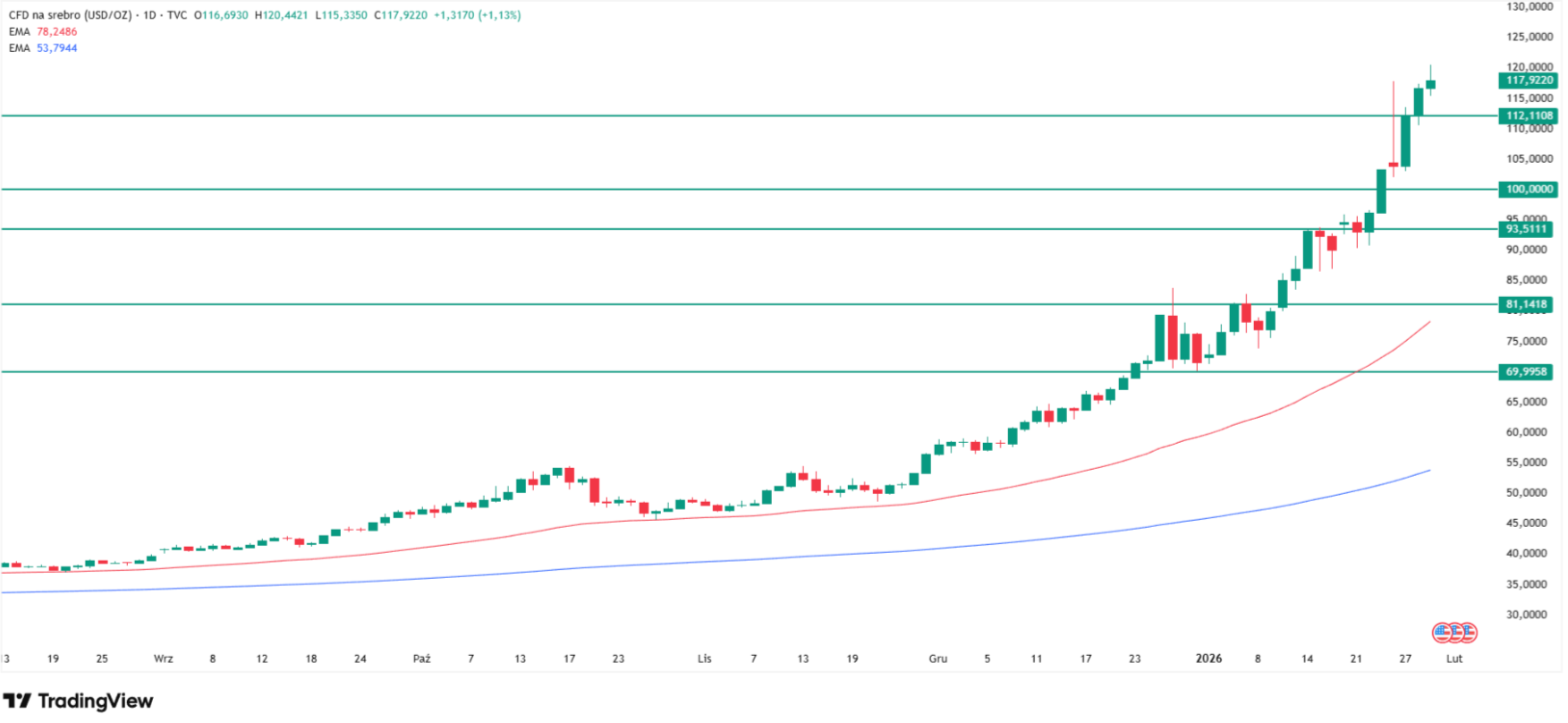
Silver Technical Levels
Current
price: $118 testing $120 record high
Critical support: $100 psychological level
(first major floor)
Trend structure: Strongly bullish with no
clear resistance until Citi's $150 target
Moving averages: Price significantly extended
from all major EMAs
Silver price technical analysis. Why silver is surging? Source: Tradingview.com
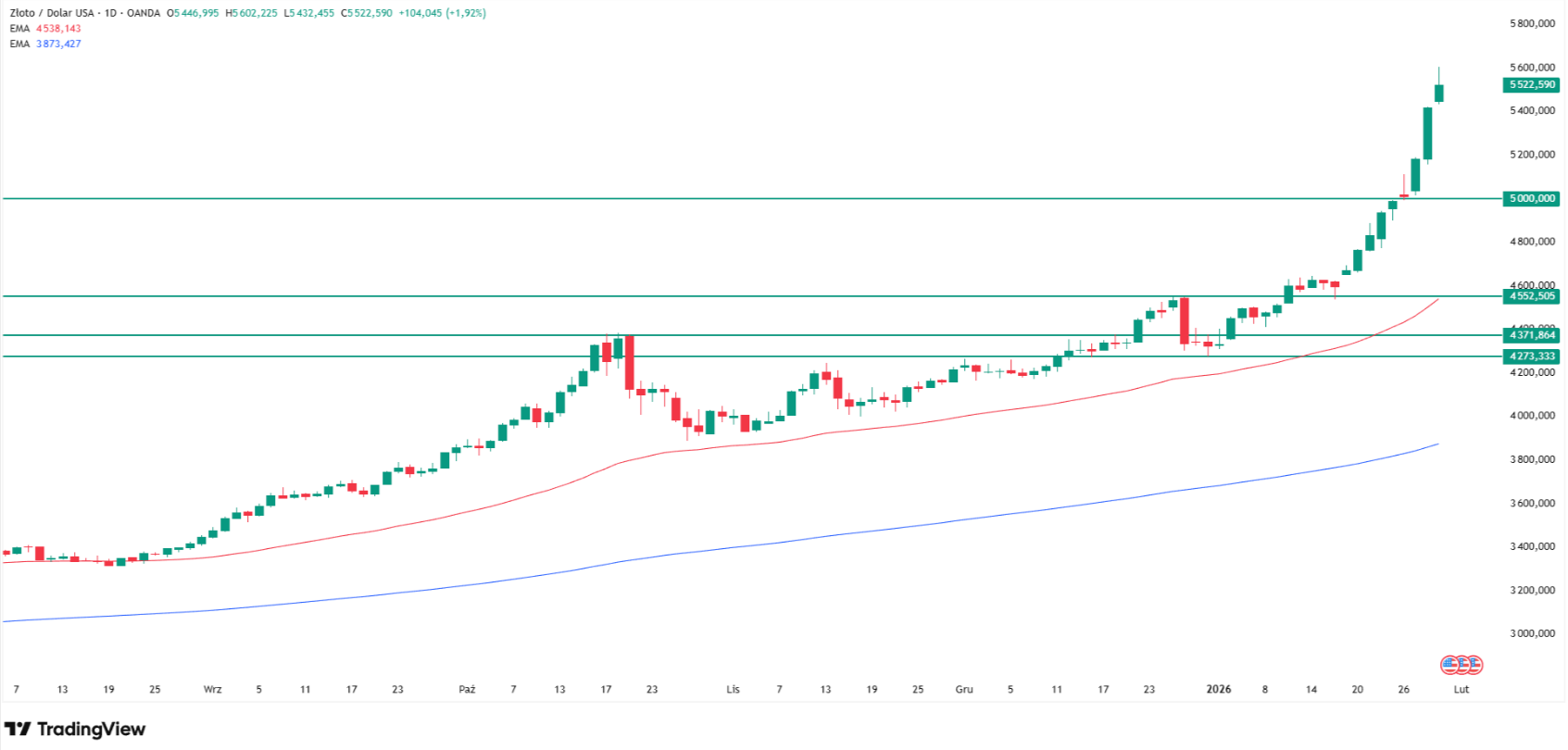
Gold Technical Levels
Current
price: $5,523 after testing $5,600
Key
support levels:
$5,000: Psychological round number
(primary support)
$4,550:
50-day EMA and December 2025 highs
$4,374-4,273:
October 2025 peaks and December lows
Short-term targets: $5,670-5,700 on close above
$5,600
Pullback
support: $5,420 intraday low
Gold price technical analysis. Why gold is surging? Source: Tradingview.com
Both metals
have moved approximately 30% above their 200-day exponential moving
averages, an extreme deviation that typically triggers corrections under
normal market conditions. However, the convergence of geopolitical tensions,
dollar weakness, and persistent buying has kept momentum strongly positive.
Expert Warning: Volatility
and Bubble Dynamics
Despite
bullish forecasts, several analysts are raising caution flags. Bank of America
ranked silver highest for "bubblelike asset dynamics" in a recent
analysis of stocks, commodities, and cryptocurrencies, placing it just ahead of
gold.
He adds:
"In such a volatile environment, position sizing and risk management are
more critical than directional bets and warrant extra caution from
traders."
Marc
Loeffert, trader at Heraeus Precious Metals, warned: "History suggests
that this rally is much nearer to its end than its beginning. The gold/silver
ratio has been lower than today several times in the past but has rarely seen
such a large swing in such a short time."
Analysts at
Sucden Financial wrote: "We remain cautious about how much further the
rally can extend and see the potential for a sharp, rapid reversal if sentiment
shifts decisively."
Silver Price Analysis, FAQ
What is the silver price
today?
Silver is
trading at $117.63 per ounce as of Thursday, January 29, 2026, after hitting an
all-time high of $120 earlier in the session.
Why is silver surging with
gold?
Silver is
surging due to dollar weakness (four-year lows), Chinese buying momentum,
China's export restrictions, Fed dovish pivot, safe-haven demand from
geopolitical tensions, and robust industrial demand for AI infrastructure,
solar panels, and electric vehicles.
Will silver surge in 2026?
Citigroup
predicts silver will reach $150 per ounce within the next three months, with
potential to hit $170 if the gold-silver ratio returns to its 2011 low of 32:1.
How high can silver go?
While Citi
targets $150-170, analysts warn the rally shows bubble-like characteristics.
Bank of America ranks silver highest for "bubblelike asset dynamics,"
suggesting caution despite bullish momentum.
Should I buy silver now?
Silver has
gained 65% in January alone and is trading 30% above key moving averages—levels
that typically see corrections. While structural drivers remain bullish (dollar
weakness, Chinese demand, industrial needs), volatility is extreme with
potential for sharp reversals. Investors should carefully consider risk
tolerance and position sizing rather than chasing momentum. Consult financial
advisors before making investment decisions.
Silver
price hit a fresh all-time high of $120 per ounce on Thursday, January 29,
2026, extending its extraordinary rally to 65% in January alone, while gold
surged past $5,600 per ounce.
Citigroup
predicts silver will reach $150 within three months, calling the white metal
"gold on steroids" as Chinese buying momentum and dollar weakness
fuel unprecedented precious metals gains.
In this
article, I am answering the question why gold and silver price is going up today,
analyzing XAU/USD and XAG/USD charts and check the newest silver price
predictions.
Silver Price Smashes
Records With 65% Monthly Gain
Silver is
trading at $117.63 per ounce as of Thursday morning, up 0.9% on the day after
testing the $120 level, a staggering 272% gain compared to the same
time last year. The metal has delivered its best January performance in
decades, surging from under $30 per ounce in early 2025 to current record
levels.
Silver's 2026 Performance:
Daily
gain: +0.9% to $117.63
January
2026: +65% (from $31.60 to $120)
Year-over-year:
+272%
Month-over-month:
+54.4%
2025
performance: +150%
The rally
has been so extreme that India's MCX silver contracts traded near Rs 3.80 lakh
per kilogram, up Rs 1.42 lakh since January 1—a nearly 60% jump in less than a
month.
Gold Breaks $5,600 as Fed
Holds Rates
Gold
extended its own historic rally Thursday, briefly touching $5,584 per
ounce—its first time above $5,600—before settling around $5,523, up nearly
2% on the day. The yellow metal has gained almost 30% year-to-date after
surging 65% throughout 2025, significantly outperforming traditional assets
like the S&P 500.
Metal
Current Price
Daily Gain
January 2026
2025 Performance
Year-over-Year
Silver
$117.63
+0.9%
+65%
+150%
+272%
Gold
$5,523
+1.7%
+30%
+65%
+97%
Gold's
advance came despite the Federal Reserve holding interest rates unchanged at
3.50%-3.75% on Wednesday, with Chair Jerome Powell striking a cautious but
dovish tone that markets interpreted as opening the door for eventual rate
cuts.
Follow
me on X for more gold and silver market analysis: @ChmielDk
Citi's "Gold on
Steroids" Silver Price Prediction
Citigroup's
commodity analysts, led by Max Layton, issued a bold forecast this week
predicting silver will surge to $150 per ounce within the next three
months. The bank describes silver as behaving like "gold squared"
or "gold on steroids," expecting the rally to continue until silver
looks expensive by historical standards relative to gold.
The
rationale behind Citi's aggressive target includes:
Chinese buying momentum: Strong physical demand
continues with no signs of slowing
Supply constraints: Higher prices needed to
encourage existing holders to sell
Gold-silver ratio compression: If the ratio returns to the
2011 low of 32:1, silver could reach $170 per ounce
"Silver
is behaving like 'gold squared' or 'gold on steroids,' and we think this likely
continues until silver looks expensive by historical standards, relative to
gold," Citi analysts wrote.
Citigroup expects spot silver prices to hit a record $150 an ounce within three months, extending a historic rally that has seen the metal surge nearly 50% in January https://t.co/s78weN6H5H
The
current gold-silver ratio sits around 47:1. A return to the 2011 extreme of
32:1, when silver last experienced a parabolic rally, would mathematically
support silver at $170 per ounce given gold's current levels.
Check
also my previous articles and analyses on gold and silver:
Why Silver Is Surging? 5
Key Drivers Behind the Precious Metals Surge
1. Dollar Collapse to
Four-Year Lows
The US
dollar has plunged to its lowest level since early 2022, with the DXY index
failing to sustain rebounds above 96.33 resistance. President Trump's comments
suggesting administration comfort with dollar weakness, combined with tariff
threats and Fed pressure, have accelerated the greenback's decline.
According
to Abdelaziz Albogdady, Market Research & Fintech Strategy Manager at FXEM:
"Gold continued to climb on Thursday, breaking yet another record as a
weaker US dollar and persistent geopolitical tensions reinforced demand for
safe-haven assets. The dollar remains under pressure while ongoing tariff
uncertainty and growing concerns about the Federal Reserve's independence boost
demand for gold."
2. Fed's Dovish Pivot
Under Powell
Wednesday's
FOMC meeting brought no policy changes, but Powell's post-meeting remarks
triggered significant market repricing. Dilin Wu, Research Strategist at
Pepperstone, notes: "Powell's dovish pivot supports gold. On inflation, he
softened his prior stance on 'maintaining high rates for longer,' instead
emphasizing the trend of falling inflation and acknowledging that policy is
already 'sufficiently restrictive.'"
Powell
suggested that if tariff-driven inflation remains contained, more accommodative
policy could be considered—indicating the Fed's reaction function is shifting
from fighting inflation toward preventing a slowdown.
3. China's Silver Buying
and Export Restrictions
China, one
of the world's largest suppliers of refined silver, began enforcing new export
restrictions this year, a move analysts believe aims to protect domestic
manufacturers from rising costs. The restrictions have tightened global supply
while Chinese investors pile into silver investments.
Evidence
of Chinese demand intensity includes:
Pure-play silver funds in China
suspended trading after premiums surged well above net asset value
Manufacturers shifting
production from jewelry to 1-kilogram investment bars
Unlike
gold, silver has extensive industrial applications that account for roughly
half of annual demand. The metal is critical for:
AI infrastructure: Data centers and
high-performance computing
Solar
panels: Photovoltaic cell production
Electric vehicles: Battery and electronic
systems
5G
networks: Enhanced conductivity requirements
Defense equipment: Advanced electronics and
radar systems
"Silver
is needed in many industrial processes," Elon Musk wrote on X in late
December, responding to China's export limitations, highlighting the metal's
economic importance.
This is not good. Silver is needed in many industrial processes.
Higher
silver costs could weigh on profit margins across these sectors or force
companies to raise prices, potentially adding to inflation pressures over time.
Silver and Gold Technical
Analysis: Price Discovery Phase
As a
technical analyst, I've identified that both silver and gold have entered a
clear price discovery phase, making traditional analysis
challenging. However, several key levels emerge:
Silver Technical Levels
Current
price: $118 testing $120 record high
Critical support: $100 psychological level
(first major floor)
Trend structure: Strongly bullish with no
clear resistance until Citi's $150 target
Moving averages: Price significantly extended
from all major EMAs
Silver price technical analysis. Why silver is surging? Source: Tradingview.com
Gold Technical Levels
Current
price: $5,523 after testing $5,600
Key
support levels:
$5,000: Psychological round number
(primary support)
$4,550:
50-day EMA and December 2025 highs
$4,374-4,273:
October 2025 peaks and December lows
Short-term targets: $5,670-5,700 on close above
$5,600
Pullback
support: $5,420 intraday low
Gold price technical analysis. Why gold is surging? Source: Tradingview.com
Both metals
have moved approximately 30% above their 200-day exponential moving
averages, an extreme deviation that typically triggers corrections under
normal market conditions. However, the convergence of geopolitical tensions,
dollar weakness, and persistent buying has kept momentum strongly positive.
Expert Warning: Volatility
and Bubble Dynamics
Despite
bullish forecasts, several analysts are raising caution flags. Bank of America
ranked silver highest for "bubblelike asset dynamics" in a recent
analysis of stocks, commodities, and cryptocurrencies, placing it just ahead of
gold.
He adds:
"In such a volatile environment, position sizing and risk management are
more critical than directional bets and warrant extra caution from
traders."
Marc
Loeffert, trader at Heraeus Precious Metals, warned: "History suggests
that this rally is much nearer to its end than its beginning. The gold/silver
ratio has been lower than today several times in the past but has rarely seen
such a large swing in such a short time."
Analysts at
Sucden Financial wrote: "We remain cautious about how much further the
rally can extend and see the potential for a sharp, rapid reversal if sentiment
shifts decisively."
Silver Price Analysis, FAQ
What is the silver price
today?
Silver is
trading at $117.63 per ounce as of Thursday, January 29, 2026, after hitting an
all-time high of $120 earlier in the session.
Why is silver surging with
gold?
Silver is
surging due to dollar weakness (four-year lows), Chinese buying momentum,
China's export restrictions, Fed dovish pivot, safe-haven demand from
geopolitical tensions, and robust industrial demand for AI infrastructure,
solar panels, and electric vehicles.
Will silver surge in 2026?
Citigroup
predicts silver will reach $150 per ounce within the next three months, with
potential to hit $170 if the gold-silver ratio returns to its 2011 low of 32:1.
How high can silver go?
While Citi
targets $150-170, analysts warn the rally shows bubble-like characteristics.
Bank of America ranks silver highest for "bubblelike asset dynamics,"
suggesting caution despite bullish momentum.
Should I buy silver now?
Silver has
gained 65% in January alone and is trading 30% above key moving averages—levels
that typically see corrections. While structural drivers remain bullish (dollar
weakness, Chinese demand, industrial needs), volatility is extreme with
potential for sharp reversals. Investors should carefully consider risk
tolerance and position sizing rather than chasing momentum. Consult financial
advisors before making investment decisions.
Damian Chmiel is a Senior Analyst & Editor at Finance Magnates with more than 15 years of experience in the CFD and online trading industry. Active as both a trader and journalist since 2010, he focuses on broker coverage, fintech innovation, and regulatory developments across Europe, the Middle East, and Asia.
His work includes interviews with C-level leaders at major brokerages and fintech platforms, as well as co-authoring Finance Magnates’ quarterly industry benchmarking reports. Damian’s reporting is data-driven, market-aware, and grounded in direct industry engagement. His analysis and commentary have also been cited by external media outlets, including Investing.com, Binance, The Asset, Stockhead, and Dispatch.
Education:
MA in Finance and Accounting, Cracow University of Economics
Ethereum Price Prediction: ETH Chart Clears Its Year-Long Downtrend as Standard Chartered and Citi Split on 2026 Targets
Featured Videos
Capital.com Separates UAE Crypto Operations; Equiti UK Pauses Risky Clients
Capital.com Separates UAE Crypto Operations; Equiti UK Pauses Risky Clients
Capital.com Separates UAE Crypto Operations; Equiti UK Pauses Risky Clients
Capital.com Separates UAE Crypto Operations; Equiti UK Pauses Risky Clients
Today’s financial news recap covers Capital.com ring-fences its UAE crypto business, Equiti UK pauses some client onboarding, and Scope Markets launches copy trading.
Finance Magnates Daily Recap brings you the latest news from forex and CFD brokers, fintech, payments, cryptocurrency, digital assets, trading platforms, financial regulation and global markets.
Get the key company news, executive moves, deals, regulatory updates and market developments of the day, in just a few minutes. New episodes published every weekday.
Read more: https://www.financemagnates.com
#FinanceMagnates #ForexNews #FintechNews
Today’s financial news recap covers Capital.com ring-fences its UAE crypto business, Equiti UK pauses some client onboarding, and Scope Markets launches copy trading.
Finance Magnates Daily Recap brings you the latest news from forex and CFD brokers, fintech, payments, cryptocurrency, digital assets, trading platforms, financial regulation and global markets.
Get the key company news, executive moves, deals, regulatory updates and market developments of the day, in just a few minutes. New episodes published every weekday.
Read more: https://www.financemagnates.com
#FinanceMagnates #ForexNews #FintechNews
Today’s financial news recap covers Capital.com ring-fences its UAE crypto business, Equiti UK pauses some client onboarding, and Scope Markets launches copy trading.
Finance Magnates Daily Recap brings you the latest news from forex and CFD brokers, fintech, payments, cryptocurrency, digital assets, trading platforms, financial regulation and global markets.
Get the key company news, executive moves, deals, regulatory updates and market developments of the day, in just a few minutes. New episodes published every weekday.
Read more: https://www.financemagnates.com
#FinanceMagnates #ForexNews #FintechNews
Today’s financial news recap covers Capital.com ring-fences its UAE crypto business, Equiti UK pauses some client onboarding, and Scope Markets launches copy trading.
Finance Magnates Daily Recap brings you the latest news from forex and CFD brokers, fintech, payments, cryptocurrency, digital assets, trading platforms, financial regulation and global markets.
Get the key company news, executive moves, deals, regulatory updates and market developments of the day, in just a few minutes. New episodes published every weekday.
Read more: https://www.financemagnates.com
#FinanceMagnates #ForexNews #FintechNews
Worsfold and Basi Take Over LCG; Brokers Go Multi-Asset
Worsfold and Basi Take Over LCG; Brokers Go Multi-Asset
Worsfold and Basi Take Over LCG; Brokers Go Multi-Asset
Worsfold and Basi Take Over LCG; Brokers Go Multi-Asset
Worsfold and Basi Take Over LCG; Brokers Go Multi-Asset
Worsfold and Basi Take Over LCG; Brokers Go Multi-Asset
Today’s financial news recap covers two senior executives take ownership of LCG, retail brokers expand into multi-asset trading, and Webull returns to profit.
Finance Magnates Daily Recap brings you the latest news from forex and CFD brokers, fintech, payments, cryptocurrency, digital assets, trading platforms, financial regulation and global markets.
Get the key company news, executive moves, deals, regulatory updates and market developments of the day, in just a few minutes. New episodes published every weekday.
Read more: https://www.financemagnates.com
#FinanceMagnates #ForexNews #FintechNews
Today’s financial news recap covers two senior executives take ownership of LCG, retail brokers expand into multi-asset trading, and Webull returns to profit.
Finance Magnates Daily Recap brings you the latest news from forex and CFD brokers, fintech, payments, cryptocurrency, digital assets, trading platforms, financial regulation and global markets.
Get the key company news, executive moves, deals, regulatory updates and market developments of the day, in just a few minutes. New episodes published every weekday.
Read more: https://www.financemagnates.com
#FinanceMagnates #ForexNews #FintechNews
Today’s financial news recap covers two senior executives take ownership of LCG, retail brokers expand into multi-asset trading, and Webull returns to profit.
Finance Magnates Daily Recap brings you the latest news from forex and CFD brokers, fintech, payments, cryptocurrency, digital assets, trading platforms, financial regulation and global markets.
Get the key company news, executive moves, deals, regulatory updates and market developments of the day, in just a few minutes. New episodes published every weekday.
Read more: https://www.financemagnates.com
#FinanceMagnates #ForexNews #FintechNews
Today’s financial news recap covers two senior executives take ownership of LCG, retail brokers expand into multi-asset trading, and Webull returns to profit.
Finance Magnates Daily Recap brings you the latest news from forex and CFD brokers, fintech, payments, cryptocurrency, digital assets, trading platforms, financial regulation and global markets.
Get the key company news, executive moves, deals, regulatory updates and market developments of the day, in just a few minutes. New episodes published every weekday.
Read more: https://www.financemagnates.com
#FinanceMagnates #ForexNews #FintechNews
Today’s financial news recap covers two senior executives take ownership of LCG, retail brokers expand into multi-asset trading, and Webull returns to profit.
Finance Magnates Daily Recap brings you the latest news from forex and CFD brokers, fintech, payments, cryptocurrency, digital assets, trading platforms, financial regulation and global markets.
Get the key company news, executive moves, deals, regulatory updates and market developments of the day, in just a few minutes. New episodes published every weekday.
Read more: https://www.financemagnates.com
#FinanceMagnates #ForexNews #FintechNews
Today’s financial news recap covers two senior executives take ownership of LCG, retail brokers expand into multi-asset trading, and Webull returns to profit.
Finance Magnates Daily Recap brings you the latest news from forex and CFD brokers, fintech, payments, cryptocurrency, digital assets, trading platforms, financial regulation and global markets.
Get the key company news, executive moves, deals, regulatory updates and market developments of the day, in just a few minutes. New episodes published every weekday.
Read more: https://www.financemagnates.com
#FinanceMagnates #ForexNews #FintechNews
iFOREX Cuts Outlook; XTB Shares Fall on CFD Review
iFOREX Cuts Outlook; XTB Shares Fall on CFD Review
iFOREX Cuts Outlook; XTB Shares Fall on CFD Review
iFOREX Cuts Outlook; XTB Shares Fall on CFD Review
iFOREX Cuts Outlook; XTB Shares Fall on CFD Review
iFOREX Cuts Outlook; XTB Shares Fall on CFD Review
Today’s financial news recap covers iFOREX cuts its EBITDA outlook after a sharp July income decline, Poland keeps its CFD review open as XTB shares fall, and Singapore targets unauthorized financial advertising.
Finance Magnates Daily Recap brings you the latest news from forex and CFD brokers, fintech, payments, cryptocurrency, digital assets, trading platforms, financial regulation and global markets.
Get the key company news, executive moves, deals, regulatory updates and market developments of the day, in just a few minutes. New episodes published every weekday.
Read more: https://www.financemagnates.com
#FinanceMagnates #ForexNews #FintechNews
Today’s financial news recap covers iFOREX cuts its EBITDA outlook after a sharp July income decline, Poland keeps its CFD review open as XTB shares fall, and Singapore targets unauthorized financial advertising.
Finance Magnates Daily Recap brings you the latest news from forex and CFD brokers, fintech, payments, cryptocurrency, digital assets, trading platforms, financial regulation and global markets.
Get the key company news, executive moves, deals, regulatory updates and market developments of the day, in just a few minutes. New episodes published every weekday.
Read more: https://www.financemagnates.com
#FinanceMagnates #ForexNews #FintechNews
Today’s financial news recap covers iFOREX cuts its EBITDA outlook after a sharp July income decline, Poland keeps its CFD review open as XTB shares fall, and Singapore targets unauthorized financial advertising.
Finance Magnates Daily Recap brings you the latest news from forex and CFD brokers, fintech, payments, cryptocurrency, digital assets, trading platforms, financial regulation and global markets.
Get the key company news, executive moves, deals, regulatory updates and market developments of the day, in just a few minutes. New episodes published every weekday.
Read more: https://www.financemagnates.com
#FinanceMagnates #ForexNews #FintechNews
Today’s financial news recap covers iFOREX cuts its EBITDA outlook after a sharp July income decline, Poland keeps its CFD review open as XTB shares fall, and Singapore targets unauthorized financial advertising.
Finance Magnates Daily Recap brings you the latest news from forex and CFD brokers, fintech, payments, cryptocurrency, digital assets, trading platforms, financial regulation and global markets.
Get the key company news, executive moves, deals, regulatory updates and market developments of the day, in just a few minutes. New episodes published every weekday.
Read more: https://www.financemagnates.com
#FinanceMagnates #ForexNews #FintechNews
Today’s financial news recap covers iFOREX cuts its EBITDA outlook after a sharp July income decline, Poland keeps its CFD review open as XTB shares fall, and Singapore targets unauthorized financial advertising.
Finance Magnates Daily Recap brings you the latest news from forex and CFD brokers, fintech, payments, cryptocurrency, digital assets, trading platforms, financial regulation and global markets.
Get the key company news, executive moves, deals, regulatory updates and market developments of the day, in just a few minutes. New episodes published every weekday.
Read more: https://www.financemagnates.com
#FinanceMagnates #ForexNews #FintechNews
Today’s financial news recap covers iFOREX cuts its EBITDA outlook after a sharp July income decline, Poland keeps its CFD review open as XTB shares fall, and Singapore targets unauthorized financial advertising.
Finance Magnates Daily Recap brings you the latest news from forex and CFD brokers, fintech, payments, cryptocurrency, digital assets, trading platforms, financial regulation and global markets.
Get the key company news, executive moves, deals, regulatory updates and market developments of the day, in just a few minutes. New episodes published every weekday.
Read more: https://www.financemagnates.com
#FinanceMagnates #ForexNews #FintechNews
AI Trading Liability; Swissquote Warns Russians
AI Trading Liability; Swissquote Warns Russians
AI Trading Liability; Swissquote Warns Russians
AI Trading Liability; Swissquote Warns Russians
AI Trading Liability; Swissquote Warns Russians
AI Trading Liability; Swissquote Warns Russians
Today’s financial news recap covers AI agents raise questions over trading liability, Swissquote warns Russian customers of possible closures, and OKX sees Binance-linked inflows surge.
Finance Magnates Daily Recap brings you the latest news from forex and CFD brokers, fintech, payments, cryptocurrency, digital assets, trading platforms, financial regulation and global markets.
Get the key company news, executive moves, deals, regulatory updates and market developments of the day, in just a few minutes. New episodes published every weekday.
Read more: https://www.financemagnates.com
#FinanceMagnates #ForexNews #FintechNews
Today’s financial news recap covers AI agents raise questions over trading liability, Swissquote warns Russian customers of possible closures, and OKX sees Binance-linked inflows surge.
Finance Magnates Daily Recap brings you the latest news from forex and CFD brokers, fintech, payments, cryptocurrency, digital assets, trading platforms, financial regulation and global markets.
Get the key company news, executive moves, deals, regulatory updates and market developments of the day, in just a few minutes. New episodes published every weekday.
Read more: https://www.financemagnates.com
#FinanceMagnates #ForexNews #FintechNews
Today’s financial news recap covers AI agents raise questions over trading liability, Swissquote warns Russian customers of possible closures, and OKX sees Binance-linked inflows surge.
Finance Magnates Daily Recap brings you the latest news from forex and CFD brokers, fintech, payments, cryptocurrency, digital assets, trading platforms, financial regulation and global markets.
Get the key company news, executive moves, deals, regulatory updates and market developments of the day, in just a few minutes. New episodes published every weekday.
Read more: https://www.financemagnates.com
#FinanceMagnates #ForexNews #FintechNews
Today’s financial news recap covers AI agents raise questions over trading liability, Swissquote warns Russian customers of possible closures, and OKX sees Binance-linked inflows surge.
Finance Magnates Daily Recap brings you the latest news from forex and CFD brokers, fintech, payments, cryptocurrency, digital assets, trading platforms, financial regulation and global markets.
Get the key company news, executive moves, deals, regulatory updates and market developments of the day, in just a few minutes. New episodes published every weekday.
Read more: https://www.financemagnates.com
#FinanceMagnates #ForexNews #FintechNews
Today’s financial news recap covers AI agents raise questions over trading liability, Swissquote warns Russian customers of possible closures, and OKX sees Binance-linked inflows surge.
Finance Magnates Daily Recap brings you the latest news from forex and CFD brokers, fintech, payments, cryptocurrency, digital assets, trading platforms, financial regulation and global markets.
Get the key company news, executive moves, deals, regulatory updates and market developments of the day, in just a few minutes. New episodes published every weekday.
Read more: https://www.financemagnates.com
#FinanceMagnates #ForexNews #FintechNews
Today’s financial news recap covers AI agents raise questions over trading liability, Swissquote warns Russian customers of possible closures, and OKX sees Binance-linked inflows surge.
Finance Magnates Daily Recap brings you the latest news from forex and CFD brokers, fintech, payments, cryptocurrency, digital assets, trading platforms, financial regulation and global markets.
Get the key company news, executive moves, deals, regulatory updates and market developments of the day, in just a few minutes. New episodes published every weekday.
Read more: https://www.financemagnates.com
#FinanceMagnates #ForexNews #FintechNews
How do you stand out when applying for fintech jobs?
How do you stand out when applying for fintech jobs?
How do you stand out when applying for fintech jobs?
How do you stand out when applying for fintech jobs?
How do you stand out when applying for fintech jobs?
How do you stand out when applying for fintech jobs?
A certificate can be more than another qualification on your LinkedIn profile.
FM Academy certificates are designed to demonstrate what you’ve learned, the skills you've developed and the standards behind your education.
For employers, that can provide a clearer picture of the knowledge and skills you bring to the role.
Explore FM Academy:
https://academy.financemagnates.com/subscription-all?utm_source=youtube&utm_medium=sm_video_post&utm_campaign=fm_academy_awareness&utm_id=V2
#FinanceMagnates #FMAcademy #FintechJobs #FintechCareers #CareerDevelopment
A certificate can be more than another qualification on your LinkedIn profile.
FM Academy certificates are designed to demonstrate what you’ve learned, the skills you've developed and the standards behind your education.
For employers, that can provide a clearer picture of the knowledge and skills you bring to the role.
Explore FM Academy:
https://academy.financemagnates.com/subscription-all?utm_source=youtube&utm_medium=sm_video_post&utm_campaign=fm_academy_awareness&utm_id=V2
#FinanceMagnates #FMAcademy #FintechJobs #FintechCareers #CareerDevelopment
A certificate can be more than another qualification on your LinkedIn profile.
FM Academy certificates are designed to demonstrate what you’ve learned, the skills you've developed and the standards behind your education.
For employers, that can provide a clearer picture of the knowledge and skills you bring to the role.
Explore FM Academy:
https://academy.financemagnates.com/subscription-all?utm_source=youtube&utm_medium=sm_video_post&utm_campaign=fm_academy_awareness&utm_id=V2
#FinanceMagnates #FMAcademy #FintechJobs #FintechCareers #CareerDevelopment
A certificate can be more than another qualification on your LinkedIn profile.
FM Academy certificates are designed to demonstrate what you’ve learned, the skills you've developed and the standards behind your education.
For employers, that can provide a clearer picture of the knowledge and skills you bring to the role.
Explore FM Academy:
https://academy.financemagnates.com/subscription-all?utm_source=youtube&utm_medium=sm_video_post&utm_campaign=fm_academy_awareness&utm_id=V2
#FinanceMagnates #FMAcademy #FintechJobs #FintechCareers #CareerDevelopment
A certificate can be more than another qualification on your LinkedIn profile.
FM Academy certificates are designed to demonstrate what you’ve learned, the skills you've developed and the standards behind your education.
For employers, that can provide a clearer picture of the knowledge and skills you bring to the role.
Explore FM Academy:
https://academy.financemagnates.com/subscription-all?utm_source=youtube&utm_medium=sm_video_post&utm_campaign=fm_academy_awareness&utm_id=V2
#FinanceMagnates #FMAcademy #FintechJobs #FintechCareers #CareerDevelopment
A certificate can be more than another qualification on your LinkedIn profile.
FM Academy certificates are designed to demonstrate what you’ve learned, the skills you've developed and the standards behind your education.
For employers, that can provide a clearer picture of the knowledge and skills you bring to the role.
Explore FM Academy:
https://academy.financemagnates.com/subscription-all?utm_source=youtube&utm_medium=sm_video_post&utm_campaign=fm_academy_awareness&utm_id=V2
#FinanceMagnates #FMAcademy #FintechJobs #FintechCareers #CareerDevelopment