Bitcoin trades near $61,200 and Ethereum near $1,650 on July 2, 2026, both bouncing off multi-month lows after a heavy June crypto selloff.
My weekly charts keep Bitcoin pointed at $44,100 and Ethereum toward the $1,000 zone, both below Citi's freshly cut base-case forecasts.
Citi cut its Bitcoin target to $82,000 and Ethereum to $2,240, slashing expected ETF inflows to zero as June redemptions set a record.
Bitcoin traded near $61,200 and Ethereum near $1,650
on Thursday, July 2, 2026, both recovering from multi-month lows one day after
Citigroup cut its 12-month targets on the two largest cryptocurrencies. Bitcoin
gained 2.17% on the session and Ethereum 2.42%, a relief bounce off this week's
floor near the lowest levels since late 2024.
Citi
lowered its Bitcoin target to $82,000 from $112,000 and Ethereum to $2,240 from
$3,175, citing record ETF outflows and stalled US crypto legislation.
My Bitcoin
and Ethereum price prediction stays bearish: the bounce is a retest from below,
not a reversal.
Follow
me on X for real-time Bitcoin and Ethereum analysis: @ChmielDk
Why Are Bitcoin and
Ethereum Falling? Citi Cuts Both Targets
Citigroup's
downgrade landed on July 1, with the bank slashing its 12-month net ETF inflow
assumption to zero from $10 billion. Bitcoin (BTC) ETF flows have turned negative, down about
$3.3 billion so far in 2026, and Citi expects broader adoption to stall until a
new catalyst arrives.
Paul
Howard, Senior Director at Wincent, called June's roughly $4 billion in US spot
Bitcoin ETF outflows "part of a wider portfolio reallocation rather than a
structural loss of confidence."
Howard
argued that investors rotated into higher-conviction bets, particularly
high-profile IPOs and equities offering more immediate upside. Elevated rates
and geopolitical uncertainty pushed institutions to trim exposure to
higher-volatility assets, he added.
The
selloff has a clear structure:
Citi's cut: 12-month Bitcoin target down
to $82,000 from $112,000, Ethereum to $2,240 from $3,175
ETF inflow assumption: reduced to zero from $10
billion, with 2026 flows already down $3.3 billion
Record redemptions: US spot Bitcoin ETFs shed
roughly $4 billion in June, the largest monthly outflow on record
Capital rotation: allocators moved into the
SpaceX IPO and AI equities, draining crypto liquidity
Stalled legislation: no progress on US digital
asset market structure to anchor institutional allocations
Bitcoin Technical
Analysis: The $60,000 Trendline Holds, for Now
My chart
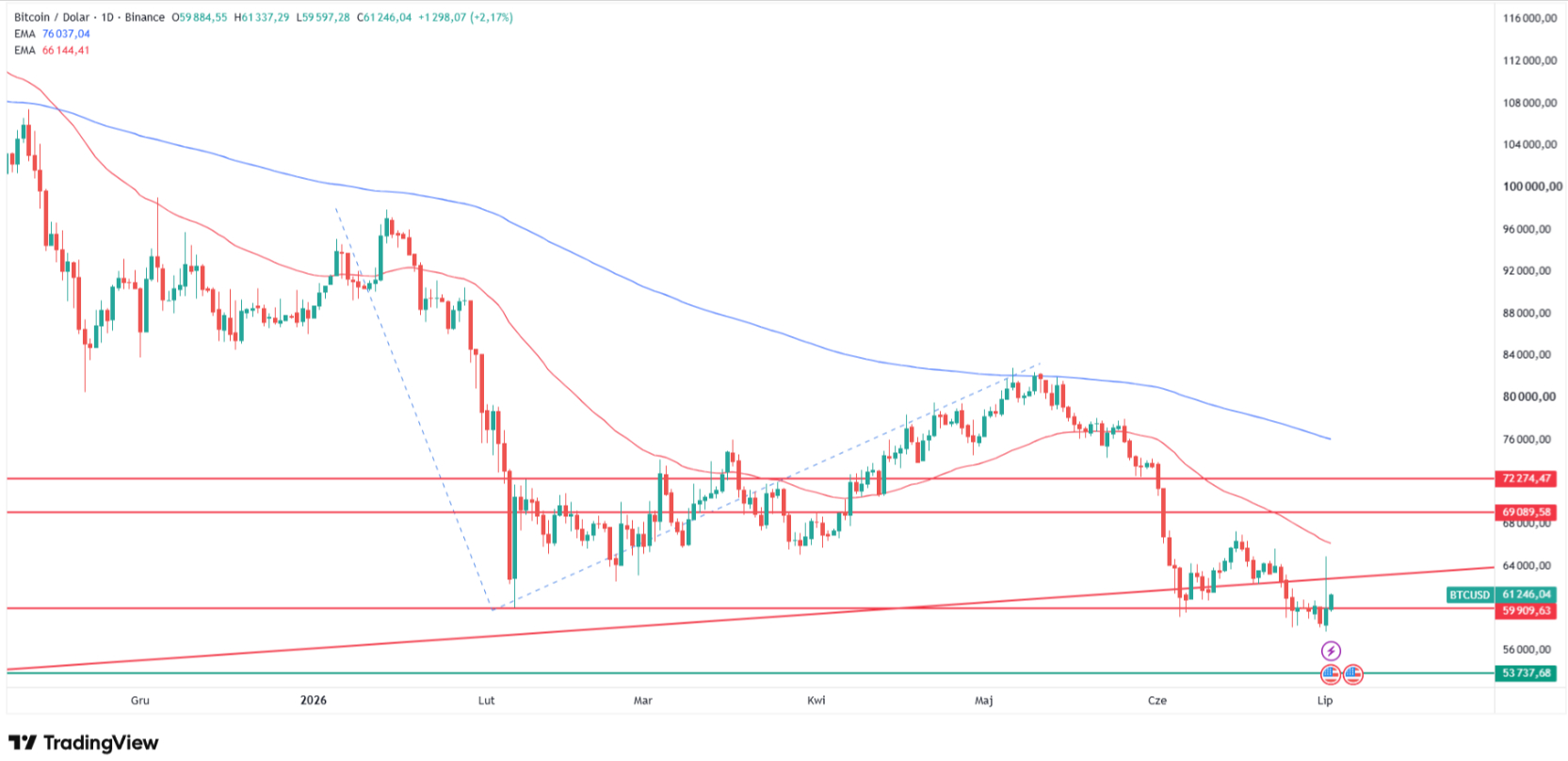
shows Bitcoin bouncing 2.17% off the $59,900 shelf, defending both this week's
low and the ascending trendline that has framed price since the February
bottom.
Wednesday's
long candle rejected the move under $60,000 and closed back near $61,200, a
bullish wick on the daily. That candle and the trendline confirm my Tuesday
analysis rather than contradict it. The $60,000 zone is broken weekly support,
and price is now retesting it from below.
Two
exponential moving averages cap the tape. The 50 EMA sits at $66,144 and the
200 EMA at $76,037, both above spot and both sloping down, the bearish stack
that has defined Bitcoin since February.
In 15 years
reading daily charts, 10 of them at FinanceMagnates.com (my analyst page), a bounce into a falling 50 EMA is a sell
candidate until price reclaims it.
As my Tuesday analysis detailed, last week's weekly close
below $60,000 flipped former support into resistance under the polarity
principle and broke the ascending trendline drawn from December 2022 lows.
My primary
target stays at $44,100, the 100% Fibonacci extension of January's decline and
a 25% drop from spot, a level I first mapped in my earlier $45,000 forecast. The first shelf below sits at
$53,700, the summer 2024 low.
Can Bitcoin hold the $60,000 trendline or does the break target $44,100? Source: Tradingview.com
A weekly reclaim of $60,000 and the 200 EMA near
$76,000 is what invalidates the bear case.
Level
Type
Notes
$76,037
200 EMA / Resistance
Trend
divider, bull reclaim line
$66,144
50 EMA / Resistance
Caps
every bounce since February
$59,900-$60,000
Support / Trigger
Ascending
trendline, broken weekly floor
$53,700
Support
Summer
2024 low, first shelf below
$44,100
Target
100% Fibonacci extension, 25% below spot
Ethereum Technical
Analysis: Consolidating Below the $1,800 Shelf
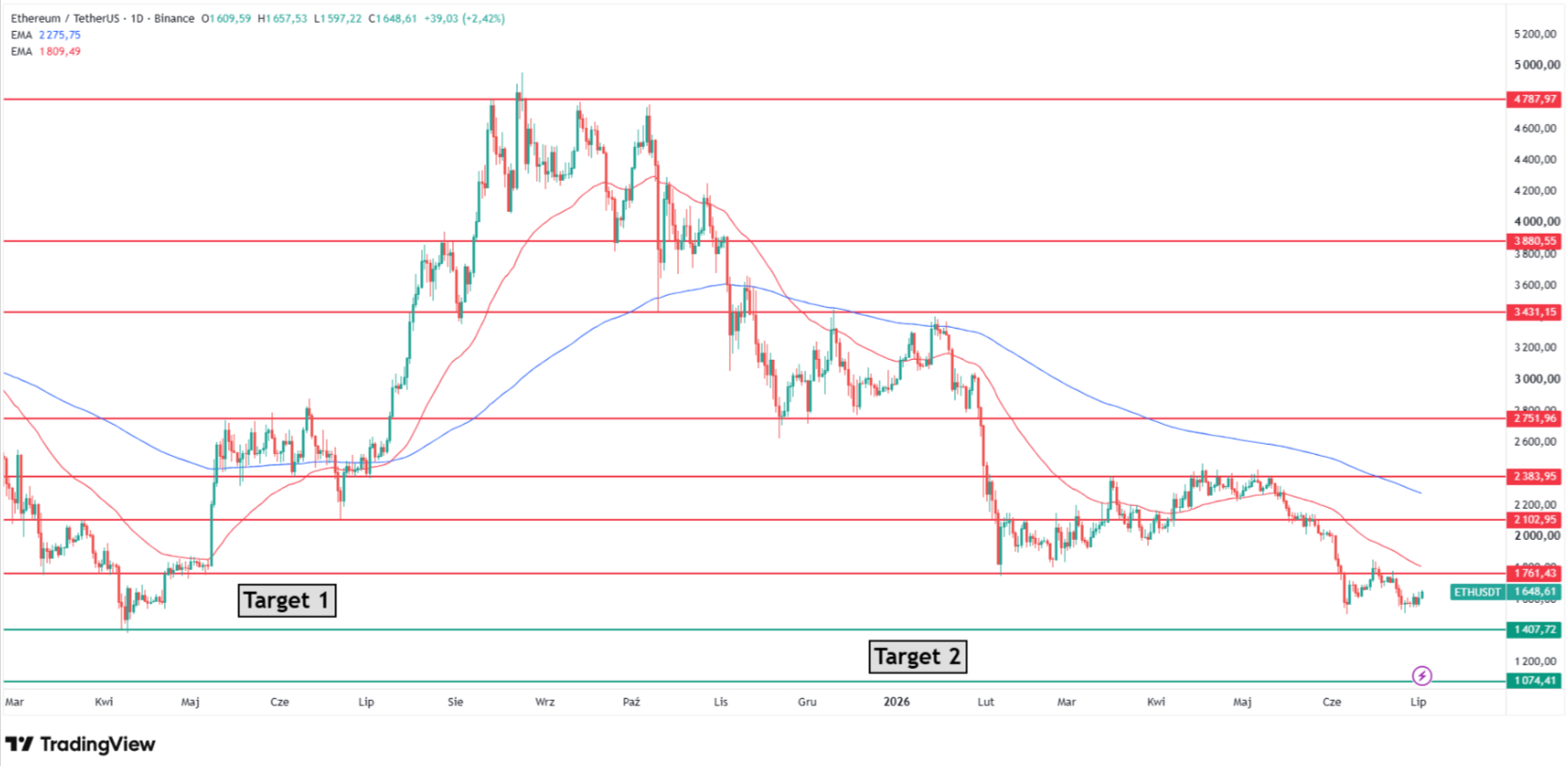
Ethereum (ETH) added 2.42% to $1,648 on Thursday, but my
chart shows price consolidating below the 2026 lows near $1,800, the shelf
marked by the $1,761 level. The rebound has not changed the structure. Local
support sits at $1,550, the floor set by the early June lows, and a daily close
below it opens the path lower.
The moving
average grid is stacked against ETH. The 50 EMA runs at $1,809 and the 200 EMA
at $2,275, both well above spot and both pointed down. Spot trades nearly 38%
under the 200 EMA, a gap that measures how far the Ethereum downtrend has
stretched.
Ethereum
sits roughly 66% below its August 2025 record, and until it reclaims the $1,809
average, every rally is a lower high in my framework.
My two
bearish targets still wait for a print. The first is $1,407, the April 2025 low
I marked as Target 1. The second is the round $1,000 handle near the $1,074
November 2022 low, Target 2 on my chart.
As my February Ethereum analysis mapped, the $1,760, $1,400, and
$1,000 levels form the descending target stack, and my November forecast flagged the same $1,400 April zone
as the medium-term destination.
Maxime
Seiler, CEO and Co-Founder at STS Digital, reads the weakness as flow-driven.
He called June's drop "less macro and more a simple lack of fresh
capital," pointing to the SpaceX IPO pulling allocation out of crypto
entirely.
How low can Ethereum go below the $1,800 shelf? Source: Tradingview.com
Seiler sees
institutions still deploying, only slower, with the AI narrative and the SpaceX
listing offering cleaner return asymmetry than a range-bound market.
How Low Can Bitcoin and
Ethereum Go? Price Predictions
Its $53,000
bear case sits just above my $44,100 target, so on the downside my chart is
more aggressive than Citi's. For Ethereum, Citi's $2,240 base case would need
ETH to clear the $1,809 and $2,275 EMAs, a move the chart shows no sign of,
while its $1,094 bear case aligns almost exactly with my $1,000 Target 2.
The bull
case leans on institutions stepping in lower. Paul Howard expects the $50,000
region to attract renewed institutional interest, a level that sits between my
$53,700 shelf and my $44,100 target.
Maxime
Seiler sees the four-year cycle intact and argues capital returns once
regulatory clarity and price momentum realign. Standard Chartered's prior
$7,500 Ethereum target and Bernstein's $150,000 Bitcoin call remain the far
bull markers, both requiring a macro turn neither chart confirms.
Source
Target
My View
Citi (base, BTC)
$82,000
Needs a
weekly $60,000 reclaim first, not yet in play
Citi (bear, BTC)
$53,000
Just
above my $44,100 target, my chart is lower
Citi (base, ETH)
$2,240
Blocked
by the $1,809 and $2,275 EMAs
Citi (bear, ETH)
$1,094
Aligns with my $1,000 Target 2
Standard Chartered (ETH)
$7,500
Far bull
case, needs a macro turn
Bernstein (BTC)
$150,000
Requires
a 200 EMA reclaim near $76,000
FAQ, Bitcoin and Ethereum
Price Prediction
Why did Citi cut its
Bitcoin and Ethereum price targets?
Citi
lowered its 12-month Bitcoin target to $82,000 from $112,000 and Ethereum to
$2,240 from $3,175 on July 1, 2026. The bank cut its expected net ETF inflows
to zero from $10 billion, citing negative flows, weak investor appetite, and
stalled US crypto legislation. Its bear case values Bitcoin at $53,000 and
Ethereum at $1,094.
How low can Bitcoin go in
2026?
My chart
targets $44,100, the 100% Fibonacci extension of January's decline and a 25%
drop from the $61,200 spot price. The first support shelf sits at $53,700, the
summer 2024 low. A weekly close reclaiming $60,000 and the 200 EMA near $76,000
would invalidate that bearish path and shift focus higher.
How low can Ethereum go?
My two
bearish targets are $1,407, the April 2025 low, and the round $1,000 handle
near the $1,074 November 2022 low. Ethereum trades below its 50 EMA at $1,809
and its 200 EMA at $2,275, with local support at $1,550. A daily close below
$1,550 opens the path toward those targets.
Are the Bitcoin ETF
outflows a structural problem?
Paul Howard
of Wincent views June's roughly $4 billion in outflows as portfolio
reallocation, not lost conviction, with capital rotating into IPOs and
equities. Maxime Seiler of STS Digital ties the drop to a lack of fresh capital
after the SpaceX IPO. Both expect flows to return once regulation and momentum
realign.
What would reverse the
crypto selloff?
A reversal
needs three things: ETF outflows turning to sustained inflows, progress on US
crypto market structure legislation, and a friendlier macro backdrop. On my
charts, Bitcoin must reclaim $60,000 and the 200 EMA near $76,000, and Ethereum
must clear its $1,809 50 EMA, before the bearish structure flips.
Bitcoin traded near $61,200 and Ethereum near $1,650
on Thursday, July 2, 2026, both recovering from multi-month lows one day after
Citigroup cut its 12-month targets on the two largest cryptocurrencies. Bitcoin
gained 2.17% on the session and Ethereum 2.42%, a relief bounce off this week's
floor near the lowest levels since late 2024.
Citi
lowered its Bitcoin target to $82,000 from $112,000 and Ethereum to $2,240 from
$3,175, citing record ETF outflows and stalled US crypto legislation.
My Bitcoin
and Ethereum price prediction stays bearish: the bounce is a retest from below,
not a reversal.
Follow
me on X for real-time Bitcoin and Ethereum analysis: @ChmielDk
Why Are Bitcoin and
Ethereum Falling? Citi Cuts Both Targets
Citigroup's
downgrade landed on July 1, with the bank slashing its 12-month net ETF inflow
assumption to zero from $10 billion. Bitcoin (BTC) ETF flows have turned negative, down about
$3.3 billion so far in 2026, and Citi expects broader adoption to stall until a
new catalyst arrives.
Paul
Howard, Senior Director at Wincent, called June's roughly $4 billion in US spot
Bitcoin ETF outflows "part of a wider portfolio reallocation rather than a
structural loss of confidence."
Howard
argued that investors rotated into higher-conviction bets, particularly
high-profile IPOs and equities offering more immediate upside. Elevated rates
and geopolitical uncertainty pushed institutions to trim exposure to
higher-volatility assets, he added.
The
selloff has a clear structure:
Citi's cut: 12-month Bitcoin target down
to $82,000 from $112,000, Ethereum to $2,240 from $3,175
ETF inflow assumption: reduced to zero from $10
billion, with 2026 flows already down $3.3 billion
Record redemptions: US spot Bitcoin ETFs shed
roughly $4 billion in June, the largest monthly outflow on record
Capital rotation: allocators moved into the
SpaceX IPO and AI equities, draining crypto liquidity
Stalled legislation: no progress on US digital
asset market structure to anchor institutional allocations
Bitcoin Technical
Analysis: The $60,000 Trendline Holds, for Now
My chart
shows Bitcoin bouncing 2.17% off the $59,900 shelf, defending both this week's
low and the ascending trendline that has framed price since the February
bottom.
Wednesday's
long candle rejected the move under $60,000 and closed back near $61,200, a
bullish wick on the daily. That candle and the trendline confirm my Tuesday
analysis rather than contradict it. The $60,000 zone is broken weekly support,
and price is now retesting it from below.
Two
exponential moving averages cap the tape. The 50 EMA sits at $66,144 and the
200 EMA at $76,037, both above spot and both sloping down, the bearish stack
that has defined Bitcoin since February.
In 15 years
reading daily charts, 10 of them at FinanceMagnates.com (my analyst page), a bounce into a falling 50 EMA is a sell
candidate until price reclaims it.
As my Tuesday analysis detailed, last week's weekly close
below $60,000 flipped former support into resistance under the polarity
principle and broke the ascending trendline drawn from December 2022 lows.
My primary
target stays at $44,100, the 100% Fibonacci extension of January's decline and
a 25% drop from spot, a level I first mapped in my earlier $45,000 forecast. The first shelf below sits at
$53,700, the summer 2024 low.
Can Bitcoin hold the $60,000 trendline or does the break target $44,100? Source: Tradingview.com
A weekly reclaim of $60,000 and the 200 EMA near
$76,000 is what invalidates the bear case.
Level
Type
Notes
$76,037
200 EMA / Resistance
Trend
divider, bull reclaim line
$66,144
50 EMA / Resistance
Caps
every bounce since February
$59,900-$60,000
Support / Trigger
Ascending
trendline, broken weekly floor
$53,700
Support
Summer
2024 low, first shelf below
$44,100
Target
100% Fibonacci extension, 25% below spot
Ethereum Technical
Analysis: Consolidating Below the $1,800 Shelf
Ethereum (ETH) added 2.42% to $1,648 on Thursday, but my
chart shows price consolidating below the 2026 lows near $1,800, the shelf
marked by the $1,761 level. The rebound has not changed the structure. Local
support sits at $1,550, the floor set by the early June lows, and a daily close
below it opens the path lower.
The moving
average grid is stacked against ETH. The 50 EMA runs at $1,809 and the 200 EMA
at $2,275, both well above spot and both pointed down. Spot trades nearly 38%
under the 200 EMA, a gap that measures how far the Ethereum downtrend has
stretched.
Ethereum
sits roughly 66% below its August 2025 record, and until it reclaims the $1,809
average, every rally is a lower high in my framework.
My two
bearish targets still wait for a print. The first is $1,407, the April 2025 low
I marked as Target 1. The second is the round $1,000 handle near the $1,074
November 2022 low, Target 2 on my chart.
As my February Ethereum analysis mapped, the $1,760, $1,400, and
$1,000 levels form the descending target stack, and my November forecast flagged the same $1,400 April zone
as the medium-term destination.
Maxime
Seiler, CEO and Co-Founder at STS Digital, reads the weakness as flow-driven.
He called June's drop "less macro and more a simple lack of fresh
capital," pointing to the SpaceX IPO pulling allocation out of crypto
entirely.
How low can Ethereum go below the $1,800 shelf? Source: Tradingview.com
Seiler sees
institutions still deploying, only slower, with the AI narrative and the SpaceX
listing offering cleaner return asymmetry than a range-bound market.
How Low Can Bitcoin and
Ethereum Go? Price Predictions
Its $53,000
bear case sits just above my $44,100 target, so on the downside my chart is
more aggressive than Citi's. For Ethereum, Citi's $2,240 base case would need
ETH to clear the $1,809 and $2,275 EMAs, a move the chart shows no sign of,
while its $1,094 bear case aligns almost exactly with my $1,000 Target 2.
The bull
case leans on institutions stepping in lower. Paul Howard expects the $50,000
region to attract renewed institutional interest, a level that sits between my
$53,700 shelf and my $44,100 target.
Maxime
Seiler sees the four-year cycle intact and argues capital returns once
regulatory clarity and price momentum realign. Standard Chartered's prior
$7,500 Ethereum target and Bernstein's $150,000 Bitcoin call remain the far
bull markers, both requiring a macro turn neither chart confirms.
Source
Target
My View
Citi (base, BTC)
$82,000
Needs a
weekly $60,000 reclaim first, not yet in play
Citi (bear, BTC)
$53,000
Just
above my $44,100 target, my chart is lower
Citi (base, ETH)
$2,240
Blocked
by the $1,809 and $2,275 EMAs
Citi (bear, ETH)
$1,094
Aligns with my $1,000 Target 2
Standard Chartered (ETH)
$7,500
Far bull
case, needs a macro turn
Bernstein (BTC)
$150,000
Requires
a 200 EMA reclaim near $76,000
FAQ, Bitcoin and Ethereum
Price Prediction
Why did Citi cut its
Bitcoin and Ethereum price targets?
Citi
lowered its 12-month Bitcoin target to $82,000 from $112,000 and Ethereum to
$2,240 from $3,175 on July 1, 2026. The bank cut its expected net ETF inflows
to zero from $10 billion, citing negative flows, weak investor appetite, and
stalled US crypto legislation. Its bear case values Bitcoin at $53,000 and
Ethereum at $1,094.
How low can Bitcoin go in
2026?
My chart
targets $44,100, the 100% Fibonacci extension of January's decline and a 25%
drop from the $61,200 spot price. The first support shelf sits at $53,700, the
summer 2024 low. A weekly close reclaiming $60,000 and the 200 EMA near $76,000
would invalidate that bearish path and shift focus higher.
How low can Ethereum go?
My two
bearish targets are $1,407, the April 2025 low, and the round $1,000 handle
near the $1,074 November 2022 low. Ethereum trades below its 50 EMA at $1,809
and its 200 EMA at $2,275, with local support at $1,550. A daily close below
$1,550 opens the path toward those targets.
Are the Bitcoin ETF
outflows a structural problem?
Paul Howard
of Wincent views June's roughly $4 billion in outflows as portfolio
reallocation, not lost conviction, with capital rotating into IPOs and
equities. Maxime Seiler of STS Digital ties the drop to a lack of fresh capital
after the SpaceX IPO. Both expect flows to return once regulation and momentum
realign.
What would reverse the
crypto selloff?
A reversal
needs three things: ETF outflows turning to sustained inflows, progress on US
crypto market structure legislation, and a friendlier macro backdrop. On my
charts, Bitcoin must reclaim $60,000 and the 200 EMA near $76,000, and Ethereum
must clear its $1,809 50 EMA, before the bearish structure flips.
Damian Chmiel is a Senior Analyst & Editor at Finance Magnates with more than 15 years of experience in the CFD and online trading industry. Active as both a trader and journalist since 2010, he focuses on broker coverage, fintech innovation, and regulatory developments across Europe, the Middle East, and Asia.
His work includes interviews with C-level leaders at major brokerages and fintech platforms, as well as co-authoring Finance Magnates’ quarterly industry benchmarking reports. Damian’s reporting is data-driven, market-aware, and grounded in direct industry engagement. His analysis and commentary have also been cited by external media outlets, including Investing.com, Binance, The Asset, Stockhead, and Dispatch.
Education:
MA in Finance and Accounting, Cracow University of Economics
Why Is Dogecoin Going Up Today? DOGE Price Prediction Shows 25% Upside Potential
Featured Videos
AvaTrade to Acquire Most of FXCM; NAGA Raises $8M
AvaTrade to Acquire Most of FXCM; NAGA Raises $8M
AvaTrade to Acquire Most of FXCM; NAGA Raises $8M
AvaTrade to Acquire Most of FXCM; NAGA Raises $8M
Today’s financial news recap covers AvaTrade agrees to acquire most of FXCM, NAGA secures eight million dollars in new financing, and Wise seeks a tax settlement in the UK.
Finance Magnates Daily Recap brings you the latest news from forex and CFD brokers, fintech, payments, cryptocurrency, digital assets, trading platforms, financial regulation and global markets.
Get the key company news, executive moves, deals, regulatory updates and market developments of the day, in just a few minutes. New episodes published every weekday.
Read more: https://www.financemagnates.com
#FinanceMagnates #ForexNews #FintechNews
Today’s financial news recap covers AvaTrade agrees to acquire most of FXCM, NAGA secures eight million dollars in new financing, and Wise seeks a tax settlement in the UK.
Finance Magnates Daily Recap brings you the latest news from forex and CFD brokers, fintech, payments, cryptocurrency, digital assets, trading platforms, financial regulation and global markets.
Get the key company news, executive moves, deals, regulatory updates and market developments of the day, in just a few minutes. New episodes published every weekday.
Read more: https://www.financemagnates.com
#FinanceMagnates #ForexNews #FintechNews
Today’s financial news recap covers AvaTrade agrees to acquire most of FXCM, NAGA secures eight million dollars in new financing, and Wise seeks a tax settlement in the UK.
Finance Magnates Daily Recap brings you the latest news from forex and CFD brokers, fintech, payments, cryptocurrency, digital assets, trading platforms, financial regulation and global markets.
Get the key company news, executive moves, deals, regulatory updates and market developments of the day, in just a few minutes. New episodes published every weekday.
Read more: https://www.financemagnates.com
#FinanceMagnates #ForexNews #FintechNews
Today’s financial news recap covers AvaTrade agrees to acquire most of FXCM, NAGA secures eight million dollars in new financing, and Wise seeks a tax settlement in the UK.
Finance Magnates Daily Recap brings you the latest news from forex and CFD brokers, fintech, payments, cryptocurrency, digital assets, trading platforms, financial regulation and global markets.
Get the key company news, executive moves, deals, regulatory updates and market developments of the day, in just a few minutes. New episodes published every weekday.
Read more: https://www.financemagnates.com
#FinanceMagnates #ForexNews #FintechNews
XTB Adds Overnight US Stock Trading; Nasdaq Ventures Invests in One Trading
XTB Adds Overnight US Stock Trading; Nasdaq Ventures Invests in One Trading
XTB Adds Overnight US Stock Trading; Nasdaq Ventures Invests in One Trading
XTB Adds Overnight US Stock Trading; Nasdaq Ventures Invests in One Trading
XTB Adds Overnight US Stock Trading; Nasdaq Ventures Invests in One Trading
XTB Adds Overnight US Stock Trading; Nasdaq Ventures Invests in One Trading
Today’s financial news recap covers XTB expands overnight US stock trading, Fortrade reports higher revenue, Nasdaq backs One Trading, and Vest Labs raises 13 million dollars.
Finance Magnates Daily Recap brings you the latest news from forex and CFD brokers, fintech, payments, cryptocurrency, digital assets, trading platforms, financial regulation and global markets.
Get the key company news, executive moves, deals, regulatory updates and market developments of the day, in just a few minutes. New episodes published every weekday.
Read more: https://www.financemagnates.com
#FinanceMagnates #ForexNews #FintechNews
Today’s financial news recap covers XTB expands overnight US stock trading, Fortrade reports higher revenue, Nasdaq backs One Trading, and Vest Labs raises 13 million dollars.
Finance Magnates Daily Recap brings you the latest news from forex and CFD brokers, fintech, payments, cryptocurrency, digital assets, trading platforms, financial regulation and global markets.
Get the key company news, executive moves, deals, regulatory updates and market developments of the day, in just a few minutes. New episodes published every weekday.
Read more: https://www.financemagnates.com
#FinanceMagnates #ForexNews #FintechNews
Today’s financial news recap covers XTB expands overnight US stock trading, Fortrade reports higher revenue, Nasdaq backs One Trading, and Vest Labs raises 13 million dollars.
Finance Magnates Daily Recap brings you the latest news from forex and CFD brokers, fintech, payments, cryptocurrency, digital assets, trading platforms, financial regulation and global markets.
Get the key company news, executive moves, deals, regulatory updates and market developments of the day, in just a few minutes. New episodes published every weekday.
Read more: https://www.financemagnates.com
#FinanceMagnates #ForexNews #FintechNews
Today’s financial news recap covers XTB expands overnight US stock trading, Fortrade reports higher revenue, Nasdaq backs One Trading, and Vest Labs raises 13 million dollars.
Finance Magnates Daily Recap brings you the latest news from forex and CFD brokers, fintech, payments, cryptocurrency, digital assets, trading platforms, financial regulation and global markets.
Get the key company news, executive moves, deals, regulatory updates and market developments of the day, in just a few minutes. New episodes published every weekday.
Read more: https://www.financemagnates.com
#FinanceMagnates #ForexNews #FintechNews
Today’s financial news recap covers XTB expands overnight US stock trading, Fortrade reports higher revenue, Nasdaq backs One Trading, and Vest Labs raises 13 million dollars.
Finance Magnates Daily Recap brings you the latest news from forex and CFD brokers, fintech, payments, cryptocurrency, digital assets, trading platforms, financial regulation and global markets.
Get the key company news, executive moves, deals, regulatory updates and market developments of the day, in just a few minutes. New episodes published every weekday.
Read more: https://www.financemagnates.com
#FinanceMagnates #ForexNews #FintechNews
Today’s financial news recap covers XTB expands overnight US stock trading, Fortrade reports higher revenue, Nasdaq backs One Trading, and Vest Labs raises 13 million dollars.
Finance Magnates Daily Recap brings you the latest news from forex and CFD brokers, fintech, payments, cryptocurrency, digital assets, trading platforms, financial regulation and global markets.
Get the key company news, executive moves, deals, regulatory updates and market developments of the day, in just a few minutes. New episodes published every weekday.
Read more: https://www.financemagnates.com
#FinanceMagnates #ForexNews #FintechNews
CMC Founder Downplays Volatility Hit; Devexperts Names CEO
CMC Founder Downplays Volatility Hit; Devexperts Names CEO
CMC Founder Downplays Volatility Hit; Devexperts Names CEO
CMC Founder Downplays Volatility Hit; Devexperts Names CEO
CMC Founder Downplays Volatility Hit; Devexperts Names CEO
CMC Founder Downplays Volatility Hit; Devexperts Names CEO
Today’s financial news recap covers low volatility pressures brokers, Devexperts names a new CEO, Saxo cuts onboarding time, and OKX reaches a 25 billion dollar valuation.
Finance Magnates Daily Recap brings you the latest news from forex and CFD brokers, fintech, payments, cryptocurrency, digital assets, trading platforms, financial regulation and global markets.
Get the key company news, executive moves, deals, regulatory updates and market developments of the day, in just a few minutes. New episodes published every weekday.
Read more: https://www.financemagnates.com
#FinanceMagnates #ForexNews #FintechNews
Today’s financial news recap covers low volatility pressures brokers, Devexperts names a new CEO, Saxo cuts onboarding time, and OKX reaches a 25 billion dollar valuation.
Finance Magnates Daily Recap brings you the latest news from forex and CFD brokers, fintech, payments, cryptocurrency, digital assets, trading platforms, financial regulation and global markets.
Get the key company news, executive moves, deals, regulatory updates and market developments of the day, in just a few minutes. New episodes published every weekday.
Read more: https://www.financemagnates.com
#FinanceMagnates #ForexNews #FintechNews
Today’s financial news recap covers low volatility pressures brokers, Devexperts names a new CEO, Saxo cuts onboarding time, and OKX reaches a 25 billion dollar valuation.
Finance Magnates Daily Recap brings you the latest news from forex and CFD brokers, fintech, payments, cryptocurrency, digital assets, trading platforms, financial regulation and global markets.
Get the key company news, executive moves, deals, regulatory updates and market developments of the day, in just a few minutes. New episodes published every weekday.
Read more: https://www.financemagnates.com
#FinanceMagnates #ForexNews #FintechNews
Today’s financial news recap covers low volatility pressures brokers, Devexperts names a new CEO, Saxo cuts onboarding time, and OKX reaches a 25 billion dollar valuation.
Finance Magnates Daily Recap brings you the latest news from forex and CFD brokers, fintech, payments, cryptocurrency, digital assets, trading platforms, financial regulation and global markets.
Get the key company news, executive moves, deals, regulatory updates and market developments of the day, in just a few minutes. New episodes published every weekday.
Read more: https://www.financemagnates.com
#FinanceMagnates #ForexNews #FintechNews
Today’s financial news recap covers low volatility pressures brokers, Devexperts names a new CEO, Saxo cuts onboarding time, and OKX reaches a 25 billion dollar valuation.
Finance Magnates Daily Recap brings you the latest news from forex and CFD brokers, fintech, payments, cryptocurrency, digital assets, trading platforms, financial regulation and global markets.
Get the key company news, executive moves, deals, regulatory updates and market developments of the day, in just a few minutes. New episodes published every weekday.
Read more: https://www.financemagnates.com
#FinanceMagnates #ForexNews #FintechNews
Today’s financial news recap covers low volatility pressures brokers, Devexperts names a new CEO, Saxo cuts onboarding time, and OKX reaches a 25 billion dollar valuation.
Finance Magnates Daily Recap brings you the latest news from forex and CFD brokers, fintech, payments, cryptocurrency, digital assets, trading platforms, financial regulation and global markets.
Get the key company news, executive moves, deals, regulatory updates and market developments of the day, in just a few minutes. New episodes published every weekday.
Read more: https://www.financemagnates.com
#FinanceMagnates #ForexNews #FintechNews
Today’s financial news recap covers Trade Nation buys FXCM's UK client book, Trading 212 reports higher revenue, the CFTC's move to allow perpetual index futures.
Finance Magnates Daily Recap brings you the latest news from forex and CFD brokers, fintech, payments, cryptocurrency, digital assets, trading platforms, financial regulation and global markets.
Get the key company news, executive moves, deals, regulatory updates and market developments of the day, in just a few minutes. New episodes published every weekday.
Read more: https://www.financemagnates.com
#FinanceMagnates #ForexNews #FintechNews
Today’s financial news recap covers Trade Nation buys FXCM's UK client book, Trading 212 reports higher revenue, the CFTC's move to allow perpetual index futures.
Finance Magnates Daily Recap brings you the latest news from forex and CFD brokers, fintech, payments, cryptocurrency, digital assets, trading platforms, financial regulation and global markets.
Get the key company news, executive moves, deals, regulatory updates and market developments of the day, in just a few minutes. New episodes published every weekday.
Read more: https://www.financemagnates.com
#FinanceMagnates #ForexNews #FintechNews
Today’s financial news recap covers Trade Nation buys FXCM's UK client book, Trading 212 reports higher revenue, the CFTC's move to allow perpetual index futures.
Finance Magnates Daily Recap brings you the latest news from forex and CFD brokers, fintech, payments, cryptocurrency, digital assets, trading platforms, financial regulation and global markets.
Get the key company news, executive moves, deals, regulatory updates and market developments of the day, in just a few minutes. New episodes published every weekday.
Read more: https://www.financemagnates.com
#FinanceMagnates #ForexNews #FintechNews
Today’s financial news recap covers Trade Nation buys FXCM's UK client book, Trading 212 reports higher revenue, the CFTC's move to allow perpetual index futures.
Finance Magnates Daily Recap brings you the latest news from forex and CFD brokers, fintech, payments, cryptocurrency, digital assets, trading platforms, financial regulation and global markets.
Get the key company news, executive moves, deals, regulatory updates and market developments of the day, in just a few minutes. New episodes published every weekday.
Read more: https://www.financemagnates.com
#FinanceMagnates #ForexNews #FintechNews
Today’s financial news recap covers Trade Nation buys FXCM's UK client book, Trading 212 reports higher revenue, the CFTC's move to allow perpetual index futures.
Finance Magnates Daily Recap brings you the latest news from forex and CFD brokers, fintech, payments, cryptocurrency, digital assets, trading platforms, financial regulation and global markets.
Get the key company news, executive moves, deals, regulatory updates and market developments of the day, in just a few minutes. New episodes published every weekday.
Read more: https://www.financemagnates.com
#FinanceMagnates #ForexNews #FintechNews
Today’s financial news recap covers Trade Nation buys FXCM's UK client book, Trading 212 reports higher revenue, the CFTC's move to allow perpetual index futures.
Finance Magnates Daily Recap brings you the latest news from forex and CFD brokers, fintech, payments, cryptocurrency, digital assets, trading platforms, financial regulation and global markets.
Get the key company news, executive moves, deals, regulatory updates and market developments of the day, in just a few minutes. New episodes published every weekday.
Read more: https://www.financemagnates.com
#FinanceMagnates #ForexNews #FintechNews
Your career isn’t a linear path.
Your career isn’t a linear path.
Your career isn’t a linear path.
Your career isn’t a linear path.
Your career isn’t a linear path.
Your career isn’t a linear path.
Roles change. Career goals change. Sometimes you want a completely new challenge.
But the skills and knowledge you build along the way can stay with you and give you something to build on.
For Jeff Patterson, that continued growth is key to long-term career development.
You bring the skills. FM Academy helps you build the knowledge.
#FMAcademy #FinanceMagnates #FinanceCareers #ProfessionalDevelopment #Fintech
Roles change. Career goals change. Sometimes you want a completely new challenge.
But the skills and knowledge you build along the way can stay with you and give you something to build on.
For Jeff Patterson, that continued growth is key to long-term career development.
You bring the skills. FM Academy helps you build the knowledge.
#FMAcademy #FinanceMagnates #FinanceCareers #ProfessionalDevelopment #Fintech
Roles change. Career goals change. Sometimes you want a completely new challenge.
But the skills and knowledge you build along the way can stay with you and give you something to build on.
For Jeff Patterson, that continued growth is key to long-term career development.
You bring the skills. FM Academy helps you build the knowledge.
#FMAcademy #FinanceMagnates #FinanceCareers #ProfessionalDevelopment #Fintech
Roles change. Career goals change. Sometimes you want a completely new challenge.
But the skills and knowledge you build along the way can stay with you and give you something to build on.
For Jeff Patterson, that continued growth is key to long-term career development.
You bring the skills. FM Academy helps you build the knowledge.
#FMAcademy #FinanceMagnates #FinanceCareers #ProfessionalDevelopment #Fintech
Roles change. Career goals change. Sometimes you want a completely new challenge.
But the skills and knowledge you build along the way can stay with you and give you something to build on.
For Jeff Patterson, that continued growth is key to long-term career development.
You bring the skills. FM Academy helps you build the knowledge.
#FMAcademy #FinanceMagnates #FinanceCareers #ProfessionalDevelopment #Fintech
Roles change. Career goals change. Sometimes you want a completely new challenge.
But the skills and knowledge you build along the way can stay with you and give you something to build on.
For Jeff Patterson, that continued growth is key to long-term career development.
You bring the skills. FM Academy helps you build the knowledge.
#FMAcademy #FinanceMagnates #FinanceCareers #ProfessionalDevelopment #Fintech