SpaceX Stock Tumbles 32% From Peak as Thin Float Whipsaws New Traders

Monday, 29/06/2026 | 08:05 GMT by Damian Chmiel
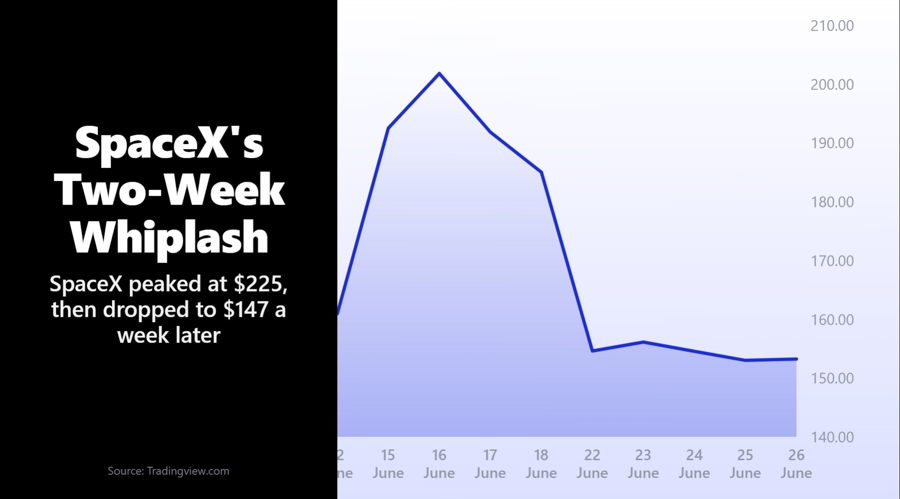
  • SPCX surged to $225.64 on June 16 before sliding to a $147.11 low on June 23, a swing tied to a free float of only about 5%.
  • The volatility lands as CFD brokers add SpaceX with leverage, amplifying both the gains and the losses on one of the year's most traded names.
spacex cfd

SpaceX shares traded near $153 on the letast close, down about 32% from the all-time high of $225.64 they reached on June 16. The pullback caps a volatile first two weeks for the most heavily traded new listing of 2026, and it has handed early buyers sharp losses after an equally sharp run higher.

The company went public on June 12 in the largest IPO on record, pricing at $135 a share and raising roughly $75 billion at a valuation of about $1.77 trillion. The stock opened at $160.95, touched $176.52 intraday, and closed its first session at $161.11, up 19%.

Thin Float Amplifies Every Move

SpaceX shares traded near $153 on Monday, down about 32% from the all-time high of $225.64 they reached on June 16. The pullback caps a volatile first two weeks for the most heavily traded new listing of 2026, and it has handed early buyers sharp losses after an equally sharp run higher.

The company went public on June 12 in the largest IPO on record, pricing at $135 a share and raising roughly $75 billion at a valuation of about $1.77 trillion. The stock opened at $160.95, touched $176.52 intraday, and closed its first session at $161.11, up 19%.

Much of the turbulence traces back to supply. Only about 5% of SpaceX's total shares are available for trading, according to market data, leaving the price sensitive to relatively small shifts in demand.

That scarcity helped lift the stock to its peak on June 16, the same day several brokers rolled out SpaceX products. It also worked in reverse. By June 23, SPCX had fallen to an all-time low of $147.11, and its market value slipped to about $2.02 trillion, down roughly 16.5% over the week.

Turnover was heavy from the start. On its debut, 522 million shares changed hands, the highest of any non-penny stock that session and more than the five busiest S&P 500 names combined, the second-largest IPO-day volume in Nasdaq history.

How Brokers Put SpaceX in Retail Hands

For most of its existence SpaceX was off-limits to retail investors, which left brokers competing to offer exposure the moment it listed. Plus500 added the stock as the first name in its 24/5 CFD rollout, framing round-the-clock access as a response to client demand.

CMC Markets and Binance moved on the same day to put the stock in front of retail clients through different products.

The access routes are not identical. Before the listing, Finance Magnates mapped three separate ways to get SpaceX exposure, from direct shares to derivatives and tokens. Robinhood had earlier offered tokenized SpaceX and OpenAI exposure in Europe through a special-purpose vehicle, a structure that later drew regulatory scrutiny and a public distancing from OpenAI.

The Leverage Math for CFD Traders

The CFD format brokers used to list SpaceX lets traders go both long and short and apply leverage, with some firms offering up to 1:20. On a stock moving this fast, that magnifies losses as readily as gains.

Options on SPCX began trading on June 16 with at-the-money implied volatility near 169% on the shortest weekly expiry, easing to about 78% on longer-dated contracts, a sign of how wide traders expect the price to swing. Market makers sought elevated premiums to take the other side.

Industry disclosures show that between 74% and 89% of retail investor accounts lose money trading CFDs. A thin float and triple-digit implied volatility raise the stakes on any leveraged position in the name. The trade-offs between CFDs and other access routes are something FM has examined before.

More Supply Is Coming

The next test is supply. Fidelity allowed IPO buyers to sell from June 27, and other brokerages open the door from July 12, which could add selling pressure as early allocations unlock.

Working the other way, SpaceX is expected to enter the Nasdaq-100, a move that would force index funds to buy the shares. Analysts tracking the stock carry an average 12-month target of $187.80, with estimates ranging from $62 to $310, according to data compiled from brokerage research.

SpaceX shares traded near $153 on the letast close, down about 32% from the all-time high of $225.64 they reached on June 16. The pullback caps a volatile first two weeks for the most heavily traded new listing of 2026, and it has handed early buyers sharp losses after an equally sharp run higher.

The company went public on June 12 in the largest IPO on record, pricing at $135 a share and raising roughly $75 billion at a valuation of about $1.77 trillion. The stock opened at $160.95, touched $176.52 intraday, and closed its first session at $161.11, up 19%.

Thin Float Amplifies Every Move

SpaceX shares traded near $153 on Monday, down about 32% from the all-time high of $225.64 they reached on June 16. The pullback caps a volatile first two weeks for the most heavily traded new listing of 2026, and it has handed early buyers sharp losses after an equally sharp run higher.

The company went public on June 12 in the largest IPO on record, pricing at $135 a share and raising roughly $75 billion at a valuation of about $1.77 trillion. The stock opened at $160.95, touched $176.52 intraday, and closed its first session at $161.11, up 19%.

Much of the turbulence traces back to supply. Only about 5% of SpaceX's total shares are available for trading, according to market data, leaving the price sensitive to relatively small shifts in demand.

That scarcity helped lift the stock to its peak on June 16, the same day several brokers rolled out SpaceX products. It also worked in reverse. By June 23, SPCX had fallen to an all-time low of $147.11, and its market value slipped to about $2.02 trillion, down roughly 16.5% over the week.

Turnover was heavy from the start. On its debut, 522 million shares changed hands, the highest of any non-penny stock that session and more than the five busiest S&P 500 names combined, the second-largest IPO-day volume in Nasdaq history.

How Brokers Put SpaceX in Retail Hands

For most of its existence SpaceX was off-limits to retail investors, which left brokers competing to offer exposure the moment it listed. Plus500 added the stock as the first name in its 24/5 CFD rollout, framing round-the-clock access as a response to client demand.

CMC Markets and Binance moved on the same day to put the stock in front of retail clients through different products.

The access routes are not identical. Before the listing, Finance Magnates mapped three separate ways to get SpaceX exposure, from direct shares to derivatives and tokens. Robinhood had earlier offered tokenized SpaceX and OpenAI exposure in Europe through a special-purpose vehicle, a structure that later drew regulatory scrutiny and a public distancing from OpenAI.

The Leverage Math for CFD Traders

The CFD format brokers used to list SpaceX lets traders go both long and short and apply leverage, with some firms offering up to 1:20. On a stock moving this fast, that magnifies losses as readily as gains.

Options on SPCX began trading on June 16 with at-the-money implied volatility near 169% on the shortest weekly expiry, easing to about 78% on longer-dated contracts, a sign of how wide traders expect the price to swing. Market makers sought elevated premiums to take the other side.

Industry disclosures show that between 74% and 89% of retail investor accounts lose money trading CFDs. A thin float and triple-digit implied volatility raise the stakes on any leveraged position in the name. The trade-offs between CFDs and other access routes are something FM has examined before.

More Supply Is Coming

The next test is supply. Fidelity allowed IPO buyers to sell from June 27, and other brokerages open the door from July 12, which could add selling pressure as early allocations unlock.

Working the other way, SpaceX is expected to enter the Nasdaq-100, a move that would force index funds to buy the shares. Analysts tracking the stock carry an average 12-month target of $187.80, with estimates ranging from $62 to $310, according to data compiled from brokerage research.

About the Author: Damian Chmiel
Damian Chmiel
  • 3685 Articles
  • 114 Followers
About the Author: Damian Chmiel
Damian Chmiel is a Senior Analyst & Editor at Finance Magnates with more than 15 years of experience in the CFD and online trading industry. Active as both a trader and journalist since 2010, he focuses on broker coverage, fintech innovation, and regulatory developments across Europe, the Middle East, and Asia. His work includes interviews with C-level leaders at major brokerages and fintech platforms, as well as co-authoring Finance Magnates’ quarterly industry benchmarking reports. Damian’s reporting is data-driven, market-aware, and grounded in direct industry engagement. His analysis and commentary have also been cited by external media outlets, including Investing.com, Binance, The Asset, Stockhead, and Dispatch. Education: MA in Finance and Accounting, Cracow University of Economics
  • 3685 Articles
  • 114 Followers

More from the Author

Trending

!"#$%&'()*+,-./0123456789:;<=>?@ABCDEFGHIJKLMNOPQRSTUVWXYZ[\]^_`abcdefghijklmnopqrstuvwxyz{|} !"#$%&'()*+,-./0123456789:;<=>?@ABCDEFGHIJKLMNOPQRSTUVWXYZ[\]^_`abcdefghijklmnopqrstuvwxyz{|}