Gold price extended losses fourth consecutive session to $3,972.30 (-0.71% Thursday, -4.14% from Friday $4,144).
Federal Reserve Chair Powell walked back December rate cut expectations during a Wednesday press conference, strengthening the dollar.
Bitcoin also declined a fourth session testing below $108,000 highlighting broad risk-asset weakness.
Why gold and Bitcoin prices are going down? Let's check the current technical analysis
Gold price extended
losses for a fourth consecutive session, trading today (Thursday), 30 October
2025, at $3,972.30 per ounce (-0.71%) after Federal Reserve (Fed) Chairman
Jerome Powell walked back market expectations for a December rate cut,
strengthening the dollar and pressuring precious metals.
The
extended selloff has pushed gold 8.9% below last Friday's $4,144 level, with
the metal testing $3,915 on Wednesday before Thursday's modest 0.8% rebound
failed to reclaim the psychologically critical $4,000 threshold.
The dollar
is strengthening, Bitcoin is also falling, and traders are asking why gold is
down today. In this article, I conduct technical analysis of the XAU/USD and
BTC/USDT charts to answer that question and review the latest gold price
predictions.
Why Gold Price Is Falling
Today? Fed's Powell Walks Back December Cut Expectations
The Federal
Reserve's rate cut Wednesday, while expected, came with hawkish commentary that
caught markets off guard. Peter Grant, VP and senior strategist at Zaner
Metals, noted: "Gold had a logical reaction to Powell trying to walk back
expectations for a December cut. We're already seeing Fed funds futures
trimming expectations, that would be dollar positive and gold negative."
The dollar
index surged to 99.36 following Powell's comments, one of the highest levels
since August, as traders reduced bets on another rate cut in December.
Yesterday's declines were mainly caused by dollar strengthening after the Fed's
rate cut decision, which boosted the DXY index to this elevated level.
Michał
Stajniak, analyst at XTB, also explained Wednesday's catalyst: "The Fed
decided to cut interest rates by 25 basis points to the 3.75-4.00% range, in
line with market expectations. Powell indicated during the press conference
that the December decision is not certain, and opinions among FOMC members are
strongly divided. EUR/USD retreated below 1.1600 after this information."
However, in
my view, the dollar will weaken in the longer perspective, which will also
translate into growth for both gold and Bitcoin. Nonetheless, in the short term
we can see some deepened correction.
Gold Price Analysis Shows
Bearish Pin Bar
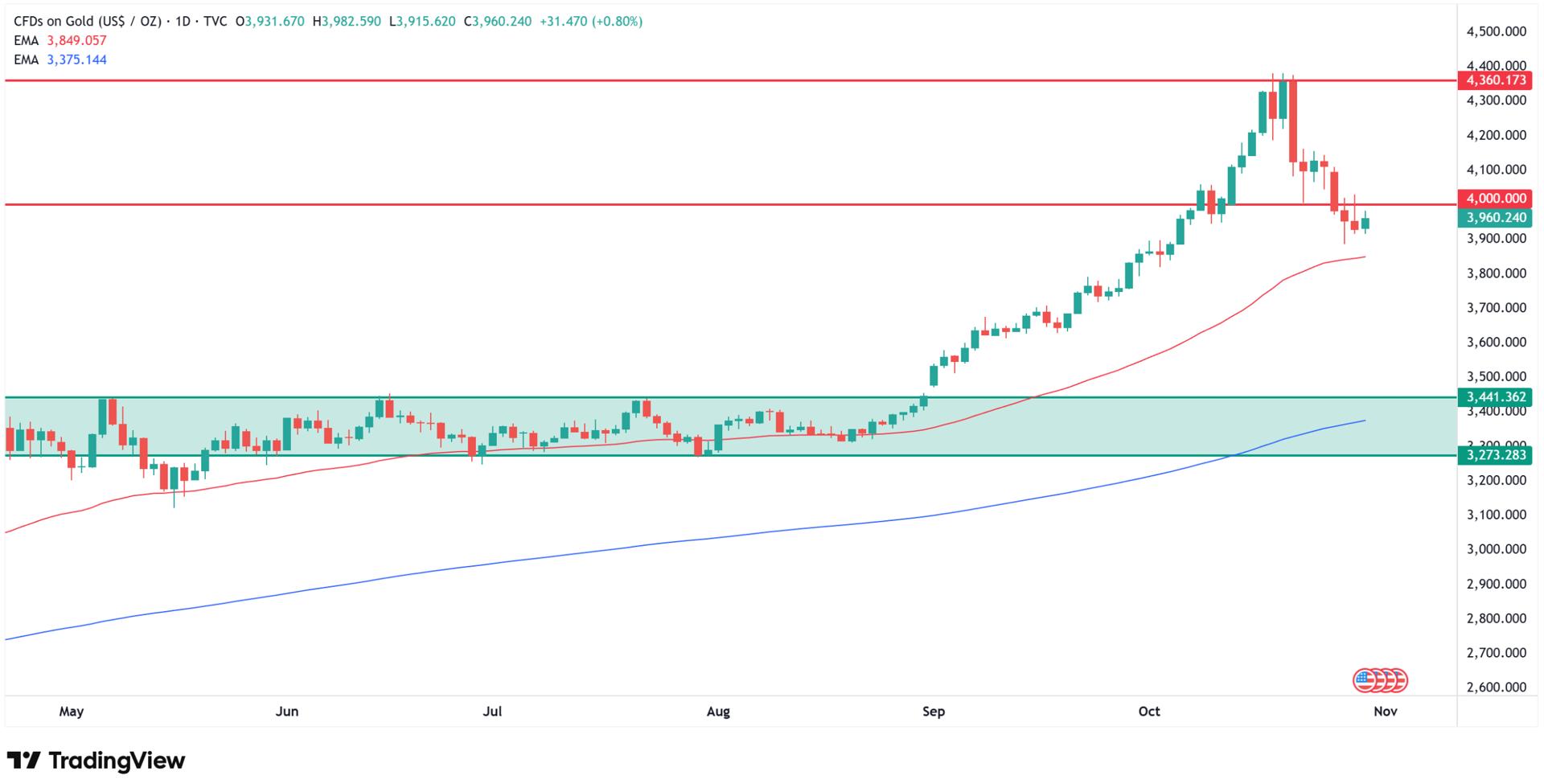
According
to my technical analysis, gold prices have now experienced four consecutive
declining sessions, correcting significantly from the $4,144 level observed
last Friday to $3,915 noted yesterday. Although Thursday, October 30, 2025
brings a modest rebound of 0.8% and a test of the $3,982 level per ounce,
precious metal prices remain below the psychological $4,000 barrier.
Simultaneously,
as my technical analysis shows, Wednesday drew a bearish pin bar on the daily
chart under this psychological resistance, which generates a sell signal and
the possibility of a stronger correction toward the support zone between $3,275
and $3,441, which I wrote about in my earlier analysis in this place. This zone
is simultaneously strengthened by the 200 EMA, and from current levels gold
could decline by 17%, as
I mentioned in my previous gold analysis.
How low can gold price go? Technical analysis of the XAU/USDT chart. Source: Tradingview.com
It's true
that gold still has the 50 EMA ahead of it, above which it has moved
continuously since the beginning of 2025. Historically, however, this average
has not proven to be as strong support as the aforementioned 200-day indicator.
The 50-day moving average currently sits at $3,776.45, representing the first
major technical test if the current correction extends.
Unlike
gold, on the BTC/USDT chart I would expect a chance for a rebound and, in the
medium term, a return to the vicinity of the ATH around $126,000, which would
certainly also help gold. For that matter, on gold, like analysts at major
banks, I also forecast a return to the price discovery phase in the medium
term.
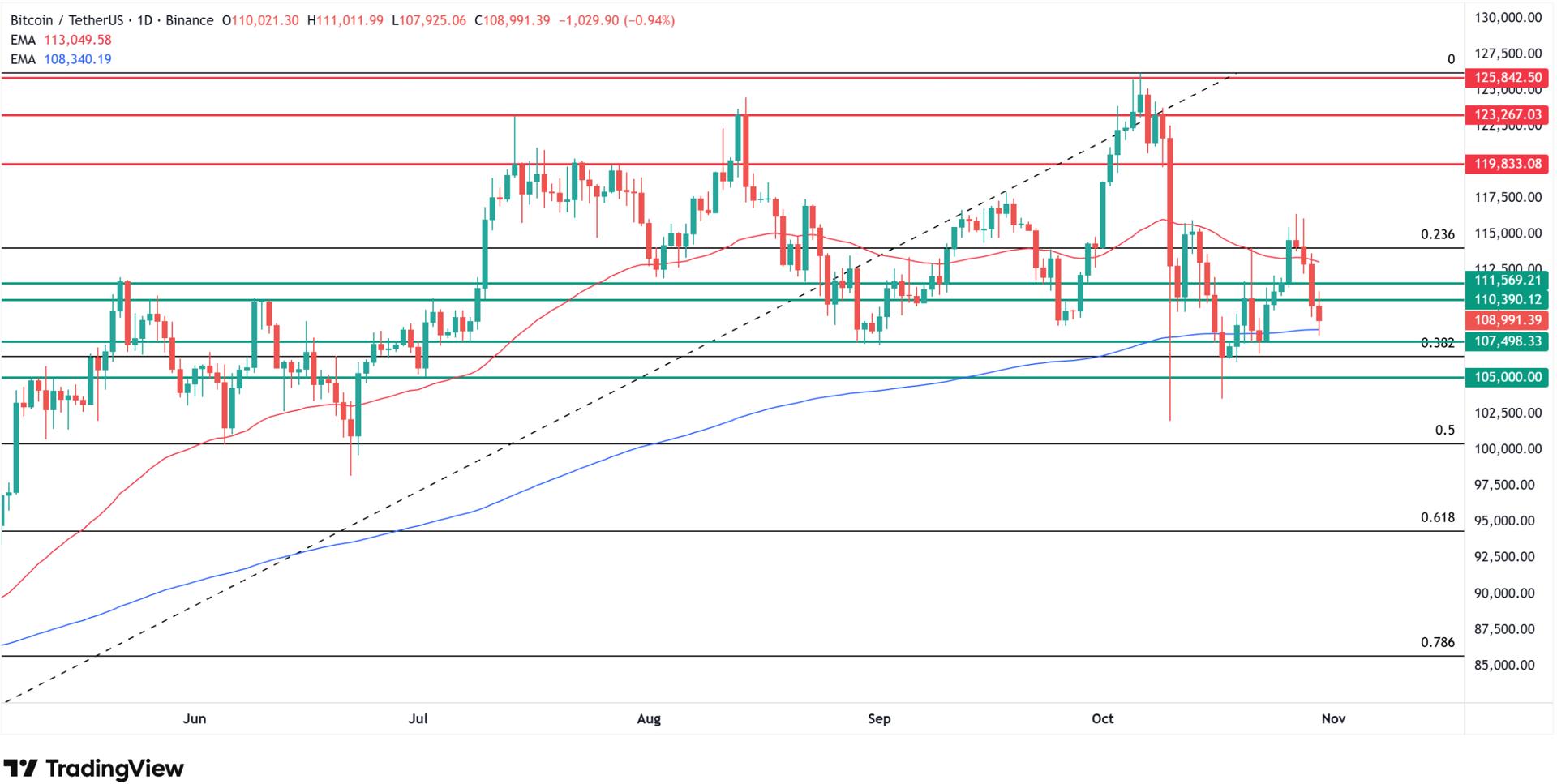
The
parallel weakness in both gold and Bitcoin, each declining for four consecutive
sessions, highlights a broader risk-asset rotation rather than isolated
precious metal weakness. Bitcoin testing support below $110,000 and finding
buyers at the 200 EMA zone suggests digital assets face similar technical
pressure as traditional safe-havens.
Bitcoin price today is also falling. Source: Tradingview.com
The
correlation between these assets typically strengthens during periods of dollar
strength, as witnessed following Powell's hawkish Wednesday comments. Volume in
gold futures surged to 64,749 contracts, 34 times the average of 1,879, indicating
heavy institutional selling pressure and potential capitulation among leveraged
traders.
Despite the
near-term bearish technical setup, major financial institutions maintain
aggressively bullish medium-term forecasts. JP Morgan projects gold averaging
$5,055 per ounce by Q4 2026, a 27% premium to current $3,972 levels, while Goldman
Sachs targets $4,900 by December 2026, representing 23% upside.
These
institutional forecasts provide important context for the current 4-day
decline. While technical indicators suggest potential for further near-term
weakness toward the $3,776 or even $3,275-$3,441 support zones, the strategic
outlook remains positive based on structural demand drivers that transcend
short-term Fed policy uncertainty or dollar strength.
Morgan
Stanley recently revised its 2026 forecast upward to $4,400 per ounce, while
Metals Focus sees gold reaching $5,000 in 2026 as uncertainty persists across
global markets. The convergence of these bullish institutional views, all
significantly above current spot prices, suggests sophisticated analysts view
the correction as a buying opportunity rather than the start of a prolonged
bear market.
Before you leave, please also check my previous analysis with Bitcoin and gold price predictions:
Gold
declined fourth consecutive session to $3,972.30 (-0.71% Thursday, -4.14% from
Friday $4,144) triggered by Federal Reserve Chair Powell walking back December
rate cut expectations during Wednesday press conference, strengthening dollar
to 99.36 (highest since August), with Peter Grant (Zaner Metals) noting
"Powell trying to walk back expectations for December cut" proving
"dollar positive and gold negative," while bearish pin bar formed
under $4,000 resistance generating technical sell signal.
Is gold crash over or will
it continue declining?
No. According
to my technical analysis, Wednesday's bearish pin bar under $4,000
psychological resistance generates sell signal with potential 17% downside
toward $3,275-$3,441 support zone (200 EMA confluence), though 50 EMA at $3,776
represents first major test, with RSI remaining elevated suggesting correction
incomplete, but everything above 200 EMA maintains uptrend definition and JP
Morgan/Goldman Sachs forecasts $4,900-$5,055 by 2026 viewing weakness as buying
opportunity.
How low will gold prices
go in 2025?
My
technical analysis identifies first downside target at 50-day EMA $3,776.45 (5%
below current $3,972), with main support zone $3,275-$3,441 coinciding with
200-day EMA $3,316 representing 17% decline potential, though volume surge to
64,749 (34x average) suggests capitulation may be approaching, while long-term
forecasts remain bullish with Trading Economics $4,157 Q4 2025, Goldman Sachs
$4,900 Dec 2026, JP Morgan $5,055 Q4 2026.
Why are Bitcoin and gold
both falling?
Bitcoin
declined fourth consecutive session testing below $108,000 alongside gold's
parallel weakness, with both assets pressured by dollar strength (DXY 99.36
after Powell's hawkish comments) indicating broad risk-asset rotation, though
my analysis expects Bitcoin chance for rebound toward $126,000 ATH in medium
term which would help gold, as longer perspective dollar weakness from Fed
easing bias and fiscal deficits will translate into growth for both gold and
Bitcoin.
Gold price extended
losses for a fourth consecutive session, trading today (Thursday), 30 October
2025, at $3,972.30 per ounce (-0.71%) after Federal Reserve (Fed) Chairman
Jerome Powell walked back market expectations for a December rate cut,
strengthening the dollar and pressuring precious metals.
The
extended selloff has pushed gold 8.9% below last Friday's $4,144 level, with
the metal testing $3,915 on Wednesday before Thursday's modest 0.8% rebound
failed to reclaim the psychologically critical $4,000 threshold.
The dollar
is strengthening, Bitcoin is also falling, and traders are asking why gold is
down today. In this article, I conduct technical analysis of the XAU/USD and
BTC/USDT charts to answer that question and review the latest gold price
predictions.
Why Gold Price Is Falling
Today? Fed's Powell Walks Back December Cut Expectations
The Federal
Reserve's rate cut Wednesday, while expected, came with hawkish commentary that
caught markets off guard. Peter Grant, VP and senior strategist at Zaner
Metals, noted: "Gold had a logical reaction to Powell trying to walk back
expectations for a December cut. We're already seeing Fed funds futures
trimming expectations, that would be dollar positive and gold negative."
The dollar
index surged to 99.36 following Powell's comments, one of the highest levels
since August, as traders reduced bets on another rate cut in December.
Yesterday's declines were mainly caused by dollar strengthening after the Fed's
rate cut decision, which boosted the DXY index to this elevated level.
Michał
Stajniak, analyst at XTB, also explained Wednesday's catalyst: "The Fed
decided to cut interest rates by 25 basis points to the 3.75-4.00% range, in
line with market expectations. Powell indicated during the press conference
that the December decision is not certain, and opinions among FOMC members are
strongly divided. EUR/USD retreated below 1.1600 after this information."
However, in
my view, the dollar will weaken in the longer perspective, which will also
translate into growth for both gold and Bitcoin. Nonetheless, in the short term
we can see some deepened correction.
Gold Price Analysis Shows
Bearish Pin Bar
According
to my technical analysis, gold prices have now experienced four consecutive
declining sessions, correcting significantly from the $4,144 level observed
last Friday to $3,915 noted yesterday. Although Thursday, October 30, 2025
brings a modest rebound of 0.8% and a test of the $3,982 level per ounce,
precious metal prices remain below the psychological $4,000 barrier.
Simultaneously,
as my technical analysis shows, Wednesday drew a bearish pin bar on the daily
chart under this psychological resistance, which generates a sell signal and
the possibility of a stronger correction toward the support zone between $3,275
and $3,441, which I wrote about in my earlier analysis in this place. This zone
is simultaneously strengthened by the 200 EMA, and from current levels gold
could decline by 17%, as
I mentioned in my previous gold analysis.
How low can gold price go? Technical analysis of the XAU/USDT chart. Source: Tradingview.com
It's true
that gold still has the 50 EMA ahead of it, above which it has moved
continuously since the beginning of 2025. Historically, however, this average
has not proven to be as strong support as the aforementioned 200-day indicator.
The 50-day moving average currently sits at $3,776.45, representing the first
major technical test if the current correction extends.
Unlike
gold, on the BTC/USDT chart I would expect a chance for a rebound and, in the
medium term, a return to the vicinity of the ATH around $126,000, which would
certainly also help gold. For that matter, on gold, like analysts at major
banks, I also forecast a return to the price discovery phase in the medium
term.
The
parallel weakness in both gold and Bitcoin, each declining for four consecutive
sessions, highlights a broader risk-asset rotation rather than isolated
precious metal weakness. Bitcoin testing support below $110,000 and finding
buyers at the 200 EMA zone suggests digital assets face similar technical
pressure as traditional safe-havens.
Bitcoin price today is also falling. Source: Tradingview.com
The
correlation between these assets typically strengthens during periods of dollar
strength, as witnessed following Powell's hawkish Wednesday comments. Volume in
gold futures surged to 64,749 contracts, 34 times the average of 1,879, indicating
heavy institutional selling pressure and potential capitulation among leveraged
traders.
Despite the
near-term bearish technical setup, major financial institutions maintain
aggressively bullish medium-term forecasts. JP Morgan projects gold averaging
$5,055 per ounce by Q4 2026, a 27% premium to current $3,972 levels, while Goldman
Sachs targets $4,900 by December 2026, representing 23% upside.
These
institutional forecasts provide important context for the current 4-day
decline. While technical indicators suggest potential for further near-term
weakness toward the $3,776 or even $3,275-$3,441 support zones, the strategic
outlook remains positive based on structural demand drivers that transcend
short-term Fed policy uncertainty or dollar strength.
Morgan
Stanley recently revised its 2026 forecast upward to $4,400 per ounce, while
Metals Focus sees gold reaching $5,000 in 2026 as uncertainty persists across
global markets. The convergence of these bullish institutional views, all
significantly above current spot prices, suggests sophisticated analysts view
the correction as a buying opportunity rather than the start of a prolonged
bear market.
Before you leave, please also check my previous analysis with Bitcoin and gold price predictions:
Gold
declined fourth consecutive session to $3,972.30 (-0.71% Thursday, -4.14% from
Friday $4,144) triggered by Federal Reserve Chair Powell walking back December
rate cut expectations during Wednesday press conference, strengthening dollar
to 99.36 (highest since August), with Peter Grant (Zaner Metals) noting
"Powell trying to walk back expectations for December cut" proving
"dollar positive and gold negative," while bearish pin bar formed
under $4,000 resistance generating technical sell signal.
Is gold crash over or will
it continue declining?
No. According
to my technical analysis, Wednesday's bearish pin bar under $4,000
psychological resistance generates sell signal with potential 17% downside
toward $3,275-$3,441 support zone (200 EMA confluence), though 50 EMA at $3,776
represents first major test, with RSI remaining elevated suggesting correction
incomplete, but everything above 200 EMA maintains uptrend definition and JP
Morgan/Goldman Sachs forecasts $4,900-$5,055 by 2026 viewing weakness as buying
opportunity.
How low will gold prices
go in 2025?
My
technical analysis identifies first downside target at 50-day EMA $3,776.45 (5%
below current $3,972), with main support zone $3,275-$3,441 coinciding with
200-day EMA $3,316 representing 17% decline potential, though volume surge to
64,749 (34x average) suggests capitulation may be approaching, while long-term
forecasts remain bullish with Trading Economics $4,157 Q4 2025, Goldman Sachs
$4,900 Dec 2026, JP Morgan $5,055 Q4 2026.
Why are Bitcoin and gold
both falling?
Bitcoin
declined fourth consecutive session testing below $108,000 alongside gold's
parallel weakness, with both assets pressured by dollar strength (DXY 99.36
after Powell's hawkish comments) indicating broad risk-asset rotation, though
my analysis expects Bitcoin chance for rebound toward $126,000 ATH in medium
term which would help gold, as longer perspective dollar weakness from Fed
easing bias and fiscal deficits will translate into growth for both gold and
Bitcoin.
Damian Chmiel is a Senior Analyst & Editor at Finance Magnates with more than 15 years of experience in the CFD and online trading industry. Active as both a trader and journalist since 2010, he focuses on broker coverage, fintech innovation, and regulatory developments across Europe, the Middle East, and Asia.
His work includes interviews with C-level leaders at major brokerages and fintech platforms, as well as co-authoring Finance Magnates’ quarterly industry benchmarking reports. Damian’s reporting is data-driven, market-aware, and grounded in direct industry engagement. His analysis and commentary have also been cited by external media outlets, including Investing.com, Binance, The Asset, Stockhead, and Dispatch.
Education:
MA in Finance and Accounting, Cracow University of Economics
Inside the Prediction Markets: $1.6B Institutional Inflow Meets a Federal Crackdown
Featured Videos
FP Markets Winner Spotlight 🏆 | Global Broker of the Year 2025 #Trading #Broker #Innovation #Shorts
FP Markets Winner Spotlight 🏆 | Global Broker of the Year 2025 #Trading #Broker #Innovation #Shorts
FP Markets Winner Spotlight 🏆 | Global Broker of the Year 2025 #Trading #Broker #Innovation #Shorts
FP Markets Winner Spotlight 🏆 | Global Broker of the Year 2025 #Trading #Broker #Innovation #Shorts
FP Markets takes the spotlight as Global Broker of the Year 2025 at the Finance Magnates Awards.
Martin Stoilov, Head of Client Experience, shares that trust, innovation, and people played a key role in the company’s success, supported by a strong foundation of integrity and client-centricity.
Following this milestone, FP Markets continues to focus on growth, technology investment, and its core values of transparency and excellence.
👉 Be part of FM Awards 2026: https://awards.financemagnates.com/#nominate
FP Markets takes the spotlight as Global Broker of the Year 2025 at the Finance Magnates Awards.
Martin Stoilov, Head of Client Experience, shares that trust, innovation, and people played a key role in the company’s success, supported by a strong foundation of integrity and client-centricity.
Following this milestone, FP Markets continues to focus on growth, technology investment, and its core values of transparency and excellence.
👉 Be part of FM Awards 2026: https://awards.financemagnates.com/#nominate
FP Markets takes the spotlight as Global Broker of the Year 2025 at the Finance Magnates Awards.
Martin Stoilov, Head of Client Experience, shares that trust, innovation, and people played a key role in the company’s success, supported by a strong foundation of integrity and client-centricity.
Following this milestone, FP Markets continues to focus on growth, technology investment, and its core values of transparency and excellence.
👉 Be part of FM Awards 2026: https://awards.financemagnates.com/#nominate
FP Markets takes the spotlight as Global Broker of the Year 2025 at the Finance Magnates Awards.
Martin Stoilov, Head of Client Experience, shares that trust, innovation, and people played a key role in the company’s success, supported by a strong foundation of integrity and client-centricity.
Following this milestone, FP Markets continues to focus on growth, technology investment, and its core values of transparency and excellence.
👉 Be part of FM Awards 2026: https://awards.financemagnates.com/#nominate
In this video, we review @HolaPrimeMarketsOfficial, a multi-asset forex and CFDs broker offering different account types, trading platforms, and flexible trading conditions.
We cover the broker’s overall offering, including account options, trading environment, platforms like MT4 and MT5, and additional services such as managed accounts and fast withdrawals.
Watch the full video to see if Hola Prime Markets fits your trading needs.
📣 Stay up to date with the latest in finance and trading. Follow Finance Magnates for industry news, insights, and global event coverage.
Connect with us:
🔗 LinkedIn: /financemagnates
👍 Facebook: /financemagnates
📸 Instagram: https://www.instagram.com/financemagnates
🐦 X: https://x.com/financemagnates
🎥 TikTok: https://www.tiktok.com/tag/financemagnates
▶️ YouTube: /@financemagnates_official
#HolaPrime #ForexBroker #CFDTrading #FinanceMagnates #Trading #Forex #BrokerReview
In this video, we review @HolaPrimeMarketsOfficial, a multi-asset forex and CFDs broker offering different account types, trading platforms, and flexible trading conditions.
We cover the broker’s overall offering, including account options, trading environment, platforms like MT4 and MT5, and additional services such as managed accounts and fast withdrawals.
Watch the full video to see if Hola Prime Markets fits your trading needs.
📣 Stay up to date with the latest in finance and trading. Follow Finance Magnates for industry news, insights, and global event coverage.
Connect with us:
🔗 LinkedIn: /financemagnates
👍 Facebook: /financemagnates
📸 Instagram: https://www.instagram.com/financemagnates
🐦 X: https://x.com/financemagnates
🎥 TikTok: https://www.tiktok.com/tag/financemagnates
▶️ YouTube: /@financemagnates_official
#HolaPrime #ForexBroker #CFDTrading #FinanceMagnates #Trading #Forex #BrokerReview
In this video, we review @HolaPrimeMarketsOfficial, a multi-asset forex and CFDs broker offering different account types, trading platforms, and flexible trading conditions.
We cover the broker’s overall offering, including account options, trading environment, platforms like MT4 and MT5, and additional services such as managed accounts and fast withdrawals.
Watch the full video to see if Hola Prime Markets fits your trading needs.
📣 Stay up to date with the latest in finance and trading. Follow Finance Magnates for industry news, insights, and global event coverage.
Connect with us:
🔗 LinkedIn: /financemagnates
👍 Facebook: /financemagnates
📸 Instagram: https://www.instagram.com/financemagnates
🐦 X: https://x.com/financemagnates
🎥 TikTok: https://www.tiktok.com/tag/financemagnates
▶️ YouTube: /@financemagnates_official
#HolaPrime #ForexBroker #CFDTrading #FinanceMagnates #Trading #Forex #BrokerReview
In this video, we review @HolaPrimeMarketsOfficial, a multi-asset forex and CFDs broker offering different account types, trading platforms, and flexible trading conditions.
We cover the broker’s overall offering, including account options, trading environment, platforms like MT4 and MT5, and additional services such as managed accounts and fast withdrawals.
Watch the full video to see if Hola Prime Markets fits your trading needs.
📣 Stay up to date with the latest in finance and trading. Follow Finance Magnates for industry news, insights, and global event coverage.
Connect with us:
🔗 LinkedIn: /financemagnates
👍 Facebook: /financemagnates
📸 Instagram: https://www.instagram.com/financemagnates
🐦 X: https://x.com/financemagnates
🎥 TikTok: https://www.tiktok.com/tag/financemagnates
▶️ YouTube: /@financemagnates_official
#HolaPrime #ForexBroker #CFDTrading #FinanceMagnates #Trading #Forex #BrokerReview
In this video, we review @HolaPrimeMarketsOfficial, a multi-asset forex and CFDs broker offering different account types, trading platforms, and flexible trading conditions.
We cover the broker’s overall offering, including account options, trading environment, platforms like MT4 and MT5, and additional services such as managed accounts and fast withdrawals.
Watch the full video to see if Hola Prime Markets fits your trading needs.
📣 Stay up to date with the latest in finance and trading. Follow Finance Magnates for industry news, insights, and global event coverage.
Connect with us:
🔗 LinkedIn: /financemagnates
👍 Facebook: /financemagnates
📸 Instagram: https://www.instagram.com/financemagnates
🐦 X: https://x.com/financemagnates
🎥 TikTok: https://www.tiktok.com/tag/financemagnates
▶️ YouTube: /@financemagnates_official
#HolaPrime #ForexBroker #CFDTrading #FinanceMagnates #Trading #Forex #BrokerReview
In this video, we review @HolaPrimeMarketsOfficial, a multi-asset forex and CFDs broker offering different account types, trading platforms, and flexible trading conditions.
We cover the broker’s overall offering, including account options, trading environment, platforms like MT4 and MT5, and additional services such as managed accounts and fast withdrawals.
Watch the full video to see if Hola Prime Markets fits your trading needs.
📣 Stay up to date with the latest in finance and trading. Follow Finance Magnates for industry news, insights, and global event coverage.
Connect with us:
🔗 LinkedIn: /financemagnates
👍 Facebook: /financemagnates
📸 Instagram: https://www.instagram.com/financemagnates
🐦 X: https://x.com/financemagnates
🎥 TikTok: https://www.tiktok.com/tag/financemagnates
▶️ YouTube: /@financemagnates_official
#HolaPrime #ForexBroker #CFDTrading #FinanceMagnates #Trading #Forex #BrokerReview
Hola Prime Review: What You Need to Know | Full Breakdown by Finance Magnates
Hola Prime Review: What You Need to Know | Full Breakdown by Finance Magnates
Hola Prime Review: What You Need to Know | Full Breakdown by Finance Magnates
Hola Prime Review: What You Need to Know | Full Breakdown by Finance Magnates
Hola Prime Review: What You Need to Know | Full Breakdown by Finance Magnates
Hola Prime Review: What You Need to Know | Full Breakdown by Finance Magnates
In this video, we review @HolaPrime_Global, a proprietary trading firm offering evaluation programs and performance-based payouts in simulated market environments.
We cover how the challenge model works, including account types, profit splits (up to 95%), trading rules, and what it takes to reach a funded account. You’ll also learn about available platforms like MT4, MT5, cTrader, and more, along with insights into payouts, support, and trading conditions.
Watch the full video to see if Hola Prime fits your trading style.
📣 Stay up to date with the latest in finance and trading. Follow Finance Magnates for industry news, insights, and global event coverage.
Connect with us:
🔗 LinkedIn: /financemagnates
👍 Facebook: /financemagnates
📸 Instagram: https://www.instagram.com/financemagnates
🐦 X: https://x.com/financemagnates
🎥 TikTok: https://www.tiktok.com/tag/financemagnates
▶️ YouTube: /@financemagnates_official
#HolaPrime #PropFirm #Trading #FinanceMagnates #Forex #FuturesTrading #TradingReview #PropFirmReview
In this video, we review @HolaPrime_Global, a proprietary trading firm offering evaluation programs and performance-based payouts in simulated market environments.
We cover how the challenge model works, including account types, profit splits (up to 95%), trading rules, and what it takes to reach a funded account. You’ll also learn about available platforms like MT4, MT5, cTrader, and more, along with insights into payouts, support, and trading conditions.
Watch the full video to see if Hola Prime fits your trading style.
📣 Stay up to date with the latest in finance and trading. Follow Finance Magnates for industry news, insights, and global event coverage.
Connect with us:
🔗 LinkedIn: /financemagnates
👍 Facebook: /financemagnates
📸 Instagram: https://www.instagram.com/financemagnates
🐦 X: https://x.com/financemagnates
🎥 TikTok: https://www.tiktok.com/tag/financemagnates
▶️ YouTube: /@financemagnates_official
#HolaPrime #PropFirm #Trading #FinanceMagnates #Forex #FuturesTrading #TradingReview #PropFirmReview
In this video, we review @HolaPrime_Global, a proprietary trading firm offering evaluation programs and performance-based payouts in simulated market environments.
We cover how the challenge model works, including account types, profit splits (up to 95%), trading rules, and what it takes to reach a funded account. You’ll also learn about available platforms like MT4, MT5, cTrader, and more, along with insights into payouts, support, and trading conditions.
Watch the full video to see if Hola Prime fits your trading style.
📣 Stay up to date with the latest in finance and trading. Follow Finance Magnates for industry news, insights, and global event coverage.
Connect with us:
🔗 LinkedIn: /financemagnates
👍 Facebook: /financemagnates
📸 Instagram: https://www.instagram.com/financemagnates
🐦 X: https://x.com/financemagnates
🎥 TikTok: https://www.tiktok.com/tag/financemagnates
▶️ YouTube: /@financemagnates_official
#HolaPrime #PropFirm #Trading #FinanceMagnates #Forex #FuturesTrading #TradingReview #PropFirmReview
In this video, we review @HolaPrime_Global, a proprietary trading firm offering evaluation programs and performance-based payouts in simulated market environments.
We cover how the challenge model works, including account types, profit splits (up to 95%), trading rules, and what it takes to reach a funded account. You’ll also learn about available platforms like MT4, MT5, cTrader, and more, along with insights into payouts, support, and trading conditions.
Watch the full video to see if Hola Prime fits your trading style.
📣 Stay up to date with the latest in finance and trading. Follow Finance Magnates for industry news, insights, and global event coverage.
Connect with us:
🔗 LinkedIn: /financemagnates
👍 Facebook: /financemagnates
📸 Instagram: https://www.instagram.com/financemagnates
🐦 X: https://x.com/financemagnates
🎥 TikTok: https://www.tiktok.com/tag/financemagnates
▶️ YouTube: /@financemagnates_official
#HolaPrime #PropFirm #Trading #FinanceMagnates #Forex #FuturesTrading #TradingReview #PropFirmReview
In this video, we review @HolaPrime_Global, a proprietary trading firm offering evaluation programs and performance-based payouts in simulated market environments.
We cover how the challenge model works, including account types, profit splits (up to 95%), trading rules, and what it takes to reach a funded account. You’ll also learn about available platforms like MT4, MT5, cTrader, and more, along with insights into payouts, support, and trading conditions.
Watch the full video to see if Hola Prime fits your trading style.
📣 Stay up to date with the latest in finance and trading. Follow Finance Magnates for industry news, insights, and global event coverage.
Connect with us:
🔗 LinkedIn: /financemagnates
👍 Facebook: /financemagnates
📸 Instagram: https://www.instagram.com/financemagnates
🐦 X: https://x.com/financemagnates
🎥 TikTok: https://www.tiktok.com/tag/financemagnates
▶️ YouTube: /@financemagnates_official
#HolaPrime #PropFirm #Trading #FinanceMagnates #Forex #FuturesTrading #TradingReview #PropFirmReview
In this video, we review @HolaPrime_Global, a proprietary trading firm offering evaluation programs and performance-based payouts in simulated market environments.
We cover how the challenge model works, including account types, profit splits (up to 95%), trading rules, and what it takes to reach a funded account. You’ll also learn about available platforms like MT4, MT5, cTrader, and more, along with insights into payouts, support, and trading conditions.
Watch the full video to see if Hola Prime fits your trading style.
📣 Stay up to date with the latest in finance and trading. Follow Finance Magnates for industry news, insights, and global event coverage.
Connect with us:
🔗 LinkedIn: /financemagnates
👍 Facebook: /financemagnates
📸 Instagram: https://www.instagram.com/financemagnates
🐦 X: https://x.com/financemagnates
🎥 TikTok: https://www.tiktok.com/tag/financemagnates
▶️ YouTube: /@financemagnates_official
#HolaPrime #PropFirm #Trading #FinanceMagnates #Forex #FuturesTrading #TradingReview #PropFirmReview
Axi Winner Spotlight 🏆 | Global Most Innovative Broker 2025 #Innovation #Trading #Fintech #Broker
Axi Winner Spotlight 🏆 | Global Most Innovative Broker 2025 #Innovation #Trading #Fintech #Broker
Axi Winner Spotlight 🏆 | Global Most Innovative Broker 2025 #Innovation #Trading #Fintech #Broker
Axi Winner Spotlight 🏆 | Global Most Innovative Broker 2025 #Innovation #Trading #Fintech #Broker
Axi Winner Spotlight 🏆 | Global Most Innovative Broker 2025 #Innovation #Trading #Fintech #Broker
Axi Winner Spotlight 🏆 | Global Most Innovative Broker 2025 #Innovation #Trading #Fintech #Broker
Axi takes the spotlight at the Finance Magnates Awards, winning Global Most Innovative Broker 2025.
Olivia Xenofontos and Ivanna Openko share how the team will feel: proud, motivated, and ready to keep delivering.
They also describe the night as well-organized, focused, and enjoyable for all.
👉 Be part of FM Awards 2026.
Axi takes the spotlight at the Finance Magnates Awards, winning Global Most Innovative Broker 2025.
Olivia Xenofontos and Ivanna Openko share how the team will feel: proud, motivated, and ready to keep delivering.
They also describe the night as well-organized, focused, and enjoyable for all.
👉 Be part of FM Awards 2026.
Axi takes the spotlight at the Finance Magnates Awards, winning Global Most Innovative Broker 2025.
Olivia Xenofontos and Ivanna Openko share how the team will feel: proud, motivated, and ready to keep delivering.
They also describe the night as well-organized, focused, and enjoyable for all.
👉 Be part of FM Awards 2026.
Axi takes the spotlight at the Finance Magnates Awards, winning Global Most Innovative Broker 2025.
Olivia Xenofontos and Ivanna Openko share how the team will feel: proud, motivated, and ready to keep delivering.
They also describe the night as well-organized, focused, and enjoyable for all.
👉 Be part of FM Awards 2026.
Axi takes the spotlight at the Finance Magnates Awards, winning Global Most Innovative Broker 2025.
Olivia Xenofontos and Ivanna Openko share how the team will feel: proud, motivated, and ready to keep delivering.
They also describe the night as well-organized, focused, and enjoyable for all.
👉 Be part of FM Awards 2026.
Axi takes the spotlight at the Finance Magnates Awards, winning Global Most Innovative Broker 2025.
Olivia Xenofontos and Ivanna Openko share how the team will feel: proud, motivated, and ready to keep delivering.
They also describe the night as well-organized, focused, and enjoyable for all.
👉 Be part of FM Awards 2026.
Recognition that matters.
Built on transparency.
Driven by the industry.
The Finance Magnates Awards 2026.
Nominations are now open.
🔗 https://awards.financemagnates.com/?utm_source=SM&utm_medium=social&utm_campaign=recognition-matters
Recognition that matters.
Built on transparency.
Driven by the industry.
The Finance Magnates Awards 2026.
Nominations are now open.
🔗 https://awards.financemagnates.com/?utm_source=SM&utm_medium=social&utm_campaign=recognition-matters
Recognition that matters.
Built on transparency.
Driven by the industry.
The Finance Magnates Awards 2026.
Nominations are now open.
🔗 https://awards.financemagnates.com/?utm_source=SM&utm_medium=social&utm_campaign=recognition-matters
Recognition that matters.
Built on transparency.
Driven by the industry.
The Finance Magnates Awards 2026.
Nominations are now open.
🔗 https://awards.financemagnates.com/?utm_source=SM&utm_medium=social&utm_campaign=recognition-matters
Recognition that matters.
Built on transparency.
Driven by the industry.
The Finance Magnates Awards 2026.
Nominations are now open.
🔗 https://awards.financemagnates.com/?utm_source=SM&utm_medium=social&utm_campaign=recognition-matters
Recognition that matters.
Built on transparency.
Driven by the industry.
The Finance Magnates Awards 2026.
Nominations are now open.
🔗 https://awards.financemagnates.com/?utm_source=SM&utm_medium=social&utm_campaign=recognition-matters