Ethereum price today stalled at a resistance level defined by this year’s highs.
However, my technical analysis suggests that, given the right fundamental setup, we could soon enter a new phase of price discovery.
Some analysts' Ethereum price prediction shows the token could climb to $7,000 in this cycle, or even surpass $16,000.
Why is Ethereum surging today? Check tecnical and fundamental analysis and price predictions
Ethereum
(ETH) price action has crypto analysts buzzing as technical patterns and
institutional demand align to suggest a massive upward breakout. With ETH
currently trading at $3,858, multiple indicators point toward a potential rally
that could see the world's second-largest cryptocurrency jump by 350% from
current levels.
The
convergence of technical analysis, institutional adoption, and supply-demand
dynamics has created what many consider the perfect storm for Ethereum price
prediction models targeting five-digit valuations.
Let’s check how high the Ethereum price can go and what the most up-to-date ETH price forecasts are.
Current Ethereum Price
Analysis and Market Performance
Ethereum
price has demonstrated remarkable resilience despite macro headwinds that
typically suppress risk appetite. Trading 23% below its November 2021 all-time
high of $5,000, ETH has established a crucial resistance level at $4,000 that
serves as the gateway to new price discovery territory.
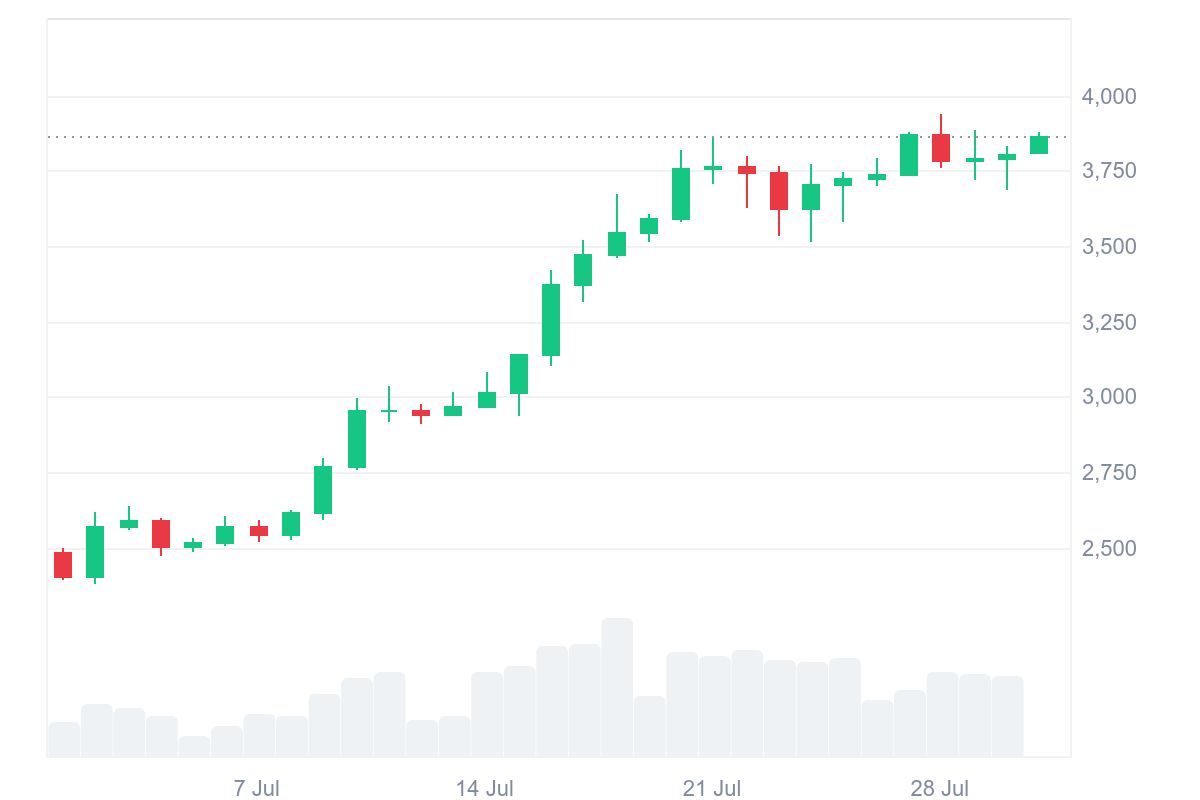
According to the latest data from CoinMarketCap, one Ethereum is currently priced at $3,865, with a 2% increase over the past 24 hours.
Current Ethereum Price for today. Source: CoinMarketCap
Ray
Youssef, CEO of NoOnes, observes that Ethereum's symbolic rebound above $3,850
during its 10th anniversary celebration showcases unusual strength.
"Despite conditions that would typically fuel a broad risk-off
environment, Ethereum has demonstrated unusual resilience, reflecting its
growing role as digital infrastructure rather than just a speculative
asset," Youssef explains.
The
cryptocurrency has already surged over 300% since establishing a cycle low of
approximately $880 in June 2022, painting compelling chart patterns that
suggest continued upward momentum.
Why Is Ethereum Going Up? Key
Factors Driving Ethereum Price Movement Today
Youssef
emphasizes this dynamic: "The demand for Ether is growing rapidly, and the
circulating supply to meet this demand is steadily evaporating. This rare
combination of factors has been known to historically precede explosive upside
movement."
Corporate
treasury accumulation continues at an aggressive pace, with companies like
SharpLink Gaming acquiring 438,000 ETH worth over $1.69 billion. This
institutional buying pressure, combined with consistent ETF inflows, creates a
demand-supply imbalance that supports bullish price trajectories.
Ethereum ETF Impact on
Price Trajectory
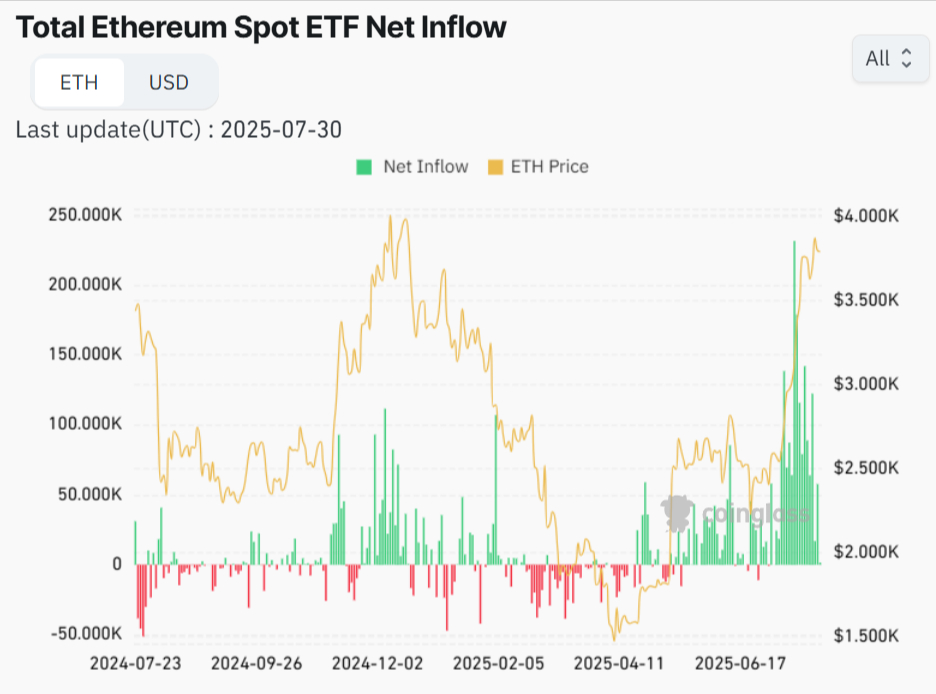
Spot Ether
ETFs have recorded an impressive 18-day streak of positive inflows, with
Tuesday's $218 million net inflow contributing to over $5.3 billion in total
inflows since July 2. Cumulative net inflows now exceed $9.6 billion since the
July 2024 launch of these investment products.
Paul Howard, Director at Wicent, sees Ethereum's recent price surge as a long-overdue correction driven by institutional adoption. "The move in ETH prices of late signifies more of an overdue directional move as the institutional market looks for alpha opportunities," he explains, pointing to key catalysts including Ethereum's transition to proof-of-stake, the launch of ETFs, corporate treasury adoption, and improved regulatory clarity from US authorities.
Paul Howard, Wincent
Howard believes the cryptocurrency was significantly undervalued for an extended period. "ETH was heavily undervalued for a long time, and its ascension back to $4K and beyond likely gives scope for continued price appreciation," though he anticipates "more modest" gains in Q3 compared to Q2's explosive growth.
Institutional Adoption and
Market Sentiment
The
institutional narrative surrounding Ethereum price has evolved significantly,
with corporate treasuries and traditional finance recognizing ETH as legitimate
digital infrastructure. This shift from speculative interest to strategic
allocation represents a fundamental change in market dynamics.
Youssef
notes: "Ethereum is not just surviving the chaos; it's building through
it." This resilience in challenging macro conditions demonstrates the
network's maturation and institutional confidence in its long-term value
proposition.
Technical Analysis: ETH
Price Patterns
According
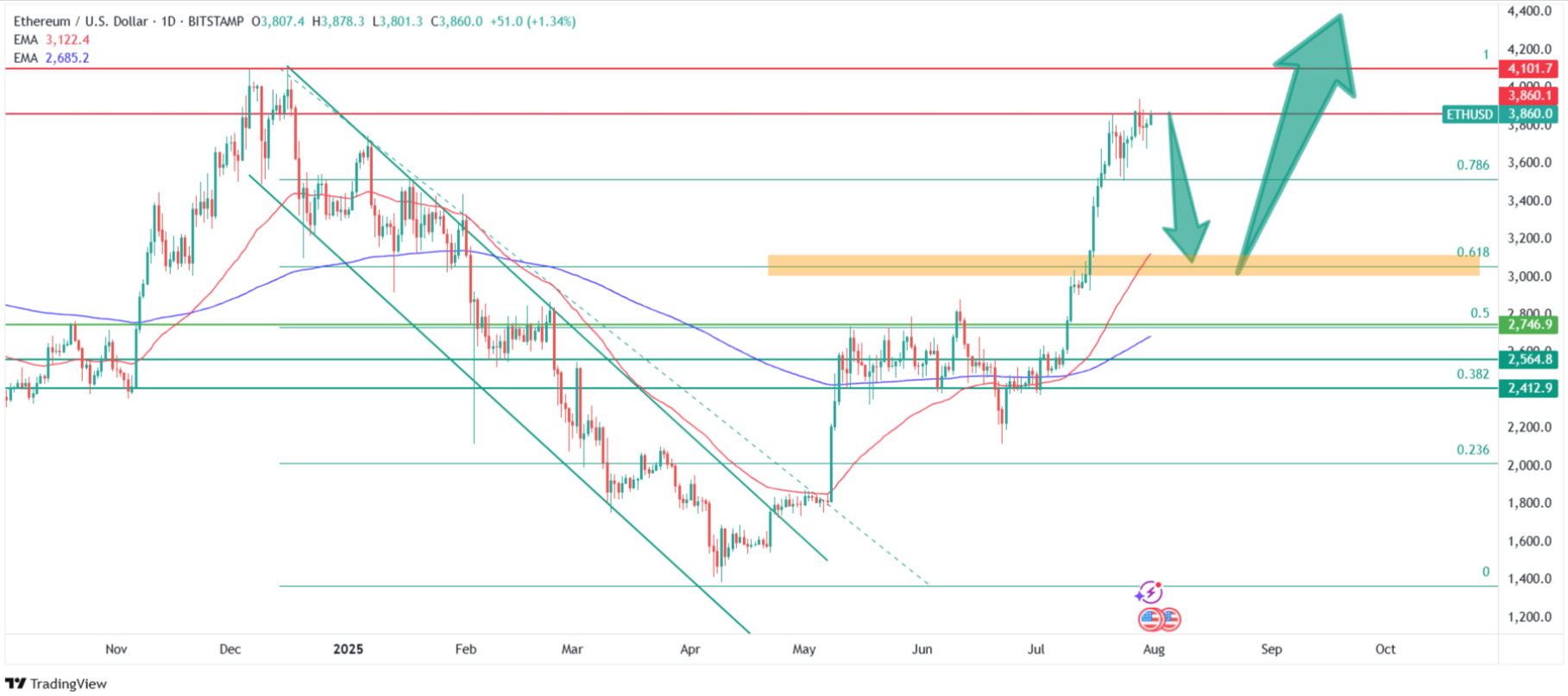
to my technical analysis, Ethereum is currently testing a local resistance zone
around the $3,850 mark. This level coincides with the year’s highs and has
proven to be a tough barrier. Since the June lows, Ether has gained about 80%.
And if we go back to the April bottom, when one token cost just $1,400, the
price has surged by nearly 180%.
Looking
ahead, I believe a pullback may be on the horizon. However, I would consider it
a technical correction rather than a trend reversal. Any decline, in my view,
would be a potential buying opportunity. The area around $3,000 stands out as
particularly interesting: it aligns with the 50-day EMA, a psychological
support level, and the 61.8 percent Fibonacci retracement.
That’s
where I’d expect a potential pullback to land, offering a chance to reassess
profits and consider re-entry. Of course, this scenario is not set in stone.
Ethereum could just as well break through the current resistance and push past
the $4,000 level, which also aligns with the December 2023 high. If that
happens, we might enter a new price discovery phase, possibly aiming again for
the all-time highs of November 2021, when Ether was trading near $5,000.
While these
price levels might seem lofty from today’s standpoint, they don’t look so
far-fetched when you consider the latest Ethereum price predictions from
several well-followed crypto analysts. In fact, compared to those forecasts, my
outlook might even be considered conservative.
Ethereum Price Prediction
Shows ETH Can Hit Almost $17K
Popular
crypto investor Ivan On Tech identifies a symmetrical triangle formation with a
measured target of $7,709, representing a 105% increase from current levels.
More
aggressively, analyst Mikycrypto Bull highlights an ascending triangle pattern
spanning five years, with a breakout target reaching approximately $16,700, a
staggering 350% increase from current price levels.
The moving
average convergence divergence (MACD) indicator has produced a bullish
crossover on the monthly chart, historically associated with significant price
rallies. Previous instances generated 2,000% gains during the 2020-2021 cycle
and 130% in Q4/2023.
Youssef
provides tactical insight for near-term price action: "By holding above
the $3,750 breakout zone, Ether is showing that bulls are not in a hurry to
take profits and believe that there is still significant room for another phase
of price discovery."
The
immediate resistance target sits at $4,100, where a clean break would open
doors toward new highs at $4,300. As long as ETH maintains support above
$3,700, the cryptocurrency remains well-positioned for continued upward
momentum.
Merlijn The
Trader also emphasizes the significance of current technical setups:
"Ethereum is setting up for a monster move, with a massive bullish monthly
candle and fresh MACD crossover. Break $4,200 and $ETH will rip like in
2021."
Long-term
ETH price prediction models suggest extraordinary upside potential as Ethereum
transitions from speculative asset to foundational digital infrastructure. The
ascending triangle breakout target of $16,700 represents the primary bull case
for this cycle.
Some
analysts project even higher valuations, with pseudonymous trader DeFi Dad
suggesting Ethereum could reach $30,000 based on recent performance metrics and
adoption trends.
I’ve completely readjusted my expectations for $ETH this run to top out between $15k-$30k.
I am buying and holding ETH believing we can run at minimum to $15k-$18k (20x from its low in 2022, 5-6x from here).
These
projections assume continued institutional adoption, successful scaling
solutions, and Ethereum's growing role in decentralized finance and Web3
applications.
Ethereum Price Prediction
Table 2025, 2026
Analyst Name
Prediction Type
Price Target
Percentage Gain
Timeframe
Technical Basis
Ivan On Tech
Conservative Target
$7,709
+105%
This Cycle
Symmetrical Triangle Formation
Mikycrypto Bull
Primary Bull Case
$16,700
+350%
2025-2026
Ascending Triangle (5-year pattern)
Ray Youssef
Short-term Resistance
$4,100
+6%
Next 30 Days
Breakout Zone Analysis
Ray Youssef
Extended Target
$4,300
+11%
Near-term
Clean Break Scenario
Merlijn The Trader
Breakout Level
$4,200
+9%
Short-term
MACD Crossover + Monthly Candle
DeFi Dad
Aggressive Scenario
$30,000
+680%
Cycle Peak
Performance Metrics & Adoption
Risk Factors and Market
Volatility Considerations
Despite
bullish Ethereum price prediction scenarios, several risk factors warrant
consideration. Regulatory uncertainty, particularly regarding cryptocurrency
taxation and oversight, could impact institutional adoption rates.
Youssef
acknowledges potential downside risks: "If geopolitical tensions and macro
headwinds intensify, ETH might retest the $3,500 support zone, and breaking
below $3,500 could lead to a deeper pullback towards $3,100."
Howard's most compelling observation positions Ethereum within the broader digital asset landscape: "If BTC is digital gold, ETH is the digital oil of the digital economy" - a metaphor that captures Ethereum's role as the fundamental infrastructure powering decentralized applications and smart contracts across the blockchain ecosystem.
Market
volatility remains elevated, and investors should prepare for significant price
swings even within bullish long-term trends.
Ethereum News FAQ
How Much Will Ethereum Be
Worth in 2025?
Ethereum
price prediction models for 2025 show significant bullish potential. According
to Mikycrypto Bull's ascending triangle analysis, ETH could reach approximately
$16,700 by 2025-2026, representing a massive 350% increase from current levels
of $3,858.
More
conservative estimates from Ivan On Tech suggest a symmetrical triangle target
of $7,709, which would still deliver impressive 105% gains. The convergence of
institutional adoption through spot Ether ETFs and corporate treasury
accumulation creates strong fundamental support for these ambitious targets.
What Will 1 Eth Be Worth
in 2030?
Long-term
Ethereum price forecasts for 2030 venture into even more speculative territory,
with some analysts projecting extraordinary valuations. DeFi Dad suggests ETH
could reach $30,000 based on performance metrics and adoption trends, though
this represents the most aggressive scenario.
Will Ethereum Hit $10,000?
Ethereum
reaching $10,000 appears increasingly plausible given current technical
patterns and institutional momentum. This milestone represents approximately
160% upside from current prices and falls well within the range of analyst
predictions.
The
ascending triangle breakout identified by multiple analysts targets $16,700,
making $10,000 a conservative intermediate milestone rather than an aggressive
projection. MACD bullish crossovers have historically generated substantial
gains, with previous cycles delivering 2,000% and 130% returns respectively.
Will Ethereum Reach
$50,000?
Ethereum
hitting $50,000 would require extraordinary circumstances and represents the
most speculative end of price prediction models. This target implies roughly
1,200% gains from current levels and would establish ETH as a genuine
store-of-value competitor to Bitcoin.
Check also my previous article from last month about Ethereum price predictions, answering the question of how high the Ether price can go.
Ethereum
(ETH) price action has crypto analysts buzzing as technical patterns and
institutional demand align to suggest a massive upward breakout. With ETH
currently trading at $3,858, multiple indicators point toward a potential rally
that could see the world's second-largest cryptocurrency jump by 350% from
current levels.
The
convergence of technical analysis, institutional adoption, and supply-demand
dynamics has created what many consider the perfect storm for Ethereum price
prediction models targeting five-digit valuations.
Let’s check how high the Ethereum price can go and what the most up-to-date ETH price forecasts are.
Current Ethereum Price
Analysis and Market Performance
Ethereum
price has demonstrated remarkable resilience despite macro headwinds that
typically suppress risk appetite. Trading 23% below its November 2021 all-time
high of $5,000, ETH has established a crucial resistance level at $4,000 that
serves as the gateway to new price discovery territory.
According to the latest data from CoinMarketCap, one Ethereum is currently priced at $3,865, with a 2% increase over the past 24 hours.
Current Ethereum Price for today. Source: CoinMarketCap
Ray
Youssef, CEO of NoOnes, observes that Ethereum's symbolic rebound above $3,850
during its 10th anniversary celebration showcases unusual strength.
"Despite conditions that would typically fuel a broad risk-off
environment, Ethereum has demonstrated unusual resilience, reflecting its
growing role as digital infrastructure rather than just a speculative
asset," Youssef explains.
The
cryptocurrency has already surged over 300% since establishing a cycle low of
approximately $880 in June 2022, painting compelling chart patterns that
suggest continued upward momentum.
Why Is Ethereum Going Up? Key
Factors Driving Ethereum Price Movement Today
Youssef
emphasizes this dynamic: "The demand for Ether is growing rapidly, and the
circulating supply to meet this demand is steadily evaporating. This rare
combination of factors has been known to historically precede explosive upside
movement."
Corporate
treasury accumulation continues at an aggressive pace, with companies like
SharpLink Gaming acquiring 438,000 ETH worth over $1.69 billion. This
institutional buying pressure, combined with consistent ETF inflows, creates a
demand-supply imbalance that supports bullish price trajectories.
Ethereum ETF Impact on
Price Trajectory
Spot Ether
ETFs have recorded an impressive 18-day streak of positive inflows, with
Tuesday's $218 million net inflow contributing to over $5.3 billion in total
inflows since July 2. Cumulative net inflows now exceed $9.6 billion since the
July 2024 launch of these investment products.
Paul Howard, Director at Wicent, sees Ethereum's recent price surge as a long-overdue correction driven by institutional adoption. "The move in ETH prices of late signifies more of an overdue directional move as the institutional market looks for alpha opportunities," he explains, pointing to key catalysts including Ethereum's transition to proof-of-stake, the launch of ETFs, corporate treasury adoption, and improved regulatory clarity from US authorities.
Paul Howard, Wincent
Howard believes the cryptocurrency was significantly undervalued for an extended period. "ETH was heavily undervalued for a long time, and its ascension back to $4K and beyond likely gives scope for continued price appreciation," though he anticipates "more modest" gains in Q3 compared to Q2's explosive growth.
Institutional Adoption and
Market Sentiment
The
institutional narrative surrounding Ethereum price has evolved significantly,
with corporate treasuries and traditional finance recognizing ETH as legitimate
digital infrastructure. This shift from speculative interest to strategic
allocation represents a fundamental change in market dynamics.
Youssef
notes: "Ethereum is not just surviving the chaos; it's building through
it." This resilience in challenging macro conditions demonstrates the
network's maturation and institutional confidence in its long-term value
proposition.
Technical Analysis: ETH
Price Patterns
According
to my technical analysis, Ethereum is currently testing a local resistance zone
around the $3,850 mark. This level coincides with the year’s highs and has
proven to be a tough barrier. Since the June lows, Ether has gained about 80%.
And if we go back to the April bottom, when one token cost just $1,400, the
price has surged by nearly 180%.
Looking
ahead, I believe a pullback may be on the horizon. However, I would consider it
a technical correction rather than a trend reversal. Any decline, in my view,
would be a potential buying opportunity. The area around $3,000 stands out as
particularly interesting: it aligns with the 50-day EMA, a psychological
support level, and the 61.8 percent Fibonacci retracement.
That’s
where I’d expect a potential pullback to land, offering a chance to reassess
profits and consider re-entry. Of course, this scenario is not set in stone.
Ethereum could just as well break through the current resistance and push past
the $4,000 level, which also aligns with the December 2023 high. If that
happens, we might enter a new price discovery phase, possibly aiming again for
the all-time highs of November 2021, when Ether was trading near $5,000.
While these
price levels might seem lofty from today’s standpoint, they don’t look so
far-fetched when you consider the latest Ethereum price predictions from
several well-followed crypto analysts. In fact, compared to those forecasts, my
outlook might even be considered conservative.
Ethereum Price Prediction
Shows ETH Can Hit Almost $17K
Popular
crypto investor Ivan On Tech identifies a symmetrical triangle formation with a
measured target of $7,709, representing a 105% increase from current levels.
More
aggressively, analyst Mikycrypto Bull highlights an ascending triangle pattern
spanning five years, with a breakout target reaching approximately $16,700, a
staggering 350% increase from current price levels.
The moving
average convergence divergence (MACD) indicator has produced a bullish
crossover on the monthly chart, historically associated with significant price
rallies. Previous instances generated 2,000% gains during the 2020-2021 cycle
and 130% in Q4/2023.
Youssef
provides tactical insight for near-term price action: "By holding above
the $3,750 breakout zone, Ether is showing that bulls are not in a hurry to
take profits and believe that there is still significant room for another phase
of price discovery."
The
immediate resistance target sits at $4,100, where a clean break would open
doors toward new highs at $4,300. As long as ETH maintains support above
$3,700, the cryptocurrency remains well-positioned for continued upward
momentum.
Merlijn The
Trader also emphasizes the significance of current technical setups:
"Ethereum is setting up for a monster move, with a massive bullish monthly
candle and fresh MACD crossover. Break $4,200 and $ETH will rip like in
2021."
Long-term
ETH price prediction models suggest extraordinary upside potential as Ethereum
transitions from speculative asset to foundational digital infrastructure. The
ascending triangle breakout target of $16,700 represents the primary bull case
for this cycle.
Some
analysts project even higher valuations, with pseudonymous trader DeFi Dad
suggesting Ethereum could reach $30,000 based on recent performance metrics and
adoption trends.
I’ve completely readjusted my expectations for $ETH this run to top out between $15k-$30k.
I am buying and holding ETH believing we can run at minimum to $15k-$18k (20x from its low in 2022, 5-6x from here).
These
projections assume continued institutional adoption, successful scaling
solutions, and Ethereum's growing role in decentralized finance and Web3
applications.
Ethereum Price Prediction
Table 2025, 2026
Analyst Name
Prediction Type
Price Target
Percentage Gain
Timeframe
Technical Basis
Ivan On Tech
Conservative Target
$7,709
+105%
This Cycle
Symmetrical Triangle Formation
Mikycrypto Bull
Primary Bull Case
$16,700
+350%
2025-2026
Ascending Triangle (5-year pattern)
Ray Youssef
Short-term Resistance
$4,100
+6%
Next 30 Days
Breakout Zone Analysis
Ray Youssef
Extended Target
$4,300
+11%
Near-term
Clean Break Scenario
Merlijn The Trader
Breakout Level
$4,200
+9%
Short-term
MACD Crossover + Monthly Candle
DeFi Dad
Aggressive Scenario
$30,000
+680%
Cycle Peak
Performance Metrics & Adoption
Risk Factors and Market
Volatility Considerations
Despite
bullish Ethereum price prediction scenarios, several risk factors warrant
consideration. Regulatory uncertainty, particularly regarding cryptocurrency
taxation and oversight, could impact institutional adoption rates.
Youssef
acknowledges potential downside risks: "If geopolitical tensions and macro
headwinds intensify, ETH might retest the $3,500 support zone, and breaking
below $3,500 could lead to a deeper pullback towards $3,100."
Howard's most compelling observation positions Ethereum within the broader digital asset landscape: "If BTC is digital gold, ETH is the digital oil of the digital economy" - a metaphor that captures Ethereum's role as the fundamental infrastructure powering decentralized applications and smart contracts across the blockchain ecosystem.
Market
volatility remains elevated, and investors should prepare for significant price
swings even within bullish long-term trends.
Ethereum News FAQ
How Much Will Ethereum Be
Worth in 2025?
Ethereum
price prediction models for 2025 show significant bullish potential. According
to Mikycrypto Bull's ascending triangle analysis, ETH could reach approximately
$16,700 by 2025-2026, representing a massive 350% increase from current levels
of $3,858.
More
conservative estimates from Ivan On Tech suggest a symmetrical triangle target
of $7,709, which would still deliver impressive 105% gains. The convergence of
institutional adoption through spot Ether ETFs and corporate treasury
accumulation creates strong fundamental support for these ambitious targets.
What Will 1 Eth Be Worth
in 2030?
Long-term
Ethereum price forecasts for 2030 venture into even more speculative territory,
with some analysts projecting extraordinary valuations. DeFi Dad suggests ETH
could reach $30,000 based on performance metrics and adoption trends, though
this represents the most aggressive scenario.
Will Ethereum Hit $10,000?
Ethereum
reaching $10,000 appears increasingly plausible given current technical
patterns and institutional momentum. This milestone represents approximately
160% upside from current prices and falls well within the range of analyst
predictions.
The
ascending triangle breakout identified by multiple analysts targets $16,700,
making $10,000 a conservative intermediate milestone rather than an aggressive
projection. MACD bullish crossovers have historically generated substantial
gains, with previous cycles delivering 2,000% and 130% returns respectively.
Will Ethereum Reach
$50,000?
Ethereum
hitting $50,000 would require extraordinary circumstances and represents the
most speculative end of price prediction models. This target implies roughly
1,200% gains from current levels and would establish ETH as a genuine
store-of-value competitor to Bitcoin.
Check also my previous article from last month about Ethereum price predictions, answering the question of how high the Ether price can go.
Damian Chmiel is a Senior Analyst & Editor at Finance Magnates with more than 15 years of experience in the CFD and online trading industry. Active as both a trader and journalist since 2010, he focuses on broker coverage, fintech innovation, and regulatory developments across Europe, the Middle East, and Asia.
His work includes interviews with C-level leaders at major brokerages and fintech platforms, as well as co-authoring Finance Magnates’ quarterly industry benchmarking reports. Damian’s reporting is data-driven, market-aware, and grounded in direct industry engagement. His analysis and commentary have also been cited by external media outlets, including Investing.com, Binance, The Asset, Stockhead, and Dispatch.
Education:
MA in Finance and Accounting, Cracow University of Economics
Inside the Prediction Markets: $1.6B Institutional Inflow Meets a Federal Crackdown
Featured Videos
FP Markets Winner Spotlight 🏆 | Global Broker of the Year 2025 #Trading #Broker #Innovation #Shorts
FP Markets Winner Spotlight 🏆 | Global Broker of the Year 2025 #Trading #Broker #Innovation #Shorts
FP Markets Winner Spotlight 🏆 | Global Broker of the Year 2025 #Trading #Broker #Innovation #Shorts
FP Markets Winner Spotlight 🏆 | Global Broker of the Year 2025 #Trading #Broker #Innovation #Shorts
FP Markets takes the spotlight as Global Broker of the Year 2025 at the Finance Magnates Awards.
Martin Stoilov, Head of Client Experience, shares that trust, innovation, and people played a key role in the company’s success, supported by a strong foundation of integrity and client-centricity.
Following this milestone, FP Markets continues to focus on growth, technology investment, and its core values of transparency and excellence.
👉 Be part of FM Awards 2026: https://awards.financemagnates.com/#nominate
FP Markets takes the spotlight as Global Broker of the Year 2025 at the Finance Magnates Awards.
Martin Stoilov, Head of Client Experience, shares that trust, innovation, and people played a key role in the company’s success, supported by a strong foundation of integrity and client-centricity.
Following this milestone, FP Markets continues to focus on growth, technology investment, and its core values of transparency and excellence.
👉 Be part of FM Awards 2026: https://awards.financemagnates.com/#nominate
FP Markets takes the spotlight as Global Broker of the Year 2025 at the Finance Magnates Awards.
Martin Stoilov, Head of Client Experience, shares that trust, innovation, and people played a key role in the company’s success, supported by a strong foundation of integrity and client-centricity.
Following this milestone, FP Markets continues to focus on growth, technology investment, and its core values of transparency and excellence.
👉 Be part of FM Awards 2026: https://awards.financemagnates.com/#nominate
FP Markets takes the spotlight as Global Broker of the Year 2025 at the Finance Magnates Awards.
Martin Stoilov, Head of Client Experience, shares that trust, innovation, and people played a key role in the company’s success, supported by a strong foundation of integrity and client-centricity.
Following this milestone, FP Markets continues to focus on growth, technology investment, and its core values of transparency and excellence.
👉 Be part of FM Awards 2026: https://awards.financemagnates.com/#nominate
In this video, we review @HolaPrimeMarketsOfficial, a multi-asset forex and CFDs broker offering different account types, trading platforms, and flexible trading conditions.
We cover the broker’s overall offering, including account options, trading environment, platforms like MT4 and MT5, and additional services such as managed accounts and fast withdrawals.
Watch the full video to see if Hola Prime Markets fits your trading needs.
📣 Stay up to date with the latest in finance and trading. Follow Finance Magnates for industry news, insights, and global event coverage.
Connect with us:
🔗 LinkedIn: /financemagnates
👍 Facebook: /financemagnates
📸 Instagram: https://www.instagram.com/financemagnates
🐦 X: https://x.com/financemagnates
🎥 TikTok: https://www.tiktok.com/tag/financemagnates
▶️ YouTube: /@financemagnates_official
#HolaPrime #ForexBroker #CFDTrading #FinanceMagnates #Trading #Forex #BrokerReview
In this video, we review @HolaPrimeMarketsOfficial, a multi-asset forex and CFDs broker offering different account types, trading platforms, and flexible trading conditions.
We cover the broker’s overall offering, including account options, trading environment, platforms like MT4 and MT5, and additional services such as managed accounts and fast withdrawals.
Watch the full video to see if Hola Prime Markets fits your trading needs.
📣 Stay up to date with the latest in finance and trading. Follow Finance Magnates for industry news, insights, and global event coverage.
Connect with us:
🔗 LinkedIn: /financemagnates
👍 Facebook: /financemagnates
📸 Instagram: https://www.instagram.com/financemagnates
🐦 X: https://x.com/financemagnates
🎥 TikTok: https://www.tiktok.com/tag/financemagnates
▶️ YouTube: /@financemagnates_official
#HolaPrime #ForexBroker #CFDTrading #FinanceMagnates #Trading #Forex #BrokerReview
In this video, we review @HolaPrimeMarketsOfficial, a multi-asset forex and CFDs broker offering different account types, trading platforms, and flexible trading conditions.
We cover the broker’s overall offering, including account options, trading environment, platforms like MT4 and MT5, and additional services such as managed accounts and fast withdrawals.
Watch the full video to see if Hola Prime Markets fits your trading needs.
📣 Stay up to date with the latest in finance and trading. Follow Finance Magnates for industry news, insights, and global event coverage.
Connect with us:
🔗 LinkedIn: /financemagnates
👍 Facebook: /financemagnates
📸 Instagram: https://www.instagram.com/financemagnates
🐦 X: https://x.com/financemagnates
🎥 TikTok: https://www.tiktok.com/tag/financemagnates
▶️ YouTube: /@financemagnates_official
#HolaPrime #ForexBroker #CFDTrading #FinanceMagnates #Trading #Forex #BrokerReview
In this video, we review @HolaPrimeMarketsOfficial, a multi-asset forex and CFDs broker offering different account types, trading platforms, and flexible trading conditions.
We cover the broker’s overall offering, including account options, trading environment, platforms like MT4 and MT5, and additional services such as managed accounts and fast withdrawals.
Watch the full video to see if Hola Prime Markets fits your trading needs.
📣 Stay up to date with the latest in finance and trading. Follow Finance Magnates for industry news, insights, and global event coverage.
Connect with us:
🔗 LinkedIn: /financemagnates
👍 Facebook: /financemagnates
📸 Instagram: https://www.instagram.com/financemagnates
🐦 X: https://x.com/financemagnates
🎥 TikTok: https://www.tiktok.com/tag/financemagnates
▶️ YouTube: /@financemagnates_official
#HolaPrime #ForexBroker #CFDTrading #FinanceMagnates #Trading #Forex #BrokerReview
In this video, we review @HolaPrimeMarketsOfficial, a multi-asset forex and CFDs broker offering different account types, trading platforms, and flexible trading conditions.
We cover the broker’s overall offering, including account options, trading environment, platforms like MT4 and MT5, and additional services such as managed accounts and fast withdrawals.
Watch the full video to see if Hola Prime Markets fits your trading needs.
📣 Stay up to date with the latest in finance and trading. Follow Finance Magnates for industry news, insights, and global event coverage.
Connect with us:
🔗 LinkedIn: /financemagnates
👍 Facebook: /financemagnates
📸 Instagram: https://www.instagram.com/financemagnates
🐦 X: https://x.com/financemagnates
🎥 TikTok: https://www.tiktok.com/tag/financemagnates
▶️ YouTube: /@financemagnates_official
#HolaPrime #ForexBroker #CFDTrading #FinanceMagnates #Trading #Forex #BrokerReview
In this video, we review @HolaPrimeMarketsOfficial, a multi-asset forex and CFDs broker offering different account types, trading platforms, and flexible trading conditions.
We cover the broker’s overall offering, including account options, trading environment, platforms like MT4 and MT5, and additional services such as managed accounts and fast withdrawals.
Watch the full video to see if Hola Prime Markets fits your trading needs.
📣 Stay up to date with the latest in finance and trading. Follow Finance Magnates for industry news, insights, and global event coverage.
Connect with us:
🔗 LinkedIn: /financemagnates
👍 Facebook: /financemagnates
📸 Instagram: https://www.instagram.com/financemagnates
🐦 X: https://x.com/financemagnates
🎥 TikTok: https://www.tiktok.com/tag/financemagnates
▶️ YouTube: /@financemagnates_official
#HolaPrime #ForexBroker #CFDTrading #FinanceMagnates #Trading #Forex #BrokerReview
Hola Prime Review: What You Need to Know | Full Breakdown by Finance Magnates
Hola Prime Review: What You Need to Know | Full Breakdown by Finance Magnates
Hola Prime Review: What You Need to Know | Full Breakdown by Finance Magnates
Hola Prime Review: What You Need to Know | Full Breakdown by Finance Magnates
Hola Prime Review: What You Need to Know | Full Breakdown by Finance Magnates
Hola Prime Review: What You Need to Know | Full Breakdown by Finance Magnates
In this video, we review @HolaPrime_Global, a proprietary trading firm offering evaluation programs and performance-based payouts in simulated market environments.
We cover how the challenge model works, including account types, profit splits (up to 95%), trading rules, and what it takes to reach a funded account. You’ll also learn about available platforms like MT4, MT5, cTrader, and more, along with insights into payouts, support, and trading conditions.
Watch the full video to see if Hola Prime fits your trading style.
📣 Stay up to date with the latest in finance and trading. Follow Finance Magnates for industry news, insights, and global event coverage.
Connect with us:
🔗 LinkedIn: /financemagnates
👍 Facebook: /financemagnates
📸 Instagram: https://www.instagram.com/financemagnates
🐦 X: https://x.com/financemagnates
🎥 TikTok: https://www.tiktok.com/tag/financemagnates
▶️ YouTube: /@financemagnates_official
#HolaPrime #PropFirm #Trading #FinanceMagnates #Forex #FuturesTrading #TradingReview #PropFirmReview
In this video, we review @HolaPrime_Global, a proprietary trading firm offering evaluation programs and performance-based payouts in simulated market environments.
We cover how the challenge model works, including account types, profit splits (up to 95%), trading rules, and what it takes to reach a funded account. You’ll also learn about available platforms like MT4, MT5, cTrader, and more, along with insights into payouts, support, and trading conditions.
Watch the full video to see if Hola Prime fits your trading style.
📣 Stay up to date with the latest in finance and trading. Follow Finance Magnates for industry news, insights, and global event coverage.
Connect with us:
🔗 LinkedIn: /financemagnates
👍 Facebook: /financemagnates
📸 Instagram: https://www.instagram.com/financemagnates
🐦 X: https://x.com/financemagnates
🎥 TikTok: https://www.tiktok.com/tag/financemagnates
▶️ YouTube: /@financemagnates_official
#HolaPrime #PropFirm #Trading #FinanceMagnates #Forex #FuturesTrading #TradingReview #PropFirmReview
In this video, we review @HolaPrime_Global, a proprietary trading firm offering evaluation programs and performance-based payouts in simulated market environments.
We cover how the challenge model works, including account types, profit splits (up to 95%), trading rules, and what it takes to reach a funded account. You’ll also learn about available platforms like MT4, MT5, cTrader, and more, along with insights into payouts, support, and trading conditions.
Watch the full video to see if Hola Prime fits your trading style.
📣 Stay up to date with the latest in finance and trading. Follow Finance Magnates for industry news, insights, and global event coverage.
Connect with us:
🔗 LinkedIn: /financemagnates
👍 Facebook: /financemagnates
📸 Instagram: https://www.instagram.com/financemagnates
🐦 X: https://x.com/financemagnates
🎥 TikTok: https://www.tiktok.com/tag/financemagnates
▶️ YouTube: /@financemagnates_official
#HolaPrime #PropFirm #Trading #FinanceMagnates #Forex #FuturesTrading #TradingReview #PropFirmReview
In this video, we review @HolaPrime_Global, a proprietary trading firm offering evaluation programs and performance-based payouts in simulated market environments.
We cover how the challenge model works, including account types, profit splits (up to 95%), trading rules, and what it takes to reach a funded account. You’ll also learn about available platforms like MT4, MT5, cTrader, and more, along with insights into payouts, support, and trading conditions.
Watch the full video to see if Hola Prime fits your trading style.
📣 Stay up to date with the latest in finance and trading. Follow Finance Magnates for industry news, insights, and global event coverage.
Connect with us:
🔗 LinkedIn: /financemagnates
👍 Facebook: /financemagnates
📸 Instagram: https://www.instagram.com/financemagnates
🐦 X: https://x.com/financemagnates
🎥 TikTok: https://www.tiktok.com/tag/financemagnates
▶️ YouTube: /@financemagnates_official
#HolaPrime #PropFirm #Trading #FinanceMagnates #Forex #FuturesTrading #TradingReview #PropFirmReview
In this video, we review @HolaPrime_Global, a proprietary trading firm offering evaluation programs and performance-based payouts in simulated market environments.
We cover how the challenge model works, including account types, profit splits (up to 95%), trading rules, and what it takes to reach a funded account. You’ll also learn about available platforms like MT4, MT5, cTrader, and more, along with insights into payouts, support, and trading conditions.
Watch the full video to see if Hola Prime fits your trading style.
📣 Stay up to date with the latest in finance and trading. Follow Finance Magnates for industry news, insights, and global event coverage.
Connect with us:
🔗 LinkedIn: /financemagnates
👍 Facebook: /financemagnates
📸 Instagram: https://www.instagram.com/financemagnates
🐦 X: https://x.com/financemagnates
🎥 TikTok: https://www.tiktok.com/tag/financemagnates
▶️ YouTube: /@financemagnates_official
#HolaPrime #PropFirm #Trading #FinanceMagnates #Forex #FuturesTrading #TradingReview #PropFirmReview
In this video, we review @HolaPrime_Global, a proprietary trading firm offering evaluation programs and performance-based payouts in simulated market environments.
We cover how the challenge model works, including account types, profit splits (up to 95%), trading rules, and what it takes to reach a funded account. You’ll also learn about available platforms like MT4, MT5, cTrader, and more, along with insights into payouts, support, and trading conditions.
Watch the full video to see if Hola Prime fits your trading style.
📣 Stay up to date with the latest in finance and trading. Follow Finance Magnates for industry news, insights, and global event coverage.
Connect with us:
🔗 LinkedIn: /financemagnates
👍 Facebook: /financemagnates
📸 Instagram: https://www.instagram.com/financemagnates
🐦 X: https://x.com/financemagnates
🎥 TikTok: https://www.tiktok.com/tag/financemagnates
▶️ YouTube: /@financemagnates_official
#HolaPrime #PropFirm #Trading #FinanceMagnates #Forex #FuturesTrading #TradingReview #PropFirmReview
Axi Winner Spotlight 🏆 | Global Most Innovative Broker 2025 #Innovation #Trading #Fintech #Broker
Axi Winner Spotlight 🏆 | Global Most Innovative Broker 2025 #Innovation #Trading #Fintech #Broker
Axi Winner Spotlight 🏆 | Global Most Innovative Broker 2025 #Innovation #Trading #Fintech #Broker
Axi Winner Spotlight 🏆 | Global Most Innovative Broker 2025 #Innovation #Trading #Fintech #Broker
Axi Winner Spotlight 🏆 | Global Most Innovative Broker 2025 #Innovation #Trading #Fintech #Broker
Axi Winner Spotlight 🏆 | Global Most Innovative Broker 2025 #Innovation #Trading #Fintech #Broker
Axi takes the spotlight at the Finance Magnates Awards, winning Global Most Innovative Broker 2025.
Olivia Xenofontos and Ivanna Openko share how the team will feel: proud, motivated, and ready to keep delivering.
They also describe the night as well-organized, focused, and enjoyable for all.
👉 Be part of FM Awards 2026.
Axi takes the spotlight at the Finance Magnates Awards, winning Global Most Innovative Broker 2025.
Olivia Xenofontos and Ivanna Openko share how the team will feel: proud, motivated, and ready to keep delivering.
They also describe the night as well-organized, focused, and enjoyable for all.
👉 Be part of FM Awards 2026.
Axi takes the spotlight at the Finance Magnates Awards, winning Global Most Innovative Broker 2025.
Olivia Xenofontos and Ivanna Openko share how the team will feel: proud, motivated, and ready to keep delivering.
They also describe the night as well-organized, focused, and enjoyable for all.
👉 Be part of FM Awards 2026.
Axi takes the spotlight at the Finance Magnates Awards, winning Global Most Innovative Broker 2025.
Olivia Xenofontos and Ivanna Openko share how the team will feel: proud, motivated, and ready to keep delivering.
They also describe the night as well-organized, focused, and enjoyable for all.
👉 Be part of FM Awards 2026.
Axi takes the spotlight at the Finance Magnates Awards, winning Global Most Innovative Broker 2025.
Olivia Xenofontos and Ivanna Openko share how the team will feel: proud, motivated, and ready to keep delivering.
They also describe the night as well-organized, focused, and enjoyable for all.
👉 Be part of FM Awards 2026.
Axi takes the spotlight at the Finance Magnates Awards, winning Global Most Innovative Broker 2025.
Olivia Xenofontos and Ivanna Openko share how the team will feel: proud, motivated, and ready to keep delivering.
They also describe the night as well-organized, focused, and enjoyable for all.
👉 Be part of FM Awards 2026.
Recognition that matters.
Built on transparency.
Driven by the industry.
The Finance Magnates Awards 2026.
Nominations are now open.
🔗 https://awards.financemagnates.com/?utm_source=SM&utm_medium=social&utm_campaign=recognition-matters
Recognition that matters.
Built on transparency.
Driven by the industry.
The Finance Magnates Awards 2026.
Nominations are now open.
🔗 https://awards.financemagnates.com/?utm_source=SM&utm_medium=social&utm_campaign=recognition-matters
Recognition that matters.
Built on transparency.
Driven by the industry.
The Finance Magnates Awards 2026.
Nominations are now open.
🔗 https://awards.financemagnates.com/?utm_source=SM&utm_medium=social&utm_campaign=recognition-matters
Recognition that matters.
Built on transparency.
Driven by the industry.
The Finance Magnates Awards 2026.
Nominations are now open.
🔗 https://awards.financemagnates.com/?utm_source=SM&utm_medium=social&utm_campaign=recognition-matters
Recognition that matters.
Built on transparency.
Driven by the industry.
The Finance Magnates Awards 2026.
Nominations are now open.
🔗 https://awards.financemagnates.com/?utm_source=SM&utm_medium=social&utm_campaign=recognition-matters
Recognition that matters.
Built on transparency.
Driven by the industry.
The Finance Magnates Awards 2026.
Nominations are now open.
🔗 https://awards.financemagnates.com/?utm_source=SM&utm_medium=social&utm_campaign=recognition-matters