Ethereum is testing its highest levels in a month, rising for a second day in a row, eying $3,000 once again.
The current Ethereum price surge reflects strong fundamentals, including Layer 2 scaling solutions and a growing DeFi ecosystem.
Ethereum's price prediction for 2025 remains bullish as the cryptocurrency benefits from reduced supply.
Why is Ethereum price going up today? Check the newest ETH price predictions
Ethereum price (ETH) has been consolidating near local highs since the first half of May, but the last two sessions have brought renewed strength and a test of the highest levels in more than four weeks. Does the price of Ethereum have a chance to return to the $3,000 area? And will the potential golden cross provide buyers with enough momentum for further gains? In this article, we examine how much Ethereum costs today and what the latest price predictions are for 2025 and beyond.
Ethereum Price—Decoding
Today’s Rally in the Crypto Market
A year ago
many investors wondered whether Ethereum could ever regain the
momentum it enjoyed in 2021 when it posted its previous all-time high.
Fast-forward to mid-2025 and the current Ethereum recovery is hard to
ignore.
The price
of Ethereum has bounced sharply from its April lows, daily trading
volume has improved and the network’s market capitalization remains
second only to Bitcoin among all cryptocurrencies by market
cap.
As of
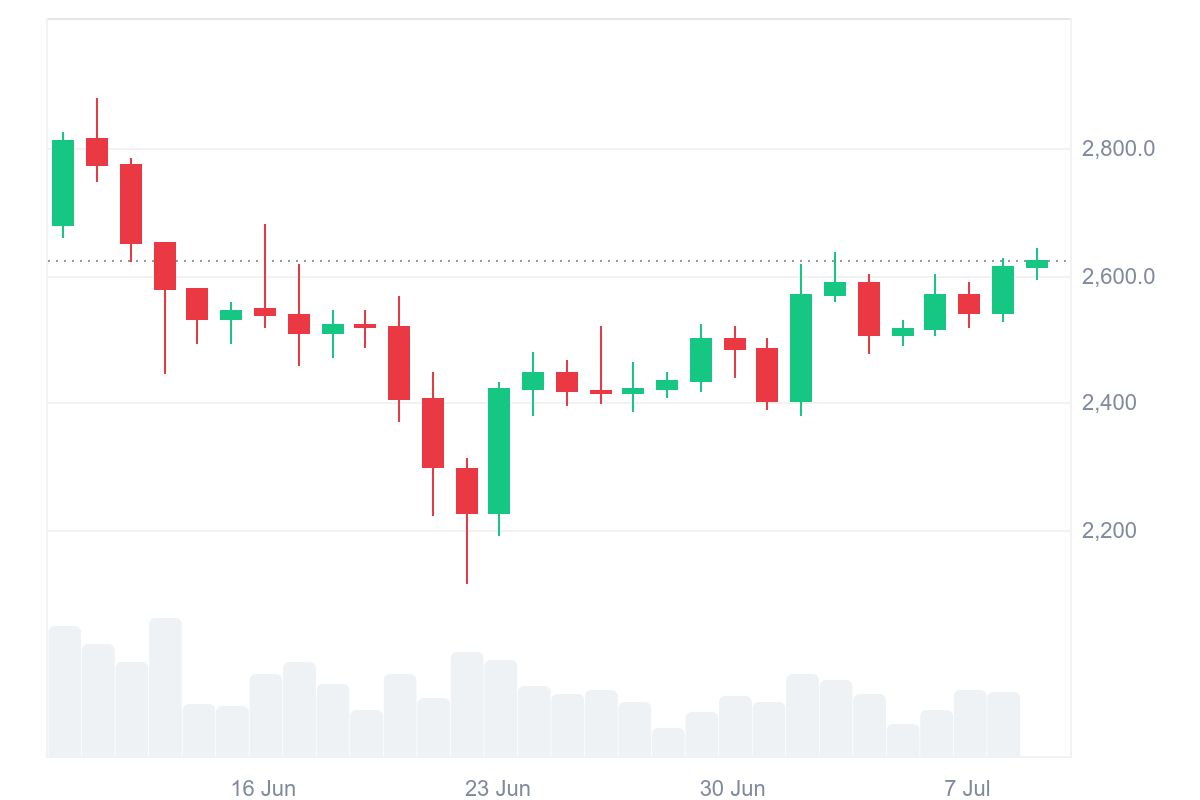
today, July 9, 2025, the price of Ethereum is rising for the second consecutive
day, testing the level of $2,646.02, its highest in a month, as it once again
moves toward the highest levels seen since the beginning of the year.
How much does Ethereum cost today? Source: tradingview.com.
Several
converging forces explain the price increase:
A structural squeeze in the
circulating supply of Ethereum since the hard fork known
as the Merge switched the consensus mechanism to Proof-of-Stake,
accelerating token burns and staking withdrawals.
A wave of institutional
investors piling
into newly-listed spot Ethereum ETFs, most notably BlackRock’s
iShares Ethereum Trust, which reports steady net inflows.
A vibrant ecosystem of decentralized
finance (DeFi), NFTs and dApps that
continues to grow thanks to low-cost Layer 2 roll-ups such as
Optimism and Arbitrum that now run on Ethereum.
Softening US inflation data that has revived risk appetite
across the broader crypto market and sparked renewed demand for
the digital-asset store of value narrative.
Ethereum Price Analysis
And Potential Strong Buy Signal
Based on my
technical analysis, the price of Ethereum against the U.S. dollar is once again
increasing its chances of testing the medium-term resistance level around
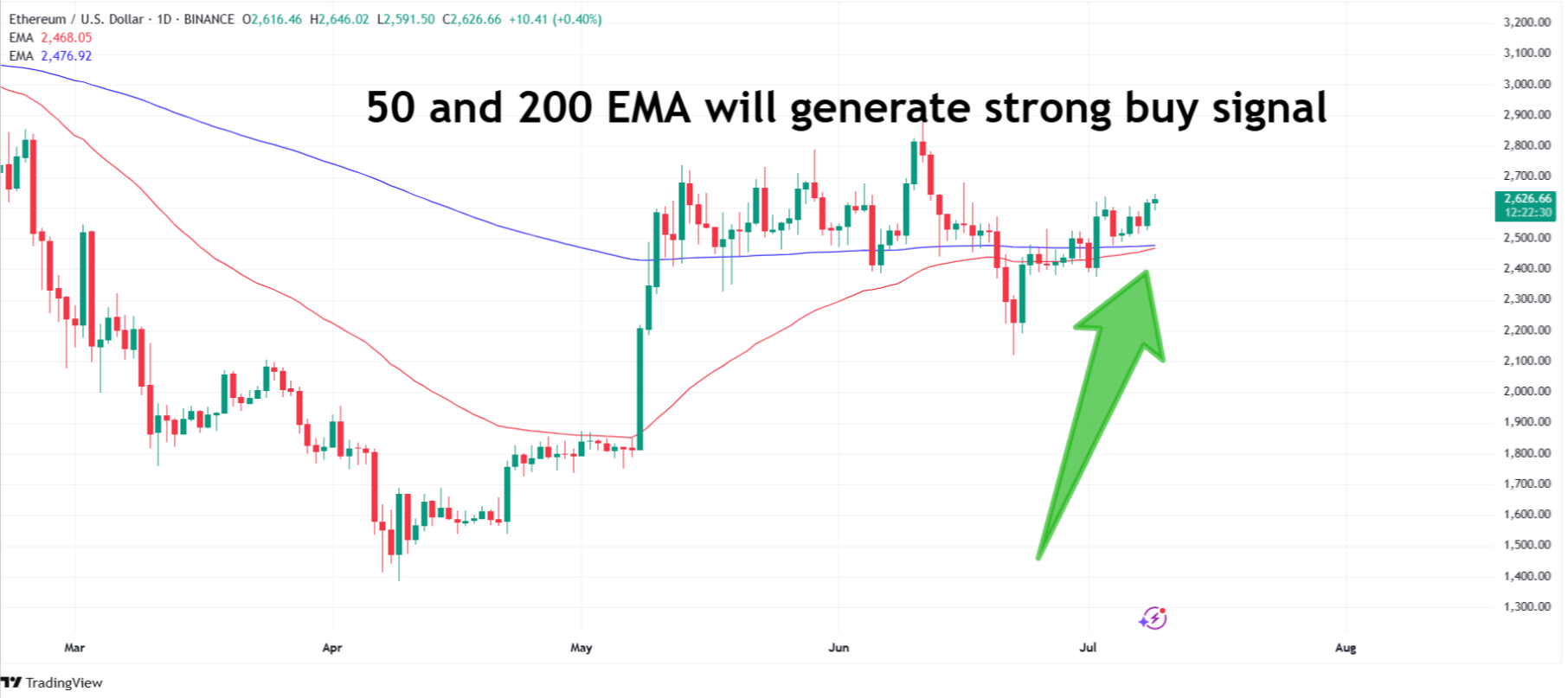
$2,700, potentially extending to $2,800. A strong bullish signal, which could
emerge in the coming days, may serve as the catalyst for this move. This signal
would be triggered by a crossover of the 50-day and 200-day exponential moving
averages. This technical pattern, commonly referred to as a “golden cross,” is
widely regarded by traders and technical analysts as a strong buy signal.
Ethereum price technical analysis and potential golden cross. Source: Tradingview.com
The last
time Ethereum's daily chart formed a golden cross was in November 2024, after
which the price surged by several dozen percent, reaching new all-time highs.
While I wouldn’t expect the same magnitude of rally this time, the formation of
this signal would undoubtedly open the path toward a test of the psychological
level at $3,000.
Ethereum Price
Prediction: Where Analysts See ETH at the End of 2025
The
average price targets published this month cluster around an ETH
price between $3,500 and $6,000 by the end of 2025. A handful of
bullish forecasters even argue that Ethereum might set a new
all-time high above $5,000, pointing to the following price of
Ethereum drivers:
Ethereum 2.0roadmap: the
upcoming Pectra and “Prague–Electra” upgrades promise to
cut transaction fees, relieve congestion and high gas costs and
raise throughput well beyond 100,000 TPS, a threshold that could make
Ethereum more attractive to Web3 developers.
Supply mechanics: more than 35 million ETH
is now staked—roughly 30% of total supply—and every block still
triggers a deflationary burn. Many analysts believe that Ethereum
continues to be structurally scarce, a phenomenon that should drive
up its price over time.
Correlation with Bitcoin: a rising price of Bitcoin often
lifts Bitcoin and Ethereum together. With BTC holdings now
appearing on several corporate balance sheets—Tesla’s own BTC
Treasury strategy among them—a renewed crypto bid could translate
into meaningful ETH price upside.
Paul Howard, Wincent
“I am
expecting prices to remain subdued with volatility at near record lows ahead of
further news from the US administration in the coming week… Given the positive
rhetoric from the USA, any new announcements from the Administration will
likely push $BTC and Ethereum ($ETH) prices higher in the coming weeks,” Paul Howard, Senior Director at
Wincent, frames the near-term risks and opportunities.
Ethereum Price Key Metrics
at the Current Level
Metric
(July 2025)
Current
Price
52-Week
Range
Average
Trading Price
Comment
Ethereum
price
$2,550–$2,620
$1,388–$4,106
$2,865
Range-bound
since June
Market cap
$310 billion
$170–$490 b
–
Still #2 in cryptocurrency by
market capitalization
ETH/BTC
ratio
0.018–0.020
0.017–0.036
0.025
Undervalued vs. BTC on
many models
Staked ETH
35 million
20 m–35 m
28 m
Growing faster than new issuance
Average
gas fee
<$0.15
$0.10–$6.00
$1.40
Layer 2 scaling
success
ETH Price Short-Term Price
Movement Scenarios
Even a
strong price prediction does not eliminate short-term turbulence. Traders
monitor three pivotal zones:
Support at $2,400–$2,300:
breakdown risks a retest of April’s lows.
Resistance at $2,800–$2,900: a
decisive breakout would validate the bullish thesis.
The options
market backs this view. Open interest in September calls implies
that ETH price predictions above $3,250 are now mainstream, echoing
Paul Howard’s observation that “the options market remains bullish with new
all-time highs (ATH) in sight before the September expiry.”
Price
fluctuations remain inevitable. Yet, most houses share one narrative: a
smaller, predictable emission schedule combined with easier on-chain user
experience supports a high-conviction bet that Ethereum
could reach a significant price zone far north of today’s
levels by the close of 2025.
Why Ethereum Is Going Up? Catalysts
That Could Make Ethereum More Attractive
Since
EIP-1559, every transaction has destroyed a fraction of ETH. Coupled with
staking yields that hover between 4% and 6%, many investors treat ETH as a
yield-bearing store of value. A deflationary supply curve plus
real-yield mechanics is precisely what long-duration macro funds crave.
Institutional Capital via
Spot Ethereum ETFs
The
presence of spot Ethereum ETFs lowers operational risk for
compliance-sensitive buyers. Over 50% of Q2 inflows came from pension
and endowment channels, a trend that bolsters ETH’s case as a
multi-trillion-dollar asset.
Regulatory overhang: Congress is still mulling
the GENIUS and CLARITY Acts. Should they classify ETH as a security, the
entire derivative stack would need urgent restructuring.
Competition from newer chains: Solana, Avalanche
and Binance Smart Chain promote higher base-layer
throughput. If they attract critical mass, Ethereum’s price movement could
stall.
Macroeconomic shocks: A strong dollar or a
surprise Fed tightening wave can drain liquidity, pulling ETH back into
the $1,500s.
Still, as
Paul Howard cautions, “We can therefore expect any run higher to be muted as we
work our way out of this low-volatility environment.” The interplay of
leveraged longs, Treasury buyers and policy noise invites patience.
Use Cases—How the
Ethereum Ecosystem Continues to Grow
Beyond
price talk lies real-world traction:
DeFi: peer-to-peer lending,
perpetual swaps and decentralized exchanges anchor a $70 billion total
value locked.
NFTs: the sector is rebounding
as mainstream brands tokenize loyalty points.
Enterprise blockchains: blue-chip adopters such
as Tesla, Visa and the European Investment Bank test pilots on the Ethereum
blockchain.
Dapps for identity: universities issue
on-chain diplomas that plug into decentralized finance scoring
algorithms.
Each use
case deepens network effects, elevating Ethereum’s value beyond
mere trading fodder.
How to Buy Ethereum—A
Quick Investor Checklist
Confirm your jurisdiction’s
stance on cryptocurrency.
Choose a regulated exchange
like Coinbase, Binance or CME futures to buy Ethereum.
Consider dollar-cost averaging
to offset price fluctuations.
Decide whether to stake via an
approved validator pool to capture yield.
Evaluate cold-storage solutions
to safeguard significant holdings.
Conclusion—Is Ethereum
Set for a New All-Time High?
The price
of ETH today sits roughly mid-channel between the 2021 all-time high and
last April’s panic low. While skeptics highlight stiff resistance at
$2,800, bullish analysts point to:
Strong macro tailwinds,
with risk assets thriving amid easing policy.
A shrinking float aggravated
by burns and staking.
Massive institutional
demand funneled through ETFs.
Fresh technological leaps that
promise to future-proof the Ethereum network.
Ethereum’s
price is expected to trend higher. Whether the future value vaults
straight to $5,000 or meanders through bouts of volatility, the signal is
clear: Ethereum also stands at the intersection of finance,
technology and culture—a nexus powerful enough to propel the next price
of Ethereum rally and potentially cement a new paradigm for
smart-contract platforms by 2025.
Ethereum News, FAQ
Why Is the ETH Price
Increasing?
The ETH
price is increasing due to several converging factors that create
strong upward pressure on Ethereum's value. Institutional
adoption through spot Ethereum ETFs is driving massive capital
into the market, with BlackRock's iShares Ethereum
Trust reporting consistent net inflows. Pension funds and
sovereign wealth funds now have regulated access to Ethereum
exposure, with over 50% of Q2 2025 inflows coming from institutional channels,
marking a fundamental shift in investor demographics.
How Much Will 1
Ethereum Be Worth in 2025?
Based on
current analyst forecasts and market conditions, Ethereum
price predictions for 2025 vary significantly but generally
point toward substantial upside potential. Galaxy Digital projects
a conservative target of $5,500 with an optimistic target of $6,200,
based on institutional flow and deflationary dynamics. JPMorgan Crypto
Research forecasts $3,800 to $4,500, citing gradual fee declines that
boost DeFi adoption. Bernstein targets $4,000 to $5,000, driven
by ETF ramp-up and macro easing conditions.
Why Is Crypto Rising?
The broader
crypto market is experiencing upward momentum driven by
multiple structural and cyclical factors that have fundamentally
changed the investment landscape. Institutional legitimization has been a
primary driver, with corporate treasury adoption following the BTC
Treasury strategy pioneered by companies like
MicroStrategy. Spot Ethereum ETFs and Bitcoin ETFs now provide
regulated investment vehicles that traditional financial institutions like BlackRock,
Fidelity, and State Street can access. The market capitalization of
crypto has remained consistently above $3 trillion for over 60 days,
demonstrating sustained institutional interest.
Ethereum price (ETH) has been consolidating near local highs since the first half of May, but the last two sessions have brought renewed strength and a test of the highest levels in more than four weeks. Does the price of Ethereum have a chance to return to the $3,000 area? And will the potential golden cross provide buyers with enough momentum for further gains? In this article, we examine how much Ethereum costs today and what the latest price predictions are for 2025 and beyond.
Ethereum Price—Decoding
Today’s Rally in the Crypto Market
A year ago
many investors wondered whether Ethereum could ever regain the
momentum it enjoyed in 2021 when it posted its previous all-time high.
Fast-forward to mid-2025 and the current Ethereum recovery is hard to
ignore.
The price
of Ethereum has bounced sharply from its April lows, daily trading
volume has improved and the network’s market capitalization remains
second only to Bitcoin among all cryptocurrencies by market
cap.
As of
today, July 9, 2025, the price of Ethereum is rising for the second consecutive
day, testing the level of $2,646.02, its highest in a month, as it once again
moves toward the highest levels seen since the beginning of the year.
How much does Ethereum cost today? Source: tradingview.com.
Several
converging forces explain the price increase:
A structural squeeze in the
circulating supply of Ethereum since the hard fork known
as the Merge switched the consensus mechanism to Proof-of-Stake,
accelerating token burns and staking withdrawals.
A wave of institutional
investors piling
into newly-listed spot Ethereum ETFs, most notably BlackRock’s
iShares Ethereum Trust, which reports steady net inflows.
A vibrant ecosystem of decentralized
finance (DeFi), NFTs and dApps that
continues to grow thanks to low-cost Layer 2 roll-ups such as
Optimism and Arbitrum that now run on Ethereum.
Softening US inflation data that has revived risk appetite
across the broader crypto market and sparked renewed demand for
the digital-asset store of value narrative.
Ethereum Price Analysis
And Potential Strong Buy Signal
Based on my
technical analysis, the price of Ethereum against the U.S. dollar is once again
increasing its chances of testing the medium-term resistance level around
$2,700, potentially extending to $2,800. A strong bullish signal, which could
emerge in the coming days, may serve as the catalyst for this move. This signal
would be triggered by a crossover of the 50-day and 200-day exponential moving
averages. This technical pattern, commonly referred to as a “golden cross,” is
widely regarded by traders and technical analysts as a strong buy signal.
Ethereum price technical analysis and potential golden cross. Source: Tradingview.com
The last
time Ethereum's daily chart formed a golden cross was in November 2024, after
which the price surged by several dozen percent, reaching new all-time highs.
While I wouldn’t expect the same magnitude of rally this time, the formation of
this signal would undoubtedly open the path toward a test of the psychological
level at $3,000.
Ethereum Price
Prediction: Where Analysts See ETH at the End of 2025
The
average price targets published this month cluster around an ETH
price between $3,500 and $6,000 by the end of 2025. A handful of
bullish forecasters even argue that Ethereum might set a new
all-time high above $5,000, pointing to the following price of
Ethereum drivers:
Ethereum 2.0roadmap: the
upcoming Pectra and “Prague–Electra” upgrades promise to
cut transaction fees, relieve congestion and high gas costs and
raise throughput well beyond 100,000 TPS, a threshold that could make
Ethereum more attractive to Web3 developers.
Supply mechanics: more than 35 million ETH
is now staked—roughly 30% of total supply—and every block still
triggers a deflationary burn. Many analysts believe that Ethereum
continues to be structurally scarce, a phenomenon that should drive
up its price over time.
Correlation with Bitcoin: a rising price of Bitcoin often
lifts Bitcoin and Ethereum together. With BTC holdings now
appearing on several corporate balance sheets—Tesla’s own BTC
Treasury strategy among them—a renewed crypto bid could translate
into meaningful ETH price upside.
Paul Howard, Wincent
“I am
expecting prices to remain subdued with volatility at near record lows ahead of
further news from the US administration in the coming week… Given the positive
rhetoric from the USA, any new announcements from the Administration will
likely push $BTC and Ethereum ($ETH) prices higher in the coming weeks,” Paul Howard, Senior Director at
Wincent, frames the near-term risks and opportunities.
Ethereum Price Key Metrics
at the Current Level
Metric
(July 2025)
Current
Price
52-Week
Range
Average
Trading Price
Comment
Ethereum
price
$2,550–$2,620
$1,388–$4,106
$2,865
Range-bound
since June
Market cap
$310 billion
$170–$490 b
–
Still #2 in cryptocurrency by
market capitalization
ETH/BTC
ratio
0.018–0.020
0.017–0.036
0.025
Undervalued vs. BTC on
many models
Staked ETH
35 million
20 m–35 m
28 m
Growing faster than new issuance
Average
gas fee
<$0.15
$0.10–$6.00
$1.40
Layer 2 scaling
success
ETH Price Short-Term Price
Movement Scenarios
Even a
strong price prediction does not eliminate short-term turbulence. Traders
monitor three pivotal zones:
Support at $2,400–$2,300:
breakdown risks a retest of April’s lows.
Resistance at $2,800–$2,900: a
decisive breakout would validate the bullish thesis.
The options
market backs this view. Open interest in September calls implies
that ETH price predictions above $3,250 are now mainstream, echoing
Paul Howard’s observation that “the options market remains bullish with new
all-time highs (ATH) in sight before the September expiry.”
Price
fluctuations remain inevitable. Yet, most houses share one narrative: a
smaller, predictable emission schedule combined with easier on-chain user
experience supports a high-conviction bet that Ethereum
could reach a significant price zone far north of today’s
levels by the close of 2025.
Why Ethereum Is Going Up? Catalysts
That Could Make Ethereum More Attractive
Since
EIP-1559, every transaction has destroyed a fraction of ETH. Coupled with
staking yields that hover between 4% and 6%, many investors treat ETH as a
yield-bearing store of value. A deflationary supply curve plus
real-yield mechanics is precisely what long-duration macro funds crave.
Institutional Capital via
Spot Ethereum ETFs
The
presence of spot Ethereum ETFs lowers operational risk for
compliance-sensitive buyers. Over 50% of Q2 inflows came from pension
and endowment channels, a trend that bolsters ETH’s case as a
multi-trillion-dollar asset.
Regulatory overhang: Congress is still mulling
the GENIUS and CLARITY Acts. Should they classify ETH as a security, the
entire derivative stack would need urgent restructuring.
Competition from newer chains: Solana, Avalanche
and Binance Smart Chain promote higher base-layer
throughput. If they attract critical mass, Ethereum’s price movement could
stall.
Macroeconomic shocks: A strong dollar or a
surprise Fed tightening wave can drain liquidity, pulling ETH back into
the $1,500s.
Still, as
Paul Howard cautions, “We can therefore expect any run higher to be muted as we
work our way out of this low-volatility environment.” The interplay of
leveraged longs, Treasury buyers and policy noise invites patience.
Use Cases—How the
Ethereum Ecosystem Continues to Grow
Beyond
price talk lies real-world traction:
DeFi: peer-to-peer lending,
perpetual swaps and decentralized exchanges anchor a $70 billion total
value locked.
NFTs: the sector is rebounding
as mainstream brands tokenize loyalty points.
Enterprise blockchains: blue-chip adopters such
as Tesla, Visa and the European Investment Bank test pilots on the Ethereum
blockchain.
Dapps for identity: universities issue
on-chain diplomas that plug into decentralized finance scoring
algorithms.
Each use
case deepens network effects, elevating Ethereum’s value beyond
mere trading fodder.
How to Buy Ethereum—A
Quick Investor Checklist
Confirm your jurisdiction’s
stance on cryptocurrency.
Choose a regulated exchange
like Coinbase, Binance or CME futures to buy Ethereum.
Consider dollar-cost averaging
to offset price fluctuations.
Decide whether to stake via an
approved validator pool to capture yield.
Evaluate cold-storage solutions
to safeguard significant holdings.
Conclusion—Is Ethereum
Set for a New All-Time High?
The price
of ETH today sits roughly mid-channel between the 2021 all-time high and
last April’s panic low. While skeptics highlight stiff resistance at
$2,800, bullish analysts point to:
Strong macro tailwinds,
with risk assets thriving amid easing policy.
A shrinking float aggravated
by burns and staking.
Massive institutional
demand funneled through ETFs.
Fresh technological leaps that
promise to future-proof the Ethereum network.
Ethereum’s
price is expected to trend higher. Whether the future value vaults
straight to $5,000 or meanders through bouts of volatility, the signal is
clear: Ethereum also stands at the intersection of finance,
technology and culture—a nexus powerful enough to propel the next price
of Ethereum rally and potentially cement a new paradigm for
smart-contract platforms by 2025.
Ethereum News, FAQ
Why Is the ETH Price
Increasing?
The ETH
price is increasing due to several converging factors that create
strong upward pressure on Ethereum's value. Institutional
adoption through spot Ethereum ETFs is driving massive capital
into the market, with BlackRock's iShares Ethereum
Trust reporting consistent net inflows. Pension funds and
sovereign wealth funds now have regulated access to Ethereum
exposure, with over 50% of Q2 2025 inflows coming from institutional channels,
marking a fundamental shift in investor demographics.
How Much Will 1
Ethereum Be Worth in 2025?
Based on
current analyst forecasts and market conditions, Ethereum
price predictions for 2025 vary significantly but generally
point toward substantial upside potential. Galaxy Digital projects
a conservative target of $5,500 with an optimistic target of $6,200,
based on institutional flow and deflationary dynamics. JPMorgan Crypto
Research forecasts $3,800 to $4,500, citing gradual fee declines that
boost DeFi adoption. Bernstein targets $4,000 to $5,000, driven
by ETF ramp-up and macro easing conditions.
Why Is Crypto Rising?
The broader
crypto market is experiencing upward momentum driven by
multiple structural and cyclical factors that have fundamentally
changed the investment landscape. Institutional legitimization has been a
primary driver, with corporate treasury adoption following the BTC
Treasury strategy pioneered by companies like
MicroStrategy. Spot Ethereum ETFs and Bitcoin ETFs now provide
regulated investment vehicles that traditional financial institutions like BlackRock,
Fidelity, and State Street can access. The market capitalization of
crypto has remained consistently above $3 trillion for over 60 days,
demonstrating sustained institutional interest.
Damian Chmiel is a Senior Analyst & Editor at Finance Magnates with more than 15 years of experience in the CFD and online trading industry. Active as both a trader and journalist since 2010, he focuses on broker coverage, fintech innovation, and regulatory developments across Europe, the Middle East, and Asia.
His work includes interviews with C-level leaders at major brokerages and fintech platforms, as well as co-authoring Finance Magnates’ quarterly industry benchmarking reports. Damian’s reporting is data-driven, market-aware, and grounded in direct industry engagement. His analysis and commentary have also been cited by external media outlets, including Investing.com, Binance, The Asset, Stockhead, and Dispatch.
Education:
MA in Finance and Accounting, Cracow University of Economics
Why Is Dogecoin Going Up Today? DOGE Price Prediction Shows 25% Upside Potential
Featured Videos
AvaTrade to Acquire Most of FXCM; NAGA Raises $8M
AvaTrade to Acquire Most of FXCM; NAGA Raises $8M
AvaTrade to Acquire Most of FXCM; NAGA Raises $8M
AvaTrade to Acquire Most of FXCM; NAGA Raises $8M
Today’s financial news recap covers AvaTrade agrees to acquire most of FXCM, NAGA secures eight million dollars in new financing, and Wise seeks a tax settlement in the UK.
Finance Magnates Daily Recap brings you the latest news from forex and CFD brokers, fintech, payments, cryptocurrency, digital assets, trading platforms, financial regulation and global markets.
Get the key company news, executive moves, deals, regulatory updates and market developments of the day, in just a few minutes. New episodes published every weekday.
Read more: https://www.financemagnates.com
#FinanceMagnates #ForexNews #FintechNews
Today’s financial news recap covers AvaTrade agrees to acquire most of FXCM, NAGA secures eight million dollars in new financing, and Wise seeks a tax settlement in the UK.
Finance Magnates Daily Recap brings you the latest news from forex and CFD brokers, fintech, payments, cryptocurrency, digital assets, trading platforms, financial regulation and global markets.
Get the key company news, executive moves, deals, regulatory updates and market developments of the day, in just a few minutes. New episodes published every weekday.
Read more: https://www.financemagnates.com
#FinanceMagnates #ForexNews #FintechNews
Today’s financial news recap covers AvaTrade agrees to acquire most of FXCM, NAGA secures eight million dollars in new financing, and Wise seeks a tax settlement in the UK.
Finance Magnates Daily Recap brings you the latest news from forex and CFD brokers, fintech, payments, cryptocurrency, digital assets, trading platforms, financial regulation and global markets.
Get the key company news, executive moves, deals, regulatory updates and market developments of the day, in just a few minutes. New episodes published every weekday.
Read more: https://www.financemagnates.com
#FinanceMagnates #ForexNews #FintechNews
Today’s financial news recap covers AvaTrade agrees to acquire most of FXCM, NAGA secures eight million dollars in new financing, and Wise seeks a tax settlement in the UK.
Finance Magnates Daily Recap brings you the latest news from forex and CFD brokers, fintech, payments, cryptocurrency, digital assets, trading platforms, financial regulation and global markets.
Get the key company news, executive moves, deals, regulatory updates and market developments of the day, in just a few minutes. New episodes published every weekday.
Read more: https://www.financemagnates.com
#FinanceMagnates #ForexNews #FintechNews
XTB Adds Overnight US Stock Trading; Nasdaq Ventures Invests in One Trading
XTB Adds Overnight US Stock Trading; Nasdaq Ventures Invests in One Trading
XTB Adds Overnight US Stock Trading; Nasdaq Ventures Invests in One Trading
XTB Adds Overnight US Stock Trading; Nasdaq Ventures Invests in One Trading
XTB Adds Overnight US Stock Trading; Nasdaq Ventures Invests in One Trading
XTB Adds Overnight US Stock Trading; Nasdaq Ventures Invests in One Trading
Today’s financial news recap covers XTB expands overnight US stock trading, Fortrade reports higher revenue, Nasdaq backs One Trading, and Vest Labs raises 13 million dollars.
Finance Magnates Daily Recap brings you the latest news from forex and CFD brokers, fintech, payments, cryptocurrency, digital assets, trading platforms, financial regulation and global markets.
Get the key company news, executive moves, deals, regulatory updates and market developments of the day, in just a few minutes. New episodes published every weekday.
Read more: https://www.financemagnates.com
#FinanceMagnates #ForexNews #FintechNews
Today’s financial news recap covers XTB expands overnight US stock trading, Fortrade reports higher revenue, Nasdaq backs One Trading, and Vest Labs raises 13 million dollars.
Finance Magnates Daily Recap brings you the latest news from forex and CFD brokers, fintech, payments, cryptocurrency, digital assets, trading platforms, financial regulation and global markets.
Get the key company news, executive moves, deals, regulatory updates and market developments of the day, in just a few minutes. New episodes published every weekday.
Read more: https://www.financemagnates.com
#FinanceMagnates #ForexNews #FintechNews
Today’s financial news recap covers XTB expands overnight US stock trading, Fortrade reports higher revenue, Nasdaq backs One Trading, and Vest Labs raises 13 million dollars.
Finance Magnates Daily Recap brings you the latest news from forex and CFD brokers, fintech, payments, cryptocurrency, digital assets, trading platforms, financial regulation and global markets.
Get the key company news, executive moves, deals, regulatory updates and market developments of the day, in just a few minutes. New episodes published every weekday.
Read more: https://www.financemagnates.com
#FinanceMagnates #ForexNews #FintechNews
Today’s financial news recap covers XTB expands overnight US stock trading, Fortrade reports higher revenue, Nasdaq backs One Trading, and Vest Labs raises 13 million dollars.
Finance Magnates Daily Recap brings you the latest news from forex and CFD brokers, fintech, payments, cryptocurrency, digital assets, trading platforms, financial regulation and global markets.
Get the key company news, executive moves, deals, regulatory updates and market developments of the day, in just a few minutes. New episodes published every weekday.
Read more: https://www.financemagnates.com
#FinanceMagnates #ForexNews #FintechNews
Today’s financial news recap covers XTB expands overnight US stock trading, Fortrade reports higher revenue, Nasdaq backs One Trading, and Vest Labs raises 13 million dollars.
Finance Magnates Daily Recap brings you the latest news from forex and CFD brokers, fintech, payments, cryptocurrency, digital assets, trading platforms, financial regulation and global markets.
Get the key company news, executive moves, deals, regulatory updates and market developments of the day, in just a few minutes. New episodes published every weekday.
Read more: https://www.financemagnates.com
#FinanceMagnates #ForexNews #FintechNews
Today’s financial news recap covers XTB expands overnight US stock trading, Fortrade reports higher revenue, Nasdaq backs One Trading, and Vest Labs raises 13 million dollars.
Finance Magnates Daily Recap brings you the latest news from forex and CFD brokers, fintech, payments, cryptocurrency, digital assets, trading platforms, financial regulation and global markets.
Get the key company news, executive moves, deals, regulatory updates and market developments of the day, in just a few minutes. New episodes published every weekday.
Read more: https://www.financemagnates.com
#FinanceMagnates #ForexNews #FintechNews
CMC Founder Downplays Volatility Hit; Devexperts Names CEO
CMC Founder Downplays Volatility Hit; Devexperts Names CEO
CMC Founder Downplays Volatility Hit; Devexperts Names CEO
CMC Founder Downplays Volatility Hit; Devexperts Names CEO
CMC Founder Downplays Volatility Hit; Devexperts Names CEO
CMC Founder Downplays Volatility Hit; Devexperts Names CEO
Today’s financial news recap covers low volatility pressures brokers, Devexperts names a new CEO, Saxo cuts onboarding time, and OKX reaches a 25 billion dollar valuation.
Finance Magnates Daily Recap brings you the latest news from forex and CFD brokers, fintech, payments, cryptocurrency, digital assets, trading platforms, financial regulation and global markets.
Get the key company news, executive moves, deals, regulatory updates and market developments of the day, in just a few minutes. New episodes published every weekday.
Read more: https://www.financemagnates.com
#FinanceMagnates #ForexNews #FintechNews
Today’s financial news recap covers low volatility pressures brokers, Devexperts names a new CEO, Saxo cuts onboarding time, and OKX reaches a 25 billion dollar valuation.
Finance Magnates Daily Recap brings you the latest news from forex and CFD brokers, fintech, payments, cryptocurrency, digital assets, trading platforms, financial regulation and global markets.
Get the key company news, executive moves, deals, regulatory updates and market developments of the day, in just a few minutes. New episodes published every weekday.
Read more: https://www.financemagnates.com
#FinanceMagnates #ForexNews #FintechNews
Today’s financial news recap covers low volatility pressures brokers, Devexperts names a new CEO, Saxo cuts onboarding time, and OKX reaches a 25 billion dollar valuation.
Finance Magnates Daily Recap brings you the latest news from forex and CFD brokers, fintech, payments, cryptocurrency, digital assets, trading platforms, financial regulation and global markets.
Get the key company news, executive moves, deals, regulatory updates and market developments of the day, in just a few minutes. New episodes published every weekday.
Read more: https://www.financemagnates.com
#FinanceMagnates #ForexNews #FintechNews
Today’s financial news recap covers low volatility pressures brokers, Devexperts names a new CEO, Saxo cuts onboarding time, and OKX reaches a 25 billion dollar valuation.
Finance Magnates Daily Recap brings you the latest news from forex and CFD brokers, fintech, payments, cryptocurrency, digital assets, trading platforms, financial regulation and global markets.
Get the key company news, executive moves, deals, regulatory updates and market developments of the day, in just a few minutes. New episodes published every weekday.
Read more: https://www.financemagnates.com
#FinanceMagnates #ForexNews #FintechNews
Today’s financial news recap covers low volatility pressures brokers, Devexperts names a new CEO, Saxo cuts onboarding time, and OKX reaches a 25 billion dollar valuation.
Finance Magnates Daily Recap brings you the latest news from forex and CFD brokers, fintech, payments, cryptocurrency, digital assets, trading platforms, financial regulation and global markets.
Get the key company news, executive moves, deals, regulatory updates and market developments of the day, in just a few minutes. New episodes published every weekday.
Read more: https://www.financemagnates.com
#FinanceMagnates #ForexNews #FintechNews
Today’s financial news recap covers low volatility pressures brokers, Devexperts names a new CEO, Saxo cuts onboarding time, and OKX reaches a 25 billion dollar valuation.
Finance Magnates Daily Recap brings you the latest news from forex and CFD brokers, fintech, payments, cryptocurrency, digital assets, trading platforms, financial regulation and global markets.
Get the key company news, executive moves, deals, regulatory updates and market developments of the day, in just a few minutes. New episodes published every weekday.
Read more: https://www.financemagnates.com
#FinanceMagnates #ForexNews #FintechNews
Today’s financial news recap covers Trade Nation buys FXCM's UK client book, Trading 212 reports higher revenue, the CFTC's move to allow perpetual index futures.
Finance Magnates Daily Recap brings you the latest news from forex and CFD brokers, fintech, payments, cryptocurrency, digital assets, trading platforms, financial regulation and global markets.
Get the key company news, executive moves, deals, regulatory updates and market developments of the day, in just a few minutes. New episodes published every weekday.
Read more: https://www.financemagnates.com
#FinanceMagnates #ForexNews #FintechNews
Today’s financial news recap covers Trade Nation buys FXCM's UK client book, Trading 212 reports higher revenue, the CFTC's move to allow perpetual index futures.
Finance Magnates Daily Recap brings you the latest news from forex and CFD brokers, fintech, payments, cryptocurrency, digital assets, trading platforms, financial regulation and global markets.
Get the key company news, executive moves, deals, regulatory updates and market developments of the day, in just a few minutes. New episodes published every weekday.
Read more: https://www.financemagnates.com
#FinanceMagnates #ForexNews #FintechNews
Today’s financial news recap covers Trade Nation buys FXCM's UK client book, Trading 212 reports higher revenue, the CFTC's move to allow perpetual index futures.
Finance Magnates Daily Recap brings you the latest news from forex and CFD brokers, fintech, payments, cryptocurrency, digital assets, trading platforms, financial regulation and global markets.
Get the key company news, executive moves, deals, regulatory updates and market developments of the day, in just a few minutes. New episodes published every weekday.
Read more: https://www.financemagnates.com
#FinanceMagnates #ForexNews #FintechNews
Today’s financial news recap covers Trade Nation buys FXCM's UK client book, Trading 212 reports higher revenue, the CFTC's move to allow perpetual index futures.
Finance Magnates Daily Recap brings you the latest news from forex and CFD brokers, fintech, payments, cryptocurrency, digital assets, trading platforms, financial regulation and global markets.
Get the key company news, executive moves, deals, regulatory updates and market developments of the day, in just a few minutes. New episodes published every weekday.
Read more: https://www.financemagnates.com
#FinanceMagnates #ForexNews #FintechNews
Today’s financial news recap covers Trade Nation buys FXCM's UK client book, Trading 212 reports higher revenue, the CFTC's move to allow perpetual index futures.
Finance Magnates Daily Recap brings you the latest news from forex and CFD brokers, fintech, payments, cryptocurrency, digital assets, trading platforms, financial regulation and global markets.
Get the key company news, executive moves, deals, regulatory updates and market developments of the day, in just a few minutes. New episodes published every weekday.
Read more: https://www.financemagnates.com
#FinanceMagnates #ForexNews #FintechNews
Today’s financial news recap covers Trade Nation buys FXCM's UK client book, Trading 212 reports higher revenue, the CFTC's move to allow perpetual index futures.
Finance Magnates Daily Recap brings you the latest news from forex and CFD brokers, fintech, payments, cryptocurrency, digital assets, trading platforms, financial regulation and global markets.
Get the key company news, executive moves, deals, regulatory updates and market developments of the day, in just a few minutes. New episodes published every weekday.
Read more: https://www.financemagnates.com
#FinanceMagnates #ForexNews #FintechNews
Your career isn’t a linear path.
Your career isn’t a linear path.
Your career isn’t a linear path.
Your career isn’t a linear path.
Your career isn’t a linear path.
Your career isn’t a linear path.
Roles change. Career goals change. Sometimes you want a completely new challenge.
But the skills and knowledge you build along the way can stay with you and give you something to build on.
For Jeff Patterson, that continued growth is key to long-term career development.
You bring the skills. FM Academy helps you build the knowledge.
#FMAcademy #FinanceMagnates #FinanceCareers #ProfessionalDevelopment #Fintech
Roles change. Career goals change. Sometimes you want a completely new challenge.
But the skills and knowledge you build along the way can stay with you and give you something to build on.
For Jeff Patterson, that continued growth is key to long-term career development.
You bring the skills. FM Academy helps you build the knowledge.
#FMAcademy #FinanceMagnates #FinanceCareers #ProfessionalDevelopment #Fintech
Roles change. Career goals change. Sometimes you want a completely new challenge.
But the skills and knowledge you build along the way can stay with you and give you something to build on.
For Jeff Patterson, that continued growth is key to long-term career development.
You bring the skills. FM Academy helps you build the knowledge.
#FMAcademy #FinanceMagnates #FinanceCareers #ProfessionalDevelopment #Fintech
Roles change. Career goals change. Sometimes you want a completely new challenge.
But the skills and knowledge you build along the way can stay with you and give you something to build on.
For Jeff Patterson, that continued growth is key to long-term career development.
You bring the skills. FM Academy helps you build the knowledge.
#FMAcademy #FinanceMagnates #FinanceCareers #ProfessionalDevelopment #Fintech
Roles change. Career goals change. Sometimes you want a completely new challenge.
But the skills and knowledge you build along the way can stay with you and give you something to build on.
For Jeff Patterson, that continued growth is key to long-term career development.
You bring the skills. FM Academy helps you build the knowledge.
#FMAcademy #FinanceMagnates #FinanceCareers #ProfessionalDevelopment #Fintech
Roles change. Career goals change. Sometimes you want a completely new challenge.
But the skills and knowledge you build along the way can stay with you and give you something to build on.
For Jeff Patterson, that continued growth is key to long-term career development.
You bring the skills. FM Academy helps you build the knowledge.
#FMAcademy #FinanceMagnates #FinanceCareers #ProfessionalDevelopment #Fintech