Gold traded at $4,793 per ounce on Monday, April 20, 2026, down 0.9% after US seizure of Iranian cargo vessel Touska lifted oil above $95.
Fibonacci extension projects $3,400 per ounce as a downside target, a 28% drop aligning with 2025's April-August resistance zone.
JPMorgan holds a $6,300 year-end target, Goldman Sachs $5,400, while State Street flags a $4,000 floor with 20% probability.
Let's check the current price of gold bar and the latest XAU/USD price forecasts
Gold traded
at $4,793 per ounce on Monday, April 20, 2026, falling 0.9% after the US Navy
seized an Iranian-flagged cargo vessel in the Gulf of Oman, sending Brent crude
up 5.33% to $95.20 and reigniting the inflation concerns that have pinned
bullion inside a month-long consolidation range.
Spot
XAU/USD sits roughly 14% below the $5,595 all-time high set on January 29 and
has failed three times at $4,800 resistance reinforced by the 50-day EMA. For
the first time since the February peak, the primary gold price prediction
question is no longer "how high," but "how low can gold
go."
Three
catalysts define this week: the US-Iran ceasefire expires Wednesday, the Fed's
preferred PCE inflation print lands Friday, and Strait of Hormuz transits
collapsed to zero on Sunday from a pre-war daily average of 138.
Follow
me on X for real-time gold market analysis: @ChmielDk
Why gold price is falling
today?
"Gold
was under pressure on Monday as rising uncertainty over the geopolitical
situation in the Middle East lifted oil prices and reignited inflation
concerns," said Konstantinos Chrysikos, Head of Customer Relationship
Management at Kudotrade.
The USS
Spruance intercepted the Iranian-flagged Touska over the weekend, with US
Marines taking custody after warnings to stop were ignored. Iran shut the
Strait of Hormuz again on Saturday, citing US breaches of the ceasefire, and
redirected at least 25 commercial vessels away from Iranian ports.
The selloff
runs through the monetary channel before it runs through flows. Energy prices
are pushing Treasury yields higher across maturities, raising the opportunity
cost of holding non-yielding bullion. The Dollar Index climbed to 98.47, making
gold more expensive for non-dollar buyers and capping the safe-haven bid that
would normally emerge from an active naval standoff.
Flow data
is the softer pillar. Gold-backed ETFs recorded two consecutive weeks of
inflows through mid-April after March produced the largest monthly outflows in
five years, but a sustained rise in yields puts that bid back at risk.
"While
ongoing central bank purchases and persistent tensions in Eastern Europe
provide a longer-term floor, sustained strength in yields and the dollar could
keep the metal under pressure in the near term," Chrysikos added.
As I wrote
in my previous UBP analysis, the Swiss private bank lifted gold
exposure back to 6% of discretionary portfolios from an Iran-war low of 3%,
reinforcing the structural floor argument even as near-term pressure builds.
The four
drivers weighing on gold price today:
US naval action: USS Spruance seized the
Iranian cargo vessel Touska, escalating the Strait of Hormuz standoff
Energy shock: Brent crude up 5.33% to
$95.20, WTI up 6.03% to $88.91
Dollar strength: DXY climbed to 98.47, its
highest in over a week
ETF flow risk: Two weeks of inflows at risk
of reversing as Treasury yields rise
Gold technical analysis:
the path to $3,400
My chart
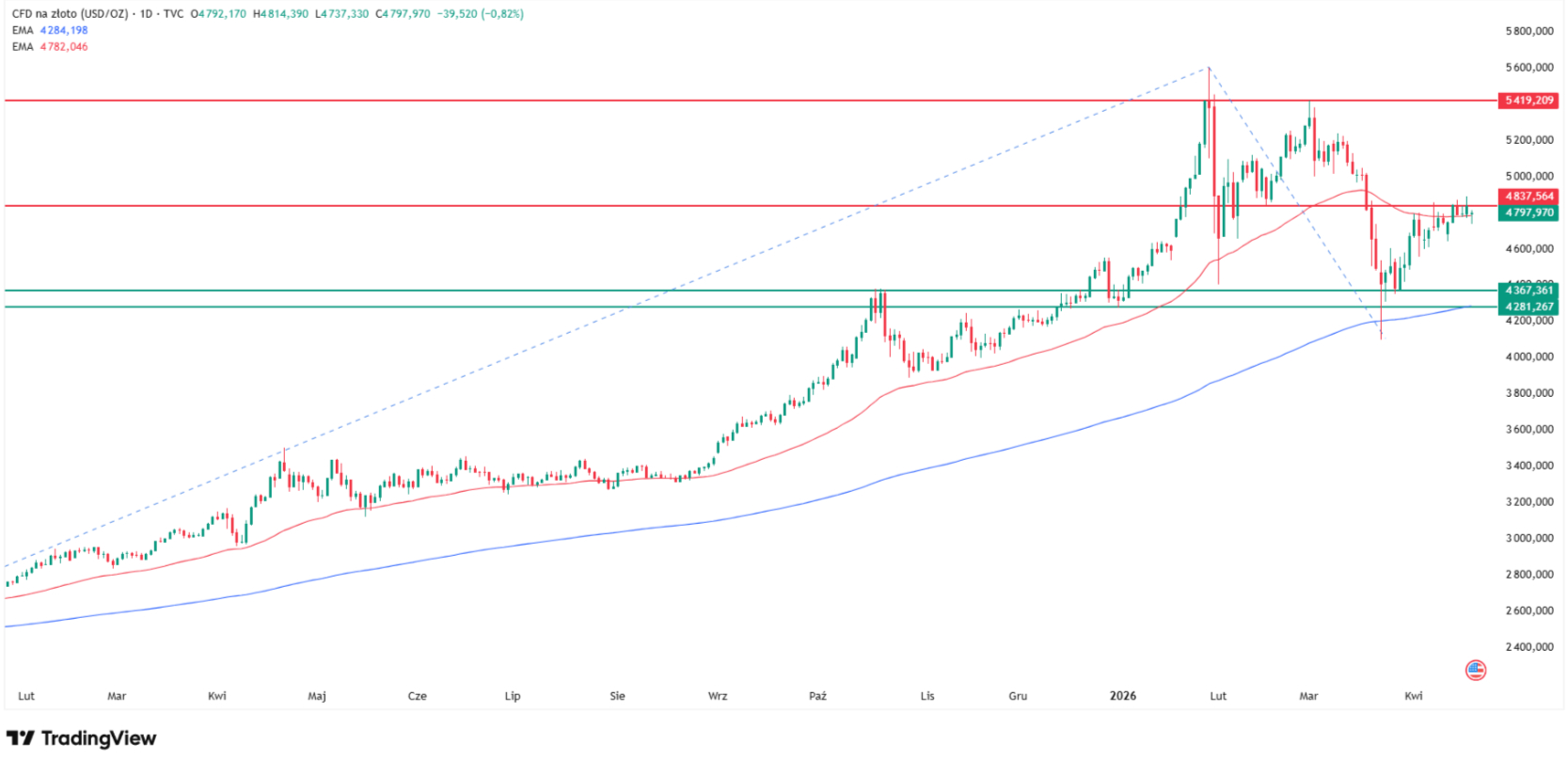
structure has not changed in three weeks. Gold remains trapped in a
consolidation bounded by the October 2025 breakout zone at $4,281 to $4,368 on
the downside and $4,800 resistance reinforced by the 50-day EMA on the upside.
Gold tried to break the $4,800 cap at the end of last week and failed, printing
a rejection candle that resolved into today's 0.9% decline. My bias inside the
range has shifted from neutral to mildly bearish after that third failed test.
Here is
where "how low can gold go" gets specific. My Fibonacci extension,
stretched across the correction from the January all-time high and the current
March-April rebound, places the 100% extension at approximately $3,400 per
ounce. That target is not arbitrary. The $3,400 zone acted as resistance from
April through August 2025 before bullion broke out into the parabolic autumn
move that eventually carried price to $5,595.
Old
resistance retested as support, if it fails, typically draws price back to its
original breakout level. A 28% decline from the current $4,793 spot sounds
extreme, but as I established in my earlier Fibonacci analysis, the same extension math that
framed the upside target at $7,000-plus also frames the downside risk with
equal validity.
A downside
break of the $4,281 floor on a weekly close would confirm the bearish scenario.
An upside break of $4,800 on strong volume opens $5,400 as the next resistance,
which was the closing high on January 28 and still represents the highest ever
daily close for gold. Until one side breaks with conviction, the $4,281 to
$4,800 range remains the operating framework.
How low can gold go? Source: Tradingview.com
Key gold price levels
Level
Type
Notes
$5,400
Resistance
January
28 closing high, highest-ever daily close
$4,800
Resistance
50-day
EMA, three failed breakout attempts since March
On the bull
side, JPMorgan holds the highest major-bank target at $6,300, built on
approximately 800 tonnes of projected central-bank buying. Deutsche Bank and
UBP both target $6,000. Goldman Sachs maintains $5,400 despite March's worst
monthly decline since 2013, with analysts Daan Struyven and Lina Thomas arguing
that the buyers who drove the 2025 rally have not left and do not need a new
wave of participants to hit the target, as I wrote in my earlier Goldman analysis. UBS sits at $5,600 but has flagged
the move as the late stage of the bull cycle, according to precious-metals
strategist Joni Teves.
The bear
framework is narrower but credible. State Street assigns 20% probability to a
$4,000 to $4,750 year-end range, flagging $4,000 to $4,100 as the structural
floor. As I wrote in my previous WGC analysis, the World Gold Council's Reflation
Return scenario models a 5% to 20% decline to $3,360 to $3,990 if Trump's
reflation policies succeed and the Fed stays restrictive. My $3,400 Fibonacci
target sits squarely inside that institutional bear zone.
Institutional gold price predictions
Source
Target
Notes
JPMorgan
$6,300
Year-end
2026, 800 tonnes central-bank buying
UBP / Deutsche Bank
$6,000
Year-end 2026, structural revaluation
UBS
$5,600
Year-end
2026, late-stage bull flag from Joni Teves
Goldman Sachs
$5,400
Year-end
2026, maintained post-March crash
Reuters poll median
$4,746.50
2026 average, 30-analyst survey
State Street
$4,000
20%
probability bear case, structural floor
World Gold Council
$3,360-$3,990
Reflation Return scenario, 5-20% decline
My Fibonacci target
$3,400
100% extension if $4,281 breaks
Frequently asked questions
How low can gold go in
2026?
My
Fibonacci extension projects a 28% drop to $3,400 per ounce if gold breaks
below the $4,281 October 2025 support. State Street assigns 20% probability to
a $4,000 to $4,750 year-end range, flagging $4,000 to $4,100 as the structural
floor. The World Gold Council's Reflation Return scenario models $3,360 to
$3,990. A weekly close below $4,281 confirms the bearish path.
Why is gold price falling
today?
Gold fell
0.9% to $4,793 on Monday, April 20, 2026, after the US Navy seized an Iranian
cargo vessel in the Gulf of Oman. Brent crude surged 5.33% to $95.20, pushing
Treasury yields higher and the Dollar Index to 98.47. Rising yields raise the
opportunity cost of holding non-yielding bullion, while the stronger dollar
makes gold more expensive for non-dollar buyers.
What is the gold price
prediction for year-end 2026?
Institutional
forecasts span $4,000 to $6,300 for year-end 2026. JPMorgan targets $6,300, UBP
and Deutsche Bank $6,000, UBS $5,600, Goldman Sachs $5,400. State Street flags
$4,000 as the bear-case floor with 20% probability. The Reuters poll median
across 30 analysts sits at $4,746.50 per ounce for the 2026 average, roughly 1%
below current spot.
What happens if gold
breaks below $4,300?
A confirmed
weekly close below $4,281 invalidates the October 2025 breakout and opens the
200-day moving average near $4,260 as the next test. Below that cluster, my
Fibonacci extension targets $3,400, the same zone that capped price between
April and August 2025. State Street views $4,000 to $4,100 as the structural
bull-bear dividing line for year-end 2026.
Is gold still in a bull
market?
Technically,
yes. Gold remains up roughly 40% year-over-year and 14% below the January
$5,595 all-time high, but still trading inside a multi-month consolidation
rather than a confirmed downtrend. A weekly close below $4,281 would be the
first major warning sign. As I wrote in my March crash analysis, the $4,200 to $4,280 zone is the
bull-bear line.
Gold traded
at $4,793 per ounce on Monday, April 20, 2026, falling 0.9% after the US Navy
seized an Iranian-flagged cargo vessel in the Gulf of Oman, sending Brent crude
up 5.33% to $95.20 and reigniting the inflation concerns that have pinned
bullion inside a month-long consolidation range.
Spot
XAU/USD sits roughly 14% below the $5,595 all-time high set on January 29 and
has failed three times at $4,800 resistance reinforced by the 50-day EMA. For
the first time since the February peak, the primary gold price prediction
question is no longer "how high," but "how low can gold
go."
Three
catalysts define this week: the US-Iran ceasefire expires Wednesday, the Fed's
preferred PCE inflation print lands Friday, and Strait of Hormuz transits
collapsed to zero on Sunday from a pre-war daily average of 138.
Follow
me on X for real-time gold market analysis: @ChmielDk
Why gold price is falling
today?
"Gold
was under pressure on Monday as rising uncertainty over the geopolitical
situation in the Middle East lifted oil prices and reignited inflation
concerns," said Konstantinos Chrysikos, Head of Customer Relationship
Management at Kudotrade.
The USS
Spruance intercepted the Iranian-flagged Touska over the weekend, with US
Marines taking custody after warnings to stop were ignored. Iran shut the
Strait of Hormuz again on Saturday, citing US breaches of the ceasefire, and
redirected at least 25 commercial vessels away from Iranian ports.
The selloff
runs through the monetary channel before it runs through flows. Energy prices
are pushing Treasury yields higher across maturities, raising the opportunity
cost of holding non-yielding bullion. The Dollar Index climbed to 98.47, making
gold more expensive for non-dollar buyers and capping the safe-haven bid that
would normally emerge from an active naval standoff.
Flow data
is the softer pillar. Gold-backed ETFs recorded two consecutive weeks of
inflows through mid-April after March produced the largest monthly outflows in
five years, but a sustained rise in yields puts that bid back at risk.
"While
ongoing central bank purchases and persistent tensions in Eastern Europe
provide a longer-term floor, sustained strength in yields and the dollar could
keep the metal under pressure in the near term," Chrysikos added.
As I wrote
in my previous UBP analysis, the Swiss private bank lifted gold
exposure back to 6% of discretionary portfolios from an Iran-war low of 3%,
reinforcing the structural floor argument even as near-term pressure builds.
The four
drivers weighing on gold price today:
US naval action: USS Spruance seized the
Iranian cargo vessel Touska, escalating the Strait of Hormuz standoff
Energy shock: Brent crude up 5.33% to
$95.20, WTI up 6.03% to $88.91
Dollar strength: DXY climbed to 98.47, its
highest in over a week
ETF flow risk: Two weeks of inflows at risk
of reversing as Treasury yields rise
Gold technical analysis:
the path to $3,400
My chart
structure has not changed in three weeks. Gold remains trapped in a
consolidation bounded by the October 2025 breakout zone at $4,281 to $4,368 on
the downside and $4,800 resistance reinforced by the 50-day EMA on the upside.
Gold tried to break the $4,800 cap at the end of last week and failed, printing
a rejection candle that resolved into today's 0.9% decline. My bias inside the
range has shifted from neutral to mildly bearish after that third failed test.
Here is
where "how low can gold go" gets specific. My Fibonacci extension,
stretched across the correction from the January all-time high and the current
March-April rebound, places the 100% extension at approximately $3,400 per
ounce. That target is not arbitrary. The $3,400 zone acted as resistance from
April through August 2025 before bullion broke out into the parabolic autumn
move that eventually carried price to $5,595.
Old
resistance retested as support, if it fails, typically draws price back to its
original breakout level. A 28% decline from the current $4,793 spot sounds
extreme, but as I established in my earlier Fibonacci analysis, the same extension math that
framed the upside target at $7,000-plus also frames the downside risk with
equal validity.
A downside
break of the $4,281 floor on a weekly close would confirm the bearish scenario.
An upside break of $4,800 on strong volume opens $5,400 as the next resistance,
which was the closing high on January 28 and still represents the highest ever
daily close for gold. Until one side breaks with conviction, the $4,281 to
$4,800 range remains the operating framework.
How low can gold go? Source: Tradingview.com
Key gold price levels
Level
Type
Notes
$5,400
Resistance
January
28 closing high, highest-ever daily close
$4,800
Resistance
50-day
EMA, three failed breakout attempts since March
On the bull
side, JPMorgan holds the highest major-bank target at $6,300, built on
approximately 800 tonnes of projected central-bank buying. Deutsche Bank and
UBP both target $6,000. Goldman Sachs maintains $5,400 despite March's worst
monthly decline since 2013, with analysts Daan Struyven and Lina Thomas arguing
that the buyers who drove the 2025 rally have not left and do not need a new
wave of participants to hit the target, as I wrote in my earlier Goldman analysis. UBS sits at $5,600 but has flagged
the move as the late stage of the bull cycle, according to precious-metals
strategist Joni Teves.
The bear
framework is narrower but credible. State Street assigns 20% probability to a
$4,000 to $4,750 year-end range, flagging $4,000 to $4,100 as the structural
floor. As I wrote in my previous WGC analysis, the World Gold Council's Reflation
Return scenario models a 5% to 20% decline to $3,360 to $3,990 if Trump's
reflation policies succeed and the Fed stays restrictive. My $3,400 Fibonacci
target sits squarely inside that institutional bear zone.
Institutional gold price predictions
Source
Target
Notes
JPMorgan
$6,300
Year-end
2026, 800 tonnes central-bank buying
UBP / Deutsche Bank
$6,000
Year-end 2026, structural revaluation
UBS
$5,600
Year-end
2026, late-stage bull flag from Joni Teves
Goldman Sachs
$5,400
Year-end
2026, maintained post-March crash
Reuters poll median
$4,746.50
2026 average, 30-analyst survey
State Street
$4,000
20%
probability bear case, structural floor
World Gold Council
$3,360-$3,990
Reflation Return scenario, 5-20% decline
My Fibonacci target
$3,400
100% extension if $4,281 breaks
Frequently asked questions
How low can gold go in
2026?
My
Fibonacci extension projects a 28% drop to $3,400 per ounce if gold breaks
below the $4,281 October 2025 support. State Street assigns 20% probability to
a $4,000 to $4,750 year-end range, flagging $4,000 to $4,100 as the structural
floor. The World Gold Council's Reflation Return scenario models $3,360 to
$3,990. A weekly close below $4,281 confirms the bearish path.
Why is gold price falling
today?
Gold fell
0.9% to $4,793 on Monday, April 20, 2026, after the US Navy seized an Iranian
cargo vessel in the Gulf of Oman. Brent crude surged 5.33% to $95.20, pushing
Treasury yields higher and the Dollar Index to 98.47. Rising yields raise the
opportunity cost of holding non-yielding bullion, while the stronger dollar
makes gold more expensive for non-dollar buyers.
What is the gold price
prediction for year-end 2026?
Institutional
forecasts span $4,000 to $6,300 for year-end 2026. JPMorgan targets $6,300, UBP
and Deutsche Bank $6,000, UBS $5,600, Goldman Sachs $5,400. State Street flags
$4,000 as the bear-case floor with 20% probability. The Reuters poll median
across 30 analysts sits at $4,746.50 per ounce for the 2026 average, roughly 1%
below current spot.
What happens if gold
breaks below $4,300?
A confirmed
weekly close below $4,281 invalidates the October 2025 breakout and opens the
200-day moving average near $4,260 as the next test. Below that cluster, my
Fibonacci extension targets $3,400, the same zone that capped price between
April and August 2025. State Street views $4,000 to $4,100 as the structural
bull-bear dividing line for year-end 2026.
Is gold still in a bull
market?
Technically,
yes. Gold remains up roughly 40% year-over-year and 14% below the January
$5,595 all-time high, but still trading inside a multi-month consolidation
rather than a confirmed downtrend. A weekly close below $4,281 would be the
first major warning sign. As I wrote in my March crash analysis, the $4,200 to $4,280 zone is the
bull-bear line.
Damian Chmiel is a Senior Analyst & Editor at Finance Magnates with more than 15 years of experience in the CFD and online trading industry. Active as both a trader and journalist since 2010, he focuses on broker coverage, fintech innovation, and regulatory developments across Europe, the Middle East, and Asia.
His work includes interviews with C-level leaders at major brokerages and fintech platforms, as well as co-authoring Finance Magnates’ quarterly industry benchmarking reports. Damian’s reporting is data-driven, market-aware, and grounded in direct industry engagement. His analysis and commentary have also been cited by external media outlets, including Investing.com, Binance, The Asset, Stockhead, and Dispatch.
Education:
MA in Finance and Accounting, Cracow University of Economics
This New Bitcoin Price Prediction Shows BTC May Drop 25% After $60K Break
Featured Videos
FM Daily Brief – 10 July 2026
Today is Friday, the 10th of July 2026, and here are our main stories: US brokers posted record trading volumes in June, Tradeify's co-founders detail the firm's rapid growth, and the Genius Act's stablecoin deadline is ten days out.
Today is Thursday, the 9th of July 2026 and here’s our main stories: Capital dot com's trading volumes slipped, while average trade size jumped. Trive loses its Australian license. And European lawmakers eye new rules for DeFi and staking.
Match2Pay on Crypto Payments, Stablecoins & Faster Broker Integrations
Are crypto payments really risky for brokers, or is the industry working with outdated assumptions?
In this exclusive Finance Magnates interview from iFX Expo International 2026, Adonis Adoni, News Editor at Finance Magnates, speaks with Andrey Kalashnikov, Head of Match2Pay, about how brokers can improve payment efficiency, reduce costs, and simplify crypto payment infrastructure.
The conversation explores why many firms are paying more than necessary by using multiple crypto providers, how one-click wallet integrations are improving the client deposit experience, and why stablecoins are changing the way finance teams view crypto payments.
In this interview you'll learn:
- Why relying only on card payments could be limiting your business
- The hidden costs of using multiple crypto payment providers
- How one-click crypto payments improve conversion and user experience
- How Match2Pay enables integrations in as little as 24–48 hours
- Why stablecoins eliminate most volatility concerns for finance teams
- How blockchain analytics and AML screening help reduce payment risk
- What brokers should consider when choosing a crypto payment infrastructure
Key Quote:
"It's a mistake to completely rely on traditional payments and not look for alternative methods to optimize your payments." — Andrey Kalashnikov
If you're a broker, payment provider, fintech executive, or compliance professional, this interview offers practical insights into the future of crypto payments.
#FinanceMagnates #Match2Pay #CryptoPayments #Fintech #Forex #CFD #Brokerage #Stablecoins #Blockchain #Payments #iFXExpo #DigitalAssets
Are crypto payments really risky for brokers, or is the industry working with outdated assumptions?
In this exclusive Finance Magnates interview from iFX Expo International 2026, Adonis Adoni, News Editor at Finance Magnates, speaks with Andrey Kalashnikov, Head of Match2Pay, about how brokers can improve payment efficiency, reduce costs, and simplify crypto payment infrastructure.
The conversation explores why many firms are paying more than necessary by using multiple crypto providers, how one-click wallet integrations are improving the client deposit experience, and why stablecoins are changing the way finance teams view crypto payments.
In this interview you'll learn:
- Why relying only on card payments could be limiting your business
- The hidden costs of using multiple crypto payment providers
- How one-click crypto payments improve conversion and user experience
- How Match2Pay enables integrations in as little as 24–48 hours
- Why stablecoins eliminate most volatility concerns for finance teams
- How blockchain analytics and AML screening help reduce payment risk
- What brokers should consider when choosing a crypto payment infrastructure
Key Quote:
"It's a mistake to completely rely on traditional payments and not look for alternative methods to optimize your payments." — Andrey Kalashnikov
If you're a broker, payment provider, fintech executive, or compliance professional, this interview offers practical insights into the future of crypto payments.
#FinanceMagnates #Match2Pay #CryptoPayments #Fintech #Forex #CFD #Brokerage #Stablecoins #Blockchain #Payments #iFXExpo #DigitalAssets
Are crypto payments really risky for brokers, or is the industry working with outdated assumptions?
In this exclusive Finance Magnates interview from iFX Expo International 2026, Adonis Adoni, News Editor at Finance Magnates, speaks with Andrey Kalashnikov, Head of Match2Pay, about how brokers can improve payment efficiency, reduce costs, and simplify crypto payment infrastructure.
The conversation explores why many firms are paying more than necessary by using multiple crypto providers, how one-click wallet integrations are improving the client deposit experience, and why stablecoins are changing the way finance teams view crypto payments.
In this interview you'll learn:
- Why relying only on card payments could be limiting your business
- The hidden costs of using multiple crypto payment providers
- How one-click crypto payments improve conversion and user experience
- How Match2Pay enables integrations in as little as 24–48 hours
- Why stablecoins eliminate most volatility concerns for finance teams
- How blockchain analytics and AML screening help reduce payment risk
- What brokers should consider when choosing a crypto payment infrastructure
Key Quote:
"It's a mistake to completely rely on traditional payments and not look for alternative methods to optimize your payments." — Andrey Kalashnikov
If you're a broker, payment provider, fintech executive, or compliance professional, this interview offers practical insights into the future of crypto payments.
#FinanceMagnates #Match2Pay #CryptoPayments #Fintech #Forex #CFD #Brokerage #Stablecoins #Blockchain #Payments #iFXExpo #DigitalAssets
Are crypto payments really risky for brokers, or is the industry working with outdated assumptions?
In this exclusive Finance Magnates interview from iFX Expo International 2026, Adonis Adoni, News Editor at Finance Magnates, speaks with Andrey Kalashnikov, Head of Match2Pay, about how brokers can improve payment efficiency, reduce costs, and simplify crypto payment infrastructure.
The conversation explores why many firms are paying more than necessary by using multiple crypto providers, how one-click wallet integrations are improving the client deposit experience, and why stablecoins are changing the way finance teams view crypto payments.
In this interview you'll learn:
- Why relying only on card payments could be limiting your business
- The hidden costs of using multiple crypto payment providers
- How one-click crypto payments improve conversion and user experience
- How Match2Pay enables integrations in as little as 24–48 hours
- Why stablecoins eliminate most volatility concerns for finance teams
- How blockchain analytics and AML screening help reduce payment risk
- What brokers should consider when choosing a crypto payment infrastructure
Key Quote:
"It's a mistake to completely rely on traditional payments and not look for alternative methods to optimize your payments." — Andrey Kalashnikov
If you're a broker, payment provider, fintech executive, or compliance professional, this interview offers practical insights into the future of crypto payments.
#FinanceMagnates #Match2Pay #CryptoPayments #Fintech #Forex #CFD #Brokerage #Stablecoins #Blockchain #Payments #iFXExpo #DigitalAssets
Are crypto payments really risky for brokers, or is the industry working with outdated assumptions?
In this exclusive Finance Magnates interview from iFX Expo International 2026, Adonis Adoni, News Editor at Finance Magnates, speaks with Andrey Kalashnikov, Head of Match2Pay, about how brokers can improve payment efficiency, reduce costs, and simplify crypto payment infrastructure.
The conversation explores why many firms are paying more than necessary by using multiple crypto providers, how one-click wallet integrations are improving the client deposit experience, and why stablecoins are changing the way finance teams view crypto payments.
In this interview you'll learn:
- Why relying only on card payments could be limiting your business
- The hidden costs of using multiple crypto payment providers
- How one-click crypto payments improve conversion and user experience
- How Match2Pay enables integrations in as little as 24–48 hours
- Why stablecoins eliminate most volatility concerns for finance teams
- How blockchain analytics and AML screening help reduce payment risk
- What brokers should consider when choosing a crypto payment infrastructure
Key Quote:
"It's a mistake to completely rely on traditional payments and not look for alternative methods to optimize your payments." — Andrey Kalashnikov
If you're a broker, payment provider, fintech executive, or compliance professional, this interview offers practical insights into the future of crypto payments.
#FinanceMagnates #Match2Pay #CryptoPayments #Fintech #Forex #CFD #Brokerage #Stablecoins #Blockchain #Payments #iFXExpo #DigitalAssets
Are crypto payments really risky for brokers, or is the industry working with outdated assumptions?
In this exclusive Finance Magnates interview from iFX Expo International 2026, Adonis Adoni, News Editor at Finance Magnates, speaks with Andrey Kalashnikov, Head of Match2Pay, about how brokers can improve payment efficiency, reduce costs, and simplify crypto payment infrastructure.
The conversation explores why many firms are paying more than necessary by using multiple crypto providers, how one-click wallet integrations are improving the client deposit experience, and why stablecoins are changing the way finance teams view crypto payments.
In this interview you'll learn:
- Why relying only on card payments could be limiting your business
- The hidden costs of using multiple crypto payment providers
- How one-click crypto payments improve conversion and user experience
- How Match2Pay enables integrations in as little as 24–48 hours
- Why stablecoins eliminate most volatility concerns for finance teams
- How blockchain analytics and AML screening help reduce payment risk
- What brokers should consider when choosing a crypto payment infrastructure
Key Quote:
"It's a mistake to completely rely on traditional payments and not look for alternative methods to optimize your payments." — Andrey Kalashnikov
If you're a broker, payment provider, fintech executive, or compliance professional, this interview offers practical insights into the future of crypto payments.
#FinanceMagnates #Match2Pay #CryptoPayments #Fintech #Forex #CFD #Brokerage #Stablecoins #Blockchain #Payments #iFXExpo #DigitalAssets
FM Daily Brief – 8 July 2026
Today is Wednesday, the 8th of July 2026, and here's our main stories: IG Group proposes a Jersey holding company as first-half revenue jumps eighteen percent. Coinbase wins UK approval for stocks and derivatives. And Plus500 taps a UAE finfluencer.
Stress-tested Liquidity, Gold Volatility & Dubai Growth | Andreas Kapsos, CEO of Match-Prime
How do liquidity providers perform when markets are under extreme pressure?
In this exclusive interview from iFX EXPO International 2026, Finance Magnates Editor-in-Chief Yam Yehoshua speaks with Andreas Kapsos, CEO of Match-Prime Liquidity, about the recent stress-tested Liquidity conducted by the company, the impact of January's historic gold market volatility, and why Dubai remains a key growth hub for the industry.
In this interview, you'll learn:
- How Match-Prime stress-tested its liquidity during major market events
- What brokers should look for in a liquidity provider during volatile markets
- Lessons from the industry's gold trading surge
- Why collaboration between liquidity providers became critical
- The challenges faced by new market entrants
- How Match-Prime's Dubai office supports growth across the Middle East and Asia
- Why face-to-face relationships still matter in institutional trading
If you're a broker, liquidity provider, fintech executive, or active in the online trading industry, this interview offers valuable insights into today's market infrastructure and risk management.
#MatchPrime #Liquidity #Forex #CFD #GoldTrading #LiquidityProvider #PrimeBrokerage #RiskManagement #Dubai #TradingInfrastructure #BrokerTechnology #iFXEXPO #FinanceMagnates #Fintech #CapitalMarkets
How do liquidity providers perform when markets are under extreme pressure?
In this exclusive interview from iFX EXPO International 2026, Finance Magnates Editor-in-Chief Yam Yehoshua speaks with Andreas Kapsos, CEO of Match-Prime Liquidity, about the recent stress-tested Liquidity conducted by the company, the impact of January's historic gold market volatility, and why Dubai remains a key growth hub for the industry.
In this interview, you'll learn:
- How Match-Prime stress-tested its liquidity during major market events
- What brokers should look for in a liquidity provider during volatile markets
- Lessons from the industry's gold trading surge
- Why collaboration between liquidity providers became critical
- The challenges faced by new market entrants
- How Match-Prime's Dubai office supports growth across the Middle East and Asia
- Why face-to-face relationships still matter in institutional trading
If you're a broker, liquidity provider, fintech executive, or active in the online trading industry, this interview offers valuable insights into today's market infrastructure and risk management.
#MatchPrime #Liquidity #Forex #CFD #GoldTrading #LiquidityProvider #PrimeBrokerage #RiskManagement #Dubai #TradingInfrastructure #BrokerTechnology #iFXEXPO #FinanceMagnates #Fintech #CapitalMarkets
How do liquidity providers perform when markets are under extreme pressure?
In this exclusive interview from iFX EXPO International 2026, Finance Magnates Editor-in-Chief Yam Yehoshua speaks with Andreas Kapsos, CEO of Match-Prime Liquidity, about the recent stress-tested Liquidity conducted by the company, the impact of January's historic gold market volatility, and why Dubai remains a key growth hub for the industry.
In this interview, you'll learn:
- How Match-Prime stress-tested its liquidity during major market events
- What brokers should look for in a liquidity provider during volatile markets
- Lessons from the industry's gold trading surge
- Why collaboration between liquidity providers became critical
- The challenges faced by new market entrants
- How Match-Prime's Dubai office supports growth across the Middle East and Asia
- Why face-to-face relationships still matter in institutional trading
If you're a broker, liquidity provider, fintech executive, or active in the online trading industry, this interview offers valuable insights into today's market infrastructure and risk management.
#MatchPrime #Liquidity #Forex #CFD #GoldTrading #LiquidityProvider #PrimeBrokerage #RiskManagement #Dubai #TradingInfrastructure #BrokerTechnology #iFXEXPO #FinanceMagnates #Fintech #CapitalMarkets
How do liquidity providers perform when markets are under extreme pressure?
In this exclusive interview from iFX EXPO International 2026, Finance Magnates Editor-in-Chief Yam Yehoshua speaks with Andreas Kapsos, CEO of Match-Prime Liquidity, about the recent stress-tested Liquidity conducted by the company, the impact of January's historic gold market volatility, and why Dubai remains a key growth hub for the industry.
In this interview, you'll learn:
- How Match-Prime stress-tested its liquidity during major market events
- What brokers should look for in a liquidity provider during volatile markets
- Lessons from the industry's gold trading surge
- Why collaboration between liquidity providers became critical
- The challenges faced by new market entrants
- How Match-Prime's Dubai office supports growth across the Middle East and Asia
- Why face-to-face relationships still matter in institutional trading
If you're a broker, liquidity provider, fintech executive, or active in the online trading industry, this interview offers valuable insights into today's market infrastructure and risk management.
#MatchPrime #Liquidity #Forex #CFD #GoldTrading #LiquidityProvider #PrimeBrokerage #RiskManagement #Dubai #TradingInfrastructure #BrokerTechnology #iFXEXPO #FinanceMagnates #Fintech #CapitalMarkets
How do liquidity providers perform when markets are under extreme pressure?
In this exclusive interview from iFX EXPO International 2026, Finance Magnates Editor-in-Chief Yam Yehoshua speaks with Andreas Kapsos, CEO of Match-Prime Liquidity, about the recent stress-tested Liquidity conducted by the company, the impact of January's historic gold market volatility, and why Dubai remains a key growth hub for the industry.
In this interview, you'll learn:
- How Match-Prime stress-tested its liquidity during major market events
- What brokers should look for in a liquidity provider during volatile markets
- Lessons from the industry's gold trading surge
- Why collaboration between liquidity providers became critical
- The challenges faced by new market entrants
- How Match-Prime's Dubai office supports growth across the Middle East and Asia
- Why face-to-face relationships still matter in institutional trading
If you're a broker, liquidity provider, fintech executive, or active in the online trading industry, this interview offers valuable insights into today's market infrastructure and risk management.
#MatchPrime #Liquidity #Forex #CFD #GoldTrading #LiquidityProvider #PrimeBrokerage #RiskManagement #Dubai #TradingInfrastructure #BrokerTechnology #iFXEXPO #FinanceMagnates #Fintech #CapitalMarkets
How do liquidity providers perform when markets are under extreme pressure?
In this exclusive interview from iFX EXPO International 2026, Finance Magnates Editor-in-Chief Yam Yehoshua speaks with Andreas Kapsos, CEO of Match-Prime Liquidity, about the recent stress-tested Liquidity conducted by the company, the impact of January's historic gold market volatility, and why Dubai remains a key growth hub for the industry.
In this interview, you'll learn:
- How Match-Prime stress-tested its liquidity during major market events
- What brokers should look for in a liquidity provider during volatile markets
- Lessons from the industry's gold trading surge
- Why collaboration between liquidity providers became critical
- The challenges faced by new market entrants
- How Match-Prime's Dubai office supports growth across the Middle East and Asia
- Why face-to-face relationships still matter in institutional trading
If you're a broker, liquidity provider, fintech executive, or active in the online trading industry, this interview offers valuable insights into today's market infrastructure and risk management.
#MatchPrime #Liquidity #Forex #CFD #GoldTrading #LiquidityProvider #PrimeBrokerage #RiskManagement #Dubai #TradingInfrastructure #BrokerTechnology #iFXEXPO #FinanceMagnates #Fintech #CapitalMarkets