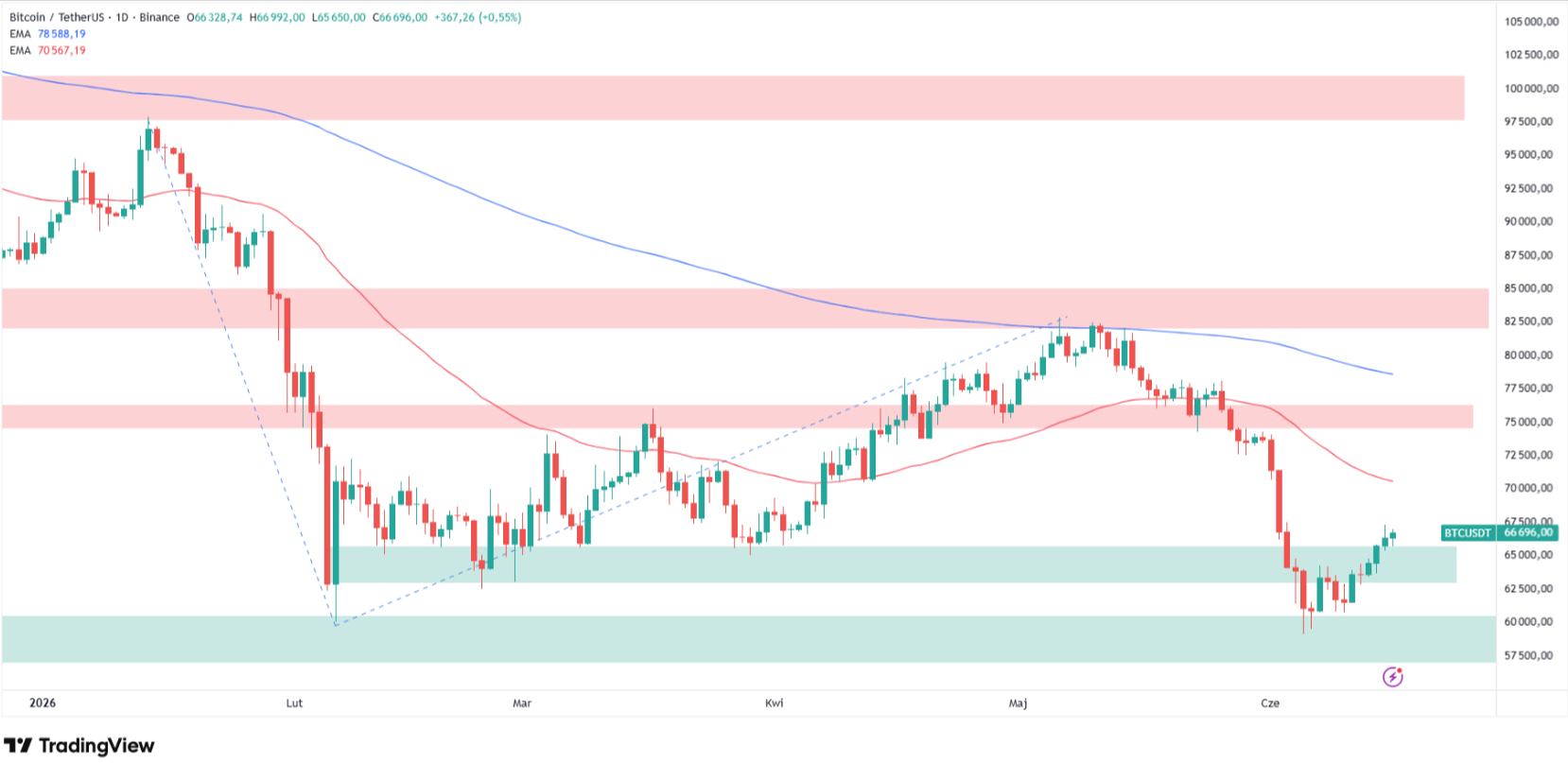
Bitcoin rose for a 4th straight session to $66,700 on June 16, 2026, a two-week high after bottoming at the $59,130 low earlier this month.
My analysis reads the bounce as a countertrend move inside the broad range that has capped Bitcoin near $70,000 since February's lows.
Standard Chartered targets $100,000 for late 2026 but warns of a $50,000 dip first, a downside that matches my own structural bear view.
Bitcoin (BTC) traded at
$66,700 on Tuesday, June 16, 2026, rising for a fourth straight session to a
two-week high as a US-Iran ceasefire and the first FOMC meeting under new Fed
Chair Kevin Warsh pulled buyers back into a market that bottomed at $59,130
this month.
Why Bitcoin
is going up comes down to two forces this week: easing geopolitical risk and a
cautious Fed, with the June 19 peace signing in Switzerland and Wednesday's dot
plot as the next triggers.
The round
$60,000 level absorbed sell pressure and turned into an accumulation zone,
lifting weight off the buyers' backs. BTC tested an intraday high near $67,000
before settling 0.5% higher. The recovery still sits 47% below the $126,198
record set on October 6, 2025.
Follow
me on X for real-time market analysis: @ChmielDk.
In my earlier analysis when Bitcoin was
falling, I argued
that holding below this range could open a path toward $50,000. I am setting
that scenario aside for now. Inside a consolidation, sideways action plays by
its own rules, and I do not chase a breakdown that has not happened.
In 15 years
analyzing markets, the last 10 of them at FinanceMagnates.com, I have learned
that consolidation ranges punish conviction in either direction. You can follow
more of my work on my analyst page.
If the
rebound extends, the first test is $70,000, a round number that lines up with
the 50-day EMA. Above it sits the $75,000 to $76,000 zone, the middle of the range I mapped in February and the site of last year's lows.
Why Bitcoin price is going up today? Source: Tradingview.com
The 200 EMA
near $79,000 is the line that matters most. The upper boundary of the
consolidation runs from $82,000 to $85,000.
Level
Type
Notes
$82,000-$85,000
Resistance
Upper
bound of the since-February range
$79,000
Resistance / 200 EMA
Bias-flip
trigger and trend separator
$75,000-$76,000
Resistance
Mid-range,
last year's lows
$70,000
Resistance / 50 EMA
First test, round number
$66,700
Spot (June 16)
4th up
session, two-week high
$60,000
Support
Buy-order accumulation zone
$59,130
Support
June low,
weakest since September 2024
$50,000
Target
Structural-bear scenario, delayed
My bias
stays bearish. The main trend is down, price sits below both the 50 and 200
EMA, and I am cautious on stronger, longer-term long positions. That bias
changes only on a clean break above the 200 EMA.
Until then
I treat this as a countertrend bounce inside a range, and I still see room
toward $50,000 over the medium term, a move that has been delayed rather than
canceled.
Why Is Bitcoin Going Up
Today?
The
strongest tailwind is geopolitical. President Trump authorized reopening the
Strait of Hormuz after the US and Iran agreed to a ceasefire, with a formal
signing set for June 19 in Switzerland.
Oil prices
fell sharply on the news, easing the inflation premium that energy markets built in during the
conflict. Lower
crude cools the inflation fear that had pushed traders out of risk assets.
Not
everyone trusts the relief. "The market is treating June 19 in Switzerland
as the real timestamp," said Nicolai Sondergaard, Research Analyst at
Nansen.
Sondergaard
noted that an April deal collapsed and that US strikes broke a second truce on
June 9, with Bitcoin handing back the entire relief move both times. Traders
burned twice this year are not redeploying in full ahead of the signing.
The second
catalyst is the Federal Reserve. The FOMC meets June 16 and 17, the first
meeting chaired by Warsh, who replaced Jerome Powell in May. CME FedWatch puts
the odds of a hold at 3.50% to 3.75% near 98%, so the focus falls on the dot
plot and Warsh's first press conference.
May CPI ran
at 4.2%, lifted by the energy shock, and prediction markets price 50% to 65%
odds of at least one 2026 rate hike.
Sentiment
is repairing from a deep low. The Crypto Fear and Greed Index climbed to 23,
still in fear territory but off the single-digit readings of last week.
"The
market is searching for a new equilibrium," said Linh Tran, Market Analyst
at XS.com. Tran traced the slide from the $80,000 area in mid-May to a low near
$59,000 and framed the bounce as positive fundamentals meeting a market that is
not yet in a supported bull cycle.
Four
forces explain why Bitcoin price is rising this week:
US-Iran ceasefire with a June 19 signing in
Switzerland and the Strait of Hormuz set to reopen
Oil prices falling, trimming the inflation
premium that weighed on risk assets
A near-certain Fed hold that shifts attention to
Warsh's dot plot on June 17
Returning institutional demand after weeks of outflows and
forced selling
Institutional Flows Return
to Bitcoin
The bid
under this bounce is institutional. Strategy, the Michael Saylor-led treasury
company, bought 1,587 BTC for roughly $100 million between June 8 and June 14,
lifting its stack to 846,842 BTC.
US spot Bitcoin ETFs turned positive with
$85.8 million of net inflows on June 13, a reversal from the record outflows earlier this year. Large holders
pulled more than 11,000 BTC off exchanges, a move that usually signals reduced
selling intent.
Strategy: plus 1,587 BTC for $100M,
total holdings 846,842 BTC
Spot ETFs: plus $85.8M net inflow on June
13, reversing late-May outflows
Exchange balances: 11,000+ BTC withdrawn by large
wallets
How High Can Bitcoin Go?
Price Predictions
How high
can Bitcoin go depends on whether this week's catalysts clear. Standard
Chartered's Geoff Kendrick holds a $100,000 year-end 2026 target, cut from
$150,000 in February, and warned the price could touch $50,000 first.
That
$50,000 dip lines up with my own downside scenario, while the rebound to
$100,000 assumes a liquidity turn I do not see before the 200 EMA breaks.
Bernstein keeps a $150,000 call for late 2026, which on my chart requires
reclaiming the $82,000 to $85,000 ceiling that nothing yet supports.
The broader
analyst field, polled by CNBC, spans $75,000 to $225,000 for 2026. The low end
is only my mid-range level, and the high end needs a full trend reversal.
A dovish
dot plot on June 17 could push Bitcoin toward $80,000, the top of my range, and
that is the single clearest near-term path higher. A hawkish surprise sends
price back toward $64,000, with a break there reopening the low $60,000s, near
the levels Peter Brandt's cycle work flagged for a final low this year.
Source
Target
Notes
Standard Chartered (Kendrick)
$100,000
Year-end
2026, warns of $50,000 dip first
Bernstein
$150,000
Late 2026
CNBC analyst poll
$75,000-$225,000
Full-year 2026 range
Dovish Fed scenario
~$80,000
If June
17 dot plot signals cuts
Fed reaction band
$64,000-$70,000
Hawkish
to dovish near-term swing
FAQ, Bitcoin Price
Analysis
Why is Bitcoin going up
today?
Bitcoin is
going up on two catalysts. A US-Iran ceasefire, with a June 19 signing in
Switzerland and the Strait of Hormuz reopening, pushed oil and inflation fears
lower. Ahead of the June 17 Fed decision, institutional buyers returned:
Strategy added 1,587 BTC, spot ETFs took in $85.8 million on June 13, and large
wallets pulled over 11,000 BTC off exchanges.
Why is Bitcoin price
rising after the recent crash?
Bitcoin
bottomed at $59,130 this month, its weakest level since September 2024, then
recovered as the $60,000 round level drew buy orders. The rebound reached a
fourth straight session and a two-week high near $67,000. The Crypto Fear and
Greed Index climbed to 23 from single digits, signaling that capitulation
selling has eased even though sentiment stays in fear territory.
How high can Bitcoin go in
2026?
Analyst
targets span $75,000 to $225,000 for 2026. Standard Chartered sees $100,000 by
year-end, Bernstein $150,000. My technical read is more measured: $70,000 is
the first resistance at the 50 EMA, then the $75,000 to $76,000 zone, then
$79,000 at the 200 EMA. I stay bearish until price closes above the 200 EMA.
What is the key level for
Bitcoin now?
The 200 EMA
near $79,000 is the level that matters most. It separates the bearish trend
from a bullish one, and my market bias flips only on a clean daily close above
it. Below that, $70,000 at the 50 EMA is the first test, while $60,000 remains
the accumulation floor that has absorbed sell pressure this month.
Will Bitcoin fall to
$50,000?
It is
possible but delayed. I argued in an earlier analysis that losing the
consolidation range could open a path toward $50,000, and Standard Chartered
flagged the same level. For now, price is holding inside the range, so I have
set that scenario aside. It returns to the table only if Bitcoin loses the
$59,130 June low on a daily close.
Bitcoin (BTC) traded at
$66,700 on Tuesday, June 16, 2026, rising for a fourth straight session to a
two-week high as a US-Iran ceasefire and the first FOMC meeting under new Fed
Chair Kevin Warsh pulled buyers back into a market that bottomed at $59,130
this month.
Why Bitcoin
is going up comes down to two forces this week: easing geopolitical risk and a
cautious Fed, with the June 19 peace signing in Switzerland and Wednesday's dot
plot as the next triggers.
The round
$60,000 level absorbed sell pressure and turned into an accumulation zone,
lifting weight off the buyers' backs. BTC tested an intraday high near $67,000
before settling 0.5% higher. The recovery still sits 47% below the $126,198
record set on October 6, 2025.
Follow
me on X for real-time market analysis: @ChmielDk.
In my earlier analysis when Bitcoin was
falling, I argued
that holding below this range could open a path toward $50,000. I am setting
that scenario aside for now. Inside a consolidation, sideways action plays by
its own rules, and I do not chase a breakdown that has not happened.
In 15 years
analyzing markets, the last 10 of them at FinanceMagnates.com, I have learned
that consolidation ranges punish conviction in either direction. You can follow
more of my work on my analyst page.
If the
rebound extends, the first test is $70,000, a round number that lines up with
the 50-day EMA. Above it sits the $75,000 to $76,000 zone, the middle of the range I mapped in February and the site of last year's lows.
Why Bitcoin price is going up today? Source: Tradingview.com
The 200 EMA
near $79,000 is the line that matters most. The upper boundary of the
consolidation runs from $82,000 to $85,000.
Level
Type
Notes
$82,000-$85,000
Resistance
Upper
bound of the since-February range
$79,000
Resistance / 200 EMA
Bias-flip
trigger and trend separator
$75,000-$76,000
Resistance
Mid-range,
last year's lows
$70,000
Resistance / 50 EMA
First test, round number
$66,700
Spot (June 16)
4th up
session, two-week high
$60,000
Support
Buy-order accumulation zone
$59,130
Support
June low,
weakest since September 2024
$50,000
Target
Structural-bear scenario, delayed
My bias
stays bearish. The main trend is down, price sits below both the 50 and 200
EMA, and I am cautious on stronger, longer-term long positions. That bias
changes only on a clean break above the 200 EMA.
Until then
I treat this as a countertrend bounce inside a range, and I still see room
toward $50,000 over the medium term, a move that has been delayed rather than
canceled.
Why Is Bitcoin Going Up
Today?
The
strongest tailwind is geopolitical. President Trump authorized reopening the
Strait of Hormuz after the US and Iran agreed to a ceasefire, with a formal
signing set for June 19 in Switzerland.
Oil prices
fell sharply on the news, easing the inflation premium that energy markets built in during the
conflict. Lower
crude cools the inflation fear that had pushed traders out of risk assets.
Not
everyone trusts the relief. "The market is treating June 19 in Switzerland
as the real timestamp," said Nicolai Sondergaard, Research Analyst at
Nansen.
Sondergaard
noted that an April deal collapsed and that US strikes broke a second truce on
June 9, with Bitcoin handing back the entire relief move both times. Traders
burned twice this year are not redeploying in full ahead of the signing.
The second
catalyst is the Federal Reserve. The FOMC meets June 16 and 17, the first
meeting chaired by Warsh, who replaced Jerome Powell in May. CME FedWatch puts
the odds of a hold at 3.50% to 3.75% near 98%, so the focus falls on the dot
plot and Warsh's first press conference.
May CPI ran
at 4.2%, lifted by the energy shock, and prediction markets price 50% to 65%
odds of at least one 2026 rate hike.
Sentiment
is repairing from a deep low. The Crypto Fear and Greed Index climbed to 23,
still in fear territory but off the single-digit readings of last week.
"The
market is searching for a new equilibrium," said Linh Tran, Market Analyst
at XS.com. Tran traced the slide from the $80,000 area in mid-May to a low near
$59,000 and framed the bounce as positive fundamentals meeting a market that is
not yet in a supported bull cycle.
Four
forces explain why Bitcoin price is rising this week:
US-Iran ceasefire with a June 19 signing in
Switzerland and the Strait of Hormuz set to reopen
Oil prices falling, trimming the inflation
premium that weighed on risk assets
A near-certain Fed hold that shifts attention to
Warsh's dot plot on June 17
Returning institutional demand after weeks of outflows and
forced selling
Institutional Flows Return
to Bitcoin
The bid
under this bounce is institutional. Strategy, the Michael Saylor-led treasury
company, bought 1,587 BTC for roughly $100 million between June 8 and June 14,
lifting its stack to 846,842 BTC.
US spot Bitcoin ETFs turned positive with
$85.8 million of net inflows on June 13, a reversal from the record outflows earlier this year. Large holders
pulled more than 11,000 BTC off exchanges, a move that usually signals reduced
selling intent.
Strategy: plus 1,587 BTC for $100M,
total holdings 846,842 BTC
Spot ETFs: plus $85.8M net inflow on June
13, reversing late-May outflows
Exchange balances: 11,000+ BTC withdrawn by large
wallets
How High Can Bitcoin Go?
Price Predictions
How high
can Bitcoin go depends on whether this week's catalysts clear. Standard
Chartered's Geoff Kendrick holds a $100,000 year-end 2026 target, cut from
$150,000 in February, and warned the price could touch $50,000 first.
That
$50,000 dip lines up with my own downside scenario, while the rebound to
$100,000 assumes a liquidity turn I do not see before the 200 EMA breaks.
Bernstein keeps a $150,000 call for late 2026, which on my chart requires
reclaiming the $82,000 to $85,000 ceiling that nothing yet supports.
The broader
analyst field, polled by CNBC, spans $75,000 to $225,000 for 2026. The low end
is only my mid-range level, and the high end needs a full trend reversal.
A dovish
dot plot on June 17 could push Bitcoin toward $80,000, the top of my range, and
that is the single clearest near-term path higher. A hawkish surprise sends
price back toward $64,000, with a break there reopening the low $60,000s, near
the levels Peter Brandt's cycle work flagged for a final low this year.
Source
Target
Notes
Standard Chartered (Kendrick)
$100,000
Year-end
2026, warns of $50,000 dip first
Bernstein
$150,000
Late 2026
CNBC analyst poll
$75,000-$225,000
Full-year 2026 range
Dovish Fed scenario
~$80,000
If June
17 dot plot signals cuts
Fed reaction band
$64,000-$70,000
Hawkish
to dovish near-term swing
FAQ, Bitcoin Price
Analysis
Why is Bitcoin going up
today?
Bitcoin is
going up on two catalysts. A US-Iran ceasefire, with a June 19 signing in
Switzerland and the Strait of Hormuz reopening, pushed oil and inflation fears
lower. Ahead of the June 17 Fed decision, institutional buyers returned:
Strategy added 1,587 BTC, spot ETFs took in $85.8 million on June 13, and large
wallets pulled over 11,000 BTC off exchanges.
Why is Bitcoin price
rising after the recent crash?
Bitcoin
bottomed at $59,130 this month, its weakest level since September 2024, then
recovered as the $60,000 round level drew buy orders. The rebound reached a
fourth straight session and a two-week high near $67,000. The Crypto Fear and
Greed Index climbed to 23 from single digits, signaling that capitulation
selling has eased even though sentiment stays in fear territory.
How high can Bitcoin go in
2026?
Analyst
targets span $75,000 to $225,000 for 2026. Standard Chartered sees $100,000 by
year-end, Bernstein $150,000. My technical read is more measured: $70,000 is
the first resistance at the 50 EMA, then the $75,000 to $76,000 zone, then
$79,000 at the 200 EMA. I stay bearish until price closes above the 200 EMA.
What is the key level for
Bitcoin now?
The 200 EMA
near $79,000 is the level that matters most. It separates the bearish trend
from a bullish one, and my market bias flips only on a clean daily close above
it. Below that, $70,000 at the 50 EMA is the first test, while $60,000 remains
the accumulation floor that has absorbed sell pressure this month.
Will Bitcoin fall to
$50,000?
It is
possible but delayed. I argued in an earlier analysis that losing the
consolidation range could open a path toward $50,000, and Standard Chartered
flagged the same level. For now, price is holding inside the range, so I have
set that scenario aside. It returns to the table only if Bitcoin loses the
$59,130 June low on a daily close.
Damian Chmiel is a Senior Analyst & Editor at Finance Magnates with more than 15 years of experience in the CFD and online trading industry. Active as both a trader and journalist since 2010, he focuses on broker coverage, fintech innovation, and regulatory developments across Europe, the Middle East, and Asia.
His work includes interviews with C-level leaders at major brokerages and fintech platforms, as well as co-authoring Finance Magnates’ quarterly industry benchmarking reports. Damian’s reporting is data-driven, market-aware, and grounded in direct industry engagement. His analysis and commentary have also been cited by external media outlets, including Investing.com, Binance, The Asset, Stockhead, and Dispatch.
Education:
MA in Finance and Accounting, Cracow University of Economics
Why Is Crypto Going Down Today? Bitcoin Slips Toward $82,600, XRP Falls 7%
Featured Videos
FMIQ: Get Verified Market Intelligence in Seconds | FM Intelligence
FMIQ: Get Verified Market Intelligence in Seconds | FM Intelligence
FMIQ: Get Verified Market Intelligence in Seconds | FM Intelligence
FMIQ: Get Verified Market Intelligence in Seconds | FM Intelligence
Meet FMIQ (FM Intelligence Quantitative), now available inside the FM Intelligence Portal.
Ask the market a question in plain language and get a sourced, verified answer in seconds. FMIQ gives you the figures, time periods, and sources you need to make informed decisions, without the need to work through dashboards, filters, or spreadsheet exports.
What makes FMIQ different?
✓ Ask questions in plain language, with no SQL or dashboard setup required.
✓ Get verified answers checked through an independent quality assurance step.
✓ Access sourced figures you can cite with confidence.
✓ Ask follow-up questions and build on the same conversation.
✓ Query seven datasets in one place, covering trading volumes, traffic, platforms, market movements, regulations, fines, and licences.
Built for professionals across the financial markets
- Editorial teams: Find reliable figures and support your reporting with clear sources.
- Commercial teams: Access the market data you need to prepare for client meetings and sales discussions.
- Research and analyst teams: Explore market trends and get answers to specific questions.
- Compliance teams: Access intelligence on regulations, fines, and licences.
Every query is run live, and answers go through an independent quality check. FMIQ is read-only, stays focused on your question, and does not alter the underlying data.
Built on Finance Magnates market intelligence, FMIQ helps professionals get the answers they need, when they need them.
Access FMIQ today: https://datalab.financemagnates.com/market?utm_source=youtube&utm_medium=video&utm_campaign=fmiq_phase1_mvp_launch
#FMIntelligence #FMIQ #MarketIntelligence #FinanceMagnates #FinancialMarkets #MarketResearch
Meet FMIQ (FM Intelligence Quantitative), now available inside the FM Intelligence Portal.
Ask the market a question in plain language and get a sourced, verified answer in seconds. FMIQ gives you the figures, time periods, and sources you need to make informed decisions, without the need to work through dashboards, filters, or spreadsheet exports.
What makes FMIQ different?
✓ Ask questions in plain language, with no SQL or dashboard setup required.
✓ Get verified answers checked through an independent quality assurance step.
✓ Access sourced figures you can cite with confidence.
✓ Ask follow-up questions and build on the same conversation.
✓ Query seven datasets in one place, covering trading volumes, traffic, platforms, market movements, regulations, fines, and licences.
Built for professionals across the financial markets
- Editorial teams: Find reliable figures and support your reporting with clear sources.
- Commercial teams: Access the market data you need to prepare for client meetings and sales discussions.
- Research and analyst teams: Explore market trends and get answers to specific questions.
- Compliance teams: Access intelligence on regulations, fines, and licences.
Every query is run live, and answers go through an independent quality check. FMIQ is read-only, stays focused on your question, and does not alter the underlying data.
Built on Finance Magnates market intelligence, FMIQ helps professionals get the answers they need, when they need them.
Access FMIQ today: https://datalab.financemagnates.com/market?utm_source=youtube&utm_medium=video&utm_campaign=fmiq_phase1_mvp_launch
#FMIntelligence #FMIQ #MarketIntelligence #FinanceMagnates #FinancialMarkets #MarketResearch
Meet FMIQ (FM Intelligence Quantitative), now available inside the FM Intelligence Portal.
Ask the market a question in plain language and get a sourced, verified answer in seconds. FMIQ gives you the figures, time periods, and sources you need to make informed decisions, without the need to work through dashboards, filters, or spreadsheet exports.
What makes FMIQ different?
✓ Ask questions in plain language, with no SQL or dashboard setup required.
✓ Get verified answers checked through an independent quality assurance step.
✓ Access sourced figures you can cite with confidence.
✓ Ask follow-up questions and build on the same conversation.
✓ Query seven datasets in one place, covering trading volumes, traffic, platforms, market movements, regulations, fines, and licences.
Built for professionals across the financial markets
- Editorial teams: Find reliable figures and support your reporting with clear sources.
- Commercial teams: Access the market data you need to prepare for client meetings and sales discussions.
- Research and analyst teams: Explore market trends and get answers to specific questions.
- Compliance teams: Access intelligence on regulations, fines, and licences.
Every query is run live, and answers go through an independent quality check. FMIQ is read-only, stays focused on your question, and does not alter the underlying data.
Built on Finance Magnates market intelligence, FMIQ helps professionals get the answers they need, when they need them.
Access FMIQ today: https://datalab.financemagnates.com/market?utm_source=youtube&utm_medium=video&utm_campaign=fmiq_phase1_mvp_launch
#FMIntelligence #FMIQ #MarketIntelligence #FinanceMagnates #FinancialMarkets #MarketResearch
Meet FMIQ (FM Intelligence Quantitative), now available inside the FM Intelligence Portal.
Ask the market a question in plain language and get a sourced, verified answer in seconds. FMIQ gives you the figures, time periods, and sources you need to make informed decisions, without the need to work through dashboards, filters, or spreadsheet exports.
What makes FMIQ different?
✓ Ask questions in plain language, with no SQL or dashboard setup required.
✓ Get verified answers checked through an independent quality assurance step.
✓ Access sourced figures you can cite with confidence.
✓ Ask follow-up questions and build on the same conversation.
✓ Query seven datasets in one place, covering trading volumes, traffic, platforms, market movements, regulations, fines, and licences.
Built for professionals across the financial markets
- Editorial teams: Find reliable figures and support your reporting with clear sources.
- Commercial teams: Access the market data you need to prepare for client meetings and sales discussions.
- Research and analyst teams: Explore market trends and get answers to specific questions.
- Compliance teams: Access intelligence on regulations, fines, and licences.
Every query is run live, and answers go through an independent quality check. FMIQ is read-only, stays focused on your question, and does not alter the underlying data.
Built on Finance Magnates market intelligence, FMIQ helps professionals get the answers they need, when they need them.
Access FMIQ today: https://datalab.financemagnates.com/market?utm_source=youtube&utm_medium=video&utm_campaign=fmiq_phase1_mvp_launch
#FMIntelligence #FMIQ #MarketIntelligence #FinanceMagnates #FinancialMarkets #MarketResearch
MyForexFunds Details No Conflict Model; UK Eyes iPhone Wallets
MyForexFunds Details No Conflict Model; UK Eyes iPhone Wallets
MyForexFunds Details No Conflict Model; UK Eyes iPhone Wallets
MyForexFunds Details No Conflict Model; UK Eyes iPhone Wallets
MyForexFunds Details No Conflict Model; UK Eyes iPhone Wallets
MyForexFunds Details No Conflict Model; UK Eyes iPhone Wallets
Today’s financial news recap covers MyForexFunds outlines its Evolution relaunch, UK brokers could get their own iPhone wallets, Goat Funded Trader reports $26 million in payouts, and Kalshi explains its pitch to brokers.
Finance Magnates Daily Recap brings you the latest news from forex and CFD brokers, fintech, payments, cryptocurrency, digital assets, trading platforms, financial regulation and global markets.
Get the key company news, executive moves, deals, regulatory updates and market developments of the day, in just a few minutes. New episodes published every weekday.
Read more: https://www.financemagnates.com
#FinanceMagnates #ForexNews #FintechNews
Today’s financial news recap covers MyForexFunds outlines its Evolution relaunch, UK brokers could get their own iPhone wallets, Goat Funded Trader reports $26 million in payouts, and Kalshi explains its pitch to brokers.
Finance Magnates Daily Recap brings you the latest news from forex and CFD brokers, fintech, payments, cryptocurrency, digital assets, trading platforms, financial regulation and global markets.
Get the key company news, executive moves, deals, regulatory updates and market developments of the day, in just a few minutes. New episodes published every weekday.
Read more: https://www.financemagnates.com
#FinanceMagnates #ForexNews #FintechNews
Today’s financial news recap covers MyForexFunds outlines its Evolution relaunch, UK brokers could get their own iPhone wallets, Goat Funded Trader reports $26 million in payouts, and Kalshi explains its pitch to brokers.
Finance Magnates Daily Recap brings you the latest news from forex and CFD brokers, fintech, payments, cryptocurrency, digital assets, trading platforms, financial regulation and global markets.
Get the key company news, executive moves, deals, regulatory updates and market developments of the day, in just a few minutes. New episodes published every weekday.
Read more: https://www.financemagnates.com
#FinanceMagnates #ForexNews #FintechNews
Today’s financial news recap covers MyForexFunds outlines its Evolution relaunch, UK brokers could get their own iPhone wallets, Goat Funded Trader reports $26 million in payouts, and Kalshi explains its pitch to brokers.
Finance Magnates Daily Recap brings you the latest news from forex and CFD brokers, fintech, payments, cryptocurrency, digital assets, trading platforms, financial regulation and global markets.
Get the key company news, executive moves, deals, regulatory updates and market developments of the day, in just a few minutes. New episodes published every weekday.
Read more: https://www.financemagnates.com
#FinanceMagnates #ForexNews #FintechNews
Today’s financial news recap covers MyForexFunds outlines its Evolution relaunch, UK brokers could get their own iPhone wallets, Goat Funded Trader reports $26 million in payouts, and Kalshi explains its pitch to brokers.
Finance Magnates Daily Recap brings you the latest news from forex and CFD brokers, fintech, payments, cryptocurrency, digital assets, trading platforms, financial regulation and global markets.
Get the key company news, executive moves, deals, regulatory updates and market developments of the day, in just a few minutes. New episodes published every weekday.
Read more: https://www.financemagnates.com
#FinanceMagnates #ForexNews #FintechNews
Today’s financial news recap covers MyForexFunds outlines its Evolution relaunch, UK brokers could get their own iPhone wallets, Goat Funded Trader reports $26 million in payouts, and Kalshi explains its pitch to brokers.
Finance Magnates Daily Recap brings you the latest news from forex and CFD brokers, fintech, payments, cryptocurrency, digital assets, trading platforms, financial regulation and global markets.
Get the key company news, executive moves, deals, regulatory updates and market developments of the day, in just a few minutes. New episodes published every weekday.
Read more: https://www.financemagnates.com
#FinanceMagnates #ForexNews #FintechNews
How Much Are CFD Industry Executives Making; Plus500 Buys Brazilian Broker
How Much Are CFD Industry Executives Making; Plus500 Buys Brazilian Broker
How Much Are CFD Industry Executives Making; Plus500 Buys Brazilian Broker
How Much Are CFD Industry Executives Making; Plus500 Buys Brazilian Broker
How Much Are CFD Industry Executives Making; Plus500 Buys Brazilian Broker
How Much Are CFD Industry Executives Making; Plus500 Buys Brazilian Broker
Today’s financial news recap covers FinTop Consulting shared its 2026 salary surveys for Dubai, London and Cyprus with Finance Magnates, Plus500 buys a Brazilian broker, and Google opens the door to CFD ads in Denmark and Chile.
Finance Magnates Daily Recap brings you the latest news from forex and CFD brokers, fintech, payments, cryptocurrency, digital assets, trading platforms, financial regulation and global markets.
Get the key company news, executive moves, deals, regulatory updates and market developments of the day, in just a few minutes. New episodes published every weekday.
Read more: https://www.financemagnates.com
#FinanceMagnates #ForexNews #FintechNews
Today’s financial news recap covers FinTop Consulting shared its 2026 salary surveys for Dubai, London and Cyprus with Finance Magnates, Plus500 buys a Brazilian broker, and Google opens the door to CFD ads in Denmark and Chile.
Finance Magnates Daily Recap brings you the latest news from forex and CFD brokers, fintech, payments, cryptocurrency, digital assets, trading platforms, financial regulation and global markets.
Get the key company news, executive moves, deals, regulatory updates and market developments of the day, in just a few minutes. New episodes published every weekday.
Read more: https://www.financemagnates.com
#FinanceMagnates #ForexNews #FintechNews
Today’s financial news recap covers FinTop Consulting shared its 2026 salary surveys for Dubai, London and Cyprus with Finance Magnates, Plus500 buys a Brazilian broker, and Google opens the door to CFD ads in Denmark and Chile.
Finance Magnates Daily Recap brings you the latest news from forex and CFD brokers, fintech, payments, cryptocurrency, digital assets, trading platforms, financial regulation and global markets.
Get the key company news, executive moves, deals, regulatory updates and market developments of the day, in just a few minutes. New episodes published every weekday.
Read more: https://www.financemagnates.com
#FinanceMagnates #ForexNews #FintechNews
Today’s financial news recap covers FinTop Consulting shared its 2026 salary surveys for Dubai, London and Cyprus with Finance Magnates, Plus500 buys a Brazilian broker, and Google opens the door to CFD ads in Denmark and Chile.
Finance Magnates Daily Recap brings you the latest news from forex and CFD brokers, fintech, payments, cryptocurrency, digital assets, trading platforms, financial regulation and global markets.
Get the key company news, executive moves, deals, regulatory updates and market developments of the day, in just a few minutes. New episodes published every weekday.
Read more: https://www.financemagnates.com
#FinanceMagnates #ForexNews #FintechNews
Today’s financial news recap covers FinTop Consulting shared its 2026 salary surveys for Dubai, London and Cyprus with Finance Magnates, Plus500 buys a Brazilian broker, and Google opens the door to CFD ads in Denmark and Chile.
Finance Magnates Daily Recap brings you the latest news from forex and CFD brokers, fintech, payments, cryptocurrency, digital assets, trading platforms, financial regulation and global markets.
Get the key company news, executive moves, deals, regulatory updates and market developments of the day, in just a few minutes. New episodes published every weekday.
Read more: https://www.financemagnates.com
#FinanceMagnates #ForexNews #FintechNews
Today’s financial news recap covers FinTop Consulting shared its 2026 salary surveys for Dubai, London and Cyprus with Finance Magnates, Plus500 buys a Brazilian broker, and Google opens the door to CFD ads in Denmark and Chile.
Finance Magnates Daily Recap brings you the latest news from forex and CFD brokers, fintech, payments, cryptocurrency, digital assets, trading platforms, financial regulation and global markets.
Get the key company news, executive moves, deals, regulatory updates and market developments of the day, in just a few minutes. New episodes published every weekday.
Read more: https://www.financemagnates.com
#FinanceMagnates #ForexNews #FintechNews
Capital.com UAE Clients Trade $1T in H1; Saxo Signs Nine Athletes
Capital.com UAE Clients Trade $1T in H1; Saxo Signs Nine Athletes
Capital.com UAE Clients Trade $1T in H1; Saxo Signs Nine Athletes
Capital.com UAE Clients Trade $1T in H1; Saxo Signs Nine Athletes
Capital.com UAE Clients Trade $1T in H1; Saxo Signs Nine Athletes
Capital.com UAE Clients Trade $1T in H1; Saxo Signs Nine Athletes
Today’s financial news recap covers Capital.com’s trading data, Saxo Bank’s athlete campaign, Revolut’s Gibraltar crypto licence, and eToro’s new desktop terminal.
Finance Magnates Daily Recap brings you the latest news from forex and CFD brokers, fintech, payments, cryptocurrency, digital assets, trading platforms, financial regulation and global markets.
Get the key company news, executive moves, deals, regulatory updates and market developments of the day, in just a few minutes. New episodes published every weekday.
Read more: https://www.financemagnates.com
#FinanceMagnates #ForexNews #FintechNews
Today’s financial news recap covers Capital.com’s trading data, Saxo Bank’s athlete campaign, Revolut’s Gibraltar crypto licence, and eToro’s new desktop terminal.
Finance Magnates Daily Recap brings you the latest news from forex and CFD brokers, fintech, payments, cryptocurrency, digital assets, trading platforms, financial regulation and global markets.
Get the key company news, executive moves, deals, regulatory updates and market developments of the day, in just a few minutes. New episodes published every weekday.
Read more: https://www.financemagnates.com
#FinanceMagnates #ForexNews #FintechNews
Today’s financial news recap covers Capital.com’s trading data, Saxo Bank’s athlete campaign, Revolut’s Gibraltar crypto licence, and eToro’s new desktop terminal.
Finance Magnates Daily Recap brings you the latest news from forex and CFD brokers, fintech, payments, cryptocurrency, digital assets, trading platforms, financial regulation and global markets.
Get the key company news, executive moves, deals, regulatory updates and market developments of the day, in just a few minutes. New episodes published every weekday.
Read more: https://www.financemagnates.com
#FinanceMagnates #ForexNews #FintechNews
Today’s financial news recap covers Capital.com’s trading data, Saxo Bank’s athlete campaign, Revolut’s Gibraltar crypto licence, and eToro’s new desktop terminal.
Finance Magnates Daily Recap brings you the latest news from forex and CFD brokers, fintech, payments, cryptocurrency, digital assets, trading platforms, financial regulation and global markets.
Get the key company news, executive moves, deals, regulatory updates and market developments of the day, in just a few minutes. New episodes published every weekday.
Read more: https://www.financemagnates.com
#FinanceMagnates #ForexNews #FintechNews
Today’s financial news recap covers Capital.com’s trading data, Saxo Bank’s athlete campaign, Revolut’s Gibraltar crypto licence, and eToro’s new desktop terminal.
Finance Magnates Daily Recap brings you the latest news from forex and CFD brokers, fintech, payments, cryptocurrency, digital assets, trading platforms, financial regulation and global markets.
Get the key company news, executive moves, deals, regulatory updates and market developments of the day, in just a few minutes. New episodes published every weekday.
Read more: https://www.financemagnates.com
#FinanceMagnates #ForexNews #FintechNews
Today’s financial news recap covers Capital.com’s trading data, Saxo Bank’s athlete campaign, Revolut’s Gibraltar crypto licence, and eToro’s new desktop terminal.
Finance Magnates Daily Recap brings you the latest news from forex and CFD brokers, fintech, payments, cryptocurrency, digital assets, trading platforms, financial regulation and global markets.
Get the key company news, executive moves, deals, regulatory updates and market developments of the day, in just a few minutes. New episodes published every weekday.
Read more: https://www.financemagnates.com
#FinanceMagnates #ForexNews #FintechNews
CXM Group to Buy TD Markets; Interactive Brokers Raises Dividend
CXM Group to Buy TD Markets; Interactive Brokers Raises Dividend
CXM Group to Buy TD Markets; Interactive Brokers Raises Dividend
CXM Group to Buy TD Markets; Interactive Brokers Raises Dividend
CXM Group to Buy TD Markets; Interactive Brokers Raises Dividend
CXM Group to Buy TD Markets; Interactive Brokers Raises Dividend
Today’s financial news recap covers CXM Group agrees to acquire TD Markets, Interactive Brokers raises its dividend, Your Bourse and 4XPORTAL formalise a technology partnership, and IC completes its rebranding from IC Markets.
Finance Magnates Daily Recap brings you the latest news from forex and CFD brokers, fintech, payments, cryptocurrency, digital assets, trading platforms, financial regulation and global markets.
Get the key company news, executive moves, deals, regulatory updates and market developments of the day, in just a few minutes. New episodes published every weekday.
Read more: https://www.financemagnates.com
#FinanceMagnates #ForexNews #FintechNews
Today’s financial news recap covers CXM Group agrees to acquire TD Markets, Interactive Brokers raises its dividend, Your Bourse and 4XPORTAL formalise a technology partnership, and IC completes its rebranding from IC Markets.
Finance Magnates Daily Recap brings you the latest news from forex and CFD brokers, fintech, payments, cryptocurrency, digital assets, trading platforms, financial regulation and global markets.
Get the key company news, executive moves, deals, regulatory updates and market developments of the day, in just a few minutes. New episodes published every weekday.
Read more: https://www.financemagnates.com
#FinanceMagnates #ForexNews #FintechNews
Today’s financial news recap covers CXM Group agrees to acquire TD Markets, Interactive Brokers raises its dividend, Your Bourse and 4XPORTAL formalise a technology partnership, and IC completes its rebranding from IC Markets.
Finance Magnates Daily Recap brings you the latest news from forex and CFD brokers, fintech, payments, cryptocurrency, digital assets, trading platforms, financial regulation and global markets.
Get the key company news, executive moves, deals, regulatory updates and market developments of the day, in just a few minutes. New episodes published every weekday.
Read more: https://www.financemagnates.com
#FinanceMagnates #ForexNews #FintechNews
Today’s financial news recap covers CXM Group agrees to acquire TD Markets, Interactive Brokers raises its dividend, Your Bourse and 4XPORTAL formalise a technology partnership, and IC completes its rebranding from IC Markets.
Finance Magnates Daily Recap brings you the latest news from forex and CFD brokers, fintech, payments, cryptocurrency, digital assets, trading platforms, financial regulation and global markets.
Get the key company news, executive moves, deals, regulatory updates and market developments of the day, in just a few minutes. New episodes published every weekday.
Read more: https://www.financemagnates.com
#FinanceMagnates #ForexNews #FintechNews
Today’s financial news recap covers CXM Group agrees to acquire TD Markets, Interactive Brokers raises its dividend, Your Bourse and 4XPORTAL formalise a technology partnership, and IC completes its rebranding from IC Markets.
Finance Magnates Daily Recap brings you the latest news from forex and CFD brokers, fintech, payments, cryptocurrency, digital assets, trading platforms, financial regulation and global markets.
Get the key company news, executive moves, deals, regulatory updates and market developments of the day, in just a few minutes. New episodes published every weekday.
Read more: https://www.financemagnates.com
#FinanceMagnates #ForexNews #FintechNews
Today’s financial news recap covers CXM Group agrees to acquire TD Markets, Interactive Brokers raises its dividend, Your Bourse and 4XPORTAL formalise a technology partnership, and IC completes its rebranding from IC Markets.
Finance Magnates Daily Recap brings you the latest news from forex and CFD brokers, fintech, payments, cryptocurrency, digital assets, trading platforms, financial regulation and global markets.
Get the key company news, executive moves, deals, regulatory updates and market developments of the day, in just a few minutes. New episodes published every weekday.
Read more: https://www.financemagnates.com
#FinanceMagnates #ForexNews #FintechNews