Bitcoin Price Prediction 2026: Can BTC Hit $225K or Will Fall to $75K?

Thursday, 08/01/2026 | 10:56 GMT by Damian Chmiel
  • Bitcoin experts forecast 2026 prices ranging from $75,000 to $225,000, while BTC remains around $90,000.
  • Consensus predictions cluster around $120,000- $175,000, supported by expectations of a Fed dovish pivot following the May Chair transition.
  • Bitcoin remains trapped in a $84,000- $94,000 consolidation, with a medium-term bearish target at $74,000 before expected reaccumulation and an ATH return.
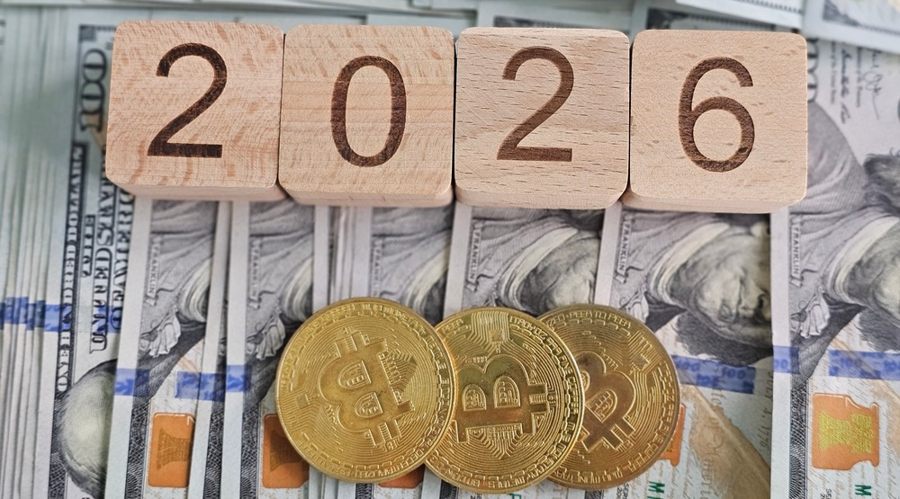
Image presents btc tokens on usd dollar stash with 2026 bricks above
Let's check how high can Bitcoin price go in 2026

Bitcoin dropped to $90,000 on Thursday, January 8, 2026, declining 2.57% as the cryptocurrency tests critical support levels following its third consecutive session of losses.

The world's largest digital asset remains approximately 28% below its October 2025 all-time high of $126,000, trapped in a consolidation pattern that has defined trading since mid-November. Industry executives and investors have released their 2026 Bitcoin price predictions, presenting a wide range from $75,000 to $225,000 that reflects deep uncertainty about the cryptocurrency's trajectory this year.

Earlier analysis explored why BTC rallied to record heights driven by institutional adoption and regulatory optimism under the Trump administration, but 2026 presents new challenges and catalysts that could determine whether Bitcoin breaks out to new highs or tests deeper support levels.

In this article, I will examine how high Bitcoin can go in 2026 and what the current Bitcoin price predictions are.

How High Can Bitcoin Go In 2026?

The divergent forecasts come as Bitcoin navigates a complex investing environment characterized by stretched equity valuations, evolving monetary policy, and a transition from retail-driven price action to institutionally-dominated market structure.

"We are in a complex investing environment. Equity valuations are stretched, the geopolitical environment is chaotic and evolving, there are fears about the near-term durability of AI capex deployment, monetary policy conditions appear to be shifting, and the U.S. midterm elections are on the horizon," explains Alex Thorn, head of research at Galaxy.

"Against this backdrop, the outlook for Bitcoin in 2026 is tough to predict."

What do the specific Bitcoin price forecasts look like?

Carol Alexander: $75,000-$150,000 High-Volatility Range

Carol Alexander, professor of finance at the University of Sussex, forecasts Bitcoin will remain in a "high-volatility range" between $75,000 and $150,000 in 2026, with the "centre of gravity around" $110,000. Her thesis centers on a fundamental market transition: "The market digests a transition from retail-led cycles to institutionally distributed liquidity."

Historically, Bitcoin's price has been driven primarily by retail traders whose behavior created the characteristic boom-bust cycles. However, over the past two years, institutional investors have increasingly entered the space through Bitcoin ETFs, corporate treasury strategies, and regulated investment vehicles. Alexander expects this institutional presence to dampen volatility while maintaining a wide trading range as the market adjusts to new dynamics.

An increasing number of CFD brokers are also moving toward cryptocurrencies. At the beginning of 2026, the owner of FOREX.com, StoneX, added a crypto offering under its MICA license through its entity StoneX Digital.

Alexander's Track Record:

  • 2026 previous call: $200,000 target did not materialize
  • Summer 2025 call: Predicted "$150,000 plus or minus $50,000" - accurate, as Bitcoin traded above $100,000 during that period
  • Overall assessment: Strong medium-term accuracy with conservative long-term projections

The professor's $75,000 floor aligns closely with my technical analysis showing support at $74,000, representing 2025 yearly lows last tested in April.

CoinShares: $120,000-$170,000 With Second-Half Strength

James Butterfill, head of research for crypto-focused asset manager CoinShares

James Butterfill, head of research for crypto-focused asset manager CoinShares, expects Bitcoin to trade between $120,000 and $170,000 in 2026, with "more constructive price action likely occurring in the second half of the year".

Butterfill identifies the Federal Reserve chair transition as a critical catalyst. Jerome Powell's tenure ends in May 2026, and President Trump is expected to appoint a successor with Kevin Hassett and Kevin Warsh considered front-runners. "The new person is likely to be dovish," Butterfill notes, "but markets will wait for clarity before repricing risk assets more decisively."

Trump has made immediately cutting interest rates a "litmus test" for the next Fed chair. The Fed has already reduced rates by 175 basis points cumulatively over 2024-2025, bringing the target range to 3.50-3.75%.

Key Catalysts Butterfill Is Watching:

  • Fed chair appointment and dovish policy confirmation (post-May 2026)
  • U.S. Clarity Act passage creating regulatory framework for digital assets
  • Resolution of persistent regulatory overhang affecting institutional adoption
  • Inflation shocks or policy errors driving demand for "alternative, non-sovereign monetary assets"

"Regulation has been a persistent overhang; resolution here would be a meaningful catalyst," Butterfill emphasizes.

CoinShares Track Record:

  • December 2024 low: Predicted $80,000 — materialized
  • 2025 high: Forecast $150,000 — did not achieve

Standard Chartered: $150,000 Target Revised Down

Standard Chartered maintains a Bitcoin price forecast of $150,000 for 2026, significantly revised down from its previous $300,000 call issued earlier. This revision aligns with other institutional forecasts showing BTC hitting only $150K in 2026 as market dynamics shift.

Geoff Kendrick, the bank's global head of digital asset research, explains that the price decline seen in 2025 "was within expected bounds." However, the structural changes in Bitcoin buying patterns prompted the dramatic revision.

"Specifically, we think buying by Bitcoin digital asset treasury companies (DATs) is likely over, as valuations no longer support further Bitcoin DAT expansion," Kendrick states. DATs are entities like Strategy (formerly MicroStrategy) that accumulate large Bitcoin holdings and attempt to outperform the market through leveraged positions.

Maple Finance: $175,000 on Bitcoin-Backed Lending Boom

Sidney Powell, CEO of Maple Finance

Sidney Powell, CEO of Maple Finance, maintains a $175,000 price target for Bitcoin in 2026, supported by interest rate cuts and "increasing institutional adoption of Bitcoin".

Powell identifies a major milestone that could catalyze the next leg up: Bitcoin-backed lending exceeding $100 billion in 2026. "Bitcoin holders are increasingly sophisticated, they don't want to sell their BTC; they want to borrow against it," Powell explains.

"This creates a virtuous cycle: less selling pressure, more utility, higher prices."

The Bitcoin-backed lending thesis suggests that as institutional holders mature, they will use Bitcoin as collateral rather than liquidating positions. This reduces circulating supply available for purchase while demonstrating Bitcoin's utility as a financial asset beyond pure speculation.

Powell's Track Record:

  • December 2024: Correctly predicted corrections in 2025
  • 2025 high: Bullish call of $180,000-$200,000 did not materialize

Nexo: $150,000-$200,000 as Supply Risk Eases

Iliya Kalchev, analyst at cryptocurrency exchange Nexo, forecasts Bitcoin reaching $150,000 to $200,000 in 2026 as supply dynamics improve.

Iliya Kalchev
Iliya Kalchev

Nexo's previous 2025 call of $250,000 "was less a rejection of its long-term thesis and more a consequence of market mechanics colliding with a shifting macro backdrop," Kalchev explains. The key issue was long-term holders who had accumulated Bitcoin at lower prices during bear markets began distributing their holdings as prices surged, creating resistance.

"Bitcoin is entering 2026 with less supply risk and a broader capital base," Kalchev argues. The long-term holder distribution phase is ending, as much of the accumulated supply from the 2022-2023 bear market has already been sold to institutional buyers. Meanwhile, "institutional allocations gradually rise from still-modest levels."

Bit Mining: $75,000-$225,000 Wide Volatility Range

Youwei Yang, chief economist at Bit Mining, presents the widest forecast range among major predictions: $75,000 to $225,000. This 200% spread reflects extraordinary uncertainty about how multiple competing forces will resolve.

"2026 could be a strong year for Bitcoin, supported by potential rate cuts and a more accommodating regulatory stance toward crypto," Yang states. "However, heightened volatility is likely amid ongoing macroeconomic and geopolitical uncertainties."

Yang's Track Record:

  • December 2024 low: Predicted $80,000 — materialized
  • 2025 high: Forecast $180,000-$190,000 — did not achieve

The $225,000 upper bound represents a scenario where all bullish factors align: aggressive Fed easing, breakthrough regulatory clarity, sustained institutional inflows, and favorable macroeconomic conditions.

The $75,000 lower bound assumes policy errors, inflation shocks, or financial system stress that triggers risk-off selling across all speculative assets.

Expert Bitcoin Price Predictions 2026: Comparison Table

Institution/Analyst

Low End

High End

Center Target

Key Driver

Confidence

Carol Alexander (Sussex)

$75,000

$150,000

$110,000

Institutional transition

High volatility expected

James Butterfill (CoinShares)

$120,000

$170,000

$145,000

H2 2026 Fed dovish pivot

Catalyst-dependent

Geoff Kendrick (Standard Chartered)

-

$150,000

$150,000

ETF buying only

Revised down from $300K

Sidney Powell (Maple Finance)

-

$175,000

$175,000

BTC lending >$100B

Utility-driven thesis

Iliya Kalchev (Nexo)

$150,000

$200,000

$175,000

Supply risk easing

Constructive outlook

Youwei Yang (Bit Mining)

$75,000

$225,000

$150,000

Rate cuts vs uncertainty

Widest range

Consensus Range: $120,000-$175,000 (clustering around mid-range institutional scenarios)

Outlier Scenarios:

  • Bear case: $75,000 (Alexander/Yang low end, technical $74K target)
  • Bull case: $200,000-$225,000 (Nexo/Yang high ends)

Technical Analysis: $74,000 Bear Target vs ATH Return

According to my technical analysis, Bitcoin's price action on January 8, 2026, shows little fundamental change to the structure established since mid-November. Bitcoin is currently testing round psychological support at $90,000 after declining for the third consecutive session from mid-November highs.

Current Consolidation Structure:

  • Upper boundary: $92,000-$94,000 (50 MA, 100% Fibonacci extension)
  • Lower boundary: $84,000-$86,000 (November-December lows, 78.6% Fibonacci retracement)
  • Current price: $91,257 (testing mid-range support)

Bitcoin remains trapped in this nearly two-month consolidation, moving sideways while indicators reset from the October euphoria. The structure suggests accumulation or distribution depending on which boundary breaks first.
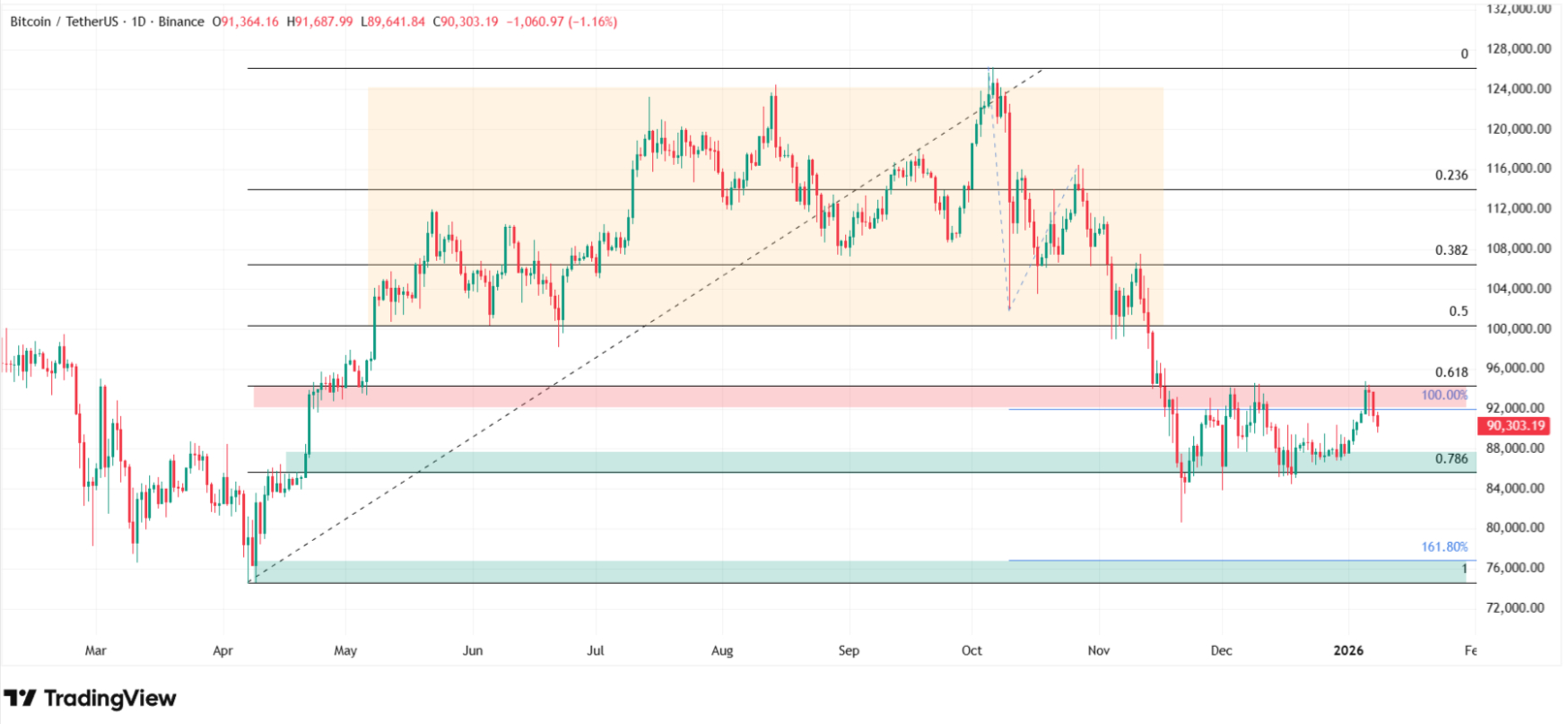
Bitcoin price technical analysis. Source: Tradingview.com

Bitcoin Medium-Term Bearish Outlook

Based on my technical analysis, the medium-term outlook remains structurally bearish with targets pointing toward continuation of declines toward $74,000 - representing 2025 yearly lows last tested in April. At that level, I expect reaccumulation by long-term institutional holders before an eventual return to challenge all-time highs above $126,000.

This bearish thesis finds support from multiple expert commentaries. "Bitcoin remains in a bullish consolidation phase. Key upside resistance lies at $95,000–$100,000, with heavy call option interest around the $100k strike for January expiry," notes Andri Fauzan Adziima, research analyst at crypto exchange Bitrue. "Immediate support sits at $88,000–$90,000, a break below could trigger a deeper correction."

Paul Howard, Wincent

Paul Howard at Wincent identifies a specific technical catalyst: "The next natural step for BTC and ETH is likely a break below $91,000 to fill the CME gap." CME (Chicago Mercantile Exchange) gaps occur when Bitcoin futures open at prices significantly different from their previous close, creating unfilled price zones that markets often revisit.

Howard tempers bullish enthusiasm: "Some anticipate Bitcoin catching up with Gold and Silver's strong run, but my money is on prices oscillating around these levels given January is typically a flat month for crypto prices (the last 15 years)."

Bullish Invalidation Levels

The bearish structure would be negated by sustained breakout above the $92,000-$94,000 upper boundary. More definitively, a return above $100,000 (where the 200-day exponential moving average resides) would signal the separator between downtrend and uptrend has been reclaimed, according to my analysis.

Bitrue's Adziima emphasizes that "there will still be volatility, but the 2026 fundamentals stay strongly bullish" - a sentiment echoed by most institutional forecasters despite near-term technical weakness.

Bitcoin Key 2026 Catalysts and Risks

Bullish Catalysts

  • Fed chair transition (May 2026): Trump's "litmus test" for immediate rate cuts could bring dovish successor like Kevin Hassett or Kevin Warsh, dramatically shifting monetary policy expectations
  • Rate cut potential: Grvt's Stan Low notes policymakers "appear open to be more accommodative in terms of liquidity, given funding market stress," though inflation trajectory will dictate actual cuts
  • Regulatory clarity: Grayscale expects Congress to pass Clarity Act in 2026, cementing "blockchain-based finance in U.S. capital markets and facilitate continued institutional investment"
  • Bitcoin-backed lending milestone: Maple Finance projects lending exceeding $100 billion, creating "virtuous cycle" of reduced selling pressure
  • Institutional adoption maturation: Gemini's Liou identifies "dawn of the institutional era" as 4-year retail cycles transition to stable institutional accumulation
  • Sustained ETF inflows: Despite DAT exhaustion, Bitcoin ETF demand remains primary price driver per Standard Chartered

Bearish Risks

  • DAT buying exhaustion: Standard Chartered warns digital asset treasury companies "can no longer support Bitcoin prices through leveraged buying as their valuations have become unsupportive of further capital raises"
  • Inflation/policy errors: CoinShares' Butterfill cites "inflation shocks or policy errors from the Fed" as key risks undermining risk assets despite dovish rhetoric
  • Macro uncertainty: Galaxy's Thorn emphasizes "fears about the near-term durability of AI capex deployment" and stretched equity valuations creating fragile environment
  • Geopolitical volatility: "Chaotic and evolving" geopolitical environment plus U.S. midterm elections could trigger sharp moves
  • Technical breakdown: Break below $88,000-$90,000 support "could trigger a deeper correction" toward $74,000 target per Bitrue analysis
  • January seasonality: Wincent's Howard notes "January is typically a flat month for crypto prices (the last 15 years)," limiting near-term upside

2026 Outlook: Volatility With Structural Strength

"Recently, BTC and ETH has surpassed 93k and 3.2k respectively, likening its price action to other risk-on assets and showing signs of a structural shift," observes Grvt's Stan Low. "In the short-term, the detention of Nicolas Maduro and markets being clear from EOY tax loss harvesting, have served as green shoots and positive catalysts."

However, Low cautions that "it could be too soon to definitively declare that crypto markets are totally out of the woods." This measured optimism characterizes most institutional forecasts for 2026: structurally bullish on adoption and infrastructure development, but tactically cautious about near-term price action.

While most analysts present bullish to moderately bullish cases, extreme bear scenarios exist. Saxo Bank's 'Outrageous Predictions' warned Bitcoin could theoretically fall to zero in a quantum computing breakthrough scenario, though this represents a tail-risk rather than base-case forecast.

The consensus view clusters around $120,000-$175,000, with Bitcoin likely oscillating within the current $84,000-$94,000 consolidation range until decisive catalysts emerge. The Fed chair appointment in May 2026 represents the most probable inflection point where markets will reprice Bitcoin based on clarity around monetary policy direction.

FAQ: Bitcoin Price Prediction 2026

What is the Bitcoin price prediction for 2026?

Expert predictions for Bitcoin in 2026 range from $75,000 to $225,000, with consensus clustering around $120,000-$175,000. Carol Alexander (University of Sussex) forecasts $75K-$150K, CoinShares predicts $120K-$170K, Standard Chartered targets $150K, Maple Finance expects $175K, Nexo sees $150K-$200K, and Bit Mining projects $75K-$225K. Current price is $91,257 as of January 8, 2026.

How high can Bitcoin go in 2026?

The highest Bitcoin price predictions for 2026 are Bit Mining's $225,000 bull case, Nexo's $200,000 upper range, and Maple Finance's $175,000 target. These projections assume favorable conditions including aggressive Fed rate cuts, breakthrough regulatory clarity (Clarity Act passage), sustained ETF inflows, Bitcoin-backed lending exceeding $100 billion, and easing financial conditions with softer dollar.

Will Bitcoin reach $200,000 in 2026?

Bitcoin reaching $200,000 in 2026 is possible but conditional according to Nexo analyst Iliya Kalchev, who states "if financial conditions turn more supportive – through easing policy, a softer dollar, or renewed liquidity expansion – Bitcoin could revisit and exceed prior highs". This requires long-term holder distribution completing, institutional allocations rising, and macro conditions improving significantly from current levels.

Will the Fed Chair change affect Bitcoin price?

The Fed chair transition after Jerome Powell's May 2026 tenure end is a critical catalyst per CoinShares' James Butterfill, who notes the new chair is "likely to be dovish" but "markets will wait for clarity before repricing risk assets more decisively". Trump has made immediately cutting rates a "litmus test" for the successor, with Kevin Hassett and Kevin Warsh as front-runners. This represents the most significant H1 2026 inflection point.

What is the most accurate Bitcoin prediction for 2026?

Carol Alexander has strong track record with accurate Summer 2025 call of "$150K plus or minus $50K" when Bitcoin traded above $100K. Her 2026 forecast of $75K-$150K range with $110K center aligns with my technical analysis showing consolidation structure ($84K-$94K) and $74K bear target. CoinShares correctly predicted December 2024 $80K low though missed $150K high. Consensus $120K-$175K represents middle-ground institutional view.

Bitcoin dropped to $90,000 on Thursday, January 8, 2026, declining 2.57% as the cryptocurrency tests critical support levels following its third consecutive session of losses.

The world's largest digital asset remains approximately 28% below its October 2025 all-time high of $126,000, trapped in a consolidation pattern that has defined trading since mid-November. Industry executives and investors have released their 2026 Bitcoin price predictions, presenting a wide range from $75,000 to $225,000 that reflects deep uncertainty about the cryptocurrency's trajectory this year.

Earlier analysis explored why BTC rallied to record heights driven by institutional adoption and regulatory optimism under the Trump administration, but 2026 presents new challenges and catalysts that could determine whether Bitcoin breaks out to new highs or tests deeper support levels.

In this article, I will examine how high Bitcoin can go in 2026 and what the current Bitcoin price predictions are.

How High Can Bitcoin Go In 2026?

The divergent forecasts come as Bitcoin navigates a complex investing environment characterized by stretched equity valuations, evolving monetary policy, and a transition from retail-driven price action to institutionally-dominated market structure.

"We are in a complex investing environment. Equity valuations are stretched, the geopolitical environment is chaotic and evolving, there are fears about the near-term durability of AI capex deployment, monetary policy conditions appear to be shifting, and the U.S. midterm elections are on the horizon," explains Alex Thorn, head of research at Galaxy.

"Against this backdrop, the outlook for Bitcoin in 2026 is tough to predict."

What do the specific Bitcoin price forecasts look like?

Carol Alexander: $75,000-$150,000 High-Volatility Range

Carol Alexander, professor of finance at the University of Sussex, forecasts Bitcoin will remain in a "high-volatility range" between $75,000 and $150,000 in 2026, with the "centre of gravity around" $110,000. Her thesis centers on a fundamental market transition: "The market digests a transition from retail-led cycles to institutionally distributed liquidity."

Historically, Bitcoin's price has been driven primarily by retail traders whose behavior created the characteristic boom-bust cycles. However, over the past two years, institutional investors have increasingly entered the space through Bitcoin ETFs, corporate treasury strategies, and regulated investment vehicles. Alexander expects this institutional presence to dampen volatility while maintaining a wide trading range as the market adjusts to new dynamics.

An increasing number of CFD brokers are also moving toward cryptocurrencies. At the beginning of 2026, the owner of FOREX.com, StoneX, added a crypto offering under its MICA license through its entity StoneX Digital.

Alexander's Track Record:

  • 2026 previous call: $200,000 target did not materialize
  • Summer 2025 call: Predicted "$150,000 plus or minus $50,000" - accurate, as Bitcoin traded above $100,000 during that period
  • Overall assessment: Strong medium-term accuracy with conservative long-term projections

The professor's $75,000 floor aligns closely with my technical analysis showing support at $74,000, representing 2025 yearly lows last tested in April.

CoinShares: $120,000-$170,000 With Second-Half Strength

James Butterfill, head of research for crypto-focused asset manager CoinShares

James Butterfill, head of research for crypto-focused asset manager CoinShares, expects Bitcoin to trade between $120,000 and $170,000 in 2026, with "more constructive price action likely occurring in the second half of the year".

Butterfill identifies the Federal Reserve chair transition as a critical catalyst. Jerome Powell's tenure ends in May 2026, and President Trump is expected to appoint a successor with Kevin Hassett and Kevin Warsh considered front-runners. "The new person is likely to be dovish," Butterfill notes, "but markets will wait for clarity before repricing risk assets more decisively."

Trump has made immediately cutting interest rates a "litmus test" for the next Fed chair. The Fed has already reduced rates by 175 basis points cumulatively over 2024-2025, bringing the target range to 3.50-3.75%.

Key Catalysts Butterfill Is Watching:

  • Fed chair appointment and dovish policy confirmation (post-May 2026)
  • U.S. Clarity Act passage creating regulatory framework for digital assets
  • Resolution of persistent regulatory overhang affecting institutional adoption
  • Inflation shocks or policy errors driving demand for "alternative, non-sovereign monetary assets"

"Regulation has been a persistent overhang; resolution here would be a meaningful catalyst," Butterfill emphasizes.

CoinShares Track Record:

  • December 2024 low: Predicted $80,000 — materialized
  • 2025 high: Forecast $150,000 — did not achieve

Standard Chartered: $150,000 Target Revised Down

Standard Chartered maintains a Bitcoin price forecast of $150,000 for 2026, significantly revised down from its previous $300,000 call issued earlier. This revision aligns with other institutional forecasts showing BTC hitting only $150K in 2026 as market dynamics shift.

Geoff Kendrick, the bank's global head of digital asset research, explains that the price decline seen in 2025 "was within expected bounds." However, the structural changes in Bitcoin buying patterns prompted the dramatic revision.

"Specifically, we think buying by Bitcoin digital asset treasury companies (DATs) is likely over, as valuations no longer support further Bitcoin DAT expansion," Kendrick states. DATs are entities like Strategy (formerly MicroStrategy) that accumulate large Bitcoin holdings and attempt to outperform the market through leveraged positions.

Maple Finance: $175,000 on Bitcoin-Backed Lending Boom

Sidney Powell, CEO of Maple Finance

Sidney Powell, CEO of Maple Finance, maintains a $175,000 price target for Bitcoin in 2026, supported by interest rate cuts and "increasing institutional adoption of Bitcoin".

Powell identifies a major milestone that could catalyze the next leg up: Bitcoin-backed lending exceeding $100 billion in 2026. "Bitcoin holders are increasingly sophisticated, they don't want to sell their BTC; they want to borrow against it," Powell explains.

"This creates a virtuous cycle: less selling pressure, more utility, higher prices."

The Bitcoin-backed lending thesis suggests that as institutional holders mature, they will use Bitcoin as collateral rather than liquidating positions. This reduces circulating supply available for purchase while demonstrating Bitcoin's utility as a financial asset beyond pure speculation.

Powell's Track Record:

  • December 2024: Correctly predicted corrections in 2025
  • 2025 high: Bullish call of $180,000-$200,000 did not materialize

Nexo: $150,000-$200,000 as Supply Risk Eases

Iliya Kalchev, analyst at cryptocurrency exchange Nexo, forecasts Bitcoin reaching $150,000 to $200,000 in 2026 as supply dynamics improve.

Iliya Kalchev
Iliya Kalchev

Nexo's previous 2025 call of $250,000 "was less a rejection of its long-term thesis and more a consequence of market mechanics colliding with a shifting macro backdrop," Kalchev explains. The key issue was long-term holders who had accumulated Bitcoin at lower prices during bear markets began distributing their holdings as prices surged, creating resistance.

"Bitcoin is entering 2026 with less supply risk and a broader capital base," Kalchev argues. The long-term holder distribution phase is ending, as much of the accumulated supply from the 2022-2023 bear market has already been sold to institutional buyers. Meanwhile, "institutional allocations gradually rise from still-modest levels."

Bit Mining: $75,000-$225,000 Wide Volatility Range

Youwei Yang, chief economist at Bit Mining, presents the widest forecast range among major predictions: $75,000 to $225,000. This 200% spread reflects extraordinary uncertainty about how multiple competing forces will resolve.

"2026 could be a strong year for Bitcoin, supported by potential rate cuts and a more accommodating regulatory stance toward crypto," Yang states. "However, heightened volatility is likely amid ongoing macroeconomic and geopolitical uncertainties."

Yang's Track Record:

  • December 2024 low: Predicted $80,000 — materialized
  • 2025 high: Forecast $180,000-$190,000 — did not achieve

The $225,000 upper bound represents a scenario where all bullish factors align: aggressive Fed easing, breakthrough regulatory clarity, sustained institutional inflows, and favorable macroeconomic conditions.

The $75,000 lower bound assumes policy errors, inflation shocks, or financial system stress that triggers risk-off selling across all speculative assets.

Expert Bitcoin Price Predictions 2026: Comparison Table

Institution/Analyst

Low End

High End

Center Target

Key Driver

Confidence

Carol Alexander (Sussex)

$75,000

$150,000

$110,000

Institutional transition

High volatility expected

James Butterfill (CoinShares)

$120,000

$170,000

$145,000

H2 2026 Fed dovish pivot

Catalyst-dependent

Geoff Kendrick (Standard Chartered)

-

$150,000

$150,000

ETF buying only

Revised down from $300K

Sidney Powell (Maple Finance)

-

$175,000

$175,000

BTC lending >$100B

Utility-driven thesis

Iliya Kalchev (Nexo)

$150,000

$200,000

$175,000

Supply risk easing

Constructive outlook

Youwei Yang (Bit Mining)

$75,000

$225,000

$150,000

Rate cuts vs uncertainty

Widest range

Consensus Range: $120,000-$175,000 (clustering around mid-range institutional scenarios)

Outlier Scenarios:

  • Bear case: $75,000 (Alexander/Yang low end, technical $74K target)
  • Bull case: $200,000-$225,000 (Nexo/Yang high ends)

Technical Analysis: $74,000 Bear Target vs ATH Return

According to my technical analysis, Bitcoin's price action on January 8, 2026, shows little fundamental change to the structure established since mid-November. Bitcoin is currently testing round psychological support at $90,000 after declining for the third consecutive session from mid-November highs.

Current Consolidation Structure:

  • Upper boundary: $92,000-$94,000 (50 MA, 100% Fibonacci extension)
  • Lower boundary: $84,000-$86,000 (November-December lows, 78.6% Fibonacci retracement)
  • Current price: $91,257 (testing mid-range support)

Bitcoin remains trapped in this nearly two-month consolidation, moving sideways while indicators reset from the October euphoria. The structure suggests accumulation or distribution depending on which boundary breaks first.

Bitcoin price technical analysis. Source: Tradingview.com

Bitcoin Medium-Term Bearish Outlook

Based on my technical analysis, the medium-term outlook remains structurally bearish with targets pointing toward continuation of declines toward $74,000 - representing 2025 yearly lows last tested in April. At that level, I expect reaccumulation by long-term institutional holders before an eventual return to challenge all-time highs above $126,000.

This bearish thesis finds support from multiple expert commentaries. "Bitcoin remains in a bullish consolidation phase. Key upside resistance lies at $95,000–$100,000, with heavy call option interest around the $100k strike for January expiry," notes Andri Fauzan Adziima, research analyst at crypto exchange Bitrue. "Immediate support sits at $88,000–$90,000, a break below could trigger a deeper correction."

Paul Howard, Wincent

Paul Howard at Wincent identifies a specific technical catalyst: "The next natural step for BTC and ETH is likely a break below $91,000 to fill the CME gap." CME (Chicago Mercantile Exchange) gaps occur when Bitcoin futures open at prices significantly different from their previous close, creating unfilled price zones that markets often revisit.

Howard tempers bullish enthusiasm: "Some anticipate Bitcoin catching up with Gold and Silver's strong run, but my money is on prices oscillating around these levels given January is typically a flat month for crypto prices (the last 15 years)."

Bullish Invalidation Levels

The bearish structure would be negated by sustained breakout above the $92,000-$94,000 upper boundary. More definitively, a return above $100,000 (where the 200-day exponential moving average resides) would signal the separator between downtrend and uptrend has been reclaimed, according to my analysis.

Bitrue's Adziima emphasizes that "there will still be volatility, but the 2026 fundamentals stay strongly bullish" - a sentiment echoed by most institutional forecasters despite near-term technical weakness.

Bitcoin Key 2026 Catalysts and Risks

Bullish Catalysts

  • Fed chair transition (May 2026): Trump's "litmus test" for immediate rate cuts could bring dovish successor like Kevin Hassett or Kevin Warsh, dramatically shifting monetary policy expectations
  • Rate cut potential: Grvt's Stan Low notes policymakers "appear open to be more accommodative in terms of liquidity, given funding market stress," though inflation trajectory will dictate actual cuts
  • Regulatory clarity: Grayscale expects Congress to pass Clarity Act in 2026, cementing "blockchain-based finance in U.S. capital markets and facilitate continued institutional investment"
  • Bitcoin-backed lending milestone: Maple Finance projects lending exceeding $100 billion, creating "virtuous cycle" of reduced selling pressure
  • Institutional adoption maturation: Gemini's Liou identifies "dawn of the institutional era" as 4-year retail cycles transition to stable institutional accumulation
  • Sustained ETF inflows: Despite DAT exhaustion, Bitcoin ETF demand remains primary price driver per Standard Chartered

Bearish Risks

  • DAT buying exhaustion: Standard Chartered warns digital asset treasury companies "can no longer support Bitcoin prices through leveraged buying as their valuations have become unsupportive of further capital raises"
  • Inflation/policy errors: CoinShares' Butterfill cites "inflation shocks or policy errors from the Fed" as key risks undermining risk assets despite dovish rhetoric
  • Macro uncertainty: Galaxy's Thorn emphasizes "fears about the near-term durability of AI capex deployment" and stretched equity valuations creating fragile environment
  • Geopolitical volatility: "Chaotic and evolving" geopolitical environment plus U.S. midterm elections could trigger sharp moves
  • Technical breakdown: Break below $88,000-$90,000 support "could trigger a deeper correction" toward $74,000 target per Bitrue analysis
  • January seasonality: Wincent's Howard notes "January is typically a flat month for crypto prices (the last 15 years)," limiting near-term upside

2026 Outlook: Volatility With Structural Strength

"Recently, BTC and ETH has surpassed 93k and 3.2k respectively, likening its price action to other risk-on assets and showing signs of a structural shift," observes Grvt's Stan Low. "In the short-term, the detention of Nicolas Maduro and markets being clear from EOY tax loss harvesting, have served as green shoots and positive catalysts."

However, Low cautions that "it could be too soon to definitively declare that crypto markets are totally out of the woods." This measured optimism characterizes most institutional forecasts for 2026: structurally bullish on adoption and infrastructure development, but tactically cautious about near-term price action.

While most analysts present bullish to moderately bullish cases, extreme bear scenarios exist. Saxo Bank's 'Outrageous Predictions' warned Bitcoin could theoretically fall to zero in a quantum computing breakthrough scenario, though this represents a tail-risk rather than base-case forecast.

The consensus view clusters around $120,000-$175,000, with Bitcoin likely oscillating within the current $84,000-$94,000 consolidation range until decisive catalysts emerge. The Fed chair appointment in May 2026 represents the most probable inflection point where markets will reprice Bitcoin based on clarity around monetary policy direction.

FAQ: Bitcoin Price Prediction 2026

What is the Bitcoin price prediction for 2026?

Expert predictions for Bitcoin in 2026 range from $75,000 to $225,000, with consensus clustering around $120,000-$175,000. Carol Alexander (University of Sussex) forecasts $75K-$150K, CoinShares predicts $120K-$170K, Standard Chartered targets $150K, Maple Finance expects $175K, Nexo sees $150K-$200K, and Bit Mining projects $75K-$225K. Current price is $91,257 as of January 8, 2026.

How high can Bitcoin go in 2026?

The highest Bitcoin price predictions for 2026 are Bit Mining's $225,000 bull case, Nexo's $200,000 upper range, and Maple Finance's $175,000 target. These projections assume favorable conditions including aggressive Fed rate cuts, breakthrough regulatory clarity (Clarity Act passage), sustained ETF inflows, Bitcoin-backed lending exceeding $100 billion, and easing financial conditions with softer dollar.

Will Bitcoin reach $200,000 in 2026?

Bitcoin reaching $200,000 in 2026 is possible but conditional according to Nexo analyst Iliya Kalchev, who states "if financial conditions turn more supportive – through easing policy, a softer dollar, or renewed liquidity expansion – Bitcoin could revisit and exceed prior highs". This requires long-term holder distribution completing, institutional allocations rising, and macro conditions improving significantly from current levels.

Will the Fed Chair change affect Bitcoin price?

The Fed chair transition after Jerome Powell's May 2026 tenure end is a critical catalyst per CoinShares' James Butterfill, who notes the new chair is "likely to be dovish" but "markets will wait for clarity before repricing risk assets more decisively". Trump has made immediately cutting rates a "litmus test" for the successor, with Kevin Hassett and Kevin Warsh as front-runners. This represents the most significant H1 2026 inflection point.

What is the most accurate Bitcoin prediction for 2026?

Carol Alexander has strong track record with accurate Summer 2025 call of "$150K plus or minus $50K" when Bitcoin traded above $100K. Her 2026 forecast of $75K-$150K range with $110K center aligns with my technical analysis showing consolidation structure ($84K-$94K) and $74K bear target. CoinShares correctly predicted December 2024 $80K low though missed $150K high. Consensus $120K-$175K represents middle-ground institutional view.

About the Author: Damian Chmiel
Damian Chmiel
  • 3142 Articles
  • 98 Followers
About the Author: Damian Chmiel
Damian's adventure with financial markets began at the Cracow University of Economics, where he obtained his MA in finance and accounting. Starting from the retail trader perspective, he collaborated with brokerage houses and financial portals in Poland as an independent editor and content manager. His adventure with Finance Magnates began in 2016, where he is working as a business intelligence analyst.
  • 3142 Articles
  • 98 Followers

More from the Author

Trending

!"#$%&'()*+,-./0123456789:;<=>?@ABCDEFGHIJKLMNOPQRSTUVWXYZ[\]^_`abcdefghijklmnopqrstuvwxyz{|} !"#$%&'()*+,-./0123456789:;<=>?@ABCDEFGHIJKLMNOPQRSTUVWXYZ[\]^_`abcdefghijklmnopqrstuvwxyz{|}