Why Brokers and Exchanges Are Racing Into Prediction Markets – and What Comes Next

Wednesday, 04/02/2026 | 13:49 GMT by Tanya Chepkova
  • Updated July 2026: Kalshi raises $1 billion at a $22 billion valuation, while Robinhood launches Rothera, its own CFTC-regulated prediction markets exchange.
  • Prediction markets go mainstream, but hinge on a fragile line between trading and gambling.
  • Kalshi has widened its lead over Polymarket, recording roughly $33 billion in June volume against Polymarket's $14 billion.
Prediction markets: trading volume is growing fast

In 2025, traditional finance players – from retail brokers to major exchange operators – moved decisively into prediction markets. What was once a niche product has turned into a fast-growing part of mainstream market infrastructure.

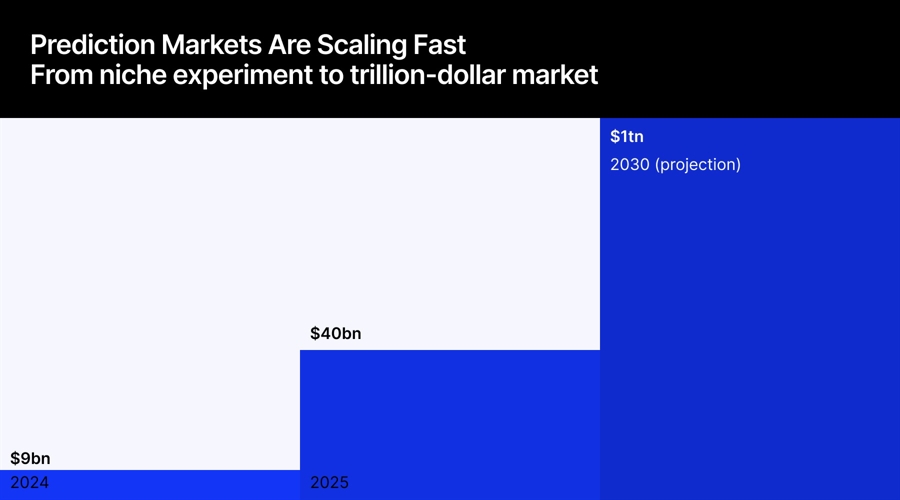
Trading volumes jumped from about $9 billion in 2024 to roughly $40 billion in 2025, according to industry research. Projections now point to annual volumes approaching $1 trillion by the end of the decade, pushing prediction markets from an experimental corner of finance into a meaningful revenue line.

Institutional Money Arrives on Both Sides

The funding market has caught up with those figures. In May 2026, Kalshi raised $1 billion in a Series F round at a $22 billion valuation, led by Coatue with participation from Sequoia Capital, Andreessen Horowitz, IVP, Paradigm, Morgan Stanley, and ARK Invest.

The valuation doubled from the $11 billion set by its Series E just five months earlier driven by a change in who is trading: institutional volume grew 800% in six months, according to the company, while annualised trading volume tripled from $52 billion to $178 billion.

Kalshi says the capital will go toward expanding access for hedge funds, asset managers, proprietary trading firms and insurance companies.

Morgan Stanley's place on the cap table is one half of a two-sided move. A day before the Series F was announced, the bank began piloting spot crypto trading on ETrade, charging 50 basis points per transaction, below the 75 basis points Charles Schwab introduced for the same product.

All 8.6 million ETrade clients are expected to gain access later this year. Within 48 hours, the wirehouse positioned itself as an investor in the largest CFTC-regulated prediction market and as a retail distribution channel for spot crypto through its own brokerage.

What Brokers Are Actually Offering

Distribution-first positioning

Retail platforms have focused on access and integration rather than product novelty. Robinhood set the template. Its Prediction Markets Hub, launched in March 2025, placed event contracts directly inside its core trading app. By late 2025, the product was generating roughly $100 million in annualized revenue, across 9 billion contracts, making it one of Robinhood’s fastest-growing lines.

By late 2025, the product was generating hundreds of millions of dollars in annualized revenue, making it one of the company’s fastest-growing business lines. The initial model relied on Kalshi, a CFTC-regulated exchange. Robinhood’s distribution power proved decisive: Kalshi’s national market share jumped from just over 3% to roughly two-thirds within months.

In November 2025, Robinhood moved to capture more of the value chain, forming a joint venture with Susquehanna International Group to acquire 90% of MIAX Derivatives Exchange, a CFTC-licensed exchange and clearinghouse. The deal closed in January 2026, and the venue relaunched as Rothera, opening limited trading in late May.

In June, Robinhood began routing World Cup contracts to its own exchange. Rothera handled $2 billion in notional volume during the month, lifted by tournament trading, and now accounts for 7% of US prediction market volume, according to Bank of America estimates.

Robinhood CFO Shiv Verma has said most of the company's prediction-market flow is expected to move to Rothera over time, though Kalshi and ForecastEx contracts remain available where Rothera does not yet list markets.

Other retail and futures brokers, including Webull, NinjaTrader and Optimus Futures, have folded similar contracts into existing derivative terminals, treating them as another short-duration asset class.

Most recently, Plus500 launched its own prediction markets offering for U.S. customers as part of Plus500 Futures, providing access to event contracts, including products from Kalshi.

Compliance-first positioning

Larger players have taken a more cautious approach, focusing on regulatory structure. Interactive Brokers launched event contracts focused on economics and politics through its CFTC-regulated unit ForecastEx, deliberately avoiding sports in its public positioning.

The strategy has been to build neutral infrastructure while waiting for courts and regulators to clarify jurisdictional boundaries.

The Broker-Tech Vendor Race

Prediction markets are also moving down the technology stack, from brokers to the vendors that supply them. Match-Trade Technologies has released a prediction markets module that brokers can deploy inside the Match-Trader platform or as a standalone white label.

Prop firm Maven Trading was the first to switch it on, adding event contracts as a native module within its existing environment, with price feeds tracking markets on Kalshi and Polymarket.

Offshore CFD broker Born2trade plans to follow in the first half of 2026, integrating the product into MetaTrader 5 and its Match-Trader-based Born2trade X platform after acquiring the predictory.com domain.

Match-Trade is not alone. Leverate has rolled out its own prediction markets solution, pitching it as a client-acquisition tool, while Devexperts has released software that lets brokers and exchanges run event markets on top of existing systems.

Event contracts, which required exchange licences and clearing memberships from early entrants, are now available as an off-the-shelf platform add-on.

Why Exchanges Are Getting Involved

The move is not limited to brokers. Intercontinental Exchange, owner of the NYSE, invested $2 billion in Polymarket in late 2025. CME Group partnered with FanDuel to launch FanDuel Predicts using CME’s exchange and clearing infrastructure.

Meanwhile, Cboe Global Markets has announced plans for its own prediction markets platform, excluding sports to preserve institutional credibility. ICE plans to distribute Polymarket’s probability data to institutional clients, positioning prediction prices as another market signal alongside rates and equities.

For exchanges, prediction markets are increasingly viewed as complementary to traditional derivatives rather than a parallel ecosystem.

Why TradFi Is Entering Now

Four factors explain the shift.

First, revenue. Prediction markets generate frequent transactions and short holding periods. Fee yields are higher than in retail equities, where commissions have been compressed for years.

Second, institutional demand. Proprietary trading firms and asset managers are testing prediction markets as forecasting tools rather than speculative products.

“It’s easy to understand why exchanges, brokers and investors are intrigued,” says Jesse Forster, Head of Equity Market Structure Research at Coalition Greenwich and author of Prediction Markets: It’s All About the Data. “By tapping into the ‘wisdom of the crowd,’ prediction markets promise unique signals about the future.”

Third, distribution effects. Once embedded in a broker app, prediction markets benefit from cross-pollination between asset classes. Scale comes from distribution, not standalone platforms.

Fourth, regulation. In 2025–2026, the CFTC signaled a more permissive stance toward event contracts, including sports outcomes, encouraging brokers and exchanges to commit infrastructure rather than treat the space as provisional.

How Brokers Defy the “Gambling” Label

Brokers frame event contracts as commodities traded on federally regulated exchanges rather than bets placed with sportsbooks. Routing transactions through CFTC-licensed venues is meant to pre-empt state gambling laws.

They also emphasize information value. Prediction markets are presented as tools for aggregating expectations about economic and political outcomes, not as entertainment products.

At the operational level, platforms apply anti-fraud and anti-manipulation rules, monitor suspicious trading patterns and suspend accounts when insider information is suspected.

Where the Argument Is Vulnerable

A central weakness in the “not gambling” framing is consumer protection. Prediction markets generally lack safeguards that are mandatory for licensed sportsbooks, such as age verification, responsible gaming tools and exclusion lists.

State regulators argue that products with similar behavioral risks should be subject to comparable protections, regardless of how they are classified at the federal level. That gap is most visible in insider trading risk. Event outcomes are binary and time-sensitive, making non-public information especially valuable.

Enforcement tends to be reactive, with platforms intervening only after suspicious trading patterns emerge. Regulators have pointed to several high-profile cases involving large, well-timed bets on political outcomes as evidence of these vulnerabilities.

The regulatory argument also weakens outside the United States. In the UK, authorities have made clear that prediction markets would almost certainly fall under gambling law rather than financial regulation.

British regulators view such products as functionally similar to betting exchanges – a model that has existed since the early 2000s and requires a dedicated gambling licence. That contrast underscores how dependent the current U.S. expansion is on jurisdictional interpretation.

What qualifies as a federally regulated derivatives product in the United States would likely be treated as gambling in most other mature markets.

What Happens Next

Prediction markets surpassed $50 billion in monthly trading volume for the first time in June, up 75% from May, according to Artemis data.

Kalshi remained the largest venue at roughly $33 billion. Polymarket processed $14 billion across its international platform and its recently launched US-regulated exchange, while Rothera added roughly $2 billion in its first full month.

The June record is inseparable from the World Cup, which began on June 11 and became the industry's largest liquidity event to date. Kalshi processed $7.4 billion in World Cup trades, more than its entire March Madness volume. Polymarket's tournament trades reached about $6.4 billion, against $138,000 during the 2022 World Cup.

The infrastructure held under sustained load around a single global event. Whether the volumes mark a new baseline is a separate question: a tournament of this scale concentrates liquidity into a short window, and the months after the final will show how much of the activity stays.

What happens next much depends on upcoming legal and regulatory decisions. If federal pre-emption is upheld, prediction markets could scale rapidly, with sports contracts becoming a standard broker product.

If states prevail, platforms may face fragmented licensing regimes that slow growth and cut margins. The most likely outcome is a hybrid system: federal oversight paired with baseline consumer protections negotiated with states.

Either way, traditional finance’s expansion into prediction markets is a calculated bet on regulation – and on the idea that probabilities, not just prices, will become a permanent feature of modern markets.

In 2025, traditional finance players – from retail brokers to major exchange operators – moved decisively into prediction markets. What was once a niche product has turned into a fast-growing part of mainstream market infrastructure.

Trading volumes jumped from about $9 billion in 2024 to roughly $40 billion in 2025, according to industry research. Projections now point to annual volumes approaching $1 trillion by the end of the decade, pushing prediction markets from an experimental corner of finance into a meaningful revenue line.

Institutional Money Arrives on Both Sides

The funding market has caught up with those figures. In May 2026, Kalshi raised $1 billion in a Series F round at a $22 billion valuation, led by Coatue with participation from Sequoia Capital, Andreessen Horowitz, IVP, Paradigm, Morgan Stanley, and ARK Invest.

The valuation doubled from the $11 billion set by its Series E just five months earlier driven by a change in who is trading: institutional volume grew 800% in six months, according to the company, while annualised trading volume tripled from $52 billion to $178 billion.

Kalshi says the capital will go toward expanding access for hedge funds, asset managers, proprietary trading firms and insurance companies.

Morgan Stanley's place on the cap table is one half of a two-sided move. A day before the Series F was announced, the bank began piloting spot crypto trading on ETrade, charging 50 basis points per transaction, below the 75 basis points Charles Schwab introduced for the same product.

All 8.6 million ETrade clients are expected to gain access later this year. Within 48 hours, the wirehouse positioned itself as an investor in the largest CFTC-regulated prediction market and as a retail distribution channel for spot crypto through its own brokerage.

What Brokers Are Actually Offering

Distribution-first positioning

Retail platforms have focused on access and integration rather than product novelty. Robinhood set the template. Its Prediction Markets Hub, launched in March 2025, placed event contracts directly inside its core trading app. By late 2025, the product was generating roughly $100 million in annualized revenue, across 9 billion contracts, making it one of Robinhood’s fastest-growing lines.

By late 2025, the product was generating hundreds of millions of dollars in annualized revenue, making it one of the company’s fastest-growing business lines. The initial model relied on Kalshi, a CFTC-regulated exchange. Robinhood’s distribution power proved decisive: Kalshi’s national market share jumped from just over 3% to roughly two-thirds within months.

In November 2025, Robinhood moved to capture more of the value chain, forming a joint venture with Susquehanna International Group to acquire 90% of MIAX Derivatives Exchange, a CFTC-licensed exchange and clearinghouse. The deal closed in January 2026, and the venue relaunched as Rothera, opening limited trading in late May.

In June, Robinhood began routing World Cup contracts to its own exchange. Rothera handled $2 billion in notional volume during the month, lifted by tournament trading, and now accounts for 7% of US prediction market volume, according to Bank of America estimates.

Robinhood CFO Shiv Verma has said most of the company's prediction-market flow is expected to move to Rothera over time, though Kalshi and ForecastEx contracts remain available where Rothera does not yet list markets.

Other retail and futures brokers, including Webull, NinjaTrader and Optimus Futures, have folded similar contracts into existing derivative terminals, treating them as another short-duration asset class.

Most recently, Plus500 launched its own prediction markets offering for U.S. customers as part of Plus500 Futures, providing access to event contracts, including products from Kalshi.

Compliance-first positioning

Larger players have taken a more cautious approach, focusing on regulatory structure. Interactive Brokers launched event contracts focused on economics and politics through its CFTC-regulated unit ForecastEx, deliberately avoiding sports in its public positioning.

The strategy has been to build neutral infrastructure while waiting for courts and regulators to clarify jurisdictional boundaries.

The Broker-Tech Vendor Race

Prediction markets are also moving down the technology stack, from brokers to the vendors that supply them. Match-Trade Technologies has released a prediction markets module that brokers can deploy inside the Match-Trader platform or as a standalone white label.

Prop firm Maven Trading was the first to switch it on, adding event contracts as a native module within its existing environment, with price feeds tracking markets on Kalshi and Polymarket.

Offshore CFD broker Born2trade plans to follow in the first half of 2026, integrating the product into MetaTrader 5 and its Match-Trader-based Born2trade X platform after acquiring the predictory.com domain.

Match-Trade is not alone. Leverate has rolled out its own prediction markets solution, pitching it as a client-acquisition tool, while Devexperts has released software that lets brokers and exchanges run event markets on top of existing systems.

Event contracts, which required exchange licences and clearing memberships from early entrants, are now available as an off-the-shelf platform add-on.

Why Exchanges Are Getting Involved

The move is not limited to brokers. Intercontinental Exchange, owner of the NYSE, invested $2 billion in Polymarket in late 2025. CME Group partnered with FanDuel to launch FanDuel Predicts using CME’s exchange and clearing infrastructure.

Meanwhile, Cboe Global Markets has announced plans for its own prediction markets platform, excluding sports to preserve institutional credibility. ICE plans to distribute Polymarket’s probability data to institutional clients, positioning prediction prices as another market signal alongside rates and equities.

For exchanges, prediction markets are increasingly viewed as complementary to traditional derivatives rather than a parallel ecosystem.

Why TradFi Is Entering Now

Four factors explain the shift.

First, revenue. Prediction markets generate frequent transactions and short holding periods. Fee yields are higher than in retail equities, where commissions have been compressed for years.

Second, institutional demand. Proprietary trading firms and asset managers are testing prediction markets as forecasting tools rather than speculative products.

“It’s easy to understand why exchanges, brokers and investors are intrigued,” says Jesse Forster, Head of Equity Market Structure Research at Coalition Greenwich and author of Prediction Markets: It’s All About the Data. “By tapping into the ‘wisdom of the crowd,’ prediction markets promise unique signals about the future.”

Third, distribution effects. Once embedded in a broker app, prediction markets benefit from cross-pollination between asset classes. Scale comes from distribution, not standalone platforms.

Fourth, regulation. In 2025–2026, the CFTC signaled a more permissive stance toward event contracts, including sports outcomes, encouraging brokers and exchanges to commit infrastructure rather than treat the space as provisional.

How Brokers Defy the “Gambling” Label

Brokers frame event contracts as commodities traded on federally regulated exchanges rather than bets placed with sportsbooks. Routing transactions through CFTC-licensed venues is meant to pre-empt state gambling laws.

They also emphasize information value. Prediction markets are presented as tools for aggregating expectations about economic and political outcomes, not as entertainment products.

At the operational level, platforms apply anti-fraud and anti-manipulation rules, monitor suspicious trading patterns and suspend accounts when insider information is suspected.

Where the Argument Is Vulnerable

A central weakness in the “not gambling” framing is consumer protection. Prediction markets generally lack safeguards that are mandatory for licensed sportsbooks, such as age verification, responsible gaming tools and exclusion lists.

State regulators argue that products with similar behavioral risks should be subject to comparable protections, regardless of how they are classified at the federal level. That gap is most visible in insider trading risk. Event outcomes are binary and time-sensitive, making non-public information especially valuable.

Enforcement tends to be reactive, with platforms intervening only after suspicious trading patterns emerge. Regulators have pointed to several high-profile cases involving large, well-timed bets on political outcomes as evidence of these vulnerabilities.

The regulatory argument also weakens outside the United States. In the UK, authorities have made clear that prediction markets would almost certainly fall under gambling law rather than financial regulation.

British regulators view such products as functionally similar to betting exchanges – a model that has existed since the early 2000s and requires a dedicated gambling licence. That contrast underscores how dependent the current U.S. expansion is on jurisdictional interpretation.

What qualifies as a federally regulated derivatives product in the United States would likely be treated as gambling in most other mature markets.

What Happens Next

Prediction markets surpassed $50 billion in monthly trading volume for the first time in June, up 75% from May, according to Artemis data.

Kalshi remained the largest venue at roughly $33 billion. Polymarket processed $14 billion across its international platform and its recently launched US-regulated exchange, while Rothera added roughly $2 billion in its first full month.

The June record is inseparable from the World Cup, which began on June 11 and became the industry's largest liquidity event to date. Kalshi processed $7.4 billion in World Cup trades, more than its entire March Madness volume. Polymarket's tournament trades reached about $6.4 billion, against $138,000 during the 2022 World Cup.

The infrastructure held under sustained load around a single global event. Whether the volumes mark a new baseline is a separate question: a tournament of this scale concentrates liquidity into a short window, and the months after the final will show how much of the activity stays.

What happens next much depends on upcoming legal and regulatory decisions. If federal pre-emption is upheld, prediction markets could scale rapidly, with sports contracts becoming a standard broker product.

If states prevail, platforms may face fragmented licensing regimes that slow growth and cut margins. The most likely outcome is a hybrid system: federal oversight paired with baseline consumer protections negotiated with states.

Either way, traditional finance’s expansion into prediction markets is a calculated bet on regulation – and on the idea that probabilities, not just prices, will become a permanent feature of modern markets.

About the Author: Tanya Chepkova
Tanya Chepkova
  • 299 Articles
  • 2 Followers
About the Author: Tanya Chepkova
Tanya Chepkova is a News Editor at Finance Magnates with more than 16 years of experience in financial journalism, covering forex, crypto, and digital asset markets. Her work spans daily industry reporting and data-driven, long-form explainers focused on market structure, trading models, and regulatory shifts. Before joining Finance Magnates, she led the editorial team of a cryptocurrency-focused media outlet for six years. Her reporting combines analytical depth with clear storytelling, with particular attention to how structural changes in trading, stablecoin infrastructure, and emerging products such as prediction markets reshape the broader financial ecosystem. She covers global developments and provides additional insight into CIS markets. Areas of Coverage: Crypto and digital asset markets Prediction markets Stablecoins and cross-border payments Industry analysis and long-form explainers
  • 299 Articles
  • 2 Followers

More from the Author

Retail FX

!"#$%&'()*+,-./0123456789:;<=>?@ABCDEFGHIJKLMNOPQRSTUVWXYZ[\]^_`abcdefghijklmnopqrstuvwxyz{|} !"#$%&'()*+,-./0123456789:;<=>?@ABCDEFGHIJKLMNOPQRSTUVWXYZ[\]^_`abcdefghijklmnopqrstuvwxyz{|}