
Prediction Markets Top $50B Monthly Volume. Will It Last Beyond the World Cup?

Thursday, 02/07/2026 | 16:15 GMT by Tanya Chepkova
  • Prediction markets topped $50 billion in monthly volume for the first time, with June activity up 75% from May.
  • The World Cup drove much of the surge, so the real test is whether trading activity stays elevated after the tournament ends.
Prediction markets. Source: Shutterstock

Prediction markets surpassed $50 billion in monthly trading volume for the first time in June, with activity jumping 75% from May, according to Artemis data.

The milestone coincided with the FIFA World Cup, making June as much a test of event-driven demand as a new market record. Kalshi remained the largest venue, recording roughly $33 billion in monthly volume.

Polymarket processed $14 billion combined across its international platform and its recently launched US-regulated exchange. Rothera, the Robinhood-backed venue, added roughly $2 billion.
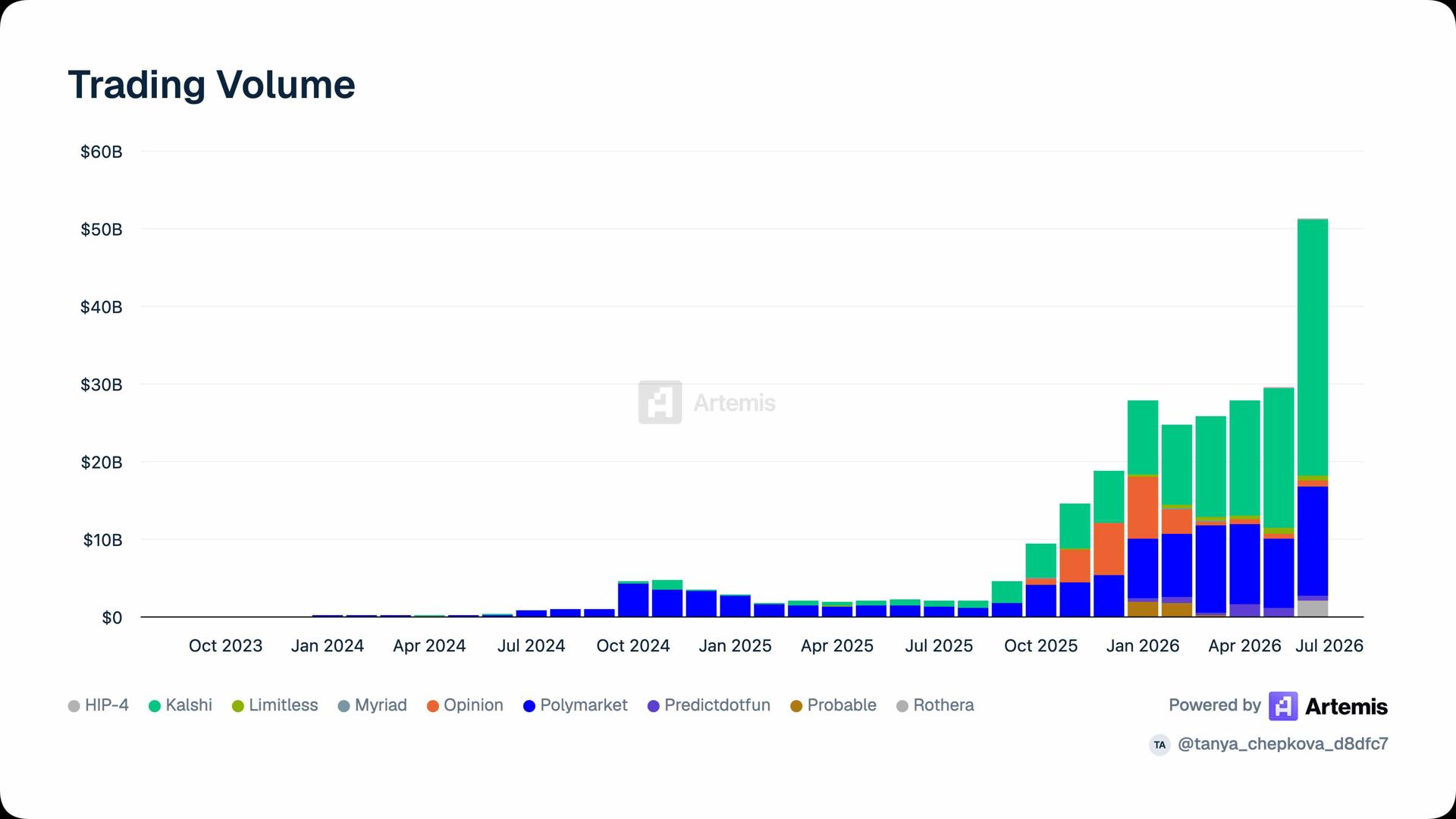
Prediction markets trading volume. Source: Artemis

A World Cup or a New Baseline?

The World Cup, which began on June 11, has been the industry's largest liquidity event to date. Kalshi alone processed $7.4 billion in World Cup trades during the tournament, more than its entire March Madness volume.

Polymarket's World Cup trades accounted for about $6.4 billion, compared with just $138,000 during the 2022 World Cup.

The June volumes also showed that prediction market infrastructure can support sustained trading activity around a single global event.

Whether that reflects a permanent shift in market structure is less clear, as the World Cup is an exceptional catalyst that naturally concentrates liquidity into a short period.

At the same time, user data suggests the World Cup may not be the whole story. A Bitget Wallet study of 857,000 active Polymarket users found that 60% had no prior onchain trading history, suggesting the prediction markets are attracting audiences beyond traditional crypto traders.

This activity would not necessarily unwind once the tournament ends.

What Brokers Should Watch

The June figures function as a stress test: the industry has demonstrated it can attract institutional-scale liquidity when a global event captures public attention.

If trading activity remains elevated after the World Cup ends, June may prove to be the beginning of a new baseline rather than a spike driven by a single sporting event.

Prediction markets surpassed $50 billion in monthly trading volume for the first time in June, with activity jumping 75% from May, according to Artemis data.

The milestone coincided with the FIFA World Cup, making June as much a test of event-driven demand as a new market record. Kalshi remained the largest venue, recording roughly $33 billion in monthly volume.

Polymarket processed $14 billion combined across its international platform and its recently launched US-regulated exchange. Rothera, the Robinhood-backed venue, added roughly $2 billion.

Prediction markets trading volume. Source: Artemis

A World Cup or a New Baseline?

The World Cup, which began on June 11, has been the industry's largest liquidity event to date. Kalshi alone processed $7.4 billion in World Cup trades during the tournament, more than its entire March Madness volume.

Polymarket's World Cup trades accounted for about $6.4 billion, compared with just $138,000 during the 2022 World Cup.

The June volumes also showed that prediction market infrastructure can support sustained trading activity around a single global event.

Whether that reflects a permanent shift in market structure is less clear, as the World Cup is an exceptional catalyst that naturally concentrates liquidity into a short period.

At the same time, user data suggests the World Cup may not be the whole story. A Bitget Wallet study of 857,000 active Polymarket users found that 60% had no prior onchain trading history, suggesting the prediction markets are attracting audiences beyond traditional crypto traders.

This activity would not necessarily unwind once the tournament ends.

What Brokers Should Watch

The June figures function as a stress test: the industry has demonstrated it can attract institutional-scale liquidity when a global event captures public attention.

If trading activity remains elevated after the World Cup ends, June may prove to be the beginning of a new baseline rather than a spike driven by a single sporting event.

About the Author: Tanya Chepkova
Tanya Chepkova
  • 264 Articles
  • 1 Follower
About the Author: Tanya Chepkova
Tanya Chepkova is a News Editor at Finance Magnates with more than 16 years of experience in financial journalism, covering forex, crypto, and digital asset markets. Her work spans daily industry reporting and data-driven, long-form explainers focused on market structure, trading models, and regulatory shifts. Before joining Finance Magnates, she led the editorial team of a cryptocurrency-focused media outlet for six years. Her reporting combines analytical depth with clear storytelling, with particular attention to how structural changes in trading, stablecoin infrastructure, and emerging products such as prediction markets reshape the broader financial ecosystem. She covers global developments and provides additional insight into CIS markets. Areas of Coverage: Crypto and digital asset markets Prediction markets Stablecoins and cross-border payments Industry analysis and long-form explainers
  • 264 Articles
  • 1 Follower

More from the Author

FinTech

!"#$%&'()*+,-./0123456789:;<=>?@ABCDEFGHIJKLMNOPQRSTUVWXYZ[\]^_`abcdefghijklmnopqrstuvwxyz{|} !"#$%&'()*+,-./0123456789:;<=>?@ABCDEFGHIJKLMNOPQRSTUVWXYZ[\]^_`abcdefghijklmnopqrstuvwxyz{|}