
Why brokers aren’t always the bad guys
What does dispute resolution in the CFD and retail FX industry actually look like in practice? FM Intelligence analyzed all 1,468 retail FX and CFD complaints handled by the Financial Commission in 2025. It found that brokers were not at fault in 94.8% of cases, based on decisions by an independent panel of 18 experts. However, these outcomes rarely gain the same visibility as the complaints themselves.
Issues like delayed withdrawals often spread quickly on platforms such as Reddit or review sites, while the final rulings receive far less attention. The data also shows a gap between claims and actual payouts. Traders collectively sought $21.4 million, but only $496,304 was awarded.
- FIFA World Cup 2026 vs Markets; ASIC Secures Record AU$300M Penalty
- Weekly Summary: Can AI Challenge Bloomberg Terminal?; China Cuts Off Offshore Brokers
- Weekly Snapshot: Prediction Markets Appeal to Young Men; IG Australia Opens Trading to ChatGPT
Most disputes were relatively small, with a median claim of $397.50. Withdrawal delays were the most common issue, accounting for 558 cases, yet 92.8% were resolved in favor of brokers, typically due to routine checks, bank processing times, or bonus terms rather than wrongdoing.
XTB tops Polish account growth, pace slows
Meanwhile, XTB remained the leading broker for Polish account openings in May, adding 48,226 new accounts, according to data from the Central Securities Depository of Poland (KDPW). This brought its total to 1,087,740 accounts, more than double the size of its closest competitor.
Rank | Institution | Accounts (May 2026) | m/m | y/y |
1 | XTB | 1,087,740 | +48,226 | +568,909 |
2 | mBank Brokerage | 560,967 | +5,357 | +76,772 |
3 | BM Pekao | 210,079 | +962 | +5,023 |
4 | ING Bank Śląski Brokerage | 205,897 | +955 | +8,061 |
5 | DM BOŚ | 195,540 | +1,087 | +17,756 |
6 | BM PKO BP | 186,233 | +858 | +20,189 |
— | Total market | 2,856,520 | +59,444 | +713,71 |
However, the pace of growth has slowed compared to earlier in the year, when the broker added 68,300 accounts in January and just over 51,000 in February.
Monthly additions fell below 50,000 in April, the same month XTB surpassed the 1 million account mark. Despite the slowdown, XTB continues to widen its lead over rivals. mBank’s brokerage arm, the second-largest player, reached 560,967 accounts after adding 5,357 in May. BM Pekao followed with 210,079 accounts, while ING Bank Śląski’s brokerage unit held 205,897, leaving a significant gap between XTB and the rest of the market.
eToro eyes wealth-tech deals, weighs banking licence
In the fintch space, eToro is exploring acquisitions as it looks to expand its wealth-tech offering. CEO Yoni Assia confirmed that the company is in talks to buy two firms, one in the United States and another in a different market. Speaking to the Financial Times, Assia said eToro is working with investment bankers on the potential deals. The company, which went public last year, also confirmed to Finance Magnates that it is reviewing several opportunities but noted that discussions are still at an early stage.
Assia described eToro as “very acquisitive,” adding that pursuing deals was one of the motivations behind its listing. While no details on deal size were disclosed, he said the company is targeting businesses that can strengthen its wealth offering and support global expansion, particularly in the US. In addition, eToro is considering applying for a banking licence as part of a broader push into the payments space.
Axi enters Mauritius with dealer licence
Amid growing broker interest in Mauritius as an offshore hub, Axi expanded its regulatory footprint by securing a local license. The approval allows the company to operate as a full-service investment dealer in the region. Axi Markets Mauritius was granted a Category SEC-2.1B Investment Dealer license on May 14, 2026.
The authorization, confirmed to Finance Magnates by a company representative, permits the firm to carry out full-service dealer activities, excluding underwriting. The broker holds multiple licenses globally, including authorization from the UK Financial Conduct Authority for its London operations.
Brokers are not the only ones eyeing Mauritius, as proprietary trading firms are increasingly following suit. Prop trading firms that moved to the Comoros after MetaQuotes tightened white-label rules in early 2024 are now shifting toward Mauritius. Companies such as FundingPips, FundedNext (via FNmarkets), Hola Prime, and Finotive Markets have recently secured licenses from the Mauritius Financial Services Commission (FSC), with several now operating their brokerage services from there instead of the Comoros.
The earlier move to the Comoros was largely driven by necessity, as firms sought ways to retain access to MetaTrader platforms after restrictions disrupted their models. However, licenses issued in the Comoros have faced credibility concerns.
Robinhood to cut 10% of staff
Layoffs across financial firms show little sign of slowing. Robinhood plans to cut about 10% of its full-time workforce, impacting roughly 290 employees, as part of a restructuring effort aimed at improving efficiency. The move comes despite strong trading activity, including high demand for its prediction markets, which saw 8.8 billion event contracts traded in the first quarter of 2026.
Trading platform Robinhood cuts 10% of workforce to flatten management layers https://t.co/wdvMsO7vWy
— CNBC (@CNBC) June 16, 2026
According to Reuters, the layoffs are intended to simplify the company’s structure and reduce management layers. CEO Vlad Tenev said the goal is to speed up decision-making and avoid operating with too many layers of management, even as the business continues to perform strongly.
“You can’t grow by cutting”: Trieu on AI in finance
As AI adoption accelerates across finance, questions are growing about its impact on jobs and career paths. Huy Nguyen Trieu, co-founder of the Centre for Finance, Technology and Entrepreneurship (CFTE), argues that the term “Artificial Intelligence” no longer fits, as the gap between human and machine capabilities has narrowed significantly.
He prefers “Digital Intelligence,” noting that technology can now handle complex tasks like drafting legal briefs or building trading platforms. As adoption grows, the financial industry is increasingly questioning what this means for traditional career paths, especially as some retail brokers have already linked AI to recent layoffs.
In 2026, more firms are pointing to AI as a reason for cutting staff, although there is rising skepticism that automation is sometimes used to justify cost reductions and improve financial optics. Trieu believes this reflects a deeper issue, where companies focus on reducing headcount instead of using AI to drive growth. He argues that treating employees mainly as a cost centre risks limiting the broader opportunities AI could bring to the industry.
Where smart money finds value
Small- and mid-cap stocks remain among the least efficiently priced areas of global equity markets, creating opportunities for active investors to find undervalued companies. It is widely accepted that share prices do not always reflect a company’s true value, which allows investors to target businesses with strong long-term growth potential.
MARKET RECAP 📉 What a wild and crazy day, the S&P 500 was up in morning but closed the day down 1.2%, losing around $1 trillion in market cap 😳
— Peter Tuchman (@EinsteinoWallSt) June 17, 2026
The Fed left interest rates unchanged, as expected.
What the heck is going on??! Let’s talk about it 🗣️ https://t.co/xm4C82iTbG pic.twitter.com/5WqLms6cfw
To identify such opportunities, investors use a range of metrics, including analyzing revenue streams, focusing on companies that can benefit from industry shifts, and spotting those positioned for earnings growth. For example, Fidelity International’s Global Future Leaders strategy starts with a universe of about 1,000 small- and mid-cap companies and filters out those with poor ESG ratings before selecting potential investments.
Tokenized SpaceX bets on four crypto exchanges fall short
SpaceX’s long-awaited market debut has exposed cracks in the promise of tokenized equities. Several crypto platforms have promoted tokenization as a way to disrupt traditional stock markets, but the recent cancellation of tokenized SpaceX share offerings highlights its limitations when the underlying asset is unavailable.
Binance, Bybit, Bitget Wallet, and MEXC all withdrew their tokenized IPO campaigns and refunded users after failing to secure the actual shares behind the tokens.
On June 12, the same day SpaceX began trading on Nasdaq under the ticker SPCX, the platforms confirmed that xStocks, the provider responsible for sourcing the shares, could not deliver the allocations. Bybit said it received no shares, Binance pointed to circumstances beyond its control, while Bitget Wallet and MEXC also cited a lack of available allocation, leading all four to cancel their offerings and return funds to subscribers.
Binance vows commitment to MiCA licence as EU exit risk looms
Binance faces the risk of losing access to the European Union market as a key regulatory decision approaches under the EU’s new MiCA regime. If the crypto exchange does not secure approval, it will no longer be able to serve users across the bloc starting next month. Sources cited by Reuters say Greece’s Hellenic Capital Market Commission is expected to reject Binance’s MiCA licence application.
Under MiCA, crypto firms must obtain authorization from a national regulator by the end of June to continue operating EU-wide. Binance has said it engaged with the Greek regulator in good faith and believes its application meets the required standards.
Perps hit $61.7 trillion
At the same time, perpetual futures recorded $61.7 trillion in trading volume last year, according to Reuters, making them an increasingly important product for the industry. For brokers, offering perps means handling continuous funding payments, margin and liquidation mechanisms, order routing, and compliance for an instrument that trades 24/7.
A perpetual future gives traders long or short exposure to an asset with no fixed expiry date, so positions can remain open as long as margin requirements are met. The product began with crypto assets like bitcoin and ether, but brokers are now extending the same no-expiry, leveraged structure to FX pairs, equities, metals, and even pre-IPO markets, bringing perps into channels they already serve.
CME sues CFTC in high-stakes perps clash
Outgoing CME Group CEO Terrence Duffy says the exchange will file a federal lawsuit against the US Commodity Futures Trading Commission (CFTC) over its decision to approve crypto perpetual futures in the United States. He told CNBC’s Fast Money that the case will specifically challenge the CFTC’s late-May authorization of Kalshi’s BTCPERP contract, the first regulated crypto perpetual futures product in US markets, along with a related no-action letter granted to Coinbase.
Duffy, who is also preparing to step down from his role as CME’s chief executive, criticized the CFTC’s handling of the approval process. He argued that the regulator moved too quickly and bypassed what he describes as a mandatory full review for products it has classified as “novel and complex.”
Meanwhile, Kalshi’s new crypto perpetual futures have generated more than $5.5 billion in trading volume in their first two weeks, making them the company’s fastest-growing product launch to date. The rollout marks a shift from Kalshi’s original focus on event contracts linked to politics, sports, and other real-world outcomes toward a broader slice of the derivatives market on its CFTC-regulated exchange.
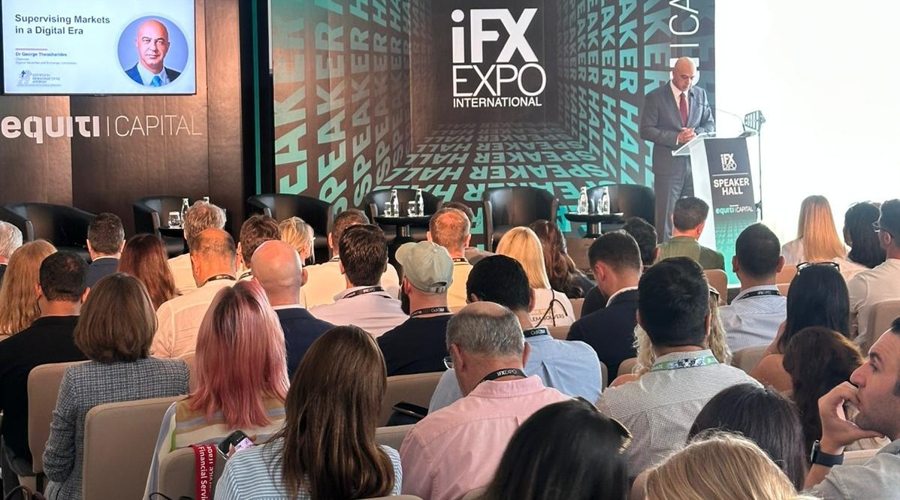
Highlights from the iFX EXPO International 2026
Lastly, the iFX EXPO International 2026, held at City of Dreams Mediterranean, entered its final day on Thursday. The event gathered brokers, fintech firms, liquidity and payment providers, technology vendors, and other stakeholders from across the online trading industry.

Interestingly, the Seychelles Financial Services Authority was also exhibiting at the event, promoting its offshore regulatory regime directly to brokers and other industry participants.


