Kalshi Hits $5.5B in Crypto Perps, Expanding Beyond Prediction Markets

Thursday, 18/06/2026 | 15:01 GMT by Tanya Chepkova
  • Kalshi’s new crypto perpetual futures generated more than $5.5 billion in trading volume in their first two weeks.
  • The launch gives Kalshi a way to expand beyond event contracts and compete for volume in a much larger derivatives market.
Kalshi's crypto perps trading volume hit $5.5B in two weeks

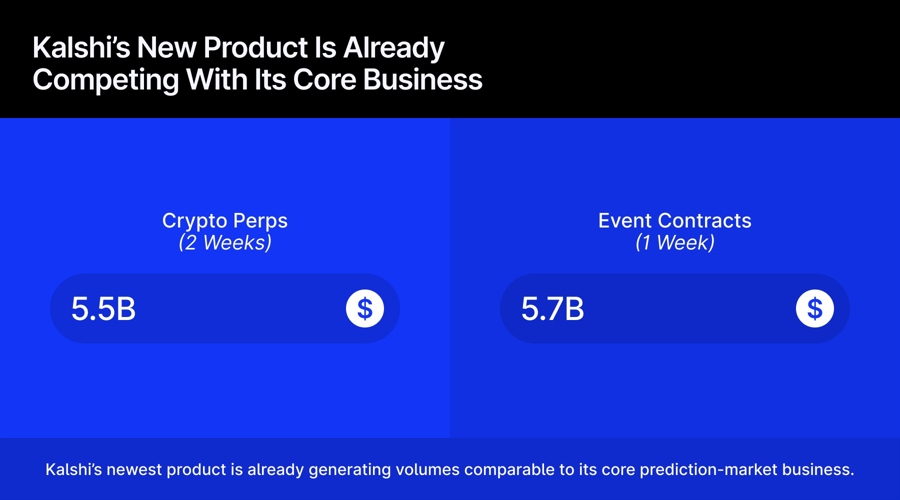
Kalshi’s crypto perpetual futures generated more than $5.5 billion in trading volume in their first two weeks. The company said it was the fastest-growing product launch in its history.

The debut suggests Kalshi’s ambitions now extend beyond prediction markets. While the company built its business around politics, sports, and event contracts, it is now pushing into a much larger derivatives market through its CFTC-regulated exchange.

Perpetual futures, or perps, are leveraged derivatives with no expiry date. Until recently, they were mostly associated with offshore crypto exchanges. Kalshi is now trying to bring that product structure into a regulated US venue.

Tarek Mansour
Tarek Mansour, the Founder and CEO of Kalshi

“It’s been our fastest-growing launch in terms of adoption and customers,” Kalshi co-founder Tarek Mansour said at the Bloomberg Market Structure Conference.

He added that the company is already speaking with regulators about applying the perpetuals model to asset classes beyond crypto.

Kalshi processed roughly $5.7 billion in total trading volume last week, boosted by World Cup activity. Against that backdrop, a new product generating $5.5 billion in its first two weeks stands out even during a period of record platform activity.

Beyond Prediction Markets

For most of its history, Kalshi’s growth story was tied to event contracts. Perpetual futures give the company access to a market that generated an estimated $61.7 trillion in global trading volume in 2025.

The move also fits Kalshi’s broader effort to position itself within the regulated derivatives industry rather than the gambling sector. Expanding into products already familiar to futures and crypto traders supports that strategy.

Kalshi is not alone. Coinbase and Kraken have both expanded beyond their original crypto focus by adding stocks, prediction markets, and other products to become multi-asset platforms.

Kalshi’s expansion has already drawn resistance from incumbent exchanges. CME Group CEO Terry Duffy has raised concerns about the risk profile of the contracts and said CME will sue the CFTC over its approval of Kalshi’s perps, calling the process legally flawed and rushed.

Mansour framed the reaction as a response to new competition. “You have incumbent participants that have a status quo that’s working, and there’s competition now,” he said.

You may also like: Perps vs CFDs and Futures - What Brokers Need to Know Before Adding Crypto’s Hottest Derivative

What Does it Mean for Brokers

Kalshi’s trajectory offers a case study in how quickly product categories are expanding.

The company is building a multi-product derivatives business under a single regulatory framework. Event contracts remain its core business, but perpetual futures provide access to a much larger pool of trading volume and a user base already familiar with leveraged crypto products.

Perpetual futures give Kalshi access to a market far larger than prediction contracts alone. After generating $5.5 billion in two weeks, the product is already becoming a meaningful part of the company’s growth story.

Kalshi’s crypto perpetual futures generated more than $5.5 billion in trading volume in their first two weeks. The company said it was the fastest-growing product launch in its history.

The debut suggests Kalshi’s ambitions now extend beyond prediction markets. While the company built its business around politics, sports, and event contracts, it is now pushing into a much larger derivatives market through its CFTC-regulated exchange.

Perpetual futures, or perps, are leveraged derivatives with no expiry date. Until recently, they were mostly associated with offshore crypto exchanges. Kalshi is now trying to bring that product structure into a regulated US venue.

Tarek Mansour
Tarek Mansour, the Founder and CEO of Kalshi

“It’s been our fastest-growing launch in terms of adoption and customers,” Kalshi co-founder Tarek Mansour said at the Bloomberg Market Structure Conference.

He added that the company is already speaking with regulators about applying the perpetuals model to asset classes beyond crypto.

Kalshi processed roughly $5.7 billion in total trading volume last week, boosted by World Cup activity. Against that backdrop, a new product generating $5.5 billion in its first two weeks stands out even during a period of record platform activity.

Beyond Prediction Markets

For most of its history, Kalshi’s growth story was tied to event contracts. Perpetual futures give the company access to a market that generated an estimated $61.7 trillion in global trading volume in 2025.

The move also fits Kalshi’s broader effort to position itself within the regulated derivatives industry rather than the gambling sector. Expanding into products already familiar to futures and crypto traders supports that strategy.

Kalshi is not alone. Coinbase and Kraken have both expanded beyond their original crypto focus by adding stocks, prediction markets, and other products to become multi-asset platforms.

Kalshi’s expansion has already drawn resistance from incumbent exchanges. CME Group CEO Terry Duffy has raised concerns about the risk profile of the contracts and said CME will sue the CFTC over its approval of Kalshi’s perps, calling the process legally flawed and rushed.

Mansour framed the reaction as a response to new competition. “You have incumbent participants that have a status quo that’s working, and there’s competition now,” he said.

You may also like: Perps vs CFDs and Futures - What Brokers Need to Know Before Adding Crypto’s Hottest Derivative

What Does it Mean for Brokers

Kalshi’s trajectory offers a case study in how quickly product categories are expanding.

The company is building a multi-product derivatives business under a single regulatory framework. Event contracts remain its core business, but perpetual futures provide access to a much larger pool of trading volume and a user base already familiar with leveraged crypto products.

Perpetual futures give Kalshi access to a market far larger than prediction contracts alone. After generating $5.5 billion in two weeks, the product is already becoming a meaningful part of the company’s growth story.

About the Author: Tanya Chepkova
Tanya Chepkova
  • 245 Articles
About the Author: Tanya Chepkova
Tanya Chepkova is a News Editor at Finance Magnates with more than 16 years of experience in financial journalism, covering forex, crypto, and digital asset markets. Her work spans daily industry reporting and data-driven, long-form explainers focused on market structure, trading models, and regulatory shifts. Before joining Finance Magnates, she led the editorial team of a cryptocurrency-focused media outlet for six years. Her reporting combines analytical depth with clear storytelling, with particular attention to how structural changes in trading, stablecoin infrastructure, and emerging products such as prediction markets reshape the broader financial ecosystem. She covers global developments and provides additional insight into CIS markets. Areas of Coverage: Crypto and digital asset markets Prediction markets Stablecoins and cross-border payments Industry analysis and long-form explainers
  • 245 Articles

More from the Author

FinTech

!"#$%&'()*+,-./0123456789:;<=>?@ABCDEFGHIJKLMNOPQRSTUVWXYZ[\]^_`abcdefghijklmnopqrstuvwxyz{|} !"#$%&'()*+,-./0123456789:;<=>?@ABCDEFGHIJKLMNOPQRSTUVWXYZ[\]^_`abcdefghijklmnopqrstuvwxyz{|}