

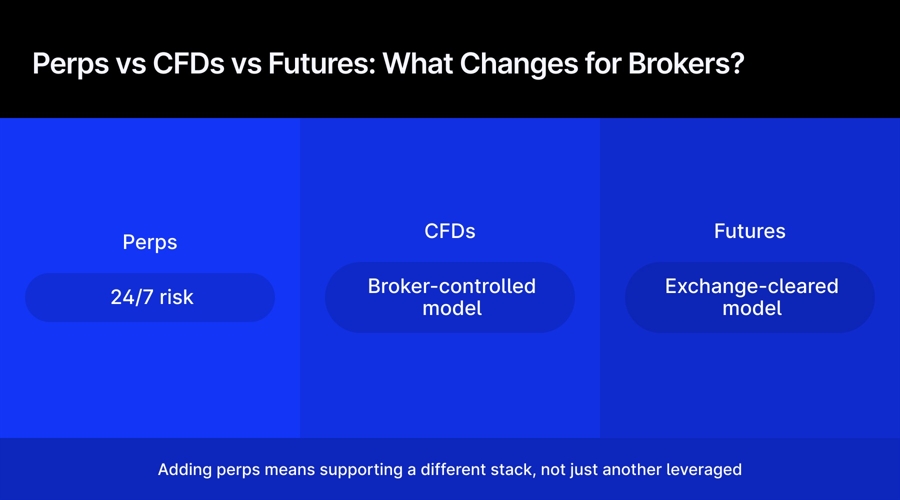
Perpetual futures reached $61.7 trillion in trading volume last year, according to Reuters. The demand is drawing brokers toward the product, but adding perps means supporting funding, margin, liquidation, routing, and compliance in a product that trades around the clock.
How Perps Work: No Expiry, Funding, and Liquidation
A perpetual future gives traders long or short exposure to an asset with no fixed expiry date. Unlike a dated future, there is no settlement cycle that forces the trader to close or roll the contract. The position stays open as long as the margin holds.
Perps started as crypto-native contracts, first around bitcoin and then ether. Now brokers are building the same kind of no-expiry, leveraged exposure on FX pairs, equities, metals, and even pre-IPO markets. That brings the product into markets many brokers already serve.
Funding Replaces Expiry
No expiry creates a design problem: without a maturity date, there is no natural point where the contract price converges with the spot or index price.
Perps solve this through a funding rate - a periodic payment between long and short holders. When the perp trades above the underlying index, longs pay shorts. When it trades below, shorts pay longs.
Unlike an overnight CFD charge, funding is a transfer between the two sides of the market, not a broker fee. As it is calculated on the notional position size rather than the margin posted, leverage can make the cost significant even when the posted collateral is small.
Mark Price Instead of Last Price
Perps calculate margin and liquidation thresholds using a mark price, which is typically an index-linked reference price rather than the last traded price.
The last traded price can be distorted by thin liquidity or short-lived spikes. If liquidation were tied to it, clients could be forced out by temporary moves. For brokers, mark price feeds directly into unrealised P&L, margin requirements, and liquidation decisions.
Liquidation Is Part of the Product
Margin structures vary. Isolated margin ties collateral to a specific position. Cross margin lets the broader account balance support multiple positions. It is more capital-efficient, but losses in one position can affect the rest of the account.
When equity falls below the maintenance margin threshold, the position is reduced or closed automatically. Crypto-native venues often pair this with insurance funds or auto-deleveraging systems to absorb losses that exceed normal liquidation capacity.
Cleared models use a different risk waterfall, but the principle is the same: positions must be contained before losses exceed available collateral.
Perps vs CFDs vs Dated Futures
Perps, CFDs, and dated futures all give clients leveraged market exposure. They differ in how that exposure is funded, margined, traded, and regulated.
| Feature | Perpetual Futures | CFDs | Dated Futures |
| Expiry | None for true perps; some regulated versions use long-dated wrappers | None for rolling CFDs | Fixed maturity date |
| Cost of carry | Funding rate between longs and shorts | Overnight financing charge | Embedded in the futures curve; roll cost if extended |
| Counterparty / venue | Depends on structure: exchange, clearinghouse, or crypto-native venue | Broker as OTC counterparty | Exchange-traded and centrally cleared |
| Leverage | Venue- and jurisdiction-dependent; can be high offshore | Retail-restricted in major regimes; higher for professionals | Set by exchange, clearing, and broker margin requirements |
| Liquidation trigger | Mark price and liquidation engine | Broker margin close-out rules | Exchange margin calls and broker controls |
| Roll | Not required | Not required; overnight costs apply | Required to maintain exposure past expiry |
| Regulation | Jurisdiction-specific; still developing | Established rulebooks in the UK, EU, and Australia | Mature listed-derivatives framework |
For clients, perps and crypto CFDs look similar: leverage, long and short exposure, no ownership of the underlying.
For brokers, the structure is different: funding rates, mark price logic, venue rules, and, in regulated models, exchange or clearing infrastructure replace the OTC controls a CFD broker manages in-house.
CFTC Chairman Mike Selig framed the move as part of the agency’s push to bring crypto perpetuals into the US regulatory framework.
In my first public remarks as @CFTC Chairman, I made clear that the agency would use the tools at its disposal to onshore crypto asset perpetuals. Today, the @CFTC delivered on that commitment.
— Mike Selig (@ChairmanSelig) May 29, 2026
This morning, the @CFTC took historic action to permit the listing of a true bitcoin…
The Broker Decision: Offer, Route, Hedge, or Stay Out?
Before anything goes on the platform, a firm needs answers to four questions: what the product is legally, how it will be routed, how risk will be managed, and which clients it is meant for.
Licensing and Legal Wrapper
A perp can mean different things depending on jurisdiction and structure. Kalshi’s BTCPERP is a true perpetual approved through a DCM route. Coinbase’s US perpetual-style product uses a long-dated futures wrapper. In Europe, One Trading operates under a MiFID II venue framework.
The client category matters too. A structure available to institutional or professional clients may not be open for retail distribution.
Execution and Routing
A broker can list directly, route to an exchange, use an affiliate venue, white-label another provider’s product, or keep perps away from clients and use them only for hedging.
In practice, firms such as Interactive Brokers and Robinhood EU have taken the partnership route rather than listing perps themselves. Kraken is taking a different path through Bitnomial, a regulated venue the group controls.
Coinbase makes the same routing point from the liquidity side. Brian Armstrong framed the Deribit approval as a way to connect US users with global perpetual futures liquidity through a compliant channel.
Something that got missed in the noise last week: Coinbase got approved to offer true global crypto perps in the US. This took many years of work, and we're the first to offer this global liquidity to US users.
— Brian Armstrong (@brian_armstrong) June 10, 2026
Backstory: For many years crypto trading has been moving offshore…
Each model changes who controls execution, margin, collateral, liquidation, and disclosures.
Liquidity and Hedge Quality
A deep perp market can look attractive as a hedge for crypto CFD exposure, but the firm still has to test how closely the hedge tracks the client-facing product. Funding rates, index methodology, and venue liquidity can all diverge under stress, leaving the broker with basis risk.
Risk Engine and Operations
Brokers need to know how mark price is calculated, who controls the index, how often funding is settled, and how liquidation is handled. Coinbase’s US perpetual-style futures, for example, settle funding and variation through Nodal Clear twice daily. SGX’s BTC and ETH perps show another regulated model, with exchange clearing for institutional users.
Crypto-native venues may rely instead on internal liquidation engines, insurance funds, or auto-deleveraging. The model determines where the loss waterfall runs: through a clearing structure, a venue-level mechanism, or potentially back to the broker’s own balance sheet.
Client Suitability and Conduct
Funding can change the economics of a position, and liquidation can happen automatically when margin falls below the required threshold.
Retail distribution brings additional obligations, including appropriateness checks, risk warnings, negative balance protection where required, and a KID under PRIIPs in Europe.
Product Economics
CFD brokers earn through spread, commission, and overnight financing. Perps change that model because funding is often a transfer between traders, not broker revenue.
The firm may still earn through execution, commissions, or routing, but the revenue opportunity has to be weighed against a more complex operational and conduct-risk burden.
US Routes: True Perp, Futures Wrapper, and Foreign Futures Access
The US market is developing several regulated routes for perp exposure, and they are not the same model. It can mean a direct listed contract, a long-dated futures wrapper, foreign futures access, or a controlled infrastructure route.
| Route | Example | Structure | Access / status |
| Direct listed perp | Kalshi BTCPERP | True bitcoin perpetual approved as a futures contract through a DCM route | Live / confirmed for BTC |
| Perpetual-style futures wrapper | Coinbase US | Long-dated futures structure with perp-like economics | Live |
| Foreign futures access | Coinbase / Deribit | Institutional access to Deribit perpetuals through a foreign futures route | Institutional onboarding |
| Controlled infrastructure route | Kraken / Bitnomial | US perp launch through a CFTC-regulated venue Kraken owns | Live for 16 contracts |
Kalshi CEO Tarek Mansour said the product reached $1 billion in perps volume within five days of launch, a company-reported milestone that points to fast early uptake for the regulated route.
Risks and Trade-Offs: What the Critics Get Right
CME Group CEO Terry Duffy told Reuters that crypto perps are "a disaster waiting to happen." His criticism focuses on high leverage, automatic liquidation, and speculative retail use rather than only on the legal wrapper.
LATEST: ⚡️ CME Group CEO Terry Duffy says newly approved crypto perpetual futures could be a "disaster waiting to happen." pic.twitter.com/s0IuktjePb
— CoinMarketCap (@CoinMarketCap) June 5, 2026
High leverage and automatic liquidation work differently when the client does not fully understand the funding mechanics. Better Markets has made a similar argument: that retail interfaces can encourage excessive trading, and that forced liquidations during volatile moves can hit clients harder than they expect.
There is also a classification concern. Critics argue that product approvals are moving faster than market-wide safeguards, and that if similar structures expand beyond crypto, the regulatory questions will get harder.
However, supporters argue that perp trading is already happening offshore, where regulators have less visibility and clients have fewer protections. Regulated venues can improve transparency and supervision, but they do not make the product low-risk.
Whatever the venue or clearing model, conduct risk and reputational exposure stay with the broker that puts the product in front of the client.
- A Shift from CFDs to Futures: A Hype or a Viable Option?
- CME Group Hits Record SOFR Futures Volume in October
- Binance Futures Launches DeFi-Based Index Line of Perpetual Contracts
The Europe Gap: Substance Over Label
In February 2026, ESMA warned that derivatives marketed as perpetual futures are likely to fall under national CFD product intervention measures where they meet the CFD definition.
The regulator made it clear that the substance is more important than branding. If the product falls under the CFD measures, the consequences are familiar: leverage limits, mandatory risk warnings, margin close-out rules, and negative balance protection.
ESMA also expects a narrow target market for complex leveraged products and warned against mass marketing to inexperienced investors, broad campaigns, pop-up promotions, or "get started now" messaging.
For retail distribution, firms also need to consider appropriateness checks, conflicts of interest, and product documentation such as a KID under PRIIPs.
Malta's MFSA followed with a circular asking licensed firms to assess their product line-ups. That was not an enforcement action, but it shows how the ESMA position can move into national supervisory expectations.
The Bottom Line
Perps are becoming a serious product question for brokers because they sit close to crypto CFDs in client use case, while requiring a different operating model.
The same logic is now spreading beyond BTC and ETH into FX, equities, metals, and pre-IPO exposure. Demand for new instruments is growing, and brokers may be tempted to add perps before competitors do.
However, before making that call, they need to account for the parts that make the product difficult to support: funding, margin, liquidation, routing, client eligibility, disclosures, and regulatory treatment.
Some brokers will launch the product. Others will use perps only for hedging or institutional access. Staying out may also be the right answer. The weak position is having no position at all.


