


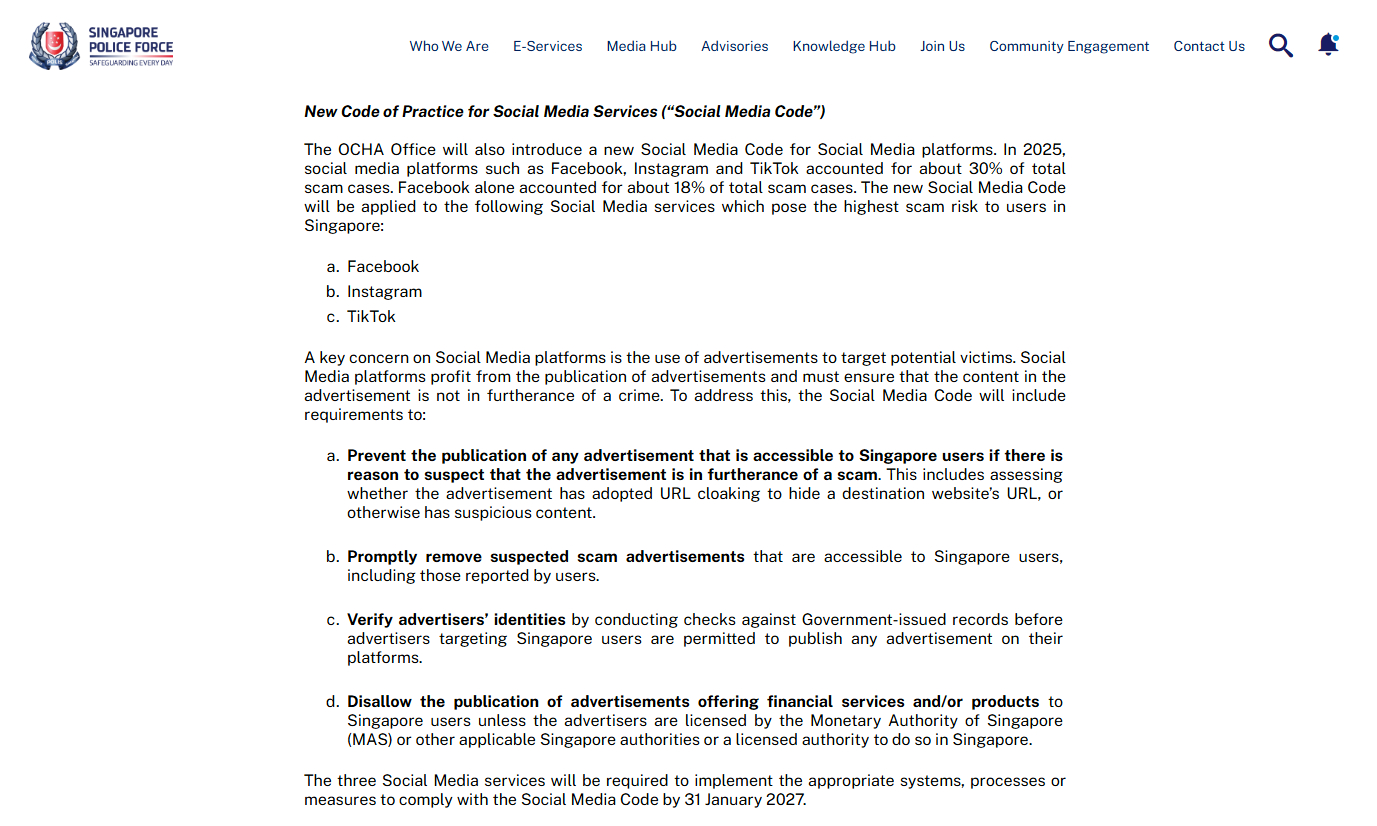
Singapore said yesterday (Tuesday) that Facebook, Instagram and TikTok must block financial-services ads from providers that lack local authorization. The platforms have until Jan. 31, 2027, to comply.
For brokers, crypto firms and trading promoters, the rule sets a new condition for paid access to Singapore users. Overseas incorporation is not the deciding factor. The advertiser must hold the relevant local license or act with the authority of a licensed entity.
The Singapore Police Force (SPF) announced the requirements under the Online Criminal Harms Act (OCHA). It said social-media platforms, including Facebook, Instagram and TikTok, accounted for about 30% of reported scam cases in 2025. Facebook alone accounted for about 18%.
Local Authorization Extends Beyond Brokers
The Code of Practice for Social Media Services requires platforms to reject ads offering financial services or products to Singapore users unless the advertiser is licensed by the Monetary Authority of Singapore (MAS), another applicable Singapore authority or is authorized by a licensed entity.
The advertiser definition reaches beyond the company named in the promotion. It includes brand owners, merchants, advertising and public-relations agencies.
Content creators, influencers, affiliate marketers and other intermediaries also fall inside the definition when they help create, target, fund or distribute an ad.
- Singapore Attracts Global Millionaires as Advisors Adjust Cross-Border Wealth Strategies
- Singapore Private Banking Draws Global Wealth as Assets Near $200B
- “AI Very Useful for Fraud Detection, Monitoring”: FM Singapore Summit 2026 Enters Final Day
An offshore broker without Singapore authority would therefore lose the paid channel when its promotion is accessible to users in the country. A foreign group could still advertise through an appropriately licensed local entity or an advertiser that the entity has authorized.
The code applies to paid content. It does not state that every unpaid social-media post about a financial product falls within the advertising restriction.
Platforms Must Review Ads Before Publication
Facebook, Instagram and TikTok must review all ads intended to be accessible to Singapore users before publication. They must prevent an ad from going live when there is reason to suspect that it supports a scam or malicious cyber activity.
The screening process must look for URL cloaking and monitor embedded links for changes during an ad's lifecycle.
The code lists unrealistic investment returns, impersonation, redirects to unverified sites, pressure tactics and unlicensed financial products among the indicators of suspicious content.
Platforms must also verify advertisers against government-issued records, including business-registration records and identity documents where applicable. Suspected scam ads already online must be removed promptly.
Other duties include acting on user reports within 24 hours, retaining specified account data for at least 90 days and filing an annual implementation report. The report must cover detection systems, emerging tactics and agreed effectiveness metrics.
Regulators elsewhere have also increased online takedowns. The Australian Securities and Investments Commission removed more than 19,400 online scams in FY 2026, up 182% from the previous year.
Penalty Increase Still Awaits Parliament
Singapore has proposed a financial penalty of as much as S$10 million (about $7.83 million) for each instance of noncompliance with a code or implementation directive. The amendment has been introduced in Parliament but is not yet part of the current penalty framework.
Under the existing rules, the OCHA Office may issue a Rectification Notice. Failure to comply without a reasonable excuse is an offense carrying a maximum fine of $1 million, followed by as much as $100,000 for each day the offense continues after conviction.
The proposed framework would also allow a Rectification Notice or Compliance Order. Ignoring either could bring a fine of up to S$10 million and a further S$300,000 for each day of a continuing offense after conviction.
The government expects to provide more detail during the bill's second reading in September.
The OCHA Office said it may apply the duties according to the scam risk of each service and grant full or partial waivers. Reported scam cases on designated online services fell about 37% between 2024 and 2025, although SPF said multiple factors affected the total.


