

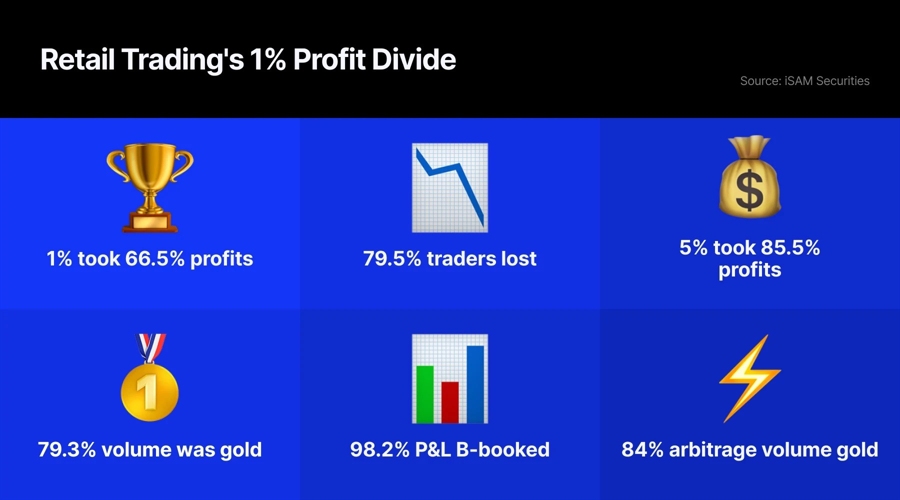
Just 1% of winning retail trading accounts took home 66.5% of all client profits generated across the retail FX and CFD industry over the past year, according to new data shared with Finance Magnates by iSAM Securities.
The figures come from Radar, iSAM Securities' risk analytics platform, which brokers use to monitor client trading activity, exposure, and profitability in real time.
The dataset covers a 12-month period until the middle of last month, and is drawn from Radar’s full brokerage client base.
London's trading industry is coming home!
A Small Slice of Traders Doing Most of the Winning
The headline figures point to a familiar but stark pattern in retail trading: most traders lose money, and the ones who win tend to win big. Across the Radar network, 79.5% of retail clients ended the period in loss, against 20.5% who finished in profit.
Within that winning minority, the concentration is severe. The top 1% of winning accounts accounted for 66.5% of all client winnings, while the top 5% took 85.5%.
That concentration also shows up on the losing side of the ledger. iSAM Securities’ data shows that 1% of clients can account for 30% of a broker's total drawdown, the losses a broker pays out to its profitable traders. Radar's Smart Alerts feature is built to flag the kind of activity behind this to brokers directly, sending configurable alerts to a broker's Slack or Teams channels.
The data also breaks down how brokers are managing that risk. Across the Radar network, 94.6% of client trading volume is B-booked, meaning brokers take the other side of the trade themselves, against just 5.4% that is A-booked, or passed on to a liquidity provider.
The gap widens further when measured by profit and loss: B-booking accounts for 98.2% of broker P&L, against 1.8% from A-booking.
Gold dominates the picture. XAUUSD accounted for 79.3% of broker trading volume and 62% of broker P&L across the network, dwarfing other instruments. EURUSD was a distant second at 3.3% of volume, followed by GBPUSD at 2.1% and BTCUSD at 1.3%.
Gold, Latency Arbitrage, and High-Frequency Trading
A closer look at trade timing points to latency arbitrage as a persistent issue for brokers. Using Radar's Aftermath feature, which tracks how trades would have performed a set period after execution, iSAM Securities found that 9.6% of retail clients were still in profit one second after their trade, even once spread costs were factored in. Among those, 2.5% of clients earned more than 100 dollars per million (dpm) traded on that basis, a level iSAM Securities says is a strong indicator of latency arbitrage.
Read more: Nigeria’s Proposed CFD Rules Are Not Irrational; They Are Mispriced
Gold again stands out: 84% of the notional volume traced back to these likely arbitrageurs was concentrated in XAUUSD, a finding iSAM Securities says lines up with longstanding industry rumours that gold is a primary target for latency-based strategies.
More broadly, over 1% of traders across the Radar network carry a system recommendation flagging them for high-frequency, arbitrage, or martingale-style trading. Of those, 80% sit on books that are fully warehoused, meaning the broker is holding all of the risk in-house rather than hedging it out. iSAM Securities suggests many of these accounts are likely being missed altogether, tying back to the concentrated winnings described above.
Bill Holter sees gold potentially exceeding $180,000 an ounce in a major monetary crisis. He calculates that backing roughly $40 trillion in U.S. debt with reported gold reserves would imply a price just below $180,000. He also believes silver could surge as capital moves into… pic.twitter.com/WLwacLmZUM
— TheGladiator (@TheGladiatorHC) September 23, 2026
The Cross-Broker Problem
Cross-broker activity adds another layer to the problem. Radar’s data shows that 3.4% of accounts on the network are part of clusters that employ high-frequency or potentially abusive hedged strategies across multiple brokers. These accounts often run sophisticated strategies designed to drain broker P&L, including bonus abuse, swap abuse, latency arbitrage, and zero-downside protection abuse, the exact strategies Radar’s Network Alerts feature is designed to flag to brokers.
- iSAM Moves to New London Headquarters after New Cyprus and Hong Kong Offices
- Retail Brokers Can Now Access Risk and Trading Solutions via Spotware and iSAM Securities
- iSAM Securities’ New Risk Management Tool Allows Brokers to Optimise A- and B-Booking
Securities estimates that brokers acting on network alerts could save the average medium-sized broker around $5 million per quarter in P&L that would otherwise go to high-frequency or abusive trading activity.
iSAM Securities expects Radar's footprint to continue growing. The company projects that the platform will process more than $15 trillion in monthly trading volume by the end of the year.


