>
FCA Outlines Proposed Expenses Levy For Financial Compensation Scheme
Monday,20/01/2014|21:02GMTby
Andrew Saks McLeod
Britain's Financial Conduct Authority has today released a consultation paper proposing that the Management Expenses Levy Limit under its customer compensation scheme should be set at £80 Million
Britain's financial markets regulator has today released a consultation paper which outlines the proposed management expenses levy limit (MELL) for the FSCS for 2014 and 2015.
As the Financial Conduct Authority (FCA) enters its second year in existence following its assumption of duties from its long-standing predecessor, the Financial Services Authority, proposals are contained within today's consultation paper which the regulatory authority advises that all registered financial services companies should read.
On this basis, the FCA has proposed in its consultation paper on the matter that this should be set at £80 million for the years 2014 and 2015.
Additionally, the consultation paper aims this proposal squarely at companies which operate in the UK's financial sector solely, therefore being applicable to companies in this sector rather than bearing any relevance whatsoever to consumers or consumer groups.
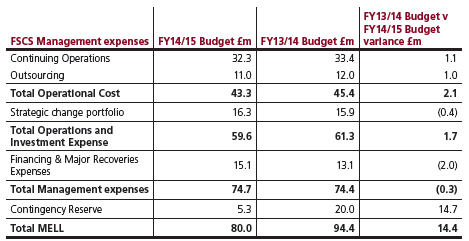
The proposed structure which the MELL could be scheduled to take comprises of FSCS management expenses of £74.7m, which is the minimum amount that will be levied for 2014 and 2015.
A contingency reserve of £5.3m should make up the difference, which allows the FSCS to levy additional funds without formal consultation by the FCA and PRA, in order to meet contingencies that were not expected when the annual levy was raised.
This, according to the FCA, would most probably be at relatively short notice, and would not be levied unless required by the FSCS.
Time is most certainly of the essence in responding to this proposal, with the FCA having stipulated that comments from regulated entities on the proposed MELLs must be sent to the regulatory authority by February 17, just less than one month from now.
After reviewing consultation responses, and subject to approval in March 2014 by the FCA Board and the PRA Board, both regulators will finalize the proposal in this CP to take effect on 1 April, 2014, with invoices due to be sent out from July 2014.
What Purpose Does The Limit Perform?
The FCA has detailed that the amount levied to pay compensation claims is determined by the FSCS and is not consulted on. There are limits under the FEES rules on how much firms can be levied each year. The FSCS indicates its current estimated compensation figures and its related funding and levies in its Plan and Budget. The FSCS states that it is to confirm its actual levy requirements in early April 2014.
The management expenses levy is made up of a specific cost element, which comprises costs attributable to a particular funding class and allocated to that class 8 January, 2014 FCA and PRA.
The PRA's Financial Services Compensation Scheme is scheduled to contain a management expenses levy limit for 2014 and 2015, consisting of a base cost element, relating to the general costs of the FSCS (which is not dependent on the level of claims received).
Base costs are divided equally between the PRA and FCA regulatory fee classes, and then distributed in proportion to regulatory fees.
The benefits from the FSCS are to improve consumer confidence, increase consumer protection and financial stability. The main consumer protection benefit is the reduced financial loss to consumers in the event of firm failure, a matter which regulatory authorities have begun to look at very closely since the demise of MF Global and Peregrine Financial Group in North America, a jurisdiction which raised capital adequacy requirements for retail firms to $20 million in order to mitigate the occurrence of such incidents.
Cost Advantage
It is difficult to estimate the number of potential instances of firm failure which may occur during 2014 and 2015, along with the subsequent reduction in financial losses to consumers due to FSCS compensation. However, to illustrate the potential scale of the benefits to consumers, the average annual value of compensation paid out over the past three years is £400 million.
Overview of FSCS Budget Information Source: Financial Conduct Authority
Britain's financial markets regulator has today released a consultation paper which outlines the proposed management expenses levy limit (MELL) for the FSCS for 2014 and 2015.
As the Financial Conduct Authority (FCA) enters its second year in existence following its assumption of duties from its long-standing predecessor, the Financial Services Authority, proposals are contained within today's consultation paper which the regulatory authority advises that all registered financial services companies should read.
On this basis, the FCA has proposed in its consultation paper on the matter that this should be set at £80 million for the years 2014 and 2015.
Additionally, the consultation paper aims this proposal squarely at companies which operate in the UK's financial sector solely, therefore being applicable to companies in this sector rather than bearing any relevance whatsoever to consumers or consumer groups.
The proposed structure which the MELL could be scheduled to take comprises of FSCS management expenses of £74.7m, which is the minimum amount that will be levied for 2014 and 2015.
A contingency reserve of £5.3m should make up the difference, which allows the FSCS to levy additional funds without formal consultation by the FCA and PRA, in order to meet contingencies that were not expected when the annual levy was raised.
This, according to the FCA, would most probably be at relatively short notice, and would not be levied unless required by the FSCS.
Time is most certainly of the essence in responding to this proposal, with the FCA having stipulated that comments from regulated entities on the proposed MELLs must be sent to the regulatory authority by February 17, just less than one month from now.
After reviewing consultation responses, and subject to approval in March 2014 by the FCA Board and the PRA Board, both regulators will finalize the proposal in this CP to take effect on 1 April, 2014, with invoices due to be sent out from July 2014.
What Purpose Does The Limit Perform?
The FCA has detailed that the amount levied to pay compensation claims is determined by the FSCS and is not consulted on. There are limits under the FEES rules on how much firms can be levied each year. The FSCS indicates its current estimated compensation figures and its related funding and levies in its Plan and Budget. The FSCS states that it is to confirm its actual levy requirements in early April 2014.
The management expenses levy is made up of a specific cost element, which comprises costs attributable to a particular funding class and allocated to that class 8 January, 2014 FCA and PRA.
The PRA's Financial Services Compensation Scheme is scheduled to contain a management expenses levy limit for 2014 and 2015, consisting of a base cost element, relating to the general costs of the FSCS (which is not dependent on the level of claims received).
Base costs are divided equally between the PRA and FCA regulatory fee classes, and then distributed in proportion to regulatory fees.
The benefits from the FSCS are to improve consumer confidence, increase consumer protection and financial stability. The main consumer protection benefit is the reduced financial loss to consumers in the event of firm failure, a matter which regulatory authorities have begun to look at very closely since the demise of MF Global and Peregrine Financial Group in North America, a jurisdiction which raised capital adequacy requirements for retail firms to $20 million in order to mitigate the occurrence of such incidents.
Cost Advantage
It is difficult to estimate the number of potential instances of firm failure which may occur during 2014 and 2015, along with the subsequent reduction in financial losses to consumers due to FSCS compensation. However, to illustrate the potential scale of the benefits to consumers, the average annual value of compensation paid out over the past three years is £400 million.
SpaceX IPO Reaches Prop Trading as The Trading Pit Markets SPCX Debut Access
Featured Videos
Precious Insights: APAC's Bullion Market amid Record Volatility
The precious metals rally has challenged how brokers and LPs think about hedging, pricing, and physical delivery. But with regional banks eyeing physical gold retail and bullion brokers across Southeast Asia harnessing new tech, volatility is not only in 'safe havens'.
This session gathers practitioners from across the bullion ecosystem to unpack what the rally means on the ground in APAC.
Attendees will walk away with:
Insight into the physical market dynamics driving retail demand across Southeast Asia, from central bank buying to store-of-value purchases
Understanding of Singapore's distinct role as APAC's bullion gateway, and competition near and far
Perspective on operational challenges unique to APAC: kilogram pricing, local delivery, and bridging CFD and physical bullion infrastructure
The precious metals rally has challenged how brokers and LPs think about hedging, pricing, and physical delivery. But with regional banks eyeing physical gold retail and bullion brokers across Southeast Asia harnessing new tech, volatility is not only in 'safe havens'.
This session gathers practitioners from across the bullion ecosystem to unpack what the rally means on the ground in APAC.
Attendees will walk away with:
Insight into the physical market dynamics driving retail demand across Southeast Asia, from central bank buying to store-of-value purchases
Understanding of Singapore's distinct role as APAC's bullion gateway, and competition near and far
Perspective on operational challenges unique to APAC: kilogram pricing, local delivery, and bridging CFD and physical bullion infrastructure
The precious metals rally has challenged how brokers and LPs think about hedging, pricing, and physical delivery. But with regional banks eyeing physical gold retail and bullion brokers across Southeast Asia harnessing new tech, volatility is not only in 'safe havens'.
This session gathers practitioners from across the bullion ecosystem to unpack what the rally means on the ground in APAC.
Attendees will walk away with:
Insight into the physical market dynamics driving retail demand across Southeast Asia, from central bank buying to store-of-value purchases
Understanding of Singapore's distinct role as APAC's bullion gateway, and competition near and far
Perspective on operational challenges unique to APAC: kilogram pricing, local delivery, and bridging CFD and physical bullion infrastructure
The precious metals rally has challenged how brokers and LPs think about hedging, pricing, and physical delivery. But with regional banks eyeing physical gold retail and bullion brokers across Southeast Asia harnessing new tech, volatility is not only in 'safe havens'.
This session gathers practitioners from across the bullion ecosystem to unpack what the rally means on the ground in APAC.
Attendees will walk away with:
Insight into the physical market dynamics driving retail demand across Southeast Asia, from central bank buying to store-of-value purchases
Understanding of Singapore's distinct role as APAC's bullion gateway, and competition near and far
Perspective on operational challenges unique to APAC: kilogram pricing, local delivery, and bridging CFD and physical bullion infrastructure
License to Fill: Market Liquidity amid Global Turmoil
Asian markets bear unique characteristics, from connectivity to asset preference. The Singapore Summit will connect global executives and local experts across the liquidity chain to discuss volatility fluctuations, diversification vs over-reliance on single assets, and the role of trust and liquidity relationships in an increasingly automated sphere.
Regional Focus: Thailand, Vietnam
Bangkok is consolidating as Southeast Asia's broker hub for CLMV access, while Vietnam's trading volumes have made it harder to ignore from any regional headquarters. Most brokers know both exist. Fewer have tested what operating there actually requires.
This session gathers practitioners with on-the-ground experience in both markets to examine what it takes to build and run operations in Thailand and Vietnam.
Attendees will walk away with:
A clear view of setup requirements in both markets: entity structures, timelines, and what first-time operators tend to get wrong
Understanding of the offshore broker model and how compliant operators work within domestic restrictions in each jurisdiction
Insight into talent acquisition, client onboarding, and distribution in markets where language, culture, and acquisition channels don't follow standard APAC assumptions
Perspective on adjacent Southeast Asian markets worth monitoring for the next regional move
Bangkok is consolidating as Southeast Asia's broker hub for CLMV access, while Vietnam's trading volumes have made it harder to ignore from any regional headquarters. Most brokers know both exist. Fewer have tested what operating there actually requires.
This session gathers practitioners with on-the-ground experience in both markets to examine what it takes to build and run operations in Thailand and Vietnam.
Attendees will walk away with:
A clear view of setup requirements in both markets: entity structures, timelines, and what first-time operators tend to get wrong
Understanding of the offshore broker model and how compliant operators work within domestic restrictions in each jurisdiction
Insight into talent acquisition, client onboarding, and distribution in markets where language, culture, and acquisition channels don't follow standard APAC assumptions
Perspective on adjacent Southeast Asian markets worth monitoring for the next regional move
Bangkok is consolidating as Southeast Asia's broker hub for CLMV access, while Vietnam's trading volumes have made it harder to ignore from any regional headquarters. Most brokers know both exist. Fewer have tested what operating there actually requires.
This session gathers practitioners with on-the-ground experience in both markets to examine what it takes to build and run operations in Thailand and Vietnam.
Attendees will walk away with:
A clear view of setup requirements in both markets: entity structures, timelines, and what first-time operators tend to get wrong
Understanding of the offshore broker model and how compliant operators work within domestic restrictions in each jurisdiction
Insight into talent acquisition, client onboarding, and distribution in markets where language, culture, and acquisition channels don't follow standard APAC assumptions
Perspective on adjacent Southeast Asian markets worth monitoring for the next regional move
Bangkok is consolidating as Southeast Asia's broker hub for CLMV access, while Vietnam's trading volumes have made it harder to ignore from any regional headquarters. Most brokers know both exist. Fewer have tested what operating there actually requires.
This session gathers practitioners with on-the-ground experience in both markets to examine what it takes to build and run operations in Thailand and Vietnam.
Attendees will walk away with:
A clear view of setup requirements in both markets: entity structures, timelines, and what first-time operators tend to get wrong
Understanding of the offshore broker model and how compliant operators work within domestic restrictions in each jurisdiction
Insight into talent acquisition, client onboarding, and distribution in markets where language, culture, and acquisition channels don't follow standard APAC assumptions
Perspective on adjacent Southeast Asian markets worth monitoring for the next regional move
Bangkok is consolidating as Southeast Asia's broker hub for CLMV access, while Vietnam's trading volumes have made it harder to ignore from any regional headquarters. Most brokers know both exist. Fewer have tested what operating there actually requires.
This session gathers practitioners with on-the-ground experience in both markets to examine what it takes to build and run operations in Thailand and Vietnam.
Attendees will walk away with:
A clear view of setup requirements in both markets: entity structures, timelines, and what first-time operators tend to get wrong
Understanding of the offshore broker model and how compliant operators work within domestic restrictions in each jurisdiction
Insight into talent acquisition, client onboarding, and distribution in markets where language, culture, and acquisition channels don't follow standard APAC assumptions
Perspective on adjacent Southeast Asian markets worth monitoring for the next regional move
Bangkok is consolidating as Southeast Asia's broker hub for CLMV access, while Vietnam's trading volumes have made it harder to ignore from any regional headquarters. Most brokers know both exist. Fewer have tested what operating there actually requires.
This session gathers practitioners with on-the-ground experience in both markets to examine what it takes to build and run operations in Thailand and Vietnam.
Attendees will walk away with:
A clear view of setup requirements in both markets: entity structures, timelines, and what first-time operators tend to get wrong
Understanding of the offshore broker model and how compliant operators work within domestic restrictions in each jurisdiction
Insight into talent acquisition, client onboarding, and distribution in markets where language, culture, and acquisition channels don't follow standard APAC assumptions
Perspective on adjacent Southeast Asian markets worth monitoring for the next regional move
Join The Club: What Premium Clients Want
High-net-worth traders account for an outsized portion of revenues for various retail brokers.
This session will gather heads of premium, acquisition, and product experts to reveal how they build their client base in Asia.
Attendees will walk away with:
Understanding of how brokers view premium clients (beyond deposit size).
Insight into which services, products, and benefits increase trust and LTV.
Examples of offerings that scale without inflating cost or operational burden.
Lessons from leading brokers on growing premium segments and what’s next.
High-net-worth traders account for an outsized portion of revenues for various retail brokers.
This session will gather heads of premium, acquisition, and product experts to reveal how they build their client base in Asia.
Attendees will walk away with:
Understanding of how brokers view premium clients (beyond deposit size).
Insight into which services, products, and benefits increase trust and LTV.
Examples of offerings that scale without inflating cost or operational burden.
Lessons from leading brokers on growing premium segments and what’s next.
High-net-worth traders account for an outsized portion of revenues for various retail brokers.
This session will gather heads of premium, acquisition, and product experts to reveal how they build their client base in Asia.
Attendees will walk away with:
Understanding of how brokers view premium clients (beyond deposit size).
Insight into which services, products, and benefits increase trust and LTV.
Examples of offerings that scale without inflating cost or operational burden.
Lessons from leading brokers on growing premium segments and what’s next.
High-net-worth traders account for an outsized portion of revenues for various retail brokers.
This session will gather heads of premium, acquisition, and product experts to reveal how they build their client base in Asia.
Attendees will walk away with:
Understanding of how brokers view premium clients (beyond deposit size).
Insight into which services, products, and benefits increase trust and LTV.
Examples of offerings that scale without inflating cost or operational burden.
Lessons from leading brokers on growing premium segments and what’s next.
High-net-worth traders account for an outsized portion of revenues for various retail brokers.
This session will gather heads of premium, acquisition, and product experts to reveal how they build their client base in Asia.
Attendees will walk away with:
Understanding of how brokers view premium clients (beyond deposit size).
Insight into which services, products, and benefits increase trust and LTV.
Examples of offerings that scale without inflating cost or operational burden.
Lessons from leading brokers on growing premium segments and what’s next.
High-net-worth traders account for an outsized portion of revenues for various retail brokers.
This session will gather heads of premium, acquisition, and product experts to reveal how they build their client base in Asia.
Attendees will walk away with:
Understanding of how brokers view premium clients (beyond deposit size).
Insight into which services, products, and benefits increase trust and LTV.
Examples of offerings that scale without inflating cost or operational burden.
Lessons from leading brokers on growing premium segments and what’s next.
Buying The Deep: Digital Asset Adoption in APAC and Beyond
The persisting price drops test the industry's commitment to crypto adoption. While on-chain innovation is making headway across market mechanics, from stablecoins to tokenization, investors remains cautious.
This session brings together market structure experts and institutional investors to explore how a prolonged bear market affects their long-term strategy, and where the opportunities lie ahead of the next cycle.
Attendees will walk away with:
First-hand account of the bear market's impact on various industry players
Understanding of what custody, connectivity, and settlement gaps still hamper growth in APAC
Insight into how client mandates and operational readiness are shaping who moves and who waits
Perspective on what institutional investors need to move toward actual digital asset capital deployment
The persisting price drops test the industry's commitment to crypto adoption. While on-chain innovation is making headway across market mechanics, from stablecoins to tokenization, investors remains cautious.
This session brings together market structure experts and institutional investors to explore how a prolonged bear market affects their long-term strategy, and where the opportunities lie ahead of the next cycle.
Attendees will walk away with:
First-hand account of the bear market's impact on various industry players
Understanding of what custody, connectivity, and settlement gaps still hamper growth in APAC
Insight into how client mandates and operational readiness are shaping who moves and who waits
Perspective on what institutional investors need to move toward actual digital asset capital deployment
The persisting price drops test the industry's commitment to crypto adoption. While on-chain innovation is making headway across market mechanics, from stablecoins to tokenization, investors remains cautious.
This session brings together market structure experts and institutional investors to explore how a prolonged bear market affects their long-term strategy, and where the opportunities lie ahead of the next cycle.
Attendees will walk away with:
First-hand account of the bear market's impact on various industry players
Understanding of what custody, connectivity, and settlement gaps still hamper growth in APAC
Insight into how client mandates and operational readiness are shaping who moves and who waits
Perspective on what institutional investors need to move toward actual digital asset capital deployment
The persisting price drops test the industry's commitment to crypto adoption. While on-chain innovation is making headway across market mechanics, from stablecoins to tokenization, investors remains cautious.
This session brings together market structure experts and institutional investors to explore how a prolonged bear market affects their long-term strategy, and where the opportunities lie ahead of the next cycle.
Attendees will walk away with:
First-hand account of the bear market's impact on various industry players
Understanding of what custody, connectivity, and settlement gaps still hamper growth in APAC
Insight into how client mandates and operational readiness are shaping who moves and who waits
Perspective on what institutional investors need to move toward actual digital asset capital deployment
The persisting price drops test the industry's commitment to crypto adoption. While on-chain innovation is making headway across market mechanics, from stablecoins to tokenization, investors remains cautious.
This session brings together market structure experts and institutional investors to explore how a prolonged bear market affects their long-term strategy, and where the opportunities lie ahead of the next cycle.
Attendees will walk away with:
First-hand account of the bear market's impact on various industry players
Understanding of what custody, connectivity, and settlement gaps still hamper growth in APAC
Insight into how client mandates and operational readiness are shaping who moves and who waits
Perspective on what institutional investors need to move toward actual digital asset capital deployment
The persisting price drops test the industry's commitment to crypto adoption. While on-chain innovation is making headway across market mechanics, from stablecoins to tokenization, investors remains cautious.
This session brings together market structure experts and institutional investors to explore how a prolonged bear market affects their long-term strategy, and where the opportunities lie ahead of the next cycle.
Attendees will walk away with:
First-hand account of the bear market's impact on various industry players
Understanding of what custody, connectivity, and settlement gaps still hamper growth in APAC
Insight into how client mandates and operational readiness are shaping who moves and who waits
Perspective on what institutional investors need to move toward actual digital asset capital deployment