Anish Lal, CBDO at BlackBull Markets, argues that the commercial model is shifting from pure CPA and rebates towards retainers, commissions, event support and hybrid performance deals.
The IB model will not disappear, but it will professionalise, with retainers increasingly justified by retained client books rather than event attendance.
For years, the default IB playbook in emerging markets
was familiar: buy search, rank for “mejor broker” and “cuenta demo,” run Google
and Meta ads, then hope the CPA model still cleared. In Latin America, that
playbook is breaking.
The
Old IB Playbook is Breaking
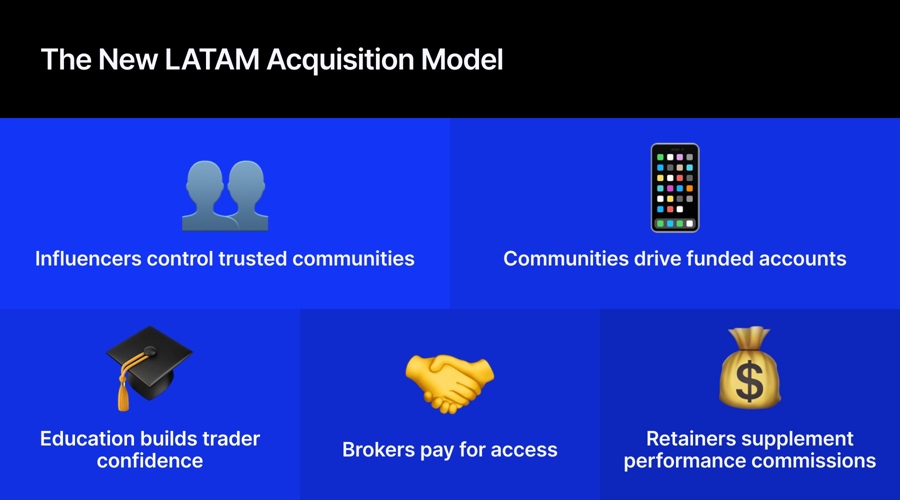
The traffic that actually funds accounts is no longer
coming from keywords. It is coming from education networks like Discord,
Telegram and WhatsApp groups, academy communities, seminar circuits and
workshop tours, run by local educators and influencers who already hold trust.
We have seen over 10,000 active users enter through
those communities in LATAM. That is not a side channel. That is the channel,
from a broker that’s had a presence in the region since 2020.
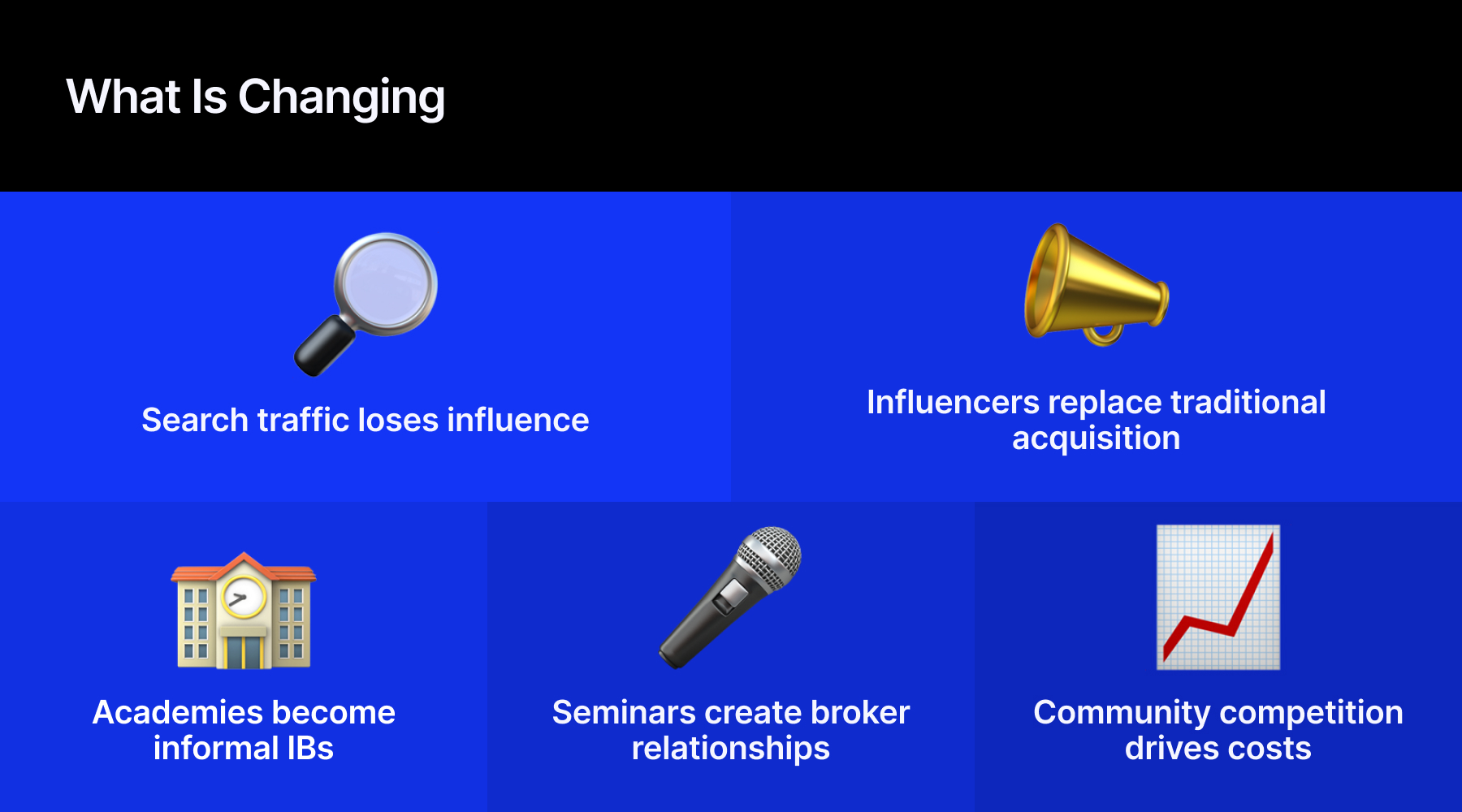
Google ads still exist, but they no longer buy trust
in this region. Auction costs have risen, conversion quality has fallen, and
the user who clicks a search ad is rarely the user who stays. Ranking for a
handful of commercial keywords is equally fragile: the page is crowded, the
intent is transactional, and the relationship starts at zero.
LATAM retail traders do not discover a broker the way
a London or Sydney user does. They discover a person. They sit in a live
session, join a community, attend a Saturday workshop in Mexico City, Lima or
Bogotá, and only then open an account on the platform that person recommends.
Education is not a content marketing add-on. It is the distribution layer.
That is why academies and “finfluencers” have become
IBs in all but name. They already run the events, the seminars and the ongoing
mentorship. The broker is arriving late to a relationship that already exists.
The market got crowded and the commercial terms
followed. Brokers have noticed. The
LATAM partner space is no longer a quiet rebate market. More
firms are entering, more brands are hiring local partnership desks, and the bid
for quality community owners has gone up.
The commercial model is changing with it. Pure CPA is
no longer enough to lock a serious educator. Neither is a vanilla rebate. The
packages now being offered look more like media and talent deals than classic
IB contracts:
A
meaningful monthly retainer to secure exclusivity, or at least priority,
inside the community
A
commission or rebate overlay on funded flow
Event
support, co-branded workshops, and sometimes travel and production budgets
Hybrid
structures that pay for presence and performance
Influencers and academy owners can, and often do, hold
more than one of these deals at once. A creator with a live community in Mexico
and a seminar calendar in Colombia is now a multi-homing distribution asset. Brokers
are bidding against each other for the same rooms.
Is this the way now? In LATAM, yes, if the question is
where funded accounts come from. It is not a branding experiment. It is how
10,000 active users arrived.
LATAM’s
Next Trading Cohort
The current crowd is still early. That is the part the
industry underestimates. Latin America is young. Large parts of the region sit
well below the median age of Western Europe or East Asia. Smartphone
penetration is high, digital banking is normal, and a growing middle class is looking
for something beyond a local savings account that inflation quietly eats.
Retail FX and CFD participation is still a small slice of the economically
active population compared with mature markets. That gap is the opportunity,
and the reason education networks work so well. First-time users need a person
in the room before they need a spread table.
El Salvador is a useful, if imperfect, preview. It is
a small market, but it compressed a decade of financial-technology familiarity
into a few years: legal-tender experiments, wallet apps, remittances moving
through crypto rails, and a generation that grew up hearing about digital
assets in daily news rather than as a niche hobby.
Scale that pattern across Mexico,
Brazil, Colombia, Peru and Central America and you get the next adoption wave: not
only the current seminar attendee, but the younger sibling who is still in
university, the first-job professional entering the middle class, and the
remittance household that already lives on a phone. In five to ten years, the
rooms will be more mature.
Community-led acquisition is the right model for this
phase of the market: high curiosity, low formal market literacy, trust
concentrated in local educators.
What
Happens When the Crowd Grows Up
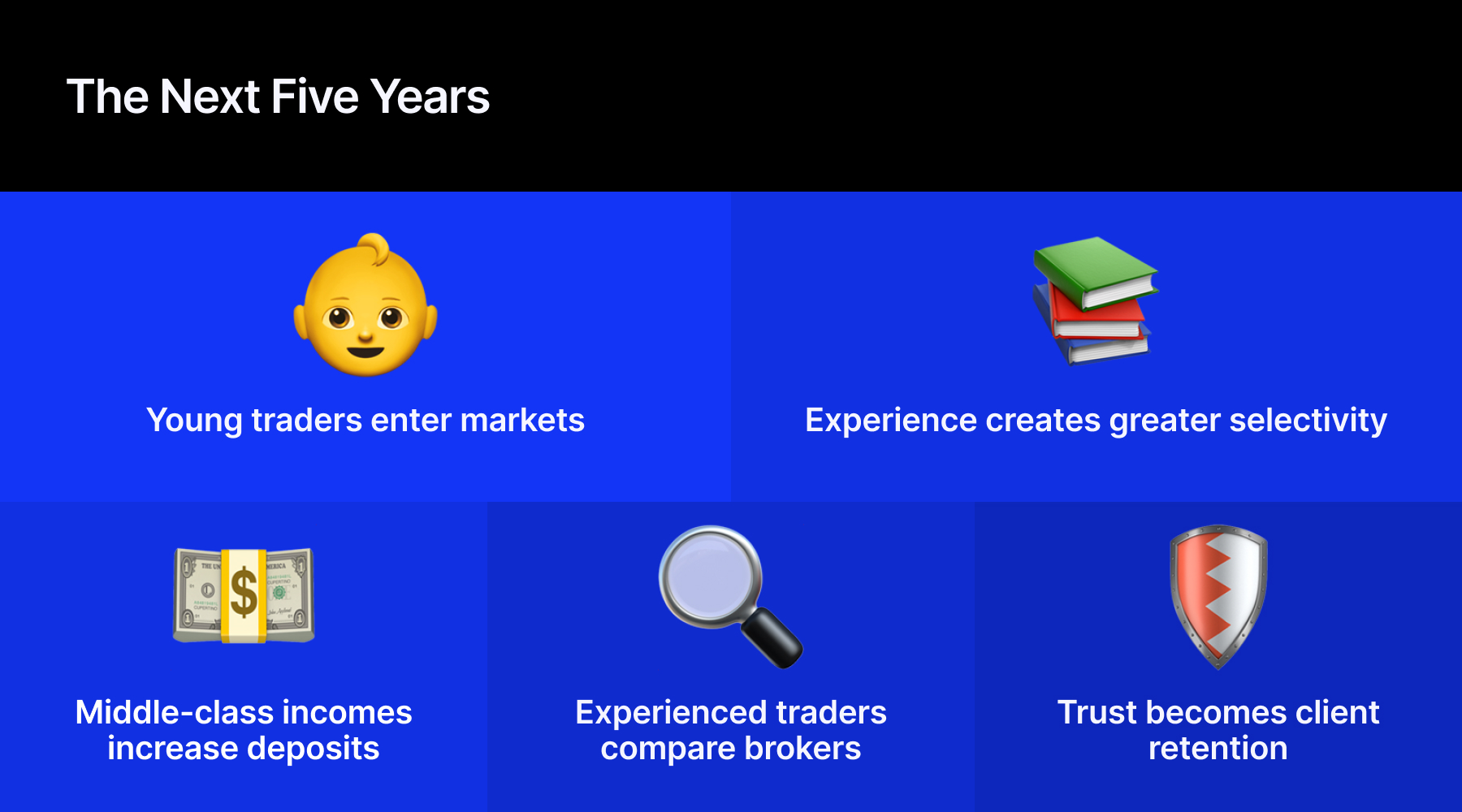
It will not look the same in 2031 or 2036. The users
entering now through academies and influencer groups will be older. Some will
have lost money. Some will have compounded. Many will have compared three
brokers, sat through two education brands, and learned which incentives are
theatre.
Growing household income and a thicker middle class change the product
conversation from “how do I start?” to “who still deserves my volume?” That
maturation cuts both ways.
They notice when the
same educator is paid by three firms. They care more about withdrawals,
slippage and whether the workshop was a classroom or a sales floor.
The IB model will not disappear. It will
professionalise. Retainers will still exist, but they will be justified by
retained book, not by headcount at an event. Education networks that survive
will look less like launch funnels and more like long-term distribution
utilities, closer to how mature-market IBs already operate, just
with a LATAM-native community layer underneath.
What This Means for Brokers?
First, stop treating IBs as a spreadsheet of links.
The valuable partner in this region is an education business: curriculum,
community ops, event production, and a local reputation that advertising cannot
manufacture.
Second, accept that acquisition cost is moving from
media platforms to people. Retainers look expensive until they are compared
with wasted search spend and low-quality CPA.
Third, build for the cohort behind the current room.
The 10,000 active users coming through LATAM education networks today are the
top of a younger, more digital, more financially curious pyramid. The next five
to ten years add middle-class depth, not just more of the same seminar traffic.
Fourth, exclusivity and disclosure will matter more as
the audience matures. If influencers can stack retainers, brokers need clearer
rules now before a more experienced client base starts punishing brands that
treated communities as rented inventory.
Fifth, compliance cannot be an afterthought.
Education-led acquisition is powerful because it feels personal. That is also
why it attracts scrutiny. The real test is who still owns the relationship when
the crowd grows up. Google can rent attention. Communities in LATAM sell trust.
Right now, trust is what opens the account.
In a decade, trust will be what
keeps it. The brokers that win will treat education networks as infrastructure
for a demographic that is still forming: younger, more numerous, and on its way
to becoming a more mature, more demanding middle-class client base.
El Salvador
showed how fast familiarity with digital money can spread in a young country.
The rest of the region will do it at larger scale, over a longer cycle, and
with less patience for a funnel that only works on first-timers.
For years, the default IB playbook in emerging markets
was familiar: buy search, rank for “mejor broker” and “cuenta demo,” run Google
and Meta ads, then hope the CPA model still cleared. In Latin America, that
playbook is breaking.
The
Old IB Playbook is Breaking
The traffic that actually funds accounts is no longer
coming from keywords. It is coming from education networks like Discord,
Telegram and WhatsApp groups, academy communities, seminar circuits and
workshop tours, run by local educators and influencers who already hold trust.
We have seen over 10,000 active users enter through
those communities in LATAM. That is not a side channel. That is the channel,
from a broker that’s had a presence in the region since 2020.
Google ads still exist, but they no longer buy trust
in this region. Auction costs have risen, conversion quality has fallen, and
the user who clicks a search ad is rarely the user who stays. Ranking for a
handful of commercial keywords is equally fragile: the page is crowded, the
intent is transactional, and the relationship starts at zero.
LATAM retail traders do not discover a broker the way
a London or Sydney user does. They discover a person. They sit in a live
session, join a community, attend a Saturday workshop in Mexico City, Lima or
Bogotá, and only then open an account on the platform that person recommends.
Education is not a content marketing add-on. It is the distribution layer.
That is why academies and “finfluencers” have become
IBs in all but name. They already run the events, the seminars and the ongoing
mentorship. The broker is arriving late to a relationship that already exists.
The market got crowded and the commercial terms
followed. Brokers have noticed. The
LATAM partner space is no longer a quiet rebate market. More
firms are entering, more brands are hiring local partnership desks, and the bid
for quality community owners has gone up.
The commercial model is changing with it. Pure CPA is
no longer enough to lock a serious educator. Neither is a vanilla rebate. The
packages now being offered look more like media and talent deals than classic
IB contracts:
A
meaningful monthly retainer to secure exclusivity, or at least priority,
inside the community
A
commission or rebate overlay on funded flow
Event
support, co-branded workshops, and sometimes travel and production budgets
Hybrid
structures that pay for presence and performance
Influencers and academy owners can, and often do, hold
more than one of these deals at once. A creator with a live community in Mexico
and a seminar calendar in Colombia is now a multi-homing distribution asset. Brokers
are bidding against each other for the same rooms.
Is this the way now? In LATAM, yes, if the question is
where funded accounts come from. It is not a branding experiment. It is how
10,000 active users arrived.
LATAM’s
Next Trading Cohort
The current crowd is still early. That is the part the
industry underestimates. Latin America is young. Large parts of the region sit
well below the median age of Western Europe or East Asia. Smartphone
penetration is high, digital banking is normal, and a growing middle class is looking
for something beyond a local savings account that inflation quietly eats.
Retail FX and CFD participation is still a small slice of the economically
active population compared with mature markets. That gap is the opportunity,
and the reason education networks work so well. First-time users need a person
in the room before they need a spread table.
El Salvador is a useful, if imperfect, preview. It is
a small market, but it compressed a decade of financial-technology familiarity
into a few years: legal-tender experiments, wallet apps, remittances moving
through crypto rails, and a generation that grew up hearing about digital
assets in daily news rather than as a niche hobby.
Scale that pattern across Mexico,
Brazil, Colombia, Peru and Central America and you get the next adoption wave: not
only the current seminar attendee, but the younger sibling who is still in
university, the first-job professional entering the middle class, and the
remittance household that already lives on a phone. In five to ten years, the
rooms will be more mature.
Community-led acquisition is the right model for this
phase of the market: high curiosity, low formal market literacy, trust
concentrated in local educators.
What
Happens When the Crowd Grows Up
It will not look the same in 2031 or 2036. The users
entering now through academies and influencer groups will be older. Some will
have lost money. Some will have compounded. Many will have compared three
brokers, sat through two education brands, and learned which incentives are
theatre.
Growing household income and a thicker middle class change the product
conversation from “how do I start?” to “who still deserves my volume?” That
maturation cuts both ways.
They notice when the
same educator is paid by three firms. They care more about withdrawals,
slippage and whether the workshop was a classroom or a sales floor.
The IB model will not disappear. It will
professionalise. Retainers will still exist, but they will be justified by
retained book, not by headcount at an event. Education networks that survive
will look less like launch funnels and more like long-term distribution
utilities, closer to how mature-market IBs already operate, just
with a LATAM-native community layer underneath.
What This Means for Brokers?
First, stop treating IBs as a spreadsheet of links.
The valuable partner in this region is an education business: curriculum,
community ops, event production, and a local reputation that advertising cannot
manufacture.
Second, accept that acquisition cost is moving from
media platforms to people. Retainers look expensive until they are compared
with wasted search spend and low-quality CPA.
Third, build for the cohort behind the current room.
The 10,000 active users coming through LATAM education networks today are the
top of a younger, more digital, more financially curious pyramid. The next five
to ten years add middle-class depth, not just more of the same seminar traffic.
Fourth, exclusivity and disclosure will matter more as
the audience matures. If influencers can stack retainers, brokers need clearer
rules now before a more experienced client base starts punishing brands that
treated communities as rented inventory.
Fifth, compliance cannot be an afterthought.
Education-led acquisition is powerful because it feels personal. That is also
why it attracts scrutiny. The real test is who still owns the relationship when
the crowd grows up. Google can rent attention. Communities in LATAM sell trust.
Right now, trust is what opens the account.
In a decade, trust will be what
keeps it. The brokers that win will treat education networks as infrastructure
for a demographic that is still forming: younger, more numerous, and on its way
to becoming a more mature, more demanding middle-class client base.
El Salvador
showed how fast familiarity with digital money can spread in a young country.
The rest of the region will do it at larger scale, over a longer cycle, and
with less patience for a funnel that only works on first-timers.
Anish Lal is Chief Business Development Officer at BlackBull Markets, the New Zealand-headquartered multi-asset brokerage. He leads strategic growth, partnerships, and the firm’s global commercial footprint across retail and institutional trading.
In his current role he is responsible for around $10 billion of daily trading volume and oversees nearly $1 billion in client funds, with a focus on execution quality, liquidity, and institutional-grade infrastructure.
With more than 15 years in forex and brokerage, Anish specialises in business development, trading infrastructure, and client acquisition. He has overseen major platform and technology integrations, including TradingView and Brokeree, and is a regular industry contributor on execution, partnerships, and the commercial model of retail FX. anish.trade
Today’s financial news recap covers Trade Nation buys FXCM's UK client book, Trading 212 reports higher revenue, the CFTC's move to allow perpetual index futures.
Finance Magnates Daily Recap brings you the latest news from forex and CFD brokers, fintech, payments, cryptocurrency, digital assets, trading platforms, financial regulation and global markets.
Get the key company news, executive moves, deals, regulatory updates and market developments of the day, in just a few minutes. New episodes published every weekday.
Read more: https://www.financemagnates.com
#FinanceMagnates #ForexNews #FintechNews
Today’s financial news recap covers Trade Nation buys FXCM's UK client book, Trading 212 reports higher revenue, the CFTC's move to allow perpetual index futures.
Finance Magnates Daily Recap brings you the latest news from forex and CFD brokers, fintech, payments, cryptocurrency, digital assets, trading platforms, financial regulation and global markets.
Get the key company news, executive moves, deals, regulatory updates and market developments of the day, in just a few minutes. New episodes published every weekday.
Read more: https://www.financemagnates.com
#FinanceMagnates #ForexNews #FintechNews
Today’s financial news recap covers Trade Nation buys FXCM's UK client book, Trading 212 reports higher revenue, the CFTC's move to allow perpetual index futures.
Finance Magnates Daily Recap brings you the latest news from forex and CFD brokers, fintech, payments, cryptocurrency, digital assets, trading platforms, financial regulation and global markets.
Get the key company news, executive moves, deals, regulatory updates and market developments of the day, in just a few minutes. New episodes published every weekday.
Read more: https://www.financemagnates.com
#FinanceMagnates #ForexNews #FintechNews
Today’s financial news recap covers Trade Nation buys FXCM's UK client book, Trading 212 reports higher revenue, the CFTC's move to allow perpetual index futures.
Finance Magnates Daily Recap brings you the latest news from forex and CFD brokers, fintech, payments, cryptocurrency, digital assets, trading platforms, financial regulation and global markets.
Get the key company news, executive moves, deals, regulatory updates and market developments of the day, in just a few minutes. New episodes published every weekday.
Read more: https://www.financemagnates.com
#FinanceMagnates #ForexNews #FintechNews
Roles change. Career goals change. Sometimes you want a completely new challenge.
But the skills and knowledge you build along the way can stay with you and give you something to build on.
For Jeff Patterson, that continued growth is key to long-term career development.
You bring the skills. FM Academy helps you build the knowledge.
#FMAcademy #FinanceMagnates #FinanceCareers #ProfessionalDevelopment #Fintech
Roles change. Career goals change. Sometimes you want a completely new challenge.
But the skills and knowledge you build along the way can stay with you and give you something to build on.
For Jeff Patterson, that continued growth is key to long-term career development.
You bring the skills. FM Academy helps you build the knowledge.
#FMAcademy #FinanceMagnates #FinanceCareers #ProfessionalDevelopment #Fintech
Roles change. Career goals change. Sometimes you want a completely new challenge.
But the skills and knowledge you build along the way can stay with you and give you something to build on.
For Jeff Patterson, that continued growth is key to long-term career development.
You bring the skills. FM Academy helps you build the knowledge.
#FMAcademy #FinanceMagnates #FinanceCareers #ProfessionalDevelopment #Fintech
Roles change. Career goals change. Sometimes you want a completely new challenge.
But the skills and knowledge you build along the way can stay with you and give you something to build on.
For Jeff Patterson, that continued growth is key to long-term career development.
You bring the skills. FM Academy helps you build the knowledge.
#FMAcademy #FinanceMagnates #FinanceCareers #ProfessionalDevelopment #Fintech
Roles change. Career goals change. Sometimes you want a completely new challenge.
But the skills and knowledge you build along the way can stay with you and give you something to build on.
For Jeff Patterson, that continued growth is key to long-term career development.
You bring the skills. FM Academy helps you build the knowledge.
#FMAcademy #FinanceMagnates #FinanceCareers #ProfessionalDevelopment #Fintech
Roles change. Career goals change. Sometimes you want a completely new challenge.
But the skills and knowledge you build along the way can stay with you and give you something to build on.
For Jeff Patterson, that continued growth is key to long-term career development.
You bring the skills. FM Academy helps you build the knowledge.
#FMAcademy #FinanceMagnates #FinanceCareers #ProfessionalDevelopment #Fintech
IG Group Tech Chiefs Exit; Pepperstone Revenue Grows
IG Group Tech Chiefs Exit; Pepperstone Revenue Grows
IG Group Tech Chiefs Exit; Pepperstone Revenue Grows
IG Group Tech Chiefs Exit; Pepperstone Revenue Grows
IG Group Tech Chiefs Exit; Pepperstone Revenue Grows
IG Group Tech Chiefs Exit; Pepperstone Revenue Grows
Today’s financial news recap covers IG Group loses two technology chiefs, Pepperstone reports double-digit growth, and eToro backs a euro stablecoin.
Finance Magnates Daily Recap brings you the latest news from forex and CFD brokers, fintech, payments, cryptocurrency, digital assets, trading platforms, financial regulation and global markets.
Get the key company news, executive moves, deals, regulatory updates and market developments of the day, in just a few minutes. New episodes published every weekday.
Read more: https://www.financemagnates.com
#FinanceMagnates #ForexNews #FintechNews
Today’s financial news recap covers IG Group loses two technology chiefs, Pepperstone reports double-digit growth, and eToro backs a euro stablecoin.
Finance Magnates Daily Recap brings you the latest news from forex and CFD brokers, fintech, payments, cryptocurrency, digital assets, trading platforms, financial regulation and global markets.
Get the key company news, executive moves, deals, regulatory updates and market developments of the day, in just a few minutes. New episodes published every weekday.
Read more: https://www.financemagnates.com
#FinanceMagnates #ForexNews #FintechNews
Today’s financial news recap covers IG Group loses two technology chiefs, Pepperstone reports double-digit growth, and eToro backs a euro stablecoin.
Finance Magnates Daily Recap brings you the latest news from forex and CFD brokers, fintech, payments, cryptocurrency, digital assets, trading platforms, financial regulation and global markets.
Get the key company news, executive moves, deals, regulatory updates and market developments of the day, in just a few minutes. New episodes published every weekday.
Read more: https://www.financemagnates.com
#FinanceMagnates #ForexNews #FintechNews
Today’s financial news recap covers IG Group loses two technology chiefs, Pepperstone reports double-digit growth, and eToro backs a euro stablecoin.
Finance Magnates Daily Recap brings you the latest news from forex and CFD brokers, fintech, payments, cryptocurrency, digital assets, trading platforms, financial regulation and global markets.
Get the key company news, executive moves, deals, regulatory updates and market developments of the day, in just a few minutes. New episodes published every weekday.
Read more: https://www.financemagnates.com
#FinanceMagnates #ForexNews #FintechNews
Today’s financial news recap covers IG Group loses two technology chiefs, Pepperstone reports double-digit growth, and eToro backs a euro stablecoin.
Finance Magnates Daily Recap brings you the latest news from forex and CFD brokers, fintech, payments, cryptocurrency, digital assets, trading platforms, financial regulation and global markets.
Get the key company news, executive moves, deals, regulatory updates and market developments of the day, in just a few minutes. New episodes published every weekday.
Read more: https://www.financemagnates.com
#FinanceMagnates #ForexNews #FintechNews
Today’s financial news recap covers IG Group loses two technology chiefs, Pepperstone reports double-digit growth, and eToro backs a euro stablecoin.
Finance Magnates Daily Recap brings you the latest news from forex and CFD brokers, fintech, payments, cryptocurrency, digital assets, trading platforms, financial regulation and global markets.
Get the key company news, executive moves, deals, regulatory updates and market developments of the day, in just a few minutes. New episodes published every weekday.
Read more: https://www.financemagnates.com
#FinanceMagnates #ForexNews #FintechNews
Today’s financial news recap covers IG Group expects lower Q3 revenue, MetaQuotes adds Benzinga news, Match-Trader launches an MCP, and brokers weigh build versus buy.
Finance Magnates Daily Recap brings you the latest news from forex and CFD brokers, fintech, payments, cryptocurrency, digital assets, trading platforms, financial regulation and global markets.
Get the key company news, executive moves, deals, regulatory updates and market developments of the day, in just a few minutes. New episodes published every weekday.
Read more: https://www.financemagnates.com
#FinanceMagnates #ForexNews #FintechNews
Today’s financial news recap covers IG Group expects lower Q3 revenue, MetaQuotes adds Benzinga news, Match-Trader launches an MCP, and brokers weigh build versus buy.
Finance Magnates Daily Recap brings you the latest news from forex and CFD brokers, fintech, payments, cryptocurrency, digital assets, trading platforms, financial regulation and global markets.
Get the key company news, executive moves, deals, regulatory updates and market developments of the day, in just a few minutes. New episodes published every weekday.
Read more: https://www.financemagnates.com
#FinanceMagnates #ForexNews #FintechNews
Today’s financial news recap covers IG Group expects lower Q3 revenue, MetaQuotes adds Benzinga news, Match-Trader launches an MCP, and brokers weigh build versus buy.
Finance Magnates Daily Recap brings you the latest news from forex and CFD brokers, fintech, payments, cryptocurrency, digital assets, trading platforms, financial regulation and global markets.
Get the key company news, executive moves, deals, regulatory updates and market developments of the day, in just a few minutes. New episodes published every weekday.
Read more: https://www.financemagnates.com
#FinanceMagnates #ForexNews #FintechNews
Today’s financial news recap covers IG Group expects lower Q3 revenue, MetaQuotes adds Benzinga news, Match-Trader launches an MCP, and brokers weigh build versus buy.
Finance Magnates Daily Recap brings you the latest news from forex and CFD brokers, fintech, payments, cryptocurrency, digital assets, trading platforms, financial regulation and global markets.
Get the key company news, executive moves, deals, regulatory updates and market developments of the day, in just a few minutes. New episodes published every weekday.
Read more: https://www.financemagnates.com
#FinanceMagnates #ForexNews #FintechNews
Today’s financial news recap covers IG Group expects lower Q3 revenue, MetaQuotes adds Benzinga news, Match-Trader launches an MCP, and brokers weigh build versus buy.
Finance Magnates Daily Recap brings you the latest news from forex and CFD brokers, fintech, payments, cryptocurrency, digital assets, trading platforms, financial regulation and global markets.
Get the key company news, executive moves, deals, regulatory updates and market developments of the day, in just a few minutes. New episodes published every weekday.
Read more: https://www.financemagnates.com
#FinanceMagnates #ForexNews #FintechNews
Today’s financial news recap covers IG Group expects lower Q3 revenue, MetaQuotes adds Benzinga news, Match-Trader launches an MCP, and brokers weigh build versus buy.
Finance Magnates Daily Recap brings you the latest news from forex and CFD brokers, fintech, payments, cryptocurrency, digital assets, trading platforms, financial regulation and global markets.
Get the key company news, executive moves, deals, regulatory updates and market developments of the day, in just a few minutes. New episodes published every weekday.
Read more: https://www.financemagnates.com
#FinanceMagnates #ForexNews #FintechNews
Binance Faces EU Scrutiny; CFI Adds Seven-Day Gold Trading
Binance Faces EU Scrutiny; CFI Adds Seven-Day Gold Trading
Binance Faces EU Scrutiny; CFI Adds Seven-Day Gold Trading
Binance Faces EU Scrutiny; CFI Adds Seven-Day Gold Trading
Binance Faces EU Scrutiny; CFI Adds Seven-Day Gold Trading
Binance Faces EU Scrutiny; CFI Adds Seven-Day Gold Trading
Today’s financial news recap covers EU regulators question Binance's use of reverse solicitation, CFI launches seven-day gold trading, the FCA opens a crypto authorisation window, and Polymarket adds trading safeguards.
Finance Magnates Daily Recap brings you the latest news from forex and CFD brokers, fintech, payments, cryptocurrency, digital assets, trading platforms, financial regulation and global markets.
Get the key company news, executive moves, deals, regulatory updates and market developments of the day, in just a few minutes. New episodes published every weekday.
Read more: https://www.financemagnates.com
#FinanceMagnates #ForexNews #FintechNews
Today’s financial news recap covers EU regulators question Binance's use of reverse solicitation, CFI launches seven-day gold trading, the FCA opens a crypto authorisation window, and Polymarket adds trading safeguards.
Finance Magnates Daily Recap brings you the latest news from forex and CFD brokers, fintech, payments, cryptocurrency, digital assets, trading platforms, financial regulation and global markets.
Get the key company news, executive moves, deals, regulatory updates and market developments of the day, in just a few minutes. New episodes published every weekday.
Read more: https://www.financemagnates.com
#FinanceMagnates #ForexNews #FintechNews
Today’s financial news recap covers EU regulators question Binance's use of reverse solicitation, CFI launches seven-day gold trading, the FCA opens a crypto authorisation window, and Polymarket adds trading safeguards.
Finance Magnates Daily Recap brings you the latest news from forex and CFD brokers, fintech, payments, cryptocurrency, digital assets, trading platforms, financial regulation and global markets.
Get the key company news, executive moves, deals, regulatory updates and market developments of the day, in just a few minutes. New episodes published every weekday.
Read more: https://www.financemagnates.com
#FinanceMagnates #ForexNews #FintechNews
Today’s financial news recap covers EU regulators question Binance's use of reverse solicitation, CFI launches seven-day gold trading, the FCA opens a crypto authorisation window, and Polymarket adds trading safeguards.
Finance Magnates Daily Recap brings you the latest news from forex and CFD brokers, fintech, payments, cryptocurrency, digital assets, trading platforms, financial regulation and global markets.
Get the key company news, executive moves, deals, regulatory updates and market developments of the day, in just a few minutes. New episodes published every weekday.
Read more: https://www.financemagnates.com
#FinanceMagnates #ForexNews #FintechNews
Today’s financial news recap covers EU regulators question Binance's use of reverse solicitation, CFI launches seven-day gold trading, the FCA opens a crypto authorisation window, and Polymarket adds trading safeguards.
Finance Magnates Daily Recap brings you the latest news from forex and CFD brokers, fintech, payments, cryptocurrency, digital assets, trading platforms, financial regulation and global markets.
Get the key company news, executive moves, deals, regulatory updates and market developments of the day, in just a few minutes. New episodes published every weekday.
Read more: https://www.financemagnates.com
#FinanceMagnates #ForexNews #FintechNews
Today’s financial news recap covers EU regulators question Binance's use of reverse solicitation, CFI launches seven-day gold trading, the FCA opens a crypto authorisation window, and Polymarket adds trading safeguards.
Finance Magnates Daily Recap brings you the latest news from forex and CFD brokers, fintech, payments, cryptocurrency, digital assets, trading platforms, financial regulation and global markets.
Get the key company news, executive moves, deals, regulatory updates and market developments of the day, in just a few minutes. New episodes published every weekday.
Read more: https://www.financemagnates.com
#FinanceMagnates #ForexNews #FintechNews