Freedom 24's Valentin Shatalov argues that scale, regulation and operational resilience will shape Europe’s financial winners as fee pressure rises and firms need deeper capabilities to serve fragmented markets.
AI is changing how Europeans access financial services. The shift could make agents a new gateway to trading and financial infrastructure.
After a decade of product proliferation, mobile interface
optimization, and the quest for customer acquisition, some of the most
important competitive questions are moving below the screen: who controls the
infrastructure, who carries the operational risk, and who can be trusted to
keep the system working when the interface changes?
For much of the past, financial technology was built around
unbundling, with specialized applications promising a better experience for
trading, saving, payments, or any other finance-related services. That model
created genuine innovation and choice. But interface differentiation alone is
becoming harder to sustain.
Fee pressure, complex tax environments, and rising
capital and operating requirements across fragmented European markets are
making scale and operational depth more important.
The European Fund and Asset Management Association (EFAMA)
reported that operating profit margins fell to 11.1 basis points of average AuM
in 2023, the lowest level since the 2008 financial crisis. EFAMA attributed the
pressure to persistent fee erosion and rising costs, including technology
expenditure.
Europe’s Bank-Centred Baseline
Europe starts from a distinct financial baseline defined by
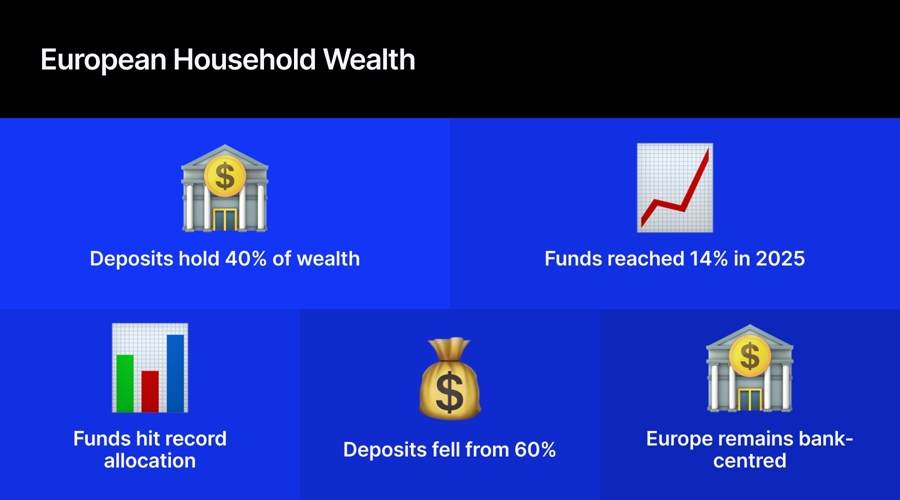
bank-centred wealth. In July 2026, EFAMA reported that European households
still held 40% of their financial wealth in bank deposits, only modestly below
the 42% peak reached in 2022 and higher than the 37% level seen in 2015.
That persistence reflects the long-standing role of banks as
the primary financial relationship for European households. Yet household
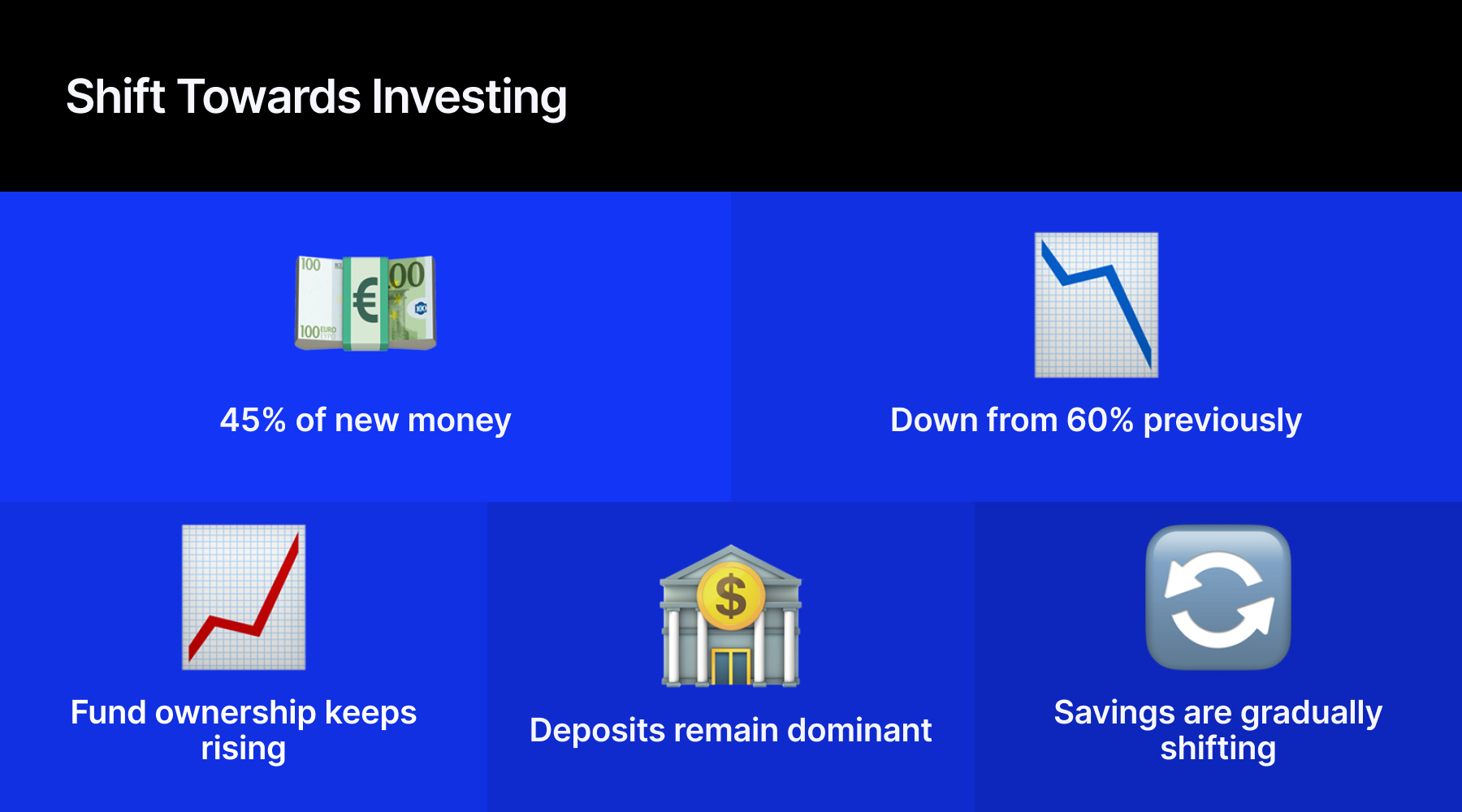
allocations are gradually shifting: deposits accounted for 45% of new financial
acquisitions after 2020, down from 60% between 2015 and 2019, while
investment-fund holdings reached a record 14% of household assets in 2025.
Policy measures such as Savings and Investment Accounts
(SIAs), now implemented across more than a dozen European countries, are designed
to accelerate that transition, but the data suggest that the reallocation of
household wealth remains an evolutionary process.
Vertical integration can offer greater control and
potentially better economics, but it also brings more capital requirements,
regulatory responsibility, and operational complexity.
Freedom24 provides one example of that trade-off, combining
centralized, digital-first Tradernet technology and physical infrastructure
with operations serving different European markets. The broader lesson is that
European scale increasingly depends on technology that can be centralized
without becoming rigid at the local level.
The more consequential shift is happening at the interface
itself. Open APIs, embedded finance, and programmatic trading have already
separated parts of the customer experience from the institution that provides
the underlying service. Artificial
intelligence extends that separation.
Protocols such as the Model Context Protocol (MCP) give AI
applications a standard way to work with external data and tools. Mobile
applications are not going away; they remain important for onboarding,
identity verification, and client relationships. But an app no longer has to be
the only door into a financial platform.
As conversational AI, automated portfolio tools, and agentic
systems develop, a customer may increasingly express an investment intention
through one interface while another institution performs the underlying
financial service. That creates a harder strategic question: if the interface
can move, where does the durable value remain?
In the first few weeks of agentic trading on Robinhood, over 50,000 customers have opened agentic trading accounts and are trading millions of dollars per day of equities and options.
Writing and executing sophisticated strategies or optimizing your everyday spending no longer…
There is a strong case for saying “infrastructure.” There is
also a good reason to be cautious. Technology history is full of examples in
which the company closest to the customer captured the economics while the
systems underneath became increasingly interchangeable.
Search, digital marketplaces, and parts of communications
all demonstrate the power of aggregation. An AI agent that can compare
providers, route transactions, and negotiate on behalf of a customer could put
similar pressure on brokerage infrastructure.
The answer, then, cannot simply be that infrastructure wins.
Value will remain where substitution is difficult.
That also changes the economics. If software agents can
compare execution and move between providers, a basic transaction fee becomes a
less convincing moat.
Infrastructure providers will need to earn from a wider set
of capabilities, whether through custody, financing, securities lending,
foreign exchange, liquidity, data, or differentiated execution. The key
question is not simply who owns the balance sheet or the licence, but who can
combine scarce capabilities in a form that other interfaces can actually use.
The same logic applies to institutions of very different
sizes. Global custodians can rely on scale in post-trade infrastructure.
Specialist brokers and technology providers may compete on market access,
execution, distribution, or particular operational capabilities.
The European market is unlikely to collapse into a single
winning model; the more interesting question is how these layers connect and
which of them remain genuinely difficult to replace.
In its April 2026 analysis of tokenized money-market funds,
the European Central Bank identified faster settlement, near-24/7 availability,
and programmability as potential benefits while also highlighting liquidity and
operational risks.
The technology can change how the system works without
eliminating the underlying jobs of authorization, settlement, liquidity, and
risk management.
Rethinking Human Oversight
The rise of automated execution also changes what “human
oversight” needs to mean. A person cannot reasonably approve every routine
transaction in a high-speed system.
In a mature agentic architecture, people would instead
define the authority under which software can act: what the system is allowed
to do, within what limits, and what events require escalation or intervention.
That is broadly consistent with the human-oversight approach
in Article 14 of the EU AI Act, which emphasizes proportionate safeguards and
deployer controls rather than continuous manual intervention.
Governance Moves Into the System
Governance therefore moves closer to the machinery of
finance itself. Legal rules, compliance requirements, and risk limits
increasingly have to be translated into system permissions, API controls,
monitoring, and transaction records that can be reconstructed after the fact.
The 2026 Oxford–GlobeScan survey illustrates why this
matters beyond technology teams: geoeconomic risk ranked first among
respondents at 76%, while AI and technology risk rose from 17% in 2025 to 44%,
and governance reached 45% among ESG-related reputational concerns.
The Fight Beneath the Interface
The interesting fight will not be between an app and an API.
It will be over what sits underneath both.
If an AI agent can choose among financial providers, the
providers best positioned to retain value will be those that still offer
something the agent cannot treat as interchangeable: reliable market access,
execution, regulated custody, financing, data, core technology and delivery
stack, or a combination of them.
At the end of the day, the interface may or may not
fundamentally change, and once more again after that. The underlying test is
whether the institution remains valuable when the customer no longer has to
enter through its front door.
After a decade of product proliferation, mobile interface
optimization, and the quest for customer acquisition, some of the most
important competitive questions are moving below the screen: who controls the
infrastructure, who carries the operational risk, and who can be trusted to
keep the system working when the interface changes?
For much of the past, financial technology was built around
unbundling, with specialized applications promising a better experience for
trading, saving, payments, or any other finance-related services. That model
created genuine innovation and choice. But interface differentiation alone is
becoming harder to sustain.
Fee pressure, complex tax environments, and rising
capital and operating requirements across fragmented European markets are
making scale and operational depth more important.
The European Fund and Asset Management Association (EFAMA)
reported that operating profit margins fell to 11.1 basis points of average AuM
in 2023, the lowest level since the 2008 financial crisis. EFAMA attributed the
pressure to persistent fee erosion and rising costs, including technology
expenditure.
Europe’s Bank-Centred Baseline
Europe starts from a distinct financial baseline defined by
bank-centred wealth. In July 2026, EFAMA reported that European households
still held 40% of their financial wealth in bank deposits, only modestly below
the 42% peak reached in 2022 and higher than the 37% level seen in 2015.
That persistence reflects the long-standing role of banks as
the primary financial relationship for European households. Yet household
allocations are gradually shifting: deposits accounted for 45% of new financial
acquisitions after 2020, down from 60% between 2015 and 2019, while
investment-fund holdings reached a record 14% of household assets in 2025.
Policy measures such as Savings and Investment Accounts
(SIAs), now implemented across more than a dozen European countries, are designed
to accelerate that transition, but the data suggest that the reallocation of
household wealth remains an evolutionary process.
Vertical integration can offer greater control and
potentially better economics, but it also brings more capital requirements,
regulatory responsibility, and operational complexity.
Freedom24 provides one example of that trade-off, combining
centralized, digital-first Tradernet technology and physical infrastructure
with operations serving different European markets. The broader lesson is that
European scale increasingly depends on technology that can be centralized
without becoming rigid at the local level.
The more consequential shift is happening at the interface
itself. Open APIs, embedded finance, and programmatic trading have already
separated parts of the customer experience from the institution that provides
the underlying service. Artificial
intelligence extends that separation.
Protocols such as the Model Context Protocol (MCP) give AI
applications a standard way to work with external data and tools. Mobile
applications are not going away; they remain important for onboarding,
identity verification, and client relationships. But an app no longer has to be
the only door into a financial platform.
As conversational AI, automated portfolio tools, and agentic
systems develop, a customer may increasingly express an investment intention
through one interface while another institution performs the underlying
financial service. That creates a harder strategic question: if the interface
can move, where does the durable value remain?
In the first few weeks of agentic trading on Robinhood, over 50,000 customers have opened agentic trading accounts and are trading millions of dollars per day of equities and options.
Writing and executing sophisticated strategies or optimizing your everyday spending no longer…
There is a strong case for saying “infrastructure.” There is
also a good reason to be cautious. Technology history is full of examples in
which the company closest to the customer captured the economics while the
systems underneath became increasingly interchangeable.
Search, digital marketplaces, and parts of communications
all demonstrate the power of aggregation. An AI agent that can compare
providers, route transactions, and negotiate on behalf of a customer could put
similar pressure on brokerage infrastructure.
The answer, then, cannot simply be that infrastructure wins.
Value will remain where substitution is difficult.
That also changes the economics. If software agents can
compare execution and move between providers, a basic transaction fee becomes a
less convincing moat.
Infrastructure providers will need to earn from a wider set
of capabilities, whether through custody, financing, securities lending,
foreign exchange, liquidity, data, or differentiated execution. The key
question is not simply who owns the balance sheet or the licence, but who can
combine scarce capabilities in a form that other interfaces can actually use.
The same logic applies to institutions of very different
sizes. Global custodians can rely on scale in post-trade infrastructure.
Specialist brokers and technology providers may compete on market access,
execution, distribution, or particular operational capabilities.
The European market is unlikely to collapse into a single
winning model; the more interesting question is how these layers connect and
which of them remain genuinely difficult to replace.
In its April 2026 analysis of tokenized money-market funds,
the European Central Bank identified faster settlement, near-24/7 availability,
and programmability as potential benefits while also highlighting liquidity and
operational risks.
The technology can change how the system works without
eliminating the underlying jobs of authorization, settlement, liquidity, and
risk management.
Rethinking Human Oversight
The rise of automated execution also changes what “human
oversight” needs to mean. A person cannot reasonably approve every routine
transaction in a high-speed system.
In a mature agentic architecture, people would instead
define the authority under which software can act: what the system is allowed
to do, within what limits, and what events require escalation or intervention.
That is broadly consistent with the human-oversight approach
in Article 14 of the EU AI Act, which emphasizes proportionate safeguards and
deployer controls rather than continuous manual intervention.
Governance Moves Into the System
Governance therefore moves closer to the machinery of
finance itself. Legal rules, compliance requirements, and risk limits
increasingly have to be translated into system permissions, API controls,
monitoring, and transaction records that can be reconstructed after the fact.
The 2026 Oxford–GlobeScan survey illustrates why this
matters beyond technology teams: geoeconomic risk ranked first among
respondents at 76%, while AI and technology risk rose from 17% in 2025 to 44%,
and governance reached 45% among ESG-related reputational concerns.
The Fight Beneath the Interface
The interesting fight will not be between an app and an API.
It will be over what sits underneath both.
If an AI agent can choose among financial providers, the
providers best positioned to retain value will be those that still offer
something the agent cannot treat as interchangeable: reliable market access,
execution, regulated custody, financing, data, core technology and delivery
stack, or a combination of them.
At the end of the day, the interface may or may not
fundamentally change, and once more again after that. The underlying test is
whether the institution remains valuable when the customer no longer has to
enter through its front door.
Valentin Shatalov is a corporate affairs and communications professional with experience across international markets and regulated industries. He currently serves as Head of Corporate Affairs at Freedom24, the European division of Freedom Holding Corp., a Nasdaq-listed financial services and technology group.
Today’s financial news recap covers Trade Nation buys FXCM's UK client book, Trading 212 reports higher revenue, the CFTC's move to allow perpetual index futures.
Finance Magnates Daily Recap brings you the latest news from forex and CFD brokers, fintech, payments, cryptocurrency, digital assets, trading platforms, financial regulation and global markets.
Get the key company news, executive moves, deals, regulatory updates and market developments of the day, in just a few minutes. New episodes published every weekday.
Read more: https://www.financemagnates.com
#FinanceMagnates #ForexNews #FintechNews
Today’s financial news recap covers Trade Nation buys FXCM's UK client book, Trading 212 reports higher revenue, the CFTC's move to allow perpetual index futures.
Finance Magnates Daily Recap brings you the latest news from forex and CFD brokers, fintech, payments, cryptocurrency, digital assets, trading platforms, financial regulation and global markets.
Get the key company news, executive moves, deals, regulatory updates and market developments of the day, in just a few minutes. New episodes published every weekday.
Read more: https://www.financemagnates.com
#FinanceMagnates #ForexNews #FintechNews
Today’s financial news recap covers Trade Nation buys FXCM's UK client book, Trading 212 reports higher revenue, the CFTC's move to allow perpetual index futures.
Finance Magnates Daily Recap brings you the latest news from forex and CFD brokers, fintech, payments, cryptocurrency, digital assets, trading platforms, financial regulation and global markets.
Get the key company news, executive moves, deals, regulatory updates and market developments of the day, in just a few minutes. New episodes published every weekday.
Read more: https://www.financemagnates.com
#FinanceMagnates #ForexNews #FintechNews
Today’s financial news recap covers Trade Nation buys FXCM's UK client book, Trading 212 reports higher revenue, the CFTC's move to allow perpetual index futures.
Finance Magnates Daily Recap brings you the latest news from forex and CFD brokers, fintech, payments, cryptocurrency, digital assets, trading platforms, financial regulation and global markets.
Get the key company news, executive moves, deals, regulatory updates and market developments of the day, in just a few minutes. New episodes published every weekday.
Read more: https://www.financemagnates.com
#FinanceMagnates #ForexNews #FintechNews
Roles change. Career goals change. Sometimes you want a completely new challenge.
But the skills and knowledge you build along the way can stay with you and give you something to build on.
For Jeff Patterson, that continued growth is key to long-term career development.
You bring the skills. FM Academy helps you build the knowledge.
#FMAcademy #FinanceMagnates #FinanceCareers #ProfessionalDevelopment #Fintech
Roles change. Career goals change. Sometimes you want a completely new challenge.
But the skills and knowledge you build along the way can stay with you and give you something to build on.
For Jeff Patterson, that continued growth is key to long-term career development.
You bring the skills. FM Academy helps you build the knowledge.
#FMAcademy #FinanceMagnates #FinanceCareers #ProfessionalDevelopment #Fintech
Roles change. Career goals change. Sometimes you want a completely new challenge.
But the skills and knowledge you build along the way can stay with you and give you something to build on.
For Jeff Patterson, that continued growth is key to long-term career development.
You bring the skills. FM Academy helps you build the knowledge.
#FMAcademy #FinanceMagnates #FinanceCareers #ProfessionalDevelopment #Fintech
Roles change. Career goals change. Sometimes you want a completely new challenge.
But the skills and knowledge you build along the way can stay with you and give you something to build on.
For Jeff Patterson, that continued growth is key to long-term career development.
You bring the skills. FM Academy helps you build the knowledge.
#FMAcademy #FinanceMagnates #FinanceCareers #ProfessionalDevelopment #Fintech
Roles change. Career goals change. Sometimes you want a completely new challenge.
But the skills and knowledge you build along the way can stay with you and give you something to build on.
For Jeff Patterson, that continued growth is key to long-term career development.
You bring the skills. FM Academy helps you build the knowledge.
#FMAcademy #FinanceMagnates #FinanceCareers #ProfessionalDevelopment #Fintech
Roles change. Career goals change. Sometimes you want a completely new challenge.
But the skills and knowledge you build along the way can stay with you and give you something to build on.
For Jeff Patterson, that continued growth is key to long-term career development.
You bring the skills. FM Academy helps you build the knowledge.
#FMAcademy #FinanceMagnates #FinanceCareers #ProfessionalDevelopment #Fintech
IG Group Tech Chiefs Exit; Pepperstone Revenue Grows
IG Group Tech Chiefs Exit; Pepperstone Revenue Grows
IG Group Tech Chiefs Exit; Pepperstone Revenue Grows
IG Group Tech Chiefs Exit; Pepperstone Revenue Grows
IG Group Tech Chiefs Exit; Pepperstone Revenue Grows
IG Group Tech Chiefs Exit; Pepperstone Revenue Grows
Today’s financial news recap covers IG Group loses two technology chiefs, Pepperstone reports double-digit growth, and eToro backs a euro stablecoin.
Finance Magnates Daily Recap brings you the latest news from forex and CFD brokers, fintech, payments, cryptocurrency, digital assets, trading platforms, financial regulation and global markets.
Get the key company news, executive moves, deals, regulatory updates and market developments of the day, in just a few minutes. New episodes published every weekday.
Read more: https://www.financemagnates.com
#FinanceMagnates #ForexNews #FintechNews
Today’s financial news recap covers IG Group loses two technology chiefs, Pepperstone reports double-digit growth, and eToro backs a euro stablecoin.
Finance Magnates Daily Recap brings you the latest news from forex and CFD brokers, fintech, payments, cryptocurrency, digital assets, trading platforms, financial regulation and global markets.
Get the key company news, executive moves, deals, regulatory updates and market developments of the day, in just a few minutes. New episodes published every weekday.
Read more: https://www.financemagnates.com
#FinanceMagnates #ForexNews #FintechNews
Today’s financial news recap covers IG Group loses two technology chiefs, Pepperstone reports double-digit growth, and eToro backs a euro stablecoin.
Finance Magnates Daily Recap brings you the latest news from forex and CFD brokers, fintech, payments, cryptocurrency, digital assets, trading platforms, financial regulation and global markets.
Get the key company news, executive moves, deals, regulatory updates and market developments of the day, in just a few minutes. New episodes published every weekday.
Read more: https://www.financemagnates.com
#FinanceMagnates #ForexNews #FintechNews
Today’s financial news recap covers IG Group loses two technology chiefs, Pepperstone reports double-digit growth, and eToro backs a euro stablecoin.
Finance Magnates Daily Recap brings you the latest news from forex and CFD brokers, fintech, payments, cryptocurrency, digital assets, trading platforms, financial regulation and global markets.
Get the key company news, executive moves, deals, regulatory updates and market developments of the day, in just a few minutes. New episodes published every weekday.
Read more: https://www.financemagnates.com
#FinanceMagnates #ForexNews #FintechNews
Today’s financial news recap covers IG Group loses two technology chiefs, Pepperstone reports double-digit growth, and eToro backs a euro stablecoin.
Finance Magnates Daily Recap brings you the latest news from forex and CFD brokers, fintech, payments, cryptocurrency, digital assets, trading platforms, financial regulation and global markets.
Get the key company news, executive moves, deals, regulatory updates and market developments of the day, in just a few minutes. New episodes published every weekday.
Read more: https://www.financemagnates.com
#FinanceMagnates #ForexNews #FintechNews
Today’s financial news recap covers IG Group loses two technology chiefs, Pepperstone reports double-digit growth, and eToro backs a euro stablecoin.
Finance Magnates Daily Recap brings you the latest news from forex and CFD brokers, fintech, payments, cryptocurrency, digital assets, trading platforms, financial regulation and global markets.
Get the key company news, executive moves, deals, regulatory updates and market developments of the day, in just a few minutes. New episodes published every weekday.
Read more: https://www.financemagnates.com
#FinanceMagnates #ForexNews #FintechNews
Today’s financial news recap covers IG Group expects lower Q3 revenue, MetaQuotes adds Benzinga news, Match-Trader launches an MCP, and brokers weigh build versus buy.
Finance Magnates Daily Recap brings you the latest news from forex and CFD brokers, fintech, payments, cryptocurrency, digital assets, trading platforms, financial regulation and global markets.
Get the key company news, executive moves, deals, regulatory updates and market developments of the day, in just a few minutes. New episodes published every weekday.
Read more: https://www.financemagnates.com
#FinanceMagnates #ForexNews #FintechNews
Today’s financial news recap covers IG Group expects lower Q3 revenue, MetaQuotes adds Benzinga news, Match-Trader launches an MCP, and brokers weigh build versus buy.
Finance Magnates Daily Recap brings you the latest news from forex and CFD brokers, fintech, payments, cryptocurrency, digital assets, trading platforms, financial regulation and global markets.
Get the key company news, executive moves, deals, regulatory updates and market developments of the day, in just a few minutes. New episodes published every weekday.
Read more: https://www.financemagnates.com
#FinanceMagnates #ForexNews #FintechNews
Today’s financial news recap covers IG Group expects lower Q3 revenue, MetaQuotes adds Benzinga news, Match-Trader launches an MCP, and brokers weigh build versus buy.
Finance Magnates Daily Recap brings you the latest news from forex and CFD brokers, fintech, payments, cryptocurrency, digital assets, trading platforms, financial regulation and global markets.
Get the key company news, executive moves, deals, regulatory updates and market developments of the day, in just a few minutes. New episodes published every weekday.
Read more: https://www.financemagnates.com
#FinanceMagnates #ForexNews #FintechNews
Today’s financial news recap covers IG Group expects lower Q3 revenue, MetaQuotes adds Benzinga news, Match-Trader launches an MCP, and brokers weigh build versus buy.
Finance Magnates Daily Recap brings you the latest news from forex and CFD brokers, fintech, payments, cryptocurrency, digital assets, trading platforms, financial regulation and global markets.
Get the key company news, executive moves, deals, regulatory updates and market developments of the day, in just a few minutes. New episodes published every weekday.
Read more: https://www.financemagnates.com
#FinanceMagnates #ForexNews #FintechNews
Today’s financial news recap covers IG Group expects lower Q3 revenue, MetaQuotes adds Benzinga news, Match-Trader launches an MCP, and brokers weigh build versus buy.
Finance Magnates Daily Recap brings you the latest news from forex and CFD brokers, fintech, payments, cryptocurrency, digital assets, trading platforms, financial regulation and global markets.
Get the key company news, executive moves, deals, regulatory updates and market developments of the day, in just a few minutes. New episodes published every weekday.
Read more: https://www.financemagnates.com
#FinanceMagnates #ForexNews #FintechNews
Today’s financial news recap covers IG Group expects lower Q3 revenue, MetaQuotes adds Benzinga news, Match-Trader launches an MCP, and brokers weigh build versus buy.
Finance Magnates Daily Recap brings you the latest news from forex and CFD brokers, fintech, payments, cryptocurrency, digital assets, trading platforms, financial regulation and global markets.
Get the key company news, executive moves, deals, regulatory updates and market developments of the day, in just a few minutes. New episodes published every weekday.
Read more: https://www.financemagnates.com
#FinanceMagnates #ForexNews #FintechNews
Binance Faces EU Scrutiny; CFI Adds Seven-Day Gold Trading
Binance Faces EU Scrutiny; CFI Adds Seven-Day Gold Trading
Binance Faces EU Scrutiny; CFI Adds Seven-Day Gold Trading
Binance Faces EU Scrutiny; CFI Adds Seven-Day Gold Trading
Binance Faces EU Scrutiny; CFI Adds Seven-Day Gold Trading
Binance Faces EU Scrutiny; CFI Adds Seven-Day Gold Trading
Today’s financial news recap covers EU regulators question Binance's use of reverse solicitation, CFI launches seven-day gold trading, the FCA opens a crypto authorisation window, and Polymarket adds trading safeguards.
Finance Magnates Daily Recap brings you the latest news from forex and CFD brokers, fintech, payments, cryptocurrency, digital assets, trading platforms, financial regulation and global markets.
Get the key company news, executive moves, deals, regulatory updates and market developments of the day, in just a few minutes. New episodes published every weekday.
Read more: https://www.financemagnates.com
#FinanceMagnates #ForexNews #FintechNews
Today’s financial news recap covers EU regulators question Binance's use of reverse solicitation, CFI launches seven-day gold trading, the FCA opens a crypto authorisation window, and Polymarket adds trading safeguards.
Finance Magnates Daily Recap brings you the latest news from forex and CFD brokers, fintech, payments, cryptocurrency, digital assets, trading platforms, financial regulation and global markets.
Get the key company news, executive moves, deals, regulatory updates and market developments of the day, in just a few minutes. New episodes published every weekday.
Read more: https://www.financemagnates.com
#FinanceMagnates #ForexNews #FintechNews
Today’s financial news recap covers EU regulators question Binance's use of reverse solicitation, CFI launches seven-day gold trading, the FCA opens a crypto authorisation window, and Polymarket adds trading safeguards.
Finance Magnates Daily Recap brings you the latest news from forex and CFD brokers, fintech, payments, cryptocurrency, digital assets, trading platforms, financial regulation and global markets.
Get the key company news, executive moves, deals, regulatory updates and market developments of the day, in just a few minutes. New episodes published every weekday.
Read more: https://www.financemagnates.com
#FinanceMagnates #ForexNews #FintechNews
Today’s financial news recap covers EU regulators question Binance's use of reverse solicitation, CFI launches seven-day gold trading, the FCA opens a crypto authorisation window, and Polymarket adds trading safeguards.
Finance Magnates Daily Recap brings you the latest news from forex and CFD brokers, fintech, payments, cryptocurrency, digital assets, trading platforms, financial regulation and global markets.
Get the key company news, executive moves, deals, regulatory updates and market developments of the day, in just a few minutes. New episodes published every weekday.
Read more: https://www.financemagnates.com
#FinanceMagnates #ForexNews #FintechNews
Today’s financial news recap covers EU regulators question Binance's use of reverse solicitation, CFI launches seven-day gold trading, the FCA opens a crypto authorisation window, and Polymarket adds trading safeguards.
Finance Magnates Daily Recap brings you the latest news from forex and CFD brokers, fintech, payments, cryptocurrency, digital assets, trading platforms, financial regulation and global markets.
Get the key company news, executive moves, deals, regulatory updates and market developments of the day, in just a few minutes. New episodes published every weekday.
Read more: https://www.financemagnates.com
#FinanceMagnates #ForexNews #FintechNews
Today’s financial news recap covers EU regulators question Binance's use of reverse solicitation, CFI launches seven-day gold trading, the FCA opens a crypto authorisation window, and Polymarket adds trading safeguards.
Finance Magnates Daily Recap brings you the latest news from forex and CFD brokers, fintech, payments, cryptocurrency, digital assets, trading platforms, financial regulation and global markets.
Get the key company news, executive moves, deals, regulatory updates and market developments of the day, in just a few minutes. New episodes published every weekday.
Read more: https://www.financemagnates.com
#FinanceMagnates #ForexNews #FintechNews