Analyzing the annual results, Interactive Brokers saw 42% increase in total revenue, outpacing IG (5%), Saxo (11%), and Fidelity (12%).
Expanding into global markets, Nasdaq Copenhagen and the Prague Stock Exchange were added to the list of tradable options.
As some of the largest international brokerage firms release – or prepare to release – their 2023 results, we thought it might be interesting to look at their performance last year compared to their main rivals and what some of the key data tells us about their business and the wider broker market.
Since Interactive Brokers announced its 2023 financials relatively recently, we felt it would be appropriate to start with the Greenwich, Connecticut-based firm.
Revenue Soars: Interactive Brokers Leads with 42% Increase
Total revenue at Interactive Brokers was up 42% to $4.3 billion, which compares very favourably with the 5% increase recorded by IG for the financial year 2023 (which in the case of the UK-based trading provider ends in June 2023), Saxo’s 11% increase and the 12% managed by Fidelity over the same period.
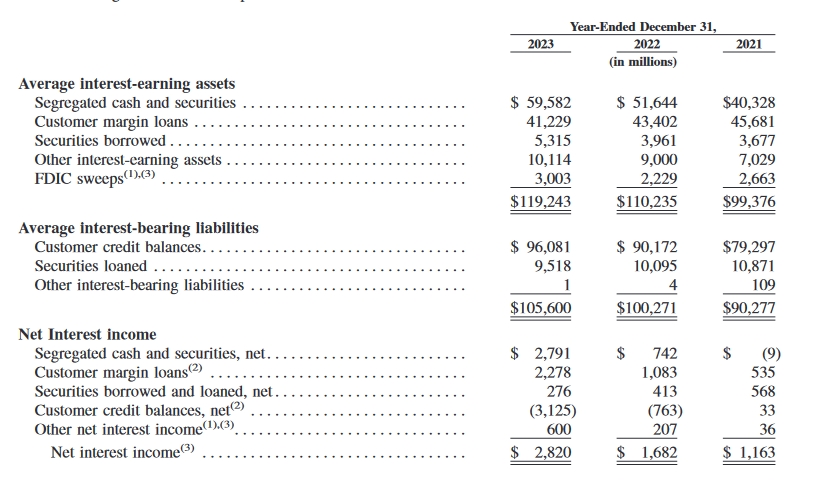
The company held $59.6 billion in segregated cash and securities at the end of 2023, an increase of almost 50% compared to 2021 and accounting for almost exactly half of total interest-earning assets.
While many of its peers have benefitted from higher interest rates - for example, IG saw its interest income increase from a negligible £800,000 in FY22 to more than £80 million in the last financial year - Interactive Brokers hit the jackpot with a 68% rise in net interest income to $2.8 billion.
In terms of revenue per client, 2.562 million Interactive Brokers clients generating $4.3 billion in revenues equates to revenue per client of approximately $1678.
By comparison, Saxo’s 1.1 million clients generated revenues of DKK 4.481 billion (which at current exchange rates equates to $627 million or around $570 per client), while IG’s revenues of just over £1 billion from 358,300 active clients works out at £3576 per client based on current exchange rates.
Of course, the impact of interest rate movements in the US compared to the EU and UK have to be taken into account when making this comparison given that around two-thirds of Interactive Brokers’ 2023 revenues were generated by net interest income.
Commission Revenue Edges Upward
Interactive Brokers’ client accounts grew by 22.5% compared to 2022, down from 24.8% in the previous year but still favourable compared to Saxo’s 14% increase. Client equity rebounded after a sharp decline in 2022 to reach $426 billion, although daily average revenue trades fell again from 2.12 million to 1.94 million (2.57 million in 2021).
Average trades per US trading day were down 9% last year on the back of a 15% reduction in 2022. This was in line with many of the company’s international competitors – for example, Saxo’s total trades in 2023 were more than 20% lower than in 2022.
From: Interactive Brokers
Stock Trading and International Presence
Interactive Brokers made a number of changes to its share trading offering during 2023 in a bid to increase stock trading activity, including the launch of fractional shares trading for Canadian stocks and the expansion of its overnight trading hours service, which lists more than 10,000 US stocks and ETFs.
The company’s international business accounted for just over 30% of total revenue, a slight decrease on the previous 12 month period. Over the same period, IG managed to reduce the proportion of revenue generated in its home market from 42% to 34%, while Saxo generated 60% of its revenues outside of the Netherlands.
Early last year the company was appointed as the primary international broker for Sinopac Securities, which meant institutional and retail clients of the Taiwanese securities firm were able to trade US stocks, ETFs and fixed income instruments and had access to over 90 stock markets worldwide.
Interactive Brokers subsequently extended client access to the Taiwan Stock Exchange, enabling investment in the Taiwanese market without maintaining a relationship with a separate regional broker.
Industry Perspectives on Profit Margins
Investors have reacted positively to the 2023 results and also to the Q1 2024 data for which Interactive Brokers reported net revenues of just over $1.2 billion and commission revenue of $379 million. From just under $77 in late November 2023, shares were trading on the Nasdaq at more than $119 as of 9 May.
An increase of more than 55% in the value of Interactive Brokers stock over the last 12 months is impressive, albeit Schwab’s performance over that period has been even more eye-catching with an increase of more than 58%. IG’s share price is up 47.5% over the last 12 months.
Interactive Brokers’ Q1 2024 results showed a continuation
of many of the trends highlighted above. Revenue of just over $1.2 billion was
up 20% over the same period in 2023 while commission revenue was 6% higher as
options activity remained strong
According to Interactive Brokers chairman Thomas Peterffy, a 71% adjusted pre-tax profit margin is unique in the industry. For context, Fitch Ratings described Schwab's adjusted pre-tax profit margin of more than 40% as ‘strong relative to retail brokerage and wealth management peers’.
As some of the largest international brokerage firms release – or prepare to release – their 2023 results, we thought it might be interesting to look at their performance last year compared to their main rivals and what some of the key data tells us about their business and the wider broker market.
Since Interactive Brokers announced its 2023 financials relatively recently, we felt it would be appropriate to start with the Greenwich, Connecticut-based firm.
Revenue Soars: Interactive Brokers Leads with 42% Increase
Total revenue at Interactive Brokers was up 42% to $4.3 billion, which compares very favourably with the 5% increase recorded by IG for the financial year 2023 (which in the case of the UK-based trading provider ends in June 2023), Saxo’s 11% increase and the 12% managed by Fidelity over the same period.
The company held $59.6 billion in segregated cash and securities at the end of 2023, an increase of almost 50% compared to 2021 and accounting for almost exactly half of total interest-earning assets.
While many of its peers have benefitted from higher interest rates - for example, IG saw its interest income increase from a negligible £800,000 in FY22 to more than £80 million in the last financial year - Interactive Brokers hit the jackpot with a 68% rise in net interest income to $2.8 billion.
In terms of revenue per client, 2.562 million Interactive Brokers clients generating $4.3 billion in revenues equates to revenue per client of approximately $1678.
By comparison, Saxo’s 1.1 million clients generated revenues of DKK 4.481 billion (which at current exchange rates equates to $627 million or around $570 per client), while IG’s revenues of just over £1 billion from 358,300 active clients works out at £3576 per client based on current exchange rates.
Of course, the impact of interest rate movements in the US compared to the EU and UK have to be taken into account when making this comparison given that around two-thirds of Interactive Brokers’ 2023 revenues were generated by net interest income.
Commission Revenue Edges Upward
Interactive Brokers’ client accounts grew by 22.5% compared to 2022, down from 24.8% in the previous year but still favourable compared to Saxo’s 14% increase. Client equity rebounded after a sharp decline in 2022 to reach $426 billion, although daily average revenue trades fell again from 2.12 million to 1.94 million (2.57 million in 2021).
Average trades per US trading day were down 9% last year on the back of a 15% reduction in 2022. This was in line with many of the company’s international competitors – for example, Saxo’s total trades in 2023 were more than 20% lower than in 2022.
From: Interactive Brokers
Stock Trading and International Presence
Interactive Brokers made a number of changes to its share trading offering during 2023 in a bid to increase stock trading activity, including the launch of fractional shares trading for Canadian stocks and the expansion of its overnight trading hours service, which lists more than 10,000 US stocks and ETFs.
The company’s international business accounted for just over 30% of total revenue, a slight decrease on the previous 12 month period. Over the same period, IG managed to reduce the proportion of revenue generated in its home market from 42% to 34%, while Saxo generated 60% of its revenues outside of the Netherlands.
Early last year the company was appointed as the primary international broker for Sinopac Securities, which meant institutional and retail clients of the Taiwanese securities firm were able to trade US stocks, ETFs and fixed income instruments and had access to over 90 stock markets worldwide.
Interactive Brokers subsequently extended client access to the Taiwan Stock Exchange, enabling investment in the Taiwanese market without maintaining a relationship with a separate regional broker.
Industry Perspectives on Profit Margins
Investors have reacted positively to the 2023 results and also to the Q1 2024 data for which Interactive Brokers reported net revenues of just over $1.2 billion and commission revenue of $379 million. From just under $77 in late November 2023, shares were trading on the Nasdaq at more than $119 as of 9 May.
An increase of more than 55% in the value of Interactive Brokers stock over the last 12 months is impressive, albeit Schwab’s performance over that period has been even more eye-catching with an increase of more than 58%. IG’s share price is up 47.5% over the last 12 months.
Interactive Brokers’ Q1 2024 results showed a continuation
of many of the trends highlighted above. Revenue of just over $1.2 billion was
up 20% over the same period in 2023 while commission revenue was 6% higher as
options activity remained strong
According to Interactive Brokers chairman Thomas Peterffy, a 71% adjusted pre-tax profit margin is unique in the industry. For context, Fitch Ratings described Schwab's adjusted pre-tax profit margin of more than 40% as ‘strong relative to retail brokerage and wealth management peers’.
Paul Golden is an experienced freelance financial journalist with a strong institutional background. Over the past two decades, he has written for globally recognised financial publications, covering topics such as market structure, regulation, trading behaviour, and economic policy.
Claude Powers Nine of Ten Broker AI Agents That Now Trade Live Accounts
Featured Videos
FM Daily Brief – 9 June 2026
Today’s Tuesday, the 9th of June 2026, and these are our main stories: eToro’s customer assets climbed back above $20 billion, Prop trading model in prediction markets, and Leverate launched a new AI assistant for brokers and traders.
War Stories: Lessons from 20 Years in Markets (the pain, the pitfalls and the profits)
The trades that taught me the most aren't the ones that worked. They're the ones that didn't — or the ones I almost caught and didn't have the nerve to ride. In this session, I'll tell you about the Brexit miss, the SNB shocker that nearly handed me a 5400% return, the BoJ surprise that punched me in the gut, and a few wins along the way. Each story carries a lesson, but the lessons aren't the point. Everyone who trades long enough collects a portfolio of moments like these; what separates the people who stay in the game is what they do with them.
The Engine and the Fuel: How AI & Data Drives African Future
If AI is the engine, data is the fuel. Without quality, accessible data, AI cannot work well; and without the right mindset, data remains just numbers instead of insight. In this session, leading experts will explore how AI and data are democratizing opportunities for businesses and personal growth. Discover practical ways to make AI accessible today, anticipate its transformative impact on African markets, and learn actionable steps to prepare for what's next. Let's talk about:
-How AI and data drive business efficiency and innovation in trading and fintech
-AI tools to elevate trading or business strategies
-How to access and maximise the power of data and AI
-Emerging AI and data trends in Africa and their economic ripple effects
If AI is the engine, data is the fuel. Without quality, accessible data, AI cannot work well; and without the right mindset, data remains just numbers instead of insight. In this session, leading experts will explore how AI and data are democratizing opportunities for businesses and personal growth. Discover practical ways to make AI accessible today, anticipate its transformative impact on African markets, and learn actionable steps to prepare for what's next. Let's talk about:
-How AI and data drive business efficiency and innovation in trading and fintech
-AI tools to elevate trading or business strategies
-How to access and maximise the power of data and AI
-Emerging AI and data trends in Africa and their economic ripple effects
If AI is the engine, data is the fuel. Without quality, accessible data, AI cannot work well; and without the right mindset, data remains just numbers instead of insight. In this session, leading experts will explore how AI and data are democratizing opportunities for businesses and personal growth. Discover practical ways to make AI accessible today, anticipate its transformative impact on African markets, and learn actionable steps to prepare for what's next. Let's talk about:
-How AI and data drive business efficiency and innovation in trading and fintech
-AI tools to elevate trading or business strategies
-How to access and maximise the power of data and AI
-Emerging AI and data trends in Africa and their economic ripple effects
If AI is the engine, data is the fuel. Without quality, accessible data, AI cannot work well; and without the right mindset, data remains just numbers instead of insight. In this session, leading experts will explore how AI and data are democratizing opportunities for businesses and personal growth. Discover practical ways to make AI accessible today, anticipate its transformative impact on African markets, and learn actionable steps to prepare for what's next. Let's talk about:
-How AI and data drive business efficiency and innovation in trading and fintech
-AI tools to elevate trading or business strategies
-How to access and maximise the power of data and AI
-Emerging AI and data trends in Africa and their economic ripple effects
If AI is the engine, data is the fuel. Without quality, accessible data, AI cannot work well; and without the right mindset, data remains just numbers instead of insight. In this session, leading experts will explore how AI and data are democratizing opportunities for businesses and personal growth. Discover practical ways to make AI accessible today, anticipate its transformative impact on African markets, and learn actionable steps to prepare for what's next. Let's talk about:
-How AI and data drive business efficiency and innovation in trading and fintech
-AI tools to elevate trading or business strategies
-How to access and maximise the power of data and AI
-Emerging AI and data trends in Africa and their economic ripple effects
If AI is the engine, data is the fuel. Without quality, accessible data, AI cannot work well; and without the right mindset, data remains just numbers instead of insight. In this session, leading experts will explore how AI and data are democratizing opportunities for businesses and personal growth. Discover practical ways to make AI accessible today, anticipate its transformative impact on African markets, and learn actionable steps to prepare for what's next. Let's talk about:
-How AI and data drive business efficiency and innovation in trading and fintech
-AI tools to elevate trading or business strategies
-How to access and maximise the power of data and AI
-Emerging AI and data trends in Africa and their economic ripple effects
Inside My Best Trade with Jimmy Moyaha
Most market post-mortems describe what happened to prices. Few describe what happened in the trading room while the position was open: the entry conviction, the moments that tested it, and the exit decision that closed the book.
This session brings one seasoned trader to the stage for an unfiltered account of the position that still defines how they think about markets.
Attendees will walk away with:
-A first-hand account of how a conviction trade is built, from thesis and entry through position management and exit
-Understanding of what turns a market observation into a live position, and what holds it when conditions shift
-Insight into how timing, execution quality, and market structure shaped the final result
-Perspective on what the trade revealed about edge, risk tolerance, and when to hold through a position moving against you
-Clarity on what separates a well-built trade from a well-timed one
Most market post-mortems describe what happened to prices. Few describe what happened in the trading room while the position was open: the entry conviction, the moments that tested it, and the exit decision that closed the book.
This session brings one seasoned trader to the stage for an unfiltered account of the position that still defines how they think about markets.
Attendees will walk away with:
-A first-hand account of how a conviction trade is built, from thesis and entry through position management and exit
-Understanding of what turns a market observation into a live position, and what holds it when conditions shift
-Insight into how timing, execution quality, and market structure shaped the final result
-Perspective on what the trade revealed about edge, risk tolerance, and when to hold through a position moving against you
-Clarity on what separates a well-built trade from a well-timed one
Most market post-mortems describe what happened to prices. Few describe what happened in the trading room while the position was open: the entry conviction, the moments that tested it, and the exit decision that closed the book.
This session brings one seasoned trader to the stage for an unfiltered account of the position that still defines how they think about markets.
Attendees will walk away with:
-A first-hand account of how a conviction trade is built, from thesis and entry through position management and exit
-Understanding of what turns a market observation into a live position, and what holds it when conditions shift
-Insight into how timing, execution quality, and market structure shaped the final result
-Perspective on what the trade revealed about edge, risk tolerance, and when to hold through a position moving against you
-Clarity on what separates a well-built trade from a well-timed one
Most market post-mortems describe what happened to prices. Few describe what happened in the trading room while the position was open: the entry conviction, the moments that tested it, and the exit decision that closed the book.
This session brings one seasoned trader to the stage for an unfiltered account of the position that still defines how they think about markets.
Attendees will walk away with:
-A first-hand account of how a conviction trade is built, from thesis and entry through position management and exit
-Understanding of what turns a market observation into a live position, and what holds it when conditions shift
-Insight into how timing, execution quality, and market structure shaped the final result
-Perspective on what the trade revealed about edge, risk tolerance, and when to hold through a position moving against you
-Clarity on what separates a well-built trade from a well-timed one
Most market post-mortems describe what happened to prices. Few describe what happened in the trading room while the position was open: the entry conviction, the moments that tested it, and the exit decision that closed the book.
This session brings one seasoned trader to the stage for an unfiltered account of the position that still defines how they think about markets.
Attendees will walk away with:
-A first-hand account of how a conviction trade is built, from thesis and entry through position management and exit
-Understanding of what turns a market observation into a live position, and what holds it when conditions shift
-Insight into how timing, execution quality, and market structure shaped the final result
-Perspective on what the trade revealed about edge, risk tolerance, and when to hold through a position moving against you
-Clarity on what separates a well-built trade from a well-timed one
Most market post-mortems describe what happened to prices. Few describe what happened in the trading room while the position was open: the entry conviction, the moments that tested it, and the exit decision that closed the book.
This session brings one seasoned trader to the stage for an unfiltered account of the position that still defines how they think about markets.
Attendees will walk away with:
-A first-hand account of how a conviction trade is built, from thesis and entry through position management and exit
-Understanding of what turns a market observation into a live position, and what holds it when conditions shift
-Insight into how timing, execution quality, and market structure shaped the final result
-Perspective on what the trade revealed about edge, risk tolerance, and when to hold through a position moving against you
-Clarity on what separates a well-built trade from a well-timed one
Agentic Inequality: Democratizing Financial Access Through AI & Blockchain
As crypto and CFD trading continue to expand across Africa, access to advanced tools and market insights remains uneven. This session explores how AI and blockchain can bridge that gap by empowering informal traders and underserved communities to participate more effectively in digital financial markets. The discussion will focus on practical applications of technology to improve accessibility, education, and investment outcomes in both formal and informal sectors.
In this discussion, we will explore:
-The role of AI in democratizing access to trading tools, insights, and strategy development
-How crypto and blockchain can enable broader participation beyond traditional financial systems
-Addressing access barriers: infrastructure, education, and affordability in underserved communities
-Opportunities for brokers and platforms to tap into the informal trading economy
As crypto and CFD trading continue to expand across Africa, access to advanced tools and market insights remains uneven. This session explores how AI and blockchain can bridge that gap by empowering informal traders and underserved communities to participate more effectively in digital financial markets. The discussion will focus on practical applications of technology to improve accessibility, education, and investment outcomes in both formal and informal sectors.
In this discussion, we will explore:
-The role of AI in democratizing access to trading tools, insights, and strategy development
-How crypto and blockchain can enable broader participation beyond traditional financial systems
-Addressing access barriers: infrastructure, education, and affordability in underserved communities
-Opportunities for brokers and platforms to tap into the informal trading economy
As crypto and CFD trading continue to expand across Africa, access to advanced tools and market insights remains uneven. This session explores how AI and blockchain can bridge that gap by empowering informal traders and underserved communities to participate more effectively in digital financial markets. The discussion will focus on practical applications of technology to improve accessibility, education, and investment outcomes in both formal and informal sectors.
In this discussion, we will explore:
-The role of AI in democratizing access to trading tools, insights, and strategy development
-How crypto and blockchain can enable broader participation beyond traditional financial systems
-Addressing access barriers: infrastructure, education, and affordability in underserved communities
-Opportunities for brokers and platforms to tap into the informal trading economy
As crypto and CFD trading continue to expand across Africa, access to advanced tools and market insights remains uneven. This session explores how AI and blockchain can bridge that gap by empowering informal traders and underserved communities to participate more effectively in digital financial markets. The discussion will focus on practical applications of technology to improve accessibility, education, and investment outcomes in both formal and informal sectors.
In this discussion, we will explore:
-The role of AI in democratizing access to trading tools, insights, and strategy development
-How crypto and blockchain can enable broader participation beyond traditional financial systems
-Addressing access barriers: infrastructure, education, and affordability in underserved communities
-Opportunities for brokers and platforms to tap into the informal trading economy
As crypto and CFD trading continue to expand across Africa, access to advanced tools and market insights remains uneven. This session explores how AI and blockchain can bridge that gap by empowering informal traders and underserved communities to participate more effectively in digital financial markets. The discussion will focus on practical applications of technology to improve accessibility, education, and investment outcomes in both formal and informal sectors.
In this discussion, we will explore:
-The role of AI in democratizing access to trading tools, insights, and strategy development
-How crypto and blockchain can enable broader participation beyond traditional financial systems
-Addressing access barriers: infrastructure, education, and affordability in underserved communities
-Opportunities for brokers and platforms to tap into the informal trading economy
As crypto and CFD trading continue to expand across Africa, access to advanced tools and market insights remains uneven. This session explores how AI and blockchain can bridge that gap by empowering informal traders and underserved communities to participate more effectively in digital financial markets. The discussion will focus on practical applications of technology to improve accessibility, education, and investment outcomes in both formal and informal sectors.
In this discussion, we will explore:
-The role of AI in democratizing access to trading tools, insights, and strategy development
-How crypto and blockchain can enable broader participation beyond traditional financial systems
-Addressing access barriers: infrastructure, education, and affordability in underserved communities
-Opportunities for brokers and platforms to tap into the informal trading economy