
The central bank has called for close monitoring of AI in financial services.
It emphasized the need to address potential market failures and associated risks.
The
European Central Bank (ECB) has highlighted the need to monitor the use of artificial intelligence (AI) in the financial sector closely and suggested that
regulatory initiatives may be necessary to address potential market failures.
ECB Calls for Monitoring
and Potential Regulation of AI in Finance
In an
article published as part
of its Financial Stability Review, the ECB acknowledged the opportunities
presented by AI, such as improved information processing, enhanced customer
service, and better detection of cyberthreats.
However,
the central bank also cautioned about the risks associated with AI, including
herding behavior, overreliance on a limited number of providers, and the
possibility of more sophisticated cyberattacks.
“Should
many institutions use AI for asset allocation and rely only on a few AI
providers, for example, then supply and demand for financial assets may be
distorted systematically, triggering costly adjustments in markets that harm
their resilience,” the central bank warned.
How often do you use AI in your work?
AI represents a major technological leap forward. Read about the impact new artificial intelligence tools can have on the financial system in our upcoming Financial Stability Review https://t.co/Y3FFJEsMEW
While the
adoption of AI systems by European financial companies is still in its early
stages, the ECB emphasized the importance of monitoring the implementation of
AI across the financial system as the technology evolves.
Despite
these measures, the ECB suggested that additional regulatory initiatives may be
necessary if market failures become apparent and cannot be addressed by the
current prudential framework.
"Therefore,
the implementation of AI across the financial system needs to be closely
monitored as the technology evolves," the ECB said.
ECB aims to take action as the industry rapidly evolves. By 2030, the generative AI market in payments is projected to exceed $85 billion. Investors are leveraging AI applications for portfolio management, with assets under management (AUM) reaching between $2.2 and $3.7 trillion in 2020.
AI enhances data processing and generation, allowing for the analysis of
unstructured data such as text, voice, and images. However, AI systems based on
foundation models may be prone to data quality issues, as they can
"learn" and sustain biases or errors inherent in the training data. Additionally,
data privacy concerns arise regarding the respect for user input data privacy
and the potential for data leakage.
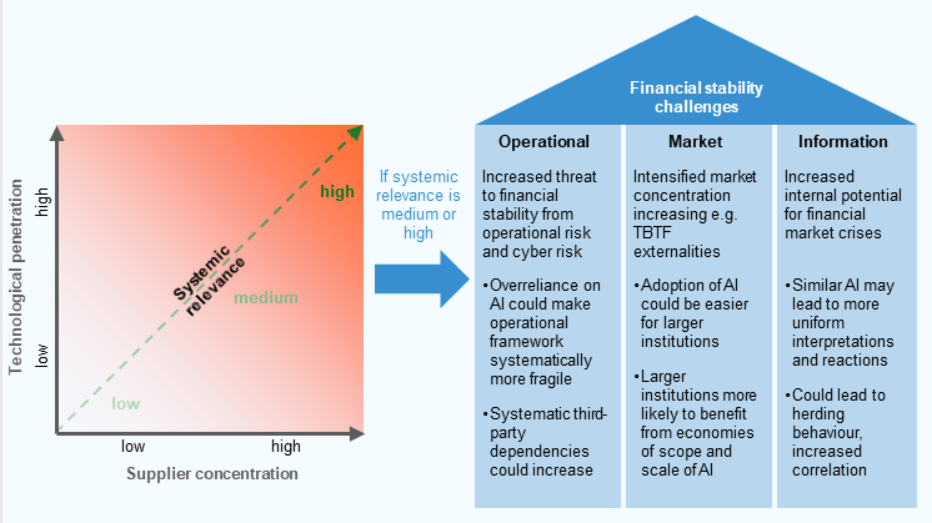
Source: ECB
“AI models
are adaptable, flexible and scalable, but prone to bias, hallucination and
greater complexity, which makes them less robust,” the ECB stated.
Deploying AI in new tasks and processes presents risks, as it is difficult to predict and control how AI will perform in practice. Furthermore, AI could be misused in harmful ways, such as by criminals fine-tuning it for
cyberattacks, misinformation, or market manipulation.
The
European Central Bank (ECB) has highlighted the need to monitor the use of artificial intelligence (AI) in the financial sector closely and suggested that
regulatory initiatives may be necessary to address potential market failures.
ECB Calls for Monitoring
and Potential Regulation of AI in Finance
In an
article published as part
of its Financial Stability Review, the ECB acknowledged the opportunities
presented by AI, such as improved information processing, enhanced customer
service, and better detection of cyberthreats.
However,
the central bank also cautioned about the risks associated with AI, including
herding behavior, overreliance on a limited number of providers, and the
possibility of more sophisticated cyberattacks.
“Should
many institutions use AI for asset allocation and rely only on a few AI
providers, for example, then supply and demand for financial assets may be
distorted systematically, triggering costly adjustments in markets that harm
their resilience,” the central bank warned.
How often do you use AI in your work?
AI represents a major technological leap forward. Read about the impact new artificial intelligence tools can have on the financial system in our upcoming Financial Stability Review https://t.co/Y3FFJEsMEW
While the
adoption of AI systems by European financial companies is still in its early
stages, the ECB emphasized the importance of monitoring the implementation of
AI across the financial system as the technology evolves.
Despite
these measures, the ECB suggested that additional regulatory initiatives may be
necessary if market failures become apparent and cannot be addressed by the
current prudential framework.
"Therefore,
the implementation of AI across the financial system needs to be closely
monitored as the technology evolves," the ECB said.
ECB aims to take action as the industry rapidly evolves. By 2030, the generative AI market in payments is projected to exceed $85 billion. Investors are leveraging AI applications for portfolio management, with assets under management (AUM) reaching between $2.2 and $3.7 trillion in 2020.
AI enhances data processing and generation, allowing for the analysis of
unstructured data such as text, voice, and images. However, AI systems based on
foundation models may be prone to data quality issues, as they can
"learn" and sustain biases or errors inherent in the training data. Additionally,
data privacy concerns arise regarding the respect for user input data privacy
and the potential for data leakage.
Source: ECB
“AI models
are adaptable, flexible and scalable, but prone to bias, hallucination and
greater complexity, which makes them less robust,” the ECB stated.
Deploying AI in new tasks and processes presents risks, as it is difficult to predict and control how AI will perform in practice. Furthermore, AI could be misused in harmful ways, such as by criminals fine-tuning it for
cyberattacks, misinformation, or market manipulation.
Damian Chmiel is a Senior Analyst & Editor at Finance Magnates with more than 15 years of experience in the CFD and online trading industry. Active as both a trader and journalist since 2010, he focuses on broker coverage, fintech innovation, and regulatory developments across Europe, the Middle East, and Asia.
His work includes interviews with C-level leaders at major brokerages and fintech platforms, as well as co-authoring Finance Magnates’ quarterly industry benchmarking reports. Damian’s reporting is data-driven, market-aware, and grounded in direct industry engagement. His analysis and commentary have also been cited by external media outlets, including Investing.com, Binance, The Asset, Stockhead, and Dispatch.
Education:
MA in Finance and Accounting, Cracow University of Economics
iForex posts its first annual results as a listed broker. Also ahead: CFI Financial secures a Brazil license, and prediction markets have a big week, with new ETF launches and fresh Polymarket loss data. It's Thursday, the thirtieth of April 2026. You're listening to the Finance Magnates Daily Brief.
FM Daily Brief - 29 April 2026
XTB and Robinhood both post first-quarter earnings. But the numbers point in very different directions. Also ahead: Capital.com pushes into three new markets and signals a move into payments.
It's Wednesday, the 29th of April 2026. You're listening to the Finance Magnates Daily Brief.
XTB and Robinhood both post first-quarter earnings. But the numbers point in very different directions. Also ahead: Capital.com pushes into three new markets and signals a move into payments.
It's Wednesday, the 29th of April 2026. You're listening to the Finance Magnates Daily Brief.
XTB and Robinhood both post first-quarter earnings. But the numbers point in very different directions. Also ahead: Capital.com pushes into three new markets and signals a move into payments.
It's Wednesday, the 29th of April 2026. You're listening to the Finance Magnates Daily Brief.
XTB and Robinhood both post first-quarter earnings. But the numbers point in very different directions. Also ahead: Capital.com pushes into three new markets and signals a move into payments.
It's Wednesday, the 29th of April 2026. You're listening to the Finance Magnates Daily Brief.
XTB and Robinhood both post first-quarter earnings. But the numbers point in very different directions. Also ahead: Capital.com pushes into three new markets and signals a move into payments.
It's Wednesday, the 29th of April 2026. You're listening to the Finance Magnates Daily Brief.
XTB and Robinhood both post first-quarter earnings. But the numbers point in very different directions. Also ahead: Capital.com pushes into three new markets and signals a move into payments.
It's Wednesday, the 29th of April 2026. You're listening to the Finance Magnates Daily Brief.
FM Daily Brief - 28 April 2026
Startrader posts three-point-one trillion dollars in first-quarter volume — up three hundred and forty percent from a year ago. Also ahead: Fintokei claims sub-second trader payouts, and eToro opens its premium subscription tier to all investors.
FM Daily Brief - 27 April 2026
Finance Magnates spoke with IG Group's MENA CEO. Also ahead: EC Markets posts a record five-point-one-three trillion dollar first quarter. Plus Hola Prime brings in Deloitte to audit prop firm payouts.