


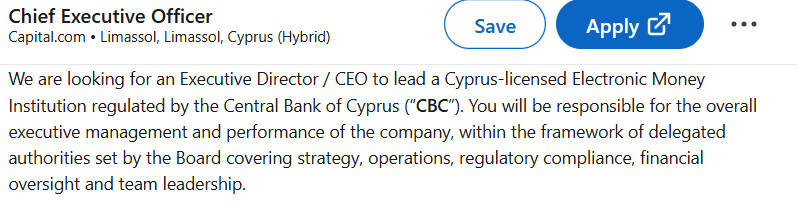
Multi-asset broker Capital.com is advertising for a Chief Executive Officer to head a Cyprus-licensed Electronic Money Institution (EMI), regulated by the Central Bank of Cyprus.
Singapore Summit: Meet the largest APAC brokers you know (and those you still don't!).
The role, based on the island, would, like all senior EMI appointments, require the Central Bank's blessing under its “fit and proper” test.
Capital.com confirmed to Finance Magnates that it is "exploring the development of an EMI business as part of its long-term strategy."
However, it is still unclear if it has secured the license.
What Is the EMI deal?
The rationale why CFD brokers are getting into payments and e-money is not hard to divine.
For years, banks have treated CFD brokers with a certain apprehension, particularly in Cyprus. Opening and maintaining client-money accounts has often proved a fraught exercise, with lenders wary of regulatory and reputational risk.
Add to this a deep-seated scepticism towards crypto-related flows from Cypriot banks.
- Capital.com Reports $1.27 Trillion in Q1 Trading Volume as Gold and Oil Drive Activity
- Capital.com’s Strategy Chief John Austin Departs
- 74% of Gold Positions on Capital.com in 2025 Were Closed within One Hour
Less encumbered than traditional banks and purpose-built for digital payments, EMIs have flourished by serving precisely those clients left underserved by incumbents.
There are, broadly, two routes in the EMI business.
One is to own the licence outright. eToro chose this path in 2020, acquiring UK-based Marq Millions and rebranding it as its payments arm, while also securing authorisation from the Malta Financial Services Authority to passport services across the European Economic Area.
This is a costly endeavour: in Cyprus, an EMI licence requires at least €350,000 in initial capital, plus application and advisory fees that can quickly mount.
The wording of Capital.com’s job posting suggests it is inclined towards this route.
The alternative is partnership. XTB, for instance, has rolled out an e-wallet and debit card by teaming up with DiPocket UAB under a white-label arrangement. It's faster and cheaper, if less autonomous.
Either way, the strategic logic converges. An EMI licence allows brokers to hold balances, process payments, issue cards and offer wallets – all within their own ecosystem. In doing so, they begin to resemble the “super apps” that bundle trading, banking and payments into a single interface.
Unsurprisingly, those already treading this path – eToro, XTB and NAGA Group among them – have been the most vocal about such ambitions.
Capital.com has said less, but combined with its push into the crypto exchange business, the potential EMI move suggests a similar trajectory.


