
Brokers Add AI Execution Tools, but Only 29% of CMC Markets Clients Trust Its Insights

Monday, 21/09/2026 | 17:47 GMT by Tanya Chepkova
  • Nearly half (48.6%) of surveyed CMC clients use AI to support investment decisions, but only 29.4% trust AI-generated market insights.
  • Brokers and trading platforms are moving AI into portfolio analysis and controlled execution, using human approvals and restricted accounts to limit risk.
Claude AI app icon displayed among other AI tools (Shutterstock)

Brokers are giving AI a larger role in trading, but many investors remain sceptical of its output. A survey of 8,506 Australian CMC clients found that 48.6% use AI to support investment decisions, while only 29.4% trust its market insights.

London's trading industry is coming home!

Most reported uses remain concentrated around research rather than delegating investment decisions.

Research and education were the most common applications, while fewer respondents used AI to generate trade ideas. Across the full sample, 33.1% used the technology occasionally and 15.6% regularly.

Regular users also expected to become more active: 46.4% planned to trade or invest more over the next six months, compared with 25% of respondents who did not use AI.
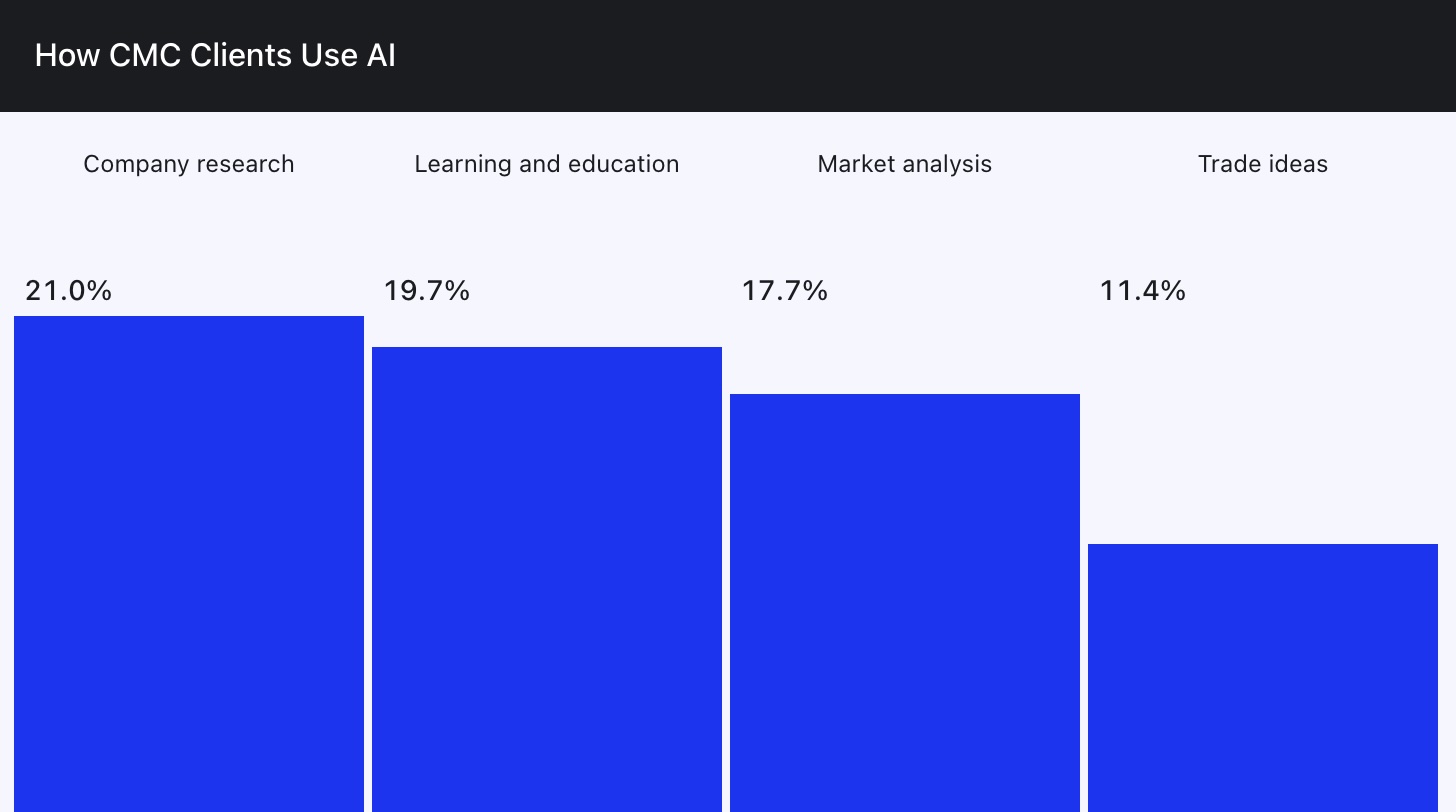
How investors US AI. Source: CMC Markets Research

They were also more bullish, more confident in their decisions, and more likely to increase their exposure to US equities.

The survey establishes an association rather than causation: more active and internationally oriented clients may be more inclined to adopt AI in the first place. Its results cover participating CMC clients rather than the wider Australian investor population.

The sample comprised 8,116 CMC Invest clients and 390 CMC Markets clients.

Brokers Connect AI to Client Accounts

Broker products are already giving AI access to portfolio data and trading workflows beyond the research activities most frequently reported in the survey.

Interactive Brokers, for example, allows clients to connect supported AI applications to authorised portfolio data. The tools can analyse holdings, identify risks and prepare trading instructions, but clients must review and submit every order themselves.

MetaQuotes has added AI to account analysis, strategy development and trading operations. MetaTrader 5 assistants can review positions and trading history, retrieve Strategy Tester reports, analyse logs and initiate strategy optimisation. Users can prohibit AI-initiated trades, allow them or require manual approval.

Binance allows authorised applications to go further. Its Agent OS provides access to market data and supported trading functions inside a dedicated sub-account. Users determine the permissions and capital available to the agent, while external withdrawals remain unavailable.

The three systems give AI different levels of control. Interactive Brokers limits it to preparing instructions, MetaTrader lets users choose whether orders require approval, and Binance can permit execution within a restricted sub-account.

The CMC survey did not ask whether clients would allow AI to place trades. It found only that AI use was more common than trust in its output, leaving open how far investors are prepared to delegate actual trading decisions.

Brokers are giving AI a larger role in trading, but many investors remain sceptical of its output. A survey of 8,506 Australian CMC clients found that 48.6% use AI to support investment decisions, while only 29.4% trust its market insights.

London's trading industry is coming home!

Most reported uses remain concentrated around research rather than delegating investment decisions.

Research and education were the most common applications, while fewer respondents used AI to generate trade ideas. Across the full sample, 33.1% used the technology occasionally and 15.6% regularly.

Regular users also expected to become more active: 46.4% planned to trade or invest more over the next six months, compared with 25% of respondents who did not use AI.

How investors US AI. Source: CMC Markets Research

They were also more bullish, more confident in their decisions, and more likely to increase their exposure to US equities.

The survey establishes an association rather than causation: more active and internationally oriented clients may be more inclined to adopt AI in the first place. Its results cover participating CMC clients rather than the wider Australian investor population.

The sample comprised 8,116 CMC Invest clients and 390 CMC Markets clients.

Brokers Connect AI to Client Accounts

Broker products are already giving AI access to portfolio data and trading workflows beyond the research activities most frequently reported in the survey.

Interactive Brokers, for example, allows clients to connect supported AI applications to authorised portfolio data. The tools can analyse holdings, identify risks and prepare trading instructions, but clients must review and submit every order themselves.

MetaQuotes has added AI to account analysis, strategy development and trading operations. MetaTrader 5 assistants can review positions and trading history, retrieve Strategy Tester reports, analyse logs and initiate strategy optimisation. Users can prohibit AI-initiated trades, allow them or require manual approval.

Binance allows authorised applications to go further. Its Agent OS provides access to market data and supported trading functions inside a dedicated sub-account. Users determine the permissions and capital available to the agent, while external withdrawals remain unavailable.

The three systems give AI different levels of control. Interactive Brokers limits it to preparing instructions, MetaTrader lets users choose whether orders require approval, and Binance can permit execution within a restricted sub-account.

The CMC survey did not ask whether clients would allow AI to place trades. It found only that AI use was more common than trust in its output, leaving open how far investors are prepared to delegate actual trading decisions.

About the Author: Tanya Chepkova
Tanya Chepkova
  • 480 Articles
  • 3 Followers
About the Author: Tanya Chepkova
Tanya Chepkova is a News Editor at Finance Magnates with more than 16 years of experience in financial journalism, covering forex, crypto, and digital asset markets. Her work spans daily industry reporting and data-driven, long-form explainers focused on market structure, trading models, and regulatory shifts. Before joining Finance Magnates, she led the editorial team of a cryptocurrency-focused media outlet for six years. Her reporting combines analytical depth with clear storytelling, with particular attention to how structural changes in trading, stablecoin infrastructure, and emerging products such as prediction markets reshape the broader financial ecosystem. She covers global developments and provides additional insight into CIS markets. Areas of Coverage: Crypto and digital asset markets Prediction markets Stablecoins and cross-border payments Industry analysis and long-form explainers
  • 480 Articles
  • 3 Followers

More from the Author

Retail FX

!"#$%&'()*+,-./0123456789:;<=>?@ABCDEFGHIJKLMNOPQRSTUVWXYZ[\]^_`abcdefghijklmnopqrstuvwxyz{|} !"#$%&'()*+,-./0123456789:;<=>?@ABCDEFGHIJKLMNOPQRSTUVWXYZ[\]^_`abcdefghijklmnopqrstuvwxyz{|}