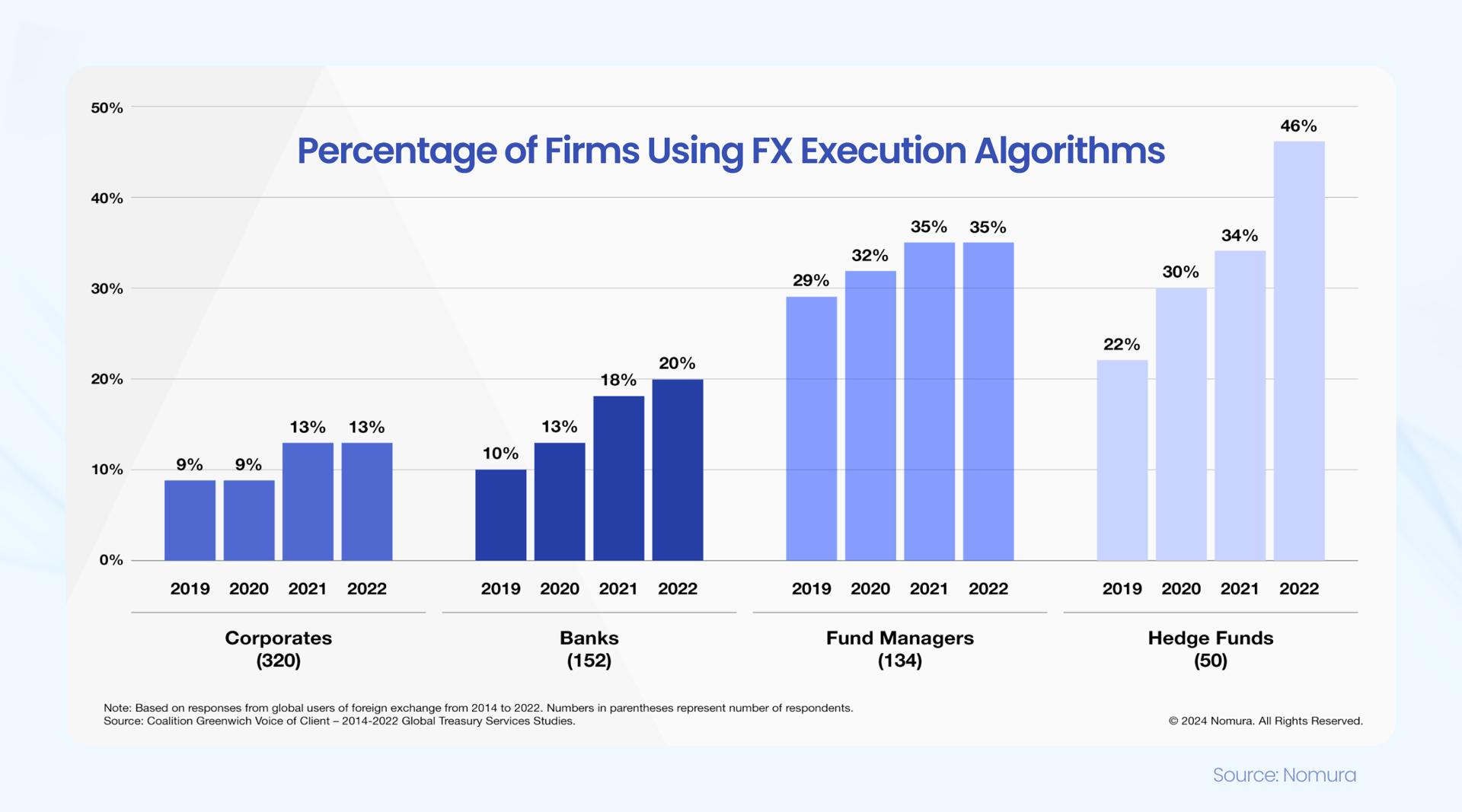
The $6 trillion Forex market is increasingly becoming a robot-dominated space.
However, experts believe that human hands will still be needed for a long time.
Algorithmic
trading is experiencing a significant uptick in foreign exchange markets as
institutional investors increasingly turn to automated strategies to navigate
fragmented liquidity and compressed spreads. This trend, driven by calmer
market conditions and technological advancements, reshapes how currencies
are traded globally.
FX Robots Take Over: Algo
Trading Quadruples
Nomura, a
major player in the FX space, has witnessed a fourfold increase in client
algorithmic trading volumes since January 2023, with pension funds and asset
managers leading the charge.
While algorithmic
trading traces its roots to the equities market in the 1970s, it only
gained prominence in FX in the mid-2000s. Today, the spot FX market is a
complex ecosystem of banks transacting across multiple venues, with each
institution typically offering a variety of algo strategies.
"As
markets have become more electronic and fragmented, clients want execution
options and analysis to measure their flow rather than charging into the
market," Antony Foster, Head of G-10 Spot Trading for EMEA at Nomura in
London, commented, attributing this shift to evolving market dynamics.
The FX
market, with its daily trading volume exceeding $6 trillion, has become
increasingly complex. Today's spot market features dozens of banks transacting
across more than 15 venues for the euro-dollar pair alone, with each
institution typically offering multiple algo strategies.
Factors Driving Algo
Adoption
The appeal
of algorithmic
trading in FX stems from several factors, including cost reduction, enhanced
speed and precision, improved risk management, and the lingering effects of
remote work practices established during the COVID-19 pandemic.
Ben Robson, EMEA Head of e-FX Sales at Nomura
"It's
no longer seen as a tool to replace traders on the desk but instead augment the
set of options around execution," Ben Robson, EMEA Head of e-FX Sales at
Nomura, noted. He emphasized that current discussions focus heavily on
data-driven decision-making and transaction cost analysis.
7
factors driving algo trading adoption:
Calmer markets: Relatively stable FX markets over
the past year have reduced the need for constant broker interaction, making
automated strategies more appealing.
Spread compression: Fierce competition among banks and
market-makers has led to tighter spreads, pushing traders to seek more
efficient execution methods.
Liquidity
fragmentation: With
dozens of electronic platforms hosting currency trading, algorithms have become
essential for navigating this complex landscape.
Cost efficiency: Algo trading can significantly
reduce transaction costs by minimizing bid-ask spreads and lowering the market
impact of large trades.
Speed
and precision: In a
market where milliseconds matter, algorithms can execute trades faster and more
accurately than human traders.
Risk management: Advanced algorithms offer superior
risk monitoring and management capabilities, adapting strategies in real-time
based on market data.
COVID-19
legacy: The
pandemic accelerated the adoption of automated trading as market participants
working remotely found it easier to rely on algos.
While algo
trading has increased market liquidity by providing continuous quotes, Nomura
cautions that this liquidity can be volatile, with algorithms quickly
withdrawing during periods of market turbulence.
The Future of FX Algo
Trading
As the FX
algo trading landscape evolves, regulatory scrutiny is expected to
intensify. However, industry insiders view this as a positive development for
long-term market maturity.
Antony Foster, Head of G-10 Spot Trading for EMEA at Nomura
"The
growth in algo trading across FX markets represents a significant shift in how
currency trading is conducted, and it will only get more sophisticated in the future,” Foster added.
As
institutions continue to seek efficiency and cost-effectiveness in their FX
operations, the role of algorithmic trading is likely to expand further.
However, the human element remains crucial. Nomura's approach, for instance,
emphasizes the importance of expert guidance alongside algorithmic tools.
"Our
USP is to offer a tailored response rather than just provide data and leave the
client to make decisions without speaking to experts," said Robson.
Algorithmic
trading is experiencing a significant uptick in foreign exchange markets as
institutional investors increasingly turn to automated strategies to navigate
fragmented liquidity and compressed spreads. This trend, driven by calmer
market conditions and technological advancements, reshapes how currencies
are traded globally.
FX Robots Take Over: Algo
Trading Quadruples
Nomura, a
major player in the FX space, has witnessed a fourfold increase in client
algorithmic trading volumes since January 2023, with pension funds and asset
managers leading the charge.
While algorithmic
trading traces its roots to the equities market in the 1970s, it only
gained prominence in FX in the mid-2000s. Today, the spot FX market is a
complex ecosystem of banks transacting across multiple venues, with each
institution typically offering a variety of algo strategies.
"As
markets have become more electronic and fragmented, clients want execution
options and analysis to measure their flow rather than charging into the
market," Antony Foster, Head of G-10 Spot Trading for EMEA at Nomura in
London, commented, attributing this shift to evolving market dynamics.
The FX
market, with its daily trading volume exceeding $6 trillion, has become
increasingly complex. Today's spot market features dozens of banks transacting
across more than 15 venues for the euro-dollar pair alone, with each
institution typically offering multiple algo strategies.
Factors Driving Algo
Adoption
The appeal
of algorithmic
trading in FX stems from several factors, including cost reduction, enhanced
speed and precision, improved risk management, and the lingering effects of
remote work practices established during the COVID-19 pandemic.
Ben Robson, EMEA Head of e-FX Sales at Nomura
"It's
no longer seen as a tool to replace traders on the desk but instead augment the
set of options around execution," Ben Robson, EMEA Head of e-FX Sales at
Nomura, noted. He emphasized that current discussions focus heavily on
data-driven decision-making and transaction cost analysis.
7
factors driving algo trading adoption:
Calmer markets: Relatively stable FX markets over
the past year have reduced the need for constant broker interaction, making
automated strategies more appealing.
Spread compression: Fierce competition among banks and
market-makers has led to tighter spreads, pushing traders to seek more
efficient execution methods.
Liquidity
fragmentation: With
dozens of electronic platforms hosting currency trading, algorithms have become
essential for navigating this complex landscape.
Cost efficiency: Algo trading can significantly
reduce transaction costs by minimizing bid-ask spreads and lowering the market
impact of large trades.
Speed
and precision: In a
market where milliseconds matter, algorithms can execute trades faster and more
accurately than human traders.
Risk management: Advanced algorithms offer superior
risk monitoring and management capabilities, adapting strategies in real-time
based on market data.
COVID-19
legacy: The
pandemic accelerated the adoption of automated trading as market participants
working remotely found it easier to rely on algos.
While algo
trading has increased market liquidity by providing continuous quotes, Nomura
cautions that this liquidity can be volatile, with algorithms quickly
withdrawing during periods of market turbulence.
The Future of FX Algo
Trading
As the FX
algo trading landscape evolves, regulatory scrutiny is expected to
intensify. However, industry insiders view this as a positive development for
long-term market maturity.
Antony Foster, Head of G-10 Spot Trading for EMEA at Nomura
"The
growth in algo trading across FX markets represents a significant shift in how
currency trading is conducted, and it will only get more sophisticated in the future,” Foster added.
As
institutions continue to seek efficiency and cost-effectiveness in their FX
operations, the role of algorithmic trading is likely to expand further.
However, the human element remains crucial. Nomura's approach, for instance,
emphasizes the importance of expert guidance alongside algorithmic tools.
"Our
USP is to offer a tailored response rather than just provide data and leave the
client to make decisions without speaking to experts," said Robson.
Damian Chmiel is a Senior Analyst & Editor at Finance Magnates with more than 15 years of experience in the CFD and online trading industry. Active as both a trader and journalist since 2010, he focuses on broker coverage, fintech innovation, and regulatory developments across Europe, the Middle East, and Asia.
His work includes interviews with C-level leaders at major brokerages and fintech platforms, as well as co-authoring Finance Magnates’ quarterly industry benchmarking reports. Damian’s reporting is data-driven, market-aware, and grounded in direct industry engagement. His analysis and commentary have also been cited by external media outlets, including Investing.com, Binance, The Asset, Stockhead, and Dispatch.
Education:
MA in Finance and Accounting, Cracow University of Economics
Today’s financial news recap covers AvaTrade agrees to acquire most of FXCM, NAGA secures eight million dollars in new financing, and Wise seeks a tax settlement in the UK.
Finance Magnates Daily Recap brings you the latest news from forex and CFD brokers, fintech, payments, cryptocurrency, digital assets, trading platforms, financial regulation and global markets.
Get the key company news, executive moves, deals, regulatory updates and market developments of the day, in just a few minutes. New episodes published every weekday.
Read more: https://www.financemagnates.com
#FinanceMagnates #ForexNews #FintechNews
Today’s financial news recap covers AvaTrade agrees to acquire most of FXCM, NAGA secures eight million dollars in new financing, and Wise seeks a tax settlement in the UK.
Finance Magnates Daily Recap brings you the latest news from forex and CFD brokers, fintech, payments, cryptocurrency, digital assets, trading platforms, financial regulation and global markets.
Get the key company news, executive moves, deals, regulatory updates and market developments of the day, in just a few minutes. New episodes published every weekday.
Read more: https://www.financemagnates.com
#FinanceMagnates #ForexNews #FintechNews
Today’s financial news recap covers AvaTrade agrees to acquire most of FXCM, NAGA secures eight million dollars in new financing, and Wise seeks a tax settlement in the UK.
Finance Magnates Daily Recap brings you the latest news from forex and CFD brokers, fintech, payments, cryptocurrency, digital assets, trading platforms, financial regulation and global markets.
Get the key company news, executive moves, deals, regulatory updates and market developments of the day, in just a few minutes. New episodes published every weekday.
Read more: https://www.financemagnates.com
#FinanceMagnates #ForexNews #FintechNews
Today’s financial news recap covers AvaTrade agrees to acquire most of FXCM, NAGA secures eight million dollars in new financing, and Wise seeks a tax settlement in the UK.
Finance Magnates Daily Recap brings you the latest news from forex and CFD brokers, fintech, payments, cryptocurrency, digital assets, trading platforms, financial regulation and global markets.
Get the key company news, executive moves, deals, regulatory updates and market developments of the day, in just a few minutes. New episodes published every weekday.
Read more: https://www.financemagnates.com
#FinanceMagnates #ForexNews #FintechNews
XTB Adds Overnight US Stock Trading; Nasdaq Ventures Invests in One Trading
XTB Adds Overnight US Stock Trading; Nasdaq Ventures Invests in One Trading
XTB Adds Overnight US Stock Trading; Nasdaq Ventures Invests in One Trading
XTB Adds Overnight US Stock Trading; Nasdaq Ventures Invests in One Trading
XTB Adds Overnight US Stock Trading; Nasdaq Ventures Invests in One Trading
XTB Adds Overnight US Stock Trading; Nasdaq Ventures Invests in One Trading
Today’s financial news recap covers XTB expands overnight US stock trading, Fortrade reports higher revenue, Nasdaq backs One Trading, and Vest Labs raises 13 million dollars.
Finance Magnates Daily Recap brings you the latest news from forex and CFD brokers, fintech, payments, cryptocurrency, digital assets, trading platforms, financial regulation and global markets.
Get the key company news, executive moves, deals, regulatory updates and market developments of the day, in just a few minutes. New episodes published every weekday.
Read more: https://www.financemagnates.com
#FinanceMagnates #ForexNews #FintechNews
Today’s financial news recap covers XTB expands overnight US stock trading, Fortrade reports higher revenue, Nasdaq backs One Trading, and Vest Labs raises 13 million dollars.
Finance Magnates Daily Recap brings you the latest news from forex and CFD brokers, fintech, payments, cryptocurrency, digital assets, trading platforms, financial regulation and global markets.
Get the key company news, executive moves, deals, regulatory updates and market developments of the day, in just a few minutes. New episodes published every weekday.
Read more: https://www.financemagnates.com
#FinanceMagnates #ForexNews #FintechNews
Today’s financial news recap covers XTB expands overnight US stock trading, Fortrade reports higher revenue, Nasdaq backs One Trading, and Vest Labs raises 13 million dollars.
Finance Magnates Daily Recap brings you the latest news from forex and CFD brokers, fintech, payments, cryptocurrency, digital assets, trading platforms, financial regulation and global markets.
Get the key company news, executive moves, deals, regulatory updates and market developments of the day, in just a few minutes. New episodes published every weekday.
Read more: https://www.financemagnates.com
#FinanceMagnates #ForexNews #FintechNews
Today’s financial news recap covers XTB expands overnight US stock trading, Fortrade reports higher revenue, Nasdaq backs One Trading, and Vest Labs raises 13 million dollars.
Finance Magnates Daily Recap brings you the latest news from forex and CFD brokers, fintech, payments, cryptocurrency, digital assets, trading platforms, financial regulation and global markets.
Get the key company news, executive moves, deals, regulatory updates and market developments of the day, in just a few minutes. New episodes published every weekday.
Read more: https://www.financemagnates.com
#FinanceMagnates #ForexNews #FintechNews
Today’s financial news recap covers XTB expands overnight US stock trading, Fortrade reports higher revenue, Nasdaq backs One Trading, and Vest Labs raises 13 million dollars.
Finance Magnates Daily Recap brings you the latest news from forex and CFD brokers, fintech, payments, cryptocurrency, digital assets, trading platforms, financial regulation and global markets.
Get the key company news, executive moves, deals, regulatory updates and market developments of the day, in just a few minutes. New episodes published every weekday.
Read more: https://www.financemagnates.com
#FinanceMagnates #ForexNews #FintechNews
Today’s financial news recap covers XTB expands overnight US stock trading, Fortrade reports higher revenue, Nasdaq backs One Trading, and Vest Labs raises 13 million dollars.
Finance Magnates Daily Recap brings you the latest news from forex and CFD brokers, fintech, payments, cryptocurrency, digital assets, trading platforms, financial regulation and global markets.
Get the key company news, executive moves, deals, regulatory updates and market developments of the day, in just a few minutes. New episodes published every weekday.
Read more: https://www.financemagnates.com
#FinanceMagnates #ForexNews #FintechNews
CMC Founder Downplays Volatility Hit; Devexperts Names CEO
CMC Founder Downplays Volatility Hit; Devexperts Names CEO
CMC Founder Downplays Volatility Hit; Devexperts Names CEO
CMC Founder Downplays Volatility Hit; Devexperts Names CEO
CMC Founder Downplays Volatility Hit; Devexperts Names CEO
CMC Founder Downplays Volatility Hit; Devexperts Names CEO
Today’s financial news recap covers low volatility pressures brokers, Devexperts names a new CEO, Saxo cuts onboarding time, and OKX reaches a 25 billion dollar valuation.
Finance Magnates Daily Recap brings you the latest news from forex and CFD brokers, fintech, payments, cryptocurrency, digital assets, trading platforms, financial regulation and global markets.
Get the key company news, executive moves, deals, regulatory updates and market developments of the day, in just a few minutes. New episodes published every weekday.
Read more: https://www.financemagnates.com
#FinanceMagnates #ForexNews #FintechNews
Today’s financial news recap covers low volatility pressures brokers, Devexperts names a new CEO, Saxo cuts onboarding time, and OKX reaches a 25 billion dollar valuation.
Finance Magnates Daily Recap brings you the latest news from forex and CFD brokers, fintech, payments, cryptocurrency, digital assets, trading platforms, financial regulation and global markets.
Get the key company news, executive moves, deals, regulatory updates and market developments of the day, in just a few minutes. New episodes published every weekday.
Read more: https://www.financemagnates.com
#FinanceMagnates #ForexNews #FintechNews
Today’s financial news recap covers low volatility pressures brokers, Devexperts names a new CEO, Saxo cuts onboarding time, and OKX reaches a 25 billion dollar valuation.
Finance Magnates Daily Recap brings you the latest news from forex and CFD brokers, fintech, payments, cryptocurrency, digital assets, trading platforms, financial regulation and global markets.
Get the key company news, executive moves, deals, regulatory updates and market developments of the day, in just a few minutes. New episodes published every weekday.
Read more: https://www.financemagnates.com
#FinanceMagnates #ForexNews #FintechNews
Today’s financial news recap covers low volatility pressures brokers, Devexperts names a new CEO, Saxo cuts onboarding time, and OKX reaches a 25 billion dollar valuation.
Finance Magnates Daily Recap brings you the latest news from forex and CFD brokers, fintech, payments, cryptocurrency, digital assets, trading platforms, financial regulation and global markets.
Get the key company news, executive moves, deals, regulatory updates and market developments of the day, in just a few minutes. New episodes published every weekday.
Read more: https://www.financemagnates.com
#FinanceMagnates #ForexNews #FintechNews
Today’s financial news recap covers low volatility pressures brokers, Devexperts names a new CEO, Saxo cuts onboarding time, and OKX reaches a 25 billion dollar valuation.
Finance Magnates Daily Recap brings you the latest news from forex and CFD brokers, fintech, payments, cryptocurrency, digital assets, trading platforms, financial regulation and global markets.
Get the key company news, executive moves, deals, regulatory updates and market developments of the day, in just a few minutes. New episodes published every weekday.
Read more: https://www.financemagnates.com
#FinanceMagnates #ForexNews #FintechNews
Today’s financial news recap covers low volatility pressures brokers, Devexperts names a new CEO, Saxo cuts onboarding time, and OKX reaches a 25 billion dollar valuation.
Finance Magnates Daily Recap brings you the latest news from forex and CFD brokers, fintech, payments, cryptocurrency, digital assets, trading platforms, financial regulation and global markets.
Get the key company news, executive moves, deals, regulatory updates and market developments of the day, in just a few minutes. New episodes published every weekday.
Read more: https://www.financemagnates.com
#FinanceMagnates #ForexNews #FintechNews
Today’s financial news recap covers Trade Nation buys FXCM's UK client book, Trading 212 reports higher revenue, the CFTC's move to allow perpetual index futures.
Finance Magnates Daily Recap brings you the latest news from forex and CFD brokers, fintech, payments, cryptocurrency, digital assets, trading platforms, financial regulation and global markets.
Get the key company news, executive moves, deals, regulatory updates and market developments of the day, in just a few minutes. New episodes published every weekday.
Read more: https://www.financemagnates.com
#FinanceMagnates #ForexNews #FintechNews
Today’s financial news recap covers Trade Nation buys FXCM's UK client book, Trading 212 reports higher revenue, the CFTC's move to allow perpetual index futures.
Finance Magnates Daily Recap brings you the latest news from forex and CFD brokers, fintech, payments, cryptocurrency, digital assets, trading platforms, financial regulation and global markets.
Get the key company news, executive moves, deals, regulatory updates and market developments of the day, in just a few minutes. New episodes published every weekday.
Read more: https://www.financemagnates.com
#FinanceMagnates #ForexNews #FintechNews
Today’s financial news recap covers Trade Nation buys FXCM's UK client book, Trading 212 reports higher revenue, the CFTC's move to allow perpetual index futures.
Finance Magnates Daily Recap brings you the latest news from forex and CFD brokers, fintech, payments, cryptocurrency, digital assets, trading platforms, financial regulation and global markets.
Get the key company news, executive moves, deals, regulatory updates and market developments of the day, in just a few minutes. New episodes published every weekday.
Read more: https://www.financemagnates.com
#FinanceMagnates #ForexNews #FintechNews
Today’s financial news recap covers Trade Nation buys FXCM's UK client book, Trading 212 reports higher revenue, the CFTC's move to allow perpetual index futures.
Finance Magnates Daily Recap brings you the latest news from forex and CFD brokers, fintech, payments, cryptocurrency, digital assets, trading platforms, financial regulation and global markets.
Get the key company news, executive moves, deals, regulatory updates and market developments of the day, in just a few minutes. New episodes published every weekday.
Read more: https://www.financemagnates.com
#FinanceMagnates #ForexNews #FintechNews
Today’s financial news recap covers Trade Nation buys FXCM's UK client book, Trading 212 reports higher revenue, the CFTC's move to allow perpetual index futures.
Finance Magnates Daily Recap brings you the latest news from forex and CFD brokers, fintech, payments, cryptocurrency, digital assets, trading platforms, financial regulation and global markets.
Get the key company news, executive moves, deals, regulatory updates and market developments of the day, in just a few minutes. New episodes published every weekday.
Read more: https://www.financemagnates.com
#FinanceMagnates #ForexNews #FintechNews
Today’s financial news recap covers Trade Nation buys FXCM's UK client book, Trading 212 reports higher revenue, the CFTC's move to allow perpetual index futures.
Finance Magnates Daily Recap brings you the latest news from forex and CFD brokers, fintech, payments, cryptocurrency, digital assets, trading platforms, financial regulation and global markets.
Get the key company news, executive moves, deals, regulatory updates and market developments of the day, in just a few minutes. New episodes published every weekday.
Read more: https://www.financemagnates.com
#FinanceMagnates #ForexNews #FintechNews
Your career isn’t a linear path.
Your career isn’t a linear path.
Your career isn’t a linear path.
Your career isn’t a linear path.
Your career isn’t a linear path.
Your career isn’t a linear path.
Roles change. Career goals change. Sometimes you want a completely new challenge.
But the skills and knowledge you build along the way can stay with you and give you something to build on.
For Jeff Patterson, that continued growth is key to long-term career development.
You bring the skills. FM Academy helps you build the knowledge.
#FMAcademy #FinanceMagnates #FinanceCareers #ProfessionalDevelopment #Fintech
Roles change. Career goals change. Sometimes you want a completely new challenge.
But the skills and knowledge you build along the way can stay with you and give you something to build on.
For Jeff Patterson, that continued growth is key to long-term career development.
You bring the skills. FM Academy helps you build the knowledge.
#FMAcademy #FinanceMagnates #FinanceCareers #ProfessionalDevelopment #Fintech
Roles change. Career goals change. Sometimes you want a completely new challenge.
But the skills and knowledge you build along the way can stay with you and give you something to build on.
For Jeff Patterson, that continued growth is key to long-term career development.
You bring the skills. FM Academy helps you build the knowledge.
#FMAcademy #FinanceMagnates #FinanceCareers #ProfessionalDevelopment #Fintech
Roles change. Career goals change. Sometimes you want a completely new challenge.
But the skills and knowledge you build along the way can stay with you and give you something to build on.
For Jeff Patterson, that continued growth is key to long-term career development.
You bring the skills. FM Academy helps you build the knowledge.
#FMAcademy #FinanceMagnates #FinanceCareers #ProfessionalDevelopment #Fintech
Roles change. Career goals change. Sometimes you want a completely new challenge.
But the skills and knowledge you build along the way can stay with you and give you something to build on.
For Jeff Patterson, that continued growth is key to long-term career development.
You bring the skills. FM Academy helps you build the knowledge.
#FMAcademy #FinanceMagnates #FinanceCareers #ProfessionalDevelopment #Fintech
Roles change. Career goals change. Sometimes you want a completely new challenge.
But the skills and knowledge you build along the way can stay with you and give you something to build on.
For Jeff Patterson, that continued growth is key to long-term career development.
You bring the skills. FM Academy helps you build the knowledge.
#FMAcademy #FinanceMagnates #FinanceCareers #ProfessionalDevelopment #Fintech