This gives them access to markets that are reserved for only a few. Despite this, the average investors prefer to diversify their savings differently, opting for crypto or gold.
More Americans Gain Access
to Private Investments amid High Inflation
An
accredited investor meets certain financial thresholds and can invest in
private securities like hedge funds, private equity, and venture capital. However,
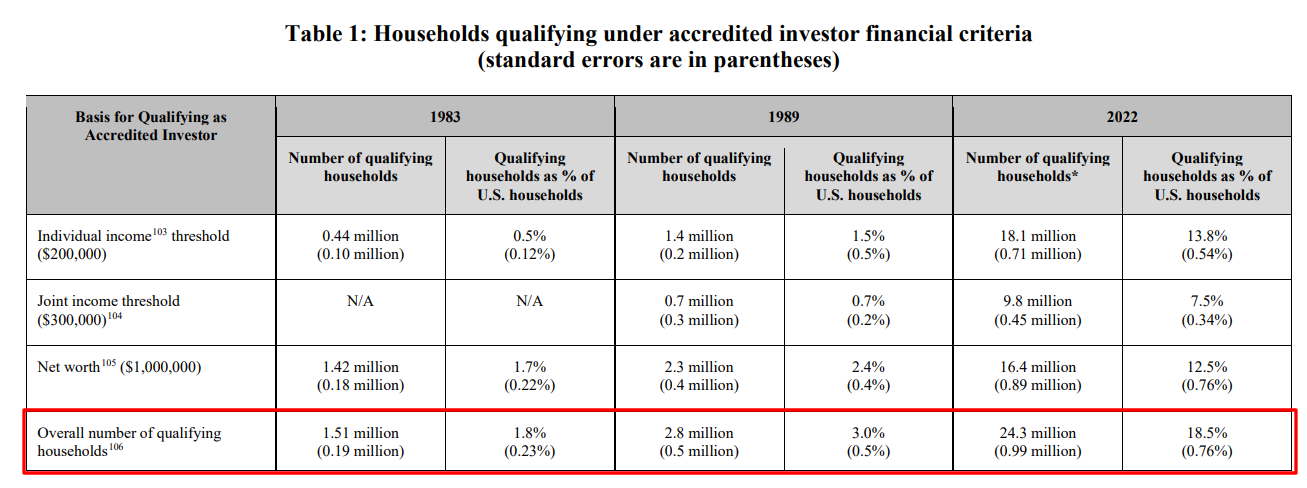
just three years ago, only 13% of US households had access to private market
investments. The record-high inflation, which drove up prices and consequently
led to an increase in earnings, has resulted in a significantly larger number
of people exceeding the accredited investor threshold. The number of eligible households
has risen by over five percentage points to 18.5%.
Source: SEC
One of the
main reasons behind this rapid increase is that the financial qualifications
for accredited investor status have not kept pace with inflation. To qualify,
an individual must have $200,000 in annual income or $1 million in net assets,
excluding their primary residence. However, these thresholds have stayed static
since they were first introduced in the early 1980s.
Accounting
for inflation, the income threshold would now need to be over $900,000 for a
couple, or the net worth threshold would need to be around $3 million. If
adjusted accordingly, only 5.7% of US households would currently qualify as
accredited.
Nearly half of U.S. households will qualify to invest in sometimes lucrative, often risky private markets deals as accredited investors by 2042, the SEC estimated in a report last week. Currently, just under 20 percent do. 👀https://t.co/qRcvrLji7z
Consumer
advocates have raised concerns that allowing too many people access to complex and
risky private investments may lead to issues down the line. Private markets
tend to be much less transparent than public markets, making it harder for
average investors to conduct proper due diligence.
However,
others argue that more investors should have the freedom to diversify their
portfolios beyond traditional stocks and bonds. In the long run, some private
assets like private equity have delivered returns exceeding public market
equivalents.
The SEC just published a report on accredited investors; a few facts on the exempt offering market (which includes syndications and crowdfunding):
- $3.7 trillion of capital raised in '22, vs $1 trillion in '21 🤯
As
inflation continues to impact income and wealth, the pool of accredited
investors is likely to keep expanding rapidly. Whether that is ultimately good
or bad for investors remains to be seen.
During Inflation, Investors
Turn to Gold
Regardless
of whether the average retail investor should have access to private markets or
not, record-high inflation is pushing American savers towards alternative
assets. According to a study shared exclusively with Finance Magnates,
83% of millennials express doubts about the current state of the economy.
Consequently, they are exploring new investment and savings avenues, including
gold.
Precious
metals, long considered as a hedge against inflation, are experiencing a
notable increase in interest. Specifically, online queries for “how to invest
in gold and silver” have skyrocketed by 656% over the last year.
A look at
the gold price chart shows this situation is not a coincidence. The precious
metal has grown almost 12% this year, significantly outperforming inflation
and the interest rates of savings accounts. Moreover, it is a safer alternative
to the more rapidly growing but riskier stock market.
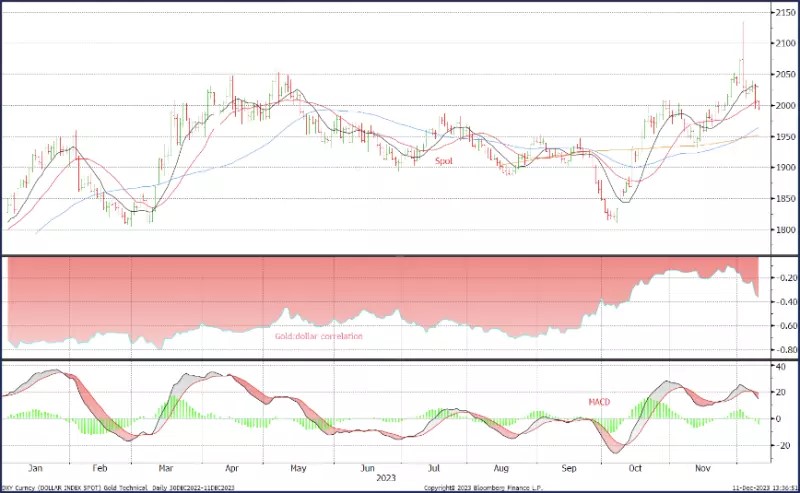
The price
of gold is once again hovering above the psychological level of $2,000 per
ounce, and according to experts at StoneX Bullion, it “is showing resilience.”
They also pointed out that on the leveraged gold market, long positions
continue to dominate.
Gold above the $2,000 level. Source: StoneX Bullion, Bloomberg.
This gives them access to markets that are reserved for only a few. Despite this, the average investors prefer to diversify their savings differently, opting for crypto or gold.
More Americans Gain Access
to Private Investments amid High Inflation
An
accredited investor meets certain financial thresholds and can invest in
private securities like hedge funds, private equity, and venture capital. However,
just three years ago, only 13% of US households had access to private market
investments. The record-high inflation, which drove up prices and consequently
led to an increase in earnings, has resulted in a significantly larger number
of people exceeding the accredited investor threshold. The number of eligible households
has risen by over five percentage points to 18.5%.
Source: SEC
One of the
main reasons behind this rapid increase is that the financial qualifications
for accredited investor status have not kept pace with inflation. To qualify,
an individual must have $200,000 in annual income or $1 million in net assets,
excluding their primary residence. However, these thresholds have stayed static
since they were first introduced in the early 1980s.
Accounting
for inflation, the income threshold would now need to be over $900,000 for a
couple, or the net worth threshold would need to be around $3 million. If
adjusted accordingly, only 5.7% of US households would currently qualify as
accredited.
Nearly half of U.S. households will qualify to invest in sometimes lucrative, often risky private markets deals as accredited investors by 2042, the SEC estimated in a report last week. Currently, just under 20 percent do. 👀https://t.co/qRcvrLji7z
Consumer
advocates have raised concerns that allowing too many people access to complex and
risky private investments may lead to issues down the line. Private markets
tend to be much less transparent than public markets, making it harder for
average investors to conduct proper due diligence.
However,
others argue that more investors should have the freedom to diversify their
portfolios beyond traditional stocks and bonds. In the long run, some private
assets like private equity have delivered returns exceeding public market
equivalents.
The SEC just published a report on accredited investors; a few facts on the exempt offering market (which includes syndications and crowdfunding):
- $3.7 trillion of capital raised in '22, vs $1 trillion in '21 🤯
As
inflation continues to impact income and wealth, the pool of accredited
investors is likely to keep expanding rapidly. Whether that is ultimately good
or bad for investors remains to be seen.
During Inflation, Investors
Turn to Gold
Regardless
of whether the average retail investor should have access to private markets or
not, record-high inflation is pushing American savers towards alternative
assets. According to a study shared exclusively with Finance Magnates,
83% of millennials express doubts about the current state of the economy.
Consequently, they are exploring new investment and savings avenues, including
gold.
Precious
metals, long considered as a hedge against inflation, are experiencing a
notable increase in interest. Specifically, online queries for “how to invest
in gold and silver” have skyrocketed by 656% over the last year.
A look at
the gold price chart shows this situation is not a coincidence. The precious
metal has grown almost 12% this year, significantly outperforming inflation
and the interest rates of savings accounts. Moreover, it is a safer alternative
to the more rapidly growing but riskier stock market.
The price
of gold is once again hovering above the psychological level of $2,000 per
ounce, and according to experts at StoneX Bullion, it “is showing resilience.”
They also pointed out that on the leveraged gold market, long positions
continue to dominate.
Gold above the $2,000 level. Source: StoneX Bullion, Bloomberg.
Damian Chmiel is a Senior Analyst & Editor at Finance Magnates with more than 15 years of experience in the CFD and online trading industry. Active as both a trader and journalist since 2010, he focuses on broker coverage, fintech innovation, and regulatory developments across Europe, the Middle East, and Asia.
His work includes interviews with C-level leaders at major brokerages and fintech platforms, as well as co-authoring Finance Magnates’ quarterly industry benchmarking reports. Damian’s reporting is data-driven, market-aware, and grounded in direct industry engagement. His analysis and commentary have also been cited by external media outlets, including Investing.com, Binance, The Asset, Stockhead, and Dispatch.
Education:
MA in Finance and Accounting, Cracow University of Economics
iForex posts its first annual results as a listed broker. Also ahead: CFI Financial secures a Brazil license, and prediction markets have a big week, with new ETF launches and fresh Polymarket loss data. It's Thursday, the thirtieth of April 2026. You're listening to the Finance Magnates Daily Brief.
FM Daily Brief - 29 April 2026
XTB and Robinhood both post first-quarter earnings. But the numbers point in very different directions. Also ahead: Capital.com pushes into three new markets and signals a move into payments.
It's Wednesday, the 29th of April 2026. You're listening to the Finance Magnates Daily Brief.
XTB and Robinhood both post first-quarter earnings. But the numbers point in very different directions. Also ahead: Capital.com pushes into three new markets and signals a move into payments.
It's Wednesday, the 29th of April 2026. You're listening to the Finance Magnates Daily Brief.
XTB and Robinhood both post first-quarter earnings. But the numbers point in very different directions. Also ahead: Capital.com pushes into three new markets and signals a move into payments.
It's Wednesday, the 29th of April 2026. You're listening to the Finance Magnates Daily Brief.
XTB and Robinhood both post first-quarter earnings. But the numbers point in very different directions. Also ahead: Capital.com pushes into three new markets and signals a move into payments.
It's Wednesday, the 29th of April 2026. You're listening to the Finance Magnates Daily Brief.
XTB and Robinhood both post first-quarter earnings. But the numbers point in very different directions. Also ahead: Capital.com pushes into three new markets and signals a move into payments.
It's Wednesday, the 29th of April 2026. You're listening to the Finance Magnates Daily Brief.
XTB and Robinhood both post first-quarter earnings. But the numbers point in very different directions. Also ahead: Capital.com pushes into three new markets and signals a move into payments.
It's Wednesday, the 29th of April 2026. You're listening to the Finance Magnates Daily Brief.
FM Daily Brief - 28 April 2026
Startrader posts three-point-one trillion dollars in first-quarter volume — up three hundred and forty percent from a year ago. Also ahead: Fintokei claims sub-second trader payouts, and eToro opens its premium subscription tier to all investors.
FM Daily Brief - 27 April 2026
Finance Magnates spoke with IG Group's MENA CEO. Also ahead: EC Markets posts a record five-point-one-three trillion dollar first quarter. Plus Hola Prime brings in Deloitte to audit prop firm payouts.