FM Intelligence Volume Rank: History, Present and Future

Thursday, 21/05/2026 | 11:00 GMT by Sylwester Majewski
  • Every new broker added to our ranking is required to provide independent verification of its volumes.
  • The Volume Rank will continue to expand, reaching for all possible market participants that meet requirements for scale and verified legitimacy.
FM volume rank header

Every quarter more and more brokers are approaching Finance Magnates, asking about joining our Volume Rank. Just this quarter, two new FX/CFD brokers decided to join the ranks. Both are currently in the process of verifying their metrics. The increasing popularity of the Volume Rank inspired this article, in which we revisit its history and current role within the industry.

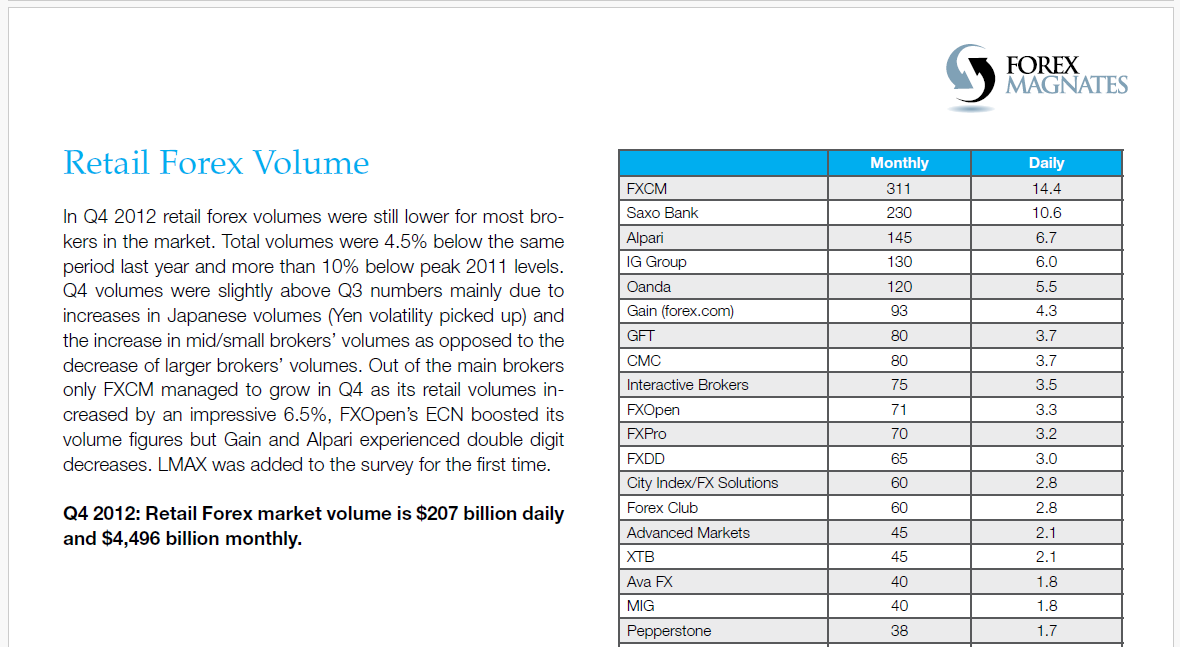
The oldest Intelligence Report we were able to locate in our archives dates back to Q4 2012. However, the first edition of the volume ranking was introduced as early as 2011. It is fair to say that the Finance Magnates Volume Rank is almost as old as the modern CFD industry itself.
old QIR

At the time, it was the first initiative of its kind in the FX/CFD industry. It was created to provide market participants with a benchmark that could support growth in a cleaner and more transparent environment. As is well known, OTC (over-the-counter) markets have historically struggled with the level of transparency typical of exchange-traded instruments. The Finance Magnates Volume Rank became one of the first tools to address this issue and quickly gained industry recognition.

Fifteen years later, it remains the only dedicated and trusted volume ranking in the FX/CFD industry.

Over time, it has become a respected source of industry data, referenced not only by major financial media outlets such as Bloomberg or Reuters, but also by academic researchers. Among clients using our data and products were such giants as AWS or Visa.

It is now one of the most frequently cited elements of our Intelligence Reports, a fact that has not gone unnoticed in the era of AI-driven information discovery. Finance Magnates and its Volume Rank are now regularly referenced by AI systems in discussions related to the size and growth of the CFD industry.

How It Started and Evolved

Our Volume Rank began as a ranking based primarily on industry estimates and market feedback. In the early days of the industry, when the sector was much smaller than it is today, the ranking was built largely on information gathered from industry participants. Shortly afterward, several brokers began publishing their trading volumes publicly.

At the same time, as the ranking gained recognition, some brokers agreed to share their metrics directly with us. From that point onward, the Volume Rank continued to evolve.

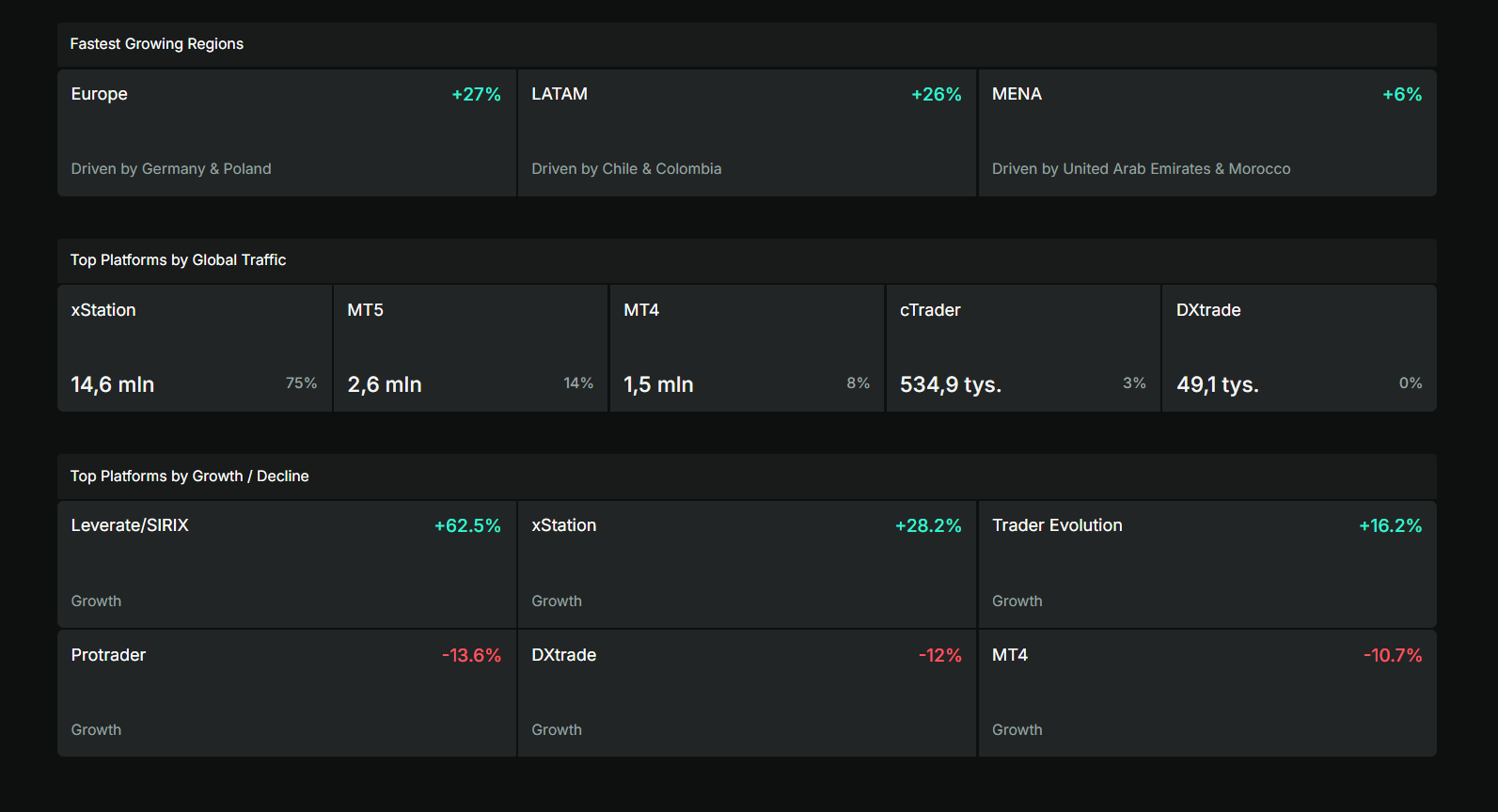
In 2019, we introduced additional performance metrics related to broker activity. One of the most important additions was tracking volume executed through specific trading platforms. This made it possible, for the first time, to actively monitor the growth of MT4 and MT5, both relative to each other and compared with alternative platforms. We also began tracking the usage of mobile and desktop trading platforms, which was still far from obvious at the time.
Platforms rank

Most recently, in 2025, we introduced the “Most Popular Trading Instrument” rank in the volumes section, showing which categories of instruments are most actively traded by CFD clients based on the traded volume. Metals, FX, equities, and indices volumes can now be analysed more clearly, helping brokers better understand client preferences and trading behaviour.

How the Volume Rank Is Created

Today, our Volume Rank currently consists of three main categories of brokers:

  • Verified - the first and most important category consists of brokers that share their metrics directly with Finance Magnates. They provide supporting documents confirming their trading volumes.
  • Reported - the second category includes brokers that publicly report their metrics, either on their websites or through official reports, usually alongside their financial results.
  • Estimated - the final category consists of brokers that, for various reasons, choose not to disclose their metrics. In such cases, we estimate the figures based on the best information available to us. To simplify a more complex process, we apply a proprietary statistical model that tracks broader industry trends in order to estimate changes in key metrics.

As with any estimation process, our figures may occasionally differ from the brokers’ actual numbers. However, any sufficiently large broker is welcome to join the ranking and provide verified data directly, provided certain requirements are met.

How Numbers Are Verified

For several years now, every new broker added to our ranking has been required to provide independent verification of its volumes. This typically takes the form of a statement from a third-party technology provider working with the broker, such as oneZero, Centroid, FXCubic, or another independent provider. We follow the same process for existing brokers whenever submitted metrics deviate significantly from broader industry trends during a given period.
Intelligence portal volumes

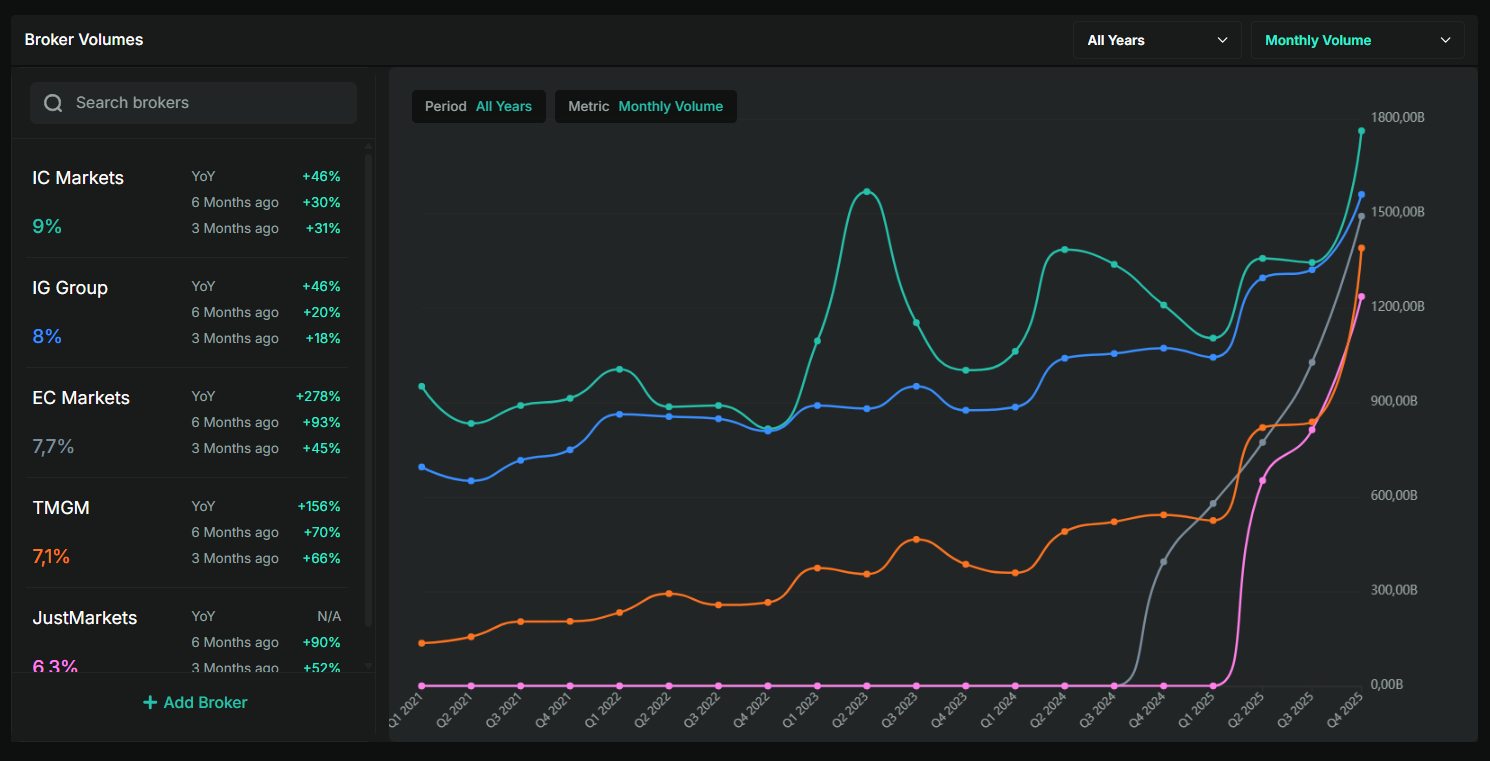
With the development of our Intelligence Portal and the adoption of new technologies, we are also introducing additional layers of verification. Submitted volumes now undergo algorithmic audits and are cross-referenced with third-party records, as well as other datasets that help us assess whether the reported metrics are consistent with the broker’s market activity and overall visibility.

These verification tools will continue to evolve, and our online ranking will soon include additional data points related to brokers and their reported metrics.

What Makes Volumes Grow

Over the long history of publishing the Volume Rank, we have learned that there are many factors influencing whether a broker generates high or low trading volumes. Volume alone does not always tell the full story about a broker’s market position. Other elements also play an important role, even if volumes naturally attract the most attention.

Brokers operating primarily in saturated and highly regulated markets, such as Europe or Australia, often find it more difficult to achieve exceptionally large volumes. This is mainly because they cannot offer high leverage to retail clients and are also restricted in the customer acquisition methods they can use to rapidly expand their client base.

In contrast, brokers focused on developing markets with less restrictive regulatory frameworks, particularly regarding leverage limits, often find it easier to generate higher trading volumes.

EXAMPLE:
Broker “A” holds licences from regulators in the UK and Germany. In both cases, it is able to offer clients leverage of up to 30:1 on major forex pairs
Broker “B” is licensed in the UK, France, and Vanuatu (VFSC), where leverage can reach as high as 500:1. Clearly, Broker “B” is more likely to generate higher trading volumes from its clients by offering services in emerging markets through its Vanuatu licence.

There are also structural differences between regional markets. For example, the Chinese market was historically characterised by a unique investment culture in which retail clients frequently opened accounts through Introducing Brokers (IBs), who in many cases also managed those accounts directly. This structure naturally generated very large trading volumes.

However, these are only some of the factors influencing reported volumes. Different regulatory environments, client behaviours, and business models all contribute to the final numbers.

The Future

With the capabilities now offered by the Intelligence Portal, the Volume Rank will continue to expand. We plan to cover significantly more than the currently listed retail brokers in the near future, reaching all possible market participants that meet our requirements for scale and verified legitimacy. In addition to volumes and other trading metrics, we aim to provide a broader overview of broker characteristics in one place, giving users a more comprehensive picture of the FX/CFD industry.

We would like to encourage all legitimate FX/CFD brokers that meet the criteria to join the ranks. Also, we encourage to share the data with us if your company is already in our rank, but your metrics are only estimated by us.

Just as at the beginning, our goal remains the same: to improve and maintain transparency across the industry. Stay tuned for more updates.

Every quarter more and more brokers are approaching Finance Magnates, asking about joining our Volume Rank. Just this quarter, two new FX/CFD brokers decided to join the ranks. Both are currently in the process of verifying their metrics. The increasing popularity of the Volume Rank inspired this article, in which we revisit its history and current role within the industry.

The oldest Intelligence Report we were able to locate in our archives dates back to Q4 2012. However, the first edition of the volume ranking was introduced as early as 2011. It is fair to say that the Finance Magnates Volume Rank is almost as old as the modern CFD industry itself.

old QIR

At the time, it was the first initiative of its kind in the FX/CFD industry. It was created to provide market participants with a benchmark that could support growth in a cleaner and more transparent environment. As is well known, OTC (over-the-counter) markets have historically struggled with the level of transparency typical of exchange-traded instruments. The Finance Magnates Volume Rank became one of the first tools to address this issue and quickly gained industry recognition.

Fifteen years later, it remains the only dedicated and trusted volume ranking in the FX/CFD industry.

Over time, it has become a respected source of industry data, referenced not only by major financial media outlets such as Bloomberg or Reuters, but also by academic researchers. Among clients using our data and products were such giants as AWS or Visa.

It is now one of the most frequently cited elements of our Intelligence Reports, a fact that has not gone unnoticed in the era of AI-driven information discovery. Finance Magnates and its Volume Rank are now regularly referenced by AI systems in discussions related to the size and growth of the CFD industry.

How It Started and Evolved

Our Volume Rank began as a ranking based primarily on industry estimates and market feedback. In the early days of the industry, when the sector was much smaller than it is today, the ranking was built largely on information gathered from industry participants. Shortly afterward, several brokers began publishing their trading volumes publicly.

At the same time, as the ranking gained recognition, some brokers agreed to share their metrics directly with us. From that point onward, the Volume Rank continued to evolve.

In 2019, we introduced additional performance metrics related to broker activity. One of the most important additions was tracking volume executed through specific trading platforms. This made it possible, for the first time, to actively monitor the growth of MT4 and MT5, both relative to each other and compared with alternative platforms. We also began tracking the usage of mobile and desktop trading platforms, which was still far from obvious at the time.

Platforms rank

Most recently, in 2025, we introduced the “Most Popular Trading Instrument” rank in the volumes section, showing which categories of instruments are most actively traded by CFD clients based on the traded volume. Metals, FX, equities, and indices volumes can now be analysed more clearly, helping brokers better understand client preferences and trading behaviour.

How the Volume Rank Is Created

Today, our Volume Rank currently consists of three main categories of brokers:

  • Verified - the first and most important category consists of brokers that share their metrics directly with Finance Magnates. They provide supporting documents confirming their trading volumes.
  • Reported - the second category includes brokers that publicly report their metrics, either on their websites or through official reports, usually alongside their financial results.
  • Estimated - the final category consists of brokers that, for various reasons, choose not to disclose their metrics. In such cases, we estimate the figures based on the best information available to us. To simplify a more complex process, we apply a proprietary statistical model that tracks broader industry trends in order to estimate changes in key metrics.

As with any estimation process, our figures may occasionally differ from the brokers’ actual numbers. However, any sufficiently large broker is welcome to join the ranking and provide verified data directly, provided certain requirements are met.

How Numbers Are Verified

For several years now, every new broker added to our ranking has been required to provide independent verification of its volumes. This typically takes the form of a statement from a third-party technology provider working with the broker, such as oneZero, Centroid, FXCubic, or another independent provider. We follow the same process for existing brokers whenever submitted metrics deviate significantly from broader industry trends during a given period.

Intelligence portal volumes

With the development of our Intelligence Portal and the adoption of new technologies, we are also introducing additional layers of verification. Submitted volumes now undergo algorithmic audits and are cross-referenced with third-party records, as well as other datasets that help us assess whether the reported metrics are consistent with the broker’s market activity and overall visibility.

These verification tools will continue to evolve, and our online ranking will soon include additional data points related to brokers and their reported metrics.

What Makes Volumes Grow

Over the long history of publishing the Volume Rank, we have learned that there are many factors influencing whether a broker generates high or low trading volumes. Volume alone does not always tell the full story about a broker’s market position. Other elements also play an important role, even if volumes naturally attract the most attention.

Brokers operating primarily in saturated and highly regulated markets, such as Europe or Australia, often find it more difficult to achieve exceptionally large volumes. This is mainly because they cannot offer high leverage to retail clients and are also restricted in the customer acquisition methods they can use to rapidly expand their client base.

In contrast, brokers focused on developing markets with less restrictive regulatory frameworks, particularly regarding leverage limits, often find it easier to generate higher trading volumes.

EXAMPLE:
Broker “A” holds licences from regulators in the UK and Germany. In both cases, it is able to offer clients leverage of up to 30:1 on major forex pairs
Broker “B” is licensed in the UK, France, and Vanuatu (VFSC), where leverage can reach as high as 500:1. Clearly, Broker “B” is more likely to generate higher trading volumes from its clients by offering services in emerging markets through its Vanuatu licence.

There are also structural differences between regional markets. For example, the Chinese market was historically characterised by a unique investment culture in which retail clients frequently opened accounts through Introducing Brokers (IBs), who in many cases also managed those accounts directly. This structure naturally generated very large trading volumes.

However, these are only some of the factors influencing reported volumes. Different regulatory environments, client behaviours, and business models all contribute to the final numbers.

The Future

With the capabilities now offered by the Intelligence Portal, the Volume Rank will continue to expand. We plan to cover significantly more than the currently listed retail brokers in the near future, reaching all possible market participants that meet our requirements for scale and verified legitimacy. In addition to volumes and other trading metrics, we aim to provide a broader overview of broker characteristics in one place, giving users a more comprehensive picture of the FX/CFD industry.

We would like to encourage all legitimate FX/CFD brokers that meet the criteria to join the ranks. Also, we encourage to share the data with us if your company is already in our rank, but your metrics are only estimated by us.

Just as at the beginning, our goal remains the same: to improve and maintain transparency across the industry. Stay tuned for more updates.

About the Author: Sylwester Majewski
Sylwester Majewski
  • 150 Articles
  • 20 Followers
About the Author: Sylwester Majewski
Sylwester is a graduate of the Warsaw School of Economics, holding an MA in Finance and Banking. He currently serves as Head of the Insights & Reporting Hub at Finance Magnates. He is also a former minority partner in an NFA-registered US forex broker and has been involved in numerous forex and trading industry projects since 2003. Privately, Sylwester is a husband and father to a 7-year-old daughter, as well as an enthusiast of trading and Formula 1.
  • 150 Articles
  • 20 Followers

More from the Author

Retail FX

!"#$%&'()*+,-./0123456789:;<=>?@ABCDEFGHIJKLMNOPQRSTUVWXYZ[\]^_`abcdefghijklmnopqrstuvwxyz{|} !"#$%&'()*+,-./0123456789:;<=>?@ABCDEFGHIJKLMNOPQRSTUVWXYZ[\]^_`abcdefghijklmnopqrstuvwxyz{|}