On Polymarket, Being Right About Dota 2 Paid Less Than Trading the Odds

Thursday, 03/09/2026 | 15:01 GMT by Tanya Chepkova
  • Predictbook found that just 5,004 Polymarket accounts made money trading Dota 2's The International 2026 by buying and selling contracts.
  • The top 10% of accounts supplied 97.8% of the $181.93 million wagered on the tournament.
A screenshot of Polymarket (shutterstock)

It paid more to trade Dota 2 prediction contracts than to bet on a winner and wait for The International 2026 to end, an account-level analysis of Polymarket accounts by Predictbook found.

The International, Dota 2's annual world championship, concluded in Shanghai on 23 August, with 16 teams competing for a combined prize pool of about $3.32 million.

Trading Prices Versus Final Settlement

The report analysed 21,936 Polymarket accounts linked to The International-related markets. It identified 5,004 accounts whose results were primarily generated through buying and selling contracts, with a combined profit of $7,582,812.

Another 16,932 accounts, representing about 77% of the sample, had outcomes determined at settlement and lost $7,611,971 in aggregate.

A prediction-market contract can be bought and sold as its price moves before the event resolves, or held into settlement, where it pays out $0 or $1 based on the outcome.

Predictbook split accounts by which of the two drove their result: price movement before the match ended, or the binary outcome once it did.

A Small Share of Accounts Drove the Numbers

The broader account distribution shows why the aggregate figures should not be read as the experience of a typical account.

The median profitable account made about $4.84, while the median losing account lost about $23.15. Only 734 accounts made more than $1,000, while 906 accounts lost more than $1,000.
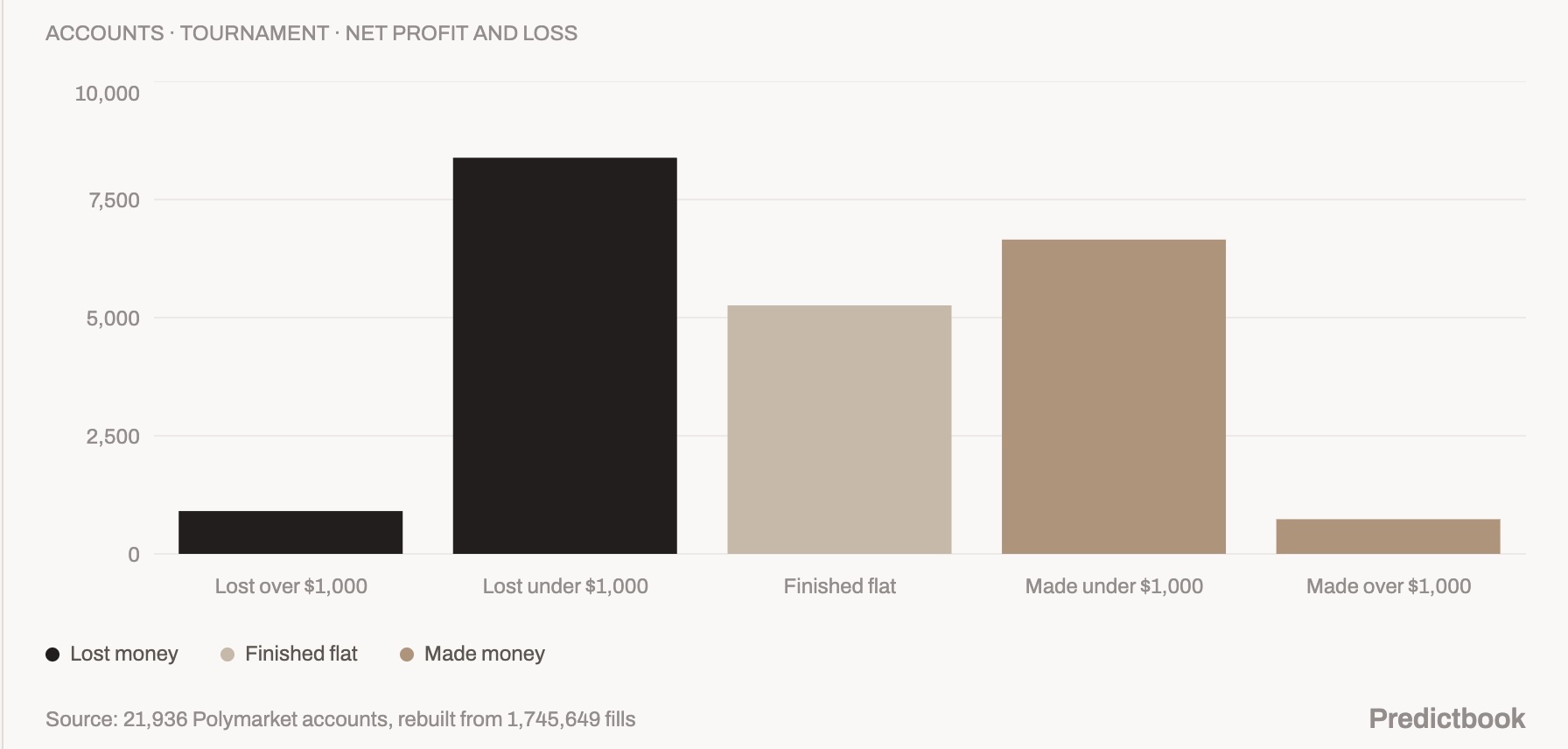
Winning and losing accounts. Source: Predictbook

The researchers built an account-level breakdown only for Polymarket, as Kalshi's public trade feed carries no account identifiers. On Polymarket, profit and loss were reconstructed from what accounts paid and collected across 622,475 trades, before fees, tied to the tournament.

Capital was also heavily concentrated. The top 10% of Polymarket accounts supplied 97.8% of the $181.93 million deposited into the tournament markets, with the top 1% accounting for 72.8%.

The Pattern Isn't Unique to Dota 2

That level of concentration isn't specific to Dota 2 or this tournament. A separate study of Polymarket's full trading history found the same pattern platform-wide.

Researchers from the University of Toronto, HEC Montréal and ESSEC Business School analysed 2.4 million users and $67 billion in volume between November 2022 and March 2026. The top 1% of profitable users captured 76.5% of all gains, while 69% of accounts lost money over the period.

The same research links profitability primarily to liquidity provision: accounts that mostly post standing orders tend to outperform accounts that mostly take the price already on screen.

The study also found that Polymarket's prices, in aggregate, still track resolved outcomes closely: a contract priced at 35 cents settled in its favour about 35% of the time. Who profits from that accuracy turned out to be a separate matter.

It paid more to trade Dota 2 prediction contracts than to bet on a winner and wait for The International 2026 to end, an account-level analysis of Polymarket accounts by Predictbook found.

The International, Dota 2's annual world championship, concluded in Shanghai on 23 August, with 16 teams competing for a combined prize pool of about $3.32 million.

Trading Prices Versus Final Settlement

The report analysed 21,936 Polymarket accounts linked to The International-related markets. It identified 5,004 accounts whose results were primarily generated through buying and selling contracts, with a combined profit of $7,582,812.

Another 16,932 accounts, representing about 77% of the sample, had outcomes determined at settlement and lost $7,611,971 in aggregate.

A prediction-market contract can be bought and sold as its price moves before the event resolves, or held into settlement, where it pays out $0 or $1 based on the outcome.

Predictbook split accounts by which of the two drove their result: price movement before the match ended, or the binary outcome once it did.

A Small Share of Accounts Drove the Numbers

The broader account distribution shows why the aggregate figures should not be read as the experience of a typical account.

The median profitable account made about $4.84, while the median losing account lost about $23.15. Only 734 accounts made more than $1,000, while 906 accounts lost more than $1,000.

Winning and losing accounts. Source: Predictbook

The researchers built an account-level breakdown only for Polymarket, as Kalshi's public trade feed carries no account identifiers. On Polymarket, profit and loss were reconstructed from what accounts paid and collected across 622,475 trades, before fees, tied to the tournament.

Capital was also heavily concentrated. The top 10% of Polymarket accounts supplied 97.8% of the $181.93 million deposited into the tournament markets, with the top 1% accounting for 72.8%.

The Pattern Isn't Unique to Dota 2

That level of concentration isn't specific to Dota 2 or this tournament. A separate study of Polymarket's full trading history found the same pattern platform-wide.

Researchers from the University of Toronto, HEC Montréal and ESSEC Business School analysed 2.4 million users and $67 billion in volume between November 2022 and March 2026. The top 1% of profitable users captured 76.5% of all gains, while 69% of accounts lost money over the period.

The same research links profitability primarily to liquidity provision: accounts that mostly post standing orders tend to outperform accounts that mostly take the price already on screen.

The study also found that Polymarket's prices, in aggregate, still track resolved outcomes closely: a contract priced at 35 cents settled in its favour about 35% of the time. Who profits from that accuracy turned out to be a separate matter.

About the Author: Tanya Chepkova
Tanya Chepkova
  • 427 Articles
  • 3 Followers
About the Author: Tanya Chepkova
Tanya Chepkova is a News Editor at Finance Magnates with more than 16 years of experience in financial journalism, covering forex, crypto, and digital asset markets. Her work spans daily industry reporting and data-driven, long-form explainers focused on market structure, trading models, and regulatory shifts. Before joining Finance Magnates, she led the editorial team of a cryptocurrency-focused media outlet for six years. Her reporting combines analytical depth with clear storytelling, with particular attention to how structural changes in trading, stablecoin infrastructure, and emerging products such as prediction markets reshape the broader financial ecosystem. She covers global developments and provides additional insight into CIS markets. Areas of Coverage: Crypto and digital asset markets Prediction markets Stablecoins and cross-border payments Industry analysis and long-form explainers
  • 427 Articles
  • 3 Followers

More from the Author

FinTech

!"#$%&'()*+,-./0123456789:;<=>?@ABCDEFGHIJKLMNOPQRSTUVWXYZ[\]^_`abcdefghijklmnopqrstuvwxyz{|} !"#$%&'()*+,-./0123456789:;<=>?@ABCDEFGHIJKLMNOPQRSTUVWXYZ[\]^_`abcdefghijklmnopqrstuvwxyz{|}