
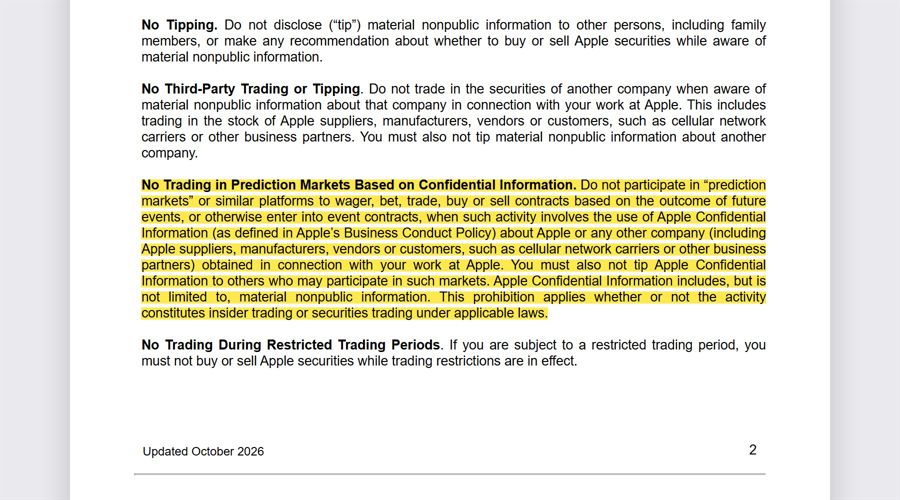
Apple has told its employees they may not use confidential company information to bet on prediction markets. The rule is new in the insider trading policy that the iPhone maker filed yesterday (Tuesday) with its annual report to the US Securities and Exchange Commission (SEC).
The clause brings event contracts into a document that had dealt only with trading in securities.
Trading on prediction markets has grown quickly. Combined taker volume at Kalshi, Polymarket and Polymarket's US venue reached $172.4 billion in the third quarter, up from $98.5 billion in the second, FM Intelligence calculations show.
Company information has already been traded on such platforms. A Polymarket user allegedly netted more than $1 million betting on Google's Year in Search rankings, a case that fed accusations of trading on nonpublic information in January.
Federal regulators treat that conduct as illegal. David Miller, enforcement director at the Commodity Futures Trading Commission (CFTC ), called insider trading on Kalshi and Polymarket illegal in March and listed it first among the agency's top five enforcement priorities.
London's trading industry is coming home!
Suppliers and Carriers Fall Under the Ban
The policy covers directors, officers, employees, contractors and consultants, plus family members who live with them. The previous version of the policy, dated September 2024, did not mention prediction markets or event contracts.
Covered people may not bet on or trade event contracts using Apple Confidential Information, a category set out in the company's Business Conduct Policy that includes, but is not limited to, material nonpublic information.
The ban reaches information about other companies learned at Apple, including suppliers, manufacturers, vendors and customers such as cellular network carriers. Staff also may not pass that information to others who trade on these platforms.
The prohibition applies "whether or not the activity constitutes insider trading or securities trading under applicable laws," the policy says.
- Apple’s Leadership Shake-Up: Key Execs and Engineers Exit
- Apple Stock Up 3.3% as iPhone 17 Beats Old Model in Early Demand
- Apple Smashes Q3 Expectations. Yes, people Are Still Buying iPhones
Under the general terms of the policy, Apple personnel who break it may face disciplinary action, including dismissal and repayment of equity awards.
Emcor, GoDaddy and Seagate Wrote Similar Rules
Apple is not the first US-listed company to write prediction markets into its rules this year. Bloomberg Law named several in May, and their rules differ in what information they cover.
Emcor Group amended its insider trading policy on April 2 to ban prediction market trades involving nonpublic information, according to that report. GoDaddy said in an April 24 proxy statement that its insider trading policy covers prediction markets.
Seagate Technology named Polymarket and Kalshi in a May 1 code of conduct update that bans "speculative activities where Seagate is the subject."
Seagate's quoted rule centers on bets about Seagate itself. Apple's extends to bets built on what employees learn about suppliers and carriers, and it applies whether or not a bet counts as insider trading.
Platforms Have Tightened Their Own Rules
The exchanges have moved in parallel. Polymarket's rules, updated in March, ban trading on stolen confidential information and on illegal tips, as well as trading by anyone able to influence an outcome.
Kalshi has already sanctioned a trader over bets tied to his employer. It fined a YouTube channel editor $20,397.58 and suspended him for two years for trading contracts tied to the channel where he worked, citing misuse of material nonpublic information.
Lawmakers are collecting evidence too. The House Oversight Committee asked both platforms in May for records on how they detect insider trading, with documents due by June 5.


