
Independent Prediction Markets Converged on Nearly Identical World Cup Probabilities as Trading Hit Record Highs

Monday, 20/07/2026 | 20:21 GMT by Tanya Chepkova
  • Polymarket and Kalshi independently priced Spain at almost identical probabilities ahead of the World Cup final.
  • The World Cup proved that independent prediction markets can arrive at similar prices even without shared liquidity or participants.
Prediction markets. Source: Shutterstock

Despite operating separate order books, liquidity pools and user bases, Polymarket and Kalshi priced Spain’s chances of winning the World Cup at almost exactly the same probability ahead of Sunday’s final.

Polymarket priced Spain at roughly a 59% chance of lifting the trophy before kickoff, while Argentina traded near 40%. Kalshi’s market independently arrived at virtually the same assessment, pricing Spain at 59,6% and Argentina at 40.4%.
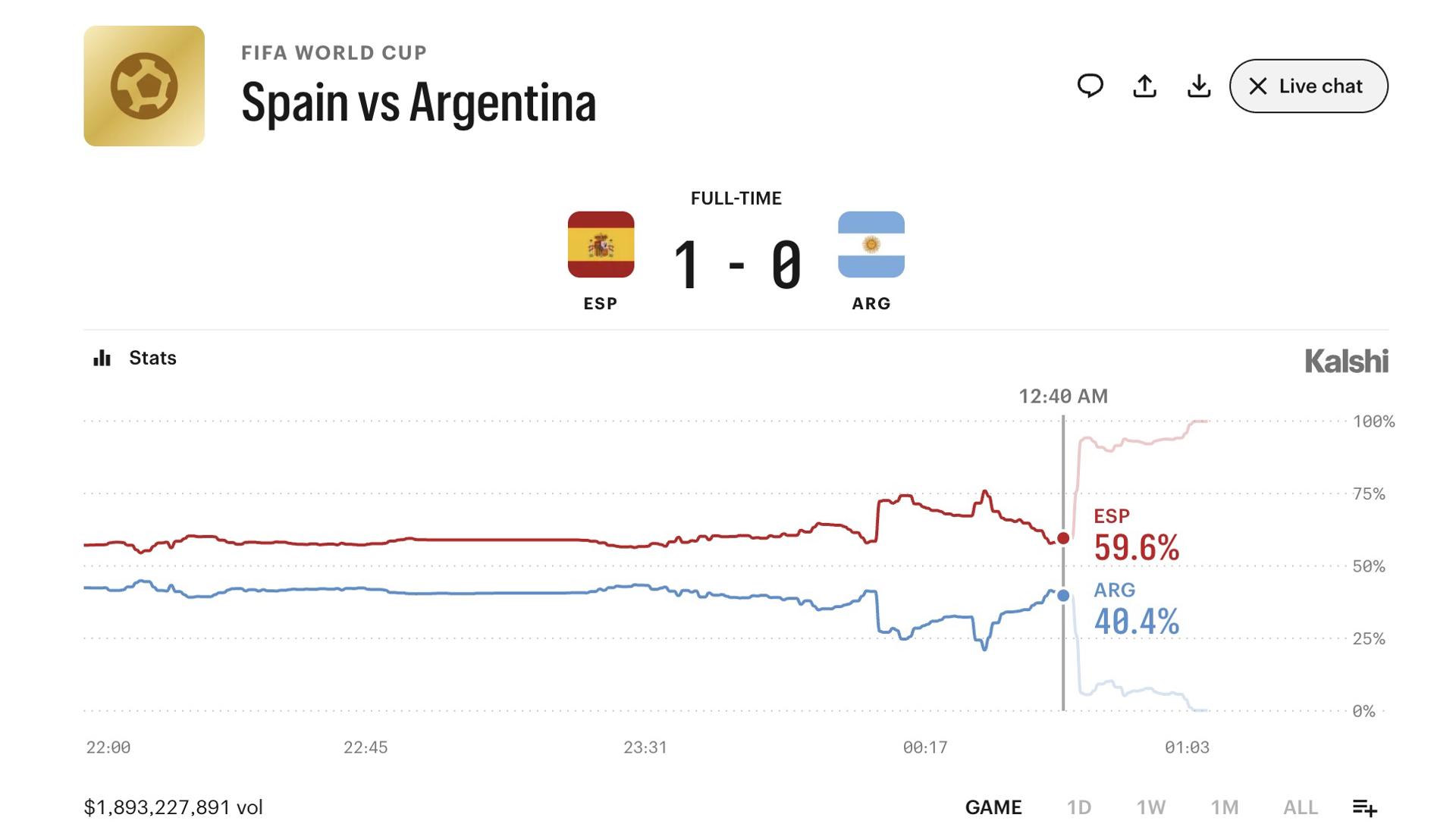
Kalshi market Argentina vs. Spain. Source: Kalshi

Different Markets, Identical Probabilities

The close alignment offered a rare illustration of how independent prediction markets with separate liquidity pools and user bases can arrive at similar probability estimates through trading alone.

That alignment emerged during the largest sporting event in prediction market history, with Polymarket’s World Cup Winner contract processing $4.28 billion in volume and Kalshi’s equivalent market another $1.29 billion.

The scale of trading makes the similarity in pricing particularly notable, even though the result of a single football match cannot determine whether those probabilities were perfectly calibrated.

Although the two markets reached nearly identical probabilities, trader positioning looked rather different. While traders often chased value on the underdog rather than backing the favourite, resulting in more capital flowing toward Argentina despite Spain’s higher implied probability, both platforms ultimately reflected nearly identical market expectations before the match.

No Widespread Profits

Blockchain analyst defioasis.eth examined more than 194,000 Polymarket wallets and found that roughly two-thirds ended the tournament with losses. Only five wallets generated profits exceeding $1 million, while the overwhelming majority of both gains and losses remained under $100.

One notable casualty was an Argentina supporter who lost a $1.23 million position in the final after previously sitting on more than $5 million in unrealized profit.

The record trading volumes were significant, but they were also largely expected. The tournament offered one of the clearest large-scale demonstrations yet of how prediction markets aggregate information through independent trading.

Despite operating separate order books, liquidity pools and user bases, Polymarket and Kalshi priced Spain’s chances of winning the World Cup at almost exactly the same probability ahead of Sunday’s final.

Polymarket priced Spain at roughly a 59% chance of lifting the trophy before kickoff, while Argentina traded near 40%. Kalshi’s market independently arrived at virtually the same assessment, pricing Spain at 59,6% and Argentina at 40.4%.

Kalshi market Argentina vs. Spain. Source: Kalshi

Different Markets, Identical Probabilities

The close alignment offered a rare illustration of how independent prediction markets with separate liquidity pools and user bases can arrive at similar probability estimates through trading alone.

That alignment emerged during the largest sporting event in prediction market history, with Polymarket’s World Cup Winner contract processing $4.28 billion in volume and Kalshi’s equivalent market another $1.29 billion.

The scale of trading makes the similarity in pricing particularly notable, even though the result of a single football match cannot determine whether those probabilities were perfectly calibrated.

Although the two markets reached nearly identical probabilities, trader positioning looked rather different. While traders often chased value on the underdog rather than backing the favourite, resulting in more capital flowing toward Argentina despite Spain’s higher implied probability, both platforms ultimately reflected nearly identical market expectations before the match.

No Widespread Profits

Blockchain analyst defioasis.eth examined more than 194,000 Polymarket wallets and found that roughly two-thirds ended the tournament with losses. Only five wallets generated profits exceeding $1 million, while the overwhelming majority of both gains and losses remained under $100.

One notable casualty was an Argentina supporter who lost a $1.23 million position in the final after previously sitting on more than $5 million in unrealized profit.

The record trading volumes were significant, but they were also largely expected. The tournament offered one of the clearest large-scale demonstrations yet of how prediction markets aggregate information through independent trading.

About the Author: Tanya Chepkova
Tanya Chepkova
  • 299 Articles
  • 2 Followers
About the Author: Tanya Chepkova
Tanya Chepkova is a News Editor at Finance Magnates with more than 16 years of experience in financial journalism, covering forex, crypto, and digital asset markets. Her work spans daily industry reporting and data-driven, long-form explainers focused on market structure, trading models, and regulatory shifts. Before joining Finance Magnates, she led the editorial team of a cryptocurrency-focused media outlet for six years. Her reporting combines analytical depth with clear storytelling, with particular attention to how structural changes in trading, stablecoin infrastructure, and emerging products such as prediction markets reshape the broader financial ecosystem. She covers global developments and provides additional insight into CIS markets. Areas of Coverage: Crypto and digital asset markets Prediction markets Stablecoins and cross-border payments Industry analysis and long-form explainers
  • 299 Articles
  • 2 Followers

More from the Author

FinTech

!"#$%&'()*+,-./0123456789:;<=>?@ABCDEFGHIJKLMNOPQRSTUVWXYZ[\]^_`abcdefghijklmnopqrstuvwxyz{|} !"#$%&'()*+,-./0123456789:;<=>?@ABCDEFGHIJKLMNOPQRSTUVWXYZ[\]^_`abcdefghijklmnopqrstuvwxyz{|}