Polymarket’s $354M Iran Dispute Exposes Prediction Markets’ Settlement Problem

Tuesday, 16/06/2026 | 18:01 GMT by Tanya Chepkova
  • Polymarket’s Iran peace-deal markets drew nearly $354 million in volume but remain disputed over the meaning of a “permanent peace deal.”
  • The case shows a growing settlement problem for prediction markets: complex events can be hard to resolve as a simple yes-or-no outcome.
Polymarket (Shutterstock)

Financial markets largely moved on after the United States and Iran announced an agreement over the weekend. On Polymarket, traders are still debating whether the event happened at all.

The prediction market platform has processed more than $345 million in volume on contracts tied to a US-Iran peace deal. While both countries announced an agreement, the market remains unresolved because users disagree on whether the developments satisfy the contract’s requirement for a “permanent peace deal.”
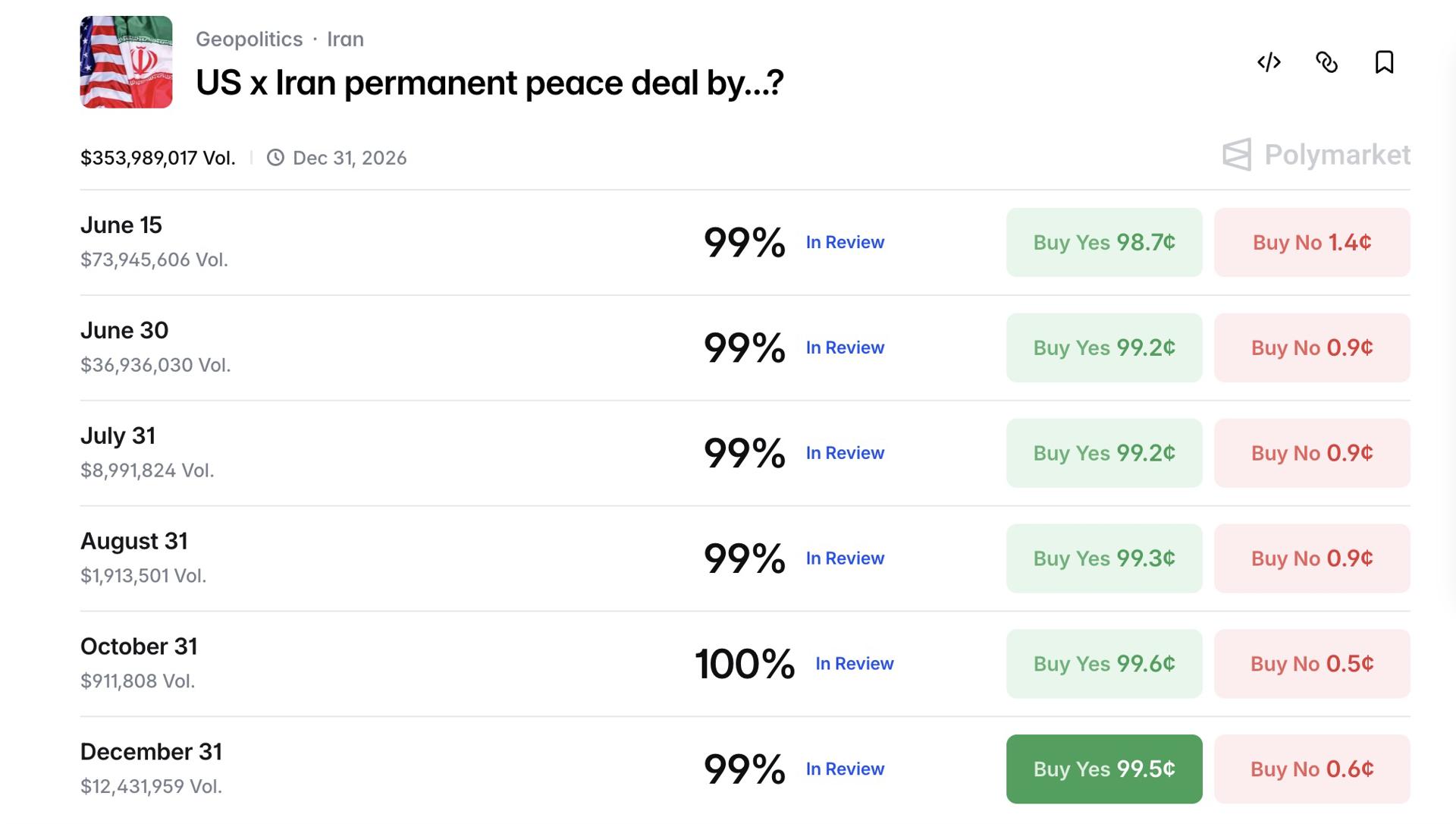
Disputed Polymarket’s Iran peace-deal bets. Source: Polymarket

When Does a Peace Deal Count?

The dispute turns on Polymarket’s definition of a “permanent peace deal.” According to the contract rules, a qualifying agreement must explicitly indicate that military hostilities between the two countries have ended or will permanently cease. Agreements that are temporary, or that do not clearly establish a lasting end to hostilities, do not qualify.

That wording has left traders split. Supporters of a “yes” resolution point to public statements describing the agreement as a permanent end to military operations.

Opponents argue that negotiations are still ongoing, no final document has been signed, and parts of the arrangement remain temporary, including the reported 60-day reopening of the Strait of Hormuz.

Traders are now arguing over contract language and official paperwork, not the underlying event itself.

Who Gets the Final Say?

As with other disputed Polymarket markets, the final decision now rests with UMA token holders. They debate contested outcomes before voting on a resolution.

The process has faced criticism in the past. Bloomberg recently reported that nine wallets control more than half of the tokens used in dispute votes. That concentration has raised concerns that a small group of participants can influence outcomes involving hundreds of millions of dollars.

The outcome now depends on how UMA voters read the contract language and the available public statements. Contracts remain tradable during the dispute process, meaning users can effectively trade on how arbitrators are likely to settle the dispute.

Beyond One Market

The Iran dispute highlights a broader challenge for prediction markets as they move into increasingly complex subjects such as geopolitics, regulation and public policy.

Prediction markets have become highly effective at aggregating expectations. Settlement remains more difficult when outcomes depend on interpretation rather than a clearly verifiable event.

Platforms have taken different approaches. Polymarket relies on external token-holder governance to resolve disputed outcomes. Kalshi, by contrast, settles markets under a predefined CFTC-regulated rulebook.

Both approaches ultimately face the same challenge: how should a binary market resolve events that do not fit neatly into a yes-or-no outcome?

Financial markets largely moved on after the United States and Iran announced an agreement over the weekend. On Polymarket, traders are still debating whether the event happened at all.

The prediction market platform has processed more than $345 million in volume on contracts tied to a US-Iran peace deal. While both countries announced an agreement, the market remains unresolved because users disagree on whether the developments satisfy the contract’s requirement for a “permanent peace deal.”

Disputed Polymarket’s Iran peace-deal bets. Source: Polymarket

When Does a Peace Deal Count?

The dispute turns on Polymarket’s definition of a “permanent peace deal.” According to the contract rules, a qualifying agreement must explicitly indicate that military hostilities between the two countries have ended or will permanently cease. Agreements that are temporary, or that do not clearly establish a lasting end to hostilities, do not qualify.

That wording has left traders split. Supporters of a “yes” resolution point to public statements describing the agreement as a permanent end to military operations.

Opponents argue that negotiations are still ongoing, no final document has been signed, and parts of the arrangement remain temporary, including the reported 60-day reopening of the Strait of Hormuz.

Traders are now arguing over contract language and official paperwork, not the underlying event itself.

Who Gets the Final Say?

As with other disputed Polymarket markets, the final decision now rests with UMA token holders. They debate contested outcomes before voting on a resolution.

The process has faced criticism in the past. Bloomberg recently reported that nine wallets control more than half of the tokens used in dispute votes. That concentration has raised concerns that a small group of participants can influence outcomes involving hundreds of millions of dollars.

The outcome now depends on how UMA voters read the contract language and the available public statements. Contracts remain tradable during the dispute process, meaning users can effectively trade on how arbitrators are likely to settle the dispute.

Beyond One Market

The Iran dispute highlights a broader challenge for prediction markets as they move into increasingly complex subjects such as geopolitics, regulation and public policy.

Prediction markets have become highly effective at aggregating expectations. Settlement remains more difficult when outcomes depend on interpretation rather than a clearly verifiable event.

Platforms have taken different approaches. Polymarket relies on external token-holder governance to resolve disputed outcomes. Kalshi, by contrast, settles markets under a predefined CFTC-regulated rulebook.

Both approaches ultimately face the same challenge: how should a binary market resolve events that do not fit neatly into a yes-or-no outcome?

About the Author: Tanya Chepkova
Tanya Chepkova
  • 240 Articles
About the Author: Tanya Chepkova
Tanya Chepkova is a News Editor at Finance Magnates with more than 16 years of experience in financial journalism, covering forex, crypto, and digital asset markets. Her work spans daily industry reporting and data-driven, long-form explainers focused on market structure, trading models, and regulatory shifts. Before joining Finance Magnates, she led the editorial team of a cryptocurrency-focused media outlet for six years. Her reporting combines analytical depth with clear storytelling, with particular attention to how structural changes in trading, stablecoin infrastructure, and emerging products such as prediction markets reshape the broader financial ecosystem. She covers global developments and provides additional insight into CIS markets. Areas of Coverage: Crypto and digital asset markets Prediction markets Stablecoins and cross-border payments Industry analysis and long-form explainers
  • 240 Articles

More from the Author

FinTech

!"#$%&'()*+,-./0123456789:;<=>?@ABCDEFGHIJKLMNOPQRSTUVWXYZ[\]^_`abcdefghijklmnopqrstuvwxyz{|} !"#$%&'()*+,-./0123456789:;<=>?@ABCDEFGHIJKLMNOPQRSTUVWXYZ[\]^_`abcdefghijklmnopqrstuvwxyz{|}