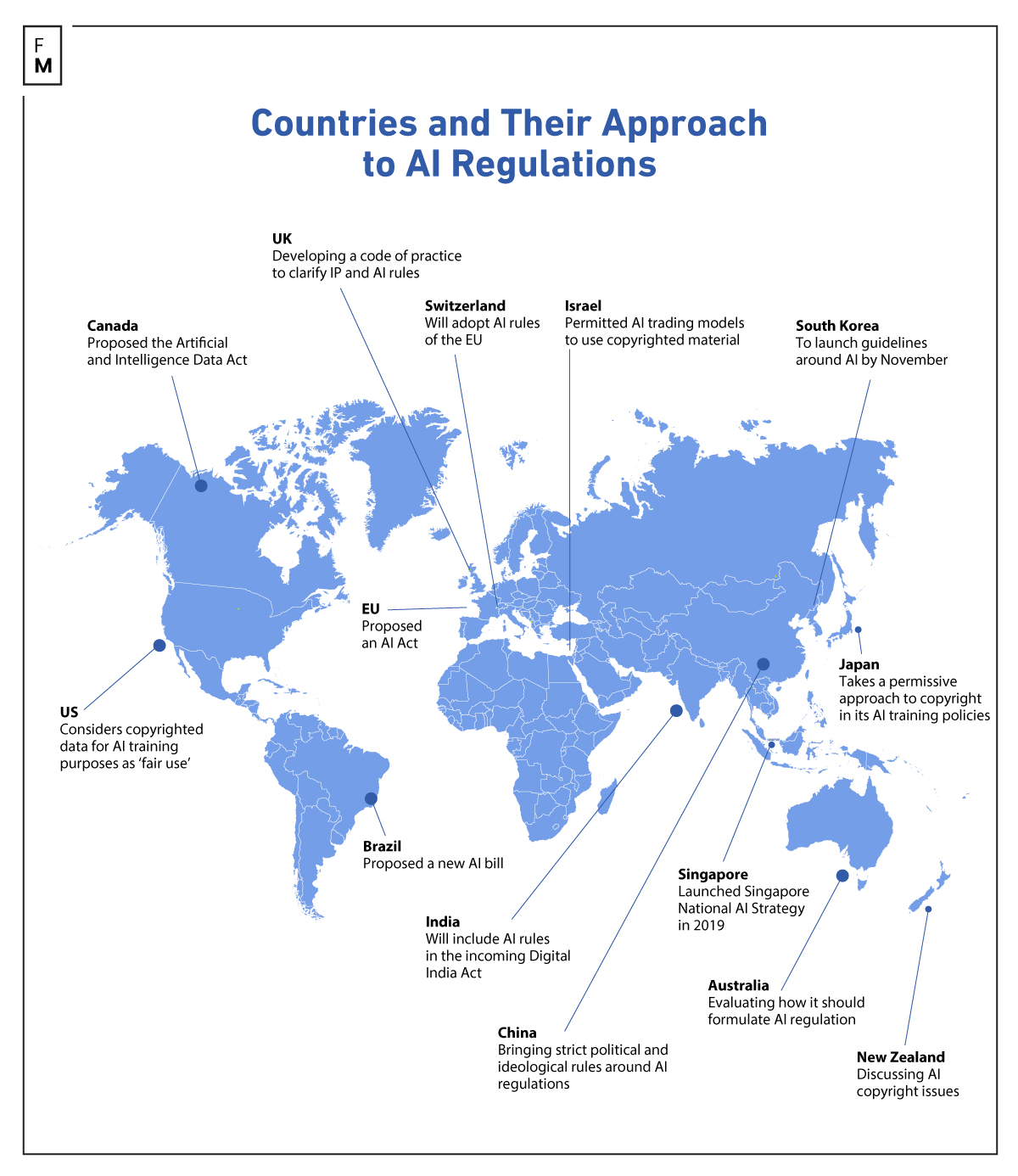
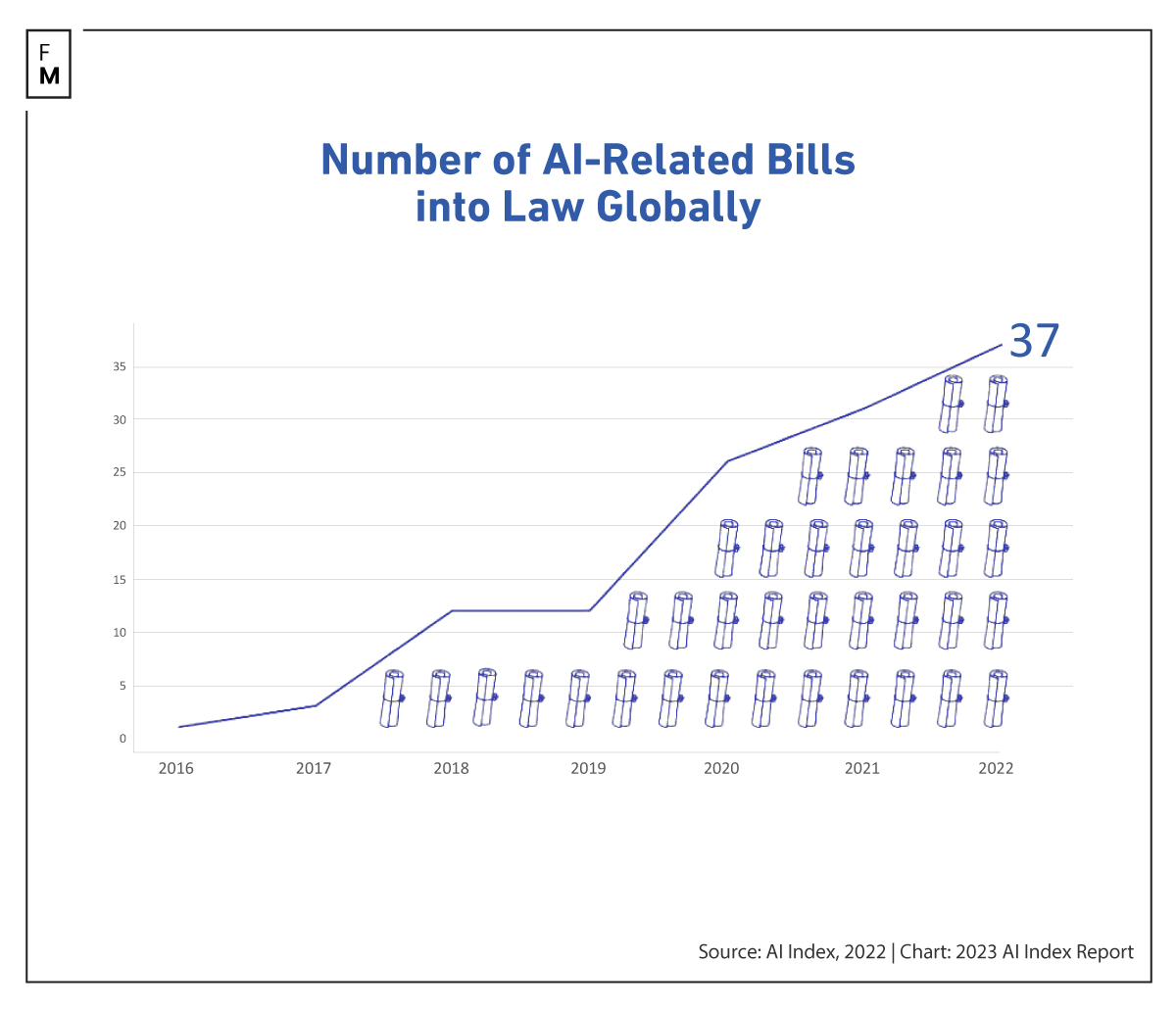
Finance Magnates maps the stance of top countries on laws around AI.
EU remains at the forefront with the proposed AI act.
When it comes to AI and Machine Learning, we are now in uncharted territory on the brink of what promises, according to its advocates, to be a technology as transformative as any in the history of human innovation.
You can find all manner of predictions (both positive and concerning) that once were confined to science fiction, and an upshot of this is that there is now a scramble among government agencies to work out how, or whether, AI can fit into existing laws and regulations. This issue covers a range of fields, but chief among them is Intellectual Property and copyright, in relation to AI training models.
Issues arise in this field because in order to produce useful outputs, AI has to be trained, and that means feeding it with high-quality data. The question then, from a legal perspective, is whether IP and copyright claims apply to the material used for these AI training purposes. This is complicated by the global nature of development, as instead of a universal standard, we currently have a rapidly altering global patchwork of differing attitudes. With that in mind, here are the latest approaches to key regions around the world.
The EU
The EU is in a position to become the first Western region to have an AI regulatory framework in place through a proposed new AI Act. The main focus of the Act is to mitigate risk, with AI systems being broken down into four risk categories (unacceptable risk, high risk, limited risk, minimal/no risk).
An additional copyright-related provision to the proposed Act is being considered, which would require transparency and disclosure around AI training models, including a publicly available summary of any training data used. This issue relates to an existing directive (the Copyright in Digital Single Market directive) which provides copyright exceptions when it comes to some use of text and data mining for commercial purposes, and there are questions now around whether these concepts apply to AI training models.
There are plans for the possible introduction of data mining licenses, which would also cover the use of text and images, with the aim of striking a balance between support and guidance for AI developers, protecting the claims of IP holders. If agreement between the AI and creative sectors cannot be reached through a code of practice (which is the responsibility of the Intellectual Property Office), then the government has indicated that it may follow it up with legislation.
The US
In the United States, there is a relatively laissez-faire and piecemeal approach to AI regulation, which started with a wide-reaching but permissive Obama-era special report called Preparing for the Future of Artificial Intelligence, and has subsequently extended through both the Trump and Biden administrations.
Currently, the use of copyrighted material and data for AI training purposes is regarded as fair use, according to the fair use doctrine, meaning that it does not violate any copyright restrictions, as the source material in question is being used to facilitate the subsequent creation of new and original material and data. Also, if the source material being used is factual data, then this furthers the case that copyright restrictions may not apply.
China
Very strict AI regulations are being rolled out in China. The general rules are overtly political and ideological, including provisions requiring that AI services “adhere to the values of socialism”, alongside bans on AI content or systems that may constitute “incitement to subvert state power”, and there are also measures that, ostensibly, are aimed at combating discrimination.
When it comes to copyright, the landscape is strict as AI systems are required to adhere to IP rights claims on data used in training models, as well as to request consent from IP owners. On a practical level, it’s not clear whether these requirements are actually compatible with efficient AI training, or whether they may instead result in defacto bans on current training models.
Japan
Japan has chosen to take an extremely permissive approach to copyright in its AI training policies, essentially allowing any material to be sourced and utilized by AI training models with no copyright restrictions in place.
This kind of data use is classed as information analysis, while it doesn’t extend to duplication. It also means that for AI training purposes, there is no distinction between commercial and non-commercial use, as well as the fact that data can be obtained from anywhere, even including illegal sites.
This copyright non-enforcement approach perhaps signals the Japanese government’s intent to position the country at the forefront of AI development and other digital innovation, although it remains to be seen whether there is pushback from the creative sector.
South Korea
The South Korean government has set a deadline of November this year by which to launch guidelines and standards around AI, copyright, and IP, although it is not planning for these new provisions to be mandated by law.
The government is organizing events at which industry participants and citizens can discuss these challenges and contribute ideas and opinions. Plus, any guidelines that come into place will be reviewed on an annual basis. The overall aim is to provide clarity and regulate disputes. And, while nothing has been decided yet, an attitude of flexibility has been established.
Singapore
Singapore appears to be openly embracing AI, and the Singapore National AI Strategy, launched in 2019, is enthusiastic about turning Singapore into a hub of AI research and development. This attitude is reflected in the country’s copyright policies, and the Intellectual Property Office has issued an IP and Artificial Intelligence Information Note.
This document is primarily focused on how AI developers can protect their own products and IP, but with regard to AI training, it clarifies that there are copyright exceptions around text and data used in data analysis, regardless of whether this is for commercial or non-commercial use. This would appear, on a practical level, to greenlight AI training without developers concerning themselves with the possibility of IP violations.
Israel
In January this year, the Israel Ministry of Justice released its opinion on the question of whether or not AI training models can utilize copyrighted material and concluded that such use was permitted by existing Israeli copyright laws.
In order to address the issue of AI regulation, Canada has proposed the Artificial and Intelligence Data Act (AIDA), part of which would deal with IP-related considerations, and this topic was also raised in the Canadian government’s earlier Consultation on a Modern Copyright Framework for Artificial Intelligence and the Internet of Things.
Overall, there is a concerted move towards establishing a comprehensive legal framework covering AI in a standardized manner. The Canadian Copyright Act contains provisions for fair use when it comes to specific purposes, one of which is research, but overall, Canada’s position on IP and AI training remains unclear and is still developing.
Australia
Having this year called for industry consultation, the Australian government is currently in the process of evaluating how it should formulate AI regulation. There is pressure from media union the Media, Entertainment and Arts Alliance to bolster copyright protections, while on the other hand, tech giants Google and Microsoft have urged Australian regulators to make copyright exemptions for AI training models.
The Australian Chamber of Commerce and Industry, with agreement from the Communications Alliance lobby group, has recommended that the government introduce voluntary guidance rather than legislation, but on the whole, AI regulation is an ongoing area of public and political debate, and it is not yet clear in which direction the authorities will proceed.
New Zealand
In New Zealand, the discussion around AI copyright issues refers back to the Copyright Act 1994. With regard to work created by a computer, the Act grants authorship of such new materials to the person who arranged for the computer to output the content. These rules predate AI but appear to be relevant and applicable.
When it comes to data used for AI training purposes, New Zealand has a comparatively restricted fair use doctrine, allowing for copyright exceptions when data is used purely for research and private study, for educational purposes, for criticism, review, reporting, or is copied incidentally.
Whether or not these designations can be applied to AI training models has yet to be legally tested, and overall, AI policies remain a grey area in New Zealand, with no clear framework in place.
Switzerland
Since the EU’s AI Act will apply to all products launched in the EU, and EU products will be intended for launch in Switzerland, the Swiss approach will be influenced and shaped by events in the EU.
In 2022, Switzerland’s Federal Department of Foreign Affairs published the Artificial Intelligence and International Rules report, which places emphasis on ensuring the country plays a role in influencing AI guidance globally, and while currently, AI copyright issues remain within the remit of existing Swiss copyright law, Switzerland is paying close attention to developments in the EU and beyond.
India
When it comes to AI in general, India performed a policy U-turn this year. In April, the government stated that there was to be no AI regulation at all, in order to foster a competitive advantage by which the country could innovate quickly. However, fast forward to June, and the plan changed. With regulation to occur as part of the incoming Digital India Act, which is to replace the existing IT Act, has placed emphasis on data protection, and is a companion to the Digital Personal Data Protection Act.
As such, it’s still unclear how AI training in particular will be affected, as the landscape is still evolving. But, it appears that the previously favored entirely hands-off with no regulation approach is set to be replaced. However, to what extent regulation will apply to AI training specifically, is yet to be seen.
Brazil
In Brazil, a comprehensive new AI Bill has been proposed, and there is discussion about how this will tie in with existing data protection laws. Among the protections central to the proposed new laws is the right to privacy and the protection of personal data, which is provided in line with Brazil’s General Data Protection Law.
The bill also includes principles requiring that copyright claims be observed when it comes to data, databases and texts used for the purpose of AI training models, and so it appears, currently, that Brazil is on course to apply familiar kinds of IP regulation to the AI sector.
When it comes to AI and Machine Learning, we are now in uncharted territory on the brink of what promises, according to its advocates, to be a technology as transformative as any in the history of human innovation.
You can find all manner of predictions (both positive and concerning) that once were confined to science fiction, and an upshot of this is that there is now a scramble among government agencies to work out how, or whether, AI can fit into existing laws and regulations. This issue covers a range of fields, but chief among them is Intellectual Property and copyright, in relation to AI training models.
Issues arise in this field because in order to produce useful outputs, AI has to be trained, and that means feeding it with high-quality data. The question then, from a legal perspective, is whether IP and copyright claims apply to the material used for these AI training purposes. This is complicated by the global nature of development, as instead of a universal standard, we currently have a rapidly altering global patchwork of differing attitudes. With that in mind, here are the latest approaches to key regions around the world.
The EU
The EU is in a position to become the first Western region to have an AI regulatory framework in place through a proposed new AI Act. The main focus of the Act is to mitigate risk, with AI systems being broken down into four risk categories (unacceptable risk, high risk, limited risk, minimal/no risk).
An additional copyright-related provision to the proposed Act is being considered, which would require transparency and disclosure around AI training models, including a publicly available summary of any training data used. This issue relates to an existing directive (the Copyright in Digital Single Market directive) which provides copyright exceptions when it comes to some use of text and data mining for commercial purposes, and there are questions now around whether these concepts apply to AI training models.
There are plans for the possible introduction of data mining licenses, which would also cover the use of text and images, with the aim of striking a balance between support and guidance for AI developers, protecting the claims of IP holders. If agreement between the AI and creative sectors cannot be reached through a code of practice (which is the responsibility of the Intellectual Property Office), then the government has indicated that it may follow it up with legislation.
The US
In the United States, there is a relatively laissez-faire and piecemeal approach to AI regulation, which started with a wide-reaching but permissive Obama-era special report called Preparing for the Future of Artificial Intelligence, and has subsequently extended through both the Trump and Biden administrations.
Currently, the use of copyrighted material and data for AI training purposes is regarded as fair use, according to the fair use doctrine, meaning that it does not violate any copyright restrictions, as the source material in question is being used to facilitate the subsequent creation of new and original material and data. Also, if the source material being used is factual data, then this furthers the case that copyright restrictions may not apply.
China
Very strict AI regulations are being rolled out in China. The general rules are overtly political and ideological, including provisions requiring that AI services “adhere to the values of socialism”, alongside bans on AI content or systems that may constitute “incitement to subvert state power”, and there are also measures that, ostensibly, are aimed at combating discrimination.
When it comes to copyright, the landscape is strict as AI systems are required to adhere to IP rights claims on data used in training models, as well as to request consent from IP owners. On a practical level, it’s not clear whether these requirements are actually compatible with efficient AI training, or whether they may instead result in defacto bans on current training models.
Japan
Japan has chosen to take an extremely permissive approach to copyright in its AI training policies, essentially allowing any material to be sourced and utilized by AI training models with no copyright restrictions in place.
This kind of data use is classed as information analysis, while it doesn’t extend to duplication. It also means that for AI training purposes, there is no distinction between commercial and non-commercial use, as well as the fact that data can be obtained from anywhere, even including illegal sites.
This copyright non-enforcement approach perhaps signals the Japanese government’s intent to position the country at the forefront of AI development and other digital innovation, although it remains to be seen whether there is pushback from the creative sector.
South Korea
The South Korean government has set a deadline of November this year by which to launch guidelines and standards around AI, copyright, and IP, although it is not planning for these new provisions to be mandated by law.
The government is organizing events at which industry participants and citizens can discuss these challenges and contribute ideas and opinions. Plus, any guidelines that come into place will be reviewed on an annual basis. The overall aim is to provide clarity and regulate disputes. And, while nothing has been decided yet, an attitude of flexibility has been established.
Singapore
Singapore appears to be openly embracing AI, and the Singapore National AI Strategy, launched in 2019, is enthusiastic about turning Singapore into a hub of AI research and development. This attitude is reflected in the country’s copyright policies, and the Intellectual Property Office has issued an IP and Artificial Intelligence Information Note.
This document is primarily focused on how AI developers can protect their own products and IP, but with regard to AI training, it clarifies that there are copyright exceptions around text and data used in data analysis, regardless of whether this is for commercial or non-commercial use. This would appear, on a practical level, to greenlight AI training without developers concerning themselves with the possibility of IP violations.
Israel
In January this year, the Israel Ministry of Justice released its opinion on the question of whether or not AI training models can utilize copyrighted material and concluded that such use was permitted by existing Israeli copyright laws.
In order to address the issue of AI regulation, Canada has proposed the Artificial and Intelligence Data Act (AIDA), part of which would deal with IP-related considerations, and this topic was also raised in the Canadian government’s earlier Consultation on a Modern Copyright Framework for Artificial Intelligence and the Internet of Things.
Overall, there is a concerted move towards establishing a comprehensive legal framework covering AI in a standardized manner. The Canadian Copyright Act contains provisions for fair use when it comes to specific purposes, one of which is research, but overall, Canada’s position on IP and AI training remains unclear and is still developing.
Australia
Having this year called for industry consultation, the Australian government is currently in the process of evaluating how it should formulate AI regulation. There is pressure from media union the Media, Entertainment and Arts Alliance to bolster copyright protections, while on the other hand, tech giants Google and Microsoft have urged Australian regulators to make copyright exemptions for AI training models.
The Australian Chamber of Commerce and Industry, with agreement from the Communications Alliance lobby group, has recommended that the government introduce voluntary guidance rather than legislation, but on the whole, AI regulation is an ongoing area of public and political debate, and it is not yet clear in which direction the authorities will proceed.
New Zealand
In New Zealand, the discussion around AI copyright issues refers back to the Copyright Act 1994. With regard to work created by a computer, the Act grants authorship of such new materials to the person who arranged for the computer to output the content. These rules predate AI but appear to be relevant and applicable.
When it comes to data used for AI training purposes, New Zealand has a comparatively restricted fair use doctrine, allowing for copyright exceptions when data is used purely for research and private study, for educational purposes, for criticism, review, reporting, or is copied incidentally.
Whether or not these designations can be applied to AI training models has yet to be legally tested, and overall, AI policies remain a grey area in New Zealand, with no clear framework in place.
Switzerland
Since the EU’s AI Act will apply to all products launched in the EU, and EU products will be intended for launch in Switzerland, the Swiss approach will be influenced and shaped by events in the EU.
In 2022, Switzerland’s Federal Department of Foreign Affairs published the Artificial Intelligence and International Rules report, which places emphasis on ensuring the country plays a role in influencing AI guidance globally, and while currently, AI copyright issues remain within the remit of existing Swiss copyright law, Switzerland is paying close attention to developments in the EU and beyond.
India
When it comes to AI in general, India performed a policy U-turn this year. In April, the government stated that there was to be no AI regulation at all, in order to foster a competitive advantage by which the country could innovate quickly. However, fast forward to June, and the plan changed. With regulation to occur as part of the incoming Digital India Act, which is to replace the existing IT Act, has placed emphasis on data protection, and is a companion to the Digital Personal Data Protection Act.
As such, it’s still unclear how AI training in particular will be affected, as the landscape is still evolving. But, it appears that the previously favored entirely hands-off with no regulation approach is set to be replaced. However, to what extent regulation will apply to AI training specifically, is yet to be seen.
Brazil
In Brazil, a comprehensive new AI Bill has been proposed, and there is discussion about how this will tie in with existing data protection laws. Among the protections central to the proposed new laws is the right to privacy and the protection of personal data, which is provided in line with Brazil’s General Data Protection Law.
The bill also includes principles requiring that copyright claims be observed when it comes to data, databases and texts used for the purpose of AI training models, and so it appears, currently, that Brazil is on course to apply familiar kinds of IP regulation to the AI sector.
Sam White is a writer and journalist from the UK who covers cryptocurrencies and web3, with a particular interest in NFTs and the crossover between art and finance. His work, on a wide variety of topics, has appeared on platforms including The Spectator, Vice and Hacker Noon.
Polymarket Replaces Bridged USDC Aiming for a U.S. Relaunch
Featured Videos
FP Markets Winner Spotlight 🏆 | Global Broker of the Year 2025 #Trading #Broker #Innovation #Shorts
FP Markets Winner Spotlight 🏆 | Global Broker of the Year 2025 #Trading #Broker #Innovation #Shorts
FP Markets Winner Spotlight 🏆 | Global Broker of the Year 2025 #Trading #Broker #Innovation #Shorts
FP Markets Winner Spotlight 🏆 | Global Broker of the Year 2025 #Trading #Broker #Innovation #Shorts
FP Markets takes the spotlight as Global Broker of the Year 2025 at the Finance Magnates Awards.
Martin Stoilov, Head of Client Experience, shares that trust, innovation, and people played a key role in the company’s success, supported by a strong foundation of integrity and client-centricity.
Following this milestone, FP Markets continues to focus on growth, technology investment, and its core values of transparency and excellence.
👉 Be part of FM Awards 2026: https://awards.financemagnates.com/#nominate
FP Markets takes the spotlight as Global Broker of the Year 2025 at the Finance Magnates Awards.
Martin Stoilov, Head of Client Experience, shares that trust, innovation, and people played a key role in the company’s success, supported by a strong foundation of integrity and client-centricity.
Following this milestone, FP Markets continues to focus on growth, technology investment, and its core values of transparency and excellence.
👉 Be part of FM Awards 2026: https://awards.financemagnates.com/#nominate
FP Markets takes the spotlight as Global Broker of the Year 2025 at the Finance Magnates Awards.
Martin Stoilov, Head of Client Experience, shares that trust, innovation, and people played a key role in the company’s success, supported by a strong foundation of integrity and client-centricity.
Following this milestone, FP Markets continues to focus on growth, technology investment, and its core values of transparency and excellence.
👉 Be part of FM Awards 2026: https://awards.financemagnates.com/#nominate
FP Markets takes the spotlight as Global Broker of the Year 2025 at the Finance Magnates Awards.
Martin Stoilov, Head of Client Experience, shares that trust, innovation, and people played a key role in the company’s success, supported by a strong foundation of integrity and client-centricity.
Following this milestone, FP Markets continues to focus on growth, technology investment, and its core values of transparency and excellence.
👉 Be part of FM Awards 2026: https://awards.financemagnates.com/#nominate
In this video, we review @HolaPrimeMarketsOfficial, a multi-asset forex and CFDs broker offering different account types, trading platforms, and flexible trading conditions.
We cover the broker’s overall offering, including account options, trading environment, platforms like MT4 and MT5, and additional services such as managed accounts and fast withdrawals.
Watch the full video to see if Hola Prime Markets fits your trading needs.
📣 Stay up to date with the latest in finance and trading. Follow Finance Magnates for industry news, insights, and global event coverage.
Connect with us:
🔗 LinkedIn: /financemagnates
👍 Facebook: /financemagnates
📸 Instagram: https://www.instagram.com/financemagnates
🐦 X: https://x.com/financemagnates
🎥 TikTok: https://www.tiktok.com/tag/financemagnates
▶️ YouTube: /@financemagnates_official
#HolaPrime #ForexBroker #CFDTrading #FinanceMagnates #Trading #Forex #BrokerReview
In this video, we review @HolaPrimeMarketsOfficial, a multi-asset forex and CFDs broker offering different account types, trading platforms, and flexible trading conditions.
We cover the broker’s overall offering, including account options, trading environment, platforms like MT4 and MT5, and additional services such as managed accounts and fast withdrawals.
Watch the full video to see if Hola Prime Markets fits your trading needs.
📣 Stay up to date with the latest in finance and trading. Follow Finance Magnates for industry news, insights, and global event coverage.
Connect with us:
🔗 LinkedIn: /financemagnates
👍 Facebook: /financemagnates
📸 Instagram: https://www.instagram.com/financemagnates
🐦 X: https://x.com/financemagnates
🎥 TikTok: https://www.tiktok.com/tag/financemagnates
▶️ YouTube: /@financemagnates_official
#HolaPrime #ForexBroker #CFDTrading #FinanceMagnates #Trading #Forex #BrokerReview
In this video, we review @HolaPrimeMarketsOfficial, a multi-asset forex and CFDs broker offering different account types, trading platforms, and flexible trading conditions.
We cover the broker’s overall offering, including account options, trading environment, platforms like MT4 and MT5, and additional services such as managed accounts and fast withdrawals.
Watch the full video to see if Hola Prime Markets fits your trading needs.
📣 Stay up to date with the latest in finance and trading. Follow Finance Magnates for industry news, insights, and global event coverage.
Connect with us:
🔗 LinkedIn: /financemagnates
👍 Facebook: /financemagnates
📸 Instagram: https://www.instagram.com/financemagnates
🐦 X: https://x.com/financemagnates
🎥 TikTok: https://www.tiktok.com/tag/financemagnates
▶️ YouTube: /@financemagnates_official
#HolaPrime #ForexBroker #CFDTrading #FinanceMagnates #Trading #Forex #BrokerReview
In this video, we review @HolaPrimeMarketsOfficial, a multi-asset forex and CFDs broker offering different account types, trading platforms, and flexible trading conditions.
We cover the broker’s overall offering, including account options, trading environment, platforms like MT4 and MT5, and additional services such as managed accounts and fast withdrawals.
Watch the full video to see if Hola Prime Markets fits your trading needs.
📣 Stay up to date with the latest in finance and trading. Follow Finance Magnates for industry news, insights, and global event coverage.
Connect with us:
🔗 LinkedIn: /financemagnates
👍 Facebook: /financemagnates
📸 Instagram: https://www.instagram.com/financemagnates
🐦 X: https://x.com/financemagnates
🎥 TikTok: https://www.tiktok.com/tag/financemagnates
▶️ YouTube: /@financemagnates_official
#HolaPrime #ForexBroker #CFDTrading #FinanceMagnates #Trading #Forex #BrokerReview
In this video, we review @HolaPrimeMarketsOfficial, a multi-asset forex and CFDs broker offering different account types, trading platforms, and flexible trading conditions.
We cover the broker’s overall offering, including account options, trading environment, platforms like MT4 and MT5, and additional services such as managed accounts and fast withdrawals.
Watch the full video to see if Hola Prime Markets fits your trading needs.
📣 Stay up to date with the latest in finance and trading. Follow Finance Magnates for industry news, insights, and global event coverage.
Connect with us:
🔗 LinkedIn: /financemagnates
👍 Facebook: /financemagnates
📸 Instagram: https://www.instagram.com/financemagnates
🐦 X: https://x.com/financemagnates
🎥 TikTok: https://www.tiktok.com/tag/financemagnates
▶️ YouTube: /@financemagnates_official
#HolaPrime #ForexBroker #CFDTrading #FinanceMagnates #Trading #Forex #BrokerReview
In this video, we review @HolaPrimeMarketsOfficial, a multi-asset forex and CFDs broker offering different account types, trading platforms, and flexible trading conditions.
We cover the broker’s overall offering, including account options, trading environment, platforms like MT4 and MT5, and additional services such as managed accounts and fast withdrawals.
Watch the full video to see if Hola Prime Markets fits your trading needs.
📣 Stay up to date with the latest in finance and trading. Follow Finance Magnates for industry news, insights, and global event coverage.
Connect with us:
🔗 LinkedIn: /financemagnates
👍 Facebook: /financemagnates
📸 Instagram: https://www.instagram.com/financemagnates
🐦 X: https://x.com/financemagnates
🎥 TikTok: https://www.tiktok.com/tag/financemagnates
▶️ YouTube: /@financemagnates_official
#HolaPrime #ForexBroker #CFDTrading #FinanceMagnates #Trading #Forex #BrokerReview
Hola Prime Review: What You Need to Know | Full Breakdown by Finance Magnates
Hola Prime Review: What You Need to Know | Full Breakdown by Finance Magnates
Hola Prime Review: What You Need to Know | Full Breakdown by Finance Magnates
Hola Prime Review: What You Need to Know | Full Breakdown by Finance Magnates
Hola Prime Review: What You Need to Know | Full Breakdown by Finance Magnates
Hola Prime Review: What You Need to Know | Full Breakdown by Finance Magnates
In this video, we review @HolaPrime_Global, a proprietary trading firm offering evaluation programs and performance-based payouts in simulated market environments.
We cover how the challenge model works, including account types, profit splits (up to 95%), trading rules, and what it takes to reach a funded account. You’ll also learn about available platforms like MT4, MT5, cTrader, and more, along with insights into payouts, support, and trading conditions.
Watch the full video to see if Hola Prime fits your trading style.
📣 Stay up to date with the latest in finance and trading. Follow Finance Magnates for industry news, insights, and global event coverage.
Connect with us:
🔗 LinkedIn: /financemagnates
👍 Facebook: /financemagnates
📸 Instagram: https://www.instagram.com/financemagnates
🐦 X: https://x.com/financemagnates
🎥 TikTok: https://www.tiktok.com/tag/financemagnates
▶️ YouTube: /@financemagnates_official
#HolaPrime #PropFirm #Trading #FinanceMagnates #Forex #FuturesTrading #TradingReview #PropFirmReview
In this video, we review @HolaPrime_Global, a proprietary trading firm offering evaluation programs and performance-based payouts in simulated market environments.
We cover how the challenge model works, including account types, profit splits (up to 95%), trading rules, and what it takes to reach a funded account. You’ll also learn about available platforms like MT4, MT5, cTrader, and more, along with insights into payouts, support, and trading conditions.
Watch the full video to see if Hola Prime fits your trading style.
📣 Stay up to date with the latest in finance and trading. Follow Finance Magnates for industry news, insights, and global event coverage.
Connect with us:
🔗 LinkedIn: /financemagnates
👍 Facebook: /financemagnates
📸 Instagram: https://www.instagram.com/financemagnates
🐦 X: https://x.com/financemagnates
🎥 TikTok: https://www.tiktok.com/tag/financemagnates
▶️ YouTube: /@financemagnates_official
#HolaPrime #PropFirm #Trading #FinanceMagnates #Forex #FuturesTrading #TradingReview #PropFirmReview
In this video, we review @HolaPrime_Global, a proprietary trading firm offering evaluation programs and performance-based payouts in simulated market environments.
We cover how the challenge model works, including account types, profit splits (up to 95%), trading rules, and what it takes to reach a funded account. You’ll also learn about available platforms like MT4, MT5, cTrader, and more, along with insights into payouts, support, and trading conditions.
Watch the full video to see if Hola Prime fits your trading style.
📣 Stay up to date with the latest in finance and trading. Follow Finance Magnates for industry news, insights, and global event coverage.
Connect with us:
🔗 LinkedIn: /financemagnates
👍 Facebook: /financemagnates
📸 Instagram: https://www.instagram.com/financemagnates
🐦 X: https://x.com/financemagnates
🎥 TikTok: https://www.tiktok.com/tag/financemagnates
▶️ YouTube: /@financemagnates_official
#HolaPrime #PropFirm #Trading #FinanceMagnates #Forex #FuturesTrading #TradingReview #PropFirmReview
In this video, we review @HolaPrime_Global, a proprietary trading firm offering evaluation programs and performance-based payouts in simulated market environments.
We cover how the challenge model works, including account types, profit splits (up to 95%), trading rules, and what it takes to reach a funded account. You’ll also learn about available platforms like MT4, MT5, cTrader, and more, along with insights into payouts, support, and trading conditions.
Watch the full video to see if Hola Prime fits your trading style.
📣 Stay up to date with the latest in finance and trading. Follow Finance Magnates for industry news, insights, and global event coverage.
Connect with us:
🔗 LinkedIn: /financemagnates
👍 Facebook: /financemagnates
📸 Instagram: https://www.instagram.com/financemagnates
🐦 X: https://x.com/financemagnates
🎥 TikTok: https://www.tiktok.com/tag/financemagnates
▶️ YouTube: /@financemagnates_official
#HolaPrime #PropFirm #Trading #FinanceMagnates #Forex #FuturesTrading #TradingReview #PropFirmReview
In this video, we review @HolaPrime_Global, a proprietary trading firm offering evaluation programs and performance-based payouts in simulated market environments.
We cover how the challenge model works, including account types, profit splits (up to 95%), trading rules, and what it takes to reach a funded account. You’ll also learn about available platforms like MT4, MT5, cTrader, and more, along with insights into payouts, support, and trading conditions.
Watch the full video to see if Hola Prime fits your trading style.
📣 Stay up to date with the latest in finance and trading. Follow Finance Magnates for industry news, insights, and global event coverage.
Connect with us:
🔗 LinkedIn: /financemagnates
👍 Facebook: /financemagnates
📸 Instagram: https://www.instagram.com/financemagnates
🐦 X: https://x.com/financemagnates
🎥 TikTok: https://www.tiktok.com/tag/financemagnates
▶️ YouTube: /@financemagnates_official
#HolaPrime #PropFirm #Trading #FinanceMagnates #Forex #FuturesTrading #TradingReview #PropFirmReview
In this video, we review @HolaPrime_Global, a proprietary trading firm offering evaluation programs and performance-based payouts in simulated market environments.
We cover how the challenge model works, including account types, profit splits (up to 95%), trading rules, and what it takes to reach a funded account. You’ll also learn about available platforms like MT4, MT5, cTrader, and more, along with insights into payouts, support, and trading conditions.
Watch the full video to see if Hola Prime fits your trading style.
📣 Stay up to date with the latest in finance and trading. Follow Finance Magnates for industry news, insights, and global event coverage.
Connect with us:
🔗 LinkedIn: /financemagnates
👍 Facebook: /financemagnates
📸 Instagram: https://www.instagram.com/financemagnates
🐦 X: https://x.com/financemagnates
🎥 TikTok: https://www.tiktok.com/tag/financemagnates
▶️ YouTube: /@financemagnates_official
#HolaPrime #PropFirm #Trading #FinanceMagnates #Forex #FuturesTrading #TradingReview #PropFirmReview
Axi Winner Spotlight 🏆 | Global Most Innovative Broker 2025 #Innovation #Trading #Fintech #Broker
Axi Winner Spotlight 🏆 | Global Most Innovative Broker 2025 #Innovation #Trading #Fintech #Broker
Axi Winner Spotlight 🏆 | Global Most Innovative Broker 2025 #Innovation #Trading #Fintech #Broker
Axi Winner Spotlight 🏆 | Global Most Innovative Broker 2025 #Innovation #Trading #Fintech #Broker
Axi Winner Spotlight 🏆 | Global Most Innovative Broker 2025 #Innovation #Trading #Fintech #Broker
Axi Winner Spotlight 🏆 | Global Most Innovative Broker 2025 #Innovation #Trading #Fintech #Broker
Axi takes the spotlight at the Finance Magnates Awards, winning Global Most Innovative Broker 2025.
Olivia Xenofontos and Ivanna Openko share how the team will feel: proud, motivated, and ready to keep delivering.
They also describe the night as well-organized, focused, and enjoyable for all.
👉 Be part of FM Awards 2026.
Axi takes the spotlight at the Finance Magnates Awards, winning Global Most Innovative Broker 2025.
Olivia Xenofontos and Ivanna Openko share how the team will feel: proud, motivated, and ready to keep delivering.
They also describe the night as well-organized, focused, and enjoyable for all.
👉 Be part of FM Awards 2026.
Axi takes the spotlight at the Finance Magnates Awards, winning Global Most Innovative Broker 2025.
Olivia Xenofontos and Ivanna Openko share how the team will feel: proud, motivated, and ready to keep delivering.
They also describe the night as well-organized, focused, and enjoyable for all.
👉 Be part of FM Awards 2026.
Axi takes the spotlight at the Finance Magnates Awards, winning Global Most Innovative Broker 2025.
Olivia Xenofontos and Ivanna Openko share how the team will feel: proud, motivated, and ready to keep delivering.
They also describe the night as well-organized, focused, and enjoyable for all.
👉 Be part of FM Awards 2026.
Axi takes the spotlight at the Finance Magnates Awards, winning Global Most Innovative Broker 2025.
Olivia Xenofontos and Ivanna Openko share how the team will feel: proud, motivated, and ready to keep delivering.
They also describe the night as well-organized, focused, and enjoyable for all.
👉 Be part of FM Awards 2026.
Axi takes the spotlight at the Finance Magnates Awards, winning Global Most Innovative Broker 2025.
Olivia Xenofontos and Ivanna Openko share how the team will feel: proud, motivated, and ready to keep delivering.
They also describe the night as well-organized, focused, and enjoyable for all.
👉 Be part of FM Awards 2026.
Recognition that matters.
Built on transparency.
Driven by the industry.
The Finance Magnates Awards 2026.
Nominations are now open.
🔗 https://awards.financemagnates.com/?utm_source=SM&utm_medium=social&utm_campaign=recognition-matters
Recognition that matters.
Built on transparency.
Driven by the industry.
The Finance Magnates Awards 2026.
Nominations are now open.
🔗 https://awards.financemagnates.com/?utm_source=SM&utm_medium=social&utm_campaign=recognition-matters
Recognition that matters.
Built on transparency.
Driven by the industry.
The Finance Magnates Awards 2026.
Nominations are now open.
🔗 https://awards.financemagnates.com/?utm_source=SM&utm_medium=social&utm_campaign=recognition-matters
Recognition that matters.
Built on transparency.
Driven by the industry.
The Finance Magnates Awards 2026.
Nominations are now open.
🔗 https://awards.financemagnates.com/?utm_source=SM&utm_medium=social&utm_campaign=recognition-matters
Recognition that matters.
Built on transparency.
Driven by the industry.
The Finance Magnates Awards 2026.
Nominations are now open.
🔗 https://awards.financemagnates.com/?utm_source=SM&utm_medium=social&utm_campaign=recognition-matters
Recognition that matters.
Built on transparency.
Driven by the industry.
The Finance Magnates Awards 2026.
Nominations are now open.
🔗 https://awards.financemagnates.com/?utm_source=SM&utm_medium=social&utm_campaign=recognition-matters