In 2025 there will be SEC changes, BTC reserve discussion, and possible further ETF growth.
There is likely also to be stable coin and RWA expansion, while crypto and AI interlink.
2024 has been one of the most positively eventful ever in the history of crypto, with three key occurrences that are likely to be remembered as particularly significant. First, the launch of spot Bitcoin ETFs back in January, followed also by spot ETH ETFs mid-year. Second, the election in November of a US president who is openly supportive of crypto and has clearly signalling a crypto-friendly approach, and third, bitcoin in December breaking the milestone $100,000 price target.
From that basis then, let’s look at some predictions about what may be incoming in 2025, and try to assess whether next year will be as ground-breaking for crypto as 2024 has proven to be.
Strategic Bitcoin Reserve Splits Opinion
Speaking at the Bitcoin Conference 2024 back in July, Trump made pledges to stockpile bitcoin, leading to speculation about a US strategic bitcoin reserve, but is this actually viable or beneficial for the US? Currently, it still seems like a long-shot, and what’s more, it’s dividing opinion even among BTC advocates.
The national debt grows every day thanks to Washington’s spending addiction. My strategic bitcoin reserve constructs a resilient financial system to eliminate the debt. We need the #BITCOINAct ! https://t.co/nQtI4RuQ6F
On the one hand, we have Senator Cynthia Lummis driving momentum in favor of the idea, while at the same time, Nic Carter–who is well known for his early exposal of the alleged anti-crypto banking strategy known as Operation Choke Point 2.0–is presenting the case against establishing a bitcoin reserve strategy.
While we can’t yet know how this one plays out, it’s likely that debate will heat up as Donald Trump’s inauguration nears, and we might see increased reference to potential competition from other BTC-holding nations.
Also, regardless of whether speculation about a bitcoin reserve actually leads to a concrete plan, there is no doubt that a firmly pro-crypto administration is on the way, with David Sacks taking on a new role as AI and Crypto Czar, Scott Bessent as Treasury Secretary, and Howard Lutnick as Commerce Secretary.
ETFs Carry On From Explosive Start
The spot Bitcoin ETFs that launched in January 2024 now collectively hold over $110 billion in assets under management, while the spot Ether ETFs that followed in July have topped $12 billion in assets under management, and we can expect that this explosive start for the Bitcoin products, with Ethereum playing catch up, can continue into 2025. The case for continued growth has been bolstered also by BlackRock recently recommending up to a 2% BTC portfolio allocation, with any uncertainty around how the ETFs would perform now dispelled.
There may also be changes to the ETFs themselves, with anticipation that both the Bitcoin and Ether products will alter to allow in-kind redemptions while the ETH products will incorporate staking, and these adaptations may potentially fuel increased interest, as long as the overall crypto market structure remains bullish.
🚨 NEW: SEC Commissioner Hester Pierce says she’s open to reconsidering both in-kind redemptions for Bitcoin and Ethereum ETFs as well as staking. pic.twitter.com/OM8NbHHSnu
Related to the political changes outlined above, the new year–after Trump takes office–will bring a change of leadership at the SEC. Current Chair Gary Gensler is on his way out, and his departure should bring an end to the Commission’s adversarial approach to the crypto industry.
Incoming as the new Chair is Paul Atkins, as announced by Trump at the start of December. Atkins is a free-market-minded former Commissioner at the SEC and a member of crypto advocacy group Token Alliance, and the decision to appoint him was greeted with enthusiasm by crypto industry execs, including Coinbase CLO Paul Grewal, who stated,
“We appreciate his commitment to balance in regulating U.S. securities markets and look forward to his fresh leadership”.
This anticipated change of direction at the SEC also increases the likelihood of further crypto ETPs for various other coins, with XRP, LTC, HBAR and SOL all noted contenders for inclusion.
Stable Coin Market Cap Grows
During 2024, the total stable coin market cap grew by almost 50% to $193 billion, and it’s plausible that this expansion continues in the new year. In fact, back in April 2024, Bernstein published a research report in which it stated that the stable coin market can reach $2.8 trillion over the next five years, alongside a prediction (according to that report) for, “Major global financial and consumer platforms to issue co-branded stable coins to power value-exchange on their platforms”.
Asset manager VanEck has also predicted that stable coins are set to “revolutionize payments”, with an expectation that stable coin settlement volumes will triple from current levels to hit $300 billion per day by the end of 2025, while Bitwise predicts a doubling in the stable coin market cap by the end of 2025.
RWA Tokenization Expands
The tokenization of real-world assets (RWAs) started gaining increased attention in 2024, thanks in part to BlackRock CEO Larry Fink speaking very positively, early in the year, about “the tokenization of financial assets”, and outlining how all stocks and bonds can be tokenized.
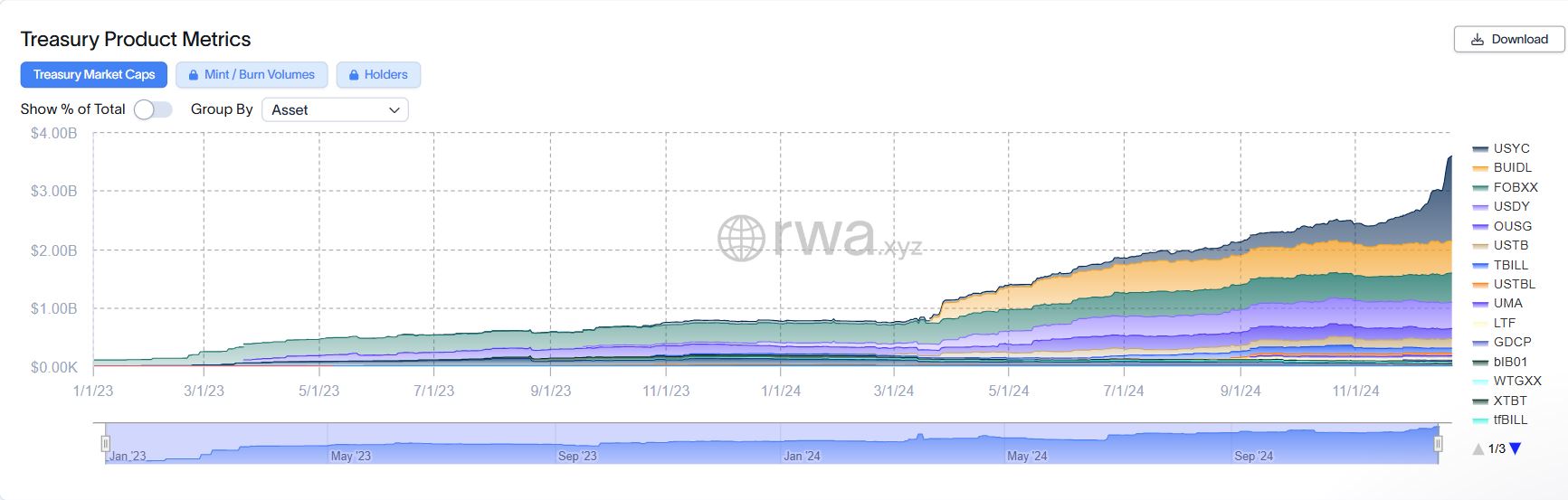
BlackRock later in the year, in partnership with Securitize, launched the BUIDL fund, which invests in tokenized US Treasuries. However, at the end of the year BUIDL was overtaken as the top tokenized Treasuries product by Hashnote, whose USYC token represents tokenized RWAs in the Hashnote International Short Duration Yield Fund, and acts as the backing for stablecoin USD0, which itself is issued by a DeFi protocol called Usual.
With the RWA sector showing plenty of utility and innovation as 2024 draws to a close, and with connections being made being platforms–as at Hashnote and Usual–we can therefore expect 2025 to bring further growth for tokenized RWA products.
Treasury Product Metrics; Source: RWA.xyz
AI and Crypto Interlink
The crypto sector is likely–in places, at least–to become increasingly influenced by and interlinked with AI progression, continuing a trend that has started to emerge in 2024. In fact, a novel new sector within the crypto ecosystem has already developed, which started out related to meme coins, but has subsequently branched off to focus on what are being classified as AI Agent Coins.
These projects incorporate elements of meme coins, but coupled with autonomous, or partly autonomous, AI agents that may be able to take on a variety of roles. There are also AI agent launchpads and infrastructure being built, with some developments branching off into art and music to create an unpredictable, culture-centric niche that is reminiscent of NFTs in 2021/22.
2024 has been one of the most positively eventful ever in the history of crypto, with three key occurrences that are likely to be remembered as particularly significant. First, the launch of spot Bitcoin ETFs back in January, followed also by spot ETH ETFs mid-year. Second, the election in November of a US president who is openly supportive of crypto and has clearly signalling a crypto-friendly approach, and third, bitcoin in December breaking the milestone $100,000 price target.
From that basis then, let’s look at some predictions about what may be incoming in 2025, and try to assess whether next year will be as ground-breaking for crypto as 2024 has proven to be.
Strategic Bitcoin Reserve Splits Opinion
Speaking at the Bitcoin Conference 2024 back in July, Trump made pledges to stockpile bitcoin, leading to speculation about a US strategic bitcoin reserve, but is this actually viable or beneficial for the US? Currently, it still seems like a long-shot, and what’s more, it’s dividing opinion even among BTC advocates.
The national debt grows every day thanks to Washington’s spending addiction. My strategic bitcoin reserve constructs a resilient financial system to eliminate the debt. We need the #BITCOINAct ! https://t.co/nQtI4RuQ6F
On the one hand, we have Senator Cynthia Lummis driving momentum in favor of the idea, while at the same time, Nic Carter–who is well known for his early exposal of the alleged anti-crypto banking strategy known as Operation Choke Point 2.0–is presenting the case against establishing a bitcoin reserve strategy.
While we can’t yet know how this one plays out, it’s likely that debate will heat up as Donald Trump’s inauguration nears, and we might see increased reference to potential competition from other BTC-holding nations.
Also, regardless of whether speculation about a bitcoin reserve actually leads to a concrete plan, there is no doubt that a firmly pro-crypto administration is on the way, with David Sacks taking on a new role as AI and Crypto Czar, Scott Bessent as Treasury Secretary, and Howard Lutnick as Commerce Secretary.
ETFs Carry On From Explosive Start
The spot Bitcoin ETFs that launched in January 2024 now collectively hold over $110 billion in assets under management, while the spot Ether ETFs that followed in July have topped $12 billion in assets under management, and we can expect that this explosive start for the Bitcoin products, with Ethereum playing catch up, can continue into 2025. The case for continued growth has been bolstered also by BlackRock recently recommending up to a 2% BTC portfolio allocation, with any uncertainty around how the ETFs would perform now dispelled.
There may also be changes to the ETFs themselves, with anticipation that both the Bitcoin and Ether products will alter to allow in-kind redemptions while the ETH products will incorporate staking, and these adaptations may potentially fuel increased interest, as long as the overall crypto market structure remains bullish.
🚨 NEW: SEC Commissioner Hester Pierce says she’s open to reconsidering both in-kind redemptions for Bitcoin and Ethereum ETFs as well as staking. pic.twitter.com/OM8NbHHSnu
Related to the political changes outlined above, the new year–after Trump takes office–will bring a change of leadership at the SEC. Current Chair Gary Gensler is on his way out, and his departure should bring an end to the Commission’s adversarial approach to the crypto industry.
Incoming as the new Chair is Paul Atkins, as announced by Trump at the start of December. Atkins is a free-market-minded former Commissioner at the SEC and a member of crypto advocacy group Token Alliance, and the decision to appoint him was greeted with enthusiasm by crypto industry execs, including Coinbase CLO Paul Grewal, who stated,
“We appreciate his commitment to balance in regulating U.S. securities markets and look forward to his fresh leadership”.
This anticipated change of direction at the SEC also increases the likelihood of further crypto ETPs for various other coins, with XRP, LTC, HBAR and SOL all noted contenders for inclusion.
Stable Coin Market Cap Grows
During 2024, the total stable coin market cap grew by almost 50% to $193 billion, and it’s plausible that this expansion continues in the new year. In fact, back in April 2024, Bernstein published a research report in which it stated that the stable coin market can reach $2.8 trillion over the next five years, alongside a prediction (according to that report) for, “Major global financial and consumer platforms to issue co-branded stable coins to power value-exchange on their platforms”.
Asset manager VanEck has also predicted that stable coins are set to “revolutionize payments”, with an expectation that stable coin settlement volumes will triple from current levels to hit $300 billion per day by the end of 2025, while Bitwise predicts a doubling in the stable coin market cap by the end of 2025.
RWA Tokenization Expands
The tokenization of real-world assets (RWAs) started gaining increased attention in 2024, thanks in part to BlackRock CEO Larry Fink speaking very positively, early in the year, about “the tokenization of financial assets”, and outlining how all stocks and bonds can be tokenized.
BlackRock later in the year, in partnership with Securitize, launched the BUIDL fund, which invests in tokenized US Treasuries. However, at the end of the year BUIDL was overtaken as the top tokenized Treasuries product by Hashnote, whose USYC token represents tokenized RWAs in the Hashnote International Short Duration Yield Fund, and acts as the backing for stablecoin USD0, which itself is issued by a DeFi protocol called Usual.
With the RWA sector showing plenty of utility and innovation as 2024 draws to a close, and with connections being made being platforms–as at Hashnote and Usual–we can therefore expect 2025 to bring further growth for tokenized RWA products.
Treasury Product Metrics; Source: RWA.xyz
AI and Crypto Interlink
The crypto sector is likely–in places, at least–to become increasingly influenced by and interlinked with AI progression, continuing a trend that has started to emerge in 2024. In fact, a novel new sector within the crypto ecosystem has already developed, which started out related to meme coins, but has subsequently branched off to focus on what are being classified as AI Agent Coins.
These projects incorporate elements of meme coins, but coupled with autonomous, or partly autonomous, AI agents that may be able to take on a variety of roles. There are also AI agent launchpads and infrastructure being built, with some developments branching off into art and music to create an unpredictable, culture-centric niche that is reminiscent of NFTs in 2021/22.
Sam White is a writer and journalist from the UK who covers cryptocurrencies and web3, with a particular interest in NFTs and the crossover between art and finance. His work, on a wide variety of topics, has appeared on platforms including The Spectator, Vice and Hacker Noon.
OKX Turns Infrastructure Partners into Investors at $25 Billion Valuation
Featured Videos
AvaTrade to Acquire Most of FXCM; NAGA Raises $8M
AvaTrade to Acquire Most of FXCM; NAGA Raises $8M
AvaTrade to Acquire Most of FXCM; NAGA Raises $8M
AvaTrade to Acquire Most of FXCM; NAGA Raises $8M
Today’s financial news recap covers AvaTrade agrees to acquire most of FXCM, NAGA secures eight million dollars in new financing, and Wise seeks a tax settlement in the UK.
Finance Magnates Daily Recap brings you the latest news from forex and CFD brokers, fintech, payments, cryptocurrency, digital assets, trading platforms, financial regulation and global markets.
Get the key company news, executive moves, deals, regulatory updates and market developments of the day, in just a few minutes. New episodes published every weekday.
Read more: https://www.financemagnates.com
#FinanceMagnates #ForexNews #FintechNews
Today’s financial news recap covers AvaTrade agrees to acquire most of FXCM, NAGA secures eight million dollars in new financing, and Wise seeks a tax settlement in the UK.
Finance Magnates Daily Recap brings you the latest news from forex and CFD brokers, fintech, payments, cryptocurrency, digital assets, trading platforms, financial regulation and global markets.
Get the key company news, executive moves, deals, regulatory updates and market developments of the day, in just a few minutes. New episodes published every weekday.
Read more: https://www.financemagnates.com
#FinanceMagnates #ForexNews #FintechNews
Today’s financial news recap covers AvaTrade agrees to acquire most of FXCM, NAGA secures eight million dollars in new financing, and Wise seeks a tax settlement in the UK.
Finance Magnates Daily Recap brings you the latest news from forex and CFD brokers, fintech, payments, cryptocurrency, digital assets, trading platforms, financial regulation and global markets.
Get the key company news, executive moves, deals, regulatory updates and market developments of the day, in just a few minutes. New episodes published every weekday.
Read more: https://www.financemagnates.com
#FinanceMagnates #ForexNews #FintechNews
Today’s financial news recap covers AvaTrade agrees to acquire most of FXCM, NAGA secures eight million dollars in new financing, and Wise seeks a tax settlement in the UK.
Finance Magnates Daily Recap brings you the latest news from forex and CFD brokers, fintech, payments, cryptocurrency, digital assets, trading platforms, financial regulation and global markets.
Get the key company news, executive moves, deals, regulatory updates and market developments of the day, in just a few minutes. New episodes published every weekday.
Read more: https://www.financemagnates.com
#FinanceMagnates #ForexNews #FintechNews
XTB Adds Overnight US Stock Trading; Nasdaq Ventures Invests in One Trading
XTB Adds Overnight US Stock Trading; Nasdaq Ventures Invests in One Trading
XTB Adds Overnight US Stock Trading; Nasdaq Ventures Invests in One Trading
XTB Adds Overnight US Stock Trading; Nasdaq Ventures Invests in One Trading
XTB Adds Overnight US Stock Trading; Nasdaq Ventures Invests in One Trading
XTB Adds Overnight US Stock Trading; Nasdaq Ventures Invests in One Trading
Today’s financial news recap covers XTB expands overnight US stock trading, Fortrade reports higher revenue, Nasdaq backs One Trading, and Vest Labs raises 13 million dollars.
Finance Magnates Daily Recap brings you the latest news from forex and CFD brokers, fintech, payments, cryptocurrency, digital assets, trading platforms, financial regulation and global markets.
Get the key company news, executive moves, deals, regulatory updates and market developments of the day, in just a few minutes. New episodes published every weekday.
Read more: https://www.financemagnates.com
#FinanceMagnates #ForexNews #FintechNews
Today’s financial news recap covers XTB expands overnight US stock trading, Fortrade reports higher revenue, Nasdaq backs One Trading, and Vest Labs raises 13 million dollars.
Finance Magnates Daily Recap brings you the latest news from forex and CFD brokers, fintech, payments, cryptocurrency, digital assets, trading platforms, financial regulation and global markets.
Get the key company news, executive moves, deals, regulatory updates and market developments of the day, in just a few minutes. New episodes published every weekday.
Read more: https://www.financemagnates.com
#FinanceMagnates #ForexNews #FintechNews
Today’s financial news recap covers XTB expands overnight US stock trading, Fortrade reports higher revenue, Nasdaq backs One Trading, and Vest Labs raises 13 million dollars.
Finance Magnates Daily Recap brings you the latest news from forex and CFD brokers, fintech, payments, cryptocurrency, digital assets, trading platforms, financial regulation and global markets.
Get the key company news, executive moves, deals, regulatory updates and market developments of the day, in just a few minutes. New episodes published every weekday.
Read more: https://www.financemagnates.com
#FinanceMagnates #ForexNews #FintechNews
Today’s financial news recap covers XTB expands overnight US stock trading, Fortrade reports higher revenue, Nasdaq backs One Trading, and Vest Labs raises 13 million dollars.
Finance Magnates Daily Recap brings you the latest news from forex and CFD brokers, fintech, payments, cryptocurrency, digital assets, trading platforms, financial regulation and global markets.
Get the key company news, executive moves, deals, regulatory updates and market developments of the day, in just a few minutes. New episodes published every weekday.
Read more: https://www.financemagnates.com
#FinanceMagnates #ForexNews #FintechNews
Today’s financial news recap covers XTB expands overnight US stock trading, Fortrade reports higher revenue, Nasdaq backs One Trading, and Vest Labs raises 13 million dollars.
Finance Magnates Daily Recap brings you the latest news from forex and CFD brokers, fintech, payments, cryptocurrency, digital assets, trading platforms, financial regulation and global markets.
Get the key company news, executive moves, deals, regulatory updates and market developments of the day, in just a few minutes. New episodes published every weekday.
Read more: https://www.financemagnates.com
#FinanceMagnates #ForexNews #FintechNews
Today’s financial news recap covers XTB expands overnight US stock trading, Fortrade reports higher revenue, Nasdaq backs One Trading, and Vest Labs raises 13 million dollars.
Finance Magnates Daily Recap brings you the latest news from forex and CFD brokers, fintech, payments, cryptocurrency, digital assets, trading platforms, financial regulation and global markets.
Get the key company news, executive moves, deals, regulatory updates and market developments of the day, in just a few minutes. New episodes published every weekday.
Read more: https://www.financemagnates.com
#FinanceMagnates #ForexNews #FintechNews
CMC Founder Downplays Volatility Hit; Devexperts Names CEO
CMC Founder Downplays Volatility Hit; Devexperts Names CEO
CMC Founder Downplays Volatility Hit; Devexperts Names CEO
CMC Founder Downplays Volatility Hit; Devexperts Names CEO
CMC Founder Downplays Volatility Hit; Devexperts Names CEO
CMC Founder Downplays Volatility Hit; Devexperts Names CEO
Today’s financial news recap covers low volatility pressures brokers, Devexperts names a new CEO, Saxo cuts onboarding time, and OKX reaches a 25 billion dollar valuation.
Finance Magnates Daily Recap brings you the latest news from forex and CFD brokers, fintech, payments, cryptocurrency, digital assets, trading platforms, financial regulation and global markets.
Get the key company news, executive moves, deals, regulatory updates and market developments of the day, in just a few minutes. New episodes published every weekday.
Read more: https://www.financemagnates.com
#FinanceMagnates #ForexNews #FintechNews
Today’s financial news recap covers low volatility pressures brokers, Devexperts names a new CEO, Saxo cuts onboarding time, and OKX reaches a 25 billion dollar valuation.
Finance Magnates Daily Recap brings you the latest news from forex and CFD brokers, fintech, payments, cryptocurrency, digital assets, trading platforms, financial regulation and global markets.
Get the key company news, executive moves, deals, regulatory updates and market developments of the day, in just a few minutes. New episodes published every weekday.
Read more: https://www.financemagnates.com
#FinanceMagnates #ForexNews #FintechNews
Today’s financial news recap covers low volatility pressures brokers, Devexperts names a new CEO, Saxo cuts onboarding time, and OKX reaches a 25 billion dollar valuation.
Finance Magnates Daily Recap brings you the latest news from forex and CFD brokers, fintech, payments, cryptocurrency, digital assets, trading platforms, financial regulation and global markets.
Get the key company news, executive moves, deals, regulatory updates and market developments of the day, in just a few minutes. New episodes published every weekday.
Read more: https://www.financemagnates.com
#FinanceMagnates #ForexNews #FintechNews
Today’s financial news recap covers low volatility pressures brokers, Devexperts names a new CEO, Saxo cuts onboarding time, and OKX reaches a 25 billion dollar valuation.
Finance Magnates Daily Recap brings you the latest news from forex and CFD brokers, fintech, payments, cryptocurrency, digital assets, trading platforms, financial regulation and global markets.
Get the key company news, executive moves, deals, regulatory updates and market developments of the day, in just a few minutes. New episodes published every weekday.
Read more: https://www.financemagnates.com
#FinanceMagnates #ForexNews #FintechNews
Today’s financial news recap covers low volatility pressures brokers, Devexperts names a new CEO, Saxo cuts onboarding time, and OKX reaches a 25 billion dollar valuation.
Finance Magnates Daily Recap brings you the latest news from forex and CFD brokers, fintech, payments, cryptocurrency, digital assets, trading platforms, financial regulation and global markets.
Get the key company news, executive moves, deals, regulatory updates and market developments of the day, in just a few minutes. New episodes published every weekday.
Read more: https://www.financemagnates.com
#FinanceMagnates #ForexNews #FintechNews
Today’s financial news recap covers low volatility pressures brokers, Devexperts names a new CEO, Saxo cuts onboarding time, and OKX reaches a 25 billion dollar valuation.
Finance Magnates Daily Recap brings you the latest news from forex and CFD brokers, fintech, payments, cryptocurrency, digital assets, trading platforms, financial regulation and global markets.
Get the key company news, executive moves, deals, regulatory updates and market developments of the day, in just a few minutes. New episodes published every weekday.
Read more: https://www.financemagnates.com
#FinanceMagnates #ForexNews #FintechNews
Today’s financial news recap covers Trade Nation buys FXCM's UK client book, Trading 212 reports higher revenue, the CFTC's move to allow perpetual index futures.
Finance Magnates Daily Recap brings you the latest news from forex and CFD brokers, fintech, payments, cryptocurrency, digital assets, trading platforms, financial regulation and global markets.
Get the key company news, executive moves, deals, regulatory updates and market developments of the day, in just a few minutes. New episodes published every weekday.
Read more: https://www.financemagnates.com
#FinanceMagnates #ForexNews #FintechNews
Today’s financial news recap covers Trade Nation buys FXCM's UK client book, Trading 212 reports higher revenue, the CFTC's move to allow perpetual index futures.
Finance Magnates Daily Recap brings you the latest news from forex and CFD brokers, fintech, payments, cryptocurrency, digital assets, trading platforms, financial regulation and global markets.
Get the key company news, executive moves, deals, regulatory updates and market developments of the day, in just a few minutes. New episodes published every weekday.
Read more: https://www.financemagnates.com
#FinanceMagnates #ForexNews #FintechNews
Today’s financial news recap covers Trade Nation buys FXCM's UK client book, Trading 212 reports higher revenue, the CFTC's move to allow perpetual index futures.
Finance Magnates Daily Recap brings you the latest news from forex and CFD brokers, fintech, payments, cryptocurrency, digital assets, trading platforms, financial regulation and global markets.
Get the key company news, executive moves, deals, regulatory updates and market developments of the day, in just a few minutes. New episodes published every weekday.
Read more: https://www.financemagnates.com
#FinanceMagnates #ForexNews #FintechNews
Today’s financial news recap covers Trade Nation buys FXCM's UK client book, Trading 212 reports higher revenue, the CFTC's move to allow perpetual index futures.
Finance Magnates Daily Recap brings you the latest news from forex and CFD brokers, fintech, payments, cryptocurrency, digital assets, trading platforms, financial regulation and global markets.
Get the key company news, executive moves, deals, regulatory updates and market developments of the day, in just a few minutes. New episodes published every weekday.
Read more: https://www.financemagnates.com
#FinanceMagnates #ForexNews #FintechNews
Today’s financial news recap covers Trade Nation buys FXCM's UK client book, Trading 212 reports higher revenue, the CFTC's move to allow perpetual index futures.
Finance Magnates Daily Recap brings you the latest news from forex and CFD brokers, fintech, payments, cryptocurrency, digital assets, trading platforms, financial regulation and global markets.
Get the key company news, executive moves, deals, regulatory updates and market developments of the day, in just a few minutes. New episodes published every weekday.
Read more: https://www.financemagnates.com
#FinanceMagnates #ForexNews #FintechNews
Today’s financial news recap covers Trade Nation buys FXCM's UK client book, Trading 212 reports higher revenue, the CFTC's move to allow perpetual index futures.
Finance Magnates Daily Recap brings you the latest news from forex and CFD brokers, fintech, payments, cryptocurrency, digital assets, trading platforms, financial regulation and global markets.
Get the key company news, executive moves, deals, regulatory updates and market developments of the day, in just a few minutes. New episodes published every weekday.
Read more: https://www.financemagnates.com
#FinanceMagnates #ForexNews #FintechNews
Your career isn’t a linear path.
Your career isn’t a linear path.
Your career isn’t a linear path.
Your career isn’t a linear path.
Your career isn’t a linear path.
Your career isn’t a linear path.
Roles change. Career goals change. Sometimes you want a completely new challenge.
But the skills and knowledge you build along the way can stay with you and give you something to build on.
For Jeff Patterson, that continued growth is key to long-term career development.
You bring the skills. FM Academy helps you build the knowledge.
#FMAcademy #FinanceMagnates #FinanceCareers #ProfessionalDevelopment #Fintech
Roles change. Career goals change. Sometimes you want a completely new challenge.
But the skills and knowledge you build along the way can stay with you and give you something to build on.
For Jeff Patterson, that continued growth is key to long-term career development.
You bring the skills. FM Academy helps you build the knowledge.
#FMAcademy #FinanceMagnates #FinanceCareers #ProfessionalDevelopment #Fintech
Roles change. Career goals change. Sometimes you want a completely new challenge.
But the skills and knowledge you build along the way can stay with you and give you something to build on.
For Jeff Patterson, that continued growth is key to long-term career development.
You bring the skills. FM Academy helps you build the knowledge.
#FMAcademy #FinanceMagnates #FinanceCareers #ProfessionalDevelopment #Fintech
Roles change. Career goals change. Sometimes you want a completely new challenge.
But the skills and knowledge you build along the way can stay with you and give you something to build on.
For Jeff Patterson, that continued growth is key to long-term career development.
You bring the skills. FM Academy helps you build the knowledge.
#FMAcademy #FinanceMagnates #FinanceCareers #ProfessionalDevelopment #Fintech
Roles change. Career goals change. Sometimes you want a completely new challenge.
But the skills and knowledge you build along the way can stay with you and give you something to build on.
For Jeff Patterson, that continued growth is key to long-term career development.
You bring the skills. FM Academy helps you build the knowledge.
#FMAcademy #FinanceMagnates #FinanceCareers #ProfessionalDevelopment #Fintech
Roles change. Career goals change. Sometimes you want a completely new challenge.
But the skills and knowledge you build along the way can stay with you and give you something to build on.
For Jeff Patterson, that continued growth is key to long-term career development.
You bring the skills. FM Academy helps you build the knowledge.
#FMAcademy #FinanceMagnates #FinanceCareers #ProfessionalDevelopment #Fintech