At the BRICS Summit 2024, there was discussion of blockchain and alternative payment systems.
Earlier this month, the European Central Bank published a report hostile towards Bitcoin.
Russian President Vladimir Putin at BRICS Kazan 2024 Summit
The BRICS Summit 2024 took place this week in Russia and the event–in the context also of some previous developments–offered useful indicators about global attitudes at government levels towards Bitcoin, crypto more widely, and the feasibility of establishing blockchain-based international payment systems.
Just prior to the start of the summit, at the BRICS Business Forum in Moscow, there was discussion of a project called BRICS Pay. This is a proposed blockchain-based payment system that has been pitched as being for both retail and B2B use, able to facilitate cross-border payments, and that could potentially use its own BRICS unit of account.
While there are no absolutes to be drawn, it’s apparent that some BRICS nations–in particular Russia, which has been operating under sanctions since breaching international law to invade Ukraine–are interested in ways of reducing reliance on the US dollar, and in fact, de-dollarization through the use of local currencies was also a subject of discussion at the summit.
Crypto on the Agenda
What’s more, the summit hosted a discussion centred around the possibility of using Bitcoin for international payments. According to reports, the proposition is that Russian bitcoin miners might sell the digital asset to international buyers, who would make use of it to purchase imports, thereby, in theory at least, bypassing sanctions.
These plans correlate with a partnership between Russian sovereign wealth fund RDIF and Russian bitcoin miner BitRiver, which jointly aim to construct data centres across several BRICS nations, while the partnership also has a focus on AI development.
Relatedly, Russia earlier this year passed legislation allowing for cryptocurrencies to be used by businesses for international trade (but not permitting private domestic payments), while there were reports in Russian media over the summer suggesting that the government was planning two state-run crypto exchanges, alongside speculation about the development of both a Chinese yuan-pegged stablecoin, and a stablecoin linked to a basket of BRICS currencies.
ECB Expresses Bitcoin Hostility
Curiously, these broadly positive blockchain discussions among BRICS members come not long after a Bitcoin report from the European Central Bank that revealed, by contrast, a hostile attitude.
3/ Then they go on to brazenly advocate for legislation ... "to prevent bitcoin prices from rising or to see bitcoin disappear altogether" in order to prevent "the division of society". pic.twitter.com/kqQfOxeYuk
The report goes as far as to argue that since BTC might continue to rise in price, non-holders, rather than purchasing bitcoin on the free market, should actively oppose the new asset instead, and should even “advocate for legislation against it, aiming to prevent Bitcoin prices from rising or to see Bitcoin disappear altogether”.
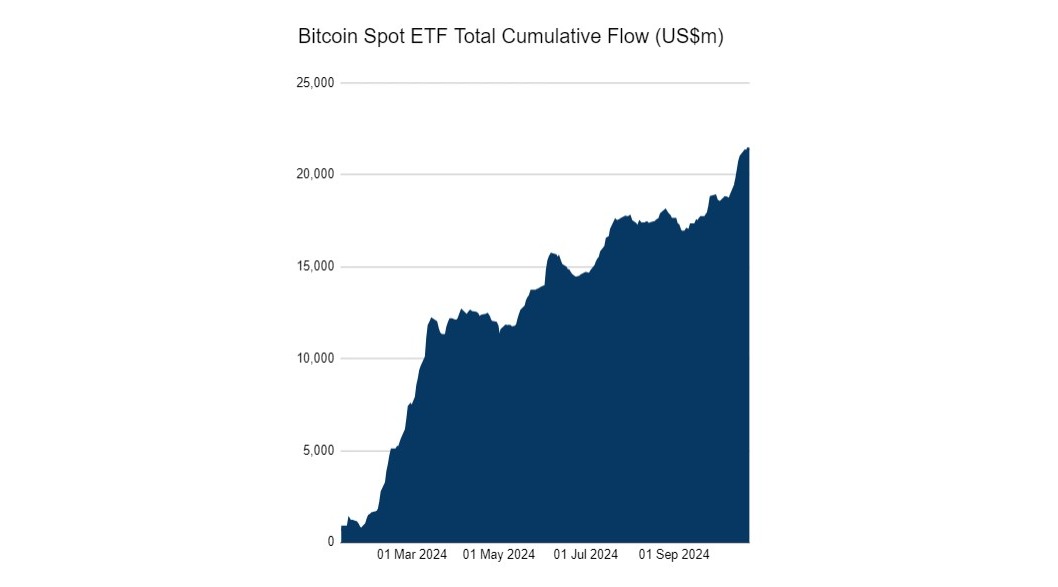
Given that on the other side of the pond, the largest asset manager in the world, BlackRock, is now actively promoting Bitcoin products to its clients, while the new spot BTC ETFs–from BlackRock and others–have hit cumulative total flows since January of above $20 billion, the ECB’s conclusions sound a jarring note.
Bitcoin spot ETF total cumulative flow; Source: Farside
And incidentally, it's worth remembering that just two years ago the ECB declared that Bitcoin was on its “last gasp before the road to irrelevance”. Evidently, there has been a profound shift in tone at the ECB since then, as it has shifted from describing BTC as a doomed asset, to implying that the cryptocurrency is so disruptive that it requires elimination.
Mixed Messages About Blockchains
What’s apparent from observing these various developments, is that while the messages are mixed, cryptocurrencies and blockchain development are now central to establishment discussions about the future of payments, and about economies more broadly, and we can see these discussions happening simultaneously in various adversarial nations.
In BRICS nations, announcements are issued about plans for a blockchain-based alternative payments system, and BTC is touted as a means of facilitating otherwise-restricted international trade, but this occurs while China still has a crypto ban in place, and amid reports that India is considering restricting crypto use, but is also weighing up the possibility of introducing a digital rupee.
As for where this all leads, firstly, it underscores the necessity of distinguishing between permissioned, private blockchains–the kind that CBDCs would run on–and permissionless, public blockchains like Bitcoin, which operate by design outside the remit of the state (or of any other controlling authority).
Relatedly, it’s notable that the Trump campaign has publicly championed Bitcoin while also stating that it would prohibit the development of an American CBDC, which aligns Trump with those who assert that CBDCs are inherently vulnerable to misuse by authoritarian regimes.
And finally, these concurrent events in oppositional countries underline Bitcoin’s neutrality as a technology, and back up the arguments of Bitcoin advocates who spoke about adoption as it relates to game theory: the idea being that in the end there would be a race–including among nation states–not to be last adopter.
The BRICS Summit 2024 took place this week in Russia and the event–in the context also of some previous developments–offered useful indicators about global attitudes at government levels towards Bitcoin, crypto more widely, and the feasibility of establishing blockchain-based international payment systems.
Just prior to the start of the summit, at the BRICS Business Forum in Moscow, there was discussion of a project called BRICS Pay. This is a proposed blockchain-based payment system that has been pitched as being for both retail and B2B use, able to facilitate cross-border payments, and that could potentially use its own BRICS unit of account.
While there are no absolutes to be drawn, it’s apparent that some BRICS nations–in particular Russia, which has been operating under sanctions since breaching international law to invade Ukraine–are interested in ways of reducing reliance on the US dollar, and in fact, de-dollarization through the use of local currencies was also a subject of discussion at the summit.
Crypto on the Agenda
What’s more, the summit hosted a discussion centred around the possibility of using Bitcoin for international payments. According to reports, the proposition is that Russian bitcoin miners might sell the digital asset to international buyers, who would make use of it to purchase imports, thereby, in theory at least, bypassing sanctions.
These plans correlate with a partnership between Russian sovereign wealth fund RDIF and Russian bitcoin miner BitRiver, which jointly aim to construct data centres across several BRICS nations, while the partnership also has a focus on AI development.
Relatedly, Russia earlier this year passed legislation allowing for cryptocurrencies to be used by businesses for international trade (but not permitting private domestic payments), while there were reports in Russian media over the summer suggesting that the government was planning two state-run crypto exchanges, alongside speculation about the development of both a Chinese yuan-pegged stablecoin, and a stablecoin linked to a basket of BRICS currencies.
ECB Expresses Bitcoin Hostility
Curiously, these broadly positive blockchain discussions among BRICS members come not long after a Bitcoin report from the European Central Bank that revealed, by contrast, a hostile attitude.
3/ Then they go on to brazenly advocate for legislation ... "to prevent bitcoin prices from rising or to see bitcoin disappear altogether" in order to prevent "the division of society". pic.twitter.com/kqQfOxeYuk
The report goes as far as to argue that since BTC might continue to rise in price, non-holders, rather than purchasing bitcoin on the free market, should actively oppose the new asset instead, and should even “advocate for legislation against it, aiming to prevent Bitcoin prices from rising or to see Bitcoin disappear altogether”.
Given that on the other side of the pond, the largest asset manager in the world, BlackRock, is now actively promoting Bitcoin products to its clients, while the new spot BTC ETFs–from BlackRock and others–have hit cumulative total flows since January of above $20 billion, the ECB’s conclusions sound a jarring note.
Bitcoin spot ETF total cumulative flow; Source: Farside
And incidentally, it's worth remembering that just two years ago the ECB declared that Bitcoin was on its “last gasp before the road to irrelevance”. Evidently, there has been a profound shift in tone at the ECB since then, as it has shifted from describing BTC as a doomed asset, to implying that the cryptocurrency is so disruptive that it requires elimination.
Mixed Messages About Blockchains
What’s apparent from observing these various developments, is that while the messages are mixed, cryptocurrencies and blockchain development are now central to establishment discussions about the future of payments, and about economies more broadly, and we can see these discussions happening simultaneously in various adversarial nations.
In BRICS nations, announcements are issued about plans for a blockchain-based alternative payments system, and BTC is touted as a means of facilitating otherwise-restricted international trade, but this occurs while China still has a crypto ban in place, and amid reports that India is considering restricting crypto use, but is also weighing up the possibility of introducing a digital rupee.
As for where this all leads, firstly, it underscores the necessity of distinguishing between permissioned, private blockchains–the kind that CBDCs would run on–and permissionless, public blockchains like Bitcoin, which operate by design outside the remit of the state (or of any other controlling authority).
Relatedly, it’s notable that the Trump campaign has publicly championed Bitcoin while also stating that it would prohibit the development of an American CBDC, which aligns Trump with those who assert that CBDCs are inherently vulnerable to misuse by authoritarian regimes.
And finally, these concurrent events in oppositional countries underline Bitcoin’s neutrality as a technology, and back up the arguments of Bitcoin advocates who spoke about adoption as it relates to game theory: the idea being that in the end there would be a race–including among nation states–not to be last adopter.
Sam White is a writer and journalist from the UK who covers cryptocurrencies and web3, with a particular interest in NFTs and the crossover between art and finance. His work, on a wide variety of topics, has appeared on platforms including The Spectator, Vice and Hacker Noon.
CFTC Seeks Public Input on Proposed Retail Crypto Regulatory Framework
Featured Videos
AvaTrade to Acquire Most of FXCM; NAGA Raises $8M
AvaTrade to Acquire Most of FXCM; NAGA Raises $8M
AvaTrade to Acquire Most of FXCM; NAGA Raises $8M
AvaTrade to Acquire Most of FXCM; NAGA Raises $8M
Today’s financial news recap covers AvaTrade agrees to acquire most of FXCM, NAGA secures eight million dollars in new financing, and Wise seeks a tax settlement in the UK.
Finance Magnates Daily Recap brings you the latest news from forex and CFD brokers, fintech, payments, cryptocurrency, digital assets, trading platforms, financial regulation and global markets.
Get the key company news, executive moves, deals, regulatory updates and market developments of the day, in just a few minutes. New episodes published every weekday.
Read more: https://www.financemagnates.com
#FinanceMagnates #ForexNews #FintechNews
Today’s financial news recap covers AvaTrade agrees to acquire most of FXCM, NAGA secures eight million dollars in new financing, and Wise seeks a tax settlement in the UK.
Finance Magnates Daily Recap brings you the latest news from forex and CFD brokers, fintech, payments, cryptocurrency, digital assets, trading platforms, financial regulation and global markets.
Get the key company news, executive moves, deals, regulatory updates and market developments of the day, in just a few minutes. New episodes published every weekday.
Read more: https://www.financemagnates.com
#FinanceMagnates #ForexNews #FintechNews
Today’s financial news recap covers AvaTrade agrees to acquire most of FXCM, NAGA secures eight million dollars in new financing, and Wise seeks a tax settlement in the UK.
Finance Magnates Daily Recap brings you the latest news from forex and CFD brokers, fintech, payments, cryptocurrency, digital assets, trading platforms, financial regulation and global markets.
Get the key company news, executive moves, deals, regulatory updates and market developments of the day, in just a few minutes. New episodes published every weekday.
Read more: https://www.financemagnates.com
#FinanceMagnates #ForexNews #FintechNews
Today’s financial news recap covers AvaTrade agrees to acquire most of FXCM, NAGA secures eight million dollars in new financing, and Wise seeks a tax settlement in the UK.
Finance Magnates Daily Recap brings you the latest news from forex and CFD brokers, fintech, payments, cryptocurrency, digital assets, trading platforms, financial regulation and global markets.
Get the key company news, executive moves, deals, regulatory updates and market developments of the day, in just a few minutes. New episodes published every weekday.
Read more: https://www.financemagnates.com
#FinanceMagnates #ForexNews #FintechNews
XTB Adds Overnight US Stock Trading; Nasdaq Ventures Invests in One Trading
XTB Adds Overnight US Stock Trading; Nasdaq Ventures Invests in One Trading
XTB Adds Overnight US Stock Trading; Nasdaq Ventures Invests in One Trading
XTB Adds Overnight US Stock Trading; Nasdaq Ventures Invests in One Trading
XTB Adds Overnight US Stock Trading; Nasdaq Ventures Invests in One Trading
XTB Adds Overnight US Stock Trading; Nasdaq Ventures Invests in One Trading
Today’s financial news recap covers XTB expands overnight US stock trading, Fortrade reports higher revenue, Nasdaq backs One Trading, and Vest Labs raises 13 million dollars.
Finance Magnates Daily Recap brings you the latest news from forex and CFD brokers, fintech, payments, cryptocurrency, digital assets, trading platforms, financial regulation and global markets.
Get the key company news, executive moves, deals, regulatory updates and market developments of the day, in just a few minutes. New episodes published every weekday.
Read more: https://www.financemagnates.com
#FinanceMagnates #ForexNews #FintechNews
Today’s financial news recap covers XTB expands overnight US stock trading, Fortrade reports higher revenue, Nasdaq backs One Trading, and Vest Labs raises 13 million dollars.
Finance Magnates Daily Recap brings you the latest news from forex and CFD brokers, fintech, payments, cryptocurrency, digital assets, trading platforms, financial regulation and global markets.
Get the key company news, executive moves, deals, regulatory updates and market developments of the day, in just a few minutes. New episodes published every weekday.
Read more: https://www.financemagnates.com
#FinanceMagnates #ForexNews #FintechNews
Today’s financial news recap covers XTB expands overnight US stock trading, Fortrade reports higher revenue, Nasdaq backs One Trading, and Vest Labs raises 13 million dollars.
Finance Magnates Daily Recap brings you the latest news from forex and CFD brokers, fintech, payments, cryptocurrency, digital assets, trading platforms, financial regulation and global markets.
Get the key company news, executive moves, deals, regulatory updates and market developments of the day, in just a few minutes. New episodes published every weekday.
Read more: https://www.financemagnates.com
#FinanceMagnates #ForexNews #FintechNews
Today’s financial news recap covers XTB expands overnight US stock trading, Fortrade reports higher revenue, Nasdaq backs One Trading, and Vest Labs raises 13 million dollars.
Finance Magnates Daily Recap brings you the latest news from forex and CFD brokers, fintech, payments, cryptocurrency, digital assets, trading platforms, financial regulation and global markets.
Get the key company news, executive moves, deals, regulatory updates and market developments of the day, in just a few minutes. New episodes published every weekday.
Read more: https://www.financemagnates.com
#FinanceMagnates #ForexNews #FintechNews
Today’s financial news recap covers XTB expands overnight US stock trading, Fortrade reports higher revenue, Nasdaq backs One Trading, and Vest Labs raises 13 million dollars.
Finance Magnates Daily Recap brings you the latest news from forex and CFD brokers, fintech, payments, cryptocurrency, digital assets, trading platforms, financial regulation and global markets.
Get the key company news, executive moves, deals, regulatory updates and market developments of the day, in just a few minutes. New episodes published every weekday.
Read more: https://www.financemagnates.com
#FinanceMagnates #ForexNews #FintechNews
Today’s financial news recap covers XTB expands overnight US stock trading, Fortrade reports higher revenue, Nasdaq backs One Trading, and Vest Labs raises 13 million dollars.
Finance Magnates Daily Recap brings you the latest news from forex and CFD brokers, fintech, payments, cryptocurrency, digital assets, trading platforms, financial regulation and global markets.
Get the key company news, executive moves, deals, regulatory updates and market developments of the day, in just a few minutes. New episodes published every weekday.
Read more: https://www.financemagnates.com
#FinanceMagnates #ForexNews #FintechNews
CMC Founder Downplays Volatility Hit; Devexperts Names CEO
CMC Founder Downplays Volatility Hit; Devexperts Names CEO
CMC Founder Downplays Volatility Hit; Devexperts Names CEO
CMC Founder Downplays Volatility Hit; Devexperts Names CEO
CMC Founder Downplays Volatility Hit; Devexperts Names CEO
CMC Founder Downplays Volatility Hit; Devexperts Names CEO
Today’s financial news recap covers low volatility pressures brokers, Devexperts names a new CEO, Saxo cuts onboarding time, and OKX reaches a 25 billion dollar valuation.
Finance Magnates Daily Recap brings you the latest news from forex and CFD brokers, fintech, payments, cryptocurrency, digital assets, trading platforms, financial regulation and global markets.
Get the key company news, executive moves, deals, regulatory updates and market developments of the day, in just a few minutes. New episodes published every weekday.
Read more: https://www.financemagnates.com
#FinanceMagnates #ForexNews #FintechNews
Today’s financial news recap covers low volatility pressures brokers, Devexperts names a new CEO, Saxo cuts onboarding time, and OKX reaches a 25 billion dollar valuation.
Finance Magnates Daily Recap brings you the latest news from forex and CFD brokers, fintech, payments, cryptocurrency, digital assets, trading platforms, financial regulation and global markets.
Get the key company news, executive moves, deals, regulatory updates and market developments of the day, in just a few minutes. New episodes published every weekday.
Read more: https://www.financemagnates.com
#FinanceMagnates #ForexNews #FintechNews
Today’s financial news recap covers low volatility pressures brokers, Devexperts names a new CEO, Saxo cuts onboarding time, and OKX reaches a 25 billion dollar valuation.
Finance Magnates Daily Recap brings you the latest news from forex and CFD brokers, fintech, payments, cryptocurrency, digital assets, trading platforms, financial regulation and global markets.
Get the key company news, executive moves, deals, regulatory updates and market developments of the day, in just a few minutes. New episodes published every weekday.
Read more: https://www.financemagnates.com
#FinanceMagnates #ForexNews #FintechNews
Today’s financial news recap covers low volatility pressures brokers, Devexperts names a new CEO, Saxo cuts onboarding time, and OKX reaches a 25 billion dollar valuation.
Finance Magnates Daily Recap brings you the latest news from forex and CFD brokers, fintech, payments, cryptocurrency, digital assets, trading platforms, financial regulation and global markets.
Get the key company news, executive moves, deals, regulatory updates and market developments of the day, in just a few minutes. New episodes published every weekday.
Read more: https://www.financemagnates.com
#FinanceMagnates #ForexNews #FintechNews
Today’s financial news recap covers low volatility pressures brokers, Devexperts names a new CEO, Saxo cuts onboarding time, and OKX reaches a 25 billion dollar valuation.
Finance Magnates Daily Recap brings you the latest news from forex and CFD brokers, fintech, payments, cryptocurrency, digital assets, trading platforms, financial regulation and global markets.
Get the key company news, executive moves, deals, regulatory updates and market developments of the day, in just a few minutes. New episodes published every weekday.
Read more: https://www.financemagnates.com
#FinanceMagnates #ForexNews #FintechNews
Today’s financial news recap covers low volatility pressures brokers, Devexperts names a new CEO, Saxo cuts onboarding time, and OKX reaches a 25 billion dollar valuation.
Finance Magnates Daily Recap brings you the latest news from forex and CFD brokers, fintech, payments, cryptocurrency, digital assets, trading platforms, financial regulation and global markets.
Get the key company news, executive moves, deals, regulatory updates and market developments of the day, in just a few minutes. New episodes published every weekday.
Read more: https://www.financemagnates.com
#FinanceMagnates #ForexNews #FintechNews
Today’s financial news recap covers Trade Nation buys FXCM's UK client book, Trading 212 reports higher revenue, the CFTC's move to allow perpetual index futures.
Finance Magnates Daily Recap brings you the latest news from forex and CFD brokers, fintech, payments, cryptocurrency, digital assets, trading platforms, financial regulation and global markets.
Get the key company news, executive moves, deals, regulatory updates and market developments of the day, in just a few minutes. New episodes published every weekday.
Read more: https://www.financemagnates.com
#FinanceMagnates #ForexNews #FintechNews
Today’s financial news recap covers Trade Nation buys FXCM's UK client book, Trading 212 reports higher revenue, the CFTC's move to allow perpetual index futures.
Finance Magnates Daily Recap brings you the latest news from forex and CFD brokers, fintech, payments, cryptocurrency, digital assets, trading platforms, financial regulation and global markets.
Get the key company news, executive moves, deals, regulatory updates and market developments of the day, in just a few minutes. New episodes published every weekday.
Read more: https://www.financemagnates.com
#FinanceMagnates #ForexNews #FintechNews
Today’s financial news recap covers Trade Nation buys FXCM's UK client book, Trading 212 reports higher revenue, the CFTC's move to allow perpetual index futures.
Finance Magnates Daily Recap brings you the latest news from forex and CFD brokers, fintech, payments, cryptocurrency, digital assets, trading platforms, financial regulation and global markets.
Get the key company news, executive moves, deals, regulatory updates and market developments of the day, in just a few minutes. New episodes published every weekday.
Read more: https://www.financemagnates.com
#FinanceMagnates #ForexNews #FintechNews
Today’s financial news recap covers Trade Nation buys FXCM's UK client book, Trading 212 reports higher revenue, the CFTC's move to allow perpetual index futures.
Finance Magnates Daily Recap brings you the latest news from forex and CFD brokers, fintech, payments, cryptocurrency, digital assets, trading platforms, financial regulation and global markets.
Get the key company news, executive moves, deals, regulatory updates and market developments of the day, in just a few minutes. New episodes published every weekday.
Read more: https://www.financemagnates.com
#FinanceMagnates #ForexNews #FintechNews
Today’s financial news recap covers Trade Nation buys FXCM's UK client book, Trading 212 reports higher revenue, the CFTC's move to allow perpetual index futures.
Finance Magnates Daily Recap brings you the latest news from forex and CFD brokers, fintech, payments, cryptocurrency, digital assets, trading platforms, financial regulation and global markets.
Get the key company news, executive moves, deals, regulatory updates and market developments of the day, in just a few minutes. New episodes published every weekday.
Read more: https://www.financemagnates.com
#FinanceMagnates #ForexNews #FintechNews
Today’s financial news recap covers Trade Nation buys FXCM's UK client book, Trading 212 reports higher revenue, the CFTC's move to allow perpetual index futures.
Finance Magnates Daily Recap brings you the latest news from forex and CFD brokers, fintech, payments, cryptocurrency, digital assets, trading platforms, financial regulation and global markets.
Get the key company news, executive moves, deals, regulatory updates and market developments of the day, in just a few minutes. New episodes published every weekday.
Read more: https://www.financemagnates.com
#FinanceMagnates #ForexNews #FintechNews
Your career isn’t a linear path.
Your career isn’t a linear path.
Your career isn’t a linear path.
Your career isn’t a linear path.
Your career isn’t a linear path.
Your career isn’t a linear path.
Roles change. Career goals change. Sometimes you want a completely new challenge.
But the skills and knowledge you build along the way can stay with you and give you something to build on.
For Jeff Patterson, that continued growth is key to long-term career development.
You bring the skills. FM Academy helps you build the knowledge.
#FMAcademy #FinanceMagnates #FinanceCareers #ProfessionalDevelopment #Fintech
Roles change. Career goals change. Sometimes you want a completely new challenge.
But the skills and knowledge you build along the way can stay with you and give you something to build on.
For Jeff Patterson, that continued growth is key to long-term career development.
You bring the skills. FM Academy helps you build the knowledge.
#FMAcademy #FinanceMagnates #FinanceCareers #ProfessionalDevelopment #Fintech
Roles change. Career goals change. Sometimes you want a completely new challenge.
But the skills and knowledge you build along the way can stay with you and give you something to build on.
For Jeff Patterson, that continued growth is key to long-term career development.
You bring the skills. FM Academy helps you build the knowledge.
#FMAcademy #FinanceMagnates #FinanceCareers #ProfessionalDevelopment #Fintech
Roles change. Career goals change. Sometimes you want a completely new challenge.
But the skills and knowledge you build along the way can stay with you and give you something to build on.
For Jeff Patterson, that continued growth is key to long-term career development.
You bring the skills. FM Academy helps you build the knowledge.
#FMAcademy #FinanceMagnates #FinanceCareers #ProfessionalDevelopment #Fintech
Roles change. Career goals change. Sometimes you want a completely new challenge.
But the skills and knowledge you build along the way can stay with you and give you something to build on.
For Jeff Patterson, that continued growth is key to long-term career development.
You bring the skills. FM Academy helps you build the knowledge.
#FMAcademy #FinanceMagnates #FinanceCareers #ProfessionalDevelopment #Fintech
Roles change. Career goals change. Sometimes you want a completely new challenge.
But the skills and knowledge you build along the way can stay with you and give you something to build on.
For Jeff Patterson, that continued growth is key to long-term career development.
You bring the skills. FM Academy helps you build the knowledge.
#FMAcademy #FinanceMagnates #FinanceCareers #ProfessionalDevelopment #Fintech