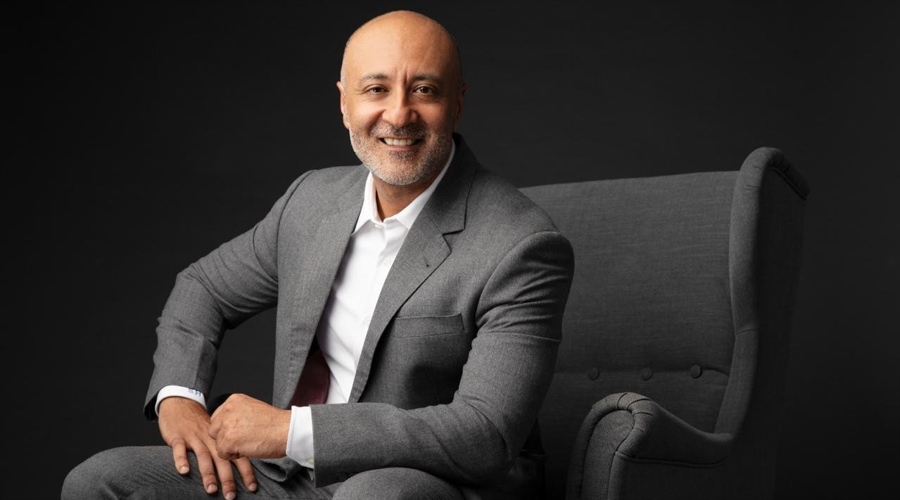
“People Knocking on Our Door to See That We’re Here,” IG Group’s MENA CEO

Monday, 27/04/2026 | 08:04 GMT by Arnab Shome
  • Sharaz Hussain revealed to Finance Magnates that the broker plans to launch “a new app later this year”.
  • “This March was an all-time record in terms of volumes for IG here regionally,” despite the disruption in its Dubai operations during the war.
Sharaz Hussain, IG Group's MENA CEO

At a time when brokers boost their online-only presence, “people knock on the door” of IG’s Dubai office, “occasionally, even someone thinking it’s Instagram (which is also known as IG),” said Sharaz Hussain, the broker’s MENA CEO, who is based out of its local Dubai office. “But most people who come in just want to see that we’re here,” he added. “Some even bring their applications with them.” He further revealed IG’s plans for launching “a new app later this year”, hinting at the broker’s ambition to become a financial super app.

Singapore Summit: Meet the largest APAC brokers you know (and those you still don't!)

“It’s an Unprecedented Time”, but COVID Prepared Us

IG established its office in Dubai’s free zone in 2015, which acts as its regional headquarters. It operates within the Dubai International Financial Centre and has about 25 staff. “Dubai is our strategic hub; it’s not a branch office,” stressed Hussain. “It gives us access to a large customer and investor base.”

Financials of the London-listed broker revealed that Dubai generated £28.7 million in net trading revenue in the year ended 31 May 2025, up from £18.9 million in the previous fiscal year. Due to its expansion in Dubai, trading volume in the APAC & Middle East division jumped by 5 per cent in the 2025 calendar year.

However, operations from this “strategic hub” were tested to their limits during the recent attack from Iran on UAE infrastructure.

“It’s an unprecedented time for us,” Hussain added. “Over the last two weeks, we’ve been fully operational, but for the first three or four weeks, we very much adhered to government guidance, which was remote working and asking people to be cautious but remain within the UAE.”

“What I can say is that, having operated through COVID, it was a very seamless experience. We now live in a world where many institutions have remote working as part of their corporate culture anyway.”

“So, in that way, there was no business disruption. Staff engagement and morale were high, and customers were very understanding.”
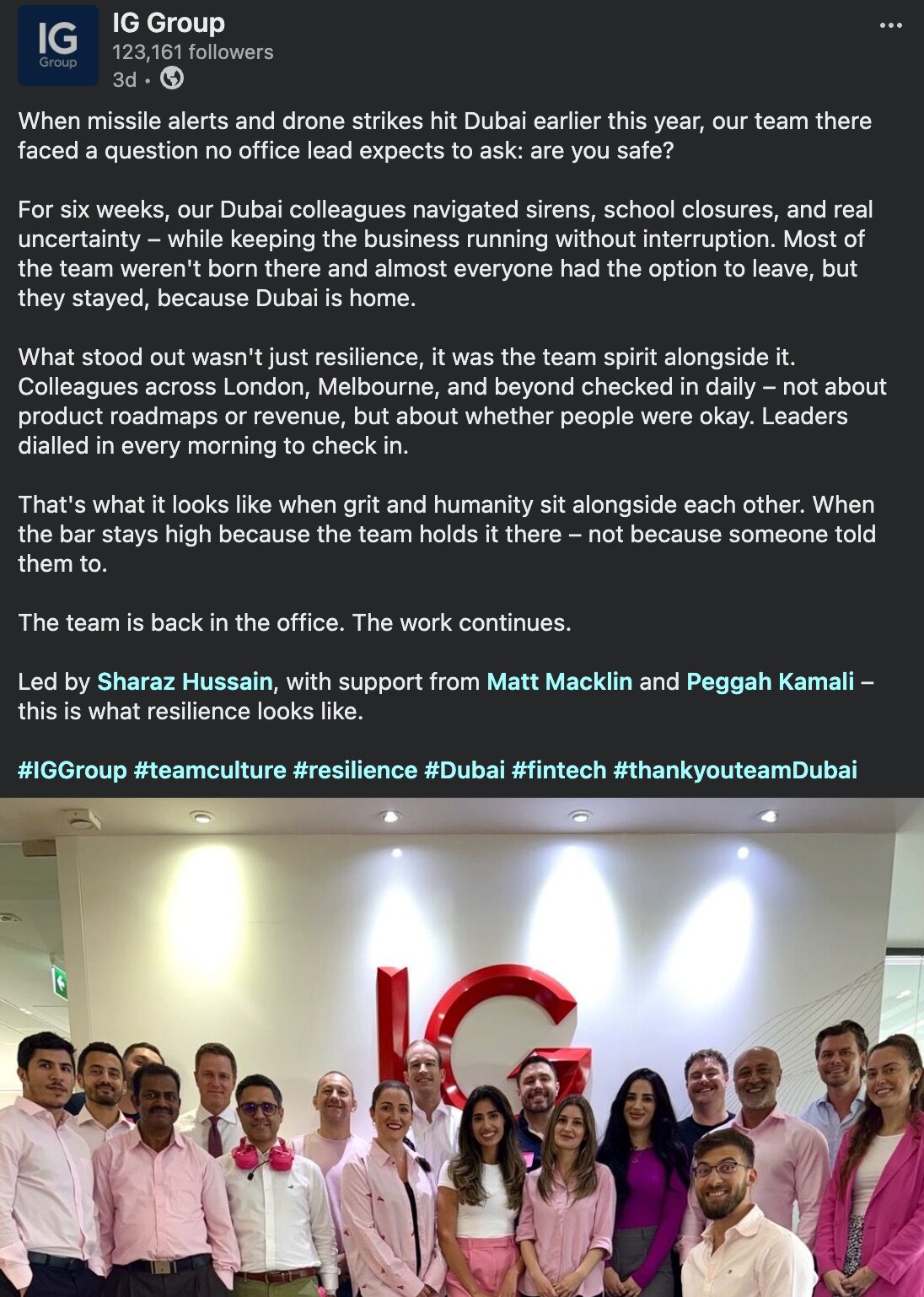
A post on IG Group's LinkedIn page

Yet, over the six weeks leading up to the war, trading demand was very strong due to volatile markets. “We’ve had a record month,” Hussain highlighted. “This March was an all-time record in terms of volumes for IG here regionally, particularly driven by a large number of products and significant trading in gold and oil. It’s regionally driven, and our clients tend to concentrate on those types of products, apart from indices.”

However, the irony was that the record volumes came at a time when business operations were facing a challenge.

“The business has been built over the last few years to be scalable,” he added. “You build businesses to be scalable, waiting for them to be tested. It was tested and, fortunately for us, it came through well.”

DFSA Licence Is “Incredibly Difficult”, and Not Every Firm Would “Qualify for One”

Although IG has been in the UAE for more than a decade, it still operates from a free zone and not as a mainland company. “Customers feel very safe and secure under DIFC law,” Hussain, who has been in the financial services industry for over three decades, said. “It’s well established and aligns with IG as a brand. We are able to offer institutional products as well as retail and professional products from here, so it gives us that advantage.”

However, recently, several foreign brokers have entered the UAE as mainland companies, mostly to adhere to the crackdown on offshore CFD marketing in the country. “I would say that, although the mainland is newer, the differences between the two are closing,” the IG MENA CEO continued. “Sometimes retail investors are offered greater leverage on the mainland, but that’s not necessarily something we’ve pursued here at IG.”

Notably, most brokers are securing Category 5 licences from the UAE’s Capital Markets Authority (formerly the Securities & Commodities Authority), with only a few pursuing Category 1, or, in other words, the full brokerage licence.

According to Hussain, however, free zone company regulations offer more protection for retail traders than mainland regulations do, adding that obtaining a DFSA licence is incredibly difficult. “I’m not sure every firm would qualify for one,” he continued.

Foreign Brokers Must “Develop a Balance Between What They Bring and What the Local Market Requires”

Addressing the growing influx of brokers in the country, he said: “Over the previous two or three years, you’ve seen a major demographic shift in the region. It’s very aspirational and high-tech. It attracts what I would describe as savvy millennials and aspirational traders. The population is generally financially literate, and I think companies have realised that if they don’t have a presence in the region, they’re probably missing a big opportunity.”

He also pointed out that the retail trading space has changed in the last few years. Since 2020, “there have been around 200 million new retail traders entering the market.”

“The landscape has changed,” he continued. “You have people trading crypto in their early 20s, as well as those in their 60s. There’s no longer a single product that appeals to everyone. The access and range of products mean that the appeal is very broad.”

He also believes that retail trading demand across the region will grow over the next few years.

Although foreign brokers are entering the UAE, the market is very tough to crack, especially given the presence of local giants such as CFI Financial, Amana Capital, MultiBank, and Equiti.

Hussain, however, believes that brokers do not necessarily need to make themselves unique to capture the UAE market; rather, they need to “develop a balance between what they bring and what the local market requires.”

“If you look at IG… It’s been around for 50 years and brings a degree of heritage, prestige, and trust,” he added. “If you look at this region, even beyond financial products, companies have attracted people by offering well-established global brands, whether in consumer goods, technology, or automobiles. It was built that way.”

“If you then combine that with local nuances and appeal to the local market, as some regional brands have done, you get the best of both.”

“If I look at the mix in my office here,” he continued, “at least half are familiar with this region, are Arabic-speaking, and aware of cultural nuances.”

IG has a local marketing team in its Dubai office that tailors creative campaigns, language, and incentives for clients in the region. “There are campaigns and messages that may work elsewhere but wouldn’t resonate here, and vice versa,” Hussain added. “For example, with oil and gold, a higher percentage of clients in this region trade these products compared to other IG offices globally.”

The broker, meanwhile, at least in the region, has also started to explore artificial intelligence (AI)-generated marketing materials. As Hussain explained: “The way we’re incorporating it is by using it alongside traditional methods of marketing and our usual creative campaigns. If AI helps us deliver things more quickly and in line with client needs, we’re not averse to using it. So, we have the capability.”

A “High-Touch Market”

Furthermore, he added that the UAE is a “high-touch market” and people in the region “are used to a high level of customer service as part of the culture.”

“In other parts of the world, you can probably rely more on automation and less on customer interaction,” Hussain added. “In the UAE, particularly with high-value clients, people prefer a personal touch and direct engagement.”

Interestingly, IG’s Dubai office has also kept its doors open to everyone, allowing anyone to walk in to interact with staff or open an account. “Some of our competitors are purely online and do not have a physical presence, but here you can come into the DIFC and meet a staff member,” Hussain added.

“If you want to speak to someone, your salesperson is here locally. Our marketing is conducted locally, and our compliance team is based here as well. I run a local office, so we’re in touch with customers when required. We do get many customers walking into the office, wanting to know that there is a physical presence.”

“Money is an interesting product—you need trust when you are dealing with it.”

“The Appeal of Crypto Is Significantly Broader than That of CFDs”

While CFDs have been IG's primary offering for years, it is expanding its product base. The broker earlier acquired a crypto exchange, Independent Reserve, and plans to launch crypto products in the UAE, while it has launched the same in a few other markets.

“Now, when you talk about crypto, you’re really talking about the growth of the digital asset space—whether that’s individual tokens, the concept of tokenising real-world assets, or even its use as a form of payment,” the IG MENA CEO said. “The appeal of crypto is significantly broader than that of CFDs.”

“MENA, and particularly the UAE, is leading in crypto adoption,” he stressed, adding that the UAE ranks first in the region and sits around fifth globally. “Everyone wants crypto now. But it has outgrown just investing in Bitcoin. I’d rather use the term digital assets than crypto, because it’s much broader than simple cryptocurrencies.”

At a time when brokers boost their online-only presence, “people knock on the door” of IG’s Dubai office, “occasionally, even someone thinking it’s Instagram (which is also known as IG),” said Sharaz Hussain, the broker’s MENA CEO, who is based out of its local Dubai office. “But most people who come in just want to see that we’re here,” he added. “Some even bring their applications with them.” He further revealed IG’s plans for launching “a new app later this year”, hinting at the broker’s ambition to become a financial super app.

Singapore Summit: Meet the largest APAC brokers you know (and those you still don't!)

“It’s an Unprecedented Time”, but COVID Prepared Us

IG established its office in Dubai’s free zone in 2015, which acts as its regional headquarters. It operates within the Dubai International Financial Centre and has about 25 staff. “Dubai is our strategic hub; it’s not a branch office,” stressed Hussain. “It gives us access to a large customer and investor base.”

Financials of the London-listed broker revealed that Dubai generated £28.7 million in net trading revenue in the year ended 31 May 2025, up from £18.9 million in the previous fiscal year. Due to its expansion in Dubai, trading volume in the APAC & Middle East division jumped by 5 per cent in the 2025 calendar year.

However, operations from this “strategic hub” were tested to their limits during the recent attack from Iran on UAE infrastructure.

“It’s an unprecedented time for us,” Hussain added. “Over the last two weeks, we’ve been fully operational, but for the first three or four weeks, we very much adhered to government guidance, which was remote working and asking people to be cautious but remain within the UAE.”

“What I can say is that, having operated through COVID, it was a very seamless experience. We now live in a world where many institutions have remote working as part of their corporate culture anyway.”

“So, in that way, there was no business disruption. Staff engagement and morale were high, and customers were very understanding.”

A post on IG Group's LinkedIn page

Yet, over the six weeks leading up to the war, trading demand was very strong due to volatile markets. “We’ve had a record month,” Hussain highlighted. “This March was an all-time record in terms of volumes for IG here regionally, particularly driven by a large number of products and significant trading in gold and oil. It’s regionally driven, and our clients tend to concentrate on those types of products, apart from indices.”

However, the irony was that the record volumes came at a time when business operations were facing a challenge.

“The business has been built over the last few years to be scalable,” he added. “You build businesses to be scalable, waiting for them to be tested. It was tested and, fortunately for us, it came through well.”

DFSA Licence Is “Incredibly Difficult”, and Not Every Firm Would “Qualify for One”

Although IG has been in the UAE for more than a decade, it still operates from a free zone and not as a mainland company. “Customers feel very safe and secure under DIFC law,” Hussain, who has been in the financial services industry for over three decades, said. “It’s well established and aligns with IG as a brand. We are able to offer institutional products as well as retail and professional products from here, so it gives us that advantage.”

However, recently, several foreign brokers have entered the UAE as mainland companies, mostly to adhere to the crackdown on offshore CFD marketing in the country. “I would say that, although the mainland is newer, the differences between the two are closing,” the IG MENA CEO continued. “Sometimes retail investors are offered greater leverage on the mainland, but that’s not necessarily something we’ve pursued here at IG.”

Notably, most brokers are securing Category 5 licences from the UAE’s Capital Markets Authority (formerly the Securities & Commodities Authority), with only a few pursuing Category 1, or, in other words, the full brokerage licence.

According to Hussain, however, free zone company regulations offer more protection for retail traders than mainland regulations do, adding that obtaining a DFSA licence is incredibly difficult. “I’m not sure every firm would qualify for one,” he continued.

Foreign Brokers Must “Develop a Balance Between What They Bring and What the Local Market Requires”

Addressing the growing influx of brokers in the country, he said: “Over the previous two or three years, you’ve seen a major demographic shift in the region. It’s very aspirational and high-tech. It attracts what I would describe as savvy millennials and aspirational traders. The population is generally financially literate, and I think companies have realised that if they don’t have a presence in the region, they’re probably missing a big opportunity.”

He also pointed out that the retail trading space has changed in the last few years. Since 2020, “there have been around 200 million new retail traders entering the market.”

“The landscape has changed,” he continued. “You have people trading crypto in their early 20s, as well as those in their 60s. There’s no longer a single product that appeals to everyone. The access and range of products mean that the appeal is very broad.”

He also believes that retail trading demand across the region will grow over the next few years.

Although foreign brokers are entering the UAE, the market is very tough to crack, especially given the presence of local giants such as CFI Financial, Amana Capital, MultiBank, and Equiti.

Hussain, however, believes that brokers do not necessarily need to make themselves unique to capture the UAE market; rather, they need to “develop a balance between what they bring and what the local market requires.”

“If you look at IG… It’s been around for 50 years and brings a degree of heritage, prestige, and trust,” he added. “If you look at this region, even beyond financial products, companies have attracted people by offering well-established global brands, whether in consumer goods, technology, or automobiles. It was built that way.”

“If you then combine that with local nuances and appeal to the local market, as some regional brands have done, you get the best of both.”

“If I look at the mix in my office here,” he continued, “at least half are familiar with this region, are Arabic-speaking, and aware of cultural nuances.”

IG has a local marketing team in its Dubai office that tailors creative campaigns, language, and incentives for clients in the region. “There are campaigns and messages that may work elsewhere but wouldn’t resonate here, and vice versa,” Hussain added. “For example, with oil and gold, a higher percentage of clients in this region trade these products compared to other IG offices globally.”

The broker, meanwhile, at least in the region, has also started to explore artificial intelligence (AI)-generated marketing materials. As Hussain explained: “The way we’re incorporating it is by using it alongside traditional methods of marketing and our usual creative campaigns. If AI helps us deliver things more quickly and in line with client needs, we’re not averse to using it. So, we have the capability.”

A “High-Touch Market”

Furthermore, he added that the UAE is a “high-touch market” and people in the region “are used to a high level of customer service as part of the culture.”

“In other parts of the world, you can probably rely more on automation and less on customer interaction,” Hussain added. “In the UAE, particularly with high-value clients, people prefer a personal touch and direct engagement.”

Interestingly, IG’s Dubai office has also kept its doors open to everyone, allowing anyone to walk in to interact with staff or open an account. “Some of our competitors are purely online and do not have a physical presence, but here you can come into the DIFC and meet a staff member,” Hussain added.

“If you want to speak to someone, your salesperson is here locally. Our marketing is conducted locally, and our compliance team is based here as well. I run a local office, so we’re in touch with customers when required. We do get many customers walking into the office, wanting to know that there is a physical presence.”

“Money is an interesting product—you need trust when you are dealing with it.”

“The Appeal of Crypto Is Significantly Broader than That of CFDs”

While CFDs have been IG's primary offering for years, it is expanding its product base. The broker earlier acquired a crypto exchange, Independent Reserve, and plans to launch crypto products in the UAE, while it has launched the same in a few other markets.

“Now, when you talk about crypto, you’re really talking about the growth of the digital asset space—whether that’s individual tokens, the concept of tokenising real-world assets, or even its use as a form of payment,” the IG MENA CEO said. “The appeal of crypto is significantly broader than that of CFDs.”

“MENA, and particularly the UAE, is leading in crypto adoption,” he stressed, adding that the UAE ranks first in the region and sits around fifth globally. “Everyone wants crypto now. But it has outgrown just investing in Bitcoin. I’d rather use the term digital assets than crypto, because it’s much broader than simple cryptocurrencies.”

About the Author: Arnab Shome
Arnab Shome
  • 7333 Articles
  • 134 Followers
About the Author: Arnab Shome
Arnab Shome is an electronics engineer-turned-financial editor. He holds a Bachelor of Technology from the National Institute of Technology, Agartala. He entered the retail trading industry about a decade ago, covering the cryptocurrency market for Finance Magnates, and later expanded his coverage to include forex and CFDs as well. His work at Finance Magnates includes C-level interviews, data-driven analysis, opinion pieces, and scoops of industry exclusives. He also contributes to Finance Magnates’ quarterly industry report. Area of coverage: 1. CFD broker-related news 2. Industry-related Regulatory updates and developments 3. New retail trading trends 4. Prop trading industry updates 5. Executive interviews Education: Bachelor of Technology - National Institute of Technology, Agartala (India)
  • 7333 Articles
  • 134 Followers

More from the Author

Executives

!"#$%&'()*+,-./0123456789:;<=>?@ABCDEFGHIJKLMNOPQRSTUVWXYZ[\]^_`abcdefghijklmnopqrstuvwxyz{|} !"#$%&'()*+,-./0123456789:;<=>?@ABCDEFGHIJKLMNOPQRSTUVWXYZ[\]^_`abcdefghijklmnopqrstuvwxyz{|}