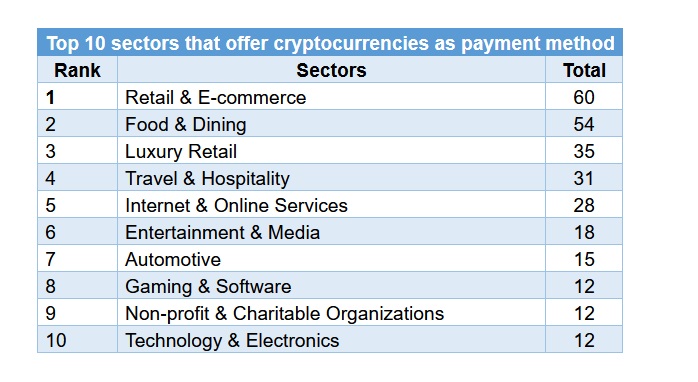
Food & Dining claims the second spot with 54 companies.
Luxury Retail takes third place with 35 companies, including brands, such as Gucci and Ralph Lauren.
In
a study conducted by the crypto tax software CoinLedger, the landscape of
cryptocurrency payments has been unveiled, shedding light on the sectors that
have embraced digital currencies as a viable method of transaction. With more
than 300 major companies under scrutiny, the Retail and E-commerce sector
emerged as the frontrunner, boasting 60 companies that now accept
cryptocurrency payments.
Epicenter
of Change: Retail & E-commerce Lead Cryptocurrency Adoption
The
Retail and E-commerce sector has become the epicenter of cryptocurrency
adoption, with major players such as adidas, Yankee Candle, and H&M leading
the charge. Notably, online shopping platforms like Etsy have integrated
cryptocurrency options, marking a significant shift in consumer behavior.
Following
closely is the Food & Dining sector, with 54 companies, including names
like Chipotle, Domino's, and delivery services such as DoorDash and Uber Eats.
Luxury Retail claims the third spot, featuring 35 companies, including brands
like Gucci and Ralph Lauren, signaling a shift towards exclusivity in the
digital payment realm.
Travel
& Hospitality secured the fourth position, with 31 companies accepting
crypto payments, ranging from commercial airlines to cruise companies. Internet
& Online Services round off the top five, with 28 companies providing
crypto-friendly payment options, including platforms like Google Play, Spotify,
and various VPN services.
Source: CoinLedger
Unveiling
the Advantages: Why Cryptocurrency Payments Are Surging
The
study delves into the reasons behind the surging popularity of cryptocurrency
payments, citing several advantages that traditional currencies lack.
Cryptocurrencies, epitomized by bitcoin, offer
decentralization, reducing the risk of manipulation or interference from
centralized entities.
Cryptocurrency transactions come with lower costs,
particularly advantageous for cross-border transfers, potentially leading to
substantial savings for individuals and businesses. The use of cryptographic
techniques and blockchain technology ensures a high level of security, making
cryptocurrency transactions resistant to fraud.
Cryptocurrencies
hold the promise of providing financial services to the unbanked or
underbanked, fostering global financial inclusion. Users benefit from increased
control and ownership of their funds, facilitated by private keys, diminishing
reliance on intermediaries and enhancing financial autonomy.
David
Kemmerer, the Co-Founder and CEO of CoinLedger commented on the findings: “The
increasing number of companies accepting cryptocurrency payments reflects the
growing acceptance and adoption of digital currencies in the mainstream
economy. This trend not only aligns with the evolving preferences of tech-savvy
consumers but also offers benefits such as reduced transaction fees and
increased security.”
“From
major retailers to small businesses, the diversification of sectors embracing cryptocurrencies
demonstrates the versatility and potential of blockchain technology. As this
trend continues, it's likely to contribute to the broader acceptance of
cryptocurrencies as a legitimate form of payment, paving the way for a more
decentralized and accessible financial landscape.”
In
a study conducted by the crypto tax software CoinLedger, the landscape of
cryptocurrency payments has been unveiled, shedding light on the sectors that
have embraced digital currencies as a viable method of transaction. With more
than 300 major companies under scrutiny, the Retail and E-commerce sector
emerged as the frontrunner, boasting 60 companies that now accept
cryptocurrency payments.
Epicenter
of Change: Retail & E-commerce Lead Cryptocurrency Adoption
The
Retail and E-commerce sector has become the epicenter of cryptocurrency
adoption, with major players such as adidas, Yankee Candle, and H&M leading
the charge. Notably, online shopping platforms like Etsy have integrated
cryptocurrency options, marking a significant shift in consumer behavior.
Following
closely is the Food & Dining sector, with 54 companies, including names
like Chipotle, Domino's, and delivery services such as DoorDash and Uber Eats.
Luxury Retail claims the third spot, featuring 35 companies, including brands
like Gucci and Ralph Lauren, signaling a shift towards exclusivity in the
digital payment realm.
Travel
& Hospitality secured the fourth position, with 31 companies accepting
crypto payments, ranging from commercial airlines to cruise companies. Internet
& Online Services round off the top five, with 28 companies providing
crypto-friendly payment options, including platforms like Google Play, Spotify,
and various VPN services.
Source: CoinLedger
Unveiling
the Advantages: Why Cryptocurrency Payments Are Surging
The
study delves into the reasons behind the surging popularity of cryptocurrency
payments, citing several advantages that traditional currencies lack.
Cryptocurrencies, epitomized by bitcoin, offer
decentralization, reducing the risk of manipulation or interference from
centralized entities.
Cryptocurrency transactions come with lower costs,
particularly advantageous for cross-border transfers, potentially leading to
substantial savings for individuals and businesses. The use of cryptographic
techniques and blockchain technology ensures a high level of security, making
cryptocurrency transactions resistant to fraud.
Cryptocurrencies
hold the promise of providing financial services to the unbanked or
underbanked, fostering global financial inclusion. Users benefit from increased
control and ownership of their funds, facilitated by private keys, diminishing
reliance on intermediaries and enhancing financial autonomy.
David
Kemmerer, the Co-Founder and CEO of CoinLedger commented on the findings: “The
increasing number of companies accepting cryptocurrency payments reflects the
growing acceptance and adoption of digital currencies in the mainstream
economy. This trend not only aligns with the evolving preferences of tech-savvy
consumers but also offers benefits such as reduced transaction fees and
increased security.”
“From
major retailers to small businesses, the diversification of sectors embracing cryptocurrencies
demonstrates the versatility and potential of blockchain technology. As this
trend continues, it's likely to contribute to the broader acceptance of
cryptocurrencies as a legitimate form of payment, paving the way for a more
decentralized and accessible financial landscape.”
Tareq is a financial writer with 15 years of experience covering global markets. His work spans technical analysis, forex broker reviews, and market sentiment, with a focus on topics relevant to retail traders. He joined Finance Magnates in 2023.
At Finance Magnates, he serves as News Editor, covering retail forex and CFD brokers, cryptocurrency exchanges, fintech firms, and regulatory developments shaping the trading industry. He holds an Honours degree in Information Technology from Anfell College, London.
Education:
Honours degree Information Technology, Anfell College, London
Binance Adds 7,000 U.S. Stocks as Crypto Exchanges Race to Become Multi-Asset Brokers
Featured Videos
The Engine and the Fuel: How AI & Data Drives African Future
If AI is the engine, data is the fuel. Without quality, accessible data, AI cannot work well; and without the right mindset, data remains just numbers instead of insight. In this session, leading experts will explore how AI and data are democratizing opportunities for businesses and personal growth. Discover practical ways to make AI accessible today, anticipate its transformative impact on African markets, and learn actionable steps to prepare for what's next. Let's talk about:
-How AI and data drive business efficiency and innovation in trading and fintech
-AI tools to elevate trading or business strategies
-How to access and maximise the power of data and AI
-Emerging AI and data trends in Africa and their economic ripple effects
If AI is the engine, data is the fuel. Without quality, accessible data, AI cannot work well; and without the right mindset, data remains just numbers instead of insight. In this session, leading experts will explore how AI and data are democratizing opportunities for businesses and personal growth. Discover practical ways to make AI accessible today, anticipate its transformative impact on African markets, and learn actionable steps to prepare for what's next. Let's talk about:
-How AI and data drive business efficiency and innovation in trading and fintech
-AI tools to elevate trading or business strategies
-How to access and maximise the power of data and AI
-Emerging AI and data trends in Africa and their economic ripple effects
If AI is the engine, data is the fuel. Without quality, accessible data, AI cannot work well; and without the right mindset, data remains just numbers instead of insight. In this session, leading experts will explore how AI and data are democratizing opportunities for businesses and personal growth. Discover practical ways to make AI accessible today, anticipate its transformative impact on African markets, and learn actionable steps to prepare for what's next. Let's talk about:
-How AI and data drive business efficiency and innovation in trading and fintech
-AI tools to elevate trading or business strategies
-How to access and maximise the power of data and AI
-Emerging AI and data trends in Africa and their economic ripple effects
If AI is the engine, data is the fuel. Without quality, accessible data, AI cannot work well; and without the right mindset, data remains just numbers instead of insight. In this session, leading experts will explore how AI and data are democratizing opportunities for businesses and personal growth. Discover practical ways to make AI accessible today, anticipate its transformative impact on African markets, and learn actionable steps to prepare for what's next. Let's talk about:
-How AI and data drive business efficiency and innovation in trading and fintech
-AI tools to elevate trading or business strategies
-How to access and maximise the power of data and AI
-Emerging AI and data trends in Africa and their economic ripple effects
Most market post-mortems describe what happened to prices. Few describe what happened in the trading room while the position was open: the entry conviction, the moments that tested it, and the exit decision that closed the book.
This session brings one seasoned trader to the stage for an unfiltered account of the position that still defines how they think about markets.
Attendees will walk away with:
-A first-hand account of how a conviction trade is built, from thesis and entry through position management and exit
-Understanding of what turns a market observation into a live position, and what holds it when conditions shift
-Insight into how timing, execution quality, and market structure shaped the final result
-Perspective on what the trade revealed about edge, risk tolerance, and when to hold through a position moving against you
-Clarity on what separates a well-built trade from a well-timed one
Most market post-mortems describe what happened to prices. Few describe what happened in the trading room while the position was open: the entry conviction, the moments that tested it, and the exit decision that closed the book.
This session brings one seasoned trader to the stage for an unfiltered account of the position that still defines how they think about markets.
Attendees will walk away with:
-A first-hand account of how a conviction trade is built, from thesis and entry through position management and exit
-Understanding of what turns a market observation into a live position, and what holds it when conditions shift
-Insight into how timing, execution quality, and market structure shaped the final result
-Perspective on what the trade revealed about edge, risk tolerance, and when to hold through a position moving against you
-Clarity on what separates a well-built trade from a well-timed one
Most market post-mortems describe what happened to prices. Few describe what happened in the trading room while the position was open: the entry conviction, the moments that tested it, and the exit decision that closed the book.
This session brings one seasoned trader to the stage for an unfiltered account of the position that still defines how they think about markets.
Attendees will walk away with:
-A first-hand account of how a conviction trade is built, from thesis and entry through position management and exit
-Understanding of what turns a market observation into a live position, and what holds it when conditions shift
-Insight into how timing, execution quality, and market structure shaped the final result
-Perspective on what the trade revealed about edge, risk tolerance, and when to hold through a position moving against you
-Clarity on what separates a well-built trade from a well-timed one
Most market post-mortems describe what happened to prices. Few describe what happened in the trading room while the position was open: the entry conviction, the moments that tested it, and the exit decision that closed the book.
This session brings one seasoned trader to the stage for an unfiltered account of the position that still defines how they think about markets.
Attendees will walk away with:
-A first-hand account of how a conviction trade is built, from thesis and entry through position management and exit
-Understanding of what turns a market observation into a live position, and what holds it when conditions shift
-Insight into how timing, execution quality, and market structure shaped the final result
-Perspective on what the trade revealed about edge, risk tolerance, and when to hold through a position moving against you
-Clarity on what separates a well-built trade from a well-timed one
Most market post-mortems describe what happened to prices. Few describe what happened in the trading room while the position was open: the entry conviction, the moments that tested it, and the exit decision that closed the book.
This session brings one seasoned trader to the stage for an unfiltered account of the position that still defines how they think about markets.
Attendees will walk away with:
-A first-hand account of how a conviction trade is built, from thesis and entry through position management and exit
-Understanding of what turns a market observation into a live position, and what holds it when conditions shift
-Insight into how timing, execution quality, and market structure shaped the final result
-Perspective on what the trade revealed about edge, risk tolerance, and when to hold through a position moving against you
-Clarity on what separates a well-built trade from a well-timed one
Most market post-mortems describe what happened to prices. Few describe what happened in the trading room while the position was open: the entry conviction, the moments that tested it, and the exit decision that closed the book.
This session brings one seasoned trader to the stage for an unfiltered account of the position that still defines how they think about markets.
Attendees will walk away with:
-A first-hand account of how a conviction trade is built, from thesis and entry through position management and exit
-Understanding of what turns a market observation into a live position, and what holds it when conditions shift
-Insight into how timing, execution quality, and market structure shaped the final result
-Perspective on what the trade revealed about edge, risk tolerance, and when to hold through a position moving against you
-Clarity on what separates a well-built trade from a well-timed one
Agentic Inequality: Democratizing Financial Access Through AI & Blockchain
As crypto and CFD trading continue to expand across Africa, access to advanced tools and market insights remains uneven. This session explores how AI and blockchain can bridge that gap by empowering informal traders and underserved communities to participate more effectively in digital financial markets. The discussion will focus on practical applications of technology to improve accessibility, education, and investment outcomes in both formal and informal sectors.
In this discussion, we will explore:
-The role of AI in democratizing access to trading tools, insights, and strategy development
-How crypto and blockchain can enable broader participation beyond traditional financial systems
-Addressing access barriers: infrastructure, education, and affordability in underserved communities
-Opportunities for brokers and platforms to tap into the informal trading economy
As crypto and CFD trading continue to expand across Africa, access to advanced tools and market insights remains uneven. This session explores how AI and blockchain can bridge that gap by empowering informal traders and underserved communities to participate more effectively in digital financial markets. The discussion will focus on practical applications of technology to improve accessibility, education, and investment outcomes in both formal and informal sectors.
In this discussion, we will explore:
-The role of AI in democratizing access to trading tools, insights, and strategy development
-How crypto and blockchain can enable broader participation beyond traditional financial systems
-Addressing access barriers: infrastructure, education, and affordability in underserved communities
-Opportunities for brokers and platforms to tap into the informal trading economy
As crypto and CFD trading continue to expand across Africa, access to advanced tools and market insights remains uneven. This session explores how AI and blockchain can bridge that gap by empowering informal traders and underserved communities to participate more effectively in digital financial markets. The discussion will focus on practical applications of technology to improve accessibility, education, and investment outcomes in both formal and informal sectors.
In this discussion, we will explore:
-The role of AI in democratizing access to trading tools, insights, and strategy development
-How crypto and blockchain can enable broader participation beyond traditional financial systems
-Addressing access barriers: infrastructure, education, and affordability in underserved communities
-Opportunities for brokers and platforms to tap into the informal trading economy
As crypto and CFD trading continue to expand across Africa, access to advanced tools and market insights remains uneven. This session explores how AI and blockchain can bridge that gap by empowering informal traders and underserved communities to participate more effectively in digital financial markets. The discussion will focus on practical applications of technology to improve accessibility, education, and investment outcomes in both formal and informal sectors.
In this discussion, we will explore:
-The role of AI in democratizing access to trading tools, insights, and strategy development
-How crypto and blockchain can enable broader participation beyond traditional financial systems
-Addressing access barriers: infrastructure, education, and affordability in underserved communities
-Opportunities for brokers and platforms to tap into the informal trading economy
As crypto and CFD trading continue to expand across Africa, access to advanced tools and market insights remains uneven. This session explores how AI and blockchain can bridge that gap by empowering informal traders and underserved communities to participate more effectively in digital financial markets. The discussion will focus on practical applications of technology to improve accessibility, education, and investment outcomes in both formal and informal sectors.
In this discussion, we will explore:
-The role of AI in democratizing access to trading tools, insights, and strategy development
-How crypto and blockchain can enable broader participation beyond traditional financial systems
-Addressing access barriers: infrastructure, education, and affordability in underserved communities
-Opportunities for brokers and platforms to tap into the informal trading economy
As crypto and CFD trading continue to expand across Africa, access to advanced tools and market insights remains uneven. This session explores how AI and blockchain can bridge that gap by empowering informal traders and underserved communities to participate more effectively in digital financial markets. The discussion will focus on practical applications of technology to improve accessibility, education, and investment outcomes in both formal and informal sectors.
In this discussion, we will explore:
-The role of AI in democratizing access to trading tools, insights, and strategy development
-How crypto and blockchain can enable broader participation beyond traditional financial systems
-Addressing access barriers: infrastructure, education, and affordability in underserved communities
-Opportunities for brokers and platforms to tap into the informal trading economy
Track Record? IBs & Brokers Between Automation and Trust
A WhatsApp group, a YouTube channel, a referral link: Most retail traders in Africa found their broker through an IB, and the relationship with brokers can become complex. This session pulls back the curtain on how IBs are tracked, paid, and incentivised, and what that means for the trader on the other side of the referral link.
You will learn:
-How IB compensation works (CPA vs. revenue share) and why it shapes the advice they give
-What brokers actually track: cookies, partner tags, MT4 manager accounts, and sub-IB networks
-Which platform perks are genuine trader value and which are IB marketing dressed up as benefits
-How to evaluate an IB before you deposit and what questions to ask when something feels off
A WhatsApp group, a YouTube channel, a referral link: Most retail traders in Africa found their broker through an IB, and the relationship with brokers can become complex. This session pulls back the curtain on how IBs are tracked, paid, and incentivised, and what that means for the trader on the other side of the referral link.
You will learn:
-How IB compensation works (CPA vs. revenue share) and why it shapes the advice they give
-What brokers actually track: cookies, partner tags, MT4 manager accounts, and sub-IB networks
-Which platform perks are genuine trader value and which are IB marketing dressed up as benefits
-How to evaluate an IB before you deposit and what questions to ask when something feels off
A WhatsApp group, a YouTube channel, a referral link: Most retail traders in Africa found their broker through an IB, and the relationship with brokers can become complex. This session pulls back the curtain on how IBs are tracked, paid, and incentivised, and what that means for the trader on the other side of the referral link.
You will learn:
-How IB compensation works (CPA vs. revenue share) and why it shapes the advice they give
-What brokers actually track: cookies, partner tags, MT4 manager accounts, and sub-IB networks
-Which platform perks are genuine trader value and which are IB marketing dressed up as benefits
-How to evaluate an IB before you deposit and what questions to ask when something feels off
A WhatsApp group, a YouTube channel, a referral link: Most retail traders in Africa found their broker through an IB, and the relationship with brokers can become complex. This session pulls back the curtain on how IBs are tracked, paid, and incentivised, and what that means for the trader on the other side of the referral link.
You will learn:
-How IB compensation works (CPA vs. revenue share) and why it shapes the advice they give
-What brokers actually track: cookies, partner tags, MT4 manager accounts, and sub-IB networks
-Which platform perks are genuine trader value and which are IB marketing dressed up as benefits
-How to evaluate an IB before you deposit and what questions to ask when something feels off
A WhatsApp group, a YouTube channel, a referral link: Most retail traders in Africa found their broker through an IB, and the relationship with brokers can become complex. This session pulls back the curtain on how IBs are tracked, paid, and incentivised, and what that means for the trader on the other side of the referral link.
You will learn:
-How IB compensation works (CPA vs. revenue share) and why it shapes the advice they give
-What brokers actually track: cookies, partner tags, MT4 manager accounts, and sub-IB networks
-Which platform perks are genuine trader value and which are IB marketing dressed up as benefits
-How to evaluate an IB before you deposit and what questions to ask when something feels off
A WhatsApp group, a YouTube channel, a referral link: Most retail traders in Africa found their broker through an IB, and the relationship with brokers can become complex. This session pulls back the curtain on how IBs are tracked, paid, and incentivised, and what that means for the trader on the other side of the referral link.
You will learn:
-How IB compensation works (CPA vs. revenue share) and why it shapes the advice they give
-What brokers actually track: cookies, partner tags, MT4 manager accounts, and sub-IB networks
-Which platform perks are genuine trader value and which are IB marketing dressed up as benefits
-How to evaluate an IB before you deposit and what questions to ask when something feels off
gRAND Plans: Trading South Africa's Most Volatile Asset
The Rand is one of the world's most politically sensitive currencies. Budget speeches, credit rating reviews, MPC decisions, election results — each one moves it. For South African traders, the ZAR is home ground; it is not safe ground. This panel asks the practical question: how do you trade a currency you live in?
Attendees will walk away with:
-A clear view of which domestic events have the most consistent impact on ZAR across recent cycles
-Understanding of how global risk appetite and dollar strength amplify or dampen local triggers
-Insight into how institutional positioning around SA credit events differs from retail assumptions
-Perspective on the risk management challenge of trading your own currency with leverage
The Rand is one of the world's most politically sensitive currencies. Budget speeches, credit rating reviews, MPC decisions, election results — each one moves it. For South African traders, the ZAR is home ground; it is not safe ground. This panel asks the practical question: how do you trade a currency you live in?
Attendees will walk away with:
-A clear view of which domestic events have the most consistent impact on ZAR across recent cycles
-Understanding of how global risk appetite and dollar strength amplify or dampen local triggers
-Insight into how institutional positioning around SA credit events differs from retail assumptions
-Perspective on the risk management challenge of trading your own currency with leverage
The Rand is one of the world's most politically sensitive currencies. Budget speeches, credit rating reviews, MPC decisions, election results — each one moves it. For South African traders, the ZAR is home ground; it is not safe ground. This panel asks the practical question: how do you trade a currency you live in?
Attendees will walk away with:
-A clear view of which domestic events have the most consistent impact on ZAR across recent cycles
-Understanding of how global risk appetite and dollar strength amplify or dampen local triggers
-Insight into how institutional positioning around SA credit events differs from retail assumptions
-Perspective on the risk management challenge of trading your own currency with leverage
The Rand is one of the world's most politically sensitive currencies. Budget speeches, credit rating reviews, MPC decisions, election results — each one moves it. For South African traders, the ZAR is home ground; it is not safe ground. This panel asks the practical question: how do you trade a currency you live in?
Attendees will walk away with:
-A clear view of which domestic events have the most consistent impact on ZAR across recent cycles
-Understanding of how global risk appetite and dollar strength amplify or dampen local triggers
-Insight into how institutional positioning around SA credit events differs from retail assumptions
-Perspective on the risk management challenge of trading your own currency with leverage
The Rand is one of the world's most politically sensitive currencies. Budget speeches, credit rating reviews, MPC decisions, election results — each one moves it. For South African traders, the ZAR is home ground; it is not safe ground. This panel asks the practical question: how do you trade a currency you live in?
Attendees will walk away with:
-A clear view of which domestic events have the most consistent impact on ZAR across recent cycles
-Understanding of how global risk appetite and dollar strength amplify or dampen local triggers
-Insight into how institutional positioning around SA credit events differs from retail assumptions
-Perspective on the risk management challenge of trading your own currency with leverage
The Rand is one of the world's most politically sensitive currencies. Budget speeches, credit rating reviews, MPC decisions, election results — each one moves it. For South African traders, the ZAR is home ground; it is not safe ground. This panel asks the practical question: how do you trade a currency you live in?
Attendees will walk away with:
-A clear view of which domestic events have the most consistent impact on ZAR across recent cycles
-Understanding of how global risk appetite and dollar strength amplify or dampen local triggers
-Insight into how institutional positioning around SA credit events differs from retail assumptions
-Perspective on the risk management challenge of trading your own currency with leverage