The ILS has not been this weak since 2016, and the TA 35 has been at its lowest in two years.
However, the Bank of Israel's intervention has effectively halted speculative sell-offs.
The stock
index that includes the largest domestic companies has plummeted to over
two-year lows, and the currency has weakened to its lowest point in seven
years. These are the market repercussions of the unexpected terrorist attack from Hamas on
Israeli civilians that occurred this weekend. The Bank of Israel has initiated the sale of
$45 billion in foreign currency reserves to manage the situation and curb the
depreciation of the shekel (ILS).
Largest Fluctuation in
Israeli Currency in 20 Years
Before the
market opened this week, the institution issued a statement informing that it
would sell up to $30 billion in reserves to support the shekel and extend an
additional $15 billion through a swap mechanism. However, the market panic has
not been contained, and on 9 October, the ILS lost nearly 2.7% against the U.S.
dollar, reaching its lowest levels since 2016.
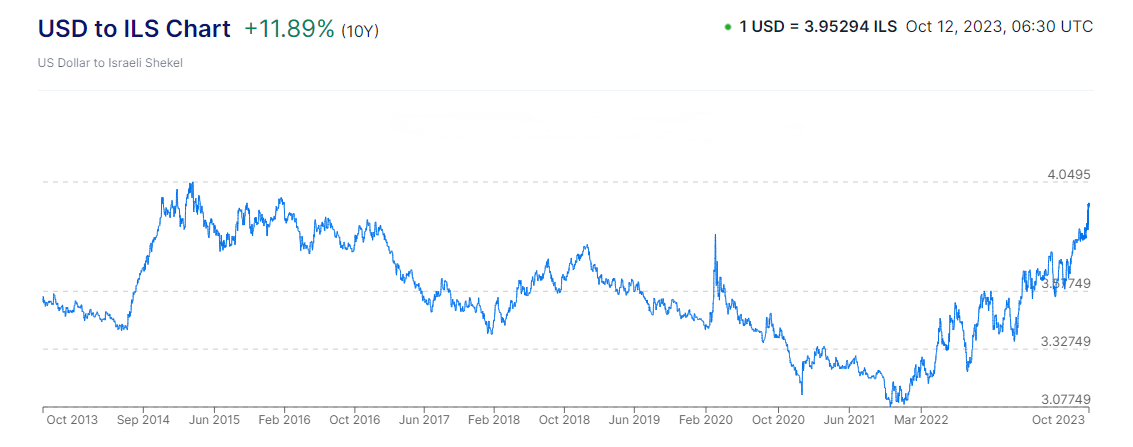
USD to ILS chart. Source: XE.com
However,
the Bank of Israel has expressed confidence in its actions and stated that an
emergency interest rate hike is not needed for the time being. Indeed,
intervention in the open market has allowed the reversal, or at least the halt,
of further sell-offs.
⚠️BREAKING:
*BANK OF ISRAEL ANNOUNCES PROGRAM TO SELL $30 BILLION DOLLARS IN FX TO SUPPORT SHEKEL
The USD/ILS
currency pair stabilized at the beginning of the week at 3.9842 and has since
dropped to 3.9535. Although the difference is minor, the central bank has
managed to maintain the rate above seven-year lows.
"However, the Israeli currency has been in decline for some time due to social unrest caused by government judicial reform. It has lost 10% against the dollar since the beginning of the year," Łukasz Klufczyński, the Chief Economist at InstaForex, commented for Finance Magnates.
Moreover,
speculators are reluctant to test the institution and short the ILS. The bank
has amassed nearly $200 billion in reserves and has a substantial cash buffer to
extinguish any speculative sell-off attempts.
The strong
depreciation has not spared the Tel Aviv Stock Exchange (TASE). The index
comprising the 35 largest Israeli companies slid during this week's opening to
a level of 1692.26, hitting lows from February of the current year. It
temporarily deepened its losses to 1689.98 a day later, testing the lowest
levels since August 2021.
Ultimately, this year's February lows are serving as a barrier against further
sell-offs, allowing TA 35 some room for an upward correction. This does not
change the fact that the benchmark is still down by nearly 6%.
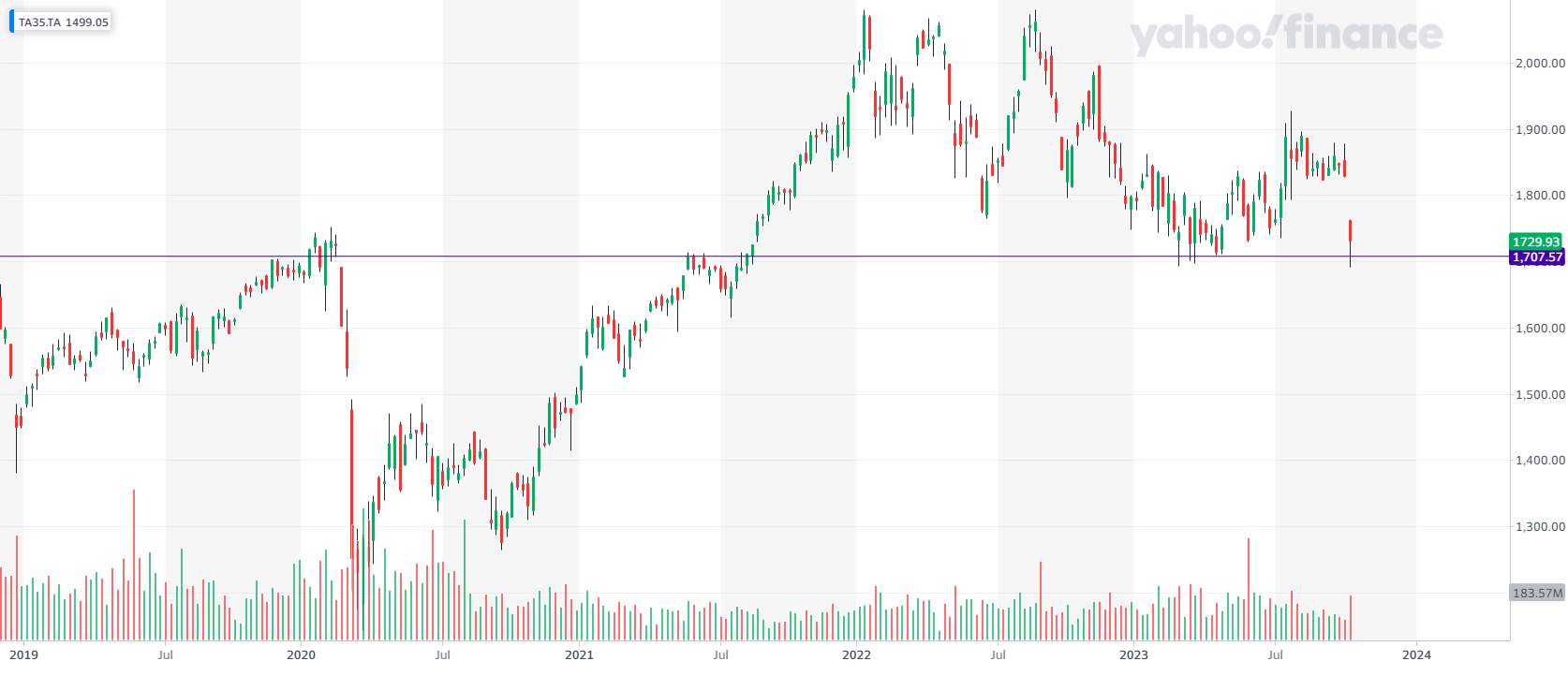
TA 35 chart. Source: Yahoo Finance
"If in
the past the reaction in the markets was for a day or two at most, it is likely
that this time we will see the local markets having difficulty recovering
quickly," Ori Greenfeld, the Chief Strategist at Psagot Investment House,
commented for The Times of Israel.
Greenfeld
argues that the war will negatively impact Israel's global image, which has
already suffered due to judicial reform. In his opinion, this could lead to a
long-term weakening of local financial markets.
Significant
declines were also recorded in the TA 90 index, which is comprised of the 90
companies with the largest market capitalizations on the TASE that are not
included in the TA 35. However, its declines were limited to lows from June and
stopped at a level of 1785.08.
"As for the old stock market saying 'buy on the sound of cannons', defense companies, in particular, reacted with growth. These changes affected the overall market capitalization of companies in the defense sector, which increased by $15 billion, reaching about $500 billion," explained Klufczyński.
The terrorist attack by Hamas on Israeli civilians has not gone unnoticed by international markets. During
Monday's opening, the price of WTI crude oil rose by 4.35% to a level of $87.20
per barrel. Investors began fleeing to safe havens, benefiting gold, among
other assets. It is currently rebounding from six-month lows, costing almost
$1,900 per ounce.
Risk
aversion has also aided "safe haven" currencies, including the
Japanese yen, which has moved away from lows that could trigger intervention by
the Bank of Japan, and the Swiss franc, which has been gaining against the
dollar for the eighth session in a row.
"The market's initial reaction to the situation in the Middle East was textbook economics. We saw a sudden risk-off move, meaning stocks were losing while assets considered safe havens, particularly sensitive to potential conflict escalation, started to gain. Precious metals and oil were the usual winners in such situations," Klufczyński added.
Interestingly,
the war in the Middle East has not triggered a capital outflow towards the
dollar. The DXY index, which measures the strength of the USD against a basket
of currencies, has been losing ground since the beginning of the week. Although
it is still up 2% for the year, its daily chart now shows a series of
consecutive bearish candles.
The stock
index that includes the largest domestic companies has plummeted to over
two-year lows, and the currency has weakened to its lowest point in seven
years. These are the market repercussions of the unexpected terrorist attack from Hamas on
Israeli civilians that occurred this weekend. The Bank of Israel has initiated the sale of
$45 billion in foreign currency reserves to manage the situation and curb the
depreciation of the shekel (ILS).
Largest Fluctuation in
Israeli Currency in 20 Years
Before the
market opened this week, the institution issued a statement informing that it
would sell up to $30 billion in reserves to support the shekel and extend an
additional $15 billion through a swap mechanism. However, the market panic has
not been contained, and on 9 October, the ILS lost nearly 2.7% against the U.S.
dollar, reaching its lowest levels since 2016.
USD to ILS chart. Source: XE.com
However,
the Bank of Israel has expressed confidence in its actions and stated that an
emergency interest rate hike is not needed for the time being. Indeed,
intervention in the open market has allowed the reversal, or at least the halt,
of further sell-offs.
⚠️BREAKING:
*BANK OF ISRAEL ANNOUNCES PROGRAM TO SELL $30 BILLION DOLLARS IN FX TO SUPPORT SHEKEL
The USD/ILS
currency pair stabilized at the beginning of the week at 3.9842 and has since
dropped to 3.9535. Although the difference is minor, the central bank has
managed to maintain the rate above seven-year lows.
"However, the Israeli currency has been in decline for some time due to social unrest caused by government judicial reform. It has lost 10% against the dollar since the beginning of the year," Łukasz Klufczyński, the Chief Economist at InstaForex, commented for Finance Magnates.
Moreover,
speculators are reluctant to test the institution and short the ILS. The bank
has amassed nearly $200 billion in reserves and has a substantial cash buffer to
extinguish any speculative sell-off attempts.
The strong
depreciation has not spared the Tel Aviv Stock Exchange (TASE). The index
comprising the 35 largest Israeli companies slid during this week's opening to
a level of 1692.26, hitting lows from February of the current year. It
temporarily deepened its losses to 1689.98 a day later, testing the lowest
levels since August 2021.
Ultimately, this year's February lows are serving as a barrier against further
sell-offs, allowing TA 35 some room for an upward correction. This does not
change the fact that the benchmark is still down by nearly 6%.
TA 35 chart. Source: Yahoo Finance
"If in
the past the reaction in the markets was for a day or two at most, it is likely
that this time we will see the local markets having difficulty recovering
quickly," Ori Greenfeld, the Chief Strategist at Psagot Investment House,
commented for The Times of Israel.
Greenfeld
argues that the war will negatively impact Israel's global image, which has
already suffered due to judicial reform. In his opinion, this could lead to a
long-term weakening of local financial markets.
Significant
declines were also recorded in the TA 90 index, which is comprised of the 90
companies with the largest market capitalizations on the TASE that are not
included in the TA 35. However, its declines were limited to lows from June and
stopped at a level of 1785.08.
"As for the old stock market saying 'buy on the sound of cannons', defense companies, in particular, reacted with growth. These changes affected the overall market capitalization of companies in the defense sector, which increased by $15 billion, reaching about $500 billion," explained Klufczyński.
The terrorist attack by Hamas on Israeli civilians has not gone unnoticed by international markets. During
Monday's opening, the price of WTI crude oil rose by 4.35% to a level of $87.20
per barrel. Investors began fleeing to safe havens, benefiting gold, among
other assets. It is currently rebounding from six-month lows, costing almost
$1,900 per ounce.
Risk
aversion has also aided "safe haven" currencies, including the
Japanese yen, which has moved away from lows that could trigger intervention by
the Bank of Japan, and the Swiss franc, which has been gaining against the
dollar for the eighth session in a row.
"The market's initial reaction to the situation in the Middle East was textbook economics. We saw a sudden risk-off move, meaning stocks were losing while assets considered safe havens, particularly sensitive to potential conflict escalation, started to gain. Precious metals and oil were the usual winners in such situations," Klufczyński added.
Interestingly,
the war in the Middle East has not triggered a capital outflow towards the
dollar. The DXY index, which measures the strength of the USD against a basket
of currencies, has been losing ground since the beginning of the week. Although
it is still up 2% for the year, its daily chart now shows a series of
consecutive bearish candles.
Damian's adventure with financial markets began at the Cracow University of Economics, where he obtained his MA in finance and accounting. Starting from the retail trader perspective, he collaborated with brokerage houses and financial portals in Poland as an independent editor and content manager. His adventure with Finance Magnates began in 2016, where he is working as a business intelligence analyst.
In this conversation, we sit down with Drew Niv, CSO at ATFX Connect and one of the most influential figures in modern FX.
We speak about market structure, the institutional view on liquidity, and the sharp rise of prop trading, a sector Drew has been commenting on in recent months. Drew explains why he once dismissed prop trading, why his view changed, and what he now thinks the model means for brokers, clients and risk managers.
We explore subscription-fee dependency, the high reneging rate, and the long-term challenge: how brokers can build a more stable and honest version of the model. Drew also talks about the traffic advantage standalone prop firms have built and why brokers may still win in the long run if they take the right approach.
In this conversation, we sit down with Drew Niv, CSO at ATFX Connect and one of the most influential figures in modern FX.
We speak about market structure, the institutional view on liquidity, and the sharp rise of prop trading, a sector Drew has been commenting on in recent months. Drew explains why he once dismissed prop trading, why his view changed, and what he now thinks the model means for brokers, clients and risk managers.
We explore subscription-fee dependency, the high reneging rate, and the long-term challenge: how brokers can build a more stable and honest version of the model. Drew also talks about the traffic advantage standalone prop firms have built and why brokers may still win in the long run if they take the right approach.
In this conversation, we sit down with Drew Niv, CSO at ATFX Connect and one of the most influential figures in modern FX.
We speak about market structure, the institutional view on liquidity, and the sharp rise of prop trading, a sector Drew has been commenting on in recent months. Drew explains why he once dismissed prop trading, why his view changed, and what he now thinks the model means for brokers, clients and risk managers.
We explore subscription-fee dependency, the high reneging rate, and the long-term challenge: how brokers can build a more stable and honest version of the model. Drew also talks about the traffic advantage standalone prop firms have built and why brokers may still win in the long run if they take the right approach.
In this conversation, we sit down with Drew Niv, CSO at ATFX Connect and one of the most influential figures in modern FX.
We speak about market structure, the institutional view on liquidity, and the sharp rise of prop trading, a sector Drew has been commenting on in recent months. Drew explains why he once dismissed prop trading, why his view changed, and what he now thinks the model means for brokers, clients and risk managers.
We explore subscription-fee dependency, the high reneging rate, and the long-term challenge: how brokers can build a more stable and honest version of the model. Drew also talks about the traffic advantage standalone prop firms have built and why brokers may still win in the long run if they take the right approach.
Executive Interview | Remonda Z. Kirketerp Møller| CEO & Founder Muinmos | FMLS:25
In this interview, Remonda Z. Kirketerp Møller, founder of Muinmos, breaks down the state of AI in regtech and what responsible adoption really looks like for brokers. We talk about rising fragmentation, the pressures around compliance accuracy, and why most firms are still in the early stages of AI maturity.
Ramanda also shares insights on regulator sandboxes, shifting expectations around accountability, and the current reality of MiCA licensing and passporting in Europe.
A concise look at where compliance, onboarding, and AI-driven processes are heading next.
In this interview, Remonda Z. Kirketerp Møller, founder of Muinmos, breaks down the state of AI in regtech and what responsible adoption really looks like for brokers. We talk about rising fragmentation, the pressures around compliance accuracy, and why most firms are still in the early stages of AI maturity.
Ramanda also shares insights on regulator sandboxes, shifting expectations around accountability, and the current reality of MiCA licensing and passporting in Europe.
A concise look at where compliance, onboarding, and AI-driven processes are heading next.
In this interview, Remonda Z. Kirketerp Møller, founder of Muinmos, breaks down the state of AI in regtech and what responsible adoption really looks like for brokers. We talk about rising fragmentation, the pressures around compliance accuracy, and why most firms are still in the early stages of AI maturity.
Ramanda also shares insights on regulator sandboxes, shifting expectations around accountability, and the current reality of MiCA licensing and passporting in Europe.
A concise look at where compliance, onboarding, and AI-driven processes are heading next.
In this interview, Remonda Z. Kirketerp Møller, founder of Muinmos, breaks down the state of AI in regtech and what responsible adoption really looks like for brokers. We talk about rising fragmentation, the pressures around compliance accuracy, and why most firms are still in the early stages of AI maturity.
Ramanda also shares insights on regulator sandboxes, shifting expectations around accountability, and the current reality of MiCA licensing and passporting in Europe.
A concise look at where compliance, onboarding, and AI-driven processes are heading next.
In this interview, Remonda Z. Kirketerp Møller, founder of Muinmos, breaks down the state of AI in regtech and what responsible adoption really looks like for brokers. We talk about rising fragmentation, the pressures around compliance accuracy, and why most firms are still in the early stages of AI maturity.
Ramanda also shares insights on regulator sandboxes, shifting expectations around accountability, and the current reality of MiCA licensing and passporting in Europe.
A concise look at where compliance, onboarding, and AI-driven processes are heading next.
In this interview, Remonda Z. Kirketerp Møller, founder of Muinmos, breaks down the state of AI in regtech and what responsible adoption really looks like for brokers. We talk about rising fragmentation, the pressures around compliance accuracy, and why most firms are still in the early stages of AI maturity.
Ramanda also shares insights on regulator sandboxes, shifting expectations around accountability, and the current reality of MiCA licensing and passporting in Europe.
A concise look at where compliance, onboarding, and AI-driven processes are heading next.
In this conversation, we speak with Aydin Bonabi, CEO and co-founder of Surveill, a firm focused on fraud detection and AI-driven compliance tools for financial institutions.
We start with Aydin’s view of the Summit and the challenges brokers face as fraud tactics grow more complex. He explains how firms can stay ahead through real-time signals, data patterns, and early-stage detection.
We also talk about AI training and why compliance teams often struggle to keep models accurate, fair, and aligned with regulatory expectations. Aydin breaks down what “good” AI training looks like inside a financial environment, including the importance of clean data, domain expertise, and human oversight.
He closes with a clear message: fraud is scaling, and so must the tools that stop it.
In this conversation, we speak with Aydin Bonabi, CEO and co-founder of Surveill, a firm focused on fraud detection and AI-driven compliance tools for financial institutions.
We start with Aydin’s view of the Summit and the challenges brokers face as fraud tactics grow more complex. He explains how firms can stay ahead through real-time signals, data patterns, and early-stage detection.
We also talk about AI training and why compliance teams often struggle to keep models accurate, fair, and aligned with regulatory expectations. Aydin breaks down what “good” AI training looks like inside a financial environment, including the importance of clean data, domain expertise, and human oversight.
He closes with a clear message: fraud is scaling, and so must the tools that stop it.
In this conversation, we speak with Aydin Bonabi, CEO and co-founder of Surveill, a firm focused on fraud detection and AI-driven compliance tools for financial institutions.
We start with Aydin’s view of the Summit and the challenges brokers face as fraud tactics grow more complex. He explains how firms can stay ahead through real-time signals, data patterns, and early-stage detection.
We also talk about AI training and why compliance teams often struggle to keep models accurate, fair, and aligned with regulatory expectations. Aydin breaks down what “good” AI training looks like inside a financial environment, including the importance of clean data, domain expertise, and human oversight.
He closes with a clear message: fraud is scaling, and so must the tools that stop it.
In this conversation, we speak with Aydin Bonabi, CEO and co-founder of Surveill, a firm focused on fraud detection and AI-driven compliance tools for financial institutions.
We start with Aydin’s view of the Summit and the challenges brokers face as fraud tactics grow more complex. He explains how firms can stay ahead through real-time signals, data patterns, and early-stage detection.
We also talk about AI training and why compliance teams often struggle to keep models accurate, fair, and aligned with regulatory expectations. Aydin breaks down what “good” AI training looks like inside a financial environment, including the importance of clean data, domain expertise, and human oversight.
He closes with a clear message: fraud is scaling, and so must the tools that stop it.
In this conversation, we speak with Aydin Bonabi, CEO and co-founder of Surveill, a firm focused on fraud detection and AI-driven compliance tools for financial institutions.
We start with Aydin’s view of the Summit and the challenges brokers face as fraud tactics grow more complex. He explains how firms can stay ahead through real-time signals, data patterns, and early-stage detection.
We also talk about AI training and why compliance teams often struggle to keep models accurate, fair, and aligned with regulatory expectations. Aydin breaks down what “good” AI training looks like inside a financial environment, including the importance of clean data, domain expertise, and human oversight.
He closes with a clear message: fraud is scaling, and so must the tools that stop it.
In this conversation, we speak with Aydin Bonabi, CEO and co-founder of Surveill, a firm focused on fraud detection and AI-driven compliance tools for financial institutions.
We start with Aydin’s view of the Summit and the challenges brokers face as fraud tactics grow more complex. He explains how firms can stay ahead through real-time signals, data patterns, and early-stage detection.
We also talk about AI training and why compliance teams often struggle to keep models accurate, fair, and aligned with regulatory expectations. Aydin breaks down what “good” AI training looks like inside a financial environment, including the importance of clean data, domain expertise, and human oversight.
He closes with a clear message: fraud is scaling, and so must the tools that stop it.
Exness expands its presence in Africa: Inside our interview with Paul Margarites in Cape Town
Finance Magnates met with Paul Margarites, Exness regional commercial director for Sub-Saharan Africa, during a visit to the firm’s office opening in Cape Town. In this talk, led by Andrea Badiola Mateos, Co-CEO at Finance Magnates, Paul shares views on the South African trading space, local user behavior, mobile trends, regulation, team growth, and how Exness plans to grow in more markets across the region. @Exness
Read the article at: https://www.financemagnates.com/thought-leadership/exness-expands-its-presence-in-africa-inside-our-interview-with-paul-margarites/
#exness #financemagnates #exnesstrading #CFDtrading #tradeonline #africanews #capetown
Finance Magnates met with Paul Margarites, Exness regional commercial director for Sub-Saharan Africa, during a visit to the firm’s office opening in Cape Town. In this talk, led by Andrea Badiola Mateos, Co-CEO at Finance Magnates, Paul shares views on the South African trading space, local user behavior, mobile trends, regulation, team growth, and how Exness plans to grow in more markets across the region. @Exness
Read the article at: https://www.financemagnates.com/thought-leadership/exness-expands-its-presence-in-africa-inside-our-interview-with-paul-margarites/
#exness #financemagnates #exnesstrading #CFDtrading #tradeonline #africanews #capetown
Finance Magnates met with Paul Margarites, Exness regional commercial director for Sub-Saharan Africa, during a visit to the firm’s office opening in Cape Town. In this talk, led by Andrea Badiola Mateos, Co-CEO at Finance Magnates, Paul shares views on the South African trading space, local user behavior, mobile trends, regulation, team growth, and how Exness plans to grow in more markets across the region. @Exness
Read the article at: https://www.financemagnates.com/thought-leadership/exness-expands-its-presence-in-africa-inside-our-interview-with-paul-margarites/
#exness #financemagnates #exnesstrading #CFDtrading #tradeonline #africanews #capetown
Finance Magnates met with Paul Margarites, Exness regional commercial director for Sub-Saharan Africa, during a visit to the firm’s office opening in Cape Town. In this talk, led by Andrea Badiola Mateos, Co-CEO at Finance Magnates, Paul shares views on the South African trading space, local user behavior, mobile trends, regulation, team growth, and how Exness plans to grow in more markets across the region. @Exness
Read the article at: https://www.financemagnates.com/thought-leadership/exness-expands-its-presence-in-africa-inside-our-interview-with-paul-margarites/
#exness #financemagnates #exnesstrading #CFDtrading #tradeonline #africanews #capetown
Finance Magnates met with Paul Margarites, Exness regional commercial director for Sub-Saharan Africa, during a visit to the firm’s office opening in Cape Town. In this talk, led by Andrea Badiola Mateos, Co-CEO at Finance Magnates, Paul shares views on the South African trading space, local user behavior, mobile trends, regulation, team growth, and how Exness plans to grow in more markets across the region. @Exness
Read the article at: https://www.financemagnates.com/thought-leadership/exness-expands-its-presence-in-africa-inside-our-interview-with-paul-margarites/
#exness #financemagnates #exnesstrading #CFDtrading #tradeonline #africanews #capetown
Finance Magnates met with Paul Margarites, Exness regional commercial director for Sub-Saharan Africa, during a visit to the firm’s office opening in Cape Town. In this talk, led by Andrea Badiola Mateos, Co-CEO at Finance Magnates, Paul shares views on the South African trading space, local user behavior, mobile trends, regulation, team growth, and how Exness plans to grow in more markets across the region. @Exness
Read the article at: https://www.financemagnates.com/thought-leadership/exness-expands-its-presence-in-africa-inside-our-interview-with-paul-margarites/
#exness #financemagnates #exnesstrading #CFDtrading #tradeonline #africanews #capetown
Executive Interview | Jas Shah | FMLS:25
Interview with Jas Shah
Builder | Adviser | Fintech Writer | Product Strategist
In this episode, Jonathan Fine sat down with Jas Shah, one of the most thoughtful voices in global fintech. Known for his work across advisory, product, stablecoins, and his widely read writing, Jas brings a rare combination of industry insight and plain-spoken clarity.
We talk about his first impression of the Summit, the projects that keep him busy today, and how they connect to the stablecoin panel he joined. Jas shares his view on the link between fintech, wealthtech and retail brokers, especially as firms like Revolut, eToro and Trading212 blur long-standing lines in the market.
We also explore what stablecoin adoption might look like for retail investment platforms, including a few product and UX angles that are not obvious at first glance.
To close, Jas explains how he thinks about writing, and how he approaches “shipping” pieces that spark debate across the industry.
Interview with Jas Shah
Builder | Adviser | Fintech Writer | Product Strategist
In this episode, Jonathan Fine sat down with Jas Shah, one of the most thoughtful voices in global fintech. Known for his work across advisory, product, stablecoins, and his widely read writing, Jas brings a rare combination of industry insight and plain-spoken clarity.
We talk about his first impression of the Summit, the projects that keep him busy today, and how they connect to the stablecoin panel he joined. Jas shares his view on the link between fintech, wealthtech and retail brokers, especially as firms like Revolut, eToro and Trading212 blur long-standing lines in the market.
We also explore what stablecoin adoption might look like for retail investment platforms, including a few product and UX angles that are not obvious at first glance.
To close, Jas explains how he thinks about writing, and how he approaches “shipping” pieces that spark debate across the industry.
Interview with Jas Shah
Builder | Adviser | Fintech Writer | Product Strategist
In this episode, Jonathan Fine sat down with Jas Shah, one of the most thoughtful voices in global fintech. Known for his work across advisory, product, stablecoins, and his widely read writing, Jas brings a rare combination of industry insight and plain-spoken clarity.
We talk about his first impression of the Summit, the projects that keep him busy today, and how they connect to the stablecoin panel he joined. Jas shares his view on the link between fintech, wealthtech and retail brokers, especially as firms like Revolut, eToro and Trading212 blur long-standing lines in the market.
We also explore what stablecoin adoption might look like for retail investment platforms, including a few product and UX angles that are not obvious at first glance.
To close, Jas explains how he thinks about writing, and how he approaches “shipping” pieces that spark debate across the industry.
Interview with Jas Shah
Builder | Adviser | Fintech Writer | Product Strategist
In this episode, Jonathan Fine sat down with Jas Shah, one of the most thoughtful voices in global fintech. Known for his work across advisory, product, stablecoins, and his widely read writing, Jas brings a rare combination of industry insight and plain-spoken clarity.
We talk about his first impression of the Summit, the projects that keep him busy today, and how they connect to the stablecoin panel he joined. Jas shares his view on the link between fintech, wealthtech and retail brokers, especially as firms like Revolut, eToro and Trading212 blur long-standing lines in the market.
We also explore what stablecoin adoption might look like for retail investment platforms, including a few product and UX angles that are not obvious at first glance.
To close, Jas explains how he thinks about writing, and how he approaches “shipping” pieces that spark debate across the industry.
Interview with Jas Shah
Builder | Adviser | Fintech Writer | Product Strategist
In this episode, Jonathan Fine sat down with Jas Shah, one of the most thoughtful voices in global fintech. Known for his work across advisory, product, stablecoins, and his widely read writing, Jas brings a rare combination of industry insight and plain-spoken clarity.
We talk about his first impression of the Summit, the projects that keep him busy today, and how they connect to the stablecoin panel he joined. Jas shares his view on the link between fintech, wealthtech and retail brokers, especially as firms like Revolut, eToro and Trading212 blur long-standing lines in the market.
We also explore what stablecoin adoption might look like for retail investment platforms, including a few product and UX angles that are not obvious at first glance.
To close, Jas explains how he thinks about writing, and how he approaches “shipping” pieces that spark debate across the industry.
Interview with Jas Shah
Builder | Adviser | Fintech Writer | Product Strategist
In this episode, Jonathan Fine sat down with Jas Shah, one of the most thoughtful voices in global fintech. Known for his work across advisory, product, stablecoins, and his widely read writing, Jas brings a rare combination of industry insight and plain-spoken clarity.
We talk about his first impression of the Summit, the projects that keep him busy today, and how they connect to the stablecoin panel he joined. Jas shares his view on the link between fintech, wealthtech and retail brokers, especially as firms like Revolut, eToro and Trading212 blur long-standing lines in the market.
We also explore what stablecoin adoption might look like for retail investment platforms, including a few product and UX angles that are not obvious at first glance.
To close, Jas explains how he thinks about writing, and how he approaches “shipping” pieces that spark debate across the industry.