Tesla stock drops 53% in 2025 as Musk focuses on politics and geopolitical tensions rise.
TSLA's price declined on Monday due to weak EV sales, competition, and the overall Wall Street market rout.
However, the future Tesla stock price predictions and forecasts remain optimistic.
Elon Musk's pay deal is being voted on this Thursday.
Tesla stock
(NASDAQ: TSLA) has always been a thrill ride for investors, but as of March 11, 2025,
that ride has taken a stomach-churning plunge. After a euphoric 91% surge
following the U.S. presidential election in November 2024, driven by hopes that
CEO Elon Musk’s alliance with President Donald Trump would propel the electric
vehicle (EV) giant to new heights, TSLA has cratered.
This above is an advertisement by Utip
The stock
dropped over 15% in a single day on Monday, its worst decline since September
2020, wiping out more than $700 billion in market value from its December 2024
peak. Today, TSLA price sits 53% below that high, leaving investors scrambling
to understand why Tesla stock is down and what it means for their portfolios.
Tesla Stock Price Today:
Analyzing Recent Performance
As of today
(Tuesday), March 11, 2025, Tesla stock is trading at $222.15, reflecting a
decrease of $40.52 (15.4%) from the previous close. Moreover, it's hard to find
a similar one-day drop on the chart in recent months, or even years. A
comparable depreciation last occurred 4.5 years ago, when markets feared the
global COVID-19 pandemic.
Why Tesla stock is down? Source: Tradingview.com
The TSLA
price decline in 2025 ties to classic financial theory—supply, demand, and
sentiment. Declining EV sales signal weaker revenue growth, while Musk’s role
in Trump’s Department of Government Efficiency (DOGE) has sparked brand
backlash, denting demand.
Add rising
competition and a broader tech sector sell-off, and you’ve got a recipe for
volatility. Historically, Tesla’s stock has been hypersensitive to Musk’s
actions—think his 2018 “funding secured” tweet that sent shares soaring, then
crashing. Today’s Elon Musk politics factor is just the latest chapter.
Why Tesla Stock Is Down
Today? 4 Main Reasons
Elon Musk,
known for his charismatic yet often controversial personality, has recently
escalated his involvement in politics, openly endorsing candidates, critiquing
government policies, and engaging in political debates through social media.
Investors generally prefer corporate leaders to remain politically neutral to
prevent unnecessary brand damage or regulatory backlash. Musk’s recent
political commentary, however, has amplified Tesla’s exposure to reputational
risks.
So, why is Tesla stock down in 2025? Four key drivers stand out:
Slowing EV Demand and
Competition:
Tesla’s global sales dropped 1% in 2024, its first annual decline in over
a decade, and 2025 isn’t looking better. In Europe, registrations fell 45%
in January, with Germany seeing a 76% plunge. Meanwhile, China’s BYD is
gaining ground with cheaper EVs and advanced self-driving tech,
threatening Tesla’s dominance.
Musk’s Political Pivot: Since joining Trump’s
administration as DOGE co-leader, Musk has been a lightning rod. His push
for government layoffs and far-right endorsements—like Germany’s AfD
party—have sparked protests, vandalism at Tesla stores, and boycotts. A
Strategic Vision survey shows Tesla’s appeal to U.S. car shoppers dropped
from 22% in 2022 to 7% in 2024, a trend likely worsened by Musk-Trump
administration ties.
Market Sentiment and
Overvaluation:
After TSLA’s post-election rally pushed its market cap above $1.5
trillion, analysts warned of a bubble. With profit margins shrinking from
price cuts and no new models since the Cybertruck, investors are
rethinking Tesla’s sky-high valuation amid a tech stock rout.
Stock market investors' fear: in just one day, the entire Nasdaq 100 index
lost $1.1 trillion in value, driven by a strong sell-off of technology
companies. Although Tesla was one of the leaders in the decline, Amazon
(-2.4%), Meta (-4.4%), Alphabet (-4.6%), Microsoft (3.3%), and Netflix (2.7%)
also experienced significant losses. The entire Nasdaq 100 slid by 3.8%, while
the S&P 500 fell by 2.7%.
Data backs
this up: Tesla’s automotive revenue fell 8% year-over-year in Q4 2024, and UBS
predicts a 5% delivery decline in 2025—contrasting with Wall Street’s earlier
12% growth hopes. The Tesla stock drop reflects a recalibration of
expectations.
Source: Tesla
Tesla Technical Analysis
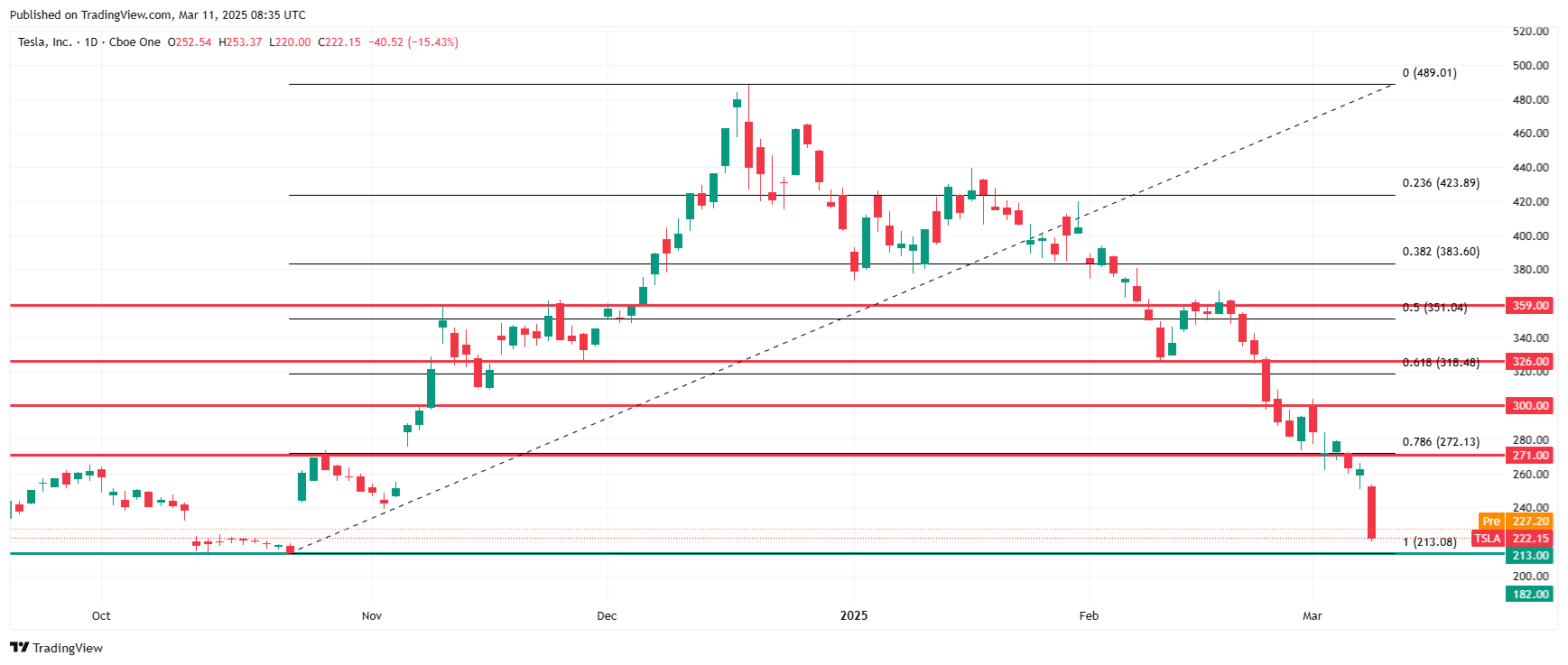
Since my
last technical analysis, Tesla's price has broken through one of the key
support levels at $271, which will now serve as a crucial resistance level. At
the same time, it's only about a year away from testing another important level
for bulls, namely $182, which marks the August 2024 lows. In my opinion, this
level should provide temporary relief and a technical rebound.
However, if
the fundamentals remain unfavorable and investor sentiment negative, I don't
rule out a continuation of the decline all the way to $138, where the April
2024 lows are located.
Tesla stock price technical analysis. Source: Tradingview.com
Technical
condition improvement could only occur when the price returns above the $271
level. Bulls will only properly return to the chart above the $351–359 zone,
which is marked by local resistance combined with a 50% retracement of the
uptrend from October and December 2024.
Support
($)
Resistance
($)
213 –
October lows
271 – July highs, key resistance in the past
182 –
August 2024 lows
300 –
Psychological level & 200 EMA
138 –
April 2024 lows
326 – Local lows from November and February
359 – Tested in November and February
Recent
Pepperstone data reveals Tesla’s stock price has seen sharp swings lately. Over
the past year, after-hours trading has outshone regular sessions, capturing
97% of gains outside normal market hours, making it a hotter spot for
profits.
Tesla Stock Price
Prediction 2025 and 2030
As the company
grapples with its steepest Tesla stock drop since 2020, analysts are split on
where TSLA is headed for the rest of 2025 and into the long term. Here’s a
snapshot of the latest forecasts as of March 11, 2025:
JPMorgan: Targets $135, a bearish call
implying a 40% slide from today’s $222 close. They point to slumping EV
sales and Musk’s political distractions as key risks.
Ross Gerber (Gerber Kawasaki): Sees a potential 50% drop,
citing an overstretched valuation, delays in Full Self-Driving (FSD), and
Elon Musk politics pulling focus from Tesla’s core.
ARK Invest: Stays wildly bullish with a
$3,000 target, banking on Tesla’s autonomous ride-hailing dreams becoming
reality by late 2025.
Morningstar: Pegs TSLA at $250, arguing
the stock’s current price—despite the TSLA price decline—still
overestimates its near-term earnings power.
Consensus Range: Analysts’ average spans
$300–$528, reflecting uncertainty tied to production hiccups, electric
vehicle market trends, and Musk’s Trump administration role.
Even amid
the gloom, some see glimmers of hope for Tesla stock in 2025. Potential
game-changers include a budget-friendly EV slated for 2026, breakthroughs in
FSD that could unlock new revenue streams, and Tesla’s energy division—think
solar panels and Megapack batteries—gaining traction as a diversification play.
Peering
further out, Tesla stock price predictions for 2030 paint a broad picture:
Goldman Sachs: Forecasts $1,200, expecting
robust growth if Tesla holds its EV crown.
Morgan Stanley: Predicts $850, a tempered
outlook based on steady but unspectacular gains.
ARK Invest: Doubles down with $2,500,
betting big on autonomy and global scale.
The catch?
Tesla’s long-term fate hinges on outpacing rivals like BYD and Volkswagen in a
crowded EV arena—a challenge made tougher by today’s Tesla investor concerns
over brand damage and leadership focus.
Should You Buy Tesla Stock
Now?
The TSLA
price decline stems from a brutal mix: sales dipping 1% in 2024 (with worse
expected in 2025), fierce competition, and Elon Musk politics—particularly his
DOGE role—stoking boycotts and protests. Macro pressures, like a tech sector
sell-off and recession jitters, haven’t helped. Yet, Tesla’s knack for defying
odds keeps optimists in the game, especially with autonomy and energy
innovations on the horizon.
For
investors eyeing TSLA today, it’s a risk-reward tightrope. Short-term pain is
real—UBS projects a 5% delivery drop in 2025—but the Tesla stock 2025 outlook
could brighten if Musk refocuses and new models hit the road.
Looking to
2030, the bulls see a titan reborn; the bears, a has-been. To decide, track
Tesla stock charts, monitor electric vehicle market trends, and weigh analyst
takes against your own goals.
Why Tesla stock is down: Weak demand, rivals gaining
ground, and Musk’s political spotlight are hammering TSLA.
The broader market’s retreat—think Nasdaq’s 10% dip—has
magnified the Tesla stock drop.
Analysts are divided on 2025, but long-term bets still see
upside if Tesla innovates.
Stay sharp: Use data, not hype, to
navigate this TSLA price decline and position yourself for what’s next.
Tesla Stock News, FAQ
What is causing Tesla
stock price to go down?
The Tesla
stock drop isn’t a one-off—it’s a pile-up of woes. Global EV sales dipped 1% in
2024, with Europe crashing 45% and China sliding too, signaling demand trouble.
Competition’s heating up—BYD’s cheaper, tech-savvy EVs are stealing share,
while legacy automakers pile in. Profit margins are thinning, dropping to the
mid-teens in Q4 2024 after price cuts failed to spark volume.
When will Tesla stock
price recover?
Pinpointing
a TSLA rebound is tricky, but catalysts could turn the tide. A successful
robotaxi debut—slated for mid-2025—could reignite growth if it delivers. New
models, like a budget EV, might lift sales, especially if Tesla hits its 25%
auto growth goal. Margins need to climb back too, and Musk refocusing on Tesla
over Musk-Trump administration duties could calm Tesla investor concerns.
How much has Tesla stock
price dropped in 2025?
The Tesla
stock 2025 story is brutal: TSLA has tumbled roughly 25% year-to-date, lagging
far behind its “Magnificent 7” tech peers. From its December 2024 peak, the
TSLA price decline clocks in at 53%, a staggering fall from grace after a 91%
post-election spike. This isn’t just a dip—it’s the Tesla stock drop of the
decade, rivaling its 2020 plunge.
What is the Tesla stock
price prediction for 2025?
Analysts
are all over the map on Tesla stock 2025. JPMorgan’s bearish $135 target warns
of a 40% further slide, citing sales woes and Musk’s distractions. Ross Gerber
predicts a 50% haircut, hammering the same risks plus FSD delays.
Why is Tesla stock down
today?
Today’s
Tesla stock drop—March 11, 2025—packs a punch: a 15% single-day nosedive, the
worst since 2020. Blame slowing sales (down 76% in Germany alone), Musk’s
Trump administration gig sparking protests, and a Q4 2024 earnings miss that
exposed shrinking margins. Rivals like BYD are nipping at Tesla’s heels, and
with the stock breaking key support levels, panic selling kicked in.
Is Tesla stock a good buy
at current prices?
With the
TSLA price decline slashing its value 53% from December 2024’s peak, cautious
investors might hesitate—its forward P/E still hovers above 100x, lofty for a
company facing a projected 5% delivery drop in 2025 (per UBS). Shrinking sales
and Tesla investor concerns over brand backlash tied to Elon Musk politics add
to the unease.
Tesla stock
(NASDAQ: TSLA) has always been a thrill ride for investors, but as of March 11, 2025,
that ride has taken a stomach-churning plunge. After a euphoric 91% surge
following the U.S. presidential election in November 2024, driven by hopes that
CEO Elon Musk’s alliance with President Donald Trump would propel the electric
vehicle (EV) giant to new heights, TSLA has cratered.
This above is an advertisement by Utip
The stock
dropped over 15% in a single day on Monday, its worst decline since September
2020, wiping out more than $700 billion in market value from its December 2024
peak. Today, TSLA price sits 53% below that high, leaving investors scrambling
to understand why Tesla stock is down and what it means for their portfolios.
Tesla Stock Price Today:
Analyzing Recent Performance
As of today
(Tuesday), March 11, 2025, Tesla stock is trading at $222.15, reflecting a
decrease of $40.52 (15.4%) from the previous close. Moreover, it's hard to find
a similar one-day drop on the chart in recent months, or even years. A
comparable depreciation last occurred 4.5 years ago, when markets feared the
global COVID-19 pandemic.
Why Tesla stock is down? Source: Tradingview.com
The TSLA
price decline in 2025 ties to classic financial theory—supply, demand, and
sentiment. Declining EV sales signal weaker revenue growth, while Musk’s role
in Trump’s Department of Government Efficiency (DOGE) has sparked brand
backlash, denting demand.
Add rising
competition and a broader tech sector sell-off, and you’ve got a recipe for
volatility. Historically, Tesla’s stock has been hypersensitive to Musk’s
actions—think his 2018 “funding secured” tweet that sent shares soaring, then
crashing. Today’s Elon Musk politics factor is just the latest chapter.
Why Tesla Stock Is Down
Today? 4 Main Reasons
Elon Musk,
known for his charismatic yet often controversial personality, has recently
escalated his involvement in politics, openly endorsing candidates, critiquing
government policies, and engaging in political debates through social media.
Investors generally prefer corporate leaders to remain politically neutral to
prevent unnecessary brand damage or regulatory backlash. Musk’s recent
political commentary, however, has amplified Tesla’s exposure to reputational
risks.
So, why is Tesla stock down in 2025? Four key drivers stand out:
Slowing EV Demand and
Competition:
Tesla’s global sales dropped 1% in 2024, its first annual decline in over
a decade, and 2025 isn’t looking better. In Europe, registrations fell 45%
in January, with Germany seeing a 76% plunge. Meanwhile, China’s BYD is
gaining ground with cheaper EVs and advanced self-driving tech,
threatening Tesla’s dominance.
Musk’s Political Pivot: Since joining Trump’s
administration as DOGE co-leader, Musk has been a lightning rod. His push
for government layoffs and far-right endorsements—like Germany’s AfD
party—have sparked protests, vandalism at Tesla stores, and boycotts. A
Strategic Vision survey shows Tesla’s appeal to U.S. car shoppers dropped
from 22% in 2022 to 7% in 2024, a trend likely worsened by Musk-Trump
administration ties.
Market Sentiment and
Overvaluation:
After TSLA’s post-election rally pushed its market cap above $1.5
trillion, analysts warned of a bubble. With profit margins shrinking from
price cuts and no new models since the Cybertruck, investors are
rethinking Tesla’s sky-high valuation amid a tech stock rout.
Stock market investors' fear: in just one day, the entire Nasdaq 100 index
lost $1.1 trillion in value, driven by a strong sell-off of technology
companies. Although Tesla was one of the leaders in the decline, Amazon
(-2.4%), Meta (-4.4%), Alphabet (-4.6%), Microsoft (3.3%), and Netflix (2.7%)
also experienced significant losses. The entire Nasdaq 100 slid by 3.8%, while
the S&P 500 fell by 2.7%.
Data backs
this up: Tesla’s automotive revenue fell 8% year-over-year in Q4 2024, and UBS
predicts a 5% delivery decline in 2025—contrasting with Wall Street’s earlier
12% growth hopes. The Tesla stock drop reflects a recalibration of
expectations.
Source: Tesla
Tesla Technical Analysis
Since my
last technical analysis, Tesla's price has broken through one of the key
support levels at $271, which will now serve as a crucial resistance level. At
the same time, it's only about a year away from testing another important level
for bulls, namely $182, which marks the August 2024 lows. In my opinion, this
level should provide temporary relief and a technical rebound.
However, if
the fundamentals remain unfavorable and investor sentiment negative, I don't
rule out a continuation of the decline all the way to $138, where the April
2024 lows are located.
Tesla stock price technical analysis. Source: Tradingview.com
Technical
condition improvement could only occur when the price returns above the $271
level. Bulls will only properly return to the chart above the $351–359 zone,
which is marked by local resistance combined with a 50% retracement of the
uptrend from October and December 2024.
Support
($)
Resistance
($)
213 –
October lows
271 – July highs, key resistance in the past
182 –
August 2024 lows
300 –
Psychological level & 200 EMA
138 –
April 2024 lows
326 – Local lows from November and February
359 – Tested in November and February
Recent
Pepperstone data reveals Tesla’s stock price has seen sharp swings lately. Over
the past year, after-hours trading has outshone regular sessions, capturing
97% of gains outside normal market hours, making it a hotter spot for
profits.
Tesla Stock Price
Prediction 2025 and 2030
As the company
grapples with its steepest Tesla stock drop since 2020, analysts are split on
where TSLA is headed for the rest of 2025 and into the long term. Here’s a
snapshot of the latest forecasts as of March 11, 2025:
JPMorgan: Targets $135, a bearish call
implying a 40% slide from today’s $222 close. They point to slumping EV
sales and Musk’s political distractions as key risks.
Ross Gerber (Gerber Kawasaki): Sees a potential 50% drop,
citing an overstretched valuation, delays in Full Self-Driving (FSD), and
Elon Musk politics pulling focus from Tesla’s core.
ARK Invest: Stays wildly bullish with a
$3,000 target, banking on Tesla’s autonomous ride-hailing dreams becoming
reality by late 2025.
Morningstar: Pegs TSLA at $250, arguing
the stock’s current price—despite the TSLA price decline—still
overestimates its near-term earnings power.
Consensus Range: Analysts’ average spans
$300–$528, reflecting uncertainty tied to production hiccups, electric
vehicle market trends, and Musk’s Trump administration role.
Even amid
the gloom, some see glimmers of hope for Tesla stock in 2025. Potential
game-changers include a budget-friendly EV slated for 2026, breakthroughs in
FSD that could unlock new revenue streams, and Tesla’s energy division—think
solar panels and Megapack batteries—gaining traction as a diversification play.
Peering
further out, Tesla stock price predictions for 2030 paint a broad picture:
Goldman Sachs: Forecasts $1,200, expecting
robust growth if Tesla holds its EV crown.
Morgan Stanley: Predicts $850, a tempered
outlook based on steady but unspectacular gains.
ARK Invest: Doubles down with $2,500,
betting big on autonomy and global scale.
The catch?
Tesla’s long-term fate hinges on outpacing rivals like BYD and Volkswagen in a
crowded EV arena—a challenge made tougher by today’s Tesla investor concerns
over brand damage and leadership focus.
Should You Buy Tesla Stock
Now?
The TSLA
price decline stems from a brutal mix: sales dipping 1% in 2024 (with worse
expected in 2025), fierce competition, and Elon Musk politics—particularly his
DOGE role—stoking boycotts and protests. Macro pressures, like a tech sector
sell-off and recession jitters, haven’t helped. Yet, Tesla’s knack for defying
odds keeps optimists in the game, especially with autonomy and energy
innovations on the horizon.
For
investors eyeing TSLA today, it’s a risk-reward tightrope. Short-term pain is
real—UBS projects a 5% delivery drop in 2025—but the Tesla stock 2025 outlook
could brighten if Musk refocuses and new models hit the road.
Looking to
2030, the bulls see a titan reborn; the bears, a has-been. To decide, track
Tesla stock charts, monitor electric vehicle market trends, and weigh analyst
takes against your own goals.
Why Tesla stock is down: Weak demand, rivals gaining
ground, and Musk’s political spotlight are hammering TSLA.
The broader market’s retreat—think Nasdaq’s 10% dip—has
magnified the Tesla stock drop.
Analysts are divided on 2025, but long-term bets still see
upside if Tesla innovates.
Stay sharp: Use data, not hype, to
navigate this TSLA price decline and position yourself for what’s next.
Tesla Stock News, FAQ
What is causing Tesla
stock price to go down?
The Tesla
stock drop isn’t a one-off—it’s a pile-up of woes. Global EV sales dipped 1% in
2024, with Europe crashing 45% and China sliding too, signaling demand trouble.
Competition’s heating up—BYD’s cheaper, tech-savvy EVs are stealing share,
while legacy automakers pile in. Profit margins are thinning, dropping to the
mid-teens in Q4 2024 after price cuts failed to spark volume.
When will Tesla stock
price recover?
Pinpointing
a TSLA rebound is tricky, but catalysts could turn the tide. A successful
robotaxi debut—slated for mid-2025—could reignite growth if it delivers. New
models, like a budget EV, might lift sales, especially if Tesla hits its 25%
auto growth goal. Margins need to climb back too, and Musk refocusing on Tesla
over Musk-Trump administration duties could calm Tesla investor concerns.
How much has Tesla stock
price dropped in 2025?
The Tesla
stock 2025 story is brutal: TSLA has tumbled roughly 25% year-to-date, lagging
far behind its “Magnificent 7” tech peers. From its December 2024 peak, the
TSLA price decline clocks in at 53%, a staggering fall from grace after a 91%
post-election spike. This isn’t just a dip—it’s the Tesla stock drop of the
decade, rivaling its 2020 plunge.
What is the Tesla stock
price prediction for 2025?
Analysts
are all over the map on Tesla stock 2025. JPMorgan’s bearish $135 target warns
of a 40% further slide, citing sales woes and Musk’s distractions. Ross Gerber
predicts a 50% haircut, hammering the same risks plus FSD delays.
Why is Tesla stock down
today?
Today’s
Tesla stock drop—March 11, 2025—packs a punch: a 15% single-day nosedive, the
worst since 2020. Blame slowing sales (down 76% in Germany alone), Musk’s
Trump administration gig sparking protests, and a Q4 2024 earnings miss that
exposed shrinking margins. Rivals like BYD are nipping at Tesla’s heels, and
with the stock breaking key support levels, panic selling kicked in.
Is Tesla stock a good buy
at current prices?
With the
TSLA price decline slashing its value 53% from December 2024’s peak, cautious
investors might hesitate—its forward P/E still hovers above 100x, lofty for a
company facing a projected 5% delivery drop in 2025 (per UBS). Shrinking sales
and Tesla investor concerns over brand backlash tied to Elon Musk politics add
to the unease.
Damian Chmiel is a Senior Analyst & Editor at Finance Magnates with more than 15 years of experience in the CFD and online trading industry. Active as both a trader and journalist since 2010, he focuses on broker coverage, fintech innovation, and regulatory developments across Europe, the Middle East, and Asia.
His work includes interviews with C-level leaders at major brokerages and fintech platforms, as well as co-authoring Finance Magnates’ quarterly industry benchmarking reports. Damian’s reporting is data-driven, market-aware, and grounded in direct industry engagement. His analysis and commentary have also been cited by external media outlets, including Investing.com, Binance, The Asset, Stockhead, and Dispatch.
Education:
MA in Finance and Accounting, Cracow University of Economics
Inside the Prediction Markets: $1.6B Institutional Inflow Meets a Federal Crackdown
Featured Videos
FP Markets Winner Spotlight 🏆 | Global Broker of the Year 2025 #Trading #Broker #Innovation #Shorts
FP Markets Winner Spotlight 🏆 | Global Broker of the Year 2025 #Trading #Broker #Innovation #Shorts
FP Markets Winner Spotlight 🏆 | Global Broker of the Year 2025 #Trading #Broker #Innovation #Shorts
FP Markets Winner Spotlight 🏆 | Global Broker of the Year 2025 #Trading #Broker #Innovation #Shorts
FP Markets takes the spotlight as Global Broker of the Year 2025 at the Finance Magnates Awards.
Martin Stoilov, Head of Client Experience, shares that trust, innovation, and people played a key role in the company’s success, supported by a strong foundation of integrity and client-centricity.
Following this milestone, FP Markets continues to focus on growth, technology investment, and its core values of transparency and excellence.
👉 Be part of FM Awards 2026: https://awards.financemagnates.com/#nominate
FP Markets takes the spotlight as Global Broker of the Year 2025 at the Finance Magnates Awards.
Martin Stoilov, Head of Client Experience, shares that trust, innovation, and people played a key role in the company’s success, supported by a strong foundation of integrity and client-centricity.
Following this milestone, FP Markets continues to focus on growth, technology investment, and its core values of transparency and excellence.
👉 Be part of FM Awards 2026: https://awards.financemagnates.com/#nominate
FP Markets takes the spotlight as Global Broker of the Year 2025 at the Finance Magnates Awards.
Martin Stoilov, Head of Client Experience, shares that trust, innovation, and people played a key role in the company’s success, supported by a strong foundation of integrity and client-centricity.
Following this milestone, FP Markets continues to focus on growth, technology investment, and its core values of transparency and excellence.
👉 Be part of FM Awards 2026: https://awards.financemagnates.com/#nominate
FP Markets takes the spotlight as Global Broker of the Year 2025 at the Finance Magnates Awards.
Martin Stoilov, Head of Client Experience, shares that trust, innovation, and people played a key role in the company’s success, supported by a strong foundation of integrity and client-centricity.
Following this milestone, FP Markets continues to focus on growth, technology investment, and its core values of transparency and excellence.
👉 Be part of FM Awards 2026: https://awards.financemagnates.com/#nominate
In this video, we review @HolaPrimeMarketsOfficial, a multi-asset forex and CFDs broker offering different account types, trading platforms, and flexible trading conditions.
We cover the broker’s overall offering, including account options, trading environment, platforms like MT4 and MT5, and additional services such as managed accounts and fast withdrawals.
Watch the full video to see if Hola Prime Markets fits your trading needs.
📣 Stay up to date with the latest in finance and trading. Follow Finance Magnates for industry news, insights, and global event coverage.
Connect with us:
🔗 LinkedIn: /financemagnates
👍 Facebook: /financemagnates
📸 Instagram: https://www.instagram.com/financemagnates
🐦 X: https://x.com/financemagnates
🎥 TikTok: https://www.tiktok.com/tag/financemagnates
▶️ YouTube: /@financemagnates_official
#HolaPrime #ForexBroker #CFDTrading #FinanceMagnates #Trading #Forex #BrokerReview
In this video, we review @HolaPrimeMarketsOfficial, a multi-asset forex and CFDs broker offering different account types, trading platforms, and flexible trading conditions.
We cover the broker’s overall offering, including account options, trading environment, platforms like MT4 and MT5, and additional services such as managed accounts and fast withdrawals.
Watch the full video to see if Hola Prime Markets fits your trading needs.
📣 Stay up to date with the latest in finance and trading. Follow Finance Magnates for industry news, insights, and global event coverage.
Connect with us:
🔗 LinkedIn: /financemagnates
👍 Facebook: /financemagnates
📸 Instagram: https://www.instagram.com/financemagnates
🐦 X: https://x.com/financemagnates
🎥 TikTok: https://www.tiktok.com/tag/financemagnates
▶️ YouTube: /@financemagnates_official
#HolaPrime #ForexBroker #CFDTrading #FinanceMagnates #Trading #Forex #BrokerReview
In this video, we review @HolaPrimeMarketsOfficial, a multi-asset forex and CFDs broker offering different account types, trading platforms, and flexible trading conditions.
We cover the broker’s overall offering, including account options, trading environment, platforms like MT4 and MT5, and additional services such as managed accounts and fast withdrawals.
Watch the full video to see if Hola Prime Markets fits your trading needs.
📣 Stay up to date with the latest in finance and trading. Follow Finance Magnates for industry news, insights, and global event coverage.
Connect with us:
🔗 LinkedIn: /financemagnates
👍 Facebook: /financemagnates
📸 Instagram: https://www.instagram.com/financemagnates
🐦 X: https://x.com/financemagnates
🎥 TikTok: https://www.tiktok.com/tag/financemagnates
▶️ YouTube: /@financemagnates_official
#HolaPrime #ForexBroker #CFDTrading #FinanceMagnates #Trading #Forex #BrokerReview
In this video, we review @HolaPrimeMarketsOfficial, a multi-asset forex and CFDs broker offering different account types, trading platforms, and flexible trading conditions.
We cover the broker’s overall offering, including account options, trading environment, platforms like MT4 and MT5, and additional services such as managed accounts and fast withdrawals.
Watch the full video to see if Hola Prime Markets fits your trading needs.
📣 Stay up to date with the latest in finance and trading. Follow Finance Magnates for industry news, insights, and global event coverage.
Connect with us:
🔗 LinkedIn: /financemagnates
👍 Facebook: /financemagnates
📸 Instagram: https://www.instagram.com/financemagnates
🐦 X: https://x.com/financemagnates
🎥 TikTok: https://www.tiktok.com/tag/financemagnates
▶️ YouTube: /@financemagnates_official
#HolaPrime #ForexBroker #CFDTrading #FinanceMagnates #Trading #Forex #BrokerReview
In this video, we review @HolaPrimeMarketsOfficial, a multi-asset forex and CFDs broker offering different account types, trading platforms, and flexible trading conditions.
We cover the broker’s overall offering, including account options, trading environment, platforms like MT4 and MT5, and additional services such as managed accounts and fast withdrawals.
Watch the full video to see if Hola Prime Markets fits your trading needs.
📣 Stay up to date with the latest in finance and trading. Follow Finance Magnates for industry news, insights, and global event coverage.
Connect with us:
🔗 LinkedIn: /financemagnates
👍 Facebook: /financemagnates
📸 Instagram: https://www.instagram.com/financemagnates
🐦 X: https://x.com/financemagnates
🎥 TikTok: https://www.tiktok.com/tag/financemagnates
▶️ YouTube: /@financemagnates_official
#HolaPrime #ForexBroker #CFDTrading #FinanceMagnates #Trading #Forex #BrokerReview
In this video, we review @HolaPrimeMarketsOfficial, a multi-asset forex and CFDs broker offering different account types, trading platforms, and flexible trading conditions.
We cover the broker’s overall offering, including account options, trading environment, platforms like MT4 and MT5, and additional services such as managed accounts and fast withdrawals.
Watch the full video to see if Hola Prime Markets fits your trading needs.
📣 Stay up to date with the latest in finance and trading. Follow Finance Magnates for industry news, insights, and global event coverage.
Connect with us:
🔗 LinkedIn: /financemagnates
👍 Facebook: /financemagnates
📸 Instagram: https://www.instagram.com/financemagnates
🐦 X: https://x.com/financemagnates
🎥 TikTok: https://www.tiktok.com/tag/financemagnates
▶️ YouTube: /@financemagnates_official
#HolaPrime #ForexBroker #CFDTrading #FinanceMagnates #Trading #Forex #BrokerReview
Hola Prime Review: What You Need to Know | Full Breakdown by Finance Magnates
Hola Prime Review: What You Need to Know | Full Breakdown by Finance Magnates
Hola Prime Review: What You Need to Know | Full Breakdown by Finance Magnates
Hola Prime Review: What You Need to Know | Full Breakdown by Finance Magnates
Hola Prime Review: What You Need to Know | Full Breakdown by Finance Magnates
Hola Prime Review: What You Need to Know | Full Breakdown by Finance Magnates
In this video, we review @HolaPrime_Global, a proprietary trading firm offering evaluation programs and performance-based payouts in simulated market environments.
We cover how the challenge model works, including account types, profit splits (up to 95%), trading rules, and what it takes to reach a funded account. You’ll also learn about available platforms like MT4, MT5, cTrader, and more, along with insights into payouts, support, and trading conditions.
Watch the full video to see if Hola Prime fits your trading style.
📣 Stay up to date with the latest in finance and trading. Follow Finance Magnates for industry news, insights, and global event coverage.
Connect with us:
🔗 LinkedIn: /financemagnates
👍 Facebook: /financemagnates
📸 Instagram: https://www.instagram.com/financemagnates
🐦 X: https://x.com/financemagnates
🎥 TikTok: https://www.tiktok.com/tag/financemagnates
▶️ YouTube: /@financemagnates_official
#HolaPrime #PropFirm #Trading #FinanceMagnates #Forex #FuturesTrading #TradingReview #PropFirmReview
In this video, we review @HolaPrime_Global, a proprietary trading firm offering evaluation programs and performance-based payouts in simulated market environments.
We cover how the challenge model works, including account types, profit splits (up to 95%), trading rules, and what it takes to reach a funded account. You’ll also learn about available platforms like MT4, MT5, cTrader, and more, along with insights into payouts, support, and trading conditions.
Watch the full video to see if Hola Prime fits your trading style.
📣 Stay up to date with the latest in finance and trading. Follow Finance Magnates for industry news, insights, and global event coverage.
Connect with us:
🔗 LinkedIn: /financemagnates
👍 Facebook: /financemagnates
📸 Instagram: https://www.instagram.com/financemagnates
🐦 X: https://x.com/financemagnates
🎥 TikTok: https://www.tiktok.com/tag/financemagnates
▶️ YouTube: /@financemagnates_official
#HolaPrime #PropFirm #Trading #FinanceMagnates #Forex #FuturesTrading #TradingReview #PropFirmReview
In this video, we review @HolaPrime_Global, a proprietary trading firm offering evaluation programs and performance-based payouts in simulated market environments.
We cover how the challenge model works, including account types, profit splits (up to 95%), trading rules, and what it takes to reach a funded account. You’ll also learn about available platforms like MT4, MT5, cTrader, and more, along with insights into payouts, support, and trading conditions.
Watch the full video to see if Hola Prime fits your trading style.
📣 Stay up to date with the latest in finance and trading. Follow Finance Magnates for industry news, insights, and global event coverage.
Connect with us:
🔗 LinkedIn: /financemagnates
👍 Facebook: /financemagnates
📸 Instagram: https://www.instagram.com/financemagnates
🐦 X: https://x.com/financemagnates
🎥 TikTok: https://www.tiktok.com/tag/financemagnates
▶️ YouTube: /@financemagnates_official
#HolaPrime #PropFirm #Trading #FinanceMagnates #Forex #FuturesTrading #TradingReview #PropFirmReview
In this video, we review @HolaPrime_Global, a proprietary trading firm offering evaluation programs and performance-based payouts in simulated market environments.
We cover how the challenge model works, including account types, profit splits (up to 95%), trading rules, and what it takes to reach a funded account. You’ll also learn about available platforms like MT4, MT5, cTrader, and more, along with insights into payouts, support, and trading conditions.
Watch the full video to see if Hola Prime fits your trading style.
📣 Stay up to date with the latest in finance and trading. Follow Finance Magnates for industry news, insights, and global event coverage.
Connect with us:
🔗 LinkedIn: /financemagnates
👍 Facebook: /financemagnates
📸 Instagram: https://www.instagram.com/financemagnates
🐦 X: https://x.com/financemagnates
🎥 TikTok: https://www.tiktok.com/tag/financemagnates
▶️ YouTube: /@financemagnates_official
#HolaPrime #PropFirm #Trading #FinanceMagnates #Forex #FuturesTrading #TradingReview #PropFirmReview
In this video, we review @HolaPrime_Global, a proprietary trading firm offering evaluation programs and performance-based payouts in simulated market environments.
We cover how the challenge model works, including account types, profit splits (up to 95%), trading rules, and what it takes to reach a funded account. You’ll also learn about available platforms like MT4, MT5, cTrader, and more, along with insights into payouts, support, and trading conditions.
Watch the full video to see if Hola Prime fits your trading style.
📣 Stay up to date with the latest in finance and trading. Follow Finance Magnates for industry news, insights, and global event coverage.
Connect with us:
🔗 LinkedIn: /financemagnates
👍 Facebook: /financemagnates
📸 Instagram: https://www.instagram.com/financemagnates
🐦 X: https://x.com/financemagnates
🎥 TikTok: https://www.tiktok.com/tag/financemagnates
▶️ YouTube: /@financemagnates_official
#HolaPrime #PropFirm #Trading #FinanceMagnates #Forex #FuturesTrading #TradingReview #PropFirmReview
In this video, we review @HolaPrime_Global, a proprietary trading firm offering evaluation programs and performance-based payouts in simulated market environments.
We cover how the challenge model works, including account types, profit splits (up to 95%), trading rules, and what it takes to reach a funded account. You’ll also learn about available platforms like MT4, MT5, cTrader, and more, along with insights into payouts, support, and trading conditions.
Watch the full video to see if Hola Prime fits your trading style.
📣 Stay up to date with the latest in finance and trading. Follow Finance Magnates for industry news, insights, and global event coverage.
Connect with us:
🔗 LinkedIn: /financemagnates
👍 Facebook: /financemagnates
📸 Instagram: https://www.instagram.com/financemagnates
🐦 X: https://x.com/financemagnates
🎥 TikTok: https://www.tiktok.com/tag/financemagnates
▶️ YouTube: /@financemagnates_official
#HolaPrime #PropFirm #Trading #FinanceMagnates #Forex #FuturesTrading #TradingReview #PropFirmReview
Axi Winner Spotlight 🏆 | Global Most Innovative Broker 2025 #Innovation #Trading #Fintech #Broker
Axi Winner Spotlight 🏆 | Global Most Innovative Broker 2025 #Innovation #Trading #Fintech #Broker
Axi Winner Spotlight 🏆 | Global Most Innovative Broker 2025 #Innovation #Trading #Fintech #Broker
Axi Winner Spotlight 🏆 | Global Most Innovative Broker 2025 #Innovation #Trading #Fintech #Broker
Axi Winner Spotlight 🏆 | Global Most Innovative Broker 2025 #Innovation #Trading #Fintech #Broker
Axi Winner Spotlight 🏆 | Global Most Innovative Broker 2025 #Innovation #Trading #Fintech #Broker
Axi takes the spotlight at the Finance Magnates Awards, winning Global Most Innovative Broker 2025.
Olivia Xenofontos and Ivanna Openko share how the team will feel: proud, motivated, and ready to keep delivering.
They also describe the night as well-organized, focused, and enjoyable for all.
👉 Be part of FM Awards 2026.
Axi takes the spotlight at the Finance Magnates Awards, winning Global Most Innovative Broker 2025.
Olivia Xenofontos and Ivanna Openko share how the team will feel: proud, motivated, and ready to keep delivering.
They also describe the night as well-organized, focused, and enjoyable for all.
👉 Be part of FM Awards 2026.
Axi takes the spotlight at the Finance Magnates Awards, winning Global Most Innovative Broker 2025.
Olivia Xenofontos and Ivanna Openko share how the team will feel: proud, motivated, and ready to keep delivering.
They also describe the night as well-organized, focused, and enjoyable for all.
👉 Be part of FM Awards 2026.
Axi takes the spotlight at the Finance Magnates Awards, winning Global Most Innovative Broker 2025.
Olivia Xenofontos and Ivanna Openko share how the team will feel: proud, motivated, and ready to keep delivering.
They also describe the night as well-organized, focused, and enjoyable for all.
👉 Be part of FM Awards 2026.
Axi takes the spotlight at the Finance Magnates Awards, winning Global Most Innovative Broker 2025.
Olivia Xenofontos and Ivanna Openko share how the team will feel: proud, motivated, and ready to keep delivering.
They also describe the night as well-organized, focused, and enjoyable for all.
👉 Be part of FM Awards 2026.
Axi takes the spotlight at the Finance Magnates Awards, winning Global Most Innovative Broker 2025.
Olivia Xenofontos and Ivanna Openko share how the team will feel: proud, motivated, and ready to keep delivering.
They also describe the night as well-organized, focused, and enjoyable for all.
👉 Be part of FM Awards 2026.
Recognition that matters.
Built on transparency.
Driven by the industry.
The Finance Magnates Awards 2026.
Nominations are now open.
🔗 https://awards.financemagnates.com/?utm_source=SM&utm_medium=social&utm_campaign=recognition-matters
Recognition that matters.
Built on transparency.
Driven by the industry.
The Finance Magnates Awards 2026.
Nominations are now open.
🔗 https://awards.financemagnates.com/?utm_source=SM&utm_medium=social&utm_campaign=recognition-matters
Recognition that matters.
Built on transparency.
Driven by the industry.
The Finance Magnates Awards 2026.
Nominations are now open.
🔗 https://awards.financemagnates.com/?utm_source=SM&utm_medium=social&utm_campaign=recognition-matters
Recognition that matters.
Built on transparency.
Driven by the industry.
The Finance Magnates Awards 2026.
Nominations are now open.
🔗 https://awards.financemagnates.com/?utm_source=SM&utm_medium=social&utm_campaign=recognition-matters
Recognition that matters.
Built on transparency.
Driven by the industry.
The Finance Magnates Awards 2026.
Nominations are now open.
🔗 https://awards.financemagnates.com/?utm_source=SM&utm_medium=social&utm_campaign=recognition-matters
Recognition that matters.
Built on transparency.
Driven by the industry.
The Finance Magnates Awards 2026.
Nominations are now open.
🔗 https://awards.financemagnates.com/?utm_source=SM&utm_medium=social&utm_campaign=recognition-matters