Nasdaq 100 crashed 4%, dragging Robinhood stock down with tech sector woes.
Robinhood shares sank 20% as crypto trading slumped with Bitcoin’s fall.
The imposed financial penalty by FINRA on Monday, totaling $30 million, was also important.
Robinhood's billboards in New York’s Times Square (Photo: rblfmr/Shutterstock)
Robinhood
Markets Inc. (NASDAQ: HOOD)
faced a sharp downturn on Monday, March 10, 2025, with shares falling almost
20%, closing at $35.63, down significantly from the previous close of $44.42.
The
sell-off coincided with a devastating day for Wall Street, where the Nasdaq 100
plunged over 4%, its worst single-day decline since September 2022, dragging
down the broader technological sector, including all FAANG stocks
(Facebook/Meta, Amazon, Apple, Netflix, and Google/Alphabet).
Robinhood Stock Price
Today: HOOD Falls 20%
Today
(Tuesday, March 11, 2025), the price of a single HOOD share on NASDAQ stands at
$35.63 ahead of Wall Street’s opening. This marks its lowest level since
December 2024, and the 20% drop during a single session was one of the sharpest
declines across the entire index.
The severe
drop is part of a broader downward trend that has seen Robinhood shares lose
almost half their value since mid-February when they traded at approximately
$67. This represents a stark reversal of fortune for a company whose stock had
more than doubled in value over the past year before this recent collapse.
However, as
of writing, in the pre-market, HOOD shares are rebounding, rising by $1.30
(3.6%) to $36.90,
Investors
responded swiftly to these regulatory issues, contributing to elevated selling
pressure. Trading volume surged, indicating heightened investor anxiety and
undermining market confidence in Robinhood’s near-term outlook.
Moreover, investor
sentiment has been severely damaged by ongoing uncertainty surrounding
President Trump's trade policies and tariff announcements. Adding to these
concerns, President Trump did not dismiss the possibility of a recession in
2025 during a Fox News interview, stating: "There is a period of
transition because what we're doing is very big. We're bringing wealth back to
America. That's a big thing... It takes a little time."
Nasdaq 100, Tech Sector
Declines and Bitcoin Going South
Robinhood’s
decline occurred within a broader context, as major indices experienced
significant downturns:
Nasdaq Composite: Dropped 4% to close at 17,468.32, marking the index’s steepest
single-day fall since 2022.
S&P 500:
Declined by 2.7%.
Dow Jones Industrial Average: Fell by 2.1%.
Technology
giants known collectively as the FAANG stocks—Meta (formerly Facebook), Amazon,
Apple, Netflix, and Alphabet (Google)—also saw considerable losses. Tesla was
notably impacted, with shares declining over 15%, its worst one-day performance
since 2020.
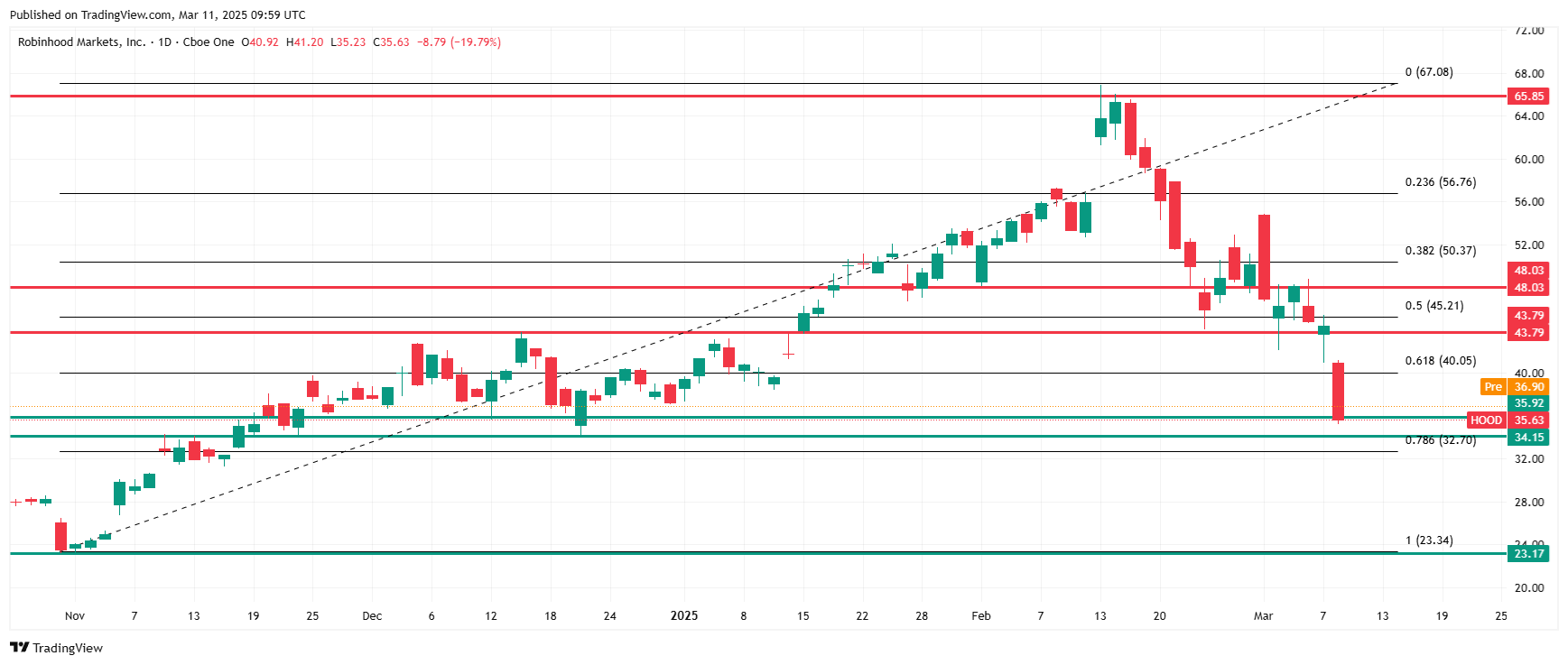
Technical Analysis and Robinhood
Stock Price Forecasts
From a
technical standpoint, Robinhood’s sharp decline broke key support levels,
prompting further bearish signals. The key level was the $44 zone, reinforced
by the 50% Fibonacci retracement at $45, which acted as a dividing line between
bulls and bears.
Breaking
this level—defined by the highs from late last year and the local lows from
late February—indicates that sellers are regaining control. The sharp, nearly
20% drop pushed the stock straight to the next support zone, formed by
December's lows. If this support fails, I would expect Robinhood shares to
decline toward $23, which aligns with the October lows.
Support
Resistance
$36 – December
lows
$44 – Key support level broken in March
$34 –
Additional support/December lows
$48 – September
2021 highs
$23 – Potential
downside target
$66 – February
2025 peaks
According
to MarketBeat, Robinhood has received a consensus rating of "Moderate
Buy" from 16 research firms covering the stock. The average 12-month price
target among these analysts is $59.53.
Several
investment firms have recently updated their outlook on Robinhood:
Piper Sandler:
Raised their price objective from $54.00 to $75.00 and gave the company an
"overweight" rating (February 13th, 2025)
Mizuho:
Boosted their price objective from $60.00 to $65.00 and maintained an
"outperform" rating (February 7th, 2025)
Is Robinhood Stock a Buy
After the Crash?
Robinhood’s
dramatic fall on March 10, 2025, reflects a perfect storm of Wall Street’s tech
sector woes, crypto volatility, and macroeconomic uncertainty. While the Nasdaq
100 and FAANG stocks struggled, Robinhood’s retail-driven model amplified its
losses. For investors, the question remains: Is this a dip to buy or a sign of
deeper trouble?
Short-term
risks loom large, but long-term believers in Robinhood’s growth story might see
value at these levels. Stay updated with Robinhood stock charts, market news,
and expert analyses to navigate this turbulent landscape.
Key
Takeaways:
Robinhood
stock crashed nearly 20% on March 10 amid a Wall Street sell-off.
The
Nasdaq 100 and FAANG stocks tanked, dragging the tech sector down.
Recession
fears, crypto declines, and earnings woes fueled the drop.
Robinhood
stock prediction 2025 remains uncertain—proceed with caution.
Robinhood News, FAQ
Why Is Robinhood Stock
Going Down?
Robinhood's
stock price fell sharply due to regulatory fines totaling $26 million, issued
by FINRA, along with broader market volatility driven by fears of an economic
recession. This situation led investors to sell off Robinhood shares, resulting
in nearly a 20% drop.
Is There a Problem With
Robinhood Today?
Yes,
Robinhood faces significant regulatory challenges. FINRA fined the company $26
million for inadequate anti-money laundering practices and issues related to
its clearing systems. This regulatory scrutiny has shaken investor confidence,
triggering significant selling pressure.
What's Going On With
Robinhood?
Robinhood's
shares plunged nearly 20% due to regulatory penalties combined with a broader
market downturn that impacted technology and financial stocks. Economic
uncertainty and recession fears, amplified by political commentary and tariff
disputes, have further affected investor sentiment.
Is Robinhood Stock
Expected to Rise?
Robinhood's
future stock price movement will depend on resolving current regulatory issues
and overall market conditions. Analysts recommend closely monitoring
developments in regulatory matters, broader economic indicators, and technical
support levels, particularly around the $30 and $32 range, before anticipating
any significant recovery.
Robinhood
Markets Inc. (NASDAQ: HOOD)
faced a sharp downturn on Monday, March 10, 2025, with shares falling almost
20%, closing at $35.63, down significantly from the previous close of $44.42.
The
sell-off coincided with a devastating day for Wall Street, where the Nasdaq 100
plunged over 4%, its worst single-day decline since September 2022, dragging
down the broader technological sector, including all FAANG stocks
(Facebook/Meta, Amazon, Apple, Netflix, and Google/Alphabet).
Robinhood Stock Price
Today: HOOD Falls 20%
Today
(Tuesday, March 11, 2025), the price of a single HOOD share on NASDAQ stands at
$35.63 ahead of Wall Street’s opening. This marks its lowest level since
December 2024, and the 20% drop during a single session was one of the sharpest
declines across the entire index.
The severe
drop is part of a broader downward trend that has seen Robinhood shares lose
almost half their value since mid-February when they traded at approximately
$67. This represents a stark reversal of fortune for a company whose stock had
more than doubled in value over the past year before this recent collapse.
However, as
of writing, in the pre-market, HOOD shares are rebounding, rising by $1.30
(3.6%) to $36.90,
Investors
responded swiftly to these regulatory issues, contributing to elevated selling
pressure. Trading volume surged, indicating heightened investor anxiety and
undermining market confidence in Robinhood’s near-term outlook.
Moreover, investor
sentiment has been severely damaged by ongoing uncertainty surrounding
President Trump's trade policies and tariff announcements. Adding to these
concerns, President Trump did not dismiss the possibility of a recession in
2025 during a Fox News interview, stating: "There is a period of
transition because what we're doing is very big. We're bringing wealth back to
America. That's a big thing... It takes a little time."
Nasdaq 100, Tech Sector
Declines and Bitcoin Going South
Robinhood’s
decline occurred within a broader context, as major indices experienced
significant downturns:
Nasdaq Composite: Dropped 4% to close at 17,468.32, marking the index’s steepest
single-day fall since 2022.
S&P 500:
Declined by 2.7%.
Dow Jones Industrial Average: Fell by 2.1%.
Technology
giants known collectively as the FAANG stocks—Meta (formerly Facebook), Amazon,
Apple, Netflix, and Alphabet (Google)—also saw considerable losses. Tesla was
notably impacted, with shares declining over 15%, its worst one-day performance
since 2020.
Technical Analysis and Robinhood
Stock Price Forecasts
From a
technical standpoint, Robinhood’s sharp decline broke key support levels,
prompting further bearish signals. The key level was the $44 zone, reinforced
by the 50% Fibonacci retracement at $45, which acted as a dividing line between
bulls and bears.
Breaking
this level—defined by the highs from late last year and the local lows from
late February—indicates that sellers are regaining control. The sharp, nearly
20% drop pushed the stock straight to the next support zone, formed by
December's lows. If this support fails, I would expect Robinhood shares to
decline toward $23, which aligns with the October lows.
Support
Resistance
$36 – December
lows
$44 – Key support level broken in March
$34 –
Additional support/December lows
$48 – September
2021 highs
$23 – Potential
downside target
$66 – February
2025 peaks
According
to MarketBeat, Robinhood has received a consensus rating of "Moderate
Buy" from 16 research firms covering the stock. The average 12-month price
target among these analysts is $59.53.
Several
investment firms have recently updated their outlook on Robinhood:
Piper Sandler:
Raised their price objective from $54.00 to $75.00 and gave the company an
"overweight" rating (February 13th, 2025)
Mizuho:
Boosted their price objective from $60.00 to $65.00 and maintained an
"outperform" rating (February 7th, 2025)
Is Robinhood Stock a Buy
After the Crash?
Robinhood’s
dramatic fall on March 10, 2025, reflects a perfect storm of Wall Street’s tech
sector woes, crypto volatility, and macroeconomic uncertainty. While the Nasdaq
100 and FAANG stocks struggled, Robinhood’s retail-driven model amplified its
losses. For investors, the question remains: Is this a dip to buy or a sign of
deeper trouble?
Short-term
risks loom large, but long-term believers in Robinhood’s growth story might see
value at these levels. Stay updated with Robinhood stock charts, market news,
and expert analyses to navigate this turbulent landscape.
Key
Takeaways:
Robinhood
stock crashed nearly 20% on March 10 amid a Wall Street sell-off.
The
Nasdaq 100 and FAANG stocks tanked, dragging the tech sector down.
Recession
fears, crypto declines, and earnings woes fueled the drop.
Robinhood
stock prediction 2025 remains uncertain—proceed with caution.
Robinhood News, FAQ
Why Is Robinhood Stock
Going Down?
Robinhood's
stock price fell sharply due to regulatory fines totaling $26 million, issued
by FINRA, along with broader market volatility driven by fears of an economic
recession. This situation led investors to sell off Robinhood shares, resulting
in nearly a 20% drop.
Is There a Problem With
Robinhood Today?
Yes,
Robinhood faces significant regulatory challenges. FINRA fined the company $26
million for inadequate anti-money laundering practices and issues related to
its clearing systems. This regulatory scrutiny has shaken investor confidence,
triggering significant selling pressure.
What's Going On With
Robinhood?
Robinhood's
shares plunged nearly 20% due to regulatory penalties combined with a broader
market downturn that impacted technology and financial stocks. Economic
uncertainty and recession fears, amplified by political commentary and tariff
disputes, have further affected investor sentiment.
Is Robinhood Stock
Expected to Rise?
Robinhood's
future stock price movement will depend on resolving current regulatory issues
and overall market conditions. Analysts recommend closely monitoring
developments in regulatory matters, broader economic indicators, and technical
support levels, particularly around the $30 and $32 range, before anticipating
any significant recovery.
Damian Chmiel is a Senior Analyst & Editor at Finance Magnates with more than 15 years of experience in the CFD and online trading industry. Active as both a trader and journalist since 2010, he focuses on broker coverage, fintech innovation, and regulatory developments across Europe, the Middle East, and Asia.
His work includes interviews with C-level leaders at major brokerages and fintech platforms, as well as co-authoring Finance Magnates’ quarterly industry benchmarking reports. Damian’s reporting is data-driven, market-aware, and grounded in direct industry engagement. His analysis and commentary have also been cited by external media outlets, including Investing.com, Binance, The Asset, Stockhead, and Dispatch.
Education:
MA in Finance and Accounting, Cracow University of Economics
Why Is Silver Rising Today? Inverted Head and Shoulders Pattern Activates $120 ATH Price Target
Featured Videos
FM Daily Brief - 20 May 2026
FM Daily Brief - 20 May 2026
FM Daily Brief - 20 May 2026
FM Daily Brief - 20 May 2026
Today’s lead: CFD brokers show a wide divergence in per-account trading activity. Also ahead, a deep dive into IG Group and XTB’s latest numbers. It's Wednesday, 20 May 2026. You're listening to the Finance Magnates Daily Brief.
Today’s lead: CFD brokers show a wide divergence in per-account trading activity. Also ahead, a deep dive into IG Group and XTB’s latest numbers. It's Wednesday, 20 May 2026. You're listening to the Finance Magnates Daily Brief.
Today’s lead: CFD brokers show a wide divergence in per-account trading activity. Also ahead, a deep dive into IG Group and XTB’s latest numbers. It's Wednesday, 20 May 2026. You're listening to the Finance Magnates Daily Brief.
Today’s lead: CFD brokers show a wide divergence in per-account trading activity. Also ahead, a deep dive into IG Group and XTB’s latest numbers. It's Wednesday, 20 May 2026. You're listening to the Finance Magnates Daily Brief.
Today's lead: IG Group has lifted its full-year revenue outlook after a strong quarter. Also ahead, Swissquote sets a date for its one-to-ten share split. And CMC Markets’ UK head says neobanks are becoming trading distributors. It’s Tuesday, 19 May 2026. You’re listening to the Finance Magnates Daily Brief.
Today's lead: IG Group has lifted its full-year revenue outlook after a strong quarter. Also ahead, Swissquote sets a date for its one-to-ten share split. And CMC Markets’ UK head says neobanks are becoming trading distributors. It’s Tuesday, 19 May 2026. You’re listening to the Finance Magnates Daily Brief.
Today's lead: IG Group has lifted its full-year revenue outlook after a strong quarter. Also ahead, Swissquote sets a date for its one-to-ten share split. And CMC Markets’ UK head says neobanks are becoming trading distributors. It’s Tuesday, 19 May 2026. You’re listening to the Finance Magnates Daily Brief.
Today's lead: IG Group has lifted its full-year revenue outlook after a strong quarter. Also ahead, Swissquote sets a date for its one-to-ten share split. And CMC Markets’ UK head says neobanks are becoming trading distributors. It’s Tuesday, 19 May 2026. You’re listening to the Finance Magnates Daily Brief.
Today's lead: IG Group has lifted its full-year revenue outlook after a strong quarter. Also ahead, Swissquote sets a date for its one-to-ten share split. And CMC Markets’ UK head says neobanks are becoming trading distributors. It’s Tuesday, 19 May 2026. You’re listening to the Finance Magnates Daily Brief.
Today's lead: IG Group has lifted its full-year revenue outlook after a strong quarter. Also ahead, Swissquote sets a date for its one-to-ten share split. And CMC Markets’ UK head says neobanks are becoming trading distributors. It’s Tuesday, 19 May 2026. You’re listening to the Finance Magnates Daily Brief.
FM Daily Brief - 18 May 2026
FM Daily Brief - 18 May 2026
FM Daily Brief - 18 May 2026
FM Daily Brief - 18 May 2026
FM Daily Brief - 18 May 2026
FM Daily Brief - 18 May 2026
Today’s lead: Cyprus authorities detain suspects in a forex-linked criminal probe. Also ahead: Kraken’s IPO timeline slips further, and CMC Markets expands its Spectre product to retail clients. It’s Monday, 18 May 2026. You’re listening to the Finance Magnates Daily Brief.
Today’s lead: Cyprus authorities detain suspects in a forex-linked criminal probe. Also ahead: Kraken’s IPO timeline slips further, and CMC Markets expands its Spectre product to retail clients. It’s Monday, 18 May 2026. You’re listening to the Finance Magnates Daily Brief.
Today’s lead: Cyprus authorities detain suspects in a forex-linked criminal probe. Also ahead: Kraken’s IPO timeline slips further, and CMC Markets expands its Spectre product to retail clients. It’s Monday, 18 May 2026. You’re listening to the Finance Magnates Daily Brief.
Today’s lead: Cyprus authorities detain suspects in a forex-linked criminal probe. Also ahead: Kraken’s IPO timeline slips further, and CMC Markets expands its Spectre product to retail clients. It’s Monday, 18 May 2026. You’re listening to the Finance Magnates Daily Brief.
Today’s lead: Cyprus authorities detain suspects in a forex-linked criminal probe. Also ahead: Kraken’s IPO timeline slips further, and CMC Markets expands its Spectre product to retail clients. It’s Monday, 18 May 2026. You’re listening to the Finance Magnates Daily Brief.
Today’s lead: Cyprus authorities detain suspects in a forex-linked criminal probe. Also ahead: Kraken’s IPO timeline slips further, and CMC Markets expands its Spectre product to retail clients. It’s Monday, 18 May 2026. You’re listening to the Finance Magnates Daily Brief.
FM Daily Brief - 15 May 2026
FM Daily Brief - 15 May 2026
FM Daily Brief - 15 May 2026
FM Daily Brief - 15 May 2026
FM Daily Brief - 15 May 2026
FM Daily Brief - 15 May 2026
Today’s lead: The US Senate Banking Committee approved the Clarity Act, moving US lawmakers closer to a full Senate vote. Also ahead, AI agents plug into cTrader trading workflows, and OANDA Japan ends MT4 and MT5 web access. It’s Friday, 15 May 2026. You’re listening to the Finance Magnates Daily Brief.
Today’s lead: The US Senate Banking Committee approved the Clarity Act, moving US lawmakers closer to a full Senate vote. Also ahead, AI agents plug into cTrader trading workflows, and OANDA Japan ends MT4 and MT5 web access. It’s Friday, 15 May 2026. You’re listening to the Finance Magnates Daily Brief.
Today’s lead: The US Senate Banking Committee approved the Clarity Act, moving US lawmakers closer to a full Senate vote. Also ahead, AI agents plug into cTrader trading workflows, and OANDA Japan ends MT4 and MT5 web access. It’s Friday, 15 May 2026. You’re listening to the Finance Magnates Daily Brief.
Today’s lead: The US Senate Banking Committee approved the Clarity Act, moving US lawmakers closer to a full Senate vote. Also ahead, AI agents plug into cTrader trading workflows, and OANDA Japan ends MT4 and MT5 web access. It’s Friday, 15 May 2026. You’re listening to the Finance Magnates Daily Brief.
Today’s lead: The US Senate Banking Committee approved the Clarity Act, moving US lawmakers closer to a full Senate vote. Also ahead, AI agents plug into cTrader trading workflows, and OANDA Japan ends MT4 and MT5 web access. It’s Friday, 15 May 2026. You’re listening to the Finance Magnates Daily Brief.
Today’s lead: The US Senate Banking Committee approved the Clarity Act, moving US lawmakers closer to a full Senate vote. Also ahead, AI agents plug into cTrader trading workflows, and OANDA Japan ends MT4 and MT5 web access. It’s Friday, 15 May 2026. You’re listening to the Finance Magnates Daily Brief.
FM Daily Brief - 14 May 2026
FM Daily Brief - 14 May 2026
FM Daily Brief - 14 May 2026
FM Daily Brief - 14 May 2026
FM Daily Brief - 14 May 2026
FM Daily Brief - 14 May 2026
Today’s lead: Washington moves closer to reshaping crypto markets as the CLARITY Act advances through the US Senate, with the Senate Banking Committee holding its markup and vote on the bill today. Also ahead: record revenue at Rakuten Securities, losses narrow at Valutrades, Pepperstone expands its crypto infrastructure push, and a dormant Bitcoin wallet resurfaces after more than 11 years following an AI-assisted recovery. It’s Thursday, 14 May 2026. You’re listening to the Finance Magnates Daily Brief.
Today’s lead: Washington moves closer to reshaping crypto markets as the CLARITY Act advances through the US Senate, with the Senate Banking Committee holding its markup and vote on the bill today. Also ahead: record revenue at Rakuten Securities, losses narrow at Valutrades, Pepperstone expands its crypto infrastructure push, and a dormant Bitcoin wallet resurfaces after more than 11 years following an AI-assisted recovery. It’s Thursday, 14 May 2026. You’re listening to the Finance Magnates Daily Brief.
Today’s lead: Washington moves closer to reshaping crypto markets as the CLARITY Act advances through the US Senate, with the Senate Banking Committee holding its markup and vote on the bill today. Also ahead: record revenue at Rakuten Securities, losses narrow at Valutrades, Pepperstone expands its crypto infrastructure push, and a dormant Bitcoin wallet resurfaces after more than 11 years following an AI-assisted recovery. It’s Thursday, 14 May 2026. You’re listening to the Finance Magnates Daily Brief.
Today’s lead: Washington moves closer to reshaping crypto markets as the CLARITY Act advances through the US Senate, with the Senate Banking Committee holding its markup and vote on the bill today. Also ahead: record revenue at Rakuten Securities, losses narrow at Valutrades, Pepperstone expands its crypto infrastructure push, and a dormant Bitcoin wallet resurfaces after more than 11 years following an AI-assisted recovery. It’s Thursday, 14 May 2026. You’re listening to the Finance Magnates Daily Brief.
Today’s lead: Washington moves closer to reshaping crypto markets as the CLARITY Act advances through the US Senate, with the Senate Banking Committee holding its markup and vote on the bill today. Also ahead: record revenue at Rakuten Securities, losses narrow at Valutrades, Pepperstone expands its crypto infrastructure push, and a dormant Bitcoin wallet resurfaces after more than 11 years following an AI-assisted recovery. It’s Thursday, 14 May 2026. You’re listening to the Finance Magnates Daily Brief.
Today’s lead: Washington moves closer to reshaping crypto markets as the CLARITY Act advances through the US Senate, with the Senate Banking Committee holding its markup and vote on the bill today. Also ahead: record revenue at Rakuten Securities, losses narrow at Valutrades, Pepperstone expands its crypto infrastructure push, and a dormant Bitcoin wallet resurfaces after more than 11 years following an AI-assisted recovery. It’s Thursday, 14 May 2026. You’re listening to the Finance Magnates Daily Brief.