Microsoft stock price dips to a 15-month low due to cloud competition and tariffs.
MSFT faces regulatory heat, but 2025 predictions stay bullish.
Why is Microsoft shares going down today? Technical analysis and price predictions for 2025
As of April
1, 2025, Microsoft (NASDAQ: MSFT) stock has hit a 15-month low, sliding to $375.39.
Yet, despite this stumble, Wall Street analysts remain optimistic, with 2025
price predictions still painting a bullish picture. So, what’s dragging
Microsoft stock down today, and why are experts betting on a rebound?
Let’s break
it down in plain terms: competition from Amazon and Google, regulatory
pressures, tariff troubles, and a rough quarter for the broader market. By the
end, you’ll have a clear picture of what’s happening—and what might lie ahead.
Microsoft Stock Price
Tests January 2024 Lows
On Monday,
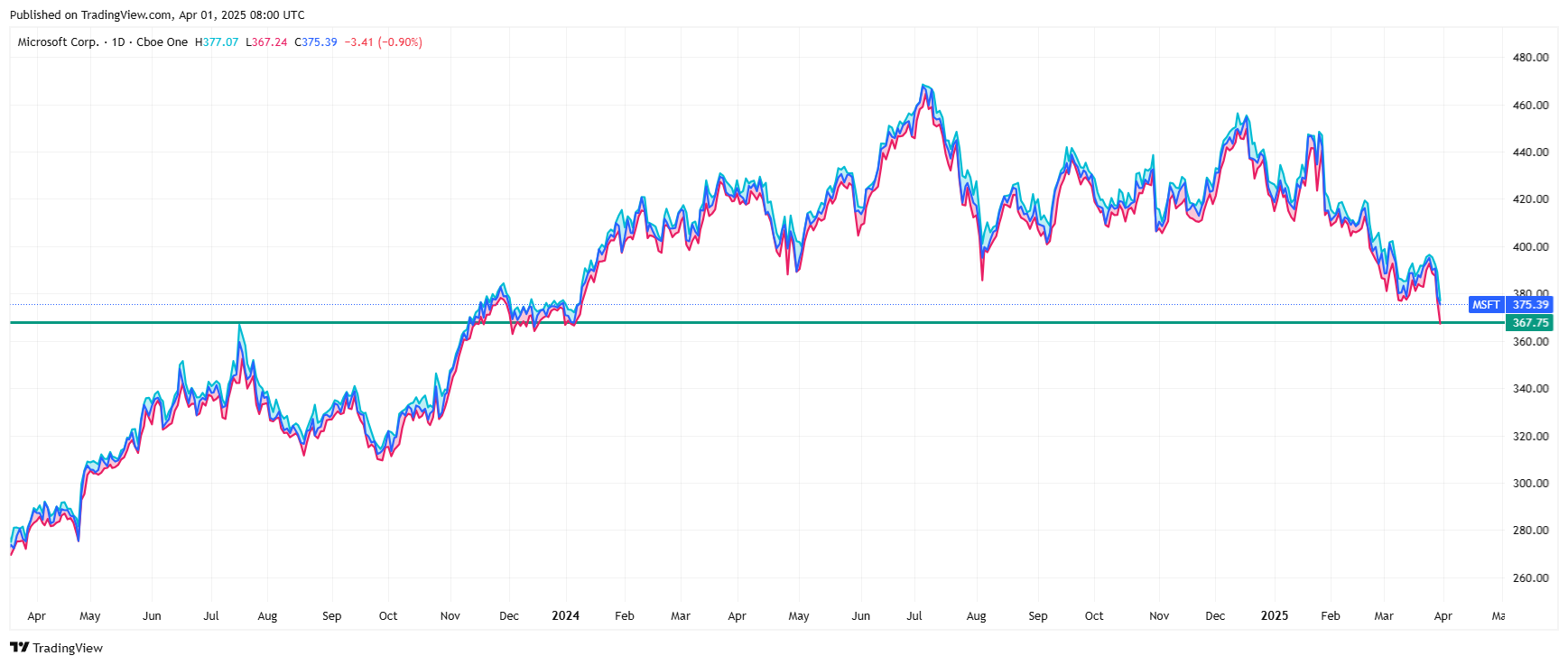
March 31, 2025, Microsoft shares fell 0.9%, closing the final session of the
first quarter at $375.39. At one point during the day, however, the stock
dropped more sharply, reaching $367.24 and testing its lowest level since
January 2024—a 15-month low.
Over the
entire first quarter, Microsoft shares declined nearly 11%, continuing their
retreat from the record highs of 2024. From a peak of nearly $470, the stock
has now fallen more than 20%.
Microsoft share price hits a 15-month low. Source: TradingView.com
While it's
little consolation for shareholders, Microsoft is not alone in its losses.
Amazon dropped 1.28%, closing at $190.26 and hitting a six-month low.
Meanwhile, the broader Nasdaq 100 index slid to its lowest level since
September last year.
What’s
driving the sell-off in Microsoft shares? Let’s take a closer look.
Why Is Microsoft Share
Price Going Down? Key Drivers
Competition with Amazon
and Google: A Cloud and AI Battle Royale
Microsoft’s
Azure cloud platform is a crown jewel, but it’s locked in a fierce fight with
Amazon Web Services (AWS) and Google Cloud. Azure’s revenue grew 31% in the
fiscal second quarter of 2025 (ended December 31, 2024), but it missed Wall
Street’s 31.8% expectation. Meanwhile, AWS continues to dominate with a larger
market share, and Google Cloud is gaining ground with lower-cost AI offerings.
Amazon’s
AWS benefits from its early-mover advantage and massive scale, while Google’s
AI innovations—like cheaper models challenging Microsoft’s OpenAI
partnership—threaten to undercut Azure’s pricing power. For retail investors,
this means Microsoft’s hefty $87 billion capital expenditure (capex) in 2025—up
55% from last year—might not deliver the immediate returns Wall Street craves.
Provider
Market Share (2025 Est.)
Q1 2025 Revenue Growth
Key AI Offering
Microsoft Azure
21%
32%
OpenAI-powered tools
Amazon AWS
30%
18%
SageMaker AI
Google Cloud
13%
34%
Vertex AI
The worry?
Microsoft is pouring cash into AI and cloud infrastructure, but Amazon and
Google could steal the spotlight if they scale faster or cheaper.
Regulatory
hurdles could delay Microsoft’s growth plans—like expanding AI through Azure—or
lead to fines that dent profits. It’s not a dealbreaker, but it’s enough to
spook the market, contributing to the stock’s 15-month low.
Tariff Impacts: A New
Trade Headache
Tariffs are
back in the news, and Microsoft isn’t immune. In late 2024, President Trump
proposed a 25% tariff on non-U.S.-made cars, set to kick in on April 2, 2025.
While Microsoft doesn’t make cars, tariffs ripple through the economy. Higher
costs for imported tech hardware—like chips powering Azure’s data centers—could
squeeze margins. Plus, if trade tensions escalate, Microsoft’s global supply
chain (think China-made components) might face disruptions.
Retail
investors might wonder: how big is this hit? It’s not catastrophic yet, but
with Microsoft spending billions on infrastructure, even small cost hikes add
pressure. Analysts estimate tariffs could shave a few percentage points off
profitability if they broaden beyond cars—a risk worth watching.
A Bad Quarter for S&P
500, Nasdaq, and Wall Street
Zoom out,
and Microsoft’s woes aren’t solo. The S&P 500 and Nasdaq are reeling from a
tough Q1 2025. Stifel’s Barry Bannister predicts the S&P 500 could drop 26%
to 4,700 by year-end after a 10% rally, citing overvaluation (21.4 times
earnings vs. a 10-year average of 18). The Nasdaq, heavy with tech stocks like
Microsoft, feels the heat too. Wall Street’s mood soured after mixed earnings,
with Microsoft’s own Q2 cloud miss fueling the gloom.
After
testing all-time highs in Q1 2025, the S&P 500 is now undergoing a sharper
correction, falling 4.6% after six consecutive quarters of gains. Meanwhile,
the tech-heavy Nasdaq has dropped nearly 9%, also retreating from its record
highs.
$US$SPX#SP500 A quarter to forget for the S&P 500. Despite eking out a 0.6% gain on Monday, the equity benchmark posted its worst period versus the rest of the world since 2009. BBG pic.twitter.com/5j5uEs6sgO
According
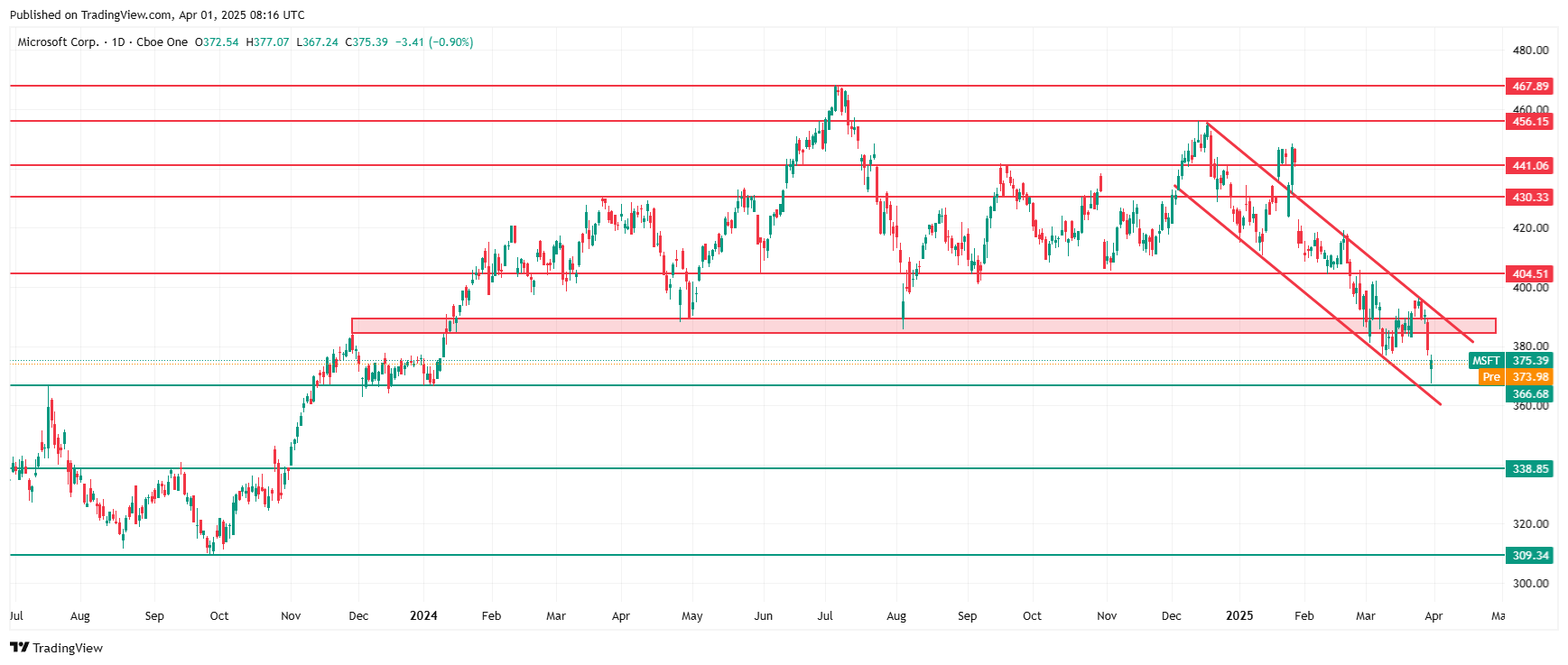
to my technical analysis, Microsoft's share price has broken below a key
support zone that had held since early 2024, located between $385 and $390. The
stock also slipped beneath the 2025 year-to-date lows from early March,
signaling further weakness.
The current
decline has paused near a support level identified around the July 2023 highs,
at approximately $367. This area was tested heavily in December 2023 and early
2024, ultimately serving as a springboard for a stronger rebound.
Adding to
the bearish outlook, Microsoft shares have remained trapped within a clearly
defined downward regression channel for the past five months. This structure
continues to pressure the price lower.
What does
this mean? In my view, Microsoft has more room to fall than to rise at this
point. I’ve identified the following key support levels to watch:
$338.85 – corresponding to the September
2023 highs
$309 – the lows tested in August and
September 2023, which marked the beginning of Microsoft’s last significant
rally
Technical analysis of Microsoft share price. Source: TradingView.com
A move back
above the resistance zone marked in red on the chart would invalidate the
bearish scenario. If that happens, the first upside target would be the Q4 2024
lows, around $404, followed by the all-time high near $468. While this rebound
seems unlikely for now, recent analyst forecasts suggest it cannot be
completely ruled out.
Microsoft Stock Price
Predictions for 2025 and Beyond
Despite
the 15-month low, the outlook isn’t bleak. Here’s what experts are saying about
Microsoft’s stock in 2025 and beyond, including the latest from Stifel and
others:
Piper
Sandler (March 25, 2025): Piper Sandler holds an “Overweight” rating with a $520 target—31% above
today’s price. They’re bullish on Azure’s momentum and Microsoft’s $100
billion-plus cash flows, per X posts. AI leadership keeps them confident.
Morgan
Stanley: Calling it
a “Strong Buy,” Morgan Stanley sees Microsoft hitting $500 by late 2025. They
highlight Office 365 and Teams anchoring steady revenue, even if cloud growth
wobbles.
Analyst Firm
Price Target
Rating
Potential Upside
Stifel
$475
Buy
20%
Piper Sandler
$520
Overweight
31%
Morgan Stanley
$500
Strong Buy
26%
Consensus Average
$510
Strong Buy
29%
Microsoft Share Price News
FAQ
Why Did Microsoft Stock Go
Down?
Microsoft
stock dropped to a 15-month low of $375 by April 1, 2025, due to a mix of
pressures. Azure’s cloud growth (31% in Q2 FY25) missed Wall Street’s lofty
expectations, facing stiff competition from Amazon AWS and Google Cloud.
Regulatory scrutiny over cybersecurity deals and the Activision Blizzard
acquisition rattled investors.
Why Is Microsoft
Declining?
Microsoft’s
decline stems from short-term stumbles and broader economic woes. Regulatory
headaches—like U.S. probes into government contracts—add uncertainty. Tariffs
could hike costs for hardware powering Azure’s data centers, squeezing margins.
Meanwhile, Wall Street’s tough quarter, with the S&P 500 overvalued at 21.4
times earnings, has soured sentiment. It’s not a collapse—just a lull amid big
spending and market jitters.
Is Microsoft Expected to
Rise?
Yes,
analysts expect Microsoft to rise in 2025 despite its current dip. Stifel cut
its target to $475 (19.6% upside from $396.89) but kept a “Buy” rating, while
Piper Sandler ($520, 31% upside) and Morgan Stanley ($500, 26% upside) stay
bullish. The consensus average of $510.03 signals a 28.5% climb, driven by
Azure’s $10 billion AI revenue run rate and Microsoft’s strong cash flows.
Can Microsoft Stock Reach
$1000?
Yes, reaching
$1,000 is a long shot by 2025, but not impossible long-term. Current 2025
targets top out at $650 (per TipRanks’ high-end range), with CoinPriceForecast
projecting $850–$1,000 by 2030 if AI and cloud dominance hold.
Why Is Microsoft Not in
FAANG?
You might
wonder: why isn’t Microsoft lumped with FAANG (Facebook, Amazon, Apple,
Netflix, Google)? The term, coined in 2013 by Jim Cramer, spotlighted
high-growth, consumer-facing tech stocks.
Microsoft,
though a tech titan, didn’t fit the mold back then—it was seen as a legacy
software giant, not a flashy growth story. Today, with Azure and AI, it rivals
FAANG in innovation, but the label stuck to its original crew (now often FAANGM
with Microsoft tacked on informally).
As of April
1, 2025, Microsoft (NASDAQ: MSFT) stock has hit a 15-month low, sliding to $375.39.
Yet, despite this stumble, Wall Street analysts remain optimistic, with 2025
price predictions still painting a bullish picture. So, what’s dragging
Microsoft stock down today, and why are experts betting on a rebound?
Let’s break
it down in plain terms: competition from Amazon and Google, regulatory
pressures, tariff troubles, and a rough quarter for the broader market. By the
end, you’ll have a clear picture of what’s happening—and what might lie ahead.
Microsoft Stock Price
Tests January 2024 Lows
On Monday,
March 31, 2025, Microsoft shares fell 0.9%, closing the final session of the
first quarter at $375.39. At one point during the day, however, the stock
dropped more sharply, reaching $367.24 and testing its lowest level since
January 2024—a 15-month low.
Over the
entire first quarter, Microsoft shares declined nearly 11%, continuing their
retreat from the record highs of 2024. From a peak of nearly $470, the stock
has now fallen more than 20%.
Microsoft share price hits a 15-month low. Source: TradingView.com
While it's
little consolation for shareholders, Microsoft is not alone in its losses.
Amazon dropped 1.28%, closing at $190.26 and hitting a six-month low.
Meanwhile, the broader Nasdaq 100 index slid to its lowest level since
September last year.
What’s
driving the sell-off in Microsoft shares? Let’s take a closer look.
Why Is Microsoft Share
Price Going Down? Key Drivers
Competition with Amazon
and Google: A Cloud and AI Battle Royale
Microsoft’s
Azure cloud platform is a crown jewel, but it’s locked in a fierce fight with
Amazon Web Services (AWS) and Google Cloud. Azure’s revenue grew 31% in the
fiscal second quarter of 2025 (ended December 31, 2024), but it missed Wall
Street’s 31.8% expectation. Meanwhile, AWS continues to dominate with a larger
market share, and Google Cloud is gaining ground with lower-cost AI offerings.
Amazon’s
AWS benefits from its early-mover advantage and massive scale, while Google’s
AI innovations—like cheaper models challenging Microsoft’s OpenAI
partnership—threaten to undercut Azure’s pricing power. For retail investors,
this means Microsoft’s hefty $87 billion capital expenditure (capex) in 2025—up
55% from last year—might not deliver the immediate returns Wall Street craves.
Provider
Market Share (2025 Est.)
Q1 2025 Revenue Growth
Key AI Offering
Microsoft Azure
21%
32%
OpenAI-powered tools
Amazon AWS
30%
18%
SageMaker AI
Google Cloud
13%
34%
Vertex AI
The worry?
Microsoft is pouring cash into AI and cloud infrastructure, but Amazon and
Google could steal the spotlight if they scale faster or cheaper.
Regulatory
hurdles could delay Microsoft’s growth plans—like expanding AI through Azure—or
lead to fines that dent profits. It’s not a dealbreaker, but it’s enough to
spook the market, contributing to the stock’s 15-month low.
Tariff Impacts: A New
Trade Headache
Tariffs are
back in the news, and Microsoft isn’t immune. In late 2024, President Trump
proposed a 25% tariff on non-U.S.-made cars, set to kick in on April 2, 2025.
While Microsoft doesn’t make cars, tariffs ripple through the economy. Higher
costs for imported tech hardware—like chips powering Azure’s data centers—could
squeeze margins. Plus, if trade tensions escalate, Microsoft’s global supply
chain (think China-made components) might face disruptions.
Retail
investors might wonder: how big is this hit? It’s not catastrophic yet, but
with Microsoft spending billions on infrastructure, even small cost hikes add
pressure. Analysts estimate tariffs could shave a few percentage points off
profitability if they broaden beyond cars—a risk worth watching.
A Bad Quarter for S&P
500, Nasdaq, and Wall Street
Zoom out,
and Microsoft’s woes aren’t solo. The S&P 500 and Nasdaq are reeling from a
tough Q1 2025. Stifel’s Barry Bannister predicts the S&P 500 could drop 26%
to 4,700 by year-end after a 10% rally, citing overvaluation (21.4 times
earnings vs. a 10-year average of 18). The Nasdaq, heavy with tech stocks like
Microsoft, feels the heat too. Wall Street’s mood soured after mixed earnings,
with Microsoft’s own Q2 cloud miss fueling the gloom.
After
testing all-time highs in Q1 2025, the S&P 500 is now undergoing a sharper
correction, falling 4.6% after six consecutive quarters of gains. Meanwhile,
the tech-heavy Nasdaq has dropped nearly 9%, also retreating from its record
highs.
$US$SPX#SP500 A quarter to forget for the S&P 500. Despite eking out a 0.6% gain on Monday, the equity benchmark posted its worst period versus the rest of the world since 2009. BBG pic.twitter.com/5j5uEs6sgO
According
to my technical analysis, Microsoft's share price has broken below a key
support zone that had held since early 2024, located between $385 and $390. The
stock also slipped beneath the 2025 year-to-date lows from early March,
signaling further weakness.
The current
decline has paused near a support level identified around the July 2023 highs,
at approximately $367. This area was tested heavily in December 2023 and early
2024, ultimately serving as a springboard for a stronger rebound.
Adding to
the bearish outlook, Microsoft shares have remained trapped within a clearly
defined downward regression channel for the past five months. This structure
continues to pressure the price lower.
What does
this mean? In my view, Microsoft has more room to fall than to rise at this
point. I’ve identified the following key support levels to watch:
$338.85 – corresponding to the September
2023 highs
$309 – the lows tested in August and
September 2023, which marked the beginning of Microsoft’s last significant
rally
Technical analysis of Microsoft share price. Source: TradingView.com
A move back
above the resistance zone marked in red on the chart would invalidate the
bearish scenario. If that happens, the first upside target would be the Q4 2024
lows, around $404, followed by the all-time high near $468. While this rebound
seems unlikely for now, recent analyst forecasts suggest it cannot be
completely ruled out.
Microsoft Stock Price
Predictions for 2025 and Beyond
Despite
the 15-month low, the outlook isn’t bleak. Here’s what experts are saying about
Microsoft’s stock in 2025 and beyond, including the latest from Stifel and
others:
Piper
Sandler (March 25, 2025): Piper Sandler holds an “Overweight” rating with a $520 target—31% above
today’s price. They’re bullish on Azure’s momentum and Microsoft’s $100
billion-plus cash flows, per X posts. AI leadership keeps them confident.
Morgan
Stanley: Calling it
a “Strong Buy,” Morgan Stanley sees Microsoft hitting $500 by late 2025. They
highlight Office 365 and Teams anchoring steady revenue, even if cloud growth
wobbles.
Analyst Firm
Price Target
Rating
Potential Upside
Stifel
$475
Buy
20%
Piper Sandler
$520
Overweight
31%
Morgan Stanley
$500
Strong Buy
26%
Consensus Average
$510
Strong Buy
29%
Microsoft Share Price News
FAQ
Why Did Microsoft Stock Go
Down?
Microsoft
stock dropped to a 15-month low of $375 by April 1, 2025, due to a mix of
pressures. Azure’s cloud growth (31% in Q2 FY25) missed Wall Street’s lofty
expectations, facing stiff competition from Amazon AWS and Google Cloud.
Regulatory scrutiny over cybersecurity deals and the Activision Blizzard
acquisition rattled investors.
Why Is Microsoft
Declining?
Microsoft’s
decline stems from short-term stumbles and broader economic woes. Regulatory
headaches—like U.S. probes into government contracts—add uncertainty. Tariffs
could hike costs for hardware powering Azure’s data centers, squeezing margins.
Meanwhile, Wall Street’s tough quarter, with the S&P 500 overvalued at 21.4
times earnings, has soured sentiment. It’s not a collapse—just a lull amid big
spending and market jitters.
Is Microsoft Expected to
Rise?
Yes,
analysts expect Microsoft to rise in 2025 despite its current dip. Stifel cut
its target to $475 (19.6% upside from $396.89) but kept a “Buy” rating, while
Piper Sandler ($520, 31% upside) and Morgan Stanley ($500, 26% upside) stay
bullish. The consensus average of $510.03 signals a 28.5% climb, driven by
Azure’s $10 billion AI revenue run rate and Microsoft’s strong cash flows.
Can Microsoft Stock Reach
$1000?
Yes, reaching
$1,000 is a long shot by 2025, but not impossible long-term. Current 2025
targets top out at $650 (per TipRanks’ high-end range), with CoinPriceForecast
projecting $850–$1,000 by 2030 if AI and cloud dominance hold.
Why Is Microsoft Not in
FAANG?
You might
wonder: why isn’t Microsoft lumped with FAANG (Facebook, Amazon, Apple,
Netflix, Google)? The term, coined in 2013 by Jim Cramer, spotlighted
high-growth, consumer-facing tech stocks.
Microsoft,
though a tech titan, didn’t fit the mold back then—it was seen as a legacy
software giant, not a flashy growth story. Today, with Azure and AI, it rivals
FAANG in innovation, but the label stuck to its original crew (now often FAANGM
with Microsoft tacked on informally).
Damian Chmiel is a Senior Analyst & Editor at Finance Magnates with more than 15 years of experience in the CFD and online trading industry. Active as both a trader and journalist since 2010, he focuses on broker coverage, fintech innovation, and regulatory developments across Europe, the Middle East, and Asia.
His work includes interviews with C-level leaders at major brokerages and fintech platforms, as well as co-authoring Finance Magnates’ quarterly industry benchmarking reports. Damian’s reporting is data-driven, market-aware, and grounded in direct industry engagement. His analysis and commentary have also been cited by external media outlets, including Investing.com, Binance, The Asset, Stockhead, and Dispatch.
Education:
MA in Finance and Accounting, Cracow University of Economics
Inside the Prediction Markets: $1.6B Institutional Inflow Meets a Federal Crackdown
Featured Videos
FP Markets Winner Spotlight 🏆 | Global Broker of the Year 2025 #Trading #Broker #Innovation #Shorts
FP Markets Winner Spotlight 🏆 | Global Broker of the Year 2025 #Trading #Broker #Innovation #Shorts
FP Markets Winner Spotlight 🏆 | Global Broker of the Year 2025 #Trading #Broker #Innovation #Shorts
FP Markets Winner Spotlight 🏆 | Global Broker of the Year 2025 #Trading #Broker #Innovation #Shorts
FP Markets takes the spotlight as Global Broker of the Year 2025 at the Finance Magnates Awards.
Martin Stoilov, Head of Client Experience, shares that trust, innovation, and people played a key role in the company’s success, supported by a strong foundation of integrity and client-centricity.
Following this milestone, FP Markets continues to focus on growth, technology investment, and its core values of transparency and excellence.
👉 Be part of FM Awards 2026: https://awards.financemagnates.com/#nominate
FP Markets takes the spotlight as Global Broker of the Year 2025 at the Finance Magnates Awards.
Martin Stoilov, Head of Client Experience, shares that trust, innovation, and people played a key role in the company’s success, supported by a strong foundation of integrity and client-centricity.
Following this milestone, FP Markets continues to focus on growth, technology investment, and its core values of transparency and excellence.
👉 Be part of FM Awards 2026: https://awards.financemagnates.com/#nominate
FP Markets takes the spotlight as Global Broker of the Year 2025 at the Finance Magnates Awards.
Martin Stoilov, Head of Client Experience, shares that trust, innovation, and people played a key role in the company’s success, supported by a strong foundation of integrity and client-centricity.
Following this milestone, FP Markets continues to focus on growth, technology investment, and its core values of transparency and excellence.
👉 Be part of FM Awards 2026: https://awards.financemagnates.com/#nominate
FP Markets takes the spotlight as Global Broker of the Year 2025 at the Finance Magnates Awards.
Martin Stoilov, Head of Client Experience, shares that trust, innovation, and people played a key role in the company’s success, supported by a strong foundation of integrity and client-centricity.
Following this milestone, FP Markets continues to focus on growth, technology investment, and its core values of transparency and excellence.
👉 Be part of FM Awards 2026: https://awards.financemagnates.com/#nominate
In this video, we review @HolaPrimeMarketsOfficial, a multi-asset forex and CFDs broker offering different account types, trading platforms, and flexible trading conditions.
We cover the broker’s overall offering, including account options, trading environment, platforms like MT4 and MT5, and additional services such as managed accounts and fast withdrawals.
Watch the full video to see if Hola Prime Markets fits your trading needs.
📣 Stay up to date with the latest in finance and trading. Follow Finance Magnates for industry news, insights, and global event coverage.
Connect with us:
🔗 LinkedIn: /financemagnates
👍 Facebook: /financemagnates
📸 Instagram: https://www.instagram.com/financemagnates
🐦 X: https://x.com/financemagnates
🎥 TikTok: https://www.tiktok.com/tag/financemagnates
▶️ YouTube: /@financemagnates_official
#HolaPrime #ForexBroker #CFDTrading #FinanceMagnates #Trading #Forex #BrokerReview
In this video, we review @HolaPrimeMarketsOfficial, a multi-asset forex and CFDs broker offering different account types, trading platforms, and flexible trading conditions.
We cover the broker’s overall offering, including account options, trading environment, platforms like MT4 and MT5, and additional services such as managed accounts and fast withdrawals.
Watch the full video to see if Hola Prime Markets fits your trading needs.
📣 Stay up to date with the latest in finance and trading. Follow Finance Magnates for industry news, insights, and global event coverage.
Connect with us:
🔗 LinkedIn: /financemagnates
👍 Facebook: /financemagnates
📸 Instagram: https://www.instagram.com/financemagnates
🐦 X: https://x.com/financemagnates
🎥 TikTok: https://www.tiktok.com/tag/financemagnates
▶️ YouTube: /@financemagnates_official
#HolaPrime #ForexBroker #CFDTrading #FinanceMagnates #Trading #Forex #BrokerReview
In this video, we review @HolaPrimeMarketsOfficial, a multi-asset forex and CFDs broker offering different account types, trading platforms, and flexible trading conditions.
We cover the broker’s overall offering, including account options, trading environment, platforms like MT4 and MT5, and additional services such as managed accounts and fast withdrawals.
Watch the full video to see if Hola Prime Markets fits your trading needs.
📣 Stay up to date with the latest in finance and trading. Follow Finance Magnates for industry news, insights, and global event coverage.
Connect with us:
🔗 LinkedIn: /financemagnates
👍 Facebook: /financemagnates
📸 Instagram: https://www.instagram.com/financemagnates
🐦 X: https://x.com/financemagnates
🎥 TikTok: https://www.tiktok.com/tag/financemagnates
▶️ YouTube: /@financemagnates_official
#HolaPrime #ForexBroker #CFDTrading #FinanceMagnates #Trading #Forex #BrokerReview
In this video, we review @HolaPrimeMarketsOfficial, a multi-asset forex and CFDs broker offering different account types, trading platforms, and flexible trading conditions.
We cover the broker’s overall offering, including account options, trading environment, platforms like MT4 and MT5, and additional services such as managed accounts and fast withdrawals.
Watch the full video to see if Hola Prime Markets fits your trading needs.
📣 Stay up to date with the latest in finance and trading. Follow Finance Magnates for industry news, insights, and global event coverage.
Connect with us:
🔗 LinkedIn: /financemagnates
👍 Facebook: /financemagnates
📸 Instagram: https://www.instagram.com/financemagnates
🐦 X: https://x.com/financemagnates
🎥 TikTok: https://www.tiktok.com/tag/financemagnates
▶️ YouTube: /@financemagnates_official
#HolaPrime #ForexBroker #CFDTrading #FinanceMagnates #Trading #Forex #BrokerReview
In this video, we review @HolaPrimeMarketsOfficial, a multi-asset forex and CFDs broker offering different account types, trading platforms, and flexible trading conditions.
We cover the broker’s overall offering, including account options, trading environment, platforms like MT4 and MT5, and additional services such as managed accounts and fast withdrawals.
Watch the full video to see if Hola Prime Markets fits your trading needs.
📣 Stay up to date with the latest in finance and trading. Follow Finance Magnates for industry news, insights, and global event coverage.
Connect with us:
🔗 LinkedIn: /financemagnates
👍 Facebook: /financemagnates
📸 Instagram: https://www.instagram.com/financemagnates
🐦 X: https://x.com/financemagnates
🎥 TikTok: https://www.tiktok.com/tag/financemagnates
▶️ YouTube: /@financemagnates_official
#HolaPrime #ForexBroker #CFDTrading #FinanceMagnates #Trading #Forex #BrokerReview
In this video, we review @HolaPrimeMarketsOfficial, a multi-asset forex and CFDs broker offering different account types, trading platforms, and flexible trading conditions.
We cover the broker’s overall offering, including account options, trading environment, platforms like MT4 and MT5, and additional services such as managed accounts and fast withdrawals.
Watch the full video to see if Hola Prime Markets fits your trading needs.
📣 Stay up to date with the latest in finance and trading. Follow Finance Magnates for industry news, insights, and global event coverage.
Connect with us:
🔗 LinkedIn: /financemagnates
👍 Facebook: /financemagnates
📸 Instagram: https://www.instagram.com/financemagnates
🐦 X: https://x.com/financemagnates
🎥 TikTok: https://www.tiktok.com/tag/financemagnates
▶️ YouTube: /@financemagnates_official
#HolaPrime #ForexBroker #CFDTrading #FinanceMagnates #Trading #Forex #BrokerReview
Hola Prime Review: What You Need to Know | Full Breakdown by Finance Magnates
Hola Prime Review: What You Need to Know | Full Breakdown by Finance Magnates
Hola Prime Review: What You Need to Know | Full Breakdown by Finance Magnates
Hola Prime Review: What You Need to Know | Full Breakdown by Finance Magnates
Hola Prime Review: What You Need to Know | Full Breakdown by Finance Magnates
Hola Prime Review: What You Need to Know | Full Breakdown by Finance Magnates
In this video, we review @HolaPrime_Global, a proprietary trading firm offering evaluation programs and performance-based payouts in simulated market environments.
We cover how the challenge model works, including account types, profit splits (up to 95%), trading rules, and what it takes to reach a funded account. You’ll also learn about available platforms like MT4, MT5, cTrader, and more, along with insights into payouts, support, and trading conditions.
Watch the full video to see if Hola Prime fits your trading style.
📣 Stay up to date with the latest in finance and trading. Follow Finance Magnates for industry news, insights, and global event coverage.
Connect with us:
🔗 LinkedIn: /financemagnates
👍 Facebook: /financemagnates
📸 Instagram: https://www.instagram.com/financemagnates
🐦 X: https://x.com/financemagnates
🎥 TikTok: https://www.tiktok.com/tag/financemagnates
▶️ YouTube: /@financemagnates_official
#HolaPrime #PropFirm #Trading #FinanceMagnates #Forex #FuturesTrading #TradingReview #PropFirmReview
In this video, we review @HolaPrime_Global, a proprietary trading firm offering evaluation programs and performance-based payouts in simulated market environments.
We cover how the challenge model works, including account types, profit splits (up to 95%), trading rules, and what it takes to reach a funded account. You’ll also learn about available platforms like MT4, MT5, cTrader, and more, along with insights into payouts, support, and trading conditions.
Watch the full video to see if Hola Prime fits your trading style.
📣 Stay up to date with the latest in finance and trading. Follow Finance Magnates for industry news, insights, and global event coverage.
Connect with us:
🔗 LinkedIn: /financemagnates
👍 Facebook: /financemagnates
📸 Instagram: https://www.instagram.com/financemagnates
🐦 X: https://x.com/financemagnates
🎥 TikTok: https://www.tiktok.com/tag/financemagnates
▶️ YouTube: /@financemagnates_official
#HolaPrime #PropFirm #Trading #FinanceMagnates #Forex #FuturesTrading #TradingReview #PropFirmReview
In this video, we review @HolaPrime_Global, a proprietary trading firm offering evaluation programs and performance-based payouts in simulated market environments.
We cover how the challenge model works, including account types, profit splits (up to 95%), trading rules, and what it takes to reach a funded account. You’ll also learn about available platforms like MT4, MT5, cTrader, and more, along with insights into payouts, support, and trading conditions.
Watch the full video to see if Hola Prime fits your trading style.
📣 Stay up to date with the latest in finance and trading. Follow Finance Magnates for industry news, insights, and global event coverage.
Connect with us:
🔗 LinkedIn: /financemagnates
👍 Facebook: /financemagnates
📸 Instagram: https://www.instagram.com/financemagnates
🐦 X: https://x.com/financemagnates
🎥 TikTok: https://www.tiktok.com/tag/financemagnates
▶️ YouTube: /@financemagnates_official
#HolaPrime #PropFirm #Trading #FinanceMagnates #Forex #FuturesTrading #TradingReview #PropFirmReview
In this video, we review @HolaPrime_Global, a proprietary trading firm offering evaluation programs and performance-based payouts in simulated market environments.
We cover how the challenge model works, including account types, profit splits (up to 95%), trading rules, and what it takes to reach a funded account. You’ll also learn about available platforms like MT4, MT5, cTrader, and more, along with insights into payouts, support, and trading conditions.
Watch the full video to see if Hola Prime fits your trading style.
📣 Stay up to date with the latest in finance and trading. Follow Finance Magnates for industry news, insights, and global event coverage.
Connect with us:
🔗 LinkedIn: /financemagnates
👍 Facebook: /financemagnates
📸 Instagram: https://www.instagram.com/financemagnates
🐦 X: https://x.com/financemagnates
🎥 TikTok: https://www.tiktok.com/tag/financemagnates
▶️ YouTube: /@financemagnates_official
#HolaPrime #PropFirm #Trading #FinanceMagnates #Forex #FuturesTrading #TradingReview #PropFirmReview
In this video, we review @HolaPrime_Global, a proprietary trading firm offering evaluation programs and performance-based payouts in simulated market environments.
We cover how the challenge model works, including account types, profit splits (up to 95%), trading rules, and what it takes to reach a funded account. You’ll also learn about available platforms like MT4, MT5, cTrader, and more, along with insights into payouts, support, and trading conditions.
Watch the full video to see if Hola Prime fits your trading style.
📣 Stay up to date with the latest in finance and trading. Follow Finance Magnates for industry news, insights, and global event coverage.
Connect with us:
🔗 LinkedIn: /financemagnates
👍 Facebook: /financemagnates
📸 Instagram: https://www.instagram.com/financemagnates
🐦 X: https://x.com/financemagnates
🎥 TikTok: https://www.tiktok.com/tag/financemagnates
▶️ YouTube: /@financemagnates_official
#HolaPrime #PropFirm #Trading #FinanceMagnates #Forex #FuturesTrading #TradingReview #PropFirmReview
In this video, we review @HolaPrime_Global, a proprietary trading firm offering evaluation programs and performance-based payouts in simulated market environments.
We cover how the challenge model works, including account types, profit splits (up to 95%), trading rules, and what it takes to reach a funded account. You’ll also learn about available platforms like MT4, MT5, cTrader, and more, along with insights into payouts, support, and trading conditions.
Watch the full video to see if Hola Prime fits your trading style.
📣 Stay up to date with the latest in finance and trading. Follow Finance Magnates for industry news, insights, and global event coverage.
Connect with us:
🔗 LinkedIn: /financemagnates
👍 Facebook: /financemagnates
📸 Instagram: https://www.instagram.com/financemagnates
🐦 X: https://x.com/financemagnates
🎥 TikTok: https://www.tiktok.com/tag/financemagnates
▶️ YouTube: /@financemagnates_official
#HolaPrime #PropFirm #Trading #FinanceMagnates #Forex #FuturesTrading #TradingReview #PropFirmReview
Axi Winner Spotlight 🏆 | Global Most Innovative Broker 2025 #Innovation #Trading #Fintech #Broker
Axi Winner Spotlight 🏆 | Global Most Innovative Broker 2025 #Innovation #Trading #Fintech #Broker
Axi Winner Spotlight 🏆 | Global Most Innovative Broker 2025 #Innovation #Trading #Fintech #Broker
Axi Winner Spotlight 🏆 | Global Most Innovative Broker 2025 #Innovation #Trading #Fintech #Broker
Axi Winner Spotlight 🏆 | Global Most Innovative Broker 2025 #Innovation #Trading #Fintech #Broker
Axi Winner Spotlight 🏆 | Global Most Innovative Broker 2025 #Innovation #Trading #Fintech #Broker
Axi takes the spotlight at the Finance Magnates Awards, winning Global Most Innovative Broker 2025.
Olivia Xenofontos and Ivanna Openko share how the team will feel: proud, motivated, and ready to keep delivering.
They also describe the night as well-organized, focused, and enjoyable for all.
👉 Be part of FM Awards 2026.
Axi takes the spotlight at the Finance Magnates Awards, winning Global Most Innovative Broker 2025.
Olivia Xenofontos and Ivanna Openko share how the team will feel: proud, motivated, and ready to keep delivering.
They also describe the night as well-organized, focused, and enjoyable for all.
👉 Be part of FM Awards 2026.
Axi takes the spotlight at the Finance Magnates Awards, winning Global Most Innovative Broker 2025.
Olivia Xenofontos and Ivanna Openko share how the team will feel: proud, motivated, and ready to keep delivering.
They also describe the night as well-organized, focused, and enjoyable for all.
👉 Be part of FM Awards 2026.
Axi takes the spotlight at the Finance Magnates Awards, winning Global Most Innovative Broker 2025.
Olivia Xenofontos and Ivanna Openko share how the team will feel: proud, motivated, and ready to keep delivering.
They also describe the night as well-organized, focused, and enjoyable for all.
👉 Be part of FM Awards 2026.
Axi takes the spotlight at the Finance Magnates Awards, winning Global Most Innovative Broker 2025.
Olivia Xenofontos and Ivanna Openko share how the team will feel: proud, motivated, and ready to keep delivering.
They also describe the night as well-organized, focused, and enjoyable for all.
👉 Be part of FM Awards 2026.
Axi takes the spotlight at the Finance Magnates Awards, winning Global Most Innovative Broker 2025.
Olivia Xenofontos and Ivanna Openko share how the team will feel: proud, motivated, and ready to keep delivering.
They also describe the night as well-organized, focused, and enjoyable for all.
👉 Be part of FM Awards 2026.
Recognition that matters.
Built on transparency.
Driven by the industry.
The Finance Magnates Awards 2026.
Nominations are now open.
🔗 https://awards.financemagnates.com/?utm_source=SM&utm_medium=social&utm_campaign=recognition-matters
Recognition that matters.
Built on transparency.
Driven by the industry.
The Finance Magnates Awards 2026.
Nominations are now open.
🔗 https://awards.financemagnates.com/?utm_source=SM&utm_medium=social&utm_campaign=recognition-matters
Recognition that matters.
Built on transparency.
Driven by the industry.
The Finance Magnates Awards 2026.
Nominations are now open.
🔗 https://awards.financemagnates.com/?utm_source=SM&utm_medium=social&utm_campaign=recognition-matters
Recognition that matters.
Built on transparency.
Driven by the industry.
The Finance Magnates Awards 2026.
Nominations are now open.
🔗 https://awards.financemagnates.com/?utm_source=SM&utm_medium=social&utm_campaign=recognition-matters
Recognition that matters.
Built on transparency.
Driven by the industry.
The Finance Magnates Awards 2026.
Nominations are now open.
🔗 https://awards.financemagnates.com/?utm_source=SM&utm_medium=social&utm_campaign=recognition-matters
Recognition that matters.
Built on transparency.
Driven by the industry.
The Finance Magnates Awards 2026.
Nominations are now open.
🔗 https://awards.financemagnates.com/?utm_source=SM&utm_medium=social&utm_campaign=recognition-matters