XRP price drops 8% over four consecutive sessions to $3.14 amid profit-taking pressure following the Ripple-SEC settlement.
XRP faces selling pressure at key Fibonacci resistance levels near $3.31, but analysts remain bullish on 2025 targets.
Experts' XRP price predictions range from $4 to $13.00 with strong institutional adoption fundamentals intact.
Why is XRP going down today? Let's check current technical analysis and XRP price predictions
Why is XRP
price going down today? XRP has declined for four consecutive
sessions, losing approximately 8% from recent highs to reach intraday
lows of $3.11 on Tuesday, August 12, 2025. Currently trading at $3.1422,
XRP faces mounting profit-taking pressure following its impressive
rally after the Ripple-SEC legal settlement.
The primary
catalyst behind today's decline stems from natural profit-taking
activities after XRP's spectacular 208% volume surge to $12.4
billion following
regulatory clarity. Trading volumes remain elevated at $9.16 billion,
indicating continued institutional interest despite the pullback.
In this
article, I examine why the XRP price is falling, conducting in-depth technical
analysis of the XRP/USDT daily chart and summarize the newest XRP price
prediction for 2025 and beyond.
XRP Price Falls 4 Sessions
in Row as Profit-Taking Dominates
At the time
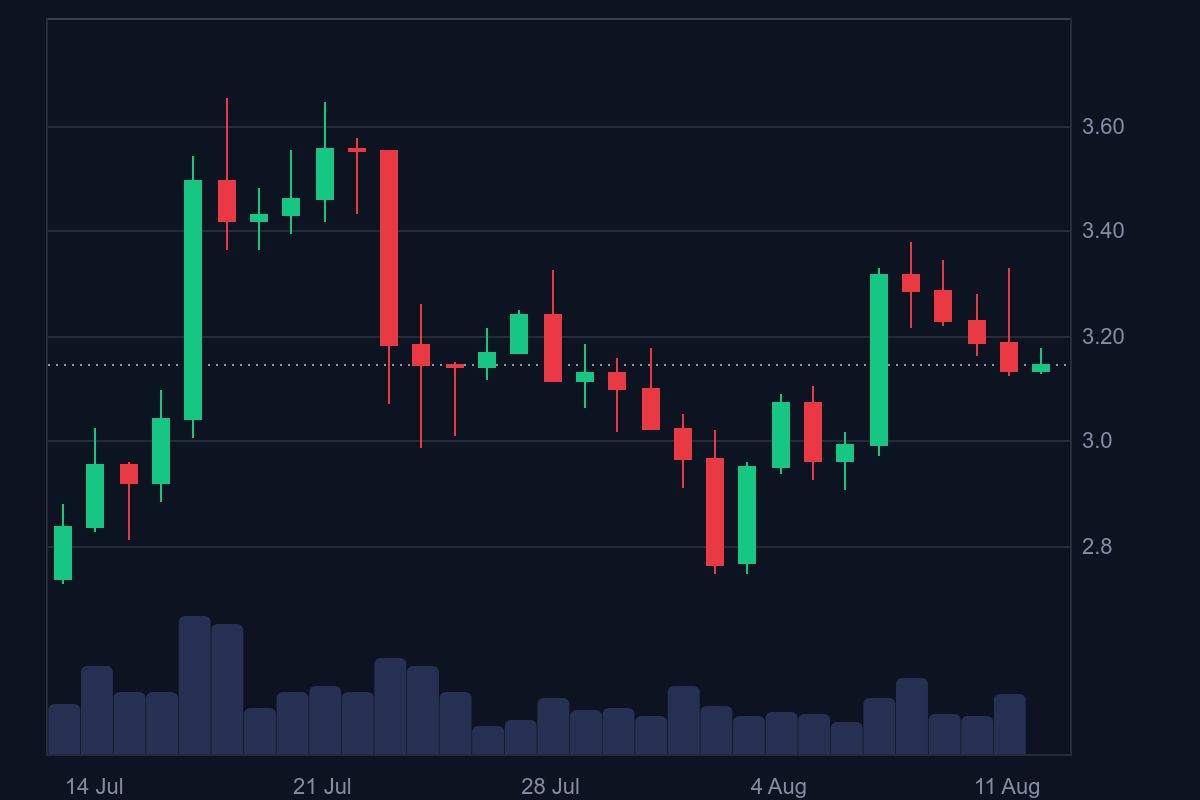
of writing, XRP is trading at 3.1422, up 0.5% since the start of the session.
The intraday low stands at 3.1178. On the daily chart, four consecutive bearish
candles have largely retraced the nearly 11% rally seen on August 7, 2025. The
current strong buying reaction has simply led to profit-taking.
What is the XRP price today? Source: CoinMarketCap.com
XRP Technical Analysis:
Support Holds But Resistance Builds
XRP's
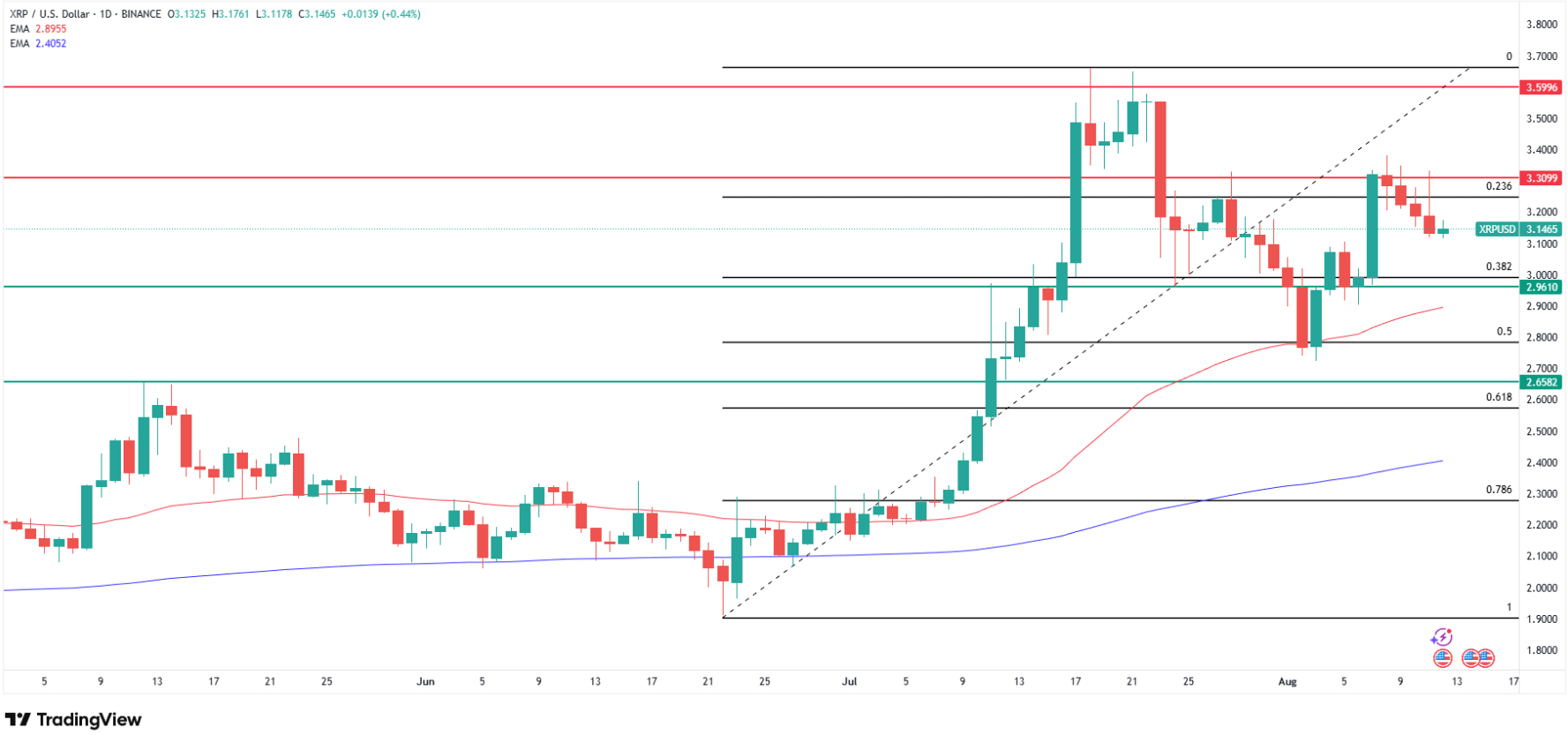
technical structure reveals critical support at $3.13 after multiple
successful tests, while resistance builds at $3.27-$3.31. The token
experienced its heaviest selling pressure during the 19:00 hour yesterday,
dropping from $3.20 to $3.15 on 73.87 million volume.
Next Downward Target: Round level at $3.00
(38.2% Fibonacci)
My
comprehensive technical analysis indicates XRP's bearish pin bar formation on
Monday's session created a potential sell signal below the important $3.31
resistance and 23.6% Fibonacci retracement level. If price
approaches this resistance zone again, it would present an opportunity for
sellers targeting the $3.00 psychological level.
Additional
support levels include the 50 Exponential Moving Average at $2.89,
followed by the 50% Fibonacci retracement at $2.78 near August lows
around $2.66. The golden ratio 61.8% Fibonacci level sits at
approximately $2.40, coinciding with the 200 Exponential Moving
Average at $2.28.
A break
below these levels would signal bearish control, potentially driving XRP
toward $2.00 or lower to $1.90 where June 22nd session
minimums reside. Conversely, a sustained break above $3.30-$3.31 would
invalidate the bearish setup, targeting consolidation between $3.60-$3.66.
XRP Support and Resistance Levels
Level Type
Price Level
Technical Significance
Probability
Immediate Support
$3.13
Multiple volume-backed tests
High
Strong Support
$3.15
Current
floor with bid support
Very High
Key Support
$3.00
Psychological round number + 38.2% Fibo
Medium-High
Critical Support (50 EMA)
$2.89
50 Exponential Moving Average
Medium
Major Support (50% Fibo)
$2.78
50% Fibonacci retracement
Medium
August Lows Support
$2.66
Previous August session lows
Low-Medium
Golden Ratio (61.8% Fibo)
$2.40
Golden ratio Fibonacci level
Low
Long-term Support (200 EMA)
$2.28
200 EMA + 78.6% Fibonacci
Very Low
June Minimums Support
$1.90
June 22nd session minimums
Very Low
Immediate Resistance
$3.27
Repeated rejection zone
High
Key Resistance (23.6% Fibo)
$3.31
23.6% Fibo retracement + pin bar
Very High
Consolidation Resistance
$3.60-$3.66
Mid-July consolidation range
Medium
Historical High Resistance
$3.84
Previous
all-time high from 2018
Low
Why XRP Price Is Falling? Market
Factors Behind XRP's Decline
Ripple's
Monthly Token Release - The routine monthly release of 1 billion XRP tokens worth $3.28
billion from escrow on August 1st triggered market uncertainty and
selling fears. Despite Ripple CTO David Schwartz's clarification as routine
monthly activity, the timing coincided with XRP's rally slowdown.
ETF
Speculation Cooling - BlackRock's denial of XRP ETF plans has tempered some bullish
sentiment, though multiple XRP ETF applications remain under SEC
review with an 85% approval probability for 2025.
Derivatives
Data Shows Selling Pressure - XRP derivatives markets reflect bearish sentiment with declining
open interest dropping 36% to $3.54 billion and negative
funding rates indicating short positioning. However, whale
accumulation continues with addresses holding 100 million to 1
billion XRP adding 900 million tokens worth $2.88 billion in
just 48 hours.
Tony
"The Bull" Severino forecasts a 333% surge within 40 days,
while Peter Brandt predicts a 60% rally to $4.47 based on
technical patterns. More conservative machine learning models project
XRP reaching $3.12 by August 31, 2025.
Fibonacci
extension analysis suggests $5.53 as the ultimate 2025 target,
representing over 80% appreciation from current levels. Ripple
CEO Brad Garlinghouse has made the most ambitious prediction of $178
by 2030, though this represents an extreme bull case scenario.
Market
veteran Ali Martinez identified XRP breaking above a key resistance channel it
had traded within for months. He noted: "XRP has successfully broken above
an extensive resistance channel... now eyeing a double-digit target."
What Traders Should Watch
Key
monitoring points for XRP include:
$3.13 support stability on
further profit-taking waves
Breakout potential above $3.27 to
resume upward momentum
Macro spillover effects from
trade and monetary policy developments
Volume patterns during
resistance tests at $3.30-$3.31
Temporary Pullback in
Bullish Structure
Why is XRP
price going down today? The decline reflects natural profit-taking after
XRP's post-settlement rally, combined with broader crypto market weakness and routine
token releases. Technical analysis shows strong support at $3.13 with
potential for deeper correction toward $3.00 if selling pressure
intensifies.
However, expert
sentiment remains predominantly bullish with targets ranging from $3.12
to $13.00 across various timeframes. The regulatory overhang removal and growing
institutional interest provide fundamental support for XRP's longer-term
trajectory.
XRP Price FAQ
Why Is XRP in Trouble?
XRP is not
currently in serious trouble. The primary concern stemmed from the SEC
lawsuit filed in December 2020, which alleged that Ripple sold $1.3
billion worth of unregistered securities. However, this legal uncertainty has
been largely resolved as of August 2025.
Is XRP Worth Buying Now?
Yes, however,
XRP presents a mixed risk-reward opportunity at current levels
around $3.14. The regulatory clarity achieved through the SEC
settlement provides a strong fundamental foundation, while multiple
XRP ETF applications have an estimated 85% approval probability for
2025.
Investment
suitability depends on your risk tolerance and time horizon.
Conservative investors might wait for deeper pullbacks toward $3.00 support,
while those bullish on crypto adoption may find current levels reasonable
for medium-term positions.
How High Will XRP Go in
2025?
Expert
predictions for XRP in 2025 vary significantly, ranging from $3.12 to
$13.00 depending on market conditions and adoption rates. Conservative
forecasts suggest XRP reaching $3.12 by August 31, 2025, while mainstream
predictions target $4.00-$5.50 by year-end. Machine
learning models project an average December 2025 price of $2.43,
though this appears conservative given recent developments.
Could XRP Reach $100?
Yes, XRP
reaching $100 is theoretically possible but faces significant practical
challenges. At $100 per XRP, the market capitalization would exceed $5
trillion with current supply levels, larger than Apple and Microsoft
combined.
$100 XRP
requires unprecedented cryptocurrency market growth to $5+ trillion
valuation. This implies either massive supply reduction through
institutional locking or fundamental transformation of global
financial systems.
Why is XRP
price going down today? XRP has declined for four consecutive
sessions, losing approximately 8% from recent highs to reach intraday
lows of $3.11 on Tuesday, August 12, 2025. Currently trading at $3.1422,
XRP faces mounting profit-taking pressure following its impressive
rally after the Ripple-SEC legal settlement.
The primary
catalyst behind today's decline stems from natural profit-taking
activities after XRP's spectacular 208% volume surge to $12.4
billion following
regulatory clarity. Trading volumes remain elevated at $9.16 billion,
indicating continued institutional interest despite the pullback.
In this
article, I examine why the XRP price is falling, conducting in-depth technical
analysis of the XRP/USDT daily chart and summarize the newest XRP price
prediction for 2025 and beyond.
XRP Price Falls 4 Sessions
in Row as Profit-Taking Dominates
At the time
of writing, XRP is trading at 3.1422, up 0.5% since the start of the session.
The intraday low stands at 3.1178. On the daily chart, four consecutive bearish
candles have largely retraced the nearly 11% rally seen on August 7, 2025. The
current strong buying reaction has simply led to profit-taking.
What is the XRP price today? Source: CoinMarketCap.com
XRP Technical Analysis:
Support Holds But Resistance Builds
XRP's
technical structure reveals critical support at $3.13 after multiple
successful tests, while resistance builds at $3.27-$3.31. The token
experienced its heaviest selling pressure during the 19:00 hour yesterday,
dropping from $3.20 to $3.15 on 73.87 million volume.
Next Downward Target: Round level at $3.00
(38.2% Fibonacci)
My
comprehensive technical analysis indicates XRP's bearish pin bar formation on
Monday's session created a potential sell signal below the important $3.31
resistance and 23.6% Fibonacci retracement level. If price
approaches this resistance zone again, it would present an opportunity for
sellers targeting the $3.00 psychological level.
Additional
support levels include the 50 Exponential Moving Average at $2.89,
followed by the 50% Fibonacci retracement at $2.78 near August lows
around $2.66. The golden ratio 61.8% Fibonacci level sits at
approximately $2.40, coinciding with the 200 Exponential Moving
Average at $2.28.
A break
below these levels would signal bearish control, potentially driving XRP
toward $2.00 or lower to $1.90 where June 22nd session
minimums reside. Conversely, a sustained break above $3.30-$3.31 would
invalidate the bearish setup, targeting consolidation between $3.60-$3.66.
XRP Support and Resistance Levels
Level Type
Price Level
Technical Significance
Probability
Immediate Support
$3.13
Multiple volume-backed tests
High
Strong Support
$3.15
Current
floor with bid support
Very High
Key Support
$3.00
Psychological round number + 38.2% Fibo
Medium-High
Critical Support (50 EMA)
$2.89
50 Exponential Moving Average
Medium
Major Support (50% Fibo)
$2.78
50% Fibonacci retracement
Medium
August Lows Support
$2.66
Previous August session lows
Low-Medium
Golden Ratio (61.8% Fibo)
$2.40
Golden ratio Fibonacci level
Low
Long-term Support (200 EMA)
$2.28
200 EMA + 78.6% Fibonacci
Very Low
June Minimums Support
$1.90
June 22nd session minimums
Very Low
Immediate Resistance
$3.27
Repeated rejection zone
High
Key Resistance (23.6% Fibo)
$3.31
23.6% Fibo retracement + pin bar
Very High
Consolidation Resistance
$3.60-$3.66
Mid-July consolidation range
Medium
Historical High Resistance
$3.84
Previous
all-time high from 2018
Low
Why XRP Price Is Falling? Market
Factors Behind XRP's Decline
Ripple's
Monthly Token Release - The routine monthly release of 1 billion XRP tokens worth $3.28
billion from escrow on August 1st triggered market uncertainty and
selling fears. Despite Ripple CTO David Schwartz's clarification as routine
monthly activity, the timing coincided with XRP's rally slowdown.
ETF
Speculation Cooling - BlackRock's denial of XRP ETF plans has tempered some bullish
sentiment, though multiple XRP ETF applications remain under SEC
review with an 85% approval probability for 2025.
Derivatives
Data Shows Selling Pressure - XRP derivatives markets reflect bearish sentiment with declining
open interest dropping 36% to $3.54 billion and negative
funding rates indicating short positioning. However, whale
accumulation continues with addresses holding 100 million to 1
billion XRP adding 900 million tokens worth $2.88 billion in
just 48 hours.
Tony
"The Bull" Severino forecasts a 333% surge within 40 days,
while Peter Brandt predicts a 60% rally to $4.47 based on
technical patterns. More conservative machine learning models project
XRP reaching $3.12 by August 31, 2025.
Fibonacci
extension analysis suggests $5.53 as the ultimate 2025 target,
representing over 80% appreciation from current levels. Ripple
CEO Brad Garlinghouse has made the most ambitious prediction of $178
by 2030, though this represents an extreme bull case scenario.
Market
veteran Ali Martinez identified XRP breaking above a key resistance channel it
had traded within for months. He noted: "XRP has successfully broken above
an extensive resistance channel... now eyeing a double-digit target."
What Traders Should Watch
Key
monitoring points for XRP include:
$3.13 support stability on
further profit-taking waves
Breakout potential above $3.27 to
resume upward momentum
Macro spillover effects from
trade and monetary policy developments
Volume patterns during
resistance tests at $3.30-$3.31
Temporary Pullback in
Bullish Structure
Why is XRP
price going down today? The decline reflects natural profit-taking after
XRP's post-settlement rally, combined with broader crypto market weakness and routine
token releases. Technical analysis shows strong support at $3.13 with
potential for deeper correction toward $3.00 if selling pressure
intensifies.
However, expert
sentiment remains predominantly bullish with targets ranging from $3.12
to $13.00 across various timeframes. The regulatory overhang removal and growing
institutional interest provide fundamental support for XRP's longer-term
trajectory.
XRP Price FAQ
Why Is XRP in Trouble?
XRP is not
currently in serious trouble. The primary concern stemmed from the SEC
lawsuit filed in December 2020, which alleged that Ripple sold $1.3
billion worth of unregistered securities. However, this legal uncertainty has
been largely resolved as of August 2025.
Is XRP Worth Buying Now?
Yes, however,
XRP presents a mixed risk-reward opportunity at current levels
around $3.14. The regulatory clarity achieved through the SEC
settlement provides a strong fundamental foundation, while multiple
XRP ETF applications have an estimated 85% approval probability for
2025.
Investment
suitability depends on your risk tolerance and time horizon.
Conservative investors might wait for deeper pullbacks toward $3.00 support,
while those bullish on crypto adoption may find current levels reasonable
for medium-term positions.
How High Will XRP Go in
2025?
Expert
predictions for XRP in 2025 vary significantly, ranging from $3.12 to
$13.00 depending on market conditions and adoption rates. Conservative
forecasts suggest XRP reaching $3.12 by August 31, 2025, while mainstream
predictions target $4.00-$5.50 by year-end. Machine
learning models project an average December 2025 price of $2.43,
though this appears conservative given recent developments.
Could XRP Reach $100?
Yes, XRP
reaching $100 is theoretically possible but faces significant practical
challenges. At $100 per XRP, the market capitalization would exceed $5
trillion with current supply levels, larger than Apple and Microsoft
combined.
$100 XRP
requires unprecedented cryptocurrency market growth to $5+ trillion
valuation. This implies either massive supply reduction through
institutional locking or fundamental transformation of global
financial systems.
Damian Chmiel is a Senior Analyst & Editor at Finance Magnates with more than 15 years of experience in the CFD and online trading industry. Active as both a trader and journalist since 2010, he focuses on broker coverage, fintech innovation, and regulatory developments across Europe, the Middle East, and Asia.
His work includes interviews with C-level leaders at major brokerages and fintech platforms, as well as co-authoring Finance Magnates’ quarterly industry benchmarking reports. Damian’s reporting is data-driven, market-aware, and grounded in direct industry engagement. His analysis and commentary have also been cited by external media outlets, including Investing.com, Binance, The Asset, Stockhead, and Dispatch.
Education:
MA in Finance and Accounting, Cracow University of Economics
Inside the Prediction Markets: $1.6B Institutional Inflow Meets a Federal Crackdown
Featured Videos
FP Markets Winner Spotlight 🏆 | Global Broker of the Year 2025 #Trading #Broker #Innovation #Shorts
FP Markets Winner Spotlight 🏆 | Global Broker of the Year 2025 #Trading #Broker #Innovation #Shorts
FP Markets Winner Spotlight 🏆 | Global Broker of the Year 2025 #Trading #Broker #Innovation #Shorts
FP Markets Winner Spotlight 🏆 | Global Broker of the Year 2025 #Trading #Broker #Innovation #Shorts
FP Markets takes the spotlight as Global Broker of the Year 2025 at the Finance Magnates Awards.
Martin Stoilov, Head of Client Experience, shares that trust, innovation, and people played a key role in the company’s success, supported by a strong foundation of integrity and client-centricity.
Following this milestone, FP Markets continues to focus on growth, technology investment, and its core values of transparency and excellence.
👉 Be part of FM Awards 2026: https://awards.financemagnates.com/#nominate
FP Markets takes the spotlight as Global Broker of the Year 2025 at the Finance Magnates Awards.
Martin Stoilov, Head of Client Experience, shares that trust, innovation, and people played a key role in the company’s success, supported by a strong foundation of integrity and client-centricity.
Following this milestone, FP Markets continues to focus on growth, technology investment, and its core values of transparency and excellence.
👉 Be part of FM Awards 2026: https://awards.financemagnates.com/#nominate
FP Markets takes the spotlight as Global Broker of the Year 2025 at the Finance Magnates Awards.
Martin Stoilov, Head of Client Experience, shares that trust, innovation, and people played a key role in the company’s success, supported by a strong foundation of integrity and client-centricity.
Following this milestone, FP Markets continues to focus on growth, technology investment, and its core values of transparency and excellence.
👉 Be part of FM Awards 2026: https://awards.financemagnates.com/#nominate
FP Markets takes the spotlight as Global Broker of the Year 2025 at the Finance Magnates Awards.
Martin Stoilov, Head of Client Experience, shares that trust, innovation, and people played a key role in the company’s success, supported by a strong foundation of integrity and client-centricity.
Following this milestone, FP Markets continues to focus on growth, technology investment, and its core values of transparency and excellence.
👉 Be part of FM Awards 2026: https://awards.financemagnates.com/#nominate
In this video, we review @HolaPrimeMarketsOfficial, a multi-asset forex and CFDs broker offering different account types, trading platforms, and flexible trading conditions.
We cover the broker’s overall offering, including account options, trading environment, platforms like MT4 and MT5, and additional services such as managed accounts and fast withdrawals.
Watch the full video to see if Hola Prime Markets fits your trading needs.
📣 Stay up to date with the latest in finance and trading. Follow Finance Magnates for industry news, insights, and global event coverage.
Connect with us:
🔗 LinkedIn: /financemagnates
👍 Facebook: /financemagnates
📸 Instagram: https://www.instagram.com/financemagnates
🐦 X: https://x.com/financemagnates
🎥 TikTok: https://www.tiktok.com/tag/financemagnates
▶️ YouTube: /@financemagnates_official
#HolaPrime #ForexBroker #CFDTrading #FinanceMagnates #Trading #Forex #BrokerReview
In this video, we review @HolaPrimeMarketsOfficial, a multi-asset forex and CFDs broker offering different account types, trading platforms, and flexible trading conditions.
We cover the broker’s overall offering, including account options, trading environment, platforms like MT4 and MT5, and additional services such as managed accounts and fast withdrawals.
Watch the full video to see if Hola Prime Markets fits your trading needs.
📣 Stay up to date with the latest in finance and trading. Follow Finance Magnates for industry news, insights, and global event coverage.
Connect with us:
🔗 LinkedIn: /financemagnates
👍 Facebook: /financemagnates
📸 Instagram: https://www.instagram.com/financemagnates
🐦 X: https://x.com/financemagnates
🎥 TikTok: https://www.tiktok.com/tag/financemagnates
▶️ YouTube: /@financemagnates_official
#HolaPrime #ForexBroker #CFDTrading #FinanceMagnates #Trading #Forex #BrokerReview
In this video, we review @HolaPrimeMarketsOfficial, a multi-asset forex and CFDs broker offering different account types, trading platforms, and flexible trading conditions.
We cover the broker’s overall offering, including account options, trading environment, platforms like MT4 and MT5, and additional services such as managed accounts and fast withdrawals.
Watch the full video to see if Hola Prime Markets fits your trading needs.
📣 Stay up to date with the latest in finance and trading. Follow Finance Magnates for industry news, insights, and global event coverage.
Connect with us:
🔗 LinkedIn: /financemagnates
👍 Facebook: /financemagnates
📸 Instagram: https://www.instagram.com/financemagnates
🐦 X: https://x.com/financemagnates
🎥 TikTok: https://www.tiktok.com/tag/financemagnates
▶️ YouTube: /@financemagnates_official
#HolaPrime #ForexBroker #CFDTrading #FinanceMagnates #Trading #Forex #BrokerReview
In this video, we review @HolaPrimeMarketsOfficial, a multi-asset forex and CFDs broker offering different account types, trading platforms, and flexible trading conditions.
We cover the broker’s overall offering, including account options, trading environment, platforms like MT4 and MT5, and additional services such as managed accounts and fast withdrawals.
Watch the full video to see if Hola Prime Markets fits your trading needs.
📣 Stay up to date with the latest in finance and trading. Follow Finance Magnates for industry news, insights, and global event coverage.
Connect with us:
🔗 LinkedIn: /financemagnates
👍 Facebook: /financemagnates
📸 Instagram: https://www.instagram.com/financemagnates
🐦 X: https://x.com/financemagnates
🎥 TikTok: https://www.tiktok.com/tag/financemagnates
▶️ YouTube: /@financemagnates_official
#HolaPrime #ForexBroker #CFDTrading #FinanceMagnates #Trading #Forex #BrokerReview
In this video, we review @HolaPrimeMarketsOfficial, a multi-asset forex and CFDs broker offering different account types, trading platforms, and flexible trading conditions.
We cover the broker’s overall offering, including account options, trading environment, platforms like MT4 and MT5, and additional services such as managed accounts and fast withdrawals.
Watch the full video to see if Hola Prime Markets fits your trading needs.
📣 Stay up to date with the latest in finance and trading. Follow Finance Magnates for industry news, insights, and global event coverage.
Connect with us:
🔗 LinkedIn: /financemagnates
👍 Facebook: /financemagnates
📸 Instagram: https://www.instagram.com/financemagnates
🐦 X: https://x.com/financemagnates
🎥 TikTok: https://www.tiktok.com/tag/financemagnates
▶️ YouTube: /@financemagnates_official
#HolaPrime #ForexBroker #CFDTrading #FinanceMagnates #Trading #Forex #BrokerReview
In this video, we review @HolaPrimeMarketsOfficial, a multi-asset forex and CFDs broker offering different account types, trading platforms, and flexible trading conditions.
We cover the broker’s overall offering, including account options, trading environment, platforms like MT4 and MT5, and additional services such as managed accounts and fast withdrawals.
Watch the full video to see if Hola Prime Markets fits your trading needs.
📣 Stay up to date with the latest in finance and trading. Follow Finance Magnates for industry news, insights, and global event coverage.
Connect with us:
🔗 LinkedIn: /financemagnates
👍 Facebook: /financemagnates
📸 Instagram: https://www.instagram.com/financemagnates
🐦 X: https://x.com/financemagnates
🎥 TikTok: https://www.tiktok.com/tag/financemagnates
▶️ YouTube: /@financemagnates_official
#HolaPrime #ForexBroker #CFDTrading #FinanceMagnates #Trading #Forex #BrokerReview
Hola Prime Review: What You Need to Know | Full Breakdown by Finance Magnates
Hola Prime Review: What You Need to Know | Full Breakdown by Finance Magnates
Hola Prime Review: What You Need to Know | Full Breakdown by Finance Magnates
Hola Prime Review: What You Need to Know | Full Breakdown by Finance Magnates
Hola Prime Review: What You Need to Know | Full Breakdown by Finance Magnates
Hola Prime Review: What You Need to Know | Full Breakdown by Finance Magnates
In this video, we review @HolaPrime_Global, a proprietary trading firm offering evaluation programs and performance-based payouts in simulated market environments.
We cover how the challenge model works, including account types, profit splits (up to 95%), trading rules, and what it takes to reach a funded account. You’ll also learn about available platforms like MT4, MT5, cTrader, and more, along with insights into payouts, support, and trading conditions.
Watch the full video to see if Hola Prime fits your trading style.
📣 Stay up to date with the latest in finance and trading. Follow Finance Magnates for industry news, insights, and global event coverage.
Connect with us:
🔗 LinkedIn: /financemagnates
👍 Facebook: /financemagnates
📸 Instagram: https://www.instagram.com/financemagnates
🐦 X: https://x.com/financemagnates
🎥 TikTok: https://www.tiktok.com/tag/financemagnates
▶️ YouTube: /@financemagnates_official
#HolaPrime #PropFirm #Trading #FinanceMagnates #Forex #FuturesTrading #TradingReview #PropFirmReview
In this video, we review @HolaPrime_Global, a proprietary trading firm offering evaluation programs and performance-based payouts in simulated market environments.
We cover how the challenge model works, including account types, profit splits (up to 95%), trading rules, and what it takes to reach a funded account. You’ll also learn about available platforms like MT4, MT5, cTrader, and more, along with insights into payouts, support, and trading conditions.
Watch the full video to see if Hola Prime fits your trading style.
📣 Stay up to date with the latest in finance and trading. Follow Finance Magnates for industry news, insights, and global event coverage.
Connect with us:
🔗 LinkedIn: /financemagnates
👍 Facebook: /financemagnates
📸 Instagram: https://www.instagram.com/financemagnates
🐦 X: https://x.com/financemagnates
🎥 TikTok: https://www.tiktok.com/tag/financemagnates
▶️ YouTube: /@financemagnates_official
#HolaPrime #PropFirm #Trading #FinanceMagnates #Forex #FuturesTrading #TradingReview #PropFirmReview
In this video, we review @HolaPrime_Global, a proprietary trading firm offering evaluation programs and performance-based payouts in simulated market environments.
We cover how the challenge model works, including account types, profit splits (up to 95%), trading rules, and what it takes to reach a funded account. You’ll also learn about available platforms like MT4, MT5, cTrader, and more, along with insights into payouts, support, and trading conditions.
Watch the full video to see if Hola Prime fits your trading style.
📣 Stay up to date with the latest in finance and trading. Follow Finance Magnates for industry news, insights, and global event coverage.
Connect with us:
🔗 LinkedIn: /financemagnates
👍 Facebook: /financemagnates
📸 Instagram: https://www.instagram.com/financemagnates
🐦 X: https://x.com/financemagnates
🎥 TikTok: https://www.tiktok.com/tag/financemagnates
▶️ YouTube: /@financemagnates_official
#HolaPrime #PropFirm #Trading #FinanceMagnates #Forex #FuturesTrading #TradingReview #PropFirmReview
In this video, we review @HolaPrime_Global, a proprietary trading firm offering evaluation programs and performance-based payouts in simulated market environments.
We cover how the challenge model works, including account types, profit splits (up to 95%), trading rules, and what it takes to reach a funded account. You’ll also learn about available platforms like MT4, MT5, cTrader, and more, along with insights into payouts, support, and trading conditions.
Watch the full video to see if Hola Prime fits your trading style.
📣 Stay up to date with the latest in finance and trading. Follow Finance Magnates for industry news, insights, and global event coverage.
Connect with us:
🔗 LinkedIn: /financemagnates
👍 Facebook: /financemagnates
📸 Instagram: https://www.instagram.com/financemagnates
🐦 X: https://x.com/financemagnates
🎥 TikTok: https://www.tiktok.com/tag/financemagnates
▶️ YouTube: /@financemagnates_official
#HolaPrime #PropFirm #Trading #FinanceMagnates #Forex #FuturesTrading #TradingReview #PropFirmReview
In this video, we review @HolaPrime_Global, a proprietary trading firm offering evaluation programs and performance-based payouts in simulated market environments.
We cover how the challenge model works, including account types, profit splits (up to 95%), trading rules, and what it takes to reach a funded account. You’ll also learn about available platforms like MT4, MT5, cTrader, and more, along with insights into payouts, support, and trading conditions.
Watch the full video to see if Hola Prime fits your trading style.
📣 Stay up to date with the latest in finance and trading. Follow Finance Magnates for industry news, insights, and global event coverage.
Connect with us:
🔗 LinkedIn: /financemagnates
👍 Facebook: /financemagnates
📸 Instagram: https://www.instagram.com/financemagnates
🐦 X: https://x.com/financemagnates
🎥 TikTok: https://www.tiktok.com/tag/financemagnates
▶️ YouTube: /@financemagnates_official
#HolaPrime #PropFirm #Trading #FinanceMagnates #Forex #FuturesTrading #TradingReview #PropFirmReview
In this video, we review @HolaPrime_Global, a proprietary trading firm offering evaluation programs and performance-based payouts in simulated market environments.
We cover how the challenge model works, including account types, profit splits (up to 95%), trading rules, and what it takes to reach a funded account. You’ll also learn about available platforms like MT4, MT5, cTrader, and more, along with insights into payouts, support, and trading conditions.
Watch the full video to see if Hola Prime fits your trading style.
📣 Stay up to date with the latest in finance and trading. Follow Finance Magnates for industry news, insights, and global event coverage.
Connect with us:
🔗 LinkedIn: /financemagnates
👍 Facebook: /financemagnates
📸 Instagram: https://www.instagram.com/financemagnates
🐦 X: https://x.com/financemagnates
🎥 TikTok: https://www.tiktok.com/tag/financemagnates
▶️ YouTube: /@financemagnates_official
#HolaPrime #PropFirm #Trading #FinanceMagnates #Forex #FuturesTrading #TradingReview #PropFirmReview
Axi Winner Spotlight 🏆 | Global Most Innovative Broker 2025 #Innovation #Trading #Fintech #Broker
Axi Winner Spotlight 🏆 | Global Most Innovative Broker 2025 #Innovation #Trading #Fintech #Broker
Axi Winner Spotlight 🏆 | Global Most Innovative Broker 2025 #Innovation #Trading #Fintech #Broker
Axi Winner Spotlight 🏆 | Global Most Innovative Broker 2025 #Innovation #Trading #Fintech #Broker
Axi Winner Spotlight 🏆 | Global Most Innovative Broker 2025 #Innovation #Trading #Fintech #Broker
Axi Winner Spotlight 🏆 | Global Most Innovative Broker 2025 #Innovation #Trading #Fintech #Broker
Axi takes the spotlight at the Finance Magnates Awards, winning Global Most Innovative Broker 2025.
Olivia Xenofontos and Ivanna Openko share how the team will feel: proud, motivated, and ready to keep delivering.
They also describe the night as well-organized, focused, and enjoyable for all.
👉 Be part of FM Awards 2026.
Axi takes the spotlight at the Finance Magnates Awards, winning Global Most Innovative Broker 2025.
Olivia Xenofontos and Ivanna Openko share how the team will feel: proud, motivated, and ready to keep delivering.
They also describe the night as well-organized, focused, and enjoyable for all.
👉 Be part of FM Awards 2026.
Axi takes the spotlight at the Finance Magnates Awards, winning Global Most Innovative Broker 2025.
Olivia Xenofontos and Ivanna Openko share how the team will feel: proud, motivated, and ready to keep delivering.
They also describe the night as well-organized, focused, and enjoyable for all.
👉 Be part of FM Awards 2026.
Axi takes the spotlight at the Finance Magnates Awards, winning Global Most Innovative Broker 2025.
Olivia Xenofontos and Ivanna Openko share how the team will feel: proud, motivated, and ready to keep delivering.
They also describe the night as well-organized, focused, and enjoyable for all.
👉 Be part of FM Awards 2026.
Axi takes the spotlight at the Finance Magnates Awards, winning Global Most Innovative Broker 2025.
Olivia Xenofontos and Ivanna Openko share how the team will feel: proud, motivated, and ready to keep delivering.
They also describe the night as well-organized, focused, and enjoyable for all.
👉 Be part of FM Awards 2026.
Axi takes the spotlight at the Finance Magnates Awards, winning Global Most Innovative Broker 2025.
Olivia Xenofontos and Ivanna Openko share how the team will feel: proud, motivated, and ready to keep delivering.
They also describe the night as well-organized, focused, and enjoyable for all.
👉 Be part of FM Awards 2026.
Recognition that matters.
Built on transparency.
Driven by the industry.
The Finance Magnates Awards 2026.
Nominations are now open.
🔗 https://awards.financemagnates.com/?utm_source=SM&utm_medium=social&utm_campaign=recognition-matters
Recognition that matters.
Built on transparency.
Driven by the industry.
The Finance Magnates Awards 2026.
Nominations are now open.
🔗 https://awards.financemagnates.com/?utm_source=SM&utm_medium=social&utm_campaign=recognition-matters
Recognition that matters.
Built on transparency.
Driven by the industry.
The Finance Magnates Awards 2026.
Nominations are now open.
🔗 https://awards.financemagnates.com/?utm_source=SM&utm_medium=social&utm_campaign=recognition-matters
Recognition that matters.
Built on transparency.
Driven by the industry.
The Finance Magnates Awards 2026.
Nominations are now open.
🔗 https://awards.financemagnates.com/?utm_source=SM&utm_medium=social&utm_campaign=recognition-matters
Recognition that matters.
Built on transparency.
Driven by the industry.
The Finance Magnates Awards 2026.
Nominations are now open.
🔗 https://awards.financemagnates.com/?utm_source=SM&utm_medium=social&utm_campaign=recognition-matters
Recognition that matters.
Built on transparency.
Driven by the industry.
The Finance Magnates Awards 2026.
Nominations are now open.
🔗 https://awards.financemagnates.com/?utm_source=SM&utm_medium=social&utm_campaign=recognition-matters