Bitcoin plunges to 4-month lows near $80,000 following Trump's executive order establishing a U.S. strategic Bitcoin reserve.
BTC price technical analysis shows critical support at $80K, with a potential downside to $72K if it is breached.
Market experts describe Bitcoin's recent price action as a "textbook correction" with 70% of selling pressure coming from newer investors.
Why is Bitcoin price dropping today? Let's check the current Bitcoin news and technical analysis
Over the
past 24 hours, Bitcoin (BTC) price has dropped nearly 3%, briefly testing the
$80,000 level. While the cryptocurrency rebounded from this psychological
support on Monday, it had just experienced a 6.4% drop on Sunday—one of the
steepest declines this year and its lowest daily close since November 2024.
This above is an advertisement by Utip
Why is
Bitcoin going down and closing at four-month lows? According to experts, the
decline is linked to market volatility triggered by an executive order signed
by President Donald Trump, which mandates the creation of a strategic
cryptocurrency reserve in the U.S., including Bitcoin.
This
decline follows a sharp drop on Sunday, when BTC fell by over 6%, marking one
of the worst sessions of the year. It also recorded its lowest daily close
since November 2024, making it the weakest level in more than four months.
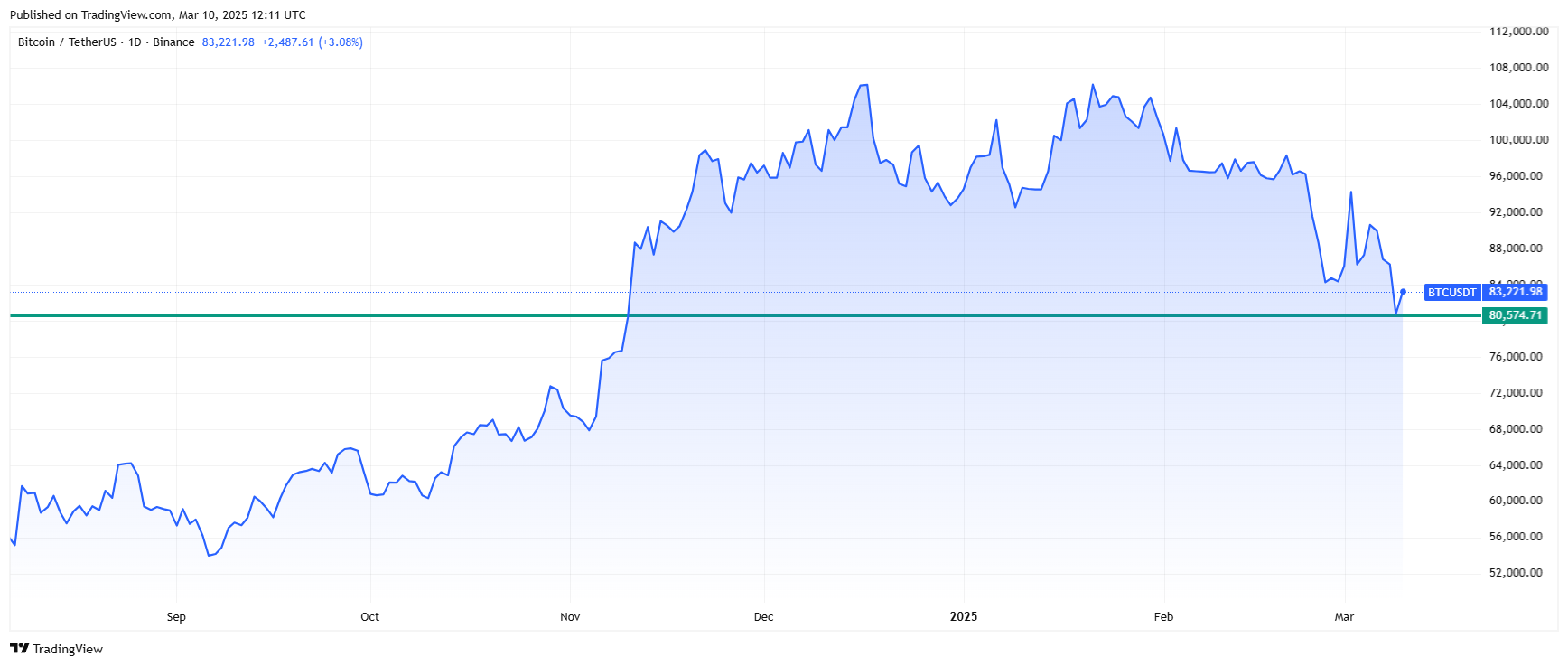
Why is Bitcoin dropping today? Source: Tradingview.com
While this
move initially sparked optimism, the lack of a bold commitment to purchase
significant amounts of Bitcoin—such as 100,000 or 200,000 coins—left investors
underwhelmed. Prices slid as traders expressed disappointment over what they
perceived as a conservative approach.
Bitcoin Holds (Again) at
$80K – BTC/USDT Technical Analysis
My
technical analysis suggests that the $80,000 level is a critical support for
buyers, having successfully halted declines for the second time in the past two
weeks. After four consecutive days of BTC depreciation, this level has
triggered a reversal and a corrective rebound of over $3,000.
However,
BTC/USDT remains under bearish pressure, far from the consolidation near its
all-time high (ATH) that was observed between November and late February. In my
view, a break above the $90,000–$92,000 zone, which marks the lower boundary of
that consolidation range, would signal that bulls have regained full control.
If the $80K
support fails, the next target would be the October highs around $72,000.
However, I see a more significant support level at the September and early
November peaks, near $67,000. In my opinion, this is the ultimate line in the
sand that will determine whether bulls or bears take dominance in the market.
Bitcoin Price Drops in “Textbook
Correction”
Beyond
policy announcements, Bitcoin’s price action reflects broader market dynamics.
Analysts at 10x Research described this as a “textbook correction,” pointing
out that roughly 70% of the selling pressure came from investors who entered
the market within the last three months. This wave of panic selling by newer
participants has amplified the decline.
Buy The Dip? Or Stay Fully Cashed Up?
Bitcoin's Textbook correction is fully playing out...
👇1-11) Bitcoin follows the price projection outlined in our ‘Bitcoin: Textbook Correction?’ report on February 25. The support structure collapsed once Bitcoin fell below the critical… pic.twitter.com/bHZ7whPSzF
Arthur
Hayes, co-founder of BitMEX and CIO of Maelstrom, warned that Bitcoin could
soon retest the $78,000 level. “If that support fails, $75,000 is next,” he
posted on X, highlighting significant open interest in Bitcoin options at the
$70,000 to $75,000 range. A drop to these levels, he cautioned, could trigger a
“violent” sell-off as derivatives traders adjust their positions.
An ugly start to the week. Looks like $BTC will retest $78k. If it fails, $75k is next in the crosshairs. There are a lot of options OI struck $70-$75k, if we get into that range it will be violent. pic.twitter.com/q4cq0rthGJ
The crypto
market doesn’t operate in a vacuum, and macroeconomic factors are also at play.
This week, the U.S. is set to release two critical inflation reports that could
sway Federal Reserve policy. Persistent inflation might prompt tighter monetary
measures, potentially dampening risk assets like Bitcoin.
Meanwhile,
trade tensions are heating up, with Canada imposing retaliatory tariffs in
response to U.S. policies under Trump. Mark Carney, Canada’s newly elected
Liberal Party leader and former central banker, vowed to challenge American
trade moves, adding uncertainty to global markets.
Bitcoin News and Price,
FAQ
Why Is Bitcoin Falling
Now?
Bitcoin’s
recent price drop is mainly linked to market reactions following President
Donald Trump’s executive order to establish a U.S. strategic Bitcoin reserve.
Instead of committing to large-scale government purchases of Bitcoin, the
reserve will be funded using assets seized in criminal and civil forfeiture
cases.
Will BTC Rise Again?
The future
trajectory of Bitcoin remains uncertain and is influenced by multiple factors,
including government policies, investor sentiment, and broader economic
conditions. While some analysts believe Bitcoin will recover in the long term
due to increasing institutional adoption and its role as a store of value,
others warn that without strong buying pressure, Bitcoin may remain under
bearish influence. A key resistance level to watch is the $90,000–$92,000
range, which could signal a return to bullish momentum. On the downside, if the
$80,000 support level fails, Bitcoin could test lower levels around $75,000 or
even $70,000.
What If You Invested
$1,000 in Bitcoin 10 Years Ago?
If you had
invested $1,000 in Bitcoin ten years ago, in March 2015, your investment would
have significantly increased in value. At that time, Bitcoin’s price ranged
from approximately $177 to $465, with an average of about $300. A $1,000
investment would have bought around 3.33 BTC. At the current price of about
$82,308 per Bitcoin, that investment would now be worth approximately $274,000.
This highlights Bitcoin’s historical potential for high returns despite its
volatility.
Is Bitcoin Going Down
Because of Trump?
Yes, to
some extent. The recent drop in Bitcoin’s price has been partially attributed
to investor disappointment over President Trump’s executive order regarding a
strategic Bitcoin reserve. While the order initially sparked optimism, the lack
of a bold commitment to purchasing significant amounts of Bitcoin left traders
underwhelmed. This led to selling pressure and price declines. However,
Bitcoin’s movement is also influenced by broader market dynamics, such as
profit-taking, macroeconomic concerns, and technical levels being tested in the
market.
Over the
past 24 hours, Bitcoin (BTC) price has dropped nearly 3%, briefly testing the
$80,000 level. While the cryptocurrency rebounded from this psychological
support on Monday, it had just experienced a 6.4% drop on Sunday—one of the
steepest declines this year and its lowest daily close since November 2024.
This above is an advertisement by Utip
Why is
Bitcoin going down and closing at four-month lows? According to experts, the
decline is linked to market volatility triggered by an executive order signed
by President Donald Trump, which mandates the creation of a strategic
cryptocurrency reserve in the U.S., including Bitcoin.
This
decline follows a sharp drop on Sunday, when BTC fell by over 6%, marking one
of the worst sessions of the year. It also recorded its lowest daily close
since November 2024, making it the weakest level in more than four months.
Why is Bitcoin dropping today? Source: Tradingview.com
While this
move initially sparked optimism, the lack of a bold commitment to purchase
significant amounts of Bitcoin—such as 100,000 or 200,000 coins—left investors
underwhelmed. Prices slid as traders expressed disappointment over what they
perceived as a conservative approach.
Bitcoin Holds (Again) at
$80K – BTC/USDT Technical Analysis
My
technical analysis suggests that the $80,000 level is a critical support for
buyers, having successfully halted declines for the second time in the past two
weeks. After four consecutive days of BTC depreciation, this level has
triggered a reversal and a corrective rebound of over $3,000.
However,
BTC/USDT remains under bearish pressure, far from the consolidation near its
all-time high (ATH) that was observed between November and late February. In my
view, a break above the $90,000–$92,000 zone, which marks the lower boundary of
that consolidation range, would signal that bulls have regained full control.
If the $80K
support fails, the next target would be the October highs around $72,000.
However, I see a more significant support level at the September and early
November peaks, near $67,000. In my opinion, this is the ultimate line in the
sand that will determine whether bulls or bears take dominance in the market.
Bitcoin Price Drops in “Textbook
Correction”
Beyond
policy announcements, Bitcoin’s price action reflects broader market dynamics.
Analysts at 10x Research described this as a “textbook correction,” pointing
out that roughly 70% of the selling pressure came from investors who entered
the market within the last three months. This wave of panic selling by newer
participants has amplified the decline.
Buy The Dip? Or Stay Fully Cashed Up?
Bitcoin's Textbook correction is fully playing out...
👇1-11) Bitcoin follows the price projection outlined in our ‘Bitcoin: Textbook Correction?’ report on February 25. The support structure collapsed once Bitcoin fell below the critical… pic.twitter.com/bHZ7whPSzF
Arthur
Hayes, co-founder of BitMEX and CIO of Maelstrom, warned that Bitcoin could
soon retest the $78,000 level. “If that support fails, $75,000 is next,” he
posted on X, highlighting significant open interest in Bitcoin options at the
$70,000 to $75,000 range. A drop to these levels, he cautioned, could trigger a
“violent” sell-off as derivatives traders adjust their positions.
An ugly start to the week. Looks like $BTC will retest $78k. If it fails, $75k is next in the crosshairs. There are a lot of options OI struck $70-$75k, if we get into that range it will be violent. pic.twitter.com/q4cq0rthGJ
The crypto
market doesn’t operate in a vacuum, and macroeconomic factors are also at play.
This week, the U.S. is set to release two critical inflation reports that could
sway Federal Reserve policy. Persistent inflation might prompt tighter monetary
measures, potentially dampening risk assets like Bitcoin.
Meanwhile,
trade tensions are heating up, with Canada imposing retaliatory tariffs in
response to U.S. policies under Trump. Mark Carney, Canada’s newly elected
Liberal Party leader and former central banker, vowed to challenge American
trade moves, adding uncertainty to global markets.
Bitcoin News and Price,
FAQ
Why Is Bitcoin Falling
Now?
Bitcoin’s
recent price drop is mainly linked to market reactions following President
Donald Trump’s executive order to establish a U.S. strategic Bitcoin reserve.
Instead of committing to large-scale government purchases of Bitcoin, the
reserve will be funded using assets seized in criminal and civil forfeiture
cases.
Will BTC Rise Again?
The future
trajectory of Bitcoin remains uncertain and is influenced by multiple factors,
including government policies, investor sentiment, and broader economic
conditions. While some analysts believe Bitcoin will recover in the long term
due to increasing institutional adoption and its role as a store of value,
others warn that without strong buying pressure, Bitcoin may remain under
bearish influence. A key resistance level to watch is the $90,000–$92,000
range, which could signal a return to bullish momentum. On the downside, if the
$80,000 support level fails, Bitcoin could test lower levels around $75,000 or
even $70,000.
What If You Invested
$1,000 in Bitcoin 10 Years Ago?
If you had
invested $1,000 in Bitcoin ten years ago, in March 2015, your investment would
have significantly increased in value. At that time, Bitcoin’s price ranged
from approximately $177 to $465, with an average of about $300. A $1,000
investment would have bought around 3.33 BTC. At the current price of about
$82,308 per Bitcoin, that investment would now be worth approximately $274,000.
This highlights Bitcoin’s historical potential for high returns despite its
volatility.
Is Bitcoin Going Down
Because of Trump?
Yes, to
some extent. The recent drop in Bitcoin’s price has been partially attributed
to investor disappointment over President Trump’s executive order regarding a
strategic Bitcoin reserve. While the order initially sparked optimism, the lack
of a bold commitment to purchasing significant amounts of Bitcoin left traders
underwhelmed. This led to selling pressure and price declines. However,
Bitcoin’s movement is also influenced by broader market dynamics, such as
profit-taking, macroeconomic concerns, and technical levels being tested in the
market.
Damian Chmiel is a Senior Analyst & Editor at Finance Magnates with more than 15 years of experience in the CFD and online trading industry. Active as both a trader and journalist since 2010, he focuses on broker coverage, fintech innovation, and regulatory developments across Europe, the Middle East, and Asia.
His work includes interviews with C-level leaders at major brokerages and fintech platforms, as well as co-authoring Finance Magnates’ quarterly industry benchmarking reports. Damian’s reporting is data-driven, market-aware, and grounded in direct industry engagement. His analysis and commentary have also been cited by external media outlets, including Investing.com, Binance, The Asset, Stockhead, and Dispatch.
Education:
MA in Finance and Accounting, Cracow University of Economics
Inside the Prediction Markets: $1.6B Institutional Inflow Meets a Federal Crackdown
Featured Videos
FP Markets Winner Spotlight 🏆 | Global Broker of the Year 2025 #Trading #Broker #Innovation #Shorts
FP Markets Winner Spotlight 🏆 | Global Broker of the Year 2025 #Trading #Broker #Innovation #Shorts
FP Markets Winner Spotlight 🏆 | Global Broker of the Year 2025 #Trading #Broker #Innovation #Shorts
FP Markets Winner Spotlight 🏆 | Global Broker of the Year 2025 #Trading #Broker #Innovation #Shorts
FP Markets takes the spotlight as Global Broker of the Year 2025 at the Finance Magnates Awards.
Martin Stoilov, Head of Client Experience, shares that trust, innovation, and people played a key role in the company’s success, supported by a strong foundation of integrity and client-centricity.
Following this milestone, FP Markets continues to focus on growth, technology investment, and its core values of transparency and excellence.
👉 Be part of FM Awards 2026: https://awards.financemagnates.com/#nominate
FP Markets takes the spotlight as Global Broker of the Year 2025 at the Finance Magnates Awards.
Martin Stoilov, Head of Client Experience, shares that trust, innovation, and people played a key role in the company’s success, supported by a strong foundation of integrity and client-centricity.
Following this milestone, FP Markets continues to focus on growth, technology investment, and its core values of transparency and excellence.
👉 Be part of FM Awards 2026: https://awards.financemagnates.com/#nominate
FP Markets takes the spotlight as Global Broker of the Year 2025 at the Finance Magnates Awards.
Martin Stoilov, Head of Client Experience, shares that trust, innovation, and people played a key role in the company’s success, supported by a strong foundation of integrity and client-centricity.
Following this milestone, FP Markets continues to focus on growth, technology investment, and its core values of transparency and excellence.
👉 Be part of FM Awards 2026: https://awards.financemagnates.com/#nominate
FP Markets takes the spotlight as Global Broker of the Year 2025 at the Finance Magnates Awards.
Martin Stoilov, Head of Client Experience, shares that trust, innovation, and people played a key role in the company’s success, supported by a strong foundation of integrity and client-centricity.
Following this milestone, FP Markets continues to focus on growth, technology investment, and its core values of transparency and excellence.
👉 Be part of FM Awards 2026: https://awards.financemagnates.com/#nominate
In this video, we review @HolaPrimeMarketsOfficial, a multi-asset forex and CFDs broker offering different account types, trading platforms, and flexible trading conditions.
We cover the broker’s overall offering, including account options, trading environment, platforms like MT4 and MT5, and additional services such as managed accounts and fast withdrawals.
Watch the full video to see if Hola Prime Markets fits your trading needs.
📣 Stay up to date with the latest in finance and trading. Follow Finance Magnates for industry news, insights, and global event coverage.
Connect with us:
🔗 LinkedIn: /financemagnates
👍 Facebook: /financemagnates
📸 Instagram: https://www.instagram.com/financemagnates
🐦 X: https://x.com/financemagnates
🎥 TikTok: https://www.tiktok.com/tag/financemagnates
▶️ YouTube: /@financemagnates_official
#HolaPrime #ForexBroker #CFDTrading #FinanceMagnates #Trading #Forex #BrokerReview
In this video, we review @HolaPrimeMarketsOfficial, a multi-asset forex and CFDs broker offering different account types, trading platforms, and flexible trading conditions.
We cover the broker’s overall offering, including account options, trading environment, platforms like MT4 and MT5, and additional services such as managed accounts and fast withdrawals.
Watch the full video to see if Hola Prime Markets fits your trading needs.
📣 Stay up to date with the latest in finance and trading. Follow Finance Magnates for industry news, insights, and global event coverage.
Connect with us:
🔗 LinkedIn: /financemagnates
👍 Facebook: /financemagnates
📸 Instagram: https://www.instagram.com/financemagnates
🐦 X: https://x.com/financemagnates
🎥 TikTok: https://www.tiktok.com/tag/financemagnates
▶️ YouTube: /@financemagnates_official
#HolaPrime #ForexBroker #CFDTrading #FinanceMagnates #Trading #Forex #BrokerReview
In this video, we review @HolaPrimeMarketsOfficial, a multi-asset forex and CFDs broker offering different account types, trading platforms, and flexible trading conditions.
We cover the broker’s overall offering, including account options, trading environment, platforms like MT4 and MT5, and additional services such as managed accounts and fast withdrawals.
Watch the full video to see if Hola Prime Markets fits your trading needs.
📣 Stay up to date with the latest in finance and trading. Follow Finance Magnates for industry news, insights, and global event coverage.
Connect with us:
🔗 LinkedIn: /financemagnates
👍 Facebook: /financemagnates
📸 Instagram: https://www.instagram.com/financemagnates
🐦 X: https://x.com/financemagnates
🎥 TikTok: https://www.tiktok.com/tag/financemagnates
▶️ YouTube: /@financemagnates_official
#HolaPrime #ForexBroker #CFDTrading #FinanceMagnates #Trading #Forex #BrokerReview
In this video, we review @HolaPrimeMarketsOfficial, a multi-asset forex and CFDs broker offering different account types, trading platforms, and flexible trading conditions.
We cover the broker’s overall offering, including account options, trading environment, platforms like MT4 and MT5, and additional services such as managed accounts and fast withdrawals.
Watch the full video to see if Hola Prime Markets fits your trading needs.
📣 Stay up to date with the latest in finance and trading. Follow Finance Magnates for industry news, insights, and global event coverage.
Connect with us:
🔗 LinkedIn: /financemagnates
👍 Facebook: /financemagnates
📸 Instagram: https://www.instagram.com/financemagnates
🐦 X: https://x.com/financemagnates
🎥 TikTok: https://www.tiktok.com/tag/financemagnates
▶️ YouTube: /@financemagnates_official
#HolaPrime #ForexBroker #CFDTrading #FinanceMagnates #Trading #Forex #BrokerReview
In this video, we review @HolaPrimeMarketsOfficial, a multi-asset forex and CFDs broker offering different account types, trading platforms, and flexible trading conditions.
We cover the broker’s overall offering, including account options, trading environment, platforms like MT4 and MT5, and additional services such as managed accounts and fast withdrawals.
Watch the full video to see if Hola Prime Markets fits your trading needs.
📣 Stay up to date with the latest in finance and trading. Follow Finance Magnates for industry news, insights, and global event coverage.
Connect with us:
🔗 LinkedIn: /financemagnates
👍 Facebook: /financemagnates
📸 Instagram: https://www.instagram.com/financemagnates
🐦 X: https://x.com/financemagnates
🎥 TikTok: https://www.tiktok.com/tag/financemagnates
▶️ YouTube: /@financemagnates_official
#HolaPrime #ForexBroker #CFDTrading #FinanceMagnates #Trading #Forex #BrokerReview
In this video, we review @HolaPrimeMarketsOfficial, a multi-asset forex and CFDs broker offering different account types, trading platforms, and flexible trading conditions.
We cover the broker’s overall offering, including account options, trading environment, platforms like MT4 and MT5, and additional services such as managed accounts and fast withdrawals.
Watch the full video to see if Hola Prime Markets fits your trading needs.
📣 Stay up to date with the latest in finance and trading. Follow Finance Magnates for industry news, insights, and global event coverage.
Connect with us:
🔗 LinkedIn: /financemagnates
👍 Facebook: /financemagnates
📸 Instagram: https://www.instagram.com/financemagnates
🐦 X: https://x.com/financemagnates
🎥 TikTok: https://www.tiktok.com/tag/financemagnates
▶️ YouTube: /@financemagnates_official
#HolaPrime #ForexBroker #CFDTrading #FinanceMagnates #Trading #Forex #BrokerReview
Hola Prime Review: What You Need to Know | Full Breakdown by Finance Magnates
Hola Prime Review: What You Need to Know | Full Breakdown by Finance Magnates
Hola Prime Review: What You Need to Know | Full Breakdown by Finance Magnates
Hola Prime Review: What You Need to Know | Full Breakdown by Finance Magnates
Hola Prime Review: What You Need to Know | Full Breakdown by Finance Magnates
Hola Prime Review: What You Need to Know | Full Breakdown by Finance Magnates
In this video, we review @HolaPrime_Global, a proprietary trading firm offering evaluation programs and performance-based payouts in simulated market environments.
We cover how the challenge model works, including account types, profit splits (up to 95%), trading rules, and what it takes to reach a funded account. You’ll also learn about available platforms like MT4, MT5, cTrader, and more, along with insights into payouts, support, and trading conditions.
Watch the full video to see if Hola Prime fits your trading style.
📣 Stay up to date with the latest in finance and trading. Follow Finance Magnates for industry news, insights, and global event coverage.
Connect with us:
🔗 LinkedIn: /financemagnates
👍 Facebook: /financemagnates
📸 Instagram: https://www.instagram.com/financemagnates
🐦 X: https://x.com/financemagnates
🎥 TikTok: https://www.tiktok.com/tag/financemagnates
▶️ YouTube: /@financemagnates_official
#HolaPrime #PropFirm #Trading #FinanceMagnates #Forex #FuturesTrading #TradingReview #PropFirmReview
In this video, we review @HolaPrime_Global, a proprietary trading firm offering evaluation programs and performance-based payouts in simulated market environments.
We cover how the challenge model works, including account types, profit splits (up to 95%), trading rules, and what it takes to reach a funded account. You’ll also learn about available platforms like MT4, MT5, cTrader, and more, along with insights into payouts, support, and trading conditions.
Watch the full video to see if Hola Prime fits your trading style.
📣 Stay up to date with the latest in finance and trading. Follow Finance Magnates for industry news, insights, and global event coverage.
Connect with us:
🔗 LinkedIn: /financemagnates
👍 Facebook: /financemagnates
📸 Instagram: https://www.instagram.com/financemagnates
🐦 X: https://x.com/financemagnates
🎥 TikTok: https://www.tiktok.com/tag/financemagnates
▶️ YouTube: /@financemagnates_official
#HolaPrime #PropFirm #Trading #FinanceMagnates #Forex #FuturesTrading #TradingReview #PropFirmReview
In this video, we review @HolaPrime_Global, a proprietary trading firm offering evaluation programs and performance-based payouts in simulated market environments.
We cover how the challenge model works, including account types, profit splits (up to 95%), trading rules, and what it takes to reach a funded account. You’ll also learn about available platforms like MT4, MT5, cTrader, and more, along with insights into payouts, support, and trading conditions.
Watch the full video to see if Hola Prime fits your trading style.
📣 Stay up to date with the latest in finance and trading. Follow Finance Magnates for industry news, insights, and global event coverage.
Connect with us:
🔗 LinkedIn: /financemagnates
👍 Facebook: /financemagnates
📸 Instagram: https://www.instagram.com/financemagnates
🐦 X: https://x.com/financemagnates
🎥 TikTok: https://www.tiktok.com/tag/financemagnates
▶️ YouTube: /@financemagnates_official
#HolaPrime #PropFirm #Trading #FinanceMagnates #Forex #FuturesTrading #TradingReview #PropFirmReview
In this video, we review @HolaPrime_Global, a proprietary trading firm offering evaluation programs and performance-based payouts in simulated market environments.
We cover how the challenge model works, including account types, profit splits (up to 95%), trading rules, and what it takes to reach a funded account. You’ll also learn about available platforms like MT4, MT5, cTrader, and more, along with insights into payouts, support, and trading conditions.
Watch the full video to see if Hola Prime fits your trading style.
📣 Stay up to date with the latest in finance and trading. Follow Finance Magnates for industry news, insights, and global event coverage.
Connect with us:
🔗 LinkedIn: /financemagnates
👍 Facebook: /financemagnates
📸 Instagram: https://www.instagram.com/financemagnates
🐦 X: https://x.com/financemagnates
🎥 TikTok: https://www.tiktok.com/tag/financemagnates
▶️ YouTube: /@financemagnates_official
#HolaPrime #PropFirm #Trading #FinanceMagnates #Forex #FuturesTrading #TradingReview #PropFirmReview
In this video, we review @HolaPrime_Global, a proprietary trading firm offering evaluation programs and performance-based payouts in simulated market environments.
We cover how the challenge model works, including account types, profit splits (up to 95%), trading rules, and what it takes to reach a funded account. You’ll also learn about available platforms like MT4, MT5, cTrader, and more, along with insights into payouts, support, and trading conditions.
Watch the full video to see if Hola Prime fits your trading style.
📣 Stay up to date with the latest in finance and trading. Follow Finance Magnates for industry news, insights, and global event coverage.
Connect with us:
🔗 LinkedIn: /financemagnates
👍 Facebook: /financemagnates
📸 Instagram: https://www.instagram.com/financemagnates
🐦 X: https://x.com/financemagnates
🎥 TikTok: https://www.tiktok.com/tag/financemagnates
▶️ YouTube: /@financemagnates_official
#HolaPrime #PropFirm #Trading #FinanceMagnates #Forex #FuturesTrading #TradingReview #PropFirmReview
In this video, we review @HolaPrime_Global, a proprietary trading firm offering evaluation programs and performance-based payouts in simulated market environments.
We cover how the challenge model works, including account types, profit splits (up to 95%), trading rules, and what it takes to reach a funded account. You’ll also learn about available platforms like MT4, MT5, cTrader, and more, along with insights into payouts, support, and trading conditions.
Watch the full video to see if Hola Prime fits your trading style.
📣 Stay up to date with the latest in finance and trading. Follow Finance Magnates for industry news, insights, and global event coverage.
Connect with us:
🔗 LinkedIn: /financemagnates
👍 Facebook: /financemagnates
📸 Instagram: https://www.instagram.com/financemagnates
🐦 X: https://x.com/financemagnates
🎥 TikTok: https://www.tiktok.com/tag/financemagnates
▶️ YouTube: /@financemagnates_official
#HolaPrime #PropFirm #Trading #FinanceMagnates #Forex #FuturesTrading #TradingReview #PropFirmReview
Axi Winner Spotlight 🏆 | Global Most Innovative Broker 2025 #Innovation #Trading #Fintech #Broker
Axi Winner Spotlight 🏆 | Global Most Innovative Broker 2025 #Innovation #Trading #Fintech #Broker
Axi Winner Spotlight 🏆 | Global Most Innovative Broker 2025 #Innovation #Trading #Fintech #Broker
Axi Winner Spotlight 🏆 | Global Most Innovative Broker 2025 #Innovation #Trading #Fintech #Broker
Axi Winner Spotlight 🏆 | Global Most Innovative Broker 2025 #Innovation #Trading #Fintech #Broker
Axi Winner Spotlight 🏆 | Global Most Innovative Broker 2025 #Innovation #Trading #Fintech #Broker
Axi takes the spotlight at the Finance Magnates Awards, winning Global Most Innovative Broker 2025.
Olivia Xenofontos and Ivanna Openko share how the team will feel: proud, motivated, and ready to keep delivering.
They also describe the night as well-organized, focused, and enjoyable for all.
👉 Be part of FM Awards 2026.
Axi takes the spotlight at the Finance Magnates Awards, winning Global Most Innovative Broker 2025.
Olivia Xenofontos and Ivanna Openko share how the team will feel: proud, motivated, and ready to keep delivering.
They also describe the night as well-organized, focused, and enjoyable for all.
👉 Be part of FM Awards 2026.
Axi takes the spotlight at the Finance Magnates Awards, winning Global Most Innovative Broker 2025.
Olivia Xenofontos and Ivanna Openko share how the team will feel: proud, motivated, and ready to keep delivering.
They also describe the night as well-organized, focused, and enjoyable for all.
👉 Be part of FM Awards 2026.
Axi takes the spotlight at the Finance Magnates Awards, winning Global Most Innovative Broker 2025.
Olivia Xenofontos and Ivanna Openko share how the team will feel: proud, motivated, and ready to keep delivering.
They also describe the night as well-organized, focused, and enjoyable for all.
👉 Be part of FM Awards 2026.
Axi takes the spotlight at the Finance Magnates Awards, winning Global Most Innovative Broker 2025.
Olivia Xenofontos and Ivanna Openko share how the team will feel: proud, motivated, and ready to keep delivering.
They also describe the night as well-organized, focused, and enjoyable for all.
👉 Be part of FM Awards 2026.
Axi takes the spotlight at the Finance Magnates Awards, winning Global Most Innovative Broker 2025.
Olivia Xenofontos and Ivanna Openko share how the team will feel: proud, motivated, and ready to keep delivering.
They also describe the night as well-organized, focused, and enjoyable for all.
👉 Be part of FM Awards 2026.
Recognition that matters.
Built on transparency.
Driven by the industry.
The Finance Magnates Awards 2026.
Nominations are now open.
🔗 https://awards.financemagnates.com/?utm_source=SM&utm_medium=social&utm_campaign=recognition-matters
Recognition that matters.
Built on transparency.
Driven by the industry.
The Finance Magnates Awards 2026.
Nominations are now open.
🔗 https://awards.financemagnates.com/?utm_source=SM&utm_medium=social&utm_campaign=recognition-matters
Recognition that matters.
Built on transparency.
Driven by the industry.
The Finance Magnates Awards 2026.
Nominations are now open.
🔗 https://awards.financemagnates.com/?utm_source=SM&utm_medium=social&utm_campaign=recognition-matters
Recognition that matters.
Built on transparency.
Driven by the industry.
The Finance Magnates Awards 2026.
Nominations are now open.
🔗 https://awards.financemagnates.com/?utm_source=SM&utm_medium=social&utm_campaign=recognition-matters
Recognition that matters.
Built on transparency.
Driven by the industry.
The Finance Magnates Awards 2026.
Nominations are now open.
🔗 https://awards.financemagnates.com/?utm_source=SM&utm_medium=social&utm_campaign=recognition-matters
Recognition that matters.
Built on transparency.
Driven by the industry.
The Finance Magnates Awards 2026.
Nominations are now open.
🔗 https://awards.financemagnates.com/?utm_source=SM&utm_medium=social&utm_campaign=recognition-matters